Artigo
*e-mail: [email protected]
SEPARATION AND PRECONCENTRATION OF COPPER IN ENVIRONMENTAL SAMPLES ON AMBERLITE XAD-8 RESIN AFTER COMPLEXATION WITH A CARBOTHIOAMIDE DERIVATIVE
Hamide Elvan
Reşadiye Vocational School, Gaziosmanpaşa University, 60250 Reşadiye/Tokat, Tuırkey Duygu Ozdes
Gumushane Vocational School, Gumushane University, 29100, Gumushane, Turkey Celal Duran*, Deniz Sahin and Mehmet Tufekci
Department of Chemistry, Faculty of Sciences, Karadeniz Technical University, 61080 Trabzon, Turkey Zekeriyya Bahadir
Department of Chemistry, Faculty of Arts and Sciences, Giresun University, 28100 Giresun, Turkey
Recebido em 16/10/12 ; aceito em 25/1/13; publicado na web em 14/5/13
A new solid phase extraction (SPE) method has been developed for the selective separation and preconcentration of Cu (II) ions in food and water samples prior to its flame atomic absorption spectrometry determination. The method is based on the adsorption of the Cu(II)–2-{[4-Amino-3-(4-methylphenyl-5-oxo-4,5-dihydro-1H-1,2,4-triazol-1-yl]acetyl}-N-phenyl hydrazinecarbothioamide complex on Amberlite XAD-8 resin. The metal complex retained on the resin was eluted with 7.5 mL of 2.0 mol L−1 HCl in acetone. The optimum conditions for the SPE of Cu(II) ions were investigated, and the method was subsequently applied to sea water, stream water, rice, tea, and tobacco samples for the determination of Cu(II) levels.
Keywords: separation and preconcentration; solid phase extraction; copper.
INTRODUCTION
Heavy metals are released into the environment from industrial emissions, exhausted gases, traffic pollution, manufacturing, or agri-cultural processes. Although heavy metals are present in food, river, and sea water in low concentrations, they accumulate in human body and damage human health.1,2 Some heavy metals such as iron, copper,
manganese, cobalt, zinc, molybdenum, vanadium, and selenium are vital for living organisms and are found in enzymes, hormones, and vitamins. However, other elements such as aluminum, arsenic, lead, mercury, and cadmium are toxic even at very low concentrations.3
Copper is important for human health because of its role in carbo-hydrate and lipid metabolisms. The average daily intake of copper is 1.0–1.1 mg for adult women and 1.2–1.6 mg for adult men. The defi-ciency or excess of copper both cause various health problems such as heart failure, nausea, anemia, vomiting, decrease of growth, hyperten-sion, impaired reproductive performance, gastrointestinal bleeding, and dermatitis.4,5 Hence, the determination of copper and other essential or
toxic metal ions in solid and liquid environmental samples is important. Flame atomic absorption spectrometry (FAAS) is the most widely used technique for determining heavy metals at trace levels owing to its low cost, operational facility, speed, and good selectivity.6,7 However, the
determination of heavy metals at microgram per liter levels is difficult because environmental samples contain complex matrices and low concentrations of metal ions.8,9 Because of these problems, a separation
and preconcentration process is necessary for improving the sensitiv-ity of the analytical detection method and for providing low detection limits. Various separation/preconcentration techniques, including solid phase extraction (SPE),10,11 ion exchange,12 cloud point extraction,13
membrane filtration,14 electroanalytical techniques,15 and
coprecipita-tion,16 are used prior to instrumental determination of trace elements.
SPE is the most widely used preconcentration technique for the determination of trace elements. SPE has the following advantages
over other conventional preconcentration methods: (i) high enrich-ment factor; (ii) low cost, simple operation, and easy automation; (iii) rapid phase separation; (iv) combination with different detection tech-niques; (v) reusability of absorbents; (vi) environmentally friendly; and (vii) low consumption of chemical reagents. Many adsorbents such as silica gel, activated carbon, Amberlite XAD resins, activated alumina, zeolite, and nanomaterials have been used to design chelat-ing resins for the separation and preconcentration of trace elements from complex matrices.17,18
In the present study, the selectivity of 2-{[4-Amino-3-(4-methylphenyl-5-oxo-4,5-dihydro-1H -1,2,4-triazol-1-yl]acetyl}-N-phenyl hydrazinecarbothioamide (AMOTACTA)19 toward the
quantitative recovery of different metal ions [Cu(II), Pb(II), Cd(II), Mn(II), Co(II), Cr(III), Cr(VI), Fe(III), Ni(II), Zn(II), Pd(II), Pt(II), and Au(III)] was analyzed in the pH range of 2.0–8.0, and the quan-titative recovery values were obtained for only Cu(II) ions in the presence of other metal ions at pH 4.5. Hence, we have proposed a simple and rapid SPE procedure for the selective separation and preconcentration of Cu(II) ions by using Amberlite XAD-8 as column packing material and AMOTACTA as a complexing reagent prior to their FAAS determinations. The influence of various analytical parameters such as the effect of pH, eluent type, concentration and volume, quantity of ligand, and matrix ions was investigated to optimize the proposed procedure. After validation of the method by analyzing certified reference materials and spike tests, it was applied to determine the presence of Cu(II) ions in several solid and liquid environmental samples.
EXPERIMENTAL
Apparatus
by the manufacturer. The wavelength selected for the determination of Cu(II) ions was 324.75 nm. pH measurements were taken on a Hanna pH-211 (HANNA instruments, Romania) digital pH meter equipped with a glass electrode. A Milestone Ethos D (Milestone Inc., Italy) closed vessel microwave system (maximum pressure 1450 psi, maximum temperature 300 °C) was used for digesting solid samples. Reagents and solutions
Analytical grade chemicals obtained from Merck (Darmstadt, Germany) or Fluka (Buchs, Switzerland) were used. Distilled/de-ionized water was obtained from Sartorius Milli-Q system (arium® 611UV) and used for all the experiments. Dilute HNO3 and NaOH
solutions were used for pH adjustments. Amberlite XAD-8 resin was purchased from Sigma. Model and standard solutions of metal ions were prepared by diluting the stock solutions in appropriate amounts. AMOTACTA was synthesized according to the literature19
in an organic chemistry research laboratory (Karadeniz Technical University, Faculty of Science, Chemistry Department). For separa-tion and preconcentrasepara-tion experiments, a 0.5% (w/v) AMOTACTA solution was prepared in ethanol. The certified reference material (IMCT-MPH-2 mixed polish herbs) was obtained from the Institute of Nuclear Chemistry and Technology (Warsaw, Poland).
Column preparation
The Amberlite XAD-8 resin was subsequently washed with 1.0 mol L−1 HNO
3, water, 1.0 mol L
−1 NaOH, water, acetone, and water.
Then, the resin was dried at 105 °C in an oven. The washed resin (250 mg) was slurred in water and poured into a glass column (length: 10 cm and diameter: 1.0 cm) equipped with a porous disk and stopcock. After each use, the resin in the column was thoroughly washed with water and then stored in water for further applications.
Sample preparation
The stream water and sea water samples were collected in pre-washedpolyethylene bottles from the Degirmendere River (Trabzon, Turkey) and from the Black Sea (Trabzon, Turkey), respectively. After filtration through aMillipore cellulose nitrate membrane of 0.45 µm pore size, thesamples were acidified with1 mL of 1% (v/v) HNO3
and stored at 4 °C in arefrigerator.
Rice, tea, and tobacco samples were purchased from a local market. Each sample (0.750 g) was digested with a closed microwave digestion system.
Analytical procedure
The developed SPE method was tested with model solutions prior to separation and preconcentration of Cu(II) ions from environmental real samples. For this purpose, the pH of 50 mL of an aqueous solution containing 15 µg of Cu(II) ions was adjusted to 4.5 by the addition of dilute NaOH and HNO3, and 2.0 mL (0.5% (w/v)) of AMOTACTA
was added. After standing for 15 min, the final solution was passed through the Amberlite XAD-8 column with a flow rate of 20 mL min−1.
The metal ions retained on the resin were eluted with 7.5 mL of 2.0 mol L−1 HCl in acetone. The eluent was evaporated to near dryness on
a hot plate and resuspended in 5.0 mL distilled water. The obtained solution was analyzed by FAAS.
Application to real samples
The solid samples and certified reference material were digested
with a closed microwave digestion system, and for this, 0.500 g of certified reference material, 0.750 g of rice, tea, and tobacco samples were separately weighed with a sensitivity of 0.1 mg onto teflon ves-sels. HNO3 (6 mL) andH2O2 (2 mL) were added into the vessels. To
perform digestion with the microwave system, cycles of 6 min each at 46 bar were applied at 250 W, 400 W, 650 W, and 250 W, vent: 3 min. After microwave digestion, the samples were diluted to 50 mL with distilled water, and the proposed method was applied. The final volume of the preconcentrated sample was 5.0 mL.
Before the analysis, the pH of stream and sea water samples was adjusted to 4.5. Then, an appropriate amount of AMOTACTA was added, and the proposed method was applied. The final volume of the preconcentrated samples was 5.0 mL, and the level of Cu(II) ions in the samples was determined by FAAS.
RESULTS AND DISCUSSION
Effect of pH on recovery of Cu(II) ions
The effect of pH on the recoveries of Cu(II), Pb(II), Cd(II), Mn(II), Co(II), Cr(III), Cr(VI), Fe(III), Ni(II), Zn(II), Pd(II), Pt(II), and Au(III) ions was evaluated in the pH range of 2.0–8.0. At pH 4.5, only Cu(II) ions were quantitatively recovered using the proposed SPE procedure, indicating that AMOTACTA is selective toward Cu(II) ions. The changes in the recovery of Cu(II) ions with pH are shown in Figure 1. Quantitative recovery values (>95%) were obtained within a pH range of 4.0–7.0. Hence, the optimum pH was determined as 4.5.
Effect of ligand concentration
The effect of the ligand concentration on the adsorption of Cu(II) ions on the resin was examined in the AMOTACTA amount range of 0–15.0 mg [0–3.0 mL (0.5% (w/v)]. Quantitative recovery values were obtained in the AMOTACTA amount range of 1.25–15.0 mg (Figure 2). Under optimum conditions, the recovery of Cu(II) ions was 6.0% without AMOTACTA, which indicated that AMOTACTA is necessary for the quantitative recovery of Cu(II) ions. Above 5.0 mg of AMOTACTA, the recovery values were approximately constant. Therefore, all the subsequent experiments were performed by using 10.0 mg [2.0 mL of 0.5%, (w/v)] of AMOTACTA.
Eluent type and volume
The eluent type and volume may remarkably affect the elution efficiency. Therefore, various acids and organic solvents were tested
Figure 1. Effect of pH on the recovery of Cu(II) ions (N = 3; ligand
concen-tration: 10 mg; eluent: 7.5 mL of 2.0 mol L−1 HCl in acetone; and sample
for the elution of retained Cu(II) ions. The recovery values were highest when HNO3 and HCl solutions in acetone were used as eluent
(Table 1). Among the tested solvents, 2.0 mol L−1 HCl in acetone was
selected as an elution solution to perform the quantitative recovery of Cu(II) ions. Afterward, the volume of the 2.0 mol L−1 HCl
solu-tion in acetone was optimized and tested in the range of 2.5–10.0 mL. It was observed that for eluent volumes higher than 7.5 mL, the recovery values were nearly constant. Hence, 7.5 mL was selected as the elution volume.
Effect of sample volume
Sample volume optimization is important to obtain a high pre-concentration factor in the analysis of real samples; therefore, the influence of the sample volume on the recovery of Cu(II) ions was evaluated in the range of 50–1500 mL of model solutions contain-ing 15 µg of Cu(II) ions. The recovery values of Cu(II) ions were quantitative until 1000 mL sample volume was used (Figure 3). The preconcentration factor is calculated as the ratio of the highest sample volume and the lowest final volume. For a final volume of 5.0 mL, the calculated concentration factor was 200.
Effect of matrix ions
The effect of contaminant ions on the selective separation and preconcentration of Cu(II) ions was evaluated by mixing different amounts of anions and cations with 15 µg of Cu(II) ions under the
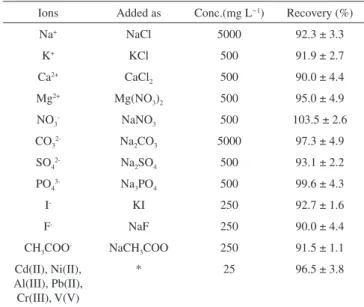
optimum conditions. The procedure was separately applied to all the interfering ions. The contaminant ions did not exhibit any significant interference effect on the SPE of Cu(II) ions (Table 2). Hence, the proposed method can be applied to samples containing high amount of salts and metal ions.
Adsorption capacity of the resin
The adsorption capacity is the maximum metal quantity uptaken by 1 g of resin. The Langmuir isotherm is a commonly used model to calculate the adsorption capacity of an adsorbate, as described by the following equation:
,
where qe (mg g
–1) is the amount of metal adsorbed per unit weight
of the resin at equilibrium, Ce (mg L
–1) is the equilibrium metal ion
concentration in an aqueous solution, qmax(mg g
–1) and b (L mg–1) are
the Langmuir constants related to the adsorption capacity and free energy or net enthalpy of adsorption, respectively.The relationship
Figure 2. Effect of ligand concentration on the recovery of Cu(II) ions (N
= 3; pH 4.5; eluent: 7.5 mL of 2.0 mol L−1 HCl in acetone; and sample
volume: 50 mL)
Figure 3. Effect of sample volume on the recovery of Cu(II) ions (N = 3; pH
4.5; and eluent: 7.5 mL of 2.0 mol L−1 HCl in acetone)
Table 1. Influence of eluent type and concentration on the recovery of Cu(II) ions (N = 3; pH 4.5; ligand concentration: 10 mg; and sample volume: 50 mL) Eluent type and conc. Recovery (%)
1 M HCl (in water) 75.1 ± 4.6 1 M HNO3 (in water) 86.2 ± 3.1 2 M HCl (in water) 79.3 ± 3.8 2 M HNO3 (in water) 88.0 ± 2.6 1 M HCl (in acetone) 92.4 ± 3.6 1 M HNO3 (in acetone) 89.5 ± 5.3 2 M HCl (in acetone) 101.8 ± 5.1 2 M HNO3 (in acetone) 103.3 ± 1.5 1 M HCl (in methanol) 86.2 ± 2.0 1 M HNO3 (in methanol) 91.3 ± 4.4
Table 2. Effect of matrix ions on the recovery of Cu(II) ions (N = 3; pH 4.5; ligand concentration: 10 mg; eluent: 7.5 mL of 2.0 mol L−1 HCl in acetone; and sample volume: 50 mL)
Ions Added as Conc.(mg L−1) Recovery (%)
Na+ NaCl 5000 92.3 ± 3.3
K+ KCl 500 91.9 ± 2.7
Ca2+ CaCl
2 500 90.0 ± 4.4
Mg2+ Mg(NO
3)2 500 95.0 ± 4.9 NO3
- NaNO
3 500 103.5 ± 2.6
CO3
2- Na
2CO3 5000 97.3 ± 4.9 SO4
2- Na
2SO4 500 93.1 ± 2.2 PO4
3- Na
3PO4 500 99.6 ± 4.3
I- KI 250 92.7 ± 1.6
F- NaF 250 90.0 ± 4.4
CH3COO
- NaCH
3COO 250 91.5 ± 1.1 Cd(II), Ni(II),
Al(III), Pb(II), Cr(III), V(V)
* 25 96.5 ± 3.8
between Ce/qe versus Ce is linear, and the constants qmax and b are
evaluated from the slope and intercept of the linear plot, respectively. To determine the resin capacity, 250–5000 µg of Cu(II) ions were loaded onto the column containing 250 mg of resin, and the recoveries were investigated. The Langmuir isotherms were plotted to determine the resin capacity (Figure 4). The maximum amount of Cu(II) adsorbed on 1.0 g resin and the adsorption equilibrium constant (b) were calculated as 2.37 mg g−1 and 0.056 L mol−1,
respectively.
Accuracy of the presented procedure
The limit of detection, defined as the concentration that gives a signal equivalent to three times the standard deviation of 10 replicate measurements of blank samples, for Cu(II) ions was found to be 0.20 µg L−1 when the sample volume was 50 mL and the final volume was
5.0 mL. To evaluate the precision of the developed SPE method, the procedure was repeated 10 times under the optimum conditions, and the relative standard deviation was calculated as 4.1%.
Method validation and application to real samples
To evaluate the accuracy of the method, different amounts of Cu(II) ions were spiked in 50 mL of sea water and stream water as liquid samples, and in 0.750 g of microwave digested rice, tea, and tobacco as solid samples. The SPE procedure given above was applied to these samples, and the results are summarized in Tables 3 and 4. A good agreement was obtained between the added and measured Cu(II) amounts, confirming the applicability of the proposed SPE method to the separation and preconcentration of Cu(II) ions in environmental liquid and solid samples. The certified reference material was also used for method validation. A good agreement was obtained between the analytical and certified value (Table 5).
After determining the accuracy of the proposed SPE method, the method was applied to the determination of environmental trace Cu(II) ions in rice, tea, and tobacco as solid samples and sea and stream water as liquid samples (Table 6).
CONCLUSIONS
The developed SPE procedure, based on the adsorption of the Cu(II)–AMOTACTA complex on Amberlite XAD-8 resin prior to the analysis of copper by FAAS, provides a versatile, simple, rapid, and low cost methodology for selective separation and preconcen-tration of Cu(II) ions in aqueous solutions. A main advantage of the method is the selectivity of AMOTACTA toward Cu(II) ions at pH 4.5 in the presence of Pb(II), Cd(II), Mn(II), Co(II), Cr(III), Cr(VI), Fe(III), Ni(II), Zn(II), Pd(II), Pt(II), and Au(III) ions. The method is applicable to water samples including sea water and stream water because of its 200-fold preconcentration factor. The procedure was also successfully employed for the determination of Cu(II) ions in some solid samples without any interference effect of the matrix ions.
Table 3. Spiked recoveries of Cu(II) ions from water samples (N = 3; pH 4.5; ligand concentration: 10 mg; eluent: 7.5 mL of 2.0 mol L−1 HCl in acetone; and sample volume: 50 mL)
Added (µg) Stream water Sea water Found (µg) Recovery (%) Found (µg) Recovery (%)
0 BDL* - BDL
-7.5 7.27 ± 0.08 96.9 6.98 ± 0.21 93.1 15.0 14.35 ± 0.64 95.7 13.70 ± 0.42 91.3 *Below detection limit.
Table 4. Spiked recoveries of Cu(II) ions from solid samples (N = 3; pH 4.5; ligand concentration: 10 mg; eluent: 7.5 mL of 2.0 mol L−1 HCl in acetone; sample quantity: 0.750 g; and final volume: 5.0 mL)
Added (µg)
Rice Black Tea Tobacco
Found (µg)
Recovery (%)
Found (µg)
Recovery (%)
Found (µg)
Recovery (%) 0 1.93 ± 0.05 - 8.32 ± 0.32 - 6.24 ± 0.27 -7.5 9.24 ± 0.31 97.5 15.25 ± 0.57 92.4 13.29 ± 0.62 94.0 15.0 16.44 ± 0.61 96.7 22.35 ± 0.85 93.5 20.03 ± 0.75 91.9
Table 5. Determination of Cu(II) ions in certified reference material for accuracy test of the method (N = 3; sample quantity: 0.500 g; and final volume: 5.0 mL)
MCT-MPH-2 Mixed Polish Herbs Certified value
(mg kg−1)
Found value (mg kg−1)
Recovery (%) 7.77 ± 0.53 7.58 ± 0.36 97.6 ± 4.6
Figure 4. Langmuir isotherm plots for the determination of resin capacity Table 6. Analyte levels in real solid/liquid samples after treatment with the
proposed SPE procedure (N = 3 and final volumes: 5.0 mL)
Element
Liquid samples (µg L−1)*
Solid samples (µg g−1)** Sea
water
Stream
water Rice
Black
REFERENCES
1. Sari, A.; Tuzen, M.; Çıtak, D.; Soylak, M.; J. Hazard. Mater. 2007, 149, 283.
2. Yıldız, O.; Citak, D.; Tuzen, M.; Soylak, M.; Food Chem. Toxicol. 2011,
49, 458.
3. Tokalıoğlu, Ş.; Gürbüz, F.; Food Chem. 2010, 123, 183.
4. Sarma, L. S.; Kumar, J. R.; Reddy, K. J.; Reddy, A. V.; J. Agric. Food Chem. 2005, 53, 5492.
5. Xiang, G.; Zhang, Y.; Jiang, X.; He, L.; Fan, L.; Zhao, W.; J. Hazard. Mater. 2010, 179, 521.
6. Blagojevic, N. Z.; Vukasinovic, V. L.; Djurovic, D. D.; Res. J. Chem. Environ. 2008, 12, 76.
7. Srogi, K.; Anal. Lett. 2008, 41, 677.
8. Faraji, M.; Yamini, Y.; Shariati, S.; J. Hazard. Mater. 2009, 166, 1383. 9. Ghaedi, M.; Shokrolalhi, A.; Mehrnoosh, R.; Hossaini, O.; Soylak, M.;
Cent. Eur. J. Chem. 2008, 6, 488.
10. Ganjali, M. R.; Pourjavid, M. R.; Haji-agha Babaei, L.; Salavati-Niasari, M.; Quim. Nova 2004, 27, 213.
11. Biscaro, P. A.; Menegário, A. A.; Tonello, P. S.; Caldorin, R.; Quim. Nova 2007, 30, 323.
12. Liu, Y.; Ingle, J. D.; Anal. Chem. 1989, 61, 520.
13. Shokrollahi, A.; Ghaedi, M.; Gharaghani, S.; Fathi, M. R.; Soylak, M.;
Quim. Nova 2008, 31, 70.
14. Narin, I.; Soylak, M.; Anal. Chim. Acta 2003, 493, 205.
15. Hwang, G. H.; Han, W. K.; Hong, S. J.; Kang, J. S.; Kang, S. G.; Talanta
2009, 77, 1432.
16. Duran, C.; Bulut, V. N.; Gundogdu, A.; Ozdes, D.; Yildirim, N.; Soylak, M.; Senturk, H. B.; Elci, L.; J. Hazard. Mater. 2009, 167, 294. 17. Bulut, V. N.; Gundogdu, A.; Duran, C.; Senturk, H. B.; Soylak, M.; Elci,
L.; Tufekci, M.; J. Hazar. Mater. 2007, 146, 155.
18. Tokalıoğlu, Ş.; Oymak, T.; Kartal, Ş.; Anal. Chim. Acta 2004, 511, 255. 19. Demirbas, A.; Sahin, D.; Demirbas, N.; Karaoglu, S. A.; Eur. J. Med.