Thermal Eets on Light Emission in
Yb 3+
-Sensitized Rare-Earth Doped Optial Glasses
E. A. Gouveia, M. T. de Araujo,and A. S. Gouveia-Neto
Departamentode Fsia, UniversidadeFederalde Alagoas
Maeio, 57072-970,AL,Brasil
Reeivedon31May,2000
The temperature eet upon infrared-to-visible frequeny uponversion uoresene emission in
o-resonaneinfraredexitedYb 3+
-sensitizedrare-earthdopedoptialglassesistheoretiallyand
experimentally investigated. We have examined samples of Er3+/Yb 3+
-odoped Ga2S3:La2O3
halogenide glasses and germanosiliate optialbers, and Ga2O3:La
2 O
3
halogenide and
u-oroindateglasses odopedwith Pr 3+
/Yb 3+
,exitedo-resonane at 1.064m. Theexperimental
resultsrevealedthermalinduedenhanementinthevisibleuponversionemissionintensityasthe
samplestemperatureswereinreasedwithintherangeof20 Æ
Cto260 Æ
C.Theuoreseneemission
enhanementisattributedtothetemperaturedependentmultiphonon-assistedanti-Stokes
exita-tionproessoftheytterbium-sensitizer. Atheoretialapproahthattakesintoaountasensitizer
temperaturedependent eetive absorptionross-setion, whihdependsuponthe phonon
ou-pationnumberinthehost matries,hasproventoagreeverywellwiththeexperimentaldata. As
beneial appliations of the thermal enhanement, a temperature tunable amplier and a ber
laserwithimprovedpowerperformanearepresented.
I Introdution
The most remarkable feature that alled attention to
the rare-earth(RE) ions in rystals was the observed
sharpness of the many absorption and emission
spe-trallines[1℄andreferenestherein. Inmanyasesthese
lines anbeasnarrowas theonesommonlyobtained
fromspetraoffreeatomsormoleules[1℄. Thisfeature
isassoiatedwiththefatthat,astheireletroni
on-guration is 4f N
5s 2
5p 6
either for divalent or trivalent
ion,theoptialativeeletronsareinthe4fshellsuh
thattheyarenottheoutermostones.Theyareshielded
fromexternaleldsbytwoeletroni shellswithlarger
radialextension(5s 2
5p 6
),whihexplainstheatomilike
behavioroftheir spetra. Asaresult, the4feletrons
are weaklyperturbed bythe statirystal eld of the
sorroundingmediumandtheirenergy-levelsanbe
de-sribed to a good degree of auray with a one-level
model. Furthermore,theRE ionsin solidshavedrawn
muh attentionowingto theirveryimpressive
hara-teristiofbeingverygoodlightemittersinthespetral
regionoveringvisible,near-infraredandinfraredupto
3.0 m.
Muheorthasreentlybeenfousedonthe
onver-sionofinfrared(IR)radiationintovisiblelightthrough
frequenyuponversioninrare-earthdopedglassy
ma-terials [2℄, for a wide variety of appliations
inlud-ing olor displays, high density optial data reading
ersandindiators, amongstmany. The frequeny
up-onversion proess involves either sequential or
mul-tiphoton stepwise exitation and energy transfer
be-tween rare-earth ions in solids and subsequent
emis-sion of photons with energies higher than the
exita-tion photons [2℄. However, for the majority of
rare-earthsingle-dopedsystemstheinfrared- to-visible
up-onversionproesshasprovenineÆientpartiularlyfor
pumpinginthewavelengthregionof1.0mto1.1m,
where high power soures are ommerially available.
TherealizationofYb 3+
-sensitizedmaterialswhih
ex-ploitsthehighabsorptionross-setion(peakedaround
980nm)ofytterbium,asomparedtootherrare-earth
ionsand theeÆient energy-transfer[2,3℄mehanism
betweenpairsortriadsofrare-earthions,hasalloweda
substantialimprovementintheuponversioneÆieny
inytterbiumsensitizedTm 3+
[4℄,Er 3+
[5-7℄,andPr 3+
[8-11℄doped bulk glassesand optial bers. This
ap-proahmakesitpossibletherealizationofuponversion
basedphotonidevies exitedby ommerially
avail-ablehigh powersouresaround1.0m. In
ytterbium-sensitized rare-earth doped materials, under infrared
nonresonantexitation,with thepump-photon energy
lower than the 2F
7=2 ! 2F
5=2
transition of theYb 3+
ion,thepopulationoftheativeions(aeptors)visible
emitting levels is aomplished viaan indiret
pump-ingproesswithmultiphonon-assistedanti-Stokes
exi-tationofthesensitizer[12℄,followedbyenergy-transfer
absorption from (or energy-transferto) proessto the
exited-state. The exited-state absorption anbe
ei-ther resonant or multiphonon-assisted as in the ase
hereinreported. Therefore,theeetivepumpingofthe
ativeions emittinglevels is stronglydependentupon
the phonon population in the host material. In this
work,thermallyinduedvisible uponversionemission
enhanement in ytterbium-sensitizedrare-earth doped
optialglassesnonresonantlyexitedat1.064mis
ex-perimentallyandtheoretiallystudied,andappliation
inoptialampliers andberlasersarepresented.
II Experimental
The experiment was arried out using Er 3+
/Yb 3+
-odopedsamplesof70%Ga
2 S
3 :30%La
2 O
3
(Ga:La:S:O)
halogenide bulk glasss[13-14℄with onentrations of
1000 ppm/wt of erbium and dierent onentrations
[5000,8000,and10000ppm/wt℄ofytterbiumions,and
a2.0 m length of germanosiliate optial berwith a
onentration of 8000 ppm/wt of ytterbium and 500
ppm/wtof erbiumions. Theberhadaut-o
wave-length around 1.3 m. For the Pr 3+
/Yb 3+
-odoped
system, the experimental investigation was onduted
usinguoroindate glasssampleswith% molar
ompo-sition of (33.5-x)InF
3 -20ZnF
2 -20SrF
2 -16BaF
2 -6GaF
3
-2NaF-0.5PrF
3 -xYbF
3
. Fluoroindate glasses [15℄ have
reentlybeenthesubjetofmuhinterestowingtotheir
potentialappliationinphotonideviesbasedon
rare-earth doped materials [11,16℄. The material presents
verygoodoptialquality,isstableagainstatmospheri
moisture, it exhibits low optialattenuationfrom 250
nm to 8 m, and due to the low maximum
phonon-energyof510m 1
[16℄,itisexpetedtopresent
sig-niantly lower nonradiativedeay rates asompared
to uorozironateglasses(590m 1
). Theinlusion
ofGdF3and NaFintheglassomposition has
onsid-erablyreduedthedevitriationproessandimproved
thethermalstability,permittingtherealizationof
uo-roindatebers[17℄. Thesampleshadonentrationof
5000ppm/wtofpraseodymiumanddierent
onentra-tionsof ytterbium ions(5000(I), 10000(II), 15000(III)
and 20000(IV)ppm/wt). Theexitation sourewasa
w Nd:YAG laser operated at 1.064 m. The pump
beamwas fouseddownintothesamplesbya5mfoal
length lens and the pump beam waist at the samples
loation was 60 m. The detetion system onsisted
of a sanning spetrograph with operating resolution
of 0.5 nmequipped with a S-20 unooled
photomulti-pliertubeoupledtoalok-inamplierandaomputer.
Thetemperatureofeahsamplewasinreasedfrom20
Æ
C up to a maximum of 260 Æ
C by plaing it into an
aluminum oven heated by resistive wire elements. A
opper-onstantanthermoouple(refereneat0 Æ
C)
at-tahedtooneofthesample'sfaeswasusedtomonitor
Æ
sample a pair of x20 unoated mirosope objetives
wasused to ouplethe pump light into it and ollet
theradiationemittedoutfromthetestber. Theber
span temperature was inreased from 17 Æ
C to 180 Æ
C
usingasimilarmethodwiththethermooupleattahed
totheberladdingbystreapingotheplastijaket.
III Results and Disussion
Inthissetionwedesribeboththeoretiallyand
exper-imentally,thethermalenhanementproessin two
dif-ferent systems: Er 3+
/Yb 3+
- and Pr 3+
/Yb 3+
-odoped
glasses.
A. Er 3+
/Yb 3+
-odoped systems
Fig. 1 shows typial visible uponversion
u-oresene spetra of radiation emanating from the
Ga:La:S:Osample,atdierenttemperaturesforaxed
exitationpowerof400mW.Thespetraexhibitthree
distintsemissionbandsenteredaround530,555,and
670nmorrespondingto the 2
H
11=2 ,
4
S
3=2 ,and
4
F
9=2
transitions to the 4
I
15=2
ground-state of erbium ions.
The spetra learly illustrate the enhanement of the
IR-to-visibleuponversioneÆienyasthesamplewas
heated from room temperature to 155 Æ
C. The
typi-al visible power spetra of radiation exiting the test
berfor axed pump powerof 700mWoupled into
it,attwodierenttemperaturesisillustratedinFig. 2.
Thespetralontentalsoexhibits threedistintbands
peakedaround530,550,and670nm,orrespondingto
the 2
H
11=2 ,
4
S
3=2 , and
4
F
9=2
transitions to the 4
I
15=2
ground-state, respetively and the less intense band
around563nmisassoiatedwiththe 2
H
9=2
-4
I
13=2
tran-sition. ThespetradepitedinFig. 2alsolearly
illus-tratetheenhanementoftheinfrared-to-visible
upon-versioneÆieny as theber temperature wasraised,
at a xed exitation power of 700 mW at 1.064 m.
Theuponversionexitationmehanismresponsiblefor
thepopulationofthevisibleandnear-infraredemitting
levelsin Er 3+
/Yb 3+
-odopedsamplesexited at1.064
m has reentlybeenreported forsilia-based optial
bers [5℄ and bulk glasses[6,7℄. Therefore, it suÆes
to mention here that the uponversion pumping
pro-essoftheexited-stateluminesentlevelsoftheEr 3+
-aeptor is obtained by means of the phonon-assisted
anti-Stokesexitation of the Yb 3+
-sensitizer or donor
fromthe 2
F
7=2
ground-statetothe 2
F
5=2
exited-state.
Theexited Yb 3+
transfersitsenergy toan Er 3+
ion,
exitingittothe 4
I
11=2
level,andasubsequent
energy-transferproesspromotestheEr 3+
ionsfromthe 4
I
11=2
totheupper 4
F
7=2
exited-state. Multiphonon-assisted
nonradiativedeays from the 4
F
7=2
exited-state
pop-ulate the 2
H
11=2 ,
4
S
3=2 , and
4
F
9=2
emitting levels, as
it is portrayed in the simplied energy-level diagram
sinethroughoutthisworkwehavefousedonthemore
intensevisiblebands. TheexitationoftheYb 3+
-donor
fromthe 2
F
7=2
ground-statetothe 2
F
5=2
exited-state,
demands the partiipationofoptial phononsin order
to ompensatefor theenergymismath of800m 1
betweentheinidentpump photon at1.064 m (9398
m 1
)andtheenergyonnetingthe 2
F
7=2
-2
F
5=2
tran-sitionoftheytterbium ionswhihis 10200m 1
. In
Yb 3+
-doped bulk glasses and optial bers, the
inho-mogeneous broadened zero-phonon absorption line is
negligiblebeyond1.05m [18℄. Asaonsequene,the
Yb 3+
eetive absorption ross-setion depends upon
thephononoupationnumberinthehostmatrix,whih
isaninreasingfuntion ofthemedium temperature.
Figure 1. Uponversion emissionspetrum at 23 and 155
Æ
C,foraxedpumppowerof400mWat1.064m.
Figure2. Uponversionpowerspetraexitingthetestber
at75 Æ
Cand180 Æ
C,foraxedpumppowerof700mWat
1.064 m.
Figure3. Simpliedenergy-leveldiagramoftheEr 3+
/Yb 3+
system. Upwardanddownwardssolidarrows indiate
pho-tonabsorption and emission, respetively. Double arrows
standforenergy-transferproessesandtiltedarrowsarefor
multiphononabsorptionandemissionmehanisms.
The behavior of the visible uponversion emission
as a funtion of sample temperature was investigated
anditsevolutionfortheoptialberaseisillustrated
in Fig. 4. As anbe observed, indeed there exists a
steadyinreaseinthevisibleemissionintensitiesasthe
berwasheated from30 Æ
Cto180 Æ
C, ataxed
ex-itation power. A similar behavior was observed for
thehalogenidebulk glass sample. Ourobservations
an be better analyzed, when one examines the
visi-bleuponversionuoreseneeÆienyasafuntionof
the sampletemperature, as indiated in the plots
de-pitedin Figs. 5 and 6. As an be inferred from the
experimental data, theintegratedvisible uponversion
uoreseneintensityinreasedbyafatorofthreefor
theGa:La:S:Oglass(Fig. 5)andgreaterthaneightfor
ber(Fig. 6)within theirrangeoftemperatures.
The experimental results shown in Figs. 5 and 6,
areexplainedusingthemodelportrayedin the
energy-leveldiagramofgure3,andthesetofpopulationrate
equationsneededtodesribethemodelarelistedbelow
asinRef. 19,
_ n
e =n
g
ge
(T)+n
2 C
2d n
g n
e C
d2 n
0 n
e
d
; (1:a)
_ n
6 =n
e C
d6 n
2 n
6
_ n 4 =n 6 W NR 64 n 4 4 ; (1:) _ n 3 =n 4 W NR 43 n 3 3 ; (1:d) _ n 2 =n e C d2 n 0 n 2 C 2d n g n 2 2 ; (1:e) where n e C di (n 2 C 2d
) is the donor (aeptor)
energy-transfer rates, whih are temperature dependent (see
Referene [1-3℄ and referenes therein), W NR
ij
is the
nonradiativetransition probability,
i
is the level
life-time, and is thepowerux. InEqs. 1,
ge
(T)
rep-resents the temperature dependent absorption
ross-setion for the donor whih takes into aount the
multiphonon-assisted sideband exitation proess [12℄
anditiswrittenas
ge (T)= 0 ge [exp(~! phonon =k B T) 1℄
p
(2)
In Eq. 2, 0
ge
is the absorption ross-setion at
reso-nane,~!
phonon
isthephonon energy,k
B
is the
Boltz-mannonstantandT istheabsolutetemperature. The
exponentpin Eq. 2aountsfor thenumber of
opti-al phonons involvedin the sensitizer exitation. The
steady-statesolutionsfor theset of Eqs. 1(a)-(e)give
risetothe populationofthethermallyoupled 2 H 11=2 and 4 S 3=2
emittinglevelsas
n 3 = 2 4 2 ge (T)N A N 2 d C d2 C d6 2 2 d (3)
InEq. 3,N
A andN
d
arethe iononentrationofthe
aeptor and donor, respetively. In order to get the
result in Eq. 3, wehave assumed that the diret and
bakenergytransferbetweentheaeptoranddonordo
notaet signiantly thelifetime ofthe exitedions,
implyingthat 1 d >>n 0 C d2 and 1 2 >>n g C 2d , and
formoderatepumpintensitiestheground-state
popula-tionsoftheYb 3+
-Er 3+
pairarenotdepleted(n
g N d ; n 0 N A
):Furthermore,theexited-statelevel 4 F 7=2 of Er 3+
deayssimplynonradiativelyto 2 H 11=2 and 4 S 3=2
levels,andmultiphonondeayfrom 2
F
7=2
levelofYb 3+
isnotexpetedduetothelargeenergyseparationtothe
ground-state sothat,
d
is mainly radiative. The
ob-servedenergyseparationbetweenthe 2 H 11=2 and 4 S 3=2
levels was E
45
700 m 1
, whih allows thermal
populationof the 2
H
11=2
level. Correspondly, the
ra-diativedeaytime R 4 ofthe 4 S 3=2
levelistemperature
dependentthrough 1 R 4 = P j A( 4 S 3=2
!j)+3e
E45=kBT P j A( 2 H 11=2 !j)
1+3e E 45 =k B T ; (4) where A( 2 H 11=2 ; 4 S 3=2
! j) are radiative transitions
rates from the two to the lower lying levels, and the
eetivepopulationsfortheoupledlevelsare
n eff 4 =n 4 1 E45=kBT (5a) n eff 5 =n 4 3e E45=kBT
1+3e E 45 =k B T (5b)
Finally,with thepropersubstitution, thevisible
emis-sionintensityisobtainedthroughtherelation
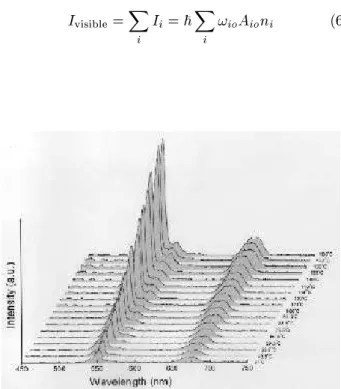
I visible = X i I i =~ X i ! io A io n i (6)
Figure 4. Temperature evolution of the visible
uponver-sionuoreseneemissionemanatingfromthetestberat
axedexitationpowerof700mWoupledintoit.
Figure5. Uponversionemissionintensityas afuntionof
temperature for a xedexitation powerof 400mW. The
solid lines represent the theoretial urves obtained from
Eqs.5 and 6, adjusted to the experimental data(symbols)
forGa:La:S:O-Er 3+
/Yb 3+
Figure6.Visibleuponversionemissionintensityasa
fun-tionoftemperatureforaxedexitationpowerof700mW.
Thesolidlinerepresentsthetheoretialurveobtainedfrom
Eqs. 5and6,adjustedtotheexperimentaldata(symbols)
for Er 3+
/Yb 3+
-dopedber.
Baseduponthesealulations,weneedthe
temper-aturedependentlifetimesforthepartiipantlevelsand
alsothenonradiativetransitionprobabilities. The
non-radiative transition probability between levelsi and j
for lowonentrationofEr 3+
ions(ourase)is dueto
multiphononrelaxationproesses,andanberelatedto
the temperatureby means of thefollowing expression
[20℄
W NR
ij
(T)=W NR
ij
(0)[1 exp( ~!
phonon =k
B T)℄
p
; (7)
where W NR
ij
(0) is its value at zero temperature.
A-tually, this probability an be obtained in two ways:
subtrating theradiativetransition probability
(alu-latedbytheJudd-Ofelttheory[21,22℄)fromtheinverse
oftheobservedlifetimeorbydiretmeasurement. F
ur-thermore,theenergyofthe 4
I
11=2
exitedlevelofEr 3+
isapproximatelyhalfofthe 4
F
7=2
levelandnearly
reso-nanttothe 2
F
5=2
levelofYb 3+
,whihimpliesthatthe
temperature dependene of the energy transfer rates
C
di
from Yb 3+
to Er 3+
is mainly due to the overlap
integrals between the emission of the ytterbium and
the absorptionoftheerbium [23℄. However,inseveral
glasses and rystals, the eet of the temperature
in-rease upon the green and red emission of the Er 3+
,
after resonant exitation of the Yb 3+
- sensitizer, is in
the diretion of the visible light intensity derease for
the range of temperatures above 20 Æ
C [24℄. Hene,
the temperaturedependene of the uponversion
visi-ble light emission assoiated with the overlapintegrals
ouldnotaountforthetemperaturebehavior
exhib-ited in our ndings. The major ontribution to the
resultsherein presentedisthen attributed to the
tem-peraturedependeneoftheytterbiumabsorption
ross-setion as displayed in Eq. (2) , and withoutlak of
generality the temperature dependene of the overlap
integrals ould be negleted in our alulations.
Us-nonradiative deay rates for halogenide [25,26℄ and
siliateglasses[27,28℄, wehave obtainedthe
tempera-turedependeneoftheemissionintensitiesofthethree
visibleemissionbandsaswellasofthetotalvisible
up-onversionemissionwiththeresultanturvesindiated
by thesolid line in plot ofFigs. 5and 6. Indeed, the
theoretialmodel basedupon thetemperature
depen-deneresidingin theeetive absorptionross-setion
oftheytterbium-sensitizerdesribesquitewellour
ex-perimentalobservationsfortheindividualemission
in-tensities at 530, 550, and 670 nm and the integrated
visibleuponversionemissioneÆieny. Analternative
approah toexplain ourresultswould be the
possibil-itythatthermalenhanementof thepopulationin the
highestlying Starksublevelsofthe ytterbium
ground-statemanyfoldwouldgiveanimportantontributionto
thetemperaturedependeneoftheuponversion
emis-sion enhanement. However, when one desribes the
systemusing onlya Boltzmannfator, the theoretial
resultsdeviatesrapidlyfrom theexperimentaldatafor
temperaturesabove135 Æ
C.Thethermalpopulationof
thehighestStarksublevelsofourseproduessome
en-hanement in the uponversionproess, but ertainly
the temperature dependene of the sensitizer
absorp-tion ross-setion through the multiphonon- asssisted
anti-Stokesexitation proessis the dominant
meha-nism.
FromtheresultspresentedinFigs.5and6,wehave
alsoobtainedtheenergiesof345m 1
(halogenide)
and690m 1
(optialber)forthephonon-modes
par-tiipatinginthemultiphonon-assistedanti-Stokes
exi-tationof thesensitizer. This resultis to be ompared
withtheonesof425m 1
and1100m 1
forthe
maxi-mumphonon-energyassoiatedwithGa
2 S
3 :La
2 O
3 and
silia-basedglasses,respetively[14,25-29℄.The
devia-tioninthevalueforthephononenergyobtainedinour
measurementsand themaximumvalues, isdue to the
fat that in anti-Stokes sideband exitation proesses
onehastoonsideran\eetive-phonon-mode",whih
hasamuhlowerenergythanthehostut-ovalue[29℄.
Athightemperaturesthepopulationdistributionofthe
phononspartiipatingin theexitation proess is
en-teredaroundthislowenergy\eetive-phonon-mode",
asdemonstratedbothexperimentallyandtheoretially
by Auzeland Chen forEr 3+
-doped ZBLAN andsilia
glasses [29℄. On the other hand, the highest phonon
frequeny of the host is the one that minimizes the
multiphononorder in radiationless emission proesses
[30,31℄.
B.Pr 3+
/Yb 3+
-odoped systems
Muh interest has reently been devoted to the
searhfor all-solid-stateblue light souresfor
applia-tionsin high-densityoptial datareading andstorage,
aus-uponversioninPr 3+
-dopedmaterialspumpedby
om-meriallyobtainableinfrared soures. Bluelaser
oper-ation using frequeny uponversionin
praseodymium-dopedsystemhasalreadybeendemonstratedin
single-and double-pumpedonguration [32-35℄. Inthis
se-tion,wedemonstratebothexperimentallyand
theoret-iallythatbyheatingnonresonantinfraredexited
u-oroindateoptial glasses odoped with praseodymium
andytterbium in thetemperatureregionof 20 Æ
C260
Æ
C,oneobtains upto timestwentyblue uponversion
emission enhanement. Fig. 7 illustrates the
temper-ature evolution of the visible uponversion emission
of light emanating from the sample (IV) at a xed
exitation power of 400 mW at 1.064 m. It an
learly be seenthat the uponversionemission signals
inreasedsigniantlyasthesample'stemperaturewas
raised from 20 Æ
C to 260 Æ
C. The spetra depited
in Fig. 7, presenteddistint emission bands entered
around 485, 530, and 630 nm orresponding to the
3
P
0 !
3
H
4 ;
3
P
0 !
3
H
5 , and
1
D
2 !
3
H
4
transitions
of Pr 3+
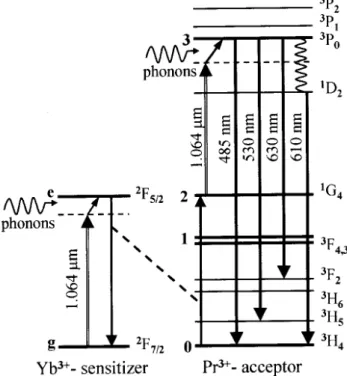
ions. Pumpingof the Pr 3+
exited-state
visi-bleemittinglevelsisaomplishedthrougha
ombina-tionofphonon-assistedabsorption,energy-transferand
phonon-assistedexited-stateabsorptionproesses,as
portrayedinthe energy-leveldiagram depitedin Fig.
8. In a rst step, a pump photon at 1.064 m
pro-vokesamultiphonon-assistedanti-Stokesexitation of
theYb 3+
-sensitizerfromthe 2
F
7=2
ground-statetothe
2
F
5=2
exited-state level. The exited Yb 3+
transfers
its energy to aneighbor Pr 3+
ion in the3H4
ground-state,exitingittothe 1
G
4
level. ThisexitedPr 3+
ion
undergoesa multiphonon-assistedanti-Stokes
exited-stateabsorption of aseond pump photonwhih
pro-motes it to the 3
P
0
upper emittinglevel. Finally, the
exitedPr 3+
iondeaysfrom 3
P
0
either radiativelyto
generate the main visible uoresene emission bands
or nonradiatively to populate lower-lyingluminesent
levels,asindiatedin Fig. 8.
Figure7. Temperatureevolutionoftheuponversion
emis-sionspetruminPr 3+
/Yb 3+
-dopeduoroindateglass.
Ex-itationpowerof400mWat1.064m. SampleIV.
Figure 8. Energy-levels shemeindiatingpartiipation of
phononsinthe absorptiontransitions. Thesolidlines
on-netedbyadashedlinerepresentstheross-relaxation
pro-ess.
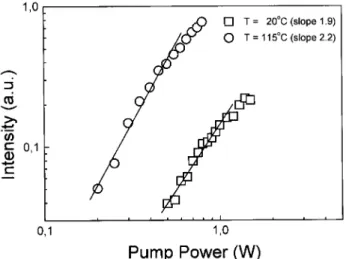
Thedependeneoftheblueuoreseneintensityon
the exitation powerat room temperature and at 115
ÆCwasexaminedandtheresultsaredepitedinthe
log-logplotofFig. 9. Itwasobservedthattheblue
uores-eneexhibitedanapproximatelyquadratipowerlaw
behavior(slope 2) with pump intensity. Within the
exitation powerrange (up to 1.5W) of our
measure-ments,theresultspresentednoindiationofavalanhe
proessestakingplae. Theavalanheproessis
hara-terizedbyanonlineardependeneof theuponversion
uoreseneupon the pump powerwith the existene
ofaritialpower(threshold)[36,37℄.However,wehave
observed the onset of asaturation eet onthe
emis-sion intensity forpump powersabove700mW at 115
ÆC,and 1.0Watroomtemperature(20 Æ
C).
The dependene of the blue emission at 485 nm
upon temperature was investigated for a xed pump
powerof400mW,andtheresultsareportrayedinFig.
10. As an be seen, the 485 nm signal intensity
in-reasedbyafatoroftwentyinthetemperaturerange
of 20 Æ
Cto260 Æ
C.Thetimes twentyenhanementin
theblueuoreseneintensitywasobtainedby
ompar-ingtheintegratedspetrumaround485nmat260oand
theoneatroomtemperature(20 Æ
C).Thebehaviorof
thePr 3+
/Yb 3+
systemanbeexplainedasfollows. The
exitation of theYb-sensitizerfrom the 2
F
7=2
ground-stateto the 2
F
5=2
exited-staterequires the
partiipa-tionofatleasttwooptialphononsinorderto
ompen-sate for theenergy mismath of 800 m 1
between
the inident photon and the ytterbium transition
en-ergy. Furthermore,thepraseodymium 1
G !
3
Figure9. Log-logplotofblueemissionintensityas a
fun-tionofthe exitationpowerinPr 3+
/Yb 3+
-doped
uoroin-date glassat roomtemperature(opensquares)and at115
Æ
C(openirles),forsampleIV.
Figure 10. Temperaturedependeneoftheemissionsignal
at 485nminPr 3+
/Yb 3+
-dopeduoroindateglass.
Exita-tionpowerof400mWat1.064m.SampleIV.
exited-state absorption also demands at least three
phononsin ordertomath theenergydiereneof
ap-proximately1450m 1
betweenthepump-photon
en-ergyandthatofthePr 3+
transition. Asaonsequene,
thepopulationofthePr 3+ exited-state 3 P 0 levelrelies
strongly onthe phonon oupationnumber in thehost
matrix. Themultiphonon-assisted absorptionleadsto
aneetiveabsorptionross-setionforbothsensitizer
andaeptor,whihareinreasingfuntionsofthe
sam-ple temperaturegivingrisetothe enhanementof the
emittinglevelspopulations.
The resultsare analyzed using an approah whih
inludes aphonon-assisted transition in the Yb 3+ ion ( 2 F 7=2 ? 2 F 5=2
),energy-transfertoPr 3+ ( 2 F 5=2 ? 1 G 4 ),
and subsequent phonon-assisted exited-state
absorp-tion to populate the 3
P
0
level as portrayedin Fig. 8.
Aordingly, the temperature dependene of the 485
nmemission intensityisdesribedbythefollowingset
ofrate-equations: _ n e =n g ge
(T) n
e C S2 n 0 n e S ; (8:a) _ n 2 =n e C S2 n 0 n 2 23 (T) n 2 2 ; (8:b) _ n 3 =n 2 23 (T) n 3 3 ; (8:) where n e C S2
is the sensitizer-aeptor energy-transfer
rate, S , 2 ,and 3
arethelifetimes ofthelevels 2 F 5=2 (levele), 1 G 4
(level2), and 3
P
0
(level3), respetively,
and is the power ux. In Eqs. 8,
ge
(T) and
23
(T) represent the temperature dependent eetive
absorption ross-setions for the Yb 3+
exitation and
Pr 3+
exited-state absorption, respetively, whih an
be written in a general form as given in Eq. 2 [12℄.
Combiningtheaboveequations,oneobtainsthe
steady-statepopulationoftheblueemittinglevelas
n 3 = 2 3 S 23 (T)N A N S C S2 ge (T) 2 (1+ S ge (T)) ; (9) where N A and N S
arethe Pr 3+
and Yb 3+
onentra-tions, respetively. Inorder to derive Eq. 9, wehave
assumedN S C S2 << 1 S
sineenergytransferbetween
sensitizerandaeptormustonlyoursbetweennearby
ions,andalso
23 <<
1
2
(fullled byour
experimen-tal onditions), whih impliesthat asmall fration of
Pr 3+
isexited,leadington
0 N
A
. Thebluelight
in-tensityat485nmisthengivenbyI
485nm =h 30 A 30 n 3 ,
whereAistheradiativetransition ratefrom level3to
theground-stateand
30
itsfrequeny.
Toobtainthetemperaturedependene of theblue
emissionintensitythroughEq. 9weneed further
on-siderationstobemade. Thelifetimeofthe 2
F
5=2 level
ismainly radiativedue to thelarge energyseparation
from ground-state (10256 m 1
). The nonradiative
transitionsfrom 1 G 4 (9696m 1
)to lower-lyinglevels
are small, as ompared to the exited-state pumping
rate 1 G 4 ! 3 P o
anddueto thelowmaximum-phonon
energy assoiated with uoroindate hosts [15,16,38℄,
whih requires the partiipationof at least six optial
phonons to bridge the energy- gap (3245 m 1
)
on-neting the levels 1 G 4 -3 F 3;4
, resulting in negligible
nonradiative transition probability [36℄. These mean
thatthelifetimes
s and
2
areapproximately
temper-atureindependent. Moreover,theenergy-transferrate
N
S C
S2
istemperaturedependentbeauseoftheenergy
mismath (E
e2
=560m 1
)betweenthe 2 F 5=2 level ofYb 3+ andthe 1 G 4
levelofPr 3+
,andthisdependene
anbeaountedthroughexp( E
e2 =k
B
T)aording
toRef. [12℄. Finally,thelifetimeofthe 3
P
0
isrelatedto
nonradiativetransitionprobabilitiesW
NR
(T)through
1 3 = X A 3j +W NR
andforlowonentrationsofrare-earthions,W
NR (T)
is due to multiphononrelaxationproesses,and given
byEq. 7[12,20℄withanexponentptakingintoaount
thephononorderlinkingthe 3
P
0
level(20367m 1
)to
thenextlowerenergylevel 1
D
2
(16942m 1
).
Using the experimental lifetime
3
for the 3
P
0 at
room temperature [16℄ and radiative transitions rate
from Ref. [39℄ for our samples, wehave obtainedthe
temperaturedependene oftheblue emissionintensity
and the result is illustrated by the solid line in plot
of Fig. 10. As an be observed, indeed the
theoreti-al model mathesverywell theexperimental results.
A model onsidering ooperativeuponversionof
Yb-Yb pairs as the major ontribution to the
uponver-sionpumpingproessofthePr-aeptorhasalsobeen
tested but theresultant ttinghasfallen far outfrom
theexperimental data. Thetheoretial ttingof data
depitedinFig. 10, alsopermittedustowithdrawthe
valueof400m 1
forthephonon-modepartiipating
in themultiphonon-assistedanti-Stokesexitationand
exited-stateabsorptionofthesensitizerandthe
aep-tor, respetively. The deviation of 110 m 1
from
the value for the maximum phonon- energy assoiated
withuoroindateglasses[38℄,isattributedtotheeet
disussedearlierfortheEr 3+
/Yb 3+
-dopedsystemase.
Wehavealsoperformedthesamesetofexperiments
us-ing samplesI - III, and theresultsexhibited basially
thesamebehaviorasfarasblue emissiontemperature
dependeneisonerned,asanbeinferredfromthe
ex-perimentaldatadepitedinFig. 11. Theuponversion
emissioneÆienieshavefollowedthesametrendwith
anoverallmaximumenhanementofapproximatelyx20
forallsamples. However,thelowerytterbium
onen-trationsamples,requiredhigherpumppowersinorder
toobtainappreiableuponversionuoresenevisible
signals.
Figure 11. Temperature dependene of the blue
emis-sion eÆienyfor samples I -IV, at xed pumppower in
Pr 3+
/Yb 3+
-dopeduoroindateglass.
IV Appliations
Theeetoftemperatureonlightemissionin
nonreso-nantexitedytterbium-sensitizedrare-earthdoped
sys-tems is beneial in at least two pratial situations:
uponversion pumped visible light ampliation in
Er 3+
/Yb 3+
-odopedhalogenideglassesandNd:YAG
laserpumpedEr 3+
/Yb 3+
-odopedoptialberlaserat
1.5 m,as we aregoingto desribe next. A. T
emper-ature tunable uponversionpumped ampliation. In
thissetion,wedesribevisiblelightampliationwith
temperature enhaned gain in nonresonant 1.064 m
uponversionexitedEr 3+
/Yb 3+
-odopedhalogenide
glasses.
The experiment was arried out in a single-pass
signal-pumpounterpropagatinggeometry asdepited
in the simplied experimental apparatus of Fig. 12.
Thisongurationpreventedthepikupof bakwards
visibleuoreseneowingtothe1.064mpumpbeam.
Phasedetetionalsowarrantedtolook atonlythe
sig-nal light. The Er 3+
/Yb 3+
-odoped halogenideglass
sampleusedasampliationmediumhasalreadybeen
desribedin detailin setionII.ThewNd:YAGlaser
pumpbeamwasfoused onthesamplebymeansofa5
m foallength lens. The light signalswere generated
byuponversionuoreseneemissioninaEr 3+
-doped
Ga
2 S
3 :La
2 O
3
halogenideglasssamplepumpedat1.54
m [40℄,and were entered around 530, 555, and 670
nmorrespondingtothemaximaoftheamplier gain
spetrum. The temperatureof the sample wasvaried
in therangeof20 Æ
Cto180 Æ
C.
Figure12. Simpliedblokdiagramofexperimental
ong-uration for the temperature tunable amplier. Inthe
g-urePDisaphotodetetorandBSisadihroibeam
split-ter(100R1.064mandhighlyreetinginthevisible).
Thesignalampliationonpropagationin thegain
mediumis givenby:
I = = f (T)[Ip℄ n
where z is the propagation distane along the gain
medium, I
s;p
are the light intensities,
s
is the
ab-sorption oeÆient at the signal wavelength, and
in-dexes s and p stand for signal and pump,
respe-tively. Theexponentndeterminesthenumberofpump
photons involved in the uponversionpumping
meh-anism. The nonlinear gain oeÆient
ps
(T) is
tem-peraturedependent through
ps
(T)= 0
ps
F(T),where
0
ps
is the nonlinear gain oeÆient at resonaneand
F(T)=[exp(h
phonon =k
B T) 1℄
p
asdesribedbefore.
The gainin the amplier is obtainedby uponversion
pumping ofthe 2
H
11=2 ,
4
S
3=2 ,and
4
F
9=2
,exited-state
levels of the Er 3+
ions, as presented in detail in Ref.
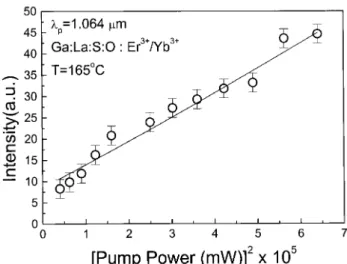
[7℄. For a xed glass temperature of 165 Æ
C, the
sig-nallightintensityasafuntionofthepumppowerwas
evaluated and the resultsare depitedin Fig. 13. As
anlearlybeseenthesignalhasinreasedbyafator
oftimessixforthehighestpumppowerutilizedinour
measurements. Furthermore,the experimental results
indeed followedtheexponentialbehaviorwithsquared
pump powerasdeterminedwiththeintegrationofEq.
(11)andindiatedbythesolidlineinFig. 13. Inorder
to integrate Eq. (11) wehave assumed the
partiipa-tionoftwopumpphotons(n=2)in theuponversion
exitation mehanism of the amplier medium [7℄. It
is important to mentionthat we havealso observeda
signiantredutionintheampliedsignalbandwidth
as ompared to the input signal. Theindiret
pump-ing mehanismin the ampliationproess herein
de-sribedrequiresthepartiipationofatleasttwooptial
phonons(themaximumphonon-energyassoiatedwith
Ga:La:S:Oglassesis425m 1
[14℄),inorderto
om-pensatefortheenergy-mismathof800m 1
between
thepump photon-energyandthe 2
F
7=2
-2
F
5=2
transi-tion of theYb 3+
. As aonsequene, one has to
on-sideraneetivephonon-populationdependent
nonlin-ear gainoeÆientfor theampliermedium, whihin
turn isaninreasingfuntionoftheglasstemperature
and is determined by F(T). For xed pump power
and input signal intensities, the ampliation gain as
afuntion ofthe amplierglass temperaturewas
ana-lyzedandresultsrevealedthattheoptialgainsteadly
enhanedwithinreasingtemperatureasillustratedin
plotofFig. 14. Forthetemperaturerangeof20 Æ
Cto
180 Æ
C, the optial gain inreased by over 70%when
ompared to its valueat room temperature.
Further-more,itanbeinferred fromdatathat thetheoretial
approah desribes quite well the temperature
behav-ioroftheamplier,whihisdemonstratedbythegood
agreementbetweentheexperimentaldataand
theoret-ialurvein Fig. 14. Thetemperaturedependene of
theampliationproess throughtheeetive
absorp-tionross-setionoftheytterbiumsensitizershowsthat
oneantunethegainoftheEr/Ybampliersystemby
varyingtheglasstemperature.
Figure 13. Amplied signal as a funtion of squared
pumppower for a xed temperature of 165 Æ
C. Solid line
standsfor thetheoretialt(Eq. 11)for theexperimental
data(symbols).
Figure14. Relativeampliation gainas afuntionof the
glass temperature for a xed pimp power of 800 mW at
1.064m.
B. Er 3+
/Yb 3+
-odoped optial ber laser
pumped at 1.064 m
High powerEr 3+
-doped optial ber soures both
narrowandbroadband[41-48℄operatedaround1.5m,
areverydesirableowingto their potentialappliation
inoptialommuniations,sensing,imaging,longrange
optial time domain reetometry and telemetry at
an eye-safe wavelength. Erbium is a three-level laser
mediumat1.5 mso that,itissuseptibleto
exited-state absorption [49℄ whih is detrimental to the
eÆ-ienyofthelaser. Moreover,erbiumsingly-doped
me-dia oer not only sparse exitation bands in the
vis-ible and near infrared, but also possess relatively low
absorptionross-setionsforthemostommonly
avail-able pump wavelengths. However, one an overome
these problems by employing Yb 3+
- sensitized Er 3+
ampliers [50-52℄, bulk glass lasers [53℄, and optial
ber and waveguide lasers [54-58℄. For several
appli-ations is desirableto pursue broadbandsoures with
outputpowersofafewWatts. UsingawNd:YLFlaser
at 1.054 m, a superuoresent Er 3+
/Yb 3+
-odoped
broadband ber soure generating as muh as 1.0 W
outputpoweraround1.5m,hasreentlybeen
demon-strated[59℄. For pumpwavelengthswithin thisregion,
theEr 3+
-ions(aeptor)upperlaserlevelpopulationis
aomplishedbymeansofenergy-transferfrom
phonon-assisted anti-Stokes exited Yb 3+
-ions(sensitizer) [12℄
andfastnonradiativedeay. Inthissetionwepresent
afourfoldoutputpowerenhanementandthreshold
re-dution in a 1.064 m pumped Er 3+
/Yb 3+
-odoped
ber laser by heating the ative medium from 23 Æ
C
to150 Æ
C.
Themeasurementswereondutedusingthe
exper-imental apparatus illustrated in Fig. 15. The ber
laseronsisted ofa2.0 msingle-length ofEr 3+
/Yb 3+
-odoped silia based optial ber forming a splieless
Fabry-Perot osillator avity. Feedbak was provided
bythe 3.5%Fresnelreetionsat thetwoglass-air
in-terfaesfromtheberends. Theberwasdopedwith
8000ppm/wtofytterbiumand500ppm/wtoferbium
and theut-owavelength wasat 1160nm. A pairof
x10 unoatedmirosopeobjetives (M.O.) were used
toouplethepumplightintoandollettheradiation
emitted out from the ber sample. A tilted dihroi
mirror(100and96%T1.54m)wasusedtoblokthe
1.064mpumplaserlightandpermittedustomonitor
the laser emission in the forward diretion. The ber
laser hadalso abakwardsoutputat the rear-end
de-liveringsimilarpoweras in thefrontendoutput. The
laser ative medium temperature was inreased from
23 Æ
Cto 150 Æ
C. A typialoutput emission spetrum
from the ber laser avity below and abovethreshold
atroomtemperatureisdepitedinFig. 16.
Figure15. Shematirepresentationoftheexperimental
ap-paratus, indiatingthe Er 3+
/Yb 3+
-odoped berlaser in
Figure 16. Emission spetrum of the laser below (dotted
line)andabove(solidline)threshold.
InEr 3+
/Yb 3+
-odoped laser materials exited
o-resonane,bysoureswithwavelengthsinthe1.0mto
1.1mrange,thepopulationoftheerbiumupperlaser
levelisahievedindiretlythroughthephonon-assisted
exitation of the Yb 3+
-sensitizer [12℄ whih eÆiently
transfersitsenergytoaneighborEr 3+
ion(aeptor)in
theground-statepromotingittothe 4
I
11=2
exited-state
level. A fastnonradiativedeay fromthe 4
I
11=2
popu-lates the 4
I
13=2
upper laser level, asillustrated in the
simpliedenergy-leveldiagramof Fig. 17. Itis
impor-tantto pointoutthat theexitationofthe
ytterbium-sensitizerrequires thepartiipationof at leastone
op-tialphonontoompensatefortheenergymismathof
800m 1
betweenthepumpphotonenergy(9400
m 1
)andtheoftheytterbium 2
F
7=2
-2
F
5=2
transition
( 10200 m 1
). Consequently, the laser pump-rate
depends strongly upon the phonon population in the
gainmedium. This behavioris aountedforhere, by
introduingatemperaturedependenteetive
absorp-tion ross-setion for theYb 3+
-sensitizer as desribed
previously in Eq.(2). Fortheber laserase, wemay
assume that p = 1 sine the pump energy mismath
( 800m 1
)orrespondsapproximatelyto thevalue
ofthepeakofthephononspetrumforsiliateglasses.
Figure 17. Simplied energy-level diagram for the
Byusingsimplerate-equationsandbearinginmind
that thelasermedium isodopedwith ytterbium, we
havederivedwith afairly aurate approximationthe
threshold powerfor the Er 3+
/Yb 3+
-berlaser system
as P
th
N
E h
p Æ
A
f =N
Y
Y (T)
E
[53,60,61℄, where
N
E and N
Y
are theonentrationsof erbium and
yt-terbium ions, respetively,
E is the
4
I
13=2
level
life-time,
p
the pump frequeny, and A
f
is the ber
ef-fetive ore area. The parameter Æ
aounts for the
avity losses, pump mode harateristis and output
oupling. Itis importantto pointoutthat in our
al-ulations the diret pumping of erbiumwas negleted
owing to the muh lower Er 3+
onentration as
om-pared to Yb 3+
. Theeetiveabsorption ross-setion
Y
(T) = 0
Y
[exp(h
phonon =k
B T) 1℄
1
is an
inreas-ingfuntion ofthetemperaturewhih inturn leadsto
a threshold power that steadly dereases as the
tem-peratureofthelasermediumrises. Whenlaser
osilla-tionommenes,thepopulationinversionislokedatthe
threshold valueand the laseroutput poweris diretly
proportionalto thepump-rate(pumppower). Bearing
thatinmindandutilizingasimilaranalysisashasjust
been donefor the thresholdpower, onean easely
in-fer that above threshold the ber laser output power
is an inreasing funtion of the ative medium
tem-perature via atemperature dependent eetive pump
powerP
p
(T)=P T
p
F(T);whereP T
p
is theatual1.064
m powerat axedtemperature.
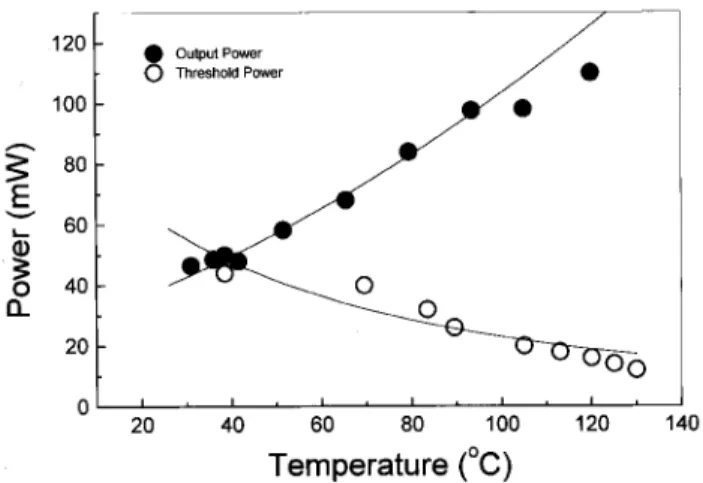
Inorder to verify experimentallyourassumptions,
thelaserthresholdpowerasafuntionoftheber
tem-peraturewasinvestigated andtheresultsare depited
in Fig. 18. As anbeobservedfrom data, indeed the
threshold power presented a ontinuous and smooth
derease with inreasing temperature and the
experi-mentalresultsareinreasonableagreementwiththeory
(solid line in graphof Fig. 18). Forthetemperature
range of 36 Æ
C to 130 Æ
C, afourfold redutionin the
threshold power was ahieved. The measurements for
the aquisition ofeahdata point were arried outby
xingthebertemperatureandarefullyadjustingthe
pumppowerinordertojustommenelaserosillation.
Thedependene oftheberlaseroutputpowerat1.54
m upon temperature for a xed pump intensity was
also analyzedand theresults arealso depitedin Fig.
18. Asanbeinferredfromdata,theoutputpowerhas
inreasedbyafatorofx2.4whenthebertemperature
wasvariedfrom 30 Æ
Cto 120 Æ
C.Forthehighest
tem-peratureof150 Æ
Cusedin ourmeasurements,asmuh
as180mWoutputpowerwasgeneratedorresponding
to afourfold output powerenhanementasompared
to the room-temperature(23 Æ
C)value of46 mW.It
is importantto all attention for the good agreement
betweentheoretial (solidline in plotof Fig. 18)and
experimentalresults. Wehavealsoevaluatedthe
wave-lengthstabilityoftheberlasersystemasthe
temper-atureinreasedandtheresultsindiatednodetetable
0.5 nm resolution of our system. Moreover, the laser
output did not present any distint intensity
utua-tion for high temperatures as ompared to the room
temperaturebehavior(5%).
Figure 18. Threshold power and output power for the
Er 3+
/Yb 3+
-dopedberlasersystemat1.54mas a
fun-tionofthebertemperature. Thesolidlinesstandfor the
theoretialurvesadjustedtotheexperimentaldata
(sym-bols).
V Conlusions
Inonlusion,theexperimentalandtheoretial
investi-gation of thermally-indued infrared-to-visible
upon-version uoresene emission enhanement in Yb 3+
-sensitizedrare-earthdopedoptialglassesnonresonant
exited at 1.064 m was examined for dierent host
materials and geometries. For Er 3+
/Yb 3+
-odoped
systems,thermally-indued threefoldand eightfold
ef-ieny enhanement for Ga
2 S
3 :La
2 O
3
halogenide
glasses[62℄andgermanosiliateoptialber[63℄,
respe-tively,wasdemonstrated. ForthePr 3+
/Yb 3+
-odoped
uoroindateglass sample,ourresultsrevealeda
twen-tyfold enhanement in the 485 nm blue emission
in-tensity as the temperature of the glass sample was
varied in the 20 Æ
C - 260 Æ
C range [64℄. The
temper-ature indued visible uponversion emission
enhane-mentfortheodopedsystemswasassignedtothe
tem-perature dependent eetive absorption ross-setion
for the ytterbium-sensitizer exitation and aeptor
exited-state absorption. Models based upon
onven-tional rate-equations onsidering the eetive
absorp-tion ross-setions of both sensitizer and aeptor as
funtions of the phonon population in the host
ma-trix, agreed very well with experimental data. As
beneial appliations of our proposals, we have
pre-senteduponversionpumpedvisiblelightampliation
withtemperaturetunablegainin Er 3+
/Yb 3+
-odoped
halogenide glass[65℄ and thermally-indued fourfold
output power inrease and threshold redution in a
it anbeused to improvethe performane, by
redu-ingtheinherentthermalnoiseat hightemperaturesof
optialtemperaturesensingdeviesbasedupon
upon-version ouresene emission in Er 3+
/Yb 3+
-odoped
glassesandberspumpedat 1.064m[67-69℄.
Aknowledgements
Thenanial supportfor thisworkbyFINEP
(Fi-naniadora de Estudos e Projetos), CNPq (Conselho
NaionaldeDesenvolvimentoCientoeTenologio),
CAPES (Coordenadoria de Aperfeioamento de
Pes-soal de Ensino Superior) and PADCT (Programa de
Apoio ao Desenvolvimento Ciento e Tenologio),
andPRONEX-NEON(UFPE/UFAL/UFPB)is
grate-fully aknowledged. Our speial thanks to all of our
ollaborators: Prof. CidB.deAraujo(UFPE),Y.
Mes-saddeq(UNESP), A. S. B.SombraandJ. A.Medeiros
Neto(UFCE), that ontributteddeisivelyto the
real-izationofthisworkandtoourgraduatestudentsP.V.
dos Santos, A. S. Oliveira, S. F. Felix, and C. J. da
Silva.
Referenes
[1℄ S.Hufner,Optialspetraoftransparentrareearth
om-pounds,AademiPress, London1978.
[2℄ F.Auzel,Pro.IEEE61,758(1973).
[3℄ F.Auzel,J.Lumin.45,341(1990).
[4℄ D.C.Hanna,R.M.Perival, I.R.Perry,R.G.Smart,
J. E. Townsend, and A. C. Tropper, Opt. Comm.78,
187(1990).
[5℄ Y-M. Hua, Q. Li, Y-L Chen, and Y-X Chen, Opt.
Comm.88,441(1992).
[6℄ A.S.Oliveira,M.T.deAraujo,A.S.Gouveia-Neto,A.
S.B.Sombra,J. A.MedeirosNeto,and N.Aranha,J.
Appl.Phys.83,604(1998).
[7℄ A.S.Oliveira,M.T.deAraujo,A.S.Gouveia-Neto,A.
S.B.Sombra,J.A.MedeirosNeto,andY.Messaddeq,
Appl.Phys.Lett.72,753(1998).
[8℄ D.M.Baney,G.Rankin,andK.W.Chang,Appl.Phys.
Lett.69,1662 (1996).
[9℄ T.R.Gosnell,Elet.Lett.33,411(1997).
[10℄ D.M.Baney,G.Rankin,andK.W.Chang,Opt.Lett.
21,1372 (1996).
[11℄ W. Lozano B., C. B. de Araujo, C. E. Egalon, A. S.
L.Gomes,B.J.Costa,andY.Messaddeq,Opt.Comm.
153,271(1998).
[12℄ F.Auzel,Phys.Rev.B13,2809(1976).
[13℄ P.N.Kumta,andS.H.Risbud,J.Mat.Si.27,1135
(1994).
[14℄ D.W.Hewak,J.A.MedeirosNeto,B.N.Samson,R.
S.Brown,K.P.Jedrzejewski,J.Wang,E.Taylor,R.I.
Laming,G.Wylangowski,andD.N.Payne,IEEEPhot.
[15℄ Y. Messaddeq, and M. Poulain, Mater. Sie. Forum,
67-68,161(1989).
[16℄ Seefor example: W.Lozano B,Cid B.deAraujo, L.
H.Aioli,andY.Messaddeq,J.Appl.Phys.84+,2263
(1998);E.Martins, CidB.deAraujo,J.R.Delben,A.
S.L. Gomes, B.J.daCosta, and Y. Messaddeq, Opt.
Comm.158,61(1998);G.S.Maiel,L.deS.Menezes,
CidB.deAraujo,andY.Messaddeq,J.Appl.Phys.85,
6782(1999), andreferenestherein.
[17℄ FibersofuoroindateglasshavebeendevelopedbyLe
Verre Floure (Frane) sine 1998-M. Poulain, (private
ommuniations).
[18℄ R. Pashotta, J. Nilsson, A. C. Tropper, and D. C.
Hanna,IEEEJ.Quant.Elet.33,1049(1997).
[19℄ J.C.Wright,Top.Appl.Phys.15,239(1976).
[20℄ M.J.Weber,Phys.Rev.B8,54(1973).
[21℄ B.R.Judd,Phys.Rev.127,750(1962).
[22℄ G.S.Ofelt,J.Chem.Phys.37,511(1962).
[23℄ T.MiyakawaandD. L.Drexter,Phys.Rev.B1, 2961
(1970).
[24℄ D. C. Yeh, W. A. Sibbey, M. Susavage, and M. G.
Drexhage,J.Appl.Phys.62,266(1987).
[25℄ C.C.Ye,D.W.Hewak,M.Hempstead,B.N.Samson,
andD.N.Payne,J.Non-Cryst.Sol.,208,56(1996).
[26℄ H.Higuhi,M. Takahashi, Y.Kawamoto, K.Kadono,
T. Ohtsuki, N. Peyghambarian, and N. Kitamura, J.
Appl.Phys.83,19(1998).
[27℄ J.A.Capobiano,G.Prevost, P.P.Proulx,P.Kabro,
andM.Bettinelli, Opt.Mat.6,175(1996).
[28℄ C. B. Layne, W. H. Lowdermilk, and M. J. Weber,
Phys.Rev.B16,10(1977).
[29℄ F. Auzel, and Y. H. Chen, J. Lumin. 66&67, 224
(1996).
[30℄ E. Okamoto, H. Masui, K. Muto, and K. Awazu, J.
Appl.Phys.43,2122(1973).
[31℄ M. D.Shinn,W.A.Sibbley,M. G.Drexhage,andR.
N.Brown,Phys.Rev.B27,6635(1983).
[32℄ J.Y.Allain,M.Monerie,andH.Poignant,Elet.Lett.
26,166(1990).
[33℄ R.G.Smart,D.C.Hanna,A.C.Tropper,S.T.Davey,
S. F. Carter, and D. Szebesta, Elet. Lett. 27, 1307
(1994).
[34℄ Y.Zhao,andS.Poole,Elet.Lett.30,967(1994).
[35℄ Y.Zhao,S.Fleming,andS.Poole,Opt.Comm.114,
285(1995).
[36℄ J.S.Chivian,W.E.Case,andD.D.Eden,Appl.Phys.
Lett.35,124(1974).
[37℄ T.R.Gosnell,Elet.Lett.33,411(1997).
[38℄ R. M. Almeida,J. C.Pereira, Y. Messaddeq, and M.
Aegerter,J.Non-Cryst.Solids161,105(1993).
[39℄ A.Florez,O.L.Malta,Y.Messaddeq,M.A.Aegerter,
J.Non-Cryst.Solids213&214,315(1997).
[40℄ H.T.Amorim,M.T.deAraujo, E.A.Gouveia,A.S.
[41℄ R.J.Mears,L.Reekie,andI.M.Jauney,Proeedings
ofCLEO,OptialSoietyofAmeria,Baltimore,paper
WD3,122(1987).
[42℄ P.Milinski,J.Chrostowsky,A.Koningstein,andJ.R.
Simpson,IEEEJ.Quant.Elet.28,371(1992).
[43℄ P.R.Morkel,K.P.Jedrzejewski,E.R.Taylor,andD.
N.Payne,IEEEPhot.Teh.Lett.4,545(1992).
[44℄ A. Chandonnet, and G. Larose, Opt. Eng. 32, 2031
(1993).
[45℄ I. N.DulingIII,W.K.Burns, andI. Goldberg, Opt.
Lett.15,33(1990).
[46℄ K.Iwatsuki,IEEEPhot.Teh.Lett.2,237(1990).
[47℄ P.F.Wysoki,M.J.F.Digonnet,andB.Y.Kim,Opt.
Lett.16,961(1991).
[48℄ P.F.Wysoki,M.J.F.Digonnet,B.Y.Kim,andH.J.
Shaw,IEEEJ.LightwaveTeh.12,550(1994).
[49℄ R.I.Laming,S.B.Poole,andE.J.Tarbox,Opt.Lett.
13,1084(1988).
[50℄ S.G.Grubb,W.F.Humer,R.S.Cannon,T.H.
Wind-horn,S.W. Vendeta, K.L. Sweeney,P.A. Lailabady,
M.R.Keur,J.G.Kwasegroh,T.C.Munks,andD.W.
Anthon,Elet.Lett.28,1275(1992).
[51℄ J.D.Minelly,W.L.Barnes,R.I.Laming,P.R.Morkel,
J.E.Thownsend,S.G.Grubb,andD.N.Payne,IEEE
Phot.Teh.Lett.5,301(1993).
[52℄ Z.J.Chen, J.D. Minelly,and Y.Gu,Elet.Lett.32,
1812(1996).
[53℄ P.Laporta, S. deSilvestri, V. Magni,and O. Svelto,
Opt.Lett.16,1952(1991).
[54℄ J.T.Kringlebotn,P.R.Morkel,L.Reekie,J.-L,
Ar-hambault,andD.N.Payne,IEEEPhot.Teh.Lett.5,
1162(1993).
[55℄ J. T. Kringlebotn, J. -L, Arhambault, L. Reekie, J.
E.Thownsend, G.G.Vienne,and D.N. Payne, Elet.
Lett.30,972(1994).
[56℄ F. diPasquale, and M. Federighi, IEEE Phot. Teh.
Lett.7,623(1995).
[57℄ A. Yeniay, J-M. P. Delavaux,J. Toulose, D. Barbier.
T.A.Strasser, and J.R.Predrazanni, Elet.Lett. 33,
1792(1997).
[58℄ L. Goldberg, and J. Koplow, Elet. Lett. 34, 2027
(1998).
[59℄ S. Gray, J. D. Minelly, A. B. Grudinin, and J. E.
Caplen,Elet.Lett.33,1382(1997).
[60℄ M. J.F. Digonnet, IEEE J. Lightwave Teh.4, 1631
(1986).
[61℄ E.Tanguy,C.Larat,andJ.P.Poholle,Opt.Commun.
153,172(1998).
[62℄ P.V.dosSantos,E.A.Gouveia,M. T.deAraujo, A.
S.Gouveia-Neto,A.S.B.Sombra,andJ.A.Medeiros
Neto,Appl.Phys.Lett.74,3607(1999).
[63℄ C.J.daSilva,M.T.deAraujo,E.A.Gouveia,andA.
S.Gouveia-Neto,Appl.Phys.B70,185(2000).
[64℄ A.S.Oliveira,E.A.Gouveia,M. T.deAraujo,A.S.
Gouveia-Neto, C.B. deAraujo, and Y. Messaddeq, J.
Appl.Phys.87,4274(2000).
[65℄ S.F.Felix,E. A.Gouveia,M. T.deAraujo,A.S.B.
Sombra,and A.S. Gouveia-Neto, J.of Lumin. 87-89,
1020(2000).
[66℄ C.J.daSilva,M.T.deAraujo,E.A.Gouveia,andA.
S.Gouveia-Neto,Opt.Lett.24,1287(1999).
[67℄ H.Berthou,andC.K.Jorgensen,Opt.Lett. 15,1100
(1990).
[68℄ P.V.dosSantos,M.T.deAraujo,A.S.Gouveia-Neto,
J.A.MedeirosNeto,andA.S.B.Sombra,Appl.Phys.
Lett.73,578(1998)
[69℄ P. V. dos Santos, M. T. de Araujo, A. S.
Gouveia-Neto,J.A.MedeirosNeto,andA.S.B.Sombra,IEEE