Effect of Air-Oxygen and Argon-Oxygen Mixtures on
Dielectric Barrier Discharge Decomposition of Toluene
O. Godoy-Cabrera
a,b, R. L´opez-Callejas
a,b, R. Valencia
a, A. Mu˜noz-Castro
a, S. R. Barocio
a,
E. Ch´avez A
a, A. Mercado-Cabrera
a, A. de la Piedad-Beneitez
b,
B. Rodr´ıguez-M´endez
c, and J. Rodr´ıguez-Arce
ca
Instituto Nacional de Investigaciones Nucleares, Plasma Physics Laboratory,
Apartado Postal No.18-1027 Col. Escand´on C. P. 11801, M´exico D.F., Mexico
b
Instituto Tecnol´ogico de Toluca, Electronics Department,
Apartado Postal 890, Toluca, Mexico
c
Instituto Tecnol´ogico y de Estudios Superiores de Monterrey, Campus Toluca,
Av. Eduardo Monroy C´ardenas 2000, Toluca, Edo. de M´exico, C.P. 50252, Mexico
Received on 4 February, 2004; revised version received on 20 May, 2004
One alternative application in the decomposition and destruction of volatile organic compounds (VOCs) by a silent plasma dielectric barrier discharge (DBD) has been successfully accomplished. For this purpose, we have designed and constructed two pairs of cells, of rectangular and circular geometries, 333.96 cm3each cell, and a similar second pair of 62.25 cm3
each one. Resonant inverters for low (3.3 kHz) and high (100 kHz) frequencies were also designed and applied to these cells. The specification of the main physical parameters of each cell contemplates:i)a first order degradation ratio of the compound, andii)air breakdown at atmospheric pressure as a function of the carrying gas. The power consumed by the cells during the discharges was computed both theoretically and experimentally by Manley’s method. The equipment was applied to the degradation of toluene, which has been degraded by an oxidation process in air-oxygen and argon-oxygen gas mixtures at atmospheric pressure within the cells. The destruction efficiency was measured as a function of the initial concentration. When air is used as an oxidant, a clear formation of solid products on the walls of dielectric glass plates has been observed, such deposits being polymeric in nature. These deposits seem to be responsible for a decline in the degradation efficiency of the treated compounds.
1
Introduction
Emission control of dilute toxic volatile organic com-pounds (VOC’s) such as toluene (C6H5CH3), oxylene C6H4(CH3)2, trichloroetane (C2H3CH3) and others, ge-nerated by several human activities, is one of the most im-portant and urgent matters for environmental protection. In this sense, various technologies have been investigated and developed for the decomposition the VOC’s. In particular, nonthermal plasma technologies (electrical discharge pro-cessing) have demonstrated their effectiveness in destroying VOC’s [1-3].
Nonthermal or silent discharge plasmas (SDP) can be created in a dielectric barrier discharge cell (DBDC). The cell is excited by a high voltage sinusoidal signal, which produces a series of micro-discharges. When this voltage exceeds the breakdown value of the carrier gas, a current channel of a short lifetime, in the order of a few nanose-conds, is created. In DBDC, the energetic electrons are ef-fective in dissociating molecular oxygen into ground state atomic oxygen, which is very effective in the initial attack on organic molecules. The product of an initial attack can be more reactive than the starting material. However, with sufficient energy deposition, the carbon in organic species
leaves the cell asCOandCO2while the hydrogen leaves asH2O[4].
We are engaged in a project to develop the DBDC pro-cess as a prototype demonstration of an effective means of destroying hazardous organic and polychlorinated com-pounds. In this paper we present the first results obtained from the degradation of toluene by the a two stage degrada-tion system.
2
Experimental Set-Up
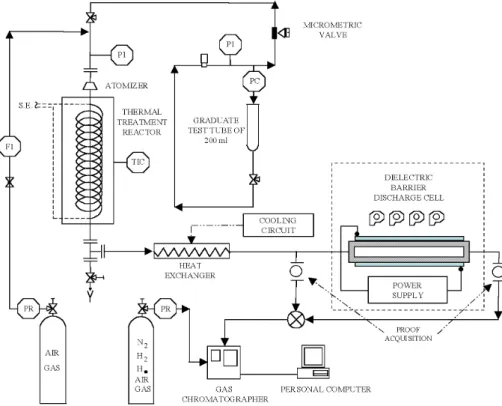
The degradation system is formed by a first stage consisting in a Thermal Treatment Reactor (TTR), and a second stage which is a silent plasma discharge (SPD) formed by DBDC (see Fig. 1). The hazardous toluene organic compound is mi-xed with a carrying liquid (in this case, demineralized light oil Mobil DTE 24 or DTE for short) at a predetermined flow. Toluene and DTE are combined with the oxidizing gas th-rough an injector which atomizes the mixture (air with a 15 l/min flow). This mixture is introduced into a packed bed column and heated up by a high temperature electric fur-nace. The temperature can be controlled up to 1000oC, thus
Figure 1. General scheme of the system for the degradation.
The gaseous mixture passes through a cylindrical container made of a Hastallowed and Hayes type stainless steel. The container presents a 7.6 cm diameter and a 152.4 cm length. In it, alumina is used as packing material. In this column the atomized hydrocarbons are converted into simpler chemical components by means of thermal combustion. The ensem-ble formed by the packed column and the electrical furnace has been called Thermal Treatment Reactor (TTR), and de-livers a 1.5 kW average power. Five K-type thermocouples are used to measure the temperature at divers points within the column.
A heat exchanger (HX) is located at the output of the TTR. The function of the HX is to cool the gaseous com-pound down to room temperature. The HX consists of two stainless steel tubes, one inside the other. The gaseous com-pound flows inside the internal tube (φ=0.127 m) whereas the external tube carries water in a counter flow. The cooling circuit includes a radiator, a pump, and a flow meter. The water flow can be controlled within the range 0-10 l/min.
Thus, for instance, the approximate dimensions of one rectangular cell are 78.58 cm in length and 17.00 cm in width with a 0.25 cm gap, providing a main discharge area of 1335.86 cm2
and an active discharge volume of 333.96 cm3
. Fig. 2 illustrates this planar cell. The cold plasma in the DBDC is produced by transient microdischarges (cur-rent streamers) when a high voltage high frequency sinusoi-dal signal, generated by a power series inverter, is applied to the DBDC. The typical power delivered by the inverter is 1.5 kW at 3.3 kHz [5]. Finally, the pollutant residence time in the plasma can be estimated as the ratio of the cell volume to the gas mixture flow rate so that, in our case, the residence time turns out to be 1.33 seconds.
Figure 2. The dielectric barrier discharge cell.
3
Results
TABLE 1: Oxidation process with air as a gas carrier
Compound Air/O2 Mixture Ar/O2
O2 2% 3.7%
CO 2349 ppm 86 ppm
CO2 15.3% 12.6% N O 252 ppm 8 ppm
N O2 114 ppm 0 ppm N OX 366 ppm 8 ppm
SO2 116 ppm 85 ppm
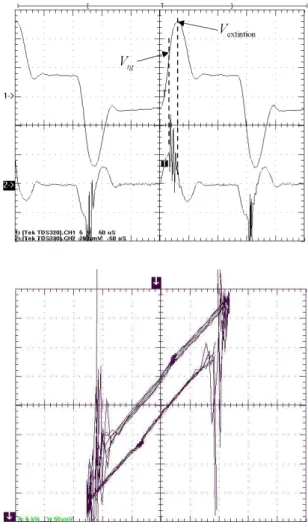
The results from the power supplies are shown in Fig. 3. The voltage (top trace) and current (bottom trace) wave-forms in the DBDC are seen in Fig. 3(a). The current trace shows i) the start and the end, and ii) the intermittent nature, of the silent discharges. The discharge start up coincides withVig ∼6250 Volts, whereas its extinction occurs at the top voltage (in this case at 12.5 kV of a possible maximum of 25 kV). The frequency of operation is 3.3 kHz. The Lis-sajous figure shown in Fig. 3(b) corresponds to the discharge in Fig. 3(a). The former one also shows the beginning and extinction of the discharge. The Lissajous figure is used to determine, experimentally, the power in the cell. First, the energy density is obtained with the formula
EC= (CmV1)V2 (1)
whereCmis the measurement capacitance (2µF in the
expe-riment) andV1is the ordinate voltage per division (1V/div in Fig. 3(b)). V2is the abscissa voltage per division (5 kV/div in Fig. 3(b)), and corresponds to the attenuation factor of the high voltage probe. After substituting these values in Equa-tion (1), the resultEC=10 mJ/div2is obtained, which
repre-sents the energy in an area of one square of the oscilloscope grid.
The electron discharge total energy is proportional to the area of the parallelepiped (Ap) (Fig. 3(b)). Thus
Ap=dmdM (2)
wheredmis the minor diagonal, anddM is the major
dia-gonal of the parallelepiped. From Fig. 3(b) we havedm=1.8
div anddM=2.7 div, therefore obtainingAp=4.86 div2. The
total energy is obtained using:
W =ECAp (3)
which yields the resultW=48.6 mJ.
The power consumed in the cell can be estimated by me-ans of Manley’s equation [6]:
P = 4VigCdief
· Vpeak−
µC
die−Cgas Cdie
¶ Vig
¸ (4)
whereVig andVpeakare the ignition and extinction voltage
respectively, Cdie andCgas are the dielectric capacities of
dielectric and gas respectively, and f is the frequency of the high voltage signal. Hence, the resulting power value isP=173.5 W.
Figure 3. Waveforms obtained in the cell of volume 333.96 cm3
: (a) Voltage and current, (b) Lissajous figure.
The efficiency of the toluene degradation process was tested in the two stages through gas chromatography (GC) by means of a Varian 3400-CX equipment. The first test, on a 3% toluene-DTE mixture, did not produce any chromato-grammes in any of both stages.
Figure 5. Chromatogramme of PFDTE + Toluene at first stage.
On the other hand, Fig. 4 exhibits the chromatogramme taken from toluene-DTE vapour at a 6% concentration. The information being shown corresponds to a 99.8811% con-centration in volume, equivalent to 713285 chromatograph counts. The chromatogrammme in Fig. 5 corresponds to the first stage of the degradation process developed with an air-oxygen carrier gas at a 34.2773% of the volume. The count number was 3066 so that the degradation at this stage rea-ched 99.5701%. In the case of Fig. 6, taken at the second degradation stage, a 2.8891% of the volume and 418 counts indicate a 86.366% degradation. Therefore, the total degra-dation, in both stages, amounts to a 99.9413%.
Figure 6. Chromatogramme of PFDTE + Toluene at the second stage.
Keeping the same 6% toluene concentration in DTE and admitting anAr−O2(80/20) mixture as a carrier gas, no toluene peaks were obtained. This points to a very high de-gradation, rate, beyond the detection threshold of the chro-matograph.
Given a 7.8 gr mass of toluene which is degraded in 40 minutes, this having a reported 173.5 W power supplied to the plasma in the DBDC, then the energy efficacy of our VOC decomposition can be estimated by the figure of merit γ=14.80 kW-h/kg.
During the silent barrier process with an air-oxygen mix-ture carrier, the glass wall insides of the cell became covered with a thin polymer film, possibly due to several compe-ting chemical processes taking place simultaneously in the
cell. Such polymer film deposits (see Fig. 7) usually result from the radical attack of oxygen on the toluene. In turn, the products of the partial oxidation are incorporated into the polymer, as it grows. In either case the result is a com-plex polymer comprising large amounts of oxygen. This is precisely observed in the infrared spectrum of Fig. 8 where strong bands at 701.8, 1043, 1208, 1457 and 1664.5 cm−1
can be noticed. These particular bands suggest that the poly-mer has incorporated large amounts ofOH andC = O groups, respectively. With argon-oxygen as the chosen car-rier, polymerization is practically null, as expected from the low concentrations of toluene in the DTE being employed.
Figure 7. Deposition of polymer film on surfaces of DBDC.
Figure 8. Infrared spectrum of polymer film depositions in the DBDC.
4
Conclusions
In the case of an air-oxygen mixture (21%/79%), the de-gradation of toluene remained in the order of 99.94%; while, with an argon-oxygen one (80%/20%), the degradation rea-ched 99.9999%. We have observed that the efficacy of the degradation processes conducted in air-oxygen mixtures be-came compromised by the formation of polymer films on the cell walls.
Acknowledgements
This work was performed with financial support from CONACYT under contract 39676-Y and COSNET under contracts 641.03-P and 642.02-03-PR. The authors wish to thank technical collaborators M. T. Torres M., M. A. Dur´an G. and I. Contreras V. for their contribution to the develop-ment of the project.
References
[1] D. Evans, L. A. Rosocha, G. K. Anderson, J. J. Coogan, and M. J. Kushner, J. Appl. Phys.74-9, 5378 (1993).
[2] H. Kohno, A. A. Berezin, J. Chang, M. Tamura, T. Yama-moto, A. Shibuya, and S. Honda, IEEE Trans. on Ind. Appli-cat.34-52, 953 (1998).
[3] T. Oda, T. Takahashi, and K. Tada, IEEE Trans. on Ind. Ap-plicat.,35-2, 373 (1999).
[4] G. K. Anderson, H. Snyder, and J. Coogan, Plasma Chemical and Plasma Processing,19-1, 131 (1999).