Quim. Nova, Vol. 34, No. 5, 884-887, 2011
Nota Técnica
*e-mail: [email protected]
DEVELOPMENT OF A FLOTATION–SPECTROPHOTOMETRIC METHOD FOR DETERMINATION OF CETYLPYRIDINIUM CHLORIDE IN PHARMACEUTICAL PRODUCTS
Hooshang Parham*, Nahid Pourrezaand Darioshi Moradi
Department of Chemistry, Faculty of Science, Shahid Chamran University, Ahvaz, Iran
Recebido em 17/8/10; aceito em 16/11/10; publicado na web em 18/2/11
A new simple and sensitive lotation–spectrophotometric method for the determination of cetylpyridinium chloride (CPC) is reported. The method is based on the formation of an ion- associate between CPC and Orange II (OR) which is loated in the interface of aqueous phase and n-hexane by vigorous shaking. The aqueous solution was discarded and the adsorbed ion associate on to the wall of a separating funnel was dissolved in a small volume of methanol solvent and its absorbance was measured at 480 nm. The apparent molar absorptivity (ε) of the ion associate was determined to be 4.12 x 10⁵ L mol-1 cm-1. The calibration graph was linear in
the concentration range of 15-800 ng mL-1 of CPC with a correlation coeficient of 0.9988. The limit of detection (LOD) was 10.8 ng
mL-1. The relative standard deviation (RSD) for determination of 100 and 800 ng mL-1 of CPC was 3.47 and 2.04% (n=7), respectively.
The method was successfully applied to the determination of CPC in a commercial mouth washer product. Keywords: lotation–spectrophotometry; cetylpyridinium chloride; Orange II.
INTRODUCTION
Flotation–spectrophotometry probably provides one of the most sensitive, relatively simple and fast approach to trace analy-sis.1 Ion-association systems, in a more general way, could be said
to result from the interaction of charged particles or complexes with oppositely charged ions. When a quaternary ammonium containing compound is used, the primary complex produced is cation, possessing the same charge as that of a metal. Such complexes were made to associate with anionic dyes in order to be extractable from aqueous solutions.1 Cetylpyridinium chloride
(CPC), a quaternary ammonium salt, is widely used in industrial and pharmaceutical products, especially in manufacturing of mouth washers, drupes and cosmetics.
Cetylpyridinium is generally determined in pharmaceutical and cosmetic products by high performance liquid chromatography,2
ion-pair extraction-TLC,3 ion-pair extraction-spectrophotometry,4
chemiluminescence,5 potentiometric6,7 and spectrophotometry.8
Using anionic dyes as counter ions are also examined.9-17 The
accuracy of these analytical methods is determined by the distribu-tion constant of ion-pair between the organic and aqueous phases. For insuficiently high distribution constants, extraction must be repeated several times. More recently, capillary electrophoresis (CE) has been employed for the analysis of cationic surfactants.18-20
In this paper, we present a lotation-spectrophotometric me-thod for quantitative determination of Cetylpyridinium chloride (CPC), based on its ion associate formation with OR and then the extraction of CPC+-OR- ion-pair into the interface between aqueous
and n-hexane phase by lotation method. The method proposed has been successfully applied to the determination of cetylpyridinium chloride in pharmaceutical products.
EXPERIMENTAL
Apparatus
The absorption spectra were recorded on a JASCO model 7850 UV-Vis recording spectrophotometer and a Perkin-Elmer model 550S spectrophotometer was used for absorbance measurements. A Metrohm model 632 pH-meter with a combined glass electrode was used for pH measurements.
Reagents
Unless otherwise stated, all commercial reagents used were of analytical grades without further puriication.
100 µg mL-1 stock solution of Cetylpyridinium chloride (CPC)
was prepared by dissolving 100 mg of CPC (Merck) in freshly dis-tilled water and diluting to the mark in a 1000 mL volumetric lask. Stock solution of 4 x 10⁻⁵ mol L-1 of OR was prepared by
dis-solving 0.0140 g of OR (Merck) in distilled water and diluting to 1000 mL in a lask.
Different buffer solutions (formate, phosphate and acetate) in the pH range of 2-8 were made by mixing 100 mL of 0.2 mol L-1
solutions of acids with appropriate volumes of 0.2 mol L-1
solu-tion of sodium hydroxide and adjusting the pH to desired value using a pH meter.
Recommended procedure
An aliquot of a sample solution containing up to 80 µg of CPC was transferred into a 100 mL volumetric lask, 3 mL of 4 x 10⁻⁵
mol L -1ofOR, 1 mL of acetate buffer pH 4 was added and diluted
Development of a lotation–spectrophotometric method 885
Vol. 34, No. 5
(color solid) loated on the interface. The methanol phase extracts the solid ion associate from n-hexane phase and dissolves it com-pletely. The absorbance of extracted colored ion associate was measured at 480 nm using 1 cm cell against a reagent blank. All experiments were carried out at room temperature.
RESULTS AND DISCUSSION
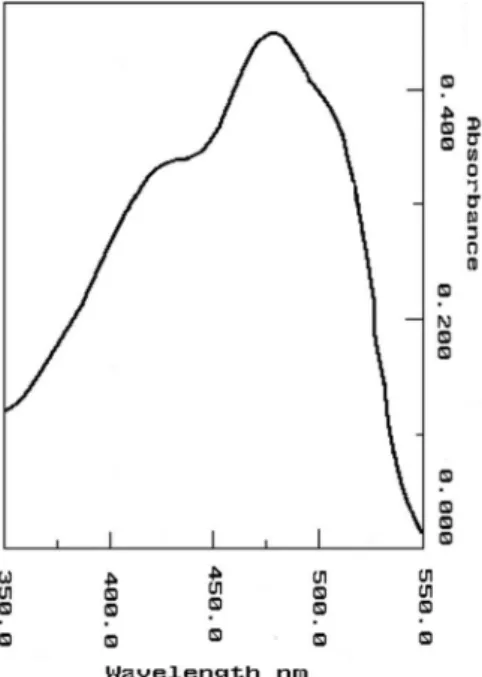
It was found that CPC interacts with OR and forms a solid ion associate which is insoluble in aqueous and highly non-polar organic phases, but soluble in some polar organic solvents such as methanol. The absorption spectrum of the dissolved CPC+-OR
-ion associate in methanol is shown in Figure 1. The maximum absorbance is found to be at 480 nm. The stoichiometry of the ion pair was determined using the continuous variation method. The mol ratio of the ion associate was 1:1, and in agreement with the literature.13
Solvent choice
Various organic solvents such as methyl ethyl ketone, carbon tetrachloride, benzene and n-hexane were examined. Among these, n-hexane showed good characteristics as a lotation dissolvent. Since the ion associated solid loats at the n-hexane-water interface and adheres on the funnel wall, the aqueous phase can be easily discarded completely and then by adding 2.5 mL of methanol to the separating funnel the solid ion associate is extracted into the methanol phase. The n-hexane in the separating funnel can be immediately used cyclically without any treatment. The volume effect of the n-hexane on the lotation process was examined in the range of 5-25 mL and the results showed no inluence on the determination process of CPC.
Among different organic solvents such as acetone, ethanol, methyl ethyl ketone, THF and methanol examined to dissolve the adhered ion associates from the wall of the separating funnel, the dissolution of the ion associate with methanol is almost perfect.
Effect of pH
The inluence of solution pH on the lotation of CPC+-OR- ion
associate was studied by varying the pH in the range of 2.0 to 8.0, before the organic phase addition (Figure 2). The pH was adjusted to the desired value using formate, acetate or phosphate buffers. The maximum lotation was observed at pH= 4.0, using acetate buffer and which was selected as optimum pH value. It must be mentioned that the protonation of sulfonate group of the dye in pH values lower than 4 causes low CPC+-OR- ion associate formation
and also competition of phosphate anion with dye anion to form ion associate with CPC causes low association of OR with CPC at pH values greater than 4.
The effect of acetate buffer concentration on the lotation of ion associate was investigated and the results showed that 1.0 x 10⁻³ M (1 mL of 0.01 M in 10 mL solution) of acetate buffer in
the inal solution is enough for the system under study. Higher concentrations of buffer show no effect on the lotation process of CPC+-OR- ion associate.
Effect of orange II concentration
The effect of OR dye concentration used for the lotation of CPC was examined by varying the amounts of OR in the test solution. The results are shown in Figure 3. As it is observed the absorbance increased with increasing OR concentration up to 1.2 x 10⁻⁶ mol L-1 of OR in the inal solution and then decreased. The
decrease in the absorbance of the ion associate is due to increase of extracted related blank absorbance.
Figure 1. The absorption spectra of the dissolved CPC+-OR- ion associate
after extraction in methanol against a related blank. Conditions: 500 ng mL-1
of CPC; 1.0 x 10⁻⁶ mol L-1 of OR; standing time of 10 min; methanol, 2.5 mL
Figure 2. The inluence of solution pH on the lotation of CPC+-OR- ion
as-sociate. Conditions: 500 ng mL-1 of CPC; 1.0 x 10⁻⁶ mol L-1 of OR; standing
time of 10 min; methanol, 2.5 mL
Figure 3.The effect of OR anionic dye concentration used for the lotation of
CPC. Conditions: 500 ng mL- of CPC; pH 4 (acetate buffer); standing time
Parham et al.
886 Quim. Nova
Effect of standing time
The effect of standing time on the ion associate formation was studied over the time period of 5-30 min for 0.5 µg mL-1 of CPC
and 1.2 x 10⁻⁶ mol L-1 of OR concentrations at pH 4.0 of solution
and then by measuring the absorbance at 480 nm after lotation. From the results shown in Figure 4 standing time of 10 min was chosen as the optimum standing time for ion associate formation.
Effect of electrolyte concentration
The effect of electrolyte concentration on the ion association of CPC with OR was examined by varying the amounts of 0.1 mol L-1
of NaCl or NaNO3 solutions separately. The absorbance intensity
of ion associate was decreased by increasing the concentration of NaCl or NaNO3. An increase in the electrolyte concentration
will decrease the effectiveness of lotation of CPC+-OR-,
proba-bly because of competition between OR and the other anions for association with CPC.
Effect of shaking time
The lotation of the ion associate may also be inluenced by the shaking time, because of increase in the surface of the gas–liquid interface. Maximum absorbance was obtained at 75 s shaking time.
Quantitative results
A calibration graph for the determination of CPC was constructed under optimum experimental conditions described above. Beer’s law was obeyed over the concentration range of 15-800 ng mL-1 of CPC
with a correlation coeficient of 0.9988 at 480 nm. The regression equation obtained by the least square method is A= 1.23 x 10⁻³C
CPC
- 0.022 for determination of CPC, where A is the absorbance and CCPC shows the concentration of CPC in ng mL
-1. With regard to the
preconcentration factor of the process (40 fold, i.e., from 100 mL aqueous solution to 2.5 mL of methanol), and a path length of 1 cm, the conditional molar absorptivity was 4.12 x 10⁵ L mol-1 cm-1 at the
above wavelength. The relative standard deviation (RSD) for 800 and 100 ng mL-1 of CPC were 2.04 and 3.47% (n=7), respectively. The
limit of detection (LOD) was 10.8 ng mL-1 based on 3S b
.21
Effect of interferences
In order to study the inluence of various cations and anions on the determination of CPC, a ixed concentration of CPC, 500
ng mL−1, was taken with different amounts of foreign ions and
the recommended procedure was followed. A relative error of 5% with respect to the absorbance difference for the CPC solution was considered tolerable. Tolerance limits are as follows: Cl−, NO
3
−, K+ (100 folds); SO
4
2−, Ca2+, Ba2+, Sr2+, Mg2+, K+, Li+, Cu2+, Zn2+, Cd2+, Ni2+, Co2+, Pb2+, Mn2+, NH
4
+, Cr3+, tartarate, citrate, EDTA
(50 folds). The results show that most of the cations and anions used have no considerable effect on the determination of CPC.
APPLICATION
Theproposed method was applied to the determination of CPC content of mouth washer pharmaceutical product (Daruo Pakhsh Co, Iran). A portion of the pharmaceutical solution containing up to 80 µg of CPC was transferred into a 100 mL volumetric lask and the procedures was followed under optimum conditions. The results are shown in Table 1. As it is seen, there is a good agreement between the results of the proposed method and the reference value of CPC content (500 µg mL-1) of the formulation.
There was no signiicant difference between the obtained average (485.2 µg mL-1) and the reference value by performing t-test at
95% conidence.
CONCLUSION
Theproposed method is simple, rapid, reproducible and highly sensitive and can be applied for quality control of pharmaceutical formulations containing CPC as a surfactant. Method shows good sensitivity due to high molar absorptivity character of Orange II dye and gave a wide linear dynamic range with respect to reported methods. In the case of working with large sample volume solu-tions of about 100 mL and also small extracting solvent volume (methanol) of 2.5 mL; a forty fold enrichment (preconcentration) factor is achieved. The limit of detection of the proposed method is better or comparable with most of the published methods2,5-8,17
for the determination of CPC and it can certainly be placed among the most sensitive ones.
ACKNOWLEDGEMENT
The authors gratefully acknowledge the inancial support of this work by Shahid Chamran University Research Council.
REFERENCES
1. Hosseini, M. S.; Naseri, Y.; Anal. Sci. 2003, 19, 1505.
2. Wang, J.; Lu, J.; Zhang, L.; Hu, Y.; J. Pharm. Biomed. Anal. 2003, 327, 381.
3. Sakai, T.; Ohsugi, Y.; Kamoto, T.; Ohno, N.; Sasaki, H.; Bunseki–kagaka
1987, 37, 335.
Table 1. Determination of CPC in mouth washer pharmaceutical (from Daruo Pakhsh Co: 500 µg mL-1) using standard addition method
Sample No CPC (ng mL-1)a %Recovery Original sample
(µg mL-1)
added found
1 - 48.5 97.0 485
2 20 69.0 102.5 490
3 50 99.6 102.2 496
4 100 147.0 98.5 470
a Average of 3 determinations
Figure 4. The effect of standing time on the CPC+-OR- ion associate
forma-tion. Conditions: 500 ng mL-1 of CPC; 1.2 x 10⁻⁶ mol L-1 of OR; pH 4 (acetate
Development of a lotation–spectrophotometric method 887
Vol. 34, No. 5
4. Nuti, V.; Bertini, D.; Farmaco 1987, 42, 335.
5. Safavi, A.; Karimi, M. A.; Anal. Chim. Acta 2002, 468, 53.
6. Baptista, P. S. C.; Araujo, A. N.; Montenegro, M. D. C. B. S. M.; Quim. Nova 2003, 26, 475.
7. Mohamed, G. G.; Ali, T. A.; El-Shahat, M. F.; Al-Sabagh, A. M.; Migahed, M. A.; Khaled, E.; Anal. Chim. Acta 2010, 673, 79.
8. Agrawal, K.; Agnihotri, G.; Shrivas, K.; Mundhara, G. L.; Patel, K. S.; Hoffmann, P.; Microchim. Acta 2004, 147, 273.
9. Kamaya, M.; Tomizawa, Y.; Nagashima, K; Anal. Chim. Acta 1998, 362, 157.
10. Nakamura, E.; Ishiwata, K.; Namiki, H.; Bunseki-Kagaku 1990, 39, 845. 11. Tsubouchi, M.; Bull. Chem. Soc. Jpn. 1971, 44, 1560.
12. Kamaga, M.; Kaneko, Y.; Nagashima, K.; Anal. Chim. Acta 1999, 384, 215. 13. Scott, G. V.; Anal. Chem. 1968, 40, 768.
14. Motomiza, S.; Gao, Y.; Microchem. J. 1994, 49, 326.
15. Irving, H. M. N. H.; Matkham, J. J.; Anal. Chim. Acta 1967, 39, 7. 16. Rosendrofora, J.; Cermakova, L.; Talanta 1980, 27, 705.
17. Ensai, A. A.; Hemmateenejad, B.; Barzegar, S., Spectrochim. Acta, Part A
2009, 73, 794.
18. Hcining, K.; Vogt, C.; Electrophoresis 1999, 20, 3311.
19. Taylor, R. B.; Toasaksiri, S.; Reid, R. G.; J. Chromatogr., A 1998, 789, 335. 20. Oztekin, N.; Erim, F. B.; J. Pharm. Biomed. Anal. 2005, 37, 1121. 21. Miller, J. C.; Miller, J. N.; Statistics for Analytical Chemistry, Ellis