From the Department of Gastroenterology, Hospital das Clínicas, Faculty of Medicine, University of São Paulo.
LONG TERM (FIVE-YEAR) SURVIVAL FOLLOWING
RADICAL SURGICAL TREATMENT PLUS ADJUVANT
CHEMOTHERAPY (FAM) IN ADVANCED GASTRIC
CANCER: A CONTROLLED STUDY
Cláudio Bresciani, Joaquim Gama-Rodrigues, Victor Strassmann, Dan L. Waitzberg, Mitsunori Matsuda and Henrique Walter Pinotti
RHCFAP/3015
BRESCIANI C et al. - Long term (five-year) survival following radical surgical treatment plus adjuvant chemotherapy (FAM) in advanced gastric cancer. A controlled study. Rev. Hosp. Clín. Fac Med. S. Paulo 55 (4):129-136, 2000.
Several drugs and their associations are being used for adjuvant or complementary chemotherapy with the aim of improving results of gastric cancer treatment. The objective of this study was to verify the impact of these drugs on nutrition and on survival rate after radical treatment of 53 patients with gastric cancer in stage III of the TNM classification. A control group including 28 patients who had only undergone radical resection was compared to a group of 25 patients who underwent the same operative technique followed by adjuvant polychemotherapy with FAM (5-fluorouracil, Adriamycin, and mitomycin C). In this latter group, chemotherapy toxicity in relation to hepatic, renal, cardiologic, neurological, hematologic, gastrointestinal, and dermatological functions was also studied.
There was no significant difference on admission between both groups in relation to gender, race, macroscopic tumoral type of tumor according to the Borrmann classification, location of the tumor in the stomach, length of the gastric resection, or response to cutaneous tests on delayed sensitivity. Chemotherapy was started on average, 2.3 months following surgical treatment. Clinical and laboratory follow-up of all patients continued for 5 years. The following conclusions were reached: 1) The nutritional status and incidence of gastrointestinal manifestation were similar in both groups; 2) There was no occurrence of cardiac, renal, neurological, or hepatic toxicity or death due to the chemotherapeutic method per se; 3) Dermatological alterations and hematological toxicity occurred exclusively in patients who underwent polychemotherapy; 4) There was no significant difference between the rate and site of tumoral recurrence, the disease-free interval, or the survival rate of both study groups; 5) Therefore, we concluded, after a 5-year follow-up, chemotherapy with the FAM regimen did not increase the survival rate.
DESCRIPTORS: Gastric Cancer. Chemotherapy. Gastrectomy. Survival. FAM regimen.
The survival rate of patients under-going surgical treatment of gastric can-cer in the Western World is disappoint-ing, especially when compared to Japa-nese centers1. Such a difference may be
explained by the low number of pa-tients with early diagnosis in the West-ern World, while in Japan most patients are operated on while still early cancer carriers2. Since the results of surgery in
patients with advanced gastric cancer are disappointing, it is natural that
other therapeutic modalities that may either complement or replace surgery are being researched. Systemic neo-plastic chemotherapy is the best hope for neutralizing microscopic neoplastic foci, which are impossible to extirpate during surgery3,4,5.
It has not yet been established in the literature that chemotherapy, either with single or multiple drugs, increases the survival rate, although the more re-sponsive patients to this treatment are those who live longer6. The objective
The objectives of this study are: 1) to investigate the effect of the FAM (5-fluorouracil, Adriamycin, and mitomy-cin C) regimen—as well as its toxic-ity—on the postoperative nutritional sta-tus of patients; 2) to analyze the impact of polychemotherapy with FAM on the 5-year survival rate of patients undergo-ing radical surgical treatment for stage III gastric cancer (TNM classification).
PATIENTS AND METHODS
The study included 53 patients with advanced stage III gastric adenocarci-noma (TNM classification of UICC)8.
All patients underwent level D2 radi-cal resection. This terminology was adopted following a suggestion of the German authors and acceptance by the Japanese (Japanese Classification of Gastric Carcinoma – Japanese Re-search Society for Gastric Cancer,
1995)9 instead of the previous
termi-nology – R2 – currently reserved to identify radicality.
After the operation the patients en-tered a controlled prospective and non-randomized study, with two groups as follows: Group I (FAM), including 25 patients who, besides having under-gone surgical treatment, received adju-vant polychemotherapy under the FAM regime; Group II, control (C), made up of 28 patients who only underwent sur-gical treatment.
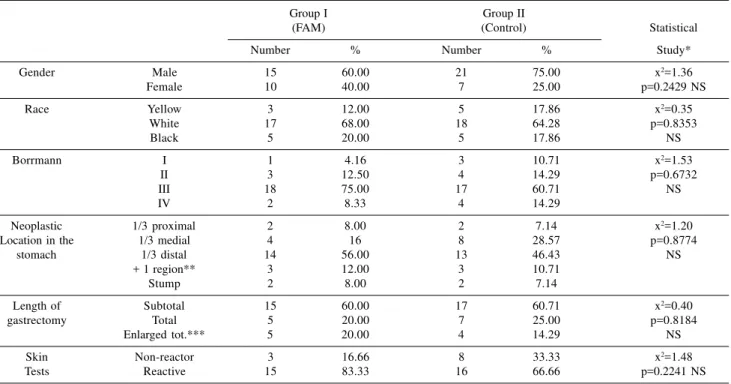
The average age of patients in Group I (FAM) was 51.80 (±10.39) and in Group II (C) 56.93 (±7.30) years (Student’s test t= 2.09; p= 0.0205). Patients of both groups had the same stage (III) gastric cancers, and the distribution according to gender, race, Borrmann macroscopic classifica-tion, tumor location in the stomach, length of gastrectomy, and immune re-sponse to skin tests did not reach
sta-tistical significance, establishing that the population in both groups were uni-form (Table 1).
Criteria of Exclusion
1) Patients with preoperative meta-static lesions (detected through physi-cal examination, radiographic, ultrasonographic, or laparoscopic methods, or even by intraoperative verification).
2) Patients with heart, hepatic, re-nal or respiratory failure, infection, anemia, or malnutrition that could not be corrected before surgery.
Postoperative Clinical and Labora-tory Evaluation
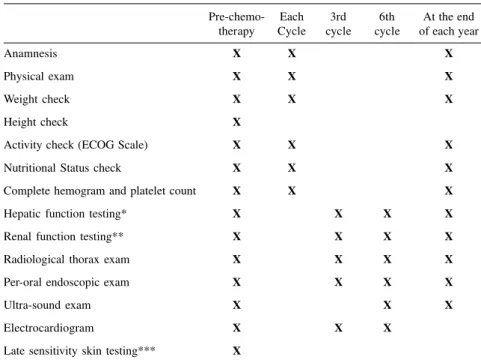
The sequence of clinical evaluation and complementary exams carried out for the patients in the two groups is shown in Table 2.
Table 1 - Stratification of patients according to gender, race, Borrmann, neoplasia location, length of gastrectomy, and skin sensitivity tests.
Group I Group II
(FAM) (Control) Statistical
Number % Number % Study*
Gender Male 15 60.00 21 75.00 x2=1.36
Female 10 40.00 7 25.00 p=0.2429 NS
Race Yellow 3 12.00 5 17.86 x2=0.35
White 17 68.00 18 64.28 p=0.8353
Black 5 20.00 5 17.86 NS
Borrmann I 1 4.16 3 10.71 x2=1.53
II 3 12.50 4 14.29 p=0.6732
III 18 75.00 17 60.71 NS
IV 2 8.33 4 14.29
Neoplastic 1/3 proximal 2 8.00 2 7.14 x2=1.20
Location in the 1/3 medial 4 16 8 28.57 p=0.8774
stomach 1/3 distal 14 56.00 13 46.43 NS
+ 1 region** 3 12.00 3 10.71
Stump 2 8.00 2 7.14
Length of Subtotal 15 60.00 17 60.71 x2=0.40
gastrectomy Total 5 20.00 7 25.00 p=0.8184
Enlarged tot.*** 5 20.00 4 14.29 NS
Skin Non-reactor 3 16.66 8 33.33 x2=1.48
Tests Reactive 15 83.33 16 66.66 p=0.2241 NS
* Statistical Test: two-tailed x2
** More than one region in the stomach
Evaluation of nutritional status was made according to the parameters sug-gested by Seltzer et al.10: ideal body
weight percentage (IBW%), serum al-bumin and number of lymphocytes, tri-ceps skin fold measure (TSF%), and arm muscular circumference (AMC%).
Chemotherapeutic method
The patients in Group I (FAM) were admitted to the protocol after 2.36 ± 0.64 months on average following surgical treatment.
The dose and regime of the in-clinic applications of chemotherapeutic drugs were planned for 6 cycles that lasted 28 days each, as shown in Table 3.
The criteria for changing the che-motherapeutic doses were based on the hematological toxicity levels verified by the number of white globules and/ or platelets on the day of drug appli-cation (Table 4).
In case of progression of disease, toxicity, or intolerance to medication, the treatment was interrupted, and a lack of response to the FAM protocol was recorded.
The following methods were rou-tinely used to detect disease progress: clinical examination, thoracic X-ray, gastroduodenal endoscopy, and ab-dominal ultrasound.
RESULTS
Statistical analysis showed similar-ity in the distribution of patients con-cerning the nutritional status in both study groups, with the exception of the number of lymphocytes at the moment of admission to the protocol, since Group I (FAM) was made up by a larger number of patients with moder-ate or severe malnutrition than the Group II (Control Group).
During the follow-up period through the third chemotherapy cycle, no statistical significance between the study groups in relation to the 5
nutri-Table 4 - Adequacy of chemotherapeutic doses in accordance with the number of
white globules and platelets.
FAM White globules Platelets
(Dose %) (Nº/mm3) (Nº/mm3)
100 > 4,000 > 100,000
50 2,500 - 4,000 75,000 - 100,000
0 < 2,500 < 75,000
Table 3 - Chemotherapy regime (FAM): doses, sequence,* and time of application
of drugs during treatment.
Doses Cycles 1,3, and 5 Cycles 2,4 and 6
(mg/m2) Days 1 8 Days 1 8
5-Fluorouracil 600 X X X X
Adriamycin 30 X - X
-Mitomycin 10 X - -
-* the treatment was planned for six 28-day sequential cycles. X = Chemotherapic application.
Table 2 - Sequence of clinical evaluation and the time of each post-operative
complementary exam.
Pre-chemo- Each 3rd 6th At the end therapy Cycle cycle cycle of each year
Anamnesis X X X
Physical exam X X X
Weight check X X X
Height check X
Activity check (ECOG Scale) X X X
Nutritional Status check X X X
Complete hemogram and platelet count X X X
Hepatic function testing* X X X X
Renal function testing** X X X X
Radiological thorax exam X X X X
Per-oral endoscopic exam X X X X
Ultra-sound exam X X X
Electrocardiogram X X X
Late sensitivity skin testing*** X
*Hepatic function testing: alkaline phosphatase, aspartate amino transferase, alanine amino transferase, gammaglutamyl-transpeptidase, total and fraction proteins and bilirubin. **Renal function testing: Urea and creatinine.
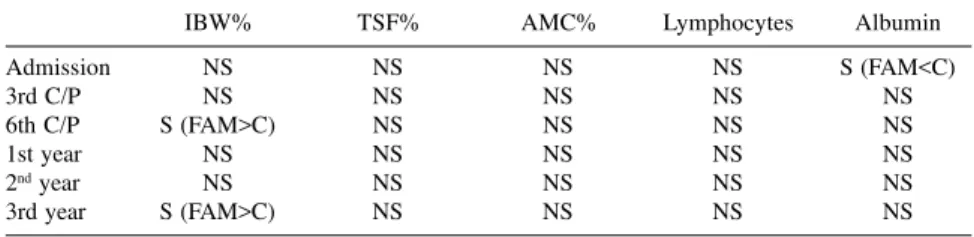
tional parameters considered was ob-served. The same was observed in the 6th cycle, except in relation to IBW%, because Group I (FAM) was made up of a larger number of patients with nor-mal check (two-tailed X² test p < 0.05). In the first and second years of fol-low-up, no statistically significant dif-ference between the groups in relation to the nutritional parameters was ob-served. Likewise, no statistically sig-nificant difference was observed be-tween the groups in the third year, ex-cept in relation to IBW% in Group I (FAM), which was made up by a larger number of eutrophic patients (two-tailed X² test p < 0.05).
The synthesis of the nutritional evaluation in the different periods of study in accordance with the 5 param-eters is shown on Table 5.
Effects of Chemotherapic Drugs
The gastrointestinal manifestations, even if observed only once in each pa-tient after operation for both groups, are shown in Table 6.
Types and frequency of dermato-logical complications are shown in Table 7. All these complications re-verted spontaneously (Table 7).
Neurological, cardiac, hepatic, or renal toxicity was not presented by any patient.
Hematological alterations were more often seen in patients who re-ceived chemotherapy, with leucopenia being the most frequent manifestation (Table 8). In one case myelodepression motivated interruption of chemo-therapy after the first cycle.
Due to either leucopenia or anemia, patients in Group I (FAM) received on average 74.4% of the total planned dos-age of 5-fluorouracil, 78.9% of Adriamycin, and 86.0% of mitomycin C.
Disease-free interval and tumoral re-currence
In patients who underwent adjuvant treatment by the FAM regimen, the
av-Table 8 - Frequency of hematological alterations in the two study groups.
Group I Group II Statistical Study
(FAM) (C) (square x)
Leucopenia 75 0 -
-Anemia 7 4 x2=1.28 P=0.7421 NS
Table 6 - Frequency of postoperative gastrointestinal manifestations in the two study groups*.
Group I (FAM) Group II (C) Statistical Study
Nº = 25 Nº = 28 (square x)
Nausea 8 2 x2=3.83 p=0.0503 NS
Vomiting 6 5 x2=0.04 p=0.8327 NS
Diarrhea 4 5 x2=0.08 p=0.8519 NS
* Observed during the 6 cycles for the FAM Group and 6 periods for the Control Group.
Table 5 - Nutritional evaluation comparison between the FAM and control groups.
IBW% TSF% AMC% Lymphocytes Albumin
Admission NS NS NS NS S (FAM<C)
3rd C/P NS NS NS NS NS
6th C/P S (FAM>C) NS NS NS NS
1st year NS NS NS NS NS
2nd year NS NS NS NS NS
3rd year S (FAM>C) NS NS NS NS
Statistical analysis: X2 two-tailed test.
NS: No statistical difference. S: Presence of statistical difference.
IBW%: Ideal body weight percentage TSF%: Triceps skin fold percentage. AMC%: Arm muscular circumference percentage.
C/P: Cycle (FAM) or Period (Control).
Table 7 – Types and frequency of dermatological changes in the two study groups.
Group I (FAM) Group II (C)
Nº = 25 Nº = 28
Alopecia 7 0
Hyperchromic 2 0
stains on fingers
Purplish fingernails 2 0
erage disease-free interval was 27.15 ± 22.35 months.
In the control group, the average disease-free interval was 23.07 ± 22.21 months (Student’s t test = 0.6700 and p = 0.2520); therefore, there was no statistically significant difference be-tween the two groups of patients.
Gastrointestinal tumor recurrence was not detected by endoscopic
exami-nation in any patient of both groups. Tumoral recurrence site in the two groups is shown on Table 9.
Survival
by the direct method (UICC TNM Gen-eral Rules) for Group I (FAM) was 28.0% and for Group II (C) was 21.4%. The survival curves were calculated by Kaplan-Meyer’s method and are shown in Graph 1.
In the initial phase (up to 21 months) a numerically higher survival rate was observed in patients in Group I (FAM).
The statistical study of the survival rates, comparing both groups by the Wilcoxon’s method did not show any difference between the two curves ei-ther considering just the first 21 months (W* = 1.21 p = 0.1131 NS) or during the whole period of study (W* = 1.14 p = 0.1271 NS).
DISCUSSION
The preliminary assessment of the results of combined chemotherapy (FAM regimen) suggested that better
survival rates could be obtained for pa-tients operated on for advanced gastric cancer without increased significant or severe side effects11,12,13.
The objective of this study was to verify the influence of the use of the polychemotherapy (FAM) regime in patients undergoing radical surgical treatment of gastric cancer. The antine-oplastic treatment was planned to be an adjuvant; it was accepted that the op-erative technique standardization in the 53 patients had reached its goal con-cerning surgical radicality. The justifi-cation for the use of the adjuvant polychemotherapeutic regimen relies on the survival rates after radical sur-gical treatment in patients with stage III tumors, which are between 19% and 33%14,15,16,17. It is also known that the
response rate to this chemotherapeutic scheme varies from 7% to 42%12,18,19,10,21. Therefore, over 50% of
the patients surely did not respond to the treatment.
Because the statistical analysis in-dicated that the two groups studied were homogeneous in relation to the main clinical and laboratory variables, and all patients had gastric cancer in the same stage, it is reasonable to ac-cept the obtained results as effectively indicative of the only distinctive vari-able, i.e., the FAM regimen.
After surgery, gastrointestinal com-plaints were frequent but easily con-trolled clinically with symptomatic medication. We observed that patients in the control group showed the same degree of gastrointestinal symptoms as the group receiving the antineoplastic drugs (Table 6). This observation may be explained as a consequence of the physiologic modifications of the diges-tive transit after gastric resection.
Neurological, renal, hepatic, or car-diologic toxicity signals or infection were not observed during the follow-up period. Nor was any physical activ-ity difference between groups observed as evaluated by the ECOG scale. The behavior similarity was remarkable in both groups in relation to the 5 nutri-tional parameters: measurement of weight, albuminemia, number of serum lymphocytes, triceps skin fold, and arm muscular circumference.
The differences between the groups, certainly arising from the use of the FAM regime, were the tempo-rary reduction of the lymphocyte num-ber in 72% of cases and the dermato-logical manifestations in 40%. The der-matological finding motivated us to change the pattern of administration of chemotherapeutic drugs. Since they were more frequent when high doses of 5-fluorouracil are used, the occur-rences of hyperchromic staining and purplish fingernails must be monitored. Cartei et al.22 observed the presence
of moderate leucopenia and plateletopenia in spite of using the FAM regimen in higher doses. Appar-ently the degree of leucopenia is not significantly influenced by the doses
Table 9 - Tumoral recurrence site during the 5-year postoperative follow-up.
Site of recurrence Group I (FAM) Group II (C)
Nº % Nº %
Carcinomatosis 11 61.11 17 77.27
Hepatic 5 27.77 4 18.18
Bone 1 5.55 1 4.54
Lung 1 5.55 0 0.00
Total 18 100.00 22 100.00
x2 test: x2 = 2.02 p = 0.5689 NS
given, but rather by the individual sen-sitivity to chemotherapeutic drugs21. In
own study, 74.4% of the planned dose of 5-fluorouracil, 78.9% of the planned dose of Adriamycin, and 86.0% of the planned dose of mitomycin C were given. A similar observation was de-scribed by MacDonald et al.12, in
which the average quantity of planned dosage started at 89% (first cycle), but was progressively reduced to only 71% of the planned dose by the sixth cycle. In this study, the patients started polychemotherapy 2.3 months on av-erage after surgical treatment; this time is longer than that established by the review by Schlag’s23 and Torelli et al.24
of some studies carried out in Japan. However, several Western study groups started chemotherapy only in the post-operative period and with an interval similar to that used in the present in-vestigation24, 25. The early introduction
of treatment could, theoretically, favor-ably affect the survival results; how-ever, the Hallisey et al.26 studies failed
to prove that hypothesis.
Regarding survival rates, there was no statistical difference between groups at the 5-year follow-up; only a higher
numerical, but not statistical signifi-cant, survival was observed up to 21 months after surgery among the pa-tients receiving chemotherapy. This re-sult allows the supposition of some ac-tivity of the drugs on the remaining neoplastic cells that is not intense enough to confirm the hypothesis for-mulated by Macdonald et al.12 that the
objective response to the therapy would correspond to an increase in the sur-vival rate. This finding reinforces the concept of Hallisey et al.27 that was
en-dorsed by Hermans et al.28 based on a
11-study analysis—that postoperative adjuvant chemotherapy should not be routinely used .
In the extensive experience of the University of Georgetown group with the FAM protocol29, an increase in
sur-vival was not observed, although a high response percentage was detected. Therefore, it is plausible to emphasize the proposal made by Clark & Slevin30,
Kelsen31, Macdonald & Gohmann6,
Treat et al.29, Murad et al.32 and
Dou-glas33, who advocate that research for
new drugs and new therapeutic trials are required to improve results of radi-cal treatment of gastric cancer.
CONCLUSIONS
Nutritional status and incidence of gastrointestinal manifestations after surgical treatment of gastric cancer were similar in the control group and in patients treated by polychemo-therapy (FAM).
There was neither occurrence of cardiac, renal, neurological, or hepatic toxicity nor of death arising from the chemotherapeutic method per se.
Dermatological alterations and he-matological toxicity occurred exclu-sively in patients who received the polychemotherapy, and these had mini-mal clinical expression.
At the 5-year follow-up, there was no difference between the rate and site of the tumoral recurrence, the disease-free interval, and the survival rate be-tween study groups.
Therefore, chemotherapy under the FAM regimen does not increase sur-vival rate; it is not recommended for routine use, but rather only for estab-lished study protocols.
RESUMO RHCFAP/3015
BRESCIANI C e col. – Sobrevivência tardia (cinco anos) após tratamento cirúrgico radical e quimioterápico adjuvante (FAM) em câncer gástri-co avançado: estudo gástri-controlado.
Rev. Hosp. Clín. Fac. Med. S. Pau-lo 55 (4):129-136, 2000.
Várias são as drogas e associações propostas tanto para a quimioterapia adjuvante como complementar visan-do melhorar os resultavisan-dos visan-do tratamen-to do câncer gástrico. Com o objetivo de se analisar o impacto sobre o
esta-do nutricional e o índice de sobrevi-vência no tratamento de 53 doentes com câncer gástrico do estádio III da classificação TNM, comparou-se um grupo controle composto de 28 doen-tes submetidos apenas a ressecção ra-dical com outro grupo tratado com a mesma conduta operatória seguida de poliquimioterapia adjuvante pelo regi-me FAM (5-fluorouracil, adriamicina e mitomicina C) e composto de 25 do-entes. Nestes últimos averiguou-se também a toxicidade das drogas antineoplásicas quanto à função
ca e laboratorialmente pelo período de 5 anos tendo se chegado às seguintes conclusões: 1) Foram semelhantes em ambos os grupos de estudo a evolução nutricional e a incidência de manifes-tações gastrintestinais; 2) não ocorreu toxicidade cardíaca, renal, neurológica ou hepática e tampouco óbito em
de-corrência do método quimioterápico em si; 3) alterações dermatológicas e mielotoxicidade ocorreram exclusiva-mente nos doentes que se submeteram à poliquimioterapia; 4) não houve di-ferença significante entre o índice e a sede da recidiva tumoral, o tempo li-vre de doença e os índices de
sobrevi-vência dos dois grupos de estudo após cinco anos de seguimento portanto, a quimioterapia pelo esquema FAM não incrementa o referido índice.
DESCRITORES: Câncer gástrico.
Quimioterapia. Gastrectomia. Sobrevi-vência. Esquema FAM.
REFERENCES
1. HEBERER G, TEICHMANN RK, KRÄMLING et al. - Results of gastric resection for carcinoma of the stomach: the European experience. World J Surg 1988; 12: 374-81.
2. LONGMIRE Jr. WP – A Current View of Gastric Cancer in the US. Ann Surg 1993; 218(5): 579-82.
3. HUGUIER M. DESTROIYES JP, BASCHET C et al. - Gastric carcinoma treated by chemotherapy after resection - a controlled study. Am J Surg 1980; 139: 197-9.
4. OKAMURA T, KORENAGA D, BABA H et al. - Postoperative adjuvant chemotherapy inhibits early recurrence of early gastric carcinoma. Cancer Chemother Pharmacol 1989; 23: 319-22. 5. WILS J, MEYER HJ & WILKE H – Current Status and Future
Directions in the Treatment of Localized Gastric Cancer. Ann Oncol 1994; 5: 69-72.
6. MACDONALD JS & GOHMAN JJ - Chemotherapy of advanced gastric cancer: present status, future prospects. Semin Oncol 1988; 15: 42-9.
7. RAKE MO, MALLINSON CN, COCKING JB et al - Chemotherapy in advanced gastric cancer: a controlled, prospective, randomized multicentre study. Gut 1979; 20: 797-801.
8. UICC - TNM “Classification of Malignant Tumors”. 3th ed. Geneve, Springer 1978.
9. JAPANESE Research Society for Gastric Cancer - Japanese Classification of Gastric Carcinoma - Tokyo, Kanehara 1995. p.15-6.
10. SELTZER MH, BASTIDAS JÁ, COOPER DM et al. - Instant nutritional assessment. J Parenter Enteral Nutr 1979; 3: 157-9. 11. MACDONALD JS, SCHEIN P, UENO W et al. - 5 Fluorouracil, mitomycin C and Adriamycin (FAM): a new combination program for advanced gastric carcinoma. Proc Am Soc Clin Oncol 1976; 17: 264.
12. MACDONALD JS, WOOLLEY PV, SUNYTHE T et al. - 5-Fluorouracil, Adriamycin and mitomycin C (FAM) combination chemotherapy in the treatment of advanced gastric cancer. Cancer 1979; 44: 42-7.
13. MACDONALD JS, SCHEIN PS, WOOLLEY PV et al. – 5-Fluorouracil, Adriamycin and mitomycin C (FAM) combination chemotherapy in the treatment of advanced gastric cancer. Ann Intern Med 1980; 93: 533-6.
14. ADASHEK K, SANGER J & LONGMIRE WP - Cancer of the stomach. Review of consecutive ten year intervals. Ann Surg 1979; 189: 6-10.
15. CSENDES A & SCHÜTTE H - Sobrevida de doentes con cáncer gástrico. In: CSENDES A & STRAUSZER T - Cáncer gástrico. Santiago, Andrés Bello 1984. p.167-77.
16. MARUYAMA K, OKABAYASHI K & KINOSHITA T - Progress in gastric cancer surgery in Japan and its limits of radicality. World J Surg 1987; 11: 418-25.
17. LISE M, NITTI M, BUYSE M et al. - Phase II clinical trial of adjuvant FAM 2 (5FU, Adriamycin and Mitomycin C) vs control in resectable gastric cancer: a study of the EORTC Gastrointestinal Tract Cancer Cooperative Group. Recent Results Cancer Res 1988; 110: 36-43. 18. HAIM N, COHEN Y, HONIGMAN J et al. - Treatment of advanced gastric Carcinoma with 5-fluorouracil, Adriamycin and mitomycin C (FAM). Cancer Chemother Pharmacol 1982; 8: 277-80. 19. CUNNINGHAM D, SOUKOP M, MCARDLE CS et al. - Advanced
gastric cancer: experience in Scotland using 5-fluorouracil, Adriamycin and mitomycin C. Br J Surg 1984; 71: 673-6. 20. RIDOLFI R, GIUNCHI DC, CORTESI C et al. - A retrospective
study of FAM regimen in 38 patients with advanced gastric cancer. Tumori 1984; 70: 375-9.
21. BIRAN H, SULKES A & BIRAN S - 5-fluorouracil, doxorubicin (Adriamycin) and mitomycin C (FAM) in advanced gastric cancer: observations on response, patients characteristics, myelosuppresion and delivered dosage. Oncology 1984; 46: 83-7.
22. CARTEI G, FORNASIERO A, DANIELE O et al. - Adjuvant fluorouracil (F), Adriamycin (A) and mitomycin (M) after radical surgery in gastric carcinoma (GCA): results of 60 months. In: CONGRESS OF THE EUROPEAN SOCIETY OF SURGICAL ONCOLOGY, 1º.Athens, 1982. (Meeting abstracts, 1982). p.366. 23. SCHLAG P - Adjuvant Chemotherapy in gastric cancer. Would J
Surg 1987; 11:473-7.
24. TORELLI P, BLANCO GF & RESCIGNO E - Terapie complementari nel trattamento del cancro gastrico. In : SANTORO E, GAROFALO A SCUTARI F eds - II cancro dello stomaco negli ospedali italiani. Roma, Nuova Editrice Scientifica Romana, 1989. p. 349-54. 25. ITALIAN Gastrointestinal Tumor Study Group - Adjuvant treatments
26. HALLISEY MT, FEILDING JWL, KELLY K et al. - Adjuvant chemoterapy for stomach cancer. Lancet 1989; 24: 1459-60. 27. HALLISEY MT DUNN JA, WARD LC et al. – The Second British
Stomach Cancer Group Trial of Adjuvant Radiotherapy or Chemotherapy in Resectable Gastric Cancer: Five-year Follow-up. Lancet 1994; 343: 1309-12.
28. HERMANS J, BONENKAMP JJ, BOON MC et al. – Adjuvant Therapy after Curative Resection for Gastric Cancer: Meta-analysis of Randomized Trials. J Clin Oncol 1993; 11(8):1441-7. 29. TREAT J, FALCHUK SC, WOOLLEY PV et al. - Therapy of
advanced gastric carcinoma. The Georgetown - Lombardi - Cancer Center Experience. Am J Clin Oncol 1989; 12: 162-8.
30. CLARK PI & SLEVIN ML - Chemotherapy for stomach cancer. Br Med J 1987; 295:870-1.
31. KELSEN D - Chemotherapy of gastric cancer: a review. Isr J Med Sci 1988; 24: 557-61.
32. MURAD AM, SANTIAGO FF, PETROIANU A et al. – Modified therapy with 5-fluorouracil, doxorubicin, and methotrexate in advanced gastric cancer. Cancer 1993; 72(1):37-41.
33. DOUGLASS Jr HO – Adjuvant Therapy of Gastric Cancer: Have We Made any Progress? Ann Oncol 1994; 5: 49-57.