Proile of plastic surgeons in the state of Paraná, Brazil
Peril do cirurgião plástico paranaense
ABSTRACT
Introduction: In the present study, we aimed to outline the overall practice proile of plastic surgeons in the state of Paraná. It represents an initial project that aimed not to provide generalizations but to understand how plastic surgeons think and their professional aspi
-rations, goals, and performance. Methods: A survey was conducted using a questionnaire consisting of 37 multiple-choice questions, mostly focusing on the current job market for plastic surgeons. The link to the online questionnaire was e-mailed to 263 members of the Brazilian Society of Plastic Surgery–Regional Paraná (SBCP-PR), which was also accessible via the SBCP-PR website, through a banner on its home page. The overall time to complete the questionnaire ranged from 3 to 5 minutes. Results: The response rate was 40.5%. Most interviewees operated only in one city, and more than half provided services only through health-care insurance plans and private practice. Half of the participants considered the market as extremely competitive and searched for several alternatives for self-maintenance, including increasing installment payment terms, lowering prices, and working at other locations. A signiicant proportion of the respondents believed that they lost more than 30 patients owing to pricing in the previous year and performed 10-20 sur
-geries per month on average. Most of the surgeons did not operate with an auxiliary plastic surgeon because this would increase their operational cost or because technologists could perform this function. Most participants believe that the number of trained residents in the state of Paraná is excessive. Conclusions: In Paraná, plastic surgeons are concerned about the job market and therefore search for alternatives to remain competitive.
Keywords: Job market. Surgery, plastic. Professional practice. Marketing of Health Services.
RESUMO
Introdução: Esta pesquisa tem por objetivo traçar o peril do cirurgião plástico do estado do Paraná. É um projeto inicial que não tem a pretensão de indicar respostas, mas sim de entender o que pensa, quais os anseios e objetivos na proissão e como atua o proissional dessa especialidade. Método: Foi idealizada uma pesquisa com 37 perguntas de múltipla escolha, em sua maioria com foco no mercado de trabalho. Ela foi enviada por e-mail aos 263 membros da Sociedade Brasileira de Cirurgia Plástica – Regional Paraná (SBCP-PR), sob forma de um link que dava acesso ao questionário. O link também estava disponível no website da SBCP-PR, com um banner em sua página inicial. O tempo médio para preenchimento do questionário variou de 3 minutos a 5 minutos. Resultados: O índice de resposta foi de 40,5%. A maioria dos entrevistados atua apenas em uma cidade, e mais da metade atende apenas convênios e particulares. Metade dos participantes considera o mercado extremamente competitivo e procura várias alternativas para se manter, entre elas: aumentar parcelamento, baixar preços e atuar em outros locais. Uma parcela signiicativa acredita ter perdido mais de 30 pacientes por preço no último ano e faz, em média, 10 a 20 This study was performed at the
Brazilian Society of Plastic Surgery (SBCP) – Regional Paraná, Curitiba, PR, Brazil. Submitted to SGP (Sistema de Gestão de Publicações/Manager Publications System) of RBCP (Revista Brasileira de Cirurgia Plástica/Brazilian Journal of Plastic Surgery). Article received: October 7, 2012 Article accepted: February 1, 2013
1. Plastic surgeon, full member of Sociedade Brasileira de Cirurgia Plástica/Brazilian Society of Plastic Surgery (SBCP), Curitiba, PR, Brazil.
2. Plastic surgeon, full member of SBCP, master in surgery at Evangelical Faculty of Paraná (FEPAR), president of SBCP–Regional Paraná, Curitiba, PR, Brazil. 3. Plastic surgeon, full member of SBCP, member of the Scientiic Committee of the Center for Integral Assistance to the Cleft Lip and Palate (CAIF),
secretary of SBCP–Regional Paraná, Curitiba, PR, Brazil.
4. Plastic surgeon, full member of SBCP, associate professor at the Federal University of Paraná (UFPR), head of the discipline and the Department of Plastic Surgery at UFPR, postdoctoral fellow at Yale University, full professor at the University of São Paulo (USP), treasurer of SBCP–Regional Paraná, Curitiba, PR, Brazil.
Luiz RobeRto Reisde
ARAújo1
AndRé AueRsvALd2
MARco AuRéLio GAMboRGi3
cirurgias mensais. A maioria dos participantes não opera com auxiliar cirurgião plástico, pois consideram que aumenta o custo ou que instrumentadoras podem fazer a mesma fun
-ção. A maioria dos participantes acredita que o número de residentes formados no estado é excessivo. Conclusões: O cirurgião plástico no Paraná está muito preocupado com o mercado de trabalho e procura alternativas para se manter competitivo.
Descritores: Mercado de trabalho. Cirurgia plástica. Prática proissional. Marketing de Ser -viços de Saúde.
INTRODUCTION
The use of plastic surgery has recently become wides
-pread and has been signiicantly popularized globally, espe
-cially in Brazil1. What was once considered a luxury for a few
people now represents a tangible dream for almost all social classes. Several factors have contributed to this scenario, such as global economic growth (indirectly boosting the Brazilian economy), increasing number of professionals in this line of work, ethical (or unethical) improvement of pay ment conditions (installment, consortium, and interme
-diating), and progressive decrease in values applied due to peer competition.
It is common to witness new surgeons mention com -plaints regarding the job market to experienced colleagues. Their opinions are almost unanimous: the market is beco
-ming more challenging, the fees are lower, and patients are increasingly demanding. What should be done to improve this situation? This question requires a complicated answer considering that the factors that may affect this market are apparently multiple.
The present research was conducted with the purpose of outlining the overall practice proile of plastic surgeons in the state of Paraná. It represents an initial, almost embryonic, project. We did not intend to provide generalizations, which would require many other studies for validation. Instead, we aimed to simply understand how these professionals think and their professional aspirations, goals, and performance.
Nevertheless, the results of this study may provide insight on some observed data and possibilities for a more encou
-raging perspective regarding the future of our profession.
METHODS
A survey was designed using a questionnaire consisting of 37 multiple-choice questions, mostly focusing on the job market for plastic surgeons in the state of Paraná. The survey was developed based on the study of Krieger and Shaw2.
Some modiications were made for the Brazilian scenario, especially in the state of Paraná. Thereafter, a specialized company created an online research system using the Google Docs platform.
The anonymity of the participants was ensured throughout the survey. The online link to the survey questionnaire was sent by e-mail to all the 263 members of the Brazilian Society of Plastic Surgery (SBCP) who work in Paraná and had updated cadastral records (4 of 267 had no e-mail information). The link was also available on the SBCP–Regional Paraná (SBCP-PR) website, through a banner on its home page.
The overall time to complete the questionnaire ranged from 3 to 5 minutes. Three reminders to respond to the survey were sent via e-mail, with an interval of 15 days. After a period of approximately 45 days, 106 responses were obtained. A spreadsheet containing all the responses was exported to the Excel platform, and statistical evaluation of crossed data was performed. To facilitate better understanding, graphs were constructed based on the most relevant data. A professional statistician performed the statistical evaluation of the data. The results were presented as mean, median, range, and standard deviations (quantitative variables) or as frequencies and percentages (qualitative variables).
RESULTS
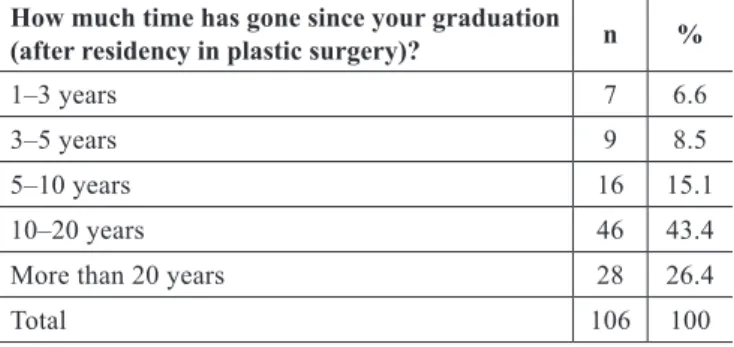
The response rate to the survey was 40.5% (106/263 res -pondents). Among the 106 respondents, 32.1% and 67.9% represented titular and specialist members, respectively. Table 1 shows the time of the participants’ completion of their professional education.
Most participants (71.7%) practiced their profession only in one city, but responses to the survey came from all regions of the state (Table 2). Most of the plastic surgeons in this study owned an ofice (65.1%) and offered private practice services (48.1%). A little more than half of the volunteers only assist patients through health-care insurance plans and private service; however, a signiicant number of surgeons reported working within the Public Health System (SUS; 34.9%). In particular, a small percentage (18%) of the inter
-viewees indicated that they performed cosmetic surgeries through health-care insurance plans (Table 3).
Table 2 – Performance of the surgeons in more than one city.
Do you work only in one city?
Years since graduation
Up to 5 n (%)
5–10 n (%)
10–20 n (%)
More than 20 n (%)
Yes 6 (37.50%) 7 (43.75%) 41 (89.13%) 22 (78.57%)
No 10 (62.50%) 9 (56.25%) 5 (10.87%) 6 (21.43%)
Total 16 16 46 28
Table 3 – Performing cosmetic surgeries through health insurance plans.
Do you perform cosmetic surgeries through health insurance plans?
Years since graduation
Up to 5 n (%)
5–10 n (%)
10–20 n (%)
More than 20 n (%)
No 15 (93.75) 15 (93.75) 31 (67.39) 27 (96.43)
Yes 1 (6.25) 1 (6.25) 15 (32.61) 1 (3.57)
Total 16 (100) 16 (100) 46 (100) 28 (100)
Table 4 – Investment in publicity.
How much do you invest monthly in publicity?
Years since graduation
Up to 5 n (%)
5–10 n (%)
10–20 n (%)
More than 20 n (%) Less than R$ 500.00 5 (31.25) 13 (86.66) 20 (71.43) 21 (91.3) R$ 500.00 to R$ 1000.00 7 (43.75) 1 (6.67) 5 (17.86) 2 (8.7) R$ 1000.00 to R$ 3000.00 2 (12.50) 1 (6.67) 2 (7.14) __
R$ 3000.00 to R$ 5000.00 1 (6.25) __ __ __
More than R$ 5000.00 1 (6.25) __ 1 (3.57) __
Total 16 (100) 15 (100) 28 (100) 23 (100)
Table 1 – Years since graduated after residency in plastic surgery.
How much time has gone since your graduation
(after residency in plastic surgery)? n %
1–3 years 7 6.6
3–5 years 9 8.5
5–10 years 16 15.1
10–20 years 46 43.4
More than 20 years 28 26.4
Total 106 100
publicity, such as advertising in television, press ofice, and radio, besides magazines and websites. Most (72%) of the surgeons who advertised their work claimed to have invested less than R$500.00 per month for this purpose (Table 4).
The monthly number of new consultations was descri bed, as follows: of the participants, 35.8% had up to 20 new con sultations, 31.3% had 30–50 new consultations, 18.9% had 20–30 new consultations, and 14.2% had more than 50 new consultations. Regarding payment methods, 56.6% of the surgeons reported accepting credit cards and 98.1% reported accepting installment payments ranging from 2 (2.9%) to 24 installments (1%). A smaller percentage of participants utilized companies to perform installment tran
-sactions on their behalf, including Saúde Service (15.4%), Online Doctor (1.1%), and Dr. Crédito (3.3%). Only one of the surgeons indicated performing free consultations, and 84.8% of the interviewees charged a consultation fee ranging from R$ 100.00 to R$ 200.00.
When asked about the number of clients that the partici
responded that 10-20, up to 10, and 20-30 clients were lost in this manner, respectively. In addition, 36.8% indicated that they perform 10-20 surgeries per month, 29.2% performed 20-30 surgeries, 23.6% performed up to 10 surgeries, and only 10.4% performed more than 30 surgeries per month. It is noteworthy that the types of procedures performed were not speciied. When asked if they operate with the help of an auxiliary plastic surgeon, 52.8% of the interviewees denied the practice (Table 5); the justiications for this are presented in Figure 1. Of the procedures the surgeons performed in their daily practice, the frequency rates of plastic surgery procedures were as follows: 81-100% in 51.4%, 61-80% in 34.3%, 41-60% in 5.7%, 21-40% in 6.7%, and 0-20% in 1.9% participants.
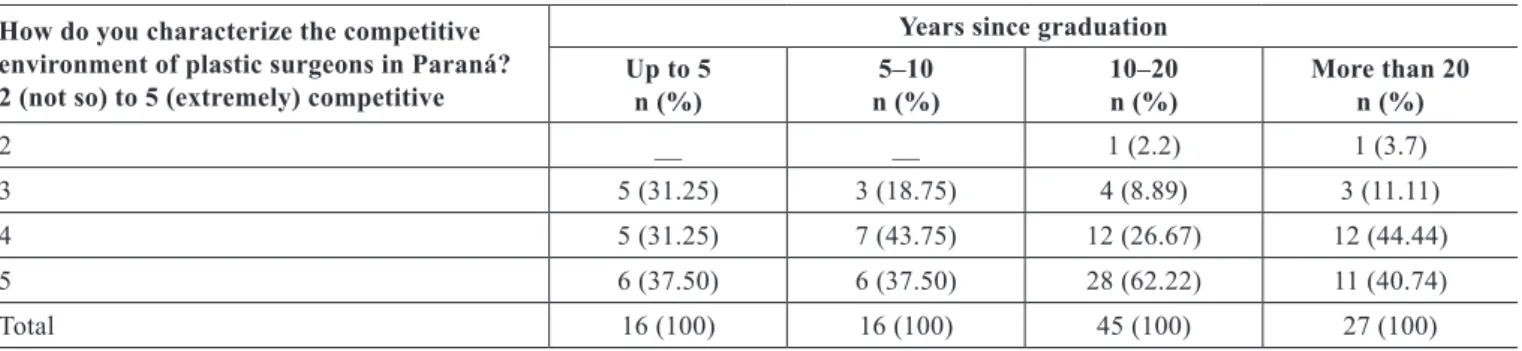
Regarding the plastic surgery market in Paraná, 49% of the surgeons reported it to be extremely competitive and only 1.9% reported it to be not so competitive (Table 6). We observed a balance between the interviewees who considered their patients to be moderately sensitive (51.5%) and those who considered their patients to be very sensitive (47.6%) to price changes. Only one surgeon classiied patients as insensitive to price changes. The social classes of the standard patients are depicted in Figure 2. The initiatives adopted by the participants to maintain the number of plastic surgery procedures that they perform are presented in Table 7.
The factors that signiicantly affect job market trends, as reported by the surgeons, are as follows: excessive number of active plastic surgeons, excessive number of recently graduated plastic surgeons entering the market, invasion of other specialties, and misdistribution of surgeons across cities. Of the respondents, 21.9% indicated all of the factors; 14.3% indicated all factors, except for misdistribution of surgeons; 13.3% indicated only excessive number of active plastic surgeons and invasion of other specialties; and 7.6% indicated only invasion of other specialties. When asked about the number of residents graduating in plastic surgery in Paraná, 62.4% of the participants considered it to be excessive; 36.6% considered it to be adequate; and only 1% considered it to be small.
In respect to the table of prices suggested by the SBCP-PR, most (62.3%) of the interviewees claimed to apply the
prices, whereas 21.7% and 16% indicated that they consi
-dered the values to be too high and too low, respectively. Furthermore, 82.1% of the surgeons reported perfor
-ming nonsurgical procedures, the most cited being the use of botulinum toxin (78.3%), hyaluronic acid illers (45.28%), chemical peeling (13.2%), and fractionated CO2
laser (13.2%). Other procedures were also performed (such as intense pulsed light treatment, radiofrequency, laser hair removal, and bioplasty), although at a much lower frequency (1-3%).
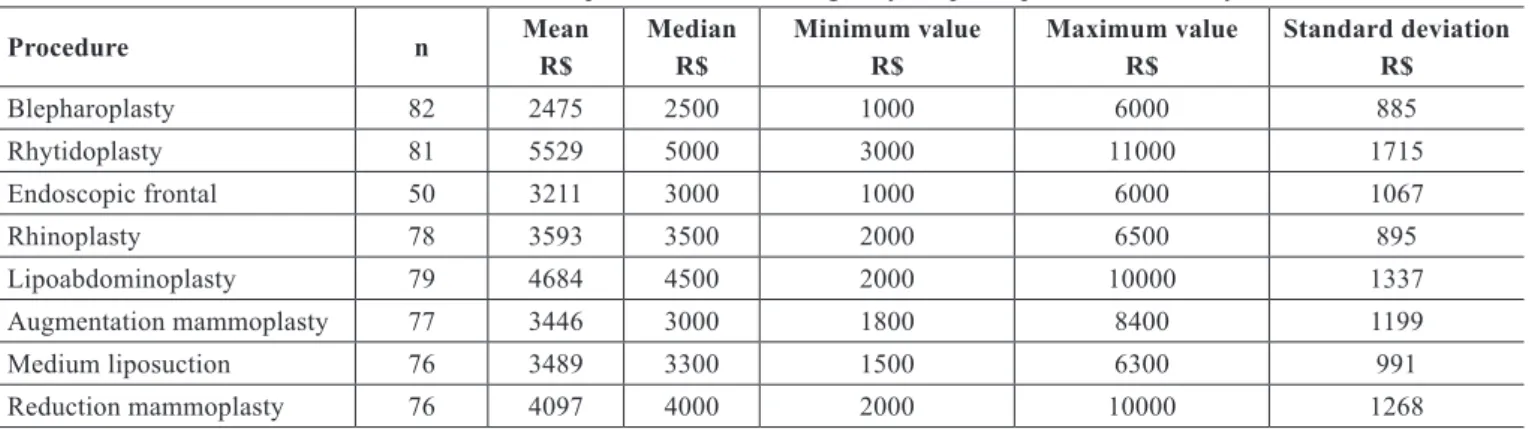
The total net values (surgeon’s fee, staff salary, prosthesis cost, and clinic/hospital operational cost) and net values of the professional fees for major surgeries implemented by the interviewees are presented in Tables 8 and 9, respectively. The net values were stratiied according to graduation time after residency in plastic surgery (Figures 3 to 6). Figure 7 presents the goals of the participants in terms of medical fees and number of surgeries performed.
DISCUSSION
For more than a decade, several authors have studied the relationship among plastic surgery, economics, and the job market3-8. However, this type of study is not common
in Brazil. In 2009, SBCP conducted an extensive research survey using a sample of slightly more than 10% of its
Table 5 – Operating with an auxiliary plastic surgeon.
Do you operate with an auxiliary plastic surgeon?
Years since graduation
Up to 5 n (%)
5–10 n (%)
10–20 n (%)
More than 20 n (%)
No 6 (37.5) 8 (50) 27 (58.7) 15 (53.57)
Yes 10 (62.5) 8 (50) 19 (41.3) 13 (46.43)
Total 16 (100) 16 (100) 46 (100) 28 (100)
Figure 1 –Justiication for not operating
members at that time, obtaining 366 responses from a total of 3533 members. This study assessed the general situation of plastic surgery and plastic surgeon performance in the country, in addition to patient proiles and the major surgeries performed. However, the focus was not speciically on the job market, and the sample population from the state of Paraná was insuficient for statistical evaluation9. The present study
may serve as a basis for other more detailed studies that aim to demonstrate the relationship between the number of surgeons and the job market trend in each Brazilian city or state.
The present online survey (via the link to the SBCP-PR website) achieved a response rate higher than the average (40.5%). Previous studies obtained a mean response rate of approximately 26%, and some factors may contribute to an increase in this value10,11, including prenotiication and
e-mailing from a trusted source or link to a reliable website. During a dinner held at the end of the year 2011, members of the SBCP-PR were informed that our research would be launched in early 2012; in addition, the e-mail from the SBCP-PR and the link to the website (www.sbcp-pr.org.br) that was made available through e-mail might have helped to increase the response rate to this survey.
Specialist members who had completed their residen cy 10-20 years previously represented most of our sample
population (Table 1). This demonstrates that the most in terested and collaborative surgeons were experienced members, who ind themselves at a period of increased professional peer competition, as also shown in Table 6. Although more than 70% of the surgeons worked in only one city, the fact that approximately 30% worked in more than one city indicates the need to search for new markets; that is, the surgeons perceived increasing competition. Similarly,
Table 6 – Characterizing the competitiveness of plastic surgeons in Paraná.
How do you characterize the competitive environment of plastic surgeons in Paraná? 2 (not so) to 5 (extremely) competitive
Years since graduation
Up to 5 n (%)
5–10 n (%)
10–20 n (%)
More than 20 n (%)
2 __ __ 1 (2.2) 1 (3.7)
3 5 (31.25) 3 (18.75) 4 (8.89) 3 (11.11)
4 5 (31.25) 7 (43.75) 12 (26.67) 12 (44.44)
5 6 (37.50) 6 (37.50) 28 (62.22) 11 (40.74)
Total 16 (100) 16 (100) 45 (100) 27 (100)
Figure 2 –Social classes to which the standard patients belonged.
Observation: only classes A–C were included in the question.
Table 7 – Initiatives to maintain the amount of surgical work amidst peer competition. Did you need to take some of the initiatives listed below to maintain your amount of surgical work amidst peer competition?
n %
Increasing installment terms 39 36.8
Lowering prices 27 25.5
Working at other locations 14 13.2 Lowering prices and increasing
installment terms 11 10.4
Increasing installment terms and working
at other locations 5 4.7
Lowering prices, increasing installment terms,
and working at other locations 2 1.9
Free consultation 2 1.9
Lowering prices and investing in
commercial promotions 1 0.9 Increasing installment terms and
offering free consultations 1 0.9 Lowering prices and working at other locations 1 0.9 Lowering prices and offering free consultations 1 0.9 Increasing installment terms and investing
in commercial promotions 1 0.9 Lowering prices, increasing installments,
and offering free consultations 1 0.9
Table 8 – Total net value charged in R$ by the participants of this survey (surgeon’s fee, staff salary, prosthesis cost, clinic/hospital operational cost).
Procedure n Mean
R$
Median R$
Minimum value R$
Maximum value R$
Standard deviation R$
Blepharoplasty 91 4009 3900 2000 8000 1409
Rhytidoplasty 91 9354 9945 4500 16000 2774
Endoscopic frontal 46 5510 5630 3000 8000 1443
Rhinoplasty 87 5756 5500 2500 10000 1472
Lipoabdominoplasty 88 8205 8000 2000 14500 2111
Augmentation mammoplasty 87 6813 6500 2000 12000 1831
Medium liposuction 86 5598 5500 2800 9635 1599
Reduction mammoplasty 85 6938 7000 700 14000 2026
Observation: Some of the surgeons did not answer this question, and others did not perform some of the surveyed procedures.
Table 9 – Net values of the professional fees charged by the participants of this survey.
Procedure n Mean
R$
Median R$
Minimum value R$
Maximum value R$
Standard deviation R$
Blepharoplasty 82 2475 2500 1000 6000 885
Rhytidoplasty 81 5529 5000 3000 11000 1715
Endoscopic frontal 50 3211 3000 1000 6000 1067
Rhinoplasty 78 3593 3500 2000 6500 895
Lipoabdominoplasty 79 4684 4500 2000 10000 1337
Augmentation mammoplasty 77 3446 3000 1800 8400 1199
Medium liposuction 76 3489 3300 1500 6300 991
Reduction mammoplasty 76 4097 4000 2000 10000 1268
Observation: Some of the surgeons did not answer this question, and others did not perform some of the surveyed procedures.
Figure 3 – Total values in R$ charged for lipoabdominoplasty
and medium liposuction according to years since graduation after residency in plastic surgery. The total values include the surgeon’s fee, staff salary, prosthesis cost, and clinic operational expense
(anesthesiologist and materials).
Figure 4 – Total values in R$ charged for augmentation
mammoplasty and reduction mammoplasty according to years since graduation after residency in plastic surgery. The total values
Figure 5 – Total values in R$ charged for rhytidoplasty and
blepharoplasty according to years since graduation after residency in plastic surgery. The total values include the surgeon’s fee,
staff salary, prosthesis cost, and clinic operational cost (anesthesiologist and materials).
Figure 6 – Total values charged for endoscopic frontal and
rhinoplasty according to years since graduation after residency in plastic surgery. The total values include the surgeon’s fee,
staff salary, prosthesis cost, and clinic operational cost (anesthesiologist and materials).
Figure 7 – Aim of the participants in terms of medical fees and
number of surgeries performed.
the percentage of surgeons (34.9%) that operated within the SUS was signiicant, as well as the percentage of those who performed cosmetic surgery through health insurance plans (17%). These values may be explained by the need to increase gains, as the values applied for the largest income source has plateaued over the recent years, with cosmetic surgery
accounting for 81-100% of the operations of 51.4% of the surveyed surgeons.
In 2004, Krieger and Lee12 published an interesting paper
on the changing performance of the plastic surgeon, from predominantly performing surgical repairs to cosmetic surge
-ries owing to the plateauing of the trend in the fees paid by health insurance plans. The authors pointed out that despite the increase in demand (number of surgeries per year) and the number of service providers (plastic surgeons), the amount of work increased by approximately 41% while the mean annual gain and cost per surgery remained stable.
It is interesting that a significant proportion of surgeons did not invest in any kind of publicity and that the most used publicity tool is the website, followed by magazines and other media (television, radio, and press office). Most of the participants who reported not investing in publicity had graduated more than 10 years earlier. The participants who reported spending on marketing were those who graduated within 5 years, spending more than R$5000.00 per month (Table 4). This demonstrates that the surgeons who were new in the market were more competitive and aggressive in this aspect. Rohrich13 claimed that career evolution in
plastic surgery should be considered as the evolution of a surgeon’s life. This evolution looks more like a marathon than a sprint. Surgeons must provide the correct rhythm to their professional growth. However, this does not appear to be the view of the newer colleagues, according to our data. In the past few years, it is difficult to imagine a surgeon who incurs high monthly marketing expenses. However, the current trends appear markedly different to those observed earlier.
Regarding market diversiication and payment facilita
-tion schemes, 98.1% of the surgeons received payment in ins tallments and more than 50% accepted credit cards despite the high overhead costs. This demonstrates the need for the surgeon to remain competitive. In addition, the utilization of companies that serve as mediators in installment transac
cards implies a decrease in the fear of competition, which is a chronic problem in many medical ofices.
Only one surgeon indicated not charging for consulta
-tions. However, for those who took so long to complete their professional education, the values applied ranging from R$100.00 to R$200.00 might be too low. The costs associated with other professions involving lesser educational effort may be much higher than these values14.
Many surgeons performed between 10 and 20 surgeries per month, followed by those who conducted between 20 and 30 surgeries. Most of these surgeries were aesthetic, corroborating the indings of Krieger and Lee12. Generally,
that number decreases to between 10 and 20 surgeries per month after 20 years of graduation, demonstrating that the surgeons did not maintain their initial number of surgeries at this stage, either by their own choice or by circumstances in their career.
The questions on the practice of operating with an au -xiliary plastic surgeon and the reasons for not doing so demonstrate some important aspects about the job market in the state of Paraná, which probably relects the situation in the rest of the country. More than half (52.8%) of the surveyed surgeons claimed to not operate with an auxiliary doctor. Among the reasons for this attitude is the high cost of surgery (44.6%); however, the fact that almost the same percentage of participants (42.9%) believed that technologists might exercise the same function is important. Only 12.5% of the interviewees indicated that they did not feel comfortable working with another plastic surgeon. The group concerned about the rising cost of operation due to the participation of an assistant surgeon obviously wanted to remain competitive in the market, reducing the total cost of the procedure, thus increasing the number of surgeries performed. The group that did not feel comfortable working with an assistant surgeon expressed dificulty in working in a team or delegating part of the procedure to an auxiliary plastic surgeon. Obviously, a well-trained and synchronized team only confers beneits to the patient and to the surgeon. The participation of an assis
-tant surgeon results in less surgical and anesthesia time, along with a lower surgical risk. In addition, the procedure is less tiresome for the surgeon, and the surgeon can complete the surgery with the necessary zeal. The resolution of the Federal Council of Medicine 1490/98 deals with the composition of the surgical team, stating that the operation is the responsi
-bility of the titular surgeon and that an assistant surgeon may be necessary if the titular is unable to continue the act. In the opinion of a counselor (1810/2007 CRM-PR), the issue can be addressed as follows: “It is good practice that the surgeon nominates an assistant surgeon to assist or replace him/her in his/her absence. A surgeon who gives up the presence of an assistant surgeon in elective surgery may be accused of unethical practice in case of failing to inish the procedure or if the procedure presents a complication leading to injury
due to lack of assistance.” Therefore, when surgeons choose to operate only with auxiliary technologists, they are exposed to an unnecessary risk. In addition, experienced surgeons may be of help to young surgeons in the start of their careers by employing them as assistants; however, they must take precaution against intermediating agents whose motive is the exploitation of the medical activity to increase their proits. Indirectly, surgeons put great value to their medical profes
-sion because of the long experience and intensive training required for them to obtain the title of expert, which is often devaluated by the statement, “Technologists may exercise the same function.”
It is also important to emphasize that most of the younger surgeons operated with auxiliary plastic surgeons (Table 5) and that more than half of the surgeons who graduated 10-20 years and more than 20 years previously operated only with technologists. This might be explained by the following facts: (i) the young surgeon does not feel conident to perform a procedure alone, having the need to look for a partner to exchange opinions with, whereas (ii) most experienced sur -geons feel conident to perform a procedure and thus dismiss any help from another plastic surgeon. Another fact to be considered is the lack of expert colleagues in smaller cities.
The professional competition increases on a daily basis, as evident in the fact that that almost half of the surveyed surgeons considered the job market to be extremely compe
-titive and their patients to be very sensitive to price changes. The surgeons who had graduated 10-20 years previously felt the most intense competition (Table 6). Furthermore, the larger number of surgeons who perform cosmetic surgeries through health insurance plans fall under this postgraduation period (Table 3).
The present study conirms the popularity of plastic sur -gery, as 24.5% of the surgeons reported that their standard patients were from social classes A and B and 19.8% reported having patients from classes A-C (Figure 2).
The volunteers also described their main initiatives to maintain their number of performed surgeries. Increasing installment terms (36.8%), lowering prices (25.5%), and working at other locations (13.2%) were the most frequent initiatives, besides their combinations (Table 7). It is very common for patients to bargain, preferring the highest discounts for services among those offered by different surgeons. The surgeon is induced to accept this situation to maintain the number of surgeries that they perform in a certain period, which leads to the transformation of their services into commodities. The doctor-patient relationship depends more on trust than on bargaining, even at present. In fact, according to the study by Waltzman et al.15, pricing is
experience (ifth). This study should be taken into account, although in our setting, the situation probably is different.
In an editorial published in the journal Plastic and Recons-tructive Surgery, Rohrich16 asked in the title, “So you want to
get paid for what you do?” In this article, Rohrich described the activity of plastic surgery as a union between physical activity and intellectually grounded knowledge and experience, and only comparable to a few activities such as playing an instru
-ment or lying an airplane. Therefore, surgeons should not think of themselves only as “service providers” or “commodi
-ties,” as their business requires much more than that. Similarly, without disparaging the role of the technologist, who plays a key role in the surgical team, surgeons should consider the technologist as having neither the ability nor the technical and intellectual knowledge of a trained plastic surgeon16.
On the question of what else affects job market trends, an important percentage of the volunteers (21.9%) scored all the following alternatives: excessive number of active plastic surgeons, excessive number of recently graduated plastic surgeons joining the market, invasion of other specialties, and misdistribution of surgeons across cities. Only 7.6% indicated that the invasion of other specialties had the most impact, accounting for the fourth highest percentage of responses to this question. These indexes suggest that the plastic surgeon is much more concerned with other active plastic surgeons and members of the SBCP than with profes
-sionals from other specialties, or even from the so-called ield of aesthetic medicine. The results for the item about the number of residents graduated in the state of Paraná conirms this. Most surgeons consider the number as exces
-sive (62.4%), and most of the surgeons who provided this opinion had graduated 10-20 years previously (79.1%). Only 1% of the surveyed surgeons consider this number as small.
The controversy described herein has also occurred in other countries17. As stated at the beginning of this article, the
problem of the job market is inluenced by multiple factors, and no single main factor can be identiied. Thus, several option should be considered.
Nonsurgical procedures have become important tools in the daily practice of plastic surgeons, which was conirmed by the index (82.1%) observed in this study. Over the years, the surgeons have added them to their arsenal of procedures to remain competitive and maintain their clientele18. The
botulinum toxin injection is still the most cited procedure, followed by the use of hyaluronic acid illers and peelings. These data conirm the indings from the Datafolha survey conducted by the SBCP9. These procedures, in most cases,
complement other facial rejuvenation surgeries. Fortunately, the index of surgeons who perform polymethylmethacrylate injections or bioplasty was very low.
Finally, the item “medical fees” was analyzed. There was a balance between the surgeons who professionally targeted high fees in order to perform fewer surgeries (44.3%) and
moderate fees in order to perform an average number of surgeries (38.7%). Even if these aims had not been achieved at the time of the survey, it represents the desired goals of the surgeons (Figure 7).
However, several aspects should be addressed in relation to the total net values and to the values considering only the surgeon’s fees (Tables 8 and 9; Figures 3-6). First, a stan
-dard curve remained in almost all the graphs, which may be described as follows: the surgeons began charging a higher value after more than 5 years of graduation; between 5 and 10 years after graduation, this value was lowered signiicantly. However, it slightly increased between 10 and 20 years after graduation. The charged amounts were higher than average only after 20 years of training. This may be interpreted as struggling from competition. After years of graduation, medical practice, and further study, new surgeons attempt to charge the amount they believe is consistent with the sacriice they have made. They then lower their prices after 5 years of graduation owing to the dificulty of self-maintenance and through observation of other colleagues that are doing the same. Between 10 and 20 years of graduation, even in the middle of a stiff competition, they slightly increase their fees to maintain the amount of work. After acquiring suficient experience and recognition by the community for more than 20 years of practice, the surgeons inally increase their fees, and do not worry much about competitiveness. There is a second aspect to be addressed, that is, the younger surgeons only charged less than the experienced surgeons for liposuc
-tion surgery (equating to surgeons 10-20 years of gradua-tion). This is probably because they have not yet encountered dificulties and complications in this surgery, even innocently believing that it is a simple procedure. The third aspect refers to surgeons who have graduated 10-20 years earlier who charge a mean value that is lower than those for all other cate
-gories, including blepharoplasty, rhinoplasty, and liposuction surgeries. The irst 2 aspects may be explained by competition with other specialties (ophthalmology and otolaryngology), which utilizes health insurance plans to perform the same surgery. In contrast, the latter is probably justiied only by the need of peer competition, as these surgeons probably already had experienced dificulties and complications inherent to liposuction. Other authors have also discussed this issue; it is not uniquely a local or national problem19.
Streu et al.20 evaluated the degree of satisfaction with
CONCLUSIONS
The overall practice proile of the plastic surgeons in the state of Paraná relects plastic surgeons who are concerned about the job market, by generally working in one city and seeking various alternatives to remain competitive, a situation that is most evident between 10 and 20 years after graduation.
REFERENCES
1. Rohrich RJ. The increasing popularity of cosmetic surgery procedu-res: a look at statistics in plastic surgery. Plast Reconstr Surg. 2000; 106(6):1363-5.
2. Krieger LM, Shaw WW. The inancial environment of aesthetic surgery: results of a survey of plastic surgeons. Plast Reconstr Surg. 1999; 104(7):2305-11.
3. Krieger LM, Shaw WW. Aesthetic surgery economics: lessons from corporate boardrooms to plastic surgery practices. Plast Reconstr Surg. 2000;105(3):1205-10.
4. Krieger LM, Shaw WW. Pricing strategy for aesthetic surgery: econo-mic analysis of a resident clinic’s change in fees. Plast Reconstr Surg. 1999;103(2):695-700.
5. Constantian M. The media and plastic surgery: on being what you want to become. Plast Reconstr Surg. 2003;111(3):1348-9.
6. Rohrich RJ. The making of a plastic surgeon: present and future. Plast Reconstr Surg. 2003;111(3):1289-90.
7. Pearl RM, McAllister H, Pruzansky J. An economic analysis of health care reform and its implications for plastic surgery. Plast Reconstr Surg. 1997;99(1):1-9.
8. Pearl RM. An economic analysis of health care reform and its implica-tions for plastic surgery: a ive-year perspective. Plast Reconstr Surg. 2003;111(1):483-4.
9. Sociedade Brasileira de Cirurgia Plástica. Cirurgia Plástica no Bra -sil. Pesquisa Datafolha. Janeiro, 2009. Disponível em: http://www2. cirurgiaplastica.org.br/wp-content/uploads/2012/11/pesquisa2009.pdf Acesso: 5/8/2012
10. Hamilton MB. Online survey response rates and times background and guidance for industry. Disponível em: http://www.supersurvey. com/papers/supersurvey_white_paper_response_rates.pdf Acesso: 5/8/2012
11. Sheehan K. E-mail survey response rates: a review. JCMC. 2001;(6)2. Disponível em: http://jcmc.indiana.edu/vol6/issue2/sheehan.html 12. Krieger LM, Lee GK. The economics of plastic surgery practices: trends
in income, procedure mix, and volume. Plast Reconstr Surg. 2004; 114(1):192-9.
13. Rohrich RJ. The market of plastic surgery: cosmetic surgery for sale - at what price? Plast Reconstr Surg. 2001;107(7):1845-7.
14. Ribeiro R. Hora trabalhada de mecânico já custa o dobro da de médico. Folha de São Paulo, 01/07/2012. Disponível em: http://f5.folha.uol. com.br/humanos/1113560-hora-trabalhada-de-mecanico-ja-custa-o --dobro-da-de-medico.shtml Acesso: 5/8/2012
15. Waltzman JT, Scholz T, Evans GR. What patients look for when choo-sing a plastic surgeon: an assessment of patient preference by conjoint analysis? Ann Plast Surg. 2011;66(6):643-7.
16. Rohrich RJ. So you want to get paid for what you do? The saga continues. Plast Reconstr Surg. 2012;130(2):471-3.
17. Young RA. A plea for reducing the number of positions for residency training in plastic surgery. Plast Reconstr Surg. 1994;93(7):1523. 18. D’Amico RA, Saltz R, Rohrich RJ, Kinney B, Haeck P, Gold AH, et al.
Risks and opportunities for plastic surgeons in a widening cosmetic medicine market: future demand, consumer preferences, and trends in practitioners’ services. Plast Reconstr Surg. 2008;121(5):1787-92. 19. Prado AS, Parada F, Andrades P. Predatory pricing in plastic surgery.
Plast Reconstr Surg. 2010;125(2):91e.
20. Streu R, Hawley S, Gay A, Salem B, Abrahamse P, Alderman AK. Sa-tisfaction with career choice among U.S. plastic surgeons: results from a national survey. Plast Reconstr Surg. 2010;126(2):636-42.
Correspondence to: Luiz Roberto Reis de Araújo