Canthopexy and tarsal reinforcement using a periosteal lap
Cantopexia e reforço tarsal com retalho de periósteo
ABSTRACT
Introduction: The low resistance of the palpebral tissues to the retractable forces of pos-toperative scarring can predispose patients to undesirable surgical outcomes. Among the
more effective techniques for solving this issue are the periosteal laps. This report aims to present a technique for canthopexy and tarsal reconstitution using a periosteal lap to obtain a consistent and deinitive reinforcement of the tarsal ligament and its continuity to
the inner face of the sidewall of the orbit. Methods: From July 2009 to December 2012,
49 patients underwent canthopexy with lap rotation of the arcus marginalis of the inferior
tarsus. The functional and aesthetic results were evaluated together with the presence of complications. Results: Eighty-four cantopexies and tarsal reinforcements using a
perios-teal lap were performed in 49 patients. No complications such as hematoma, infection, or
necrosis were observed. Complete remission of the preoperative signals was observed in 45 (91.8%) patients, while the other 4 (8.2%) showed partial remission on at least one of the sides related to prior ocularis paralysis. Conclusions: Canthopexy reinforced by a tarsal
periosteal lap provides good tarsal ligament reconstitution with appropriate positioning of
the outer corner and good contact of the eyelid with the ocular globe.
Keywords: Blepharoplasty. Ectropion/surgery. Eyelids/surgery. Periosteum/surgery.
RESUMO
Introdução: A pouca resistência dos tecidos palpebrais quando submetidos ao poder retrátil dos planos cicatriciais predispõe a resultados cirúrgicos indesejáveis. Dentre as técnicas mais resolutivas destacam-se as que utilizam retalhos de periósteo. O presente artigo tem por objetivo apresentar uma técnica de cantopexia e reconstituição tarsoligamentar com retalho
de periósteo, a im de obter um reforço consistente e deinitivo do tarso e sua continuidade
tecidual à face interna da parede lateral da órbita. Método: No período de julho de 2009 a dezembro de 2012, foram operados pacientes candidatos à realização de cantopexia com rotação de retalho do arcus marginalis sobre o tarso inferior. Foram avaliados os resultados estéticos e funcionais, bem como a presença de complicações. Resultados: Foram realiza-das 84 cantopexias e reforço tarsal com retalho de periósteo, em 49 pacientes. Não foram observadas complicações, como hematoma, infecção ou necrose. Remissão total dos sinais
pré-operatórios foi veriicada em 45 (91,8%) pacientes e 4 (8,2%) apresentaram remissão
parcial em pelo menos um dos lados, relacionada à prévia paresia orbicular. Conclusões: A cantopexia com reforço tarsal com retalho de periósteo proporciona boa reconstituição tarsoligamentar, com posicionamento adequado do canto externo e bom contato da pálpebra com o bulbo ocular.
Descritores: Blefaroplastia. Ectrópio/cirurgia. Pálpebras/cirurgia. Periósteo/cirurgia.
This study was performed at the Portuguese Beneicent Hospital of São Paulo, São Paulo, SP, Brazil.
Submitted to SGP (Sistema de Gestão de Publicações/Manager Publications System) of RBCP (Revista Brasileira de Cirurgia Plástica/Brazilian Journal of Plastic Surgery).
Article submitted: January 6, 2013 Article accepted: February 27, 2013 Vera Lucia Nocchi cardim1
KhaLed Bazzi2
aLessaNdrados saNtos
siLVa3
mariaNa Gomese siLVa2
FerNaNda martiNsdos
saNtos2
roLF Lucas saLomoNs3
adriaNode Limae siLVa3
rodriGode Faria VaLLe
dorNeLLes4
1. Plastic surgeon, full member of the Sociedade Brasileira de Cirurgia Plástica/Brazilian Society of Plastic Surgery (SBCP) and the Brazilian Association of Craniomaxillofacial Surgery (ABCCMF), Doctor in general surgery by the Faculty of Medical Sciences of Santa Casa de São Paulo (FCMSCSP), postdoctoral fellow at the FCMSCSP, responsible for the Lato Sensy post-graduate degree craniofacial surgery of the Portuguese beneicence of São Paulo and by the Center for Advanced Plastic (NPA), São Paulo, SP, Brazil.
2. Plastic surgeon, associate member of the SBCP, post-graduate in craniofacial surgery by the Portuguese beneicence of São Paulo, São Paulo, SP, Brazil. 3. Plastic surgeon, full member of the SBCP and ABCCMF, medical assistant of the NPA, São Paulo, SP, Brazil.
InTRODUCTIOn
Lateral canthopexy is a widely used procedure for the treatment and prevention of various disorders of the lower eyelid in reconstructive and cosmetic surgery1. There are se veral techniques for positioning and tightening the outer corner of the eyelid from simple points of attachment to the
tarsus and periosteal laps. In all of these techniques, the
lateral canthal ligament is suspended or reinserted at the level of the Whitnall’s tubercle on the inner side of the orbital rim. Bick2 and Tenzel3 contributed to the popularization of lateral canthopexy. Many surgeons perform it routinely du ring lower blepharoplasty or transpalpebral elevation of the middle third4-8.
This report aims to present a technique of tarsal
recons-titution using a periosteal lap to obtain a consistent and deinitive tarsal reinforcement and tissue continuity to the
inner face of the sidewall of the orbit (Figure 1).
METhODS
From July 2009 to December 2012, all patients who were eligible for canthopexy underwent the technique described below and were included in this study. The following criteria
were used for the indication of canthopexy: eligibility for transpalpebral elevation of the middle thirdof the face with tarsal laxity (snap test positive), lagophthalmos, canthal dys -topia, ectropion, and loss of substance of the lower eyelid.
Patients were grouped into primary or secondary cases according to the indication for surgery and were evaluated for aesthetic and functional results (remission of signs and symptoms) as well as the presence of complications. The postoperative follow-up examination was conducted at an
ambulatory care center in the irst week and then monthly
until the third month and semiannually until the second year. Photographs were taken preoperatively and at 3 and 6 months after surgery.
Surgical Technique
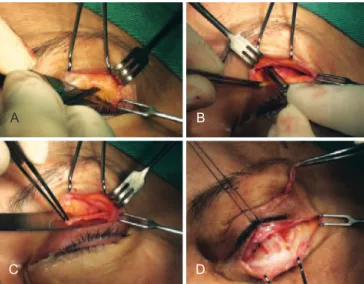
The procedure was performed under local anesthesia when isolated, and under sedation or general anesthesia de pending on the associated surgeries and each patient’s preference. The upper eyelid skin was incised in the palpe bral crease to separate the orbicularis muscle in the direction of
its ibers. The superolateral orbital margin was exposed and then the periosteum was incised with a scalpel to laterally transverse the bone crest to the supraorbital nerve until the lateral margin of the orbit above the external canthal liga-ment insertion was revealed. This point corresponds to the ligament insertion to be reinforced. The periosteum, or more
speciically the arcus marginalis, was detached from the
internal face of the orbital rim and a second incision parallel
to the irst one was made with an iris scissors or scalpel to delimit a 5-6-mm wide lap. The 2 incisions were united at the medial extremity and the lap remained pedicled in the
inner lateral margin of the orbit just above the insertion of the lateral canthal ligament (Figure 2).
The lower eyelid incision was made as close as possible to the ciliary margin to detach the orbicularis muscle from the tarsus. A tunnel was made by divulsion with scissors, passing behind the skin and the orbicular bridge between the 2 skin incisions and ending at the front of the lateral extremity of
the inferior tarsus. Through this tunnel, the lap was passed
and distended on the tarsus and a stitch was made using a 6-0 nylon suture ligating its base to the lateral extremity of
the tarsus. This stitch deined the correlation between the
outer corner of the eyelid and the orbital margin as well as the tension given to the tarsal margin. Another 2 stitches
were used to ixate the lap medially to the tarsus to ensure
good contact between them (Figure 3). When canthopexy was performed as an isolated procedure, the skin incisions
were sutured at this point. In contrast, if the canthopexy
was performed together with other procedures, these were conducted sequentially (Figure 4).
In patients in whom large tarsal ligament laxity was
noted during the snap test, shortening of the eyelid margin was performed in an associated manner using the
A
C
B
D
Figure 1 – Illustration of the surgical technique. In A, demarcation
of the periosteal lap on the inner side of the orbit; In B, the
positioned lap; In C, demarcation of the medial and lateral
periosteal laps; In D, positioned laps
the tear ducts. The fusion of the extremities of the medial
and lateral laps at the center of the eyelid was intended to
strengthen the tarsus along its length (eyelid suspension “on clothesline”) (Figure 6).
RESUlTS
Eighty-four canthopexies and tarsal reinforcements using
periosteal laps were performed in 49 patients. The patients
were aged 7–89 years. The following were the indications for surgery: prophylactic (tarsal laxity) in 19 patients, loss of substance of the lower eyelids in 10 patients, ectropion in 7 patients, lagophthalmos in 7 patients, and canthal dystopia
A
C
B
D
Figure 2 – In A, incision of the distal longitudinal edge of the
periosteum lap in the orbital rim; In B, incision of the proximal edge
of the lap on the inner orbit (arcus marginalis), after subperiosteal detachment; In C, preserving the lateral pedicle in the region of
Whitnall’s tubercle; In D, exposure of the lower eyelid tarsus.
A
C
B
D
Figure 3 – In A, creation of a tunnel between the orbicularis
muscle and the lateral canthal ligament; In B, transposition of the
lap to the lower eyelid; In C, attachment of the lap near the tarsus;
In D, the positioned lap.
Kuhnt-Szymanowski technique (Figure 5). In those patients
who underwent medial periosteal canthopexy, another
periosteal lap was made vertically above the medial canthal
ligament and the anterior glabella (Figures 1C and 1D). The
tunnel for the lap transposition passed between the orbi -cularis muscle and the medial canthal ligament to preserve
A
C
E
B
D
F
Figure 4 – A patient with canthal dystopia and lagophthalmos
who underwent canthopexy with an arcus marginalis lap
and a skin graft. In A, C, and E, preoperative aspect; In B, D, and F, 3-month postoperative appearance.
A
C
B
D
Figure 5 – A patient with severe ectropion who underwent lateral
canthopexy using a periosteal lap and reduction of the
eyelid margin using the Kuhnt-Szymanowski technique. In A and C, preoperative appearance;
are highly dependent on the tissue resistance to shear with the tarsal suture1. For this reason, some authors advocate
local periosteal laps to technically facilitate the canthopexy
procedure and prevent dehiscence10-13.
The periosteum of the outer face of the orbit is a structure that is commonly used in the reconstruction of the lateral and medial canthal ligament14. Lemke et al.12 in 1999 and Game & Morlet1 in 2007 described the use of short laps of the perios -teum overlying the tarsal strip to rebuild a new lateral canthal ligament and prevent dehiscence. As in these techniques, the
lap proposed in this paper provides some advantages over
conventional canthopexy using sutures. Among these advan-tages are the continuity of the tarsal tissue to the orbital rim, greater stretch control, and tarsal laxity correction, by not only lateral traction but also the incorporation of periosteal tissue into the tarsus. The role of the suture connecting the
lap to the tarsus is to unite the tissue for the healing process rather than to provide long-term tension. Furthermore, a lap vector that is superiorly oriented and held ixed in the region
of Whitnall’s tubercle better simulates the anatomy of the lateral canthal ligament in contrast with the other periosteal
lap described by some authors1,11,13.
The region of the periosteum used to create the flap cor responds to the arcus marginalis. This structure is a fusion zone of the periosteum, orbital septum, and perior-bital region that forms an inelastic and resistant ligament.
Its anatomical position allows for the creation of a flap
based on the inner wall of the orbit. This allows the flap, after being fixed to the lower tarsus, to approximate the outer corner of the eyelid to the eyeball and restore contact between the tarsal and the sclera conjunctiva. Furthermore, the septectomy that results from their preparation releases the upper-lateral fat bags, which diminishes the hollowed appearance of the orbit (Figure 7).
Since it provides a sturdy anchor of the tarsus to the orbital margin, the technique in the current study is of spe -cial importance in secondary cases and when it becomes necessary to reinsert the lateral canthal ligament because of
trauma to correct an antimongolic issure. It also represents
a simpler alternative to other techniques described for the reintegra tion of the canthal ligament that require the creation of a hole in the bone for the passage of the suture, and its results are less prone to dehiscence since its suture is less vulnerable due to the incorporation of tissue into the tarsus and the distribution of the forces of tension7,15.
COnClUSIOnS
Canthopexy with tarsal reinforcement using a periosteal
lap provides good tarsal reconstitution as well as adequate
positioning of the outer corner of the eyelid and good contact with the eyeball.
A
B
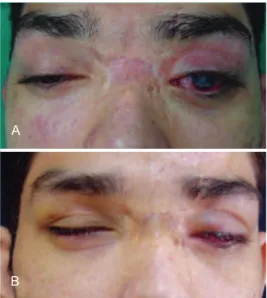
Figure 6 – A patient with posttraumatic buphthalmos
and insuficient occlusion of the left eyelid who underwent lateral and medial canthopexy using periosteal laps. In A, preoperative
appearance; In B, 3-month postoperative appearance.
in 6 patients. Seventeen patients (34.7%) were considered secondary cases. Associated horizontal eyelid shortening was performed in 6 patients (12.2%). Four patients (8.2%)
with a large degree of insuficient lid sealing also underwent medial canthopexy using a periosteal lap (suspension “on
clothesline” technique). No procedure-related complications including hematoma, infection, or necrosis were noted. Che -mosis was observed in 71.4% of the patients in the immediate postoperative period. Edema persisted for 2-3 weeks and lasted longer in older patients and smokers.
Complete remission of the preoperative signals was ob -served in 45 patients (91.8%), although 4 patients (8.2%) showed partial remission on at least one side related to previous orbicular paralysis.
DISCUSSIOn
The lid is composed of thin and compliant structures. The contractile capacity of the scar tissue that usually forms after a surgical procedure in this region can overcome the resistance of the palpebral tissues, resulting in retraction and lagophthalmos9. For this reason, it becomes necessary to ind better eyelid support, both in cases of dystopia and in cases of tarsal laxity.
The simple technique of suturing the canthal ligament
to the periosteum presents some dificulty because of the
A
C
B
D
Figure 7 – A patient with scleral exposure and orbital hollow
subjected to lateral orbital canthopexy by the proposed technique and transpalpebral elevation of the middle third.
In A and C, preoperative appearance;
In B and D, 6-month postoperative appearance
REfEREnCES
1. Game J, Morlet N. Lateral canthal ixation using an oblique vertically orientated asymmetric periosteal transposition lap. Clin Experiment Ophthalmol. 2007;35(3):204-7.
2. Bick MW. Surgical management of orbital tarsal disparity. Arch Oph -thalmol. 1966;75(3):386-9.
3. Tenzel RR. Treatment of lagophthalmos of the lower lid. Arch Ophthal-mol. 1969;81(3):366-8.
4. McCord CD, Boswell CB, Hester TR. Lateral canthal anchoring. Plast Reconstr Surg. 2003;112(1):222-37.
5. Cardim VLN. Blefaroplastia subperiostal. Rev Soc Bras Cir Plást. 1996; 11(2):7-14.
6. Hester TR Jr, Codner MA, McCord CD, Nahai F, Giannopoulos A. Evolution of technique of the direct transblepharoplasty approach for the correction of lower lid and midfacial aging: maximizing results and minimizing complications in a 5-year experience. Plast Reconstr Surg. 2000;105(1):393-406.
7. Flowers RS. Canthopexy as a routine blepharoplasty component. Clin Plast Surg. 1993;20(2):351-65.
8. Fagien S. Algorithm for canthoplasty: the lateral retinacular suspension: a simpliied suture canthopexy. Plast Reconstr Surg. 1999;103(7):2042-53. 9. Hwang K, Nam YS, Kim DJ, Han SH, Hwang SH. Anatomic study of
the lateral palpebral raphe and lateral palpebral ligament. Ann Plast Surg. 2009;62(3):232-6.
10. Leone CR Jr. Lateral canthal reconstruction. Ophthalmology. 1987; 94(3):238-41.
11. Leone CR Jr. Periosteal lap for lower eyelid reconstruction. Am J Ophthalmol.1992;114(4):513-4.
12. Lemke BN, Sires BS, Dortzbach RK. A tarsal strip-periosteal lap technique for lateral canthal ixation. Ophthalmic Surg Lasers. 1999;30(3):232-6.
13. Marsh JL, Edgerton MT. Periosteal pennant lateral canthoplasty. Plast Reconstr Surg. 1979;64(1):24-9.
14. Leibsohn JM, Hahn F. Medial canthal tendon reconstruction with nasal periosteum. Ophthal Plast Reconstr Surg. 1992;8(1):35-40.
15. McCord CD, Ford DT, Hanna K, Hester TR, Codner MA, Nahai F. La -teral canthal anchoring: special situations. Plast Reconstr Surg. 2005; 116(4):1149-57.
Correspondence to: Vera Lúcia Nocchi Cardim