Article
0103 - 5053 $6.00+0.00*e-mail: [email protected]
New Pb
2+Carbon Paste Electrode based on Organically Modiied Silicate and its Square
Wave Anodic Stripping Voltammetric Response for Pretreated Gasoline Samples
William S. Cardoso,a Teresa Cristina Oliveira da Fonseca,b
Aldaléa L. B. Marquesc and Edmar P. Marques*,d
aDepartamento de Química e Biologia, Universidade Estadual do Maranhão,
Cidade Universitária Paulo VI, CP 09, 65055-970 São Luís-MA, Brazil
bCentro de Pesquisas e Desenvolvimento Leopoldo Américo Miguez de Melo - CENPES -
PETROBRAS, 21941-915 Rio de Janeiro-RJ, Brazil
cDepartamento de Química Tecnológica and dDepartamentode Química, Universidade Federal do
Maranhão, Av. dos Portugueses s/n, 65085-580 São Luis- MA, Brazil
Este trabalho descreve um procedimento analítico para a determinação de íons chumbo (II) por voltametria de redissolução anódica de onda quadrada em amostra de gasolina pré-tratada e a avaliação de um eletrodo de pasta de carbono modiicada com um material híbrido inorgânico-orgânico (aminopropil preso a uma rede de sílica (APSil) obtido via a rota sintética sol-gel) como um sensor eletroquímico. As condições ótimas de análise dos íons Pb2+ foram as seguintes: a
composição de APSil na pasta de carbono foi 40% (em massa); o pH da solução de deposição igual a 1,8; o potencial de acumulação igual –0,7 V vs. Ag/AgCl e o tempo de deposição de 600 s. No estudo de interferentes observou-se que somente a espécie Cu2+, presente em concentração cinco
vezes maior interferiu signiicantemente na resposta de redissolução.
An analytical procedure for determining Pb2+ by square wave anodic stripping voltammetry in
pretreated gasoline sample is described and a carbon paste electrode modiied with a inorganic-organic hybrid material (aminopropyl linked to the silica network (APSil) obtained by the sol-gel method) was evaluated as an electrochemical sensor. The optimum conditions for the analysis of Pb2+
ions were presented as follows: composition of APSil on the carbon paste electrode 40% (wt.%); deposition solution of pH 1.8; accumulation potential of –0.7 V vs. Ag/AgCl and deposition time of 600 s. Interference studies indicated that only Cu2+, at a 5-fold excess, interfered drastically on
the stripping response of Pb2+.
Keywords: inorganic-organic hybrid, lead determination, stripping voltammetry, carbon paste electrode
Introduction
Many heavy metals ions are found at several products related to the industry of the petroleum, for example gasoline, diesel oil. Their presence, even in low concentrations can affect petroleum processing and impose economical setbacks to the petroleum industry1 as well as to the
environment.2 Presence of trace metals in fuels is usually
undesirable causing decomposition and poor performance of fuel, corrosion of engine and formation of sediments.3
Therefore, it is necessary to develop analytical techniques capable of detecting trace levels of these metal ions in fuel
matrices. Several techniques have been employed for such purpose.4-10 However, electrochemical methods such as
anodic stripping voltammetry is one of the most favorable for determination of traces of numerous metals, including
Pb2+,11,12 due its simplicity, relative low cost, fast analysis
and good performance in terms of detectability, selectivity and accuracy.
Anodic stripping voltammetry (ASV) presents two principal steps: reducing metal ions to zero valence at the electrode surface, and oxidizing the reduced species while sweeping a positive potential (stripping). The reduction step enables analyte preconcentration at the working electrode, improving sensitivity of the ASV methods.13
(nanocompisites), obtained by combination of silica and groups containing N, S or O, offer new approaches for the development of improved stripping voltammetric methods. In this work, the preparation of hybrid material by the sol-gel reaction of 3-aminopropyltriethoxysilane (APTES) and tetraethylorthosilicate (TEOS) is presented. The use of this material to modify carbon paste and the application of the APSil modified carbon paste electrode for the determination of Pb2+ by square-wave ASV is evaluated.
Experimental
Reagents and solutions
Metal standard solutions were prepared by diluting standard stock solution (1000 mg L-1) (atomic absorption
spectrometric grade, Merck). All other reagents were of analytical grade purity and used without further puriication. High purity de-ionized water was used to prepare the solutions from a Nanopure water system (NANOPURE Ininity, Barnstead model). Nitrogen gas (99.999%) was used for purging oxygen in a solution. The pH was adjusted to the desired values by adding controlled amounts of 0.1 mol L-1
NaOH solution in the pH range from 1.0 to 5.0. All measurements were performed at a temperature of 25 ± 2 °C.
Preparation of hybrid material
The xerogel of hybrid nanocomposite (APSil) was prepared according to the following procedure: a solution containing 40.0 mL of TEOS (0.088 mol) and ethanol (TEOS/ethanol 1:1 v/v) was prepared, and added 1.9 mL of 0.75 mol L-1 HCl aqueous solution. The mixture was stirred
for 3 h at 343 K. The resulting solution was allowed to cool to room temperature and then 130.0 mL of ethanol and 5.6 mL of 0.93 mol L-1 HCl aqueous solution were added
and stirred for 2 h. Then, 5.2 mL of APTES (0.022 mol) was added dropwise, and the formed gel was diluted by further addition of 150.0 mL of ethanol with vigorous stirring at room temperature for 2 h. Finally, the solution was careful heated at 333 K until complete evaporation of solvents. The xerogel was ground to a ine powder, and then it was exhaustively washed with ethanol in a Soxhlet apparatus (8 h) and, as inal step, immersed in demineralized water. The xerogel was iltered and dried in an oven at 323 K. For the sake of brevity, the hybrid material will hereafter be designated as APSil.
Spectroscopic measurements
In order to characterize the APSil infrared spectra from pressed KBr pellets containing 1% (wt.%) of
material were obtained using a spectrophotometer Bomen Hartmann and Braun, MB series with 4 cm-1 resolution
and 50 cumulative scan.
Electrochemical measurements
All the electrochemical measurements were performed using an Autolab PGSTAT 30 potentiostat-galvanostat apparatus. All the experiments were carried out in an electrochemical cell illed with 10.0 mL of 0.1 mol L-1
HNO3 aqueous solution (pH 1.8). A platinum wire (auxiliary electrode), a saturated Ag/AgCl reference electrode, and a carbon paste electrode (area of 0.21 cm2) modiied with
APSil as a working electrode were employed. The modiied carbon paste was prepared by hand-mixing graphite powder and APSil in a 40:60 ratio (wt.%) with a small amount of liquid hydrocarbon (used as binder) to obtain a uniform paste. The paste was introduced into a cavity with 0.1 cm of depth, in contact with a platinum disc having an area of 0.3 cm2 fused to a glass tube.
Analytical procedure
The electrochemical measurement consisted of accumulation Pb2+ at –0.7 V vs. Ag/AgCl for 600 s, then the
square wave stripping voltammograms were recorded from −0.70 to –0.4 V after 10 s quiescence (frequency: 50 Hz, step potential: 0.3 mV, pulse: 0.075V). The solutions were not degassed during this stage of the experiment.
Digestion of gasoline sample in closed system
The digestion of common gasoline sample was carried out at a microwave MULTIWAVE oven of the Anton Paar with high pressure according following program in Table 1. Each sample of gasoline (300 mg) was digested with a combination of 4.0 mL concentrated HNO3 and 2.0 mL of hydrogen peroxide. After the high pressure vessel was completely cooled, the digestion solution was diluted to 25.0 mL with deionized and ultrapure water. This procedure was also repeated for the blanks.
Results and Discussion
Characterization of APSil using infrared spectroscopy
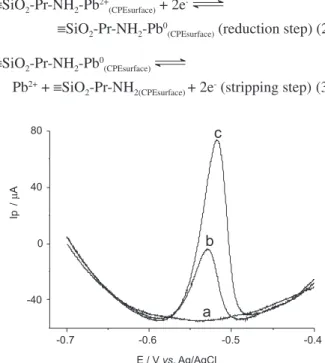
procedure are shown in Figure 2. No electrochemical process is observed on bare carbon paste electrode surface (Figure 2a) even after application of a deposition potential, but when the APSil modiied carbon paste was used, one anodic peak was observed at –0.53 V vs. Ag/AgCl (Figure 2b). The intensity of this peak increased proportionally with the concentration of Pb2+ in the electrochemical cell (Figure 2c). Lead could be
reconcentrated in the APSil carbon paste modiied electrode and the possible mechanism involved may be described by the following reactions:14, 24, 25
≡SiO2-Pr-NH2(CPEsurface) + Pb2+
≡SiO2-Pr-NH2-Pb 2+
(CPEsurface)(complex formation) (1)
≡SiO2-Pr-NH2-Pb2+(CPEsurface) + 2e
≡SiO2-Pr-NH2-Pb0(CPEsurface) (reduction step) (2)
≡SiO2-Pr-NH2-Pb 0
(CPEsurface)
Pb2+ +
≡SiO2-Pr-NH2(CPEsurface) + 2e
- (stripping step) (3)
Effect of carbon paste composition
According to the equation 1 the eficiency of modiied carbon paste electrode towards accumulation of Pb2+
on electrode surface is based on the complex formation between metal ion and APSil. Therefore, quantitative estimation of APSil in the carbon paste was studied. Six different modiied carbon paste compositions (10, 20, 30, 40, 50 and 60% APSil (wt.%)) were tested. The maximum current was obtained when the APSil composition in the paste was 40%. Higher concentration of APSil (≥ 50%) decreased the peak current signiicantly because in this and condensation reactions of TEOS (Figure 1a) and
APSIL formation (Figure 1b). The characteristic Si–O–Si bands at 1200, 1079, 948 e 791 and 465 cm-1 are
related with the condensed silica network and it can be seen at both spectra.14-17 In Figure 1b, a weak band at 695 cm-1
attributed to the N-H stretching mode conirms incorporation of amino group to the silica network.15-17 Another absorption
band at 1530 cm-1, which can be assigned to the symmetric
–NH3+ bending vibration is observed due a part of amino
group to be protonated by residual silanol groups during synthesis of hybrid material.18 A very weak intensity band
at 1408 cm-1 is ascribed to the deformation mode of COO–
produced from reaction between CO2 present in air and aminopropil group on silica matrix.16 Still in Figure 1b, in
the higher frequency region, the presence of aminopropil groups was corroborated by presence of two weak bands at 2821 and 2901cm-1 attributed to the symmetric and
asymmetric stretching vibrations of –CH2 and –CH3 groups, respectively.15,17 There is a weak absorption band around
3290 cm–1 which appears as a small shoulder superimposed
with a broad side band, which can be attributed to the stretching vibration mode of NH2 groups.16,17 The infrared
spectrum of the APSil is consistent with the spectrum of the similar materialreported in the literature.16-23 This
result conirms that the target hybrid nanocomposite was successfully synthesized in this work.
Electrochemical measurements
Typical square wave voltammograms obtained using recommended procedure speciied in section analytical
Figure 1. FTIR spectra of (a) SiO2 and (b) APSil.
Figure 2. Square wave voltammograms obtained in 0.1 mol L-1 HNO 3 aqueous solution at carbon paste electrode: (a) Bare electrode in 7.0 × 10⁻⁷ mol L-1 Pb2+ aqueous solution, (b) modiied with APSil in 7.0 × 10⁻⁷ mol L-1 Pb2+ aqueous solution, (c) modiied with APSil in 1.0 × 10⁻⁶ mol L-1 Pb2+ aqueous solution. After deposition for 600 s at pH 1.8, deposition potential: −0.7 V vs. Ag/AgCl.
Table 1. Heating program with microwave radiation
Step Power (w) time (min) Ventilation
1 2 3
500 1000
0
10 10 15
case an additional amount of modiier, in the carbon paste, increased the resistance of electrode, thus the peak current decreased.
Effect of pH
The inluence of the pH using 0.1 mol L-1 HNO
3 aqueous
solution on the preconcentration of Pb2+ was studied at
the pH range from 1.0 to 5.0. The pH was adjusted with 0.1 mol L-1 NaOH aqueous solution. The results showed
that the anodic peak current is strongly dependent of the pH value, it decreased abruptly with increasing pH up to 4.5 and then remained close to zero in pH range 5. The maximum peak current is generated at pH 1.0. The pH 1.8 was chosen instead pH 1.0 to avoid work at boundary condition.
APSil has properties that accredit it to be an electronic insulating, so the voltammetric detection of the previously accumulated Pb2+ implies a desorption process.24 According
to the study of effect of pH, a strongly acidic medium was selected as better suitable for desorption described by following reaction:
≡SiO2-Pr-NH2-Pb2+ + H+ ≡SiO
2-Pr-NH3
+ + Pb2+ (4)
Stronger acidic medium favors Pb2+ leaching out
from the APSil at the electrode/solution interface and consequently improvement voltammetric detection.
Effect of deposition potential
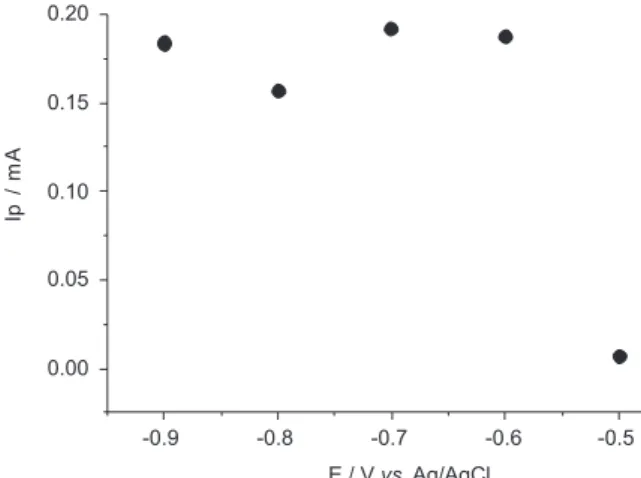
The dependence of the anodic current peak on the deposition potential was studied over the range of –0.9 to −0.5 V vs. Ag/AgCl. As it can be depict from Figure 3 the highest peak current was obtained when the initial potential was set at –0.7 V vs. Ag/AgCl. At this negative overpotential, a fast reduction of Pb2+ takes place.
Therefore, the potential of –0.7 V was chosen as the most suitable for lead determination.
Effect of accumulation time
As for any technique voltammetric employing a preconcentration step, the choice of accumulation time has a signiicant importance on the stripping peak response.26
In Figure 4, the effect of varying deposition time on anodic peak current using the APSil modiied carbon paste electrode is shown for an aqueous solution containing 1.0 × 10⁻⁵ mol L-1 Pb2+. The anodic current peak increased
linearly with increasing deposition time from 60 to 720 s. For higher deposition times, the anodic current decreases, indicating there was attainment of equilibrium between the bound Pb2+ specie on the electrode surface and the
ions in solution. In order not to extend accumulation time, it was decided that 600 s were an adequate period of time for voltammetric measurements of Pb2+. The optimum
conditions for the analysis of Pb2+ are summarized in the
Table 2.
Effect of other ions
The selectivity of the APSil modiied carbon paste electrode towards Pb2+ was studied by testing different
metal ions as potential interferents (in mol L-1) using the
Figure 3. Effect of deposition potential on the anodic peak current. Same conditions as Figure 2.
Figure 4. Effect of accumulation time on the square wave stripping voltammetric peak current. Same conditions as Figure 2.
Table 2. Optimum conditions for the analysis of Pb2+ using APSil modiied carbon paste electrode
Effect Optimum condition
Carbon paste composition 40% (wt.%)
pH 1.8
Deposition potential −0.7 V vs. Ag/AgCl
same procedure optimized for Pb2+ determination. The
experimental results are presented in Table 3. Most of the ions studied had only a little effect on the anodic peak current intensity of Pb2+, such as Ca2+, Fe2+, Cd2+, Co2+, Ni2+,
Na2+ (up to 100-fold excess); Zn2+ (up to 50-fold excess)
and Mg2+ (up to 25-fold excess). Only Cu2+ at a 5-fold
excess interfered drastically the stripping response for Pb2+,
causing a decrease of 44.4% in voltammetric peak current. However, when the recommended procedure was applied to the determination of Pb2+ using equal amount of Cu2+
no interference was observed. Cu2+ interferes signiicantly
by decreasing the Pb2+ signal, because there is a strong
competition between both metals for complex formation with APSil on the carbon paste electrode surface.25
Determination of Pb2+ in pretreated gasoline sample
The concentration of lead in pretreated gasoline sample was determined by the standard addition method. Solutions of known concentrations (over the range of 2.0 × 10⁻⁷ to
1.4 × 10⁻⁶ mol L-1) of Pb2+ were added to the pretreated
gasoline sample. Representative square wave anodic
stripping voltammograms at different concentrations of Pb2+ under optimum conditions are shown in Figure 5.
The anodic peak current increased linearly with increasing concentration up to 1.4 × 10⁻⁶ mol L-1 of Pb2+ (inserted
Figure.) and its linearity was described by the equation: Ip (mA) = 2.6 (± 1.4) + 3.3 (± 0.2) × 107 [Pb2+] (mol L-1)
with linear correlation coeficient equal to 0.990. A limit of detection was found to be 3.8 × 10⁻⁸ mol L-1 (7.9 µg L-1)
as a signal/noise ratio of 3.
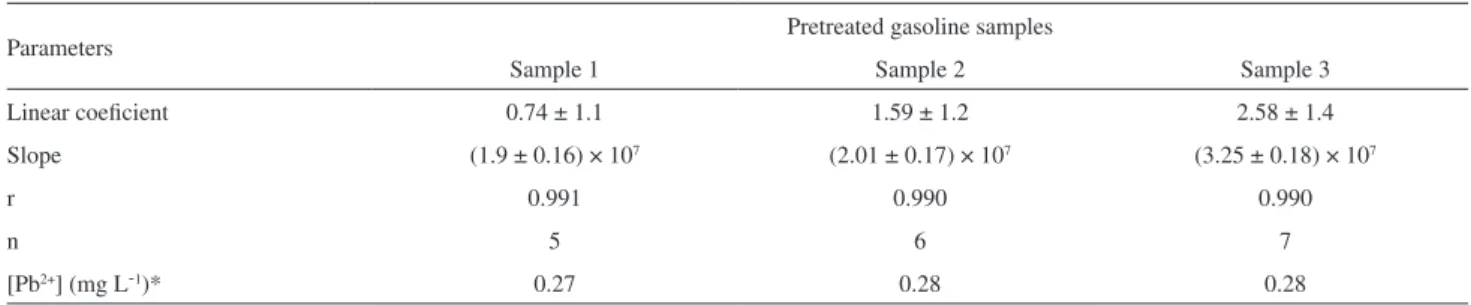
Table 4 presents summary of the results obtained from three determinations of Pb2+ in pretreated gasoline samples.
The precision of results was checked by the reproducibility of voltammetric analysis results and relative standard deviation was 2.1%. These observations shows that the carbon paste electrode modiied with APSil can be used for Pb2+ determination in pretreated gasoline sample.
Conclusion
The experimental results presented in this work showed that carbon paste electrode modiied with hybrid composite
Figure 5. Square wave anodic stripping voltammograms of Pb2+ accumulated on APSil modiied carbon paste electrode (40% (wt.%)) in pretreated gasoline sample, pH 1.8. After addition of 1.0 × 10⁻⁴ mol L-1 Pb2+ standard solution aliquots (mL): 20, 40, 60, 80, 120 and 140. Preconcentration time 600 s. Deposition potential −0.7 V vs. Ag/AgCl. Inserted Figure: Plot Ip vs. [Pb2+].
Table 3. Change in SWASV peak current of 1.0 × 10⁻⁵ mol L-1 Pb2+ in the presence of other ions
Interfering ion Concentration (mol L-1) Change of current (%)
Ca2+ 1.0 ×10⁻³
−1.76
Fe2+ 1.0 × 10⁻³ +2.42
Cd2+ 1.0 × 10⁻³ +8.19
Co2+ 1.0 × 10⁻³ +0.67
Ni2+ 1.0 × 10⁻³ −3.12
Na+ 1.0 × 10⁻³ +1.77
Zn2+ 5.0 × 10⁻⁴ +4.80
Mg2+ 2.5 × 10⁻⁴ −2.87
Cu2+ 5.0 × 10⁻⁵ −44.4
Cu2+ 2.0 × 10⁻⁵ −7.41
Cu2+ 1.0 × 10⁻⁵ +0.01
Table 4. Determination of Pb2+ in pretreated gasoline sample by square wave anodic stripping voltammetry. Digestion of gasoline in closed system
Parameters Pretreated gasoline samples
Sample 1 Sample 2 Sample 3
Linear coeicient 0.74 ± 1.1 1.59 ± 1.2 2.58 ± 1.4
Slope (1.9 ± 0.16) × 107 (2.01 ± 0.17) × 107 (3.25 ± 0.18) × 107
r 0.991 0.990 0.990
n 5 6 7
[Pb2+] (mg L-1)* 0.27 0.28 0.28
APSil (aminopropyl linked to the silica network obtained by the sol-gel method) has speciic properties that enables it to be used such as simplicity of electrode preparation, ability of aminopropyl groups to adsorb Pb2+ from aqueous
solution in acid medium (pH 1.8 using HNO3 solution) and high stability. These conditions revealed satisfactory analytical performance and better suitable for desorption process becoming the electrode as a useful device for Pb2+
determination by square wave stripping voltammetry. Under optimum conditions, the method developed to measure Pb2+
in pretreated gasoline sample is very promising presenting a satisfactory linear response, a wide linear range, good limit of detection (3.8 × 10⁻⁸ mol L-1 (7.9 mg L-1)). The
procedure is not interfered signiicantly by other metal ions and its reproducibility of voltammetric analysis results was excellent with relative standard deviation of 2.1%.
Acknowledgements
The authors are grateful to PETROBRAS (Contract 0050.0018742.06.04) and FINEP (Conv. 01.05.0883.00) for inancial support (EMEPETRO project) and posdoctoral fellowship to William Cardoso.
References
1. Zheng, J.; Tan, M. G.; Shibata, Y.; Tanaka, A.; Li, Y.; Zhang, G. L.; Zhang, Y. M.; Shan, Z.; Atmos. Environ.2004, 38, 1191. 2. Sun, D.; Wan, C.; Li, G.; Wu, K., Microchim. Acta 2007, 158,
255.
3. Takeuchi, R. M.; Santos, A. L. P.; Padilha, M.; Stradiotto, N. R.; Talanta2007, 71, 771.
4. Mielke, H. W.; Wang, G.; Gonzales, C. R.; Le, B.; Quach, V. N.; Mielke, P. W.; Sci. Total Environ.2001, 281, 217. 5. Yilmaz, F.; Yilmaz, Y. Z.; Ergin, M.; Erkol, A. Y.; Muftuoglu,
A. E.; Karakelle, B.; J. Trace Micropr. Technol.2003, 21, 523. 6. Schwikowski, I.; Barbante, C.; Doering, T.; Gaeggeler, H. W.;
Boutron, C.; Schotterer, U.; Tobler, L.; Van De Velde, K. V.; Ferrari, C.; Cozzi, G.; Rosman, K.; Cescon, P.; Environ. Sci. Technol.2004, 38, 957.
7. Fernandez, R.; Galarraga, F.; Environ. Geochem. Health2001,
23, 17.
8. Hong, S. M.; Barbante, C.; Boutron, C.; Gabrielli, P.; Gaspari, V.; Cescon, P.; Thompson, L.; Ferrari, C.; Francou, B.; Maurice-Bourgoin, L.; J. Environ. Monit.2004, 6, 322.
9. Ilacgua, V.; J. Freeman, N. C.; Fagliano, J.; Lioy, P. J.; Atmos. Environ.2003, 37, 2379.
10. Turer, D.; Maynard, J. B.; Sansalone, J. J.; Water, Air, Soil Pollut. 2001, 132, 293.
11. Ghiaci, M.; Rezaei, B.; Kalbasi, R. J.; Talanta2007, 73, 37. 12. Heitzmann, M.; Bucher, C.; Moutet, J. C.; Pereira, E.; Rivas,
B. L.; Royal, G.; Saint-Aman, E.; J. Electroanal. Chem.2007,
610, 147.
13. B a r d , A . J . ; F a u l k n e r, L . R . ; E l e c t ro c h e m i c a l Methods:Fundamentals and Applications, John Wiley & Sons:
New York, 2001.
14. Cardoso, W. S.; Francisco, M. S. P.; Lucho, A. M. S.; Gushikem, Y.; Solid State Ionics2004, 167, 165.
15. Klonkowski, A. M.; Grobelna, B.; Widernik, T.; Jankowska-Frydel, A.; Mozgawa, W.; Langmuir1999, 15, 5814. 16. Sartori, G.; Bigi, F.; Maggi, R.; Sartori, R.; Macquarrie, D. J.;
Lenarda, M.; Storaro, L.; Coluccia, S.; Martra, G.; J. Catal. 2004, 222, 410.
17. Wang, X.; Tseng, Y.- H.; Chan, J. C. C.; Cheng, S.; J. Catal. 2005, 233, 266.
18. Tezuka, T.; Tadanaga, K.; Hayashi, A.; Tatsumisago, M.; J. Am. Chem. Soc.2006, 128, 16470.
19. Zhang, Q. G.; Liu, Q. L.; Lin, J.; Chen, J. H.; Zhu, A. M.;
J. Mater. Chem. 2007, 17, 4889.
20. Jena, K. K; Raju, K. V. S. N.; Ind. Eng. Chem. Res. 2007, 46, 6408.
21. Tezuka, T.; Tadanaga, K.; Hayashi, A.; Tatsumisago, M.; Solid State Ionics2007, 178, 705.
22. Zhang, X.; Wang, J.; Wu, W.; Liu, C.; Qian, S.; J. Sol-Gel Sci. Technol.2007, 43, 305.
23. Kaneko, Y.; Iyi, N.; Matsumoto, T.; Usami, H.; J. Mater. Res. 2005, 8, 2199.
24. Etienne, M.; Bessiere, J.; Walcarius, A.; Sens. Actuators, B 2001, 76, 531.
25. Mousavi, M. F.; Rahmani, A.; Golabi, S. M.; Shamsipur, M.; Sharghi, H.; Talanta2001, 55, 305.
26. Bartlett, P. N.; Denuault, G.; Sousa, M. F. B.; Analyst2000,
125, 1135.
Submitted: August 19, 2009