© FECAP
RBGN
Received on August 22, 2014 Approved on December 03, 2015
1. Maria Rosario Alves Moreira
PhD in Management Science Faculty of Economics Universidade do Porto (Portugal)
2. Soia R.S. Andrade
MSc in International Business Faculty of Economics
Universidade do Porto (Portugal)
3. Paulo S.A. Sousa PhD in Interdisciplinary Mathematics
University of Warwick (United Kingdom) [[email protected]]
Review of Business Management
DOI:10.7819/rbgn.v17i58.2094
International Outsourcing: a process
approach to the apparel industry
Maria Rosario Alves Moreira Soia R.S. Andrade
Paulo S.A. Sousa
Faculty of Economics, Universidade do Porto, Porto, Portugal
Responsible editor: João Maurício Gama Boaventura, Dr. Evaluation process: Double Blind Review
ABStRAct
Objective – he purpose of this paper is to build a framework for an international outsourcing process in the apparel industry that can serve to support managerial decisions and actions regarding outsourcing choices and implementation.
Design/methodology/approach – We developed of a straightforward and lexible framework describing the main stages of the international outsourcing process and its main activities with application in the context of the apparel industry. A case study approach was adopted with primary data collected through in-depth interviews and secondary data aggregated from company reports and documents.
heoretical foundation – Some research gaps in the outsourcing literature and most specifically on the matter of international outsourcing were identiied by Hatonen and Eriksson (2009) and Kakabadse and Kakabadse (2000), among others. Speciically, these authors claim that there is not enough research on developing and ofering decision models, tools or guidelines to support managerial decisions with the appropriate empirical evidence. his study aims to address this gap.
Findings – We found that the international outsourcing process can be described using the proposed framework. Apparel companies can use this framework to support and supervise international outsourcing processes.
Practical implications – his study provides a simple model that can help companies in the apparel industry to enhance their outsourcing activities and operations, and also contributes to a broader academic understanding of the matter.
1 IntRODuctIOn
Outsourcing is increasing among international companies, a business level strategy that is becoming more corporate, since outsourcing decisions have evolved from being an operational matter to a strategic one (Schniederjans & Zuckweiler, 2004; Zhu, Hsu, & Lillie, 2001). he idea of outsourcing an activity represents a fundamental dilemma which many managers have to face (Dabhilkar, 2011; Momme, 2002). Companies have limited resources and cannot always meet the expenses of having all their technologies in-house. his question – whether or not to outsource certain activities – has been an important issue for many decades and in several developed countries. Over the last decades, for instance, various authors have developed a number of strategies and approaches to address outsourcing (e.g. Åkesson, Jonsson, & Edanius-Hällås, 2007; Gibbon, 2001; Mitchell, 2015; Raman, & Ahmad, 2013; Schniederjans & Zuckweiler, 2004).
E m p i r i c a l r e s e a r c h i s p r i m a r i l y concentrated on the USA (e.g., Elmuti & Kathawala, 2000; Kremic, Tukel, & Rom, 2006; Schniederjans & Zuckweiler, 2004; Su, Dyer, & Gargeya, 2009), on some European countries (e.g., Åkesson et al., 2007; Belso-Martinez, 2008; Bolisani & Scarso, 1996; Efstathiades, Rousis, Boustras, & Bratskas, 2009; Gianelle & Tattara, 2007; Graziani, 1998; Mol, Tulder, & Beije, 2005; Nassimbeni, 2006), and on other developed countries (e.g., Abramovsky, Griith, & Sako, 2004; Beaumont & Sohal, 2004; Johanson & Vahlne, 1977; Kyöstilä & Cardwell, 2005; MoosaviRad, Kara, & Ibbotson, 2014; Mitchell, 2015; Raman, & Ahmad, 2013). Nevertheless, there are some studies in developing countries (e.g., Barbosa, & Minciotti, 2007; Oliveira, Boehe, & Borini, 2009) as well as with a global focus (Hoecht & Trott, 2006; Schaaf, 2004). Although these approaches have been helpful in determining outsourcing strategies, they seem too excessively aggregated to prove
helpful to a particular ield of activity, the apparel industry, when taking managerial decisions and actions regarding outsourcing choices and implementation.
Some research gaps in outsourcing literature and, specifically, on the matter of international outsourcing were identified by Hatonen and Eriksson (2009) and Kakabadse and Kakabadse (2000), among others. Speciically, these authors claim that there is not enough research on developing and ofering decision models, tools or guidelines to support managerial decisions with appropriate empirical evidence. his study aims to address this gap by building a framework for an international outsourcing process in the apparel industry. It can help support managerial decisions and actions regarding outsourcing choices and implementation. his paper reports on the development of a framework, describing the main stages of the international outsourcing process and its main activities to address decision-making in apparel companies. A case study approach was adopted with primary data collected through in-depth interviews and secondary data added from company reports and documents. A similar single-case company study was made in New Zealand to analyze how small companies manage institutional diferences to enhance their international outsourcing success (Sharma, Lindsay, & Everton, 2015).
2 the OutSOuRcIng PROceSS In the
lIteRAtuRe
Outsourcing has been an important issue for many decades. Initially studied as a business-level strategy, it evolved to a corporate-business-level one. Outsourcing has increasingly been identiied as a management strategy, given that companies transfer major non-core activities to eicient and specialized providers (Elmuti & Kathawala, 2000) in order to sustain and enhance competitive advantages.
Outsourcing is defined as moving activities that were previously developed in-house to external organizations (Parkhe, 2007). If sourcing is done outside the home country’s borders, two distinct concepts can be identiied: international outsourcing and offshoring. International outsourcing (IS) involves moving activities traditionally developed in-house to external companies in foreign countries (Schniederjans & Zuckweiler, 2004), whereas ofshoring is moving production activities outside the home country’s borders to foreign ailiates (activities are thus kept in-house). According to Lewin, Massini, and Peeters (2008), there is an evolution of ofshoring strategies, from home-base augmenting to home-base replacing innovation capabilities. International outsourcing can also be seen as part of the ofshoring global concept (United Nations Conference on Trade and Development [UNCTAD], 2004). Due to globalization, a new concept has been developed: global outsourcing, which consists of managing integrated outsourcing activities located inside and/or outside the home country’s borders (Elmuti & Kathawala, 2000). In this paper, we focus on international outsourcing activities, since international outsourcing represents a higher risk to buyer companies than other sourcing options, thus requiring more support concerning management decisions (Harland, Knight, Lamming, & Walker, 2005).
Lonsdale’s research (Lonsdale, 1999) revealed that managers were disappointed with the results of their management decision
capacity. This frustration resulted both from weak management decision capacity and the lack of outsourcing methodologies. Indeed, the absence of methodologies, tools and guidelines to support outsourcing decisions is often referred to in literature – since the 1990s, several eforts have been made to provide outsourcing guidelines and frameworks to support the outsourcing process in companies (e.g., Bolumole, Frankel, & Naslund, 2007; Cánez, Platts, & Probert, 2000; Fill & Visser, 2000; Franceschini, Galetto, Pignatelli, & Varetto, 2003; Jennings, 1997; Marshall, Lamming, Fynnes, & Búrca, 2005; McIvor, 2000; Tate & Ellman, 2009; Vining & Globerman, 1999).
2.1 Stages of the outsourcing process
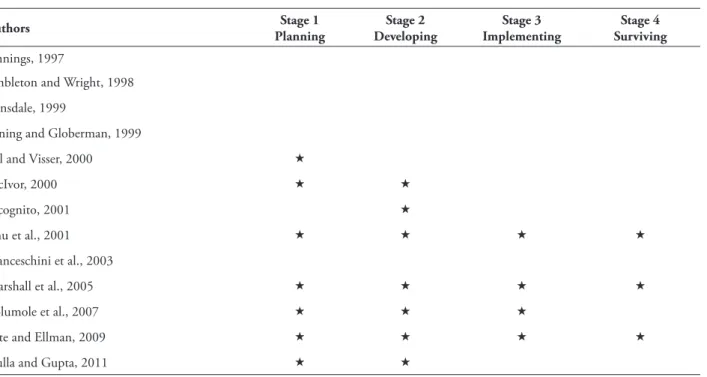
Considering these four stages, only four frameworks seemed appropriate: Embleton and Wright (1998), Marshall et al. (2005), and Tate and Ellman (2009), Zhu et al. (2001),
since they are the only ones which refer to the implementation stage. Table 1 presents an overview of these frameworks according to the main frame we are using.
tABle 1 – Approaches to the outsourcing process
Authors Stage 1
Planning
Stage 2 Developing
Stage 3 Implementing
Stage 4 Surviving Jennings, 1997
Embleton and Wright, 1998
Lonsdale, 1999
Vining and Globerman, 1999
Fill and Visser, 2000
McIvor, 2000
Incognito, 2001
Zhu et al., 2001
Franceschini et al., 2003
Marshall et al., 2005
Bolumole et al., 2007
Tate and Ellman, 2009
Gulla and Gupta, 2011
Stage 1: Planning
When companies consider outsourcing, they need to engage in certain activities in order to make outsourcing decisions. Franceschini et al. (2003) suggest that companies should conduct an internal benchmarking exercise which includes the identiication of core competences and the processes that could be outsourced. Core competences are those that give companies a sustainable competitive advantage (Quinn & Hilmer, 1994). Some authors (eg., Lonsdale, 1999) argue that core activities should remain in-house and “non-core competencies” should be outsourced, in order to enhance focus on core competencies. Others (eg., McIvor, 2000; Quinn & Hilmer, 1994) defend that companies can also consider outsourcing core activities: in this case, we talk of strategic outsourcing. his strategic idea about outsourcing is also defended
by Gião, Oliveira, & Vasconcellos (2008), who showed the strategic efect of services ofshoring on value chains.
After identifying the activities that can be outsourced, companies should engage in an internal cost analysis. Outsourcing is expected to reduce production costs. However, companies should conduct a cost analysis, so as to determine whether the expected cost from outsourcing is lower than the cost associated to performing the activity in-house. he transaction cost theory plays an important role in many of the models mentioned above (Kim & Rucker, 2005) and has its irst roots in Coase (1937).
cost analysis centered on balancing the product complexity, on asset speciicity, and on transactions frequency. In the same line of thought, Fill and Visser (2000) indicate the costs of outsourcing coordination (governance costs) that depend on asset speciicity (the transaction’s degree of customization) and transaction frequency. In extreme cases, if transaction frequency is low and asset specificity is high, the transaction cost theory foresees that activities should be governed by hierarchies (internal sourcing or ofshoring), whereas if the asset speciicity is low and transactions are frequent, these transactions should be handled through markets (outsourcing or international outsourcing).
Other relevant assessments required when taking outsourcing decisions are the business environment and the organizational structure (Park & Lennon, 2006) and capacity (Fill & Visser, 2000; Jennings, 1997). Outsourcing as a strategy may be a way of reacting to changes in the business environment. he more uncertain the market and competition is, the greater the efects on outsourcing decisions (Jiang, Frazier, & Prater, 2006). Looking inside the company, organizational structure and corporate strategy also impact on outsourcing decisions and outsourcing may impact on corporate culture as well. he idea that outsourcing is an issue that goes beyond cost factors is not new: in 1915, Ford and Porter (1915) emphasized the importance of strategic factors for make-or-buy decisions.
Stage 2: Developing
During this stage, companies need to identify supply markets and search for potential providers (e.g. Embleton & Wright, 1998; McIvor, 2000, 2008). According to Gulla and Gupta (2011), Jennings (1997) and Lonsdale (1999), with regard to supply markets, companies should avoid entering monopolistic markets due to the risk of dependency on the supplier. If there are few (or only one) suitable suppliers in that market, their potential power is raised. If the supplier proves disappointing, the costumer
company has two choices: to face high switching costs in contracting a worse supplier (assuming that the irst choice was the best one at the time) or, if there is no other suitable provider, the company may have to re-conduct the activity in-house.
In searching for potential providers, companies should undertake an external benchmarking with two objectives: costs and capability analysis. Regarding costs, companies should clarify if outsourcing selected activities will result in cost savings by comparing internal production costs with the providers’. Regarding capabilities, companies should examine if there are suppliers with the necessary capabilities to perform appropriately (Jennings, 1997; McIvor, 2000). This includes not only infrastructure but also technology and know-how (Jennings, 1997). If providers do not have suicient capacity, companies should consider keeping activities in-house or establishing cooperative alliances in order to transfer technology or know-how.
In this stage, business relationships with potential providers must be developed. his includes deining the type of provider and outsourcing strategy and also negotiation of the supply contract. Incognito (2001) indicates four categories of providers: supplier, preferred supplier, alliance partner and strategic alliance. Negotiating the supply contract must pursue a win-win solution for both costumer and supplier.
Stage 3: Implementing
processes impact a company’s morale, mainly when this implies labor downsizing. To avoid human costs and low morale, Embleton and Wright (1998) argue that companies should provide their employees with information on their outsourcing decisions, processes and impacts on the company.
Zhu et al. (2001) have a project management perspective of the outsourcing process. They argue that the outsourcing transition plan must include all the tasks to be accomplished, even the smallest or most common ones. his includes a communication plan and also an outsourcing transition timeline, scope deinition, both human and physical. Note that the implementation stage is not consensual to the framework authors studied, as they do not mention this stage, as shown in Table 1.
Stage 4: Surviving
his stage is characterized by two main aspects: a post-outsourcing review (Embleton & Wright, 1998; Jennings, 1997; Zhu et al., 2001) and the management of outsourced-outsourcer relationship (Embleton & Wright, 1998; Franceschini et al., 2003; Lonsdale, 1999; Tate & Ellman, 2009). In this stage, a post-outsourcing review should be conducted. First, the cost analysis should be re-done and compared with the results previously obtained during the contract negotiation. If costs reveal to be higher than expected, the company should try to identify the activities/processes which are causing deviations (Franceschini et al., 2003; Zhu et al., 2001). In an extreme case, the company may consider abandoning the outsourcing relationship. Besides costs, the objective of the post-review is to determine if the outsourcing process has run as planned and to target activities or processes that should be changed or improved (Freytag, Clarke, & Evald, 2012). his is also the moment to examine efective impacts of outsourcing on the buyers’ organizational culture and structure.
Also in this stage, the company should monitor and evaluate the outsourcing relationship.
his includes monitoring compliance with the supply contract (Incognito, 2001; Lonsdale, 1999) and evaluating the supplier’s performance (Franceschini et al., 2003). Service levels and other evaluation criteria should have been deined during the contract negotiation. By conducting monitoring and evaluation, the company can prevent supplier opportunism and control the supplier’s bargaining power (Lonsdale, 1999). To monitor and evaluate outsourcing contracts and suppliers, the buyer company should ensure an in-house outsourcing management structure. According to Marshall et al. (2005), previous attempts to develop outsourcing process frameworks (e.g., Zhu et al., 2001) had several gaps: a static perspective of the outsourcing process, which ignored organizational and environmental factors and did not detail activities in each stage. Tate and Ellman (2009) highlighted that there are few theoretical insights to guide managers in the purchase of services. In this study, we intend to overcome the abovementioned gaps, by proposing a dynamic outsourcing process framework and exploring each phase individually, identifying the activities in each stage.
2.2 Outsourcing in the apparel industry:
summarizing the empirical evidence
outsourcing as a functional upgrading in the apparel global value chain: companies in developed countries (lead companies) focus on their most valued activities which are basically design and marketing and moved other functions, mainly production, to suppliers in developing countries. Outsourced activities are usually labor intensive, where developed countries cannot be competitive, while knowledge and technological activities are kept in-house (Gibbon, 2001).
he literature on outsourcing of apparel activities (e.g.Bolisani & Scarso, 1996; Gibbon, 2001; Graziani, 1998; Kam, Chen, & Wilding,
2011; Kumar & Arbi, 2008; Qudrat-Ullah, 2010; Strange, 2006; Tam, Moon, Ng, & Hui, 2006; Teng & Jaramillo, 2005; Yu & Lindsay, 2011) aims to address these questions: why, the motives for outsourcing; where, in which geographical region and/or market; and how, which outsourcing strategies to undertake. Another question mentioned less often but that can be made is what to outsource and refers to which activities should be kept in-house and which should be outsourced. Table 2 presents a summary of the reviewed papers on outsourcing in the apparel industry.
tABle 2 – Outsourcing in the apparel industry: summary
Motives Strategy Methodology
Why Where How Method Country
Divita and Cassill, 2002 ● ●
Case study USA
Teng and Jaramillo, 2005 ●
Kumar and Arbi, 2008 ● ●
Kam et al., 2011 ● ● China
Yu and Lindsay, 2011 ● ●
Multi case study New Zealand
Bolisani and Scarso, 1996 ● ● ● Italy
Graziani, 1998 ● ● International Trade data
analysis
Italy
Gibbon, 2001 ● ● ● UK
Tam et al., 2006 ●
Survey Hong Kong
Åkesson et al., 2007 ● ● Sweden
Qudrat-Ullah, 2010 ● ● Empirical evidence from previous studies (literature review)
USA
Strange, 2009 ● ● Explanatory
---According to Bolisani and Scarso (1996), international outsourcing can be undertaken with four motives: natural resources seekers, market seekers (also mentioned by Qudrat-Ullah, 2010), eiciency seekers, and strategic asset seekers. Other motives for outsourcing are: cost reduction (Strange, 2006), which includes labor costs (Qudrat-Ullah, 2010), lexibility and availability of capacities and production expertise (Gibbon, 2001).
Regarding location strategies, these depend on the nation-speciic resources, such as
Double sourcing (Åkesson et al., 2007) is when a company produces the same product in a long and a short distance supplier, the irst justiied by cost and the second because of a quick response. As for outsourcing strategies, there is no clear-cut consensus. Bolisani and Scarso (1996) define how to outsource taking into consideration supplier selection criteria and forms of investment. hus, irst, the company decides on the supplier depending on the number, size and specialization of the supplier plant, technology and coordination mechanisms. Gibbon (2001) also mentions expected capacities from suppliers as a determinant of the outsourcing strategy. Åkesson et al. (2007) present an alternative approach to outsourcing strategies. here are three supply channels: direct contact with suppliers, indirect (via agents) and own (direct investment or acquisition). he last one is not an outsourcing strategy (but rather ofshoring).
hese articles (see Table 1) can also be assembled into the four-stage main framework of the previous section. Bolisani and Scarso (1996) contribute to Stage 1 (planning) by considering which activity, from the production phase, should be outsourced. Stage 2, developing, gathers contributions from Åkesson et al. (2007), Bolisani and Scarso (1996) and Gibbon (2001), on how to access supply markets and select providers. Finally, Gibbon (2001) and Kumar and Arbi (2008) provide important contributions to the last stage, surviving speciically on managing buyer-supplier relationships.
3 FRAMewORK DevelOPMent AnD
DAtA cOllectIOn MethODS
The aim of this study is to propose a new framework for an international outsourcing process in the apparel industry for decision-making and assessing the international outsourcing process choices and implementation. Such a tool aims to help apparel industry managers to operationalize their outsourcing strategies. he research procedure has been developed in
accordance with the guidelines proposed by Pero, Abdelkai, Sianesi, and Blecker (2010).
In order to build a comprehensive outsourcing framework that captures relevant factors to be taken into account in such decisions, input from theory and practice has been considered. First, a literature survey on outsourcing in general (operational and strategic aspects) and on the apparel industry in particular was carried out (previous section). From this review, key factors to be considered in outsourcing decisions were identiied and grouped into four stages of the decision-making process. At each stage, based on the empirical evidence provided by several studies and previous frameworks proposed by Bolumole et al. (2007), Embleton and Wright (1998), Fill and Visser (2000), Franceschini et al. (2003), Gulla and Gupta (2011), Incognito (2001), Jennings (1997), Lonsdale (1999), Marshall et al. (2005), McIvor (2000), Tate and Ellman (2009), Vining and Globerman (1999) and Zhu et al. (2001), we identiied and characterized the main activities and their sub-activities. hese were captured in a preliminary framework, which was discussed and iteratively modiied ive times as a result of the input received from interviews with academics and an in-company case study (which includes several interviews with senior managers). As suggested by the research procedure presented in Pero et al. (2010), as information was being collected and knowledge on the domain of study became more robust and integrated, the framework was gradually modiied by adding and subtracting information. Input from theory and empirical research proved to be key in building the framework. According to Voss, Tsikriktsis, & Frohlich (2002), theory and empirical research are helpful in identifying overlaps and contradictions between theory and practice. his process is now described in more detail.
management (both from the University of Porto). All the data were collect during 2012 year. Semi-structured interviews were conducted and aimed to address 5 main topics, besides interviewee details: 1) ields related to outsourcing, 2) critical factors for outsourcing, 3) activities to be taken into consideration when outsourcing, 4) main advantages and problems related to outsourcing, and 5) discussion on the preliminary framework. Each interview lasted about 30 minutes and they were recorded by the interviewer. hen, they were individually analyzed in order to include the information obtained in the framework. he principal inputs from the interviews with academics were related to the level of detail that the framework should have, the need for it be easy to understand and to use by managers and the focus they should have in the activity being outsourced. (Which activities? Which phase of the production process? Design? Distribution?) hese considerations were taken into account for the improvement of the framework that would be presented to the managers and then tested in the case-study company chosen from the apparel industry. Some factors were added and some relationships between phases and decision levels established.
As the aim of this study was to create a practical framework for decision-making and assessment of the international outsourcing process in buyer companies of the apparel industry, the interviews with managers were vital. To this end, a large company from the apparel industry was selected and two in-depth interviews with senior managers (director and operational manager) were conducted. he case-study company was chosen from the Portuguese apparel industry which ran outsourcing production processes in foreign suppliers (located outside Portugal). he case-study company was in the last stage of outsourcing (surviving), so it was possible to study the previous stages based on documented data. he company designs on its own label, and has been producing (outsourcing), distributing and selling women’s and menswear (mainly trousers, knitwear, jackets and shirts) for over ten years.
Se m i - s t r u c t u re d i n t e r v i e w s we re conducted to help provide a more comprehensive view of the outsourcing process and they lasted about 60 minutes. he questionnaire questions aimed to address three main topics, besides company details: a) which activities had occurred since the beginning of the outsourcing process; b) the sequential order of activities, and c) what learning took place during the process (what would they have done differently). This was intended to help us to: a) identify activities not included in the model, b) conirm or discard the four-stage sequential logic, and c) analyze the process dynamics, among other indings. he sessions were audiotaped and transcribed. he interview transcriptions were analyzed to extract information on the issues of interest and incorporated into the framework.
he main inputs from the interviews with the managers were related to the boundaries of the four stages and the more detailed speciication of the sub-activities involved in the each phase. he incorporation of additional factors and activities into the framework led to a relection on the way in which they were grouped (in stages). Elements identiied during the interviews were compared with those included in the preliminary framework and added, if they had not been considered, or slightly changed, if they had not been included in the required detail. Another concern we had when analyzing the information, was associated with avoiding overlaps and making sure that the heading of the various stages were representative of the decisions and activities comprised therein. During this process, the need to develop an approach that would be easy to use and understand was always kept in mind.
4 PROPOSeD FRAMewORK
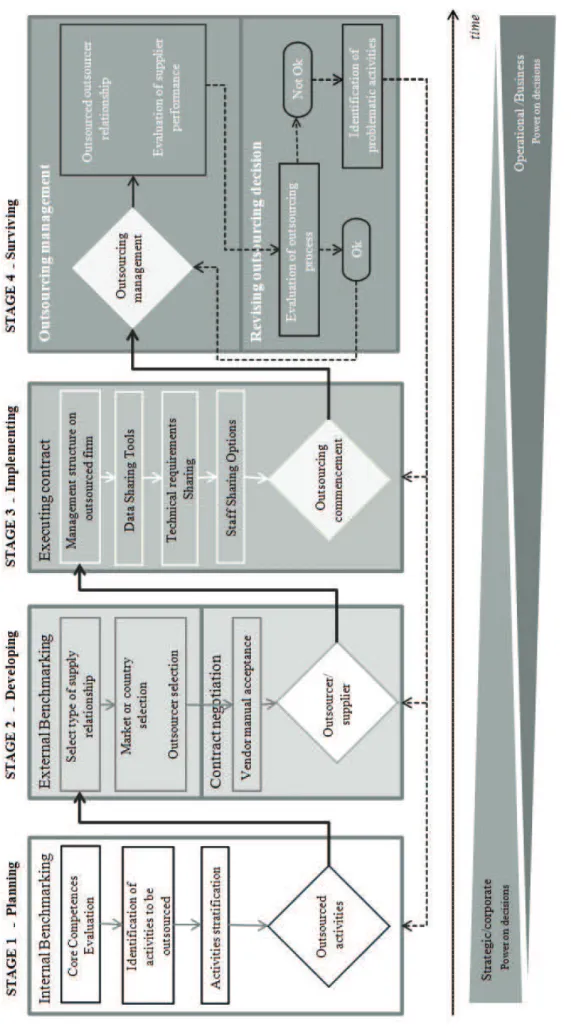
with academics and managers) enabled the construction of an outsourcing framework for the apparel industry (Figure 1). In contrast with the existing approaches that are too excessively aggregated to prove helpful in this particular ield of activity, the framework provides a tool to assist apparel industry managers in taking managerial decisions and actions regarding outsourcing and its implementation.
Considering the proposed framework, we present the activities in each stage. Although most of the activities were referred to in literature review, we will recall them and translate them to the context of the apparel industry.
Stage 1: Planning
he company is considering engagement in an international outsourcing process. An internal benchmarking analysis is conducted to ind out which activity(ies) might be outsourced.
Core Competences Evaluation. Consists of evaluating the company’s core competences that foster its competitive advantages. he most common core competences are design, branding and marketing. he most common competitive advantages of companies in the apparel industry are product differentiation and innovation, superior quality, high service, quick response and quality/price ratio (Bolisani & Scarso, 1996; Gerei & Frederick, 2010).
Identification of the activities to be outsourced. After determining the company’s core competences, there is now the need to identify which activities are core and which are not. In the apparel industry, it is common to outsource operational activities, namely the manufacturing process. It is possible to outsource the entire process or only some activities. Apparel manufacture includes: design, grade-mark, fabric cut or knitting, assembly, press-iron and inspection packaging. Given that knitting is a capital-intensive activity while assembly and press-iron are labor-intensive (Gerei & Frederick, 2010), this impacts on the next stage regarding the selection of the market or country and supplier, since an assembly company will prefer low-wage countries and a knitting company will look for a supplier with the required technology.
Stratiication of activities. If more than one activity is selected to outsource, the company must prioritize them. Usually the primary activity to outsource is assembly (known as cut-make-trim), because it is labor-intensive. Design is the activity that is usually kept in-house due to its importance to the company’s competitive advantage (Gerei & Frederick, 2010).
FIguRe
1
–
P
roposed frame
wor
k for appar
el industr
Stage 2: Developing
At this point, the company should conduct an external benchmarking analysis in order to select potential suppliers. After that, the company should select the suitable supplier and negotiate the contract terms.
Select the type of supplier relationship. he company should decide which type of supply relationship it wants to establish. According to the supplier’s functional capabilities, there are three main types of suppliers in the apparel industry. Marginal suppliers are those that only cut, make and trim (CMT or assembly): they are paid a processing fee, but not a price per garment, since all fabrics and trims are sourced and owned by the buyer. Preferred suppliers produce according to buyer speciications and design and are capable of sourcing and inancing the fabric and trims needed for production, as well as providing production services, such as inishing and packaging (also called Original Equipment Manufacturing – OEM – or Free on Board – FOB). Finally, the strategic supplier is the full package supplier or Original Design Manufacturing (ODM). his supplier carries all the production steps, and may sometimes also include design and product distribution (Gerei & Frederick, 2010).
Outsourcer selection. Outsourcer selection may be preceded by market or country selection to outsource. Outsourcing near-home or in distant countries afects the orders’ lead time (if quick response is one of the company’s competitive advantages, it might be better to outsource internationally but in near-to-home countries). Other relevant factors in selecting the outsourcing country include trade tarifs, taxes and transportation facilities (which also afect delivery time); cultural factors may be important too (Gibbon, 2001; Graziani, 1998).
According to Embleton and Wright (1998), selecting a supplier implies determining the supplier’s proile, that is, the desired characteristics of the supplier. This profile may result from previous benchmarking among suppliers in some
particular market or product line. After that, the company should request information from the potential suppliers regarding their interest in the relationship, its capabilities, corporate culture and strategy. Once the suppliers’ responses have been analyzed, the company should request a proposal so as to target suitable suppliers, in which the outsourced company provides general information about its organization and its outsourcing strategy, including outsourcing objectives and detailed outsourcing requirements (this may or may not be part of the contract). he outsourced company should also conduct site visits to conirm if the referred characteristics exist in reality, and check the outsourcer’s capabilities, technologies and processes.
Contract negotiation. Contracts cover mandatory legal topics and speciic commercial terms. Graham (1993) mentions some of the legal and speciic terms of outsourcing contracts, including: description of the outsourcing scope, detailed service characteristics and requirements, how the contract can be changed either by the outsourced company or by the supplier, the responsibilities of each party and mechanisms to solve minor problems, the parties’ rights to terminate the contract, establishment of supplier performance measures and the corresponding method to monitor and evaluate them, and also the rebates in case the supplier does not meet the deined goals. At the end of this stage, the company must have found and contracted at least one supplier for each outsourced activity.
Stage 3: Implementing
In this stage, the outsourced company must transfer all the information and materials needed by the outsourcer in order to comply with the contract.
temporarily transfer its own personnel or provide training sessions. In some cases, human resources may be transferred permanently to the outsourcer. Technical requirements. he outsourced company must ensure that the supplier has the technical requirements to execute the outsourcing contract (Zhu et al., 2001). This includes transferring all technical speciications and access to information on the outsourced company. his may imply access to information systems.
At the end of this stage, the outsourcer must be able to fulfill the contract and the outsourcing relationship is commenced.
Stage 4: Surviving
his last stage is compound by a surviving stage which includes management of the outsourcing relationship and a post-outsourcing analysis.
Management structure of the outsourced company. Regardless of whether the company starts outsourcing one or several activities, it needs to establish a management team, more speciically, an outsourcing management team, which is responsible for overseeing the entire outsourcing process (Giunipero & Monczka, 1997).
Outsourcer-outsourced relationship. The outsourcing management team is responsible for balancing this relationship. It is important for the outsourcer company to be aware of the desirable length and lexibility of the relationship: not too short or inlexible so as to be able to take full advantage of the partnership, and not too long or broad, such that it may boost the supplier’s bargaining power. Authors such as Gibbon (2001) and Kumar and Arbi (2008) mention partnerships and long-term relationships as important factors for successful outsourcing in the apparel industry. They stress that the outsourcer-outsourced relationship should be based on transparency, trust and commitment.
Evaluation of the supplier’s performance. he outsourcing management team is responsible for monitoring and evaluating the supplier’s performance, as established in the contract.
The most common performance items in apparel are delivery, quality, costs and reliability (Gibbon, 2001; Teng & Jaramillo, 2005). Teng and Jaramillo (2005) provide a detailed list of performance items which includes lexibility. he evaluation of the supplier’s performance should be conducted with care, since there are studies that show that outsourcing leads to lower product quality (Lu, Ng, & Tao, 2012).
Evaluation of the outsourcing process. At this point, it is necessary to compare outsourcing outputs with the initial expectations and predicted beneits, so as to determine whether the outsourcing process has actually improved the company’s performance (e.g., by increasing gross margins) and has contributed to the company’s competitive advantages. If the evaluation of the outsourcing process is positive, the company may proceed with the outsourcing management. If not, the company must identify each problem and return to the earliest stage in which problems must be solved, for example by selecting a new supplier, by revising the existing contract, etc..
4.1 An illustration of the framework using a
case study
his section shows how this framework and its content seem to match the considerations of the outsourcing decisions (in each stage) at an in-company case study. he case is described using the framework.
Regarding the planning stage, the company’s core activities are not outsourced; they are kept in-house to protect the company’s competitive advantages, as previewed in the literature. A cost analysis was conducted to select the outsourcing activities but it did not seem to be as accurate as recommended by Jennings (1997). They were also aware of the impact of product speciicity and complexity on the outsourcing decision, which is in accordance with coordination cost theory of Fill and Visser (2000).
‘semi-inished’ products supply type. his is similar to FOB regarding supplier responsibilities with the exception that the last stage of production is performed internally by the buyer (because it is a core activity) – the buyer company pays for the semi-inished product at a unit price. Most of the company’s suppliers are preferred suppliers, in line with Gereffi and Frederick (2010)’s recommendations.
he factors for selecting a certain market or country are in accordance with Graziani (1998) and Gibbon (2001), although they consider that proximity to the source of raw materials and components is a supplier responsibility, and they also assume that benchmarking is applied with other companies in the industry. For the supplier selection, the company’s process is quite similar to the process described by Embleton and Wright (1998), including procurement, request for information, site visits and request for proposals, which, in this case, is a request for quotation probably followed by the irst and experimental production order. he criteria referred to when selecting the supplier is cost, quality, production lead time and production capabilities, as some authors have mentioned (e.g. Jennings, 1997), but also minimum quantity order requested and also other clients of the supplier. he interviewees also mentioned that they sometimes have double sourcing situations, as argued by Åkesson et al. (2007), in order to respond to market minimizing lead time constrains (in one supplier, they beneit from a short lead time and in the other, they beneit from a lower unit cost). Still in the developing stage, the contract negotiation was a commonly mentioned step among our framework authors, although there is a lack of detailed information on this matter within the apparel industry in particular. his case study allowed us to better understand the apparel outsourcing contracts. First, a supply contract does not exist with the suppliers. When starting a relationship with the supplier, they must agree to and sign a vendor manual, the primary document governing the relationship between outsourcer and outsourced. his vendor manual includes
topics such as: description of the ordering process, buyer and vendor responsibilities, propriety rights, confidentiality, quality requirements, definition of the supplier’s key performance items, establishment of order quantities tolerance, establishment of delay or anticipation tolerance, rebates in case on nonfulillment, incoterms rules, payment conditions, logistical speciications and ethical, social and environmental requirements. he secondary document guiding the relation is the production order document. his document contains the identiication of the product(s) to be produced, quantity, unit price, delivery date, incoterms and payment conditions. his type of contract is fairly one-sided. Although it can and should be negotiated, the buyer company’s self-interest tends to prevail, and a win-win solution is not pursued as defended by Incognito (2001).
The case study was also very helpful in reaching the implementation stage. The discordance stage among the outsourcing authors reviewed revealed to be important in the execution of the outsourcing contract. In order to execute the contract, the company establishes an outsourcing management team, gathering people with technical product and production know-how. In the proposed framework (Figure 1), the management team is constituted in the last stage, but as shown in the case study, the creation of an outsourcing management team should ideally be accomplished in the implementing stage, in order to help in the execution of the contract. he company then implemented tools for sharing data with the suppliers on an internet website and for each product they order, they need to send the supplier documents with technical information, such as: technical drawing, raw materials, color, assembly and sewing instructions and artworks. hey can also send a prototype sample to exemplify. Furthermore, depending on the know-how and experience of the supplier, they may send technical support and/or quality control personnel for short- to medium-term periods to help the supplier at the start of production.
management will be composed of the outsourced-outsourcer relationship and the supplier’s performance evaluation. The outsourcing management team is responsible for the follow-up of the outsourcer-outsourced relationship. his includes following-up on the production order by checking and making comments on validation samples sent by the supplier, monitoring production quality either internally (through the samples received) or locally on the supplier’s manufacture, carrying out periodic visits to the supplier and monitoring delivery dates and other relevant data and, finally, assisting the supplier in their doubts, problems and diiculties. his implies a certain degree of commitment and partnership, as mentioned by Gibbon (2001) and Kumar and Arbi (2008). he outsourcing management team is also responsible for monitoring the supplier’s performance. he key performance indicators are largely the same as those mentioned by Teng and Jaramillo (2005), even the most subjective indicators such as lexibility, easy communication and capacity for improvement. Except for the subjective ones, the indicators are deined in the vendor manual. his evaluation results in a ranked list of the suppliers where the preferred suppliers are identiied. Improvement plans are also proposed and support is provided to suppliers that have had a bad performance, but with which the company wants to maintain the relationship for other reasons (this is also indicative of the partnership and commitment referred to above). In some cases, as a result of continued bad performances, the company may end the relationship.
he case-study company upholds that the outsourcing process is evaluated continuously, and conducts a formal evaluation at least once a year. his is in accordance with Jennings (1997) and Embleton and Wright (1998)’s proposal for the post-outsourcing review. he case-study company believes that by evaluating the outsourcing team’s members, they can extend the results of their evaluation to the outsourcing process itself. he outsourcing team’s members are evaluated by same indicators as the suppliers, namely
cost target, quality standards achievement and accomplishment of expected lead times. With this, they try to identify potentially problematic activities. They examine the process so as to identify the causes for ineiciency and then seek to implement corrective actions. he following corrective actions have already been used at least once: changing the supplier (selecting a new one); revising or changing the contract terms; changing the supply market or country.
As a whole, the proposed framework (the four stages proposed for deciding on the outsourcing and controlling it, as well as the 12 activities included) is a novelty. Actually, as we explored in the literature review, only four frameworks included the same phases (Embleton and Wright, 1998; Marshall et al., 2005; Tate and Ellman, 2009; Zhu et al., 2001) but they didn’t detail the several activities and relationships in each stage in a so deep way, and particularly to the apparel sector.
5 DIScuSSIOn AnD cOncluSIOnS
The case study revealed that after the contract with the supplier has been concluded, there is a period of time when outsourced and outsourcer company must execute the contract. For the buyer company, this means the creation of a management structure (if it does not already exist) to manage the outsourcing contract (as mentioned by Embleton & Wright, 1998), it implies the development of data sharing tools (e.g., email, internet website, etc.), requires the transfer of technical speciications and, sometimes, personnel sharing options (such as technical personnel support from the buyer company). his coniguration of the implementation stage is in line with Marshall et al. (2005), although these authors labeled it the management stage. In this study, we have opted to maintain the implementation stage since is a transitory stage to the management stage or assessment stage, as the said authors named it.
outsourcer selection process into market or country selection and the outsourcer selection itself. Even though the market or country selection is not always made prior to the outsourcer selection, this is a particular sub-activity that must be discussed during any international outsourcing process. We also renamed a sub-activity regarding the contract negotiation: as seen in our case study, the contract in the apparel industry can take the form of a vendor manual agreement followed by production orders.
In the previous sections, we have presented an international outsourcing framework for the apparel industry that was tested and reviewed as per the case study results. We concluded that the proposed framework clearly illustrates the international outsourcing process in the apparel industry and it also captures the outsourcing framework literature review made at the beginning of the paper. We have detailed and explained the activities and sub-activities at each stage, enriching the framework and also adding some dynamic to the process.
Since it is a single case study research, we must take into account that the conclusions drawn from the case study results may not be very representative of the apparel industry. he single case study itself makes it diicult to generalize the results. Such limitation can be seen as a boost for the development of future research in the clothing industry, and especially in other sectors. In fact, when analyzing the diferences and similarities in each sector, there is an increased possibility of generalizing the results and further validation of the outsourcing process framework presented here.
In order to confirm the framework’s reliability, it should be applied to apparel industry companies in other countries, and perhaps not only the production activity should be studied, but also other activities within the apparel value chain.
ReFeRenceS
Abramovsky, L., Griffith, R., & Sako, M. (2004). Offshoring of business services and
its impact on the UK economy [IFS Brieing Note BN51]. Advanced Institute Management (AIM) Research. Retrieved from http://ssrn.com/ abstract=1463419
Åkesson, J., Jonsson, P., & Edanius-Hällås, R. (2007). An assessment of sourcing strategies in the Swedish apparel industry. International Journal of Physical Distribution and Logistics Management, 37(9), 740-762.
Barbosa, T., & Minciotti, S. (2007) Serviço de atendimento ao cliente terceirizado ou próprio? Uma análise da satisfação do cliente usuário. Revista Brasileira de Gestão de Negócios, 9(25), 81-95.
Beaumont, N., & Sohal, A. (2004). Outsourcing in Australia. International Journal of Operations & Production Management, 24(7), 688-700.
Belso-Martinez, J. (2008). Diferences in survival strategies among footwear industrial districts: he role of international outsourcing. European Planning Studies, 16(9), 1229-1248.
Bolisani, E., & Scarso, E. (1996). International manufacturing strategies: Experiences from the clothing industry. International Journal of Operations & Production Management, 16(11), 71-84.
Bolumole, Y., Frankel, R., & Naslund D. (2007). Developing a theoretical framework for logistics outsourcing. Transportation Journal, 46(2), 35-54.
Cánez, L., Platts, K., & Probert, D. (2000). Developing a framework for make-or-buy decisions. International Journal Operations & Production Management, 20(11), 1313-1330.
Coase, R. (1937). The nature of the firm. Economica New Series, 4(16), 386-405.
Dabhilkar, M. (2011). Trade-ofs in make-buy decisions. Journal of Purchasing and Supply Management, 17(3), 158-166.
Exploring suppliers’ perspectives. Clothing and Textiles Research Journal, 20(3), 156-166.
Efstathiades, A., Rousis, C., Boustras, G., & Bratskas, R. (2009). Modeling the outsourcing process in small and medium size enterprises. International Journal of Economics and Business Research, 1(1), 76–99.
Elmuti, D., & Kathawala,Y. (2000). he efects of global outsourcing strategies on participants’ attitudes and organizational effectiveness. International Journal of Manpower, 21(2), 112-128.
Embleton, P., & Wright, P. (1998). A practical guide to successful outsourcing. Empowerment in Organization, 6(3), 94-106.
Fill, C., & Visser, E. (2000). he outsourcing dilemma: A composite approach to the make or buy decision. Management Decision, 38(1), 43-50.
Ford, W., & Porter, H. (1915). Deciding whether to make or buy. In Library of factory management and suppliers (Vol. 3, Chap. 5, pp. 45-52). Chicago: A. W. Shaw.
Franceschini, F., Galetto, M., Pignatelli, A., & Varetto, M. (2003). Outsourcing: Guidelines for a structured approach. Benchmarking: An International Journal, 10(3), 246-260.
Freytag, P., Clarke, A., & Evald, M. (2012). Reconsidering outsourcing solutions. European Management Journal, 30(2), 99-110.
Gerei, G., & Frederick, S. (2010). he global apparel value chain, trade and the crisis: Challenges and opportunities for developing countries [Policy Research WP 5281]. he World Bank Development Research Group Trade and Integration Team, Washington, DC.
Gianelle, C., & Tattara, G. (2007). Producing abroad while making proits at home: Veneto footwear and clothing industry [Working Paper 35]. Department of Economics, University of Venice “Ca’ Foscari”, Venezia, Italy.
Gião, P., Oliveira, M. M., Jr., & Vasconcellos, E. (2008). Services ofshoring and its strategic efects on value chains. BAR-Brazilian Administration Review, 5(3), 193-209.
Gibbon, P. (2001). At the cutting edge: UK clothing retailers’ and global sourcing [CDR Working Paper 01.4]. Centre for Development Research, Copenhagen, Denmark.
Giunipero, L., & Monczka, R. (1997). Organizational approaches to managing international sourcing. International Journal of Physical Distribution & Logistics Mng, 27(5/6), 321-336.
Graham, R. (1993). Outsourcing and keeping control: he key legal issues. Property Management, 11(2), 141-145.
Graziani, G. (1998). Globalization of production in the textile and clothing industries: the case of Italian foreign direct investment and outward processing in Eastern Europe [Working Paper 128]. Berkeley Roundtable on the International Economy, Berkeley, CA.
Gulla, U., & Gupta, M. (2011). Deciding the level of information systems outsourcing: Proposing a framework and validation with three Indian banks. Journal of Enterprise Information Management, 25(1), 28-59.
Harland, C., Knight, L., Lamming, R., & Walker, H. (2005). Outsourcing: assessing the risks and beneits for organizations, sectors and nations. International Journal of Operations & Production Management, 25(9), 831-850.
Hatonen, J., & Eriksson, T. (2009). 30+ years of research and practice of outsourcing - Exploring the past and anticipating the future. Journal of International Management, 15(2), 142-155.
Hoecht, A., & Trott, P. (2006). Outsourcing, information leakage and the risk of losing technology-based competencies. European Business Review, 18(5), 395-412.
Holcomb, T., & Hitt, M. (2007) Toward a model of strategic outsourcing. Journal of Operations Management, 25(2), 464-481.
Incognito, J. (2001). Outsourcing: Ensuring survival with strategic global partners. Journal of Facilities Management, 1(1), 7-15.
Jennings, D. (1997). Strategic guidelines for outsourcing decisions. Strategic Changes, 6(2), 85-96.
Jiang, B., Frazier, G., & Prater, E. (2006). Outsourcing efects on companies’ operational performance: An empirical study. International Journal of Operations & Production Management, 26(12), 1280-1300.
Johanson, J., & Vahlne, J. E. (1977). The internationalization process of the company-a model of knowledge development and increasing foreign market commitments. Journal of International Business Studies, 8(1), 23-32.
Kakabadse, N., & Kakabadse, A. (2000). Critical review – outsourcing: A paradigm shift. Journal of Management Development, 19(8), 670-728.
Kam, B., Chen, L., & Wilding, R. (2011). Managing production outsourcing risks in China’s apparel industry: A case study of two apparel retailers. Supply Chain Management: An International Journal, 16(6), 428-445.
Kim, Y., & Rucker, M. (2005). Production sourcing strategies in the US apparel industry: A modiied transaction cost approach. Clothing and Textiles Research Journal, 23(1), 1-12.
Kremic, T.; Tukel, O., & Rom, W. (2006). Outsourcing decision support: A survey of benefits, risks, and decision factors. Supply Chain Management: An Internat. Journal, 11(6), 467-482.
Kumar, S., & Arbi, A. (2008). Outsourcing strategies for apparel manufacture: A case study. Journal of Manufacturing Technology Management, 19(1), 73-91.
Kyöstilä, V. & Cardwell, W. (2005). he impacts of ofshoring on value creation in Finnish venture-backed software companies (Sitra an Eqvitec Partners Research Project/2005), Espoo, Finnish, Helsinky University of Technology.
Lewin, A., Massini S., & Peeters C. (2008). Why are companies ofshoring innovation? he emerging global race for talent [CEB working paper 009]. Université libre de Bruxelles, Brussels.
Lin, S., & Ma, A. (2012). Outsourcing and productivity: Evidence from Korean data. Journal of Asian Economics, 23(1), 39-49.
Lonsdale, C. (1999). Efectively managing vertical supply relationship: A risk management model for outsourcing. Supply Chain Management: An International Journal, 4(4), 176-183.
Lu, Y., Ng, T., & Tao, Z. (2012). Outsourcing, product quality, and contract enforcement. Journal of Economics and Management Strategy, 21(1), 1-30.
Marshall, D., Lamming, R., Fynnes, B., & Búrca, S. (2005). he developing of an outsourcing process model. International Journal of Logistics: Research and Applications, 8(4), 347-359.
McIvor, R. (2000). A practical framework for understanding the outsourcing process. Supply Chain Management: An International Journal, 5(1), 22-36.
McIvor, R. (2008). What is the right outsourcing strategy for your process?. European Management Journal, 26(1), 24-34.
Mol, M., Tulder R. van, & Beije, P. (2005). Antecedents and performance consequences of international outsourcing. International Business Review, 14(5), 599-617
Momme, J. (2002). Framework for outsourcing manufacturing: Strategic and operational implications. Computers in Industry, 49(1), 59-75.
MoosaviRad, S. H., Kara, S., & Ibbotson, S. (2014). Impact of international outsourcing on the value adding of industries. he International Journal of Logistics Management, 25(3), 463-486.
Nassimbeni, G. (2006). International sourcing: Empirical evidence from a sample of Italians companies. International Journal of Production Economics, 103(2), 694-706.
Oliveira, M., Jr., Boehe, D., & Borini, F. (2009). Estratégia e inovação em corporações multinacionais: A transformação das subsidiárias brasileiras. São Paulo: Saraiva.
Park, H., & Lennon, S. (2006). he organizational factors inluencing socially responsible apparel buying/sourcing. Clothing and Textiles Research Journal, 24(3), 229-247.
Parkhe, A. (2007). International outsourcing of services: Introduction to the special issue. Journal of International Management, 13(1), 3-6.
Pero, M., Abdelkai, N., Sianesi, A., & Blecker, T. (2010). A framework for the alignment of new product development and supply chains. Supply Chain Management: An International Journal, 15(2), 115-128.
Probert, D. (1996). he practical development of a make-or-buy strategy: the issue of process positioning. Integrated Manufacturing Systems, 7(2), 44-51.
Qudrat-Ullah, H. (2010). Outsourcing logistics for proitability: he case of apparel and clothing industry. Proceedings of the European and Mediterranean Conference on Information Systems, Abu Dhabi, United Arab Emirates.
Quinn, J., & Hilmer, F. (1994). Strategic outsourcing. Sloan Management Review, 35(4), 43-55.
Raman, R., & Ahmad, A. (2013). Do outsourcing and non-outsourcing New Zealand SMEs perform and perceive international outsourcing diferently? International Journal of Globalisation and Small Business, 5(4), 273-289.
Schaaf, J. (2004). Ofshoring: Globalisation wave reaches services sector. Deutsche Bank Research. E-conomics, (45), 2-15. Retrieved from http:// www.dbresearch.com/
Schniederjans, M., & Zuckweiler, K. (2004). A quantitative approach to the outsourcing-insourcing decision in an international context. Management Decision, 42(8), 974-986.
Sharma, R. R., Lindsay, V., & Everton, N. (2015). Managing institutional differences for international outsourcing success: The case of a small New Zealand manufacturing company. Journal of Small Business and Enterprise Development, 22(3), 590-607.
Strange, R. (2006). Branding and the externalization of production. International Marketing Review, 23(6), 578-584.
Su, J., Dyer, C., & Gargeya, V. (2009). Strategic sourcing and supplier selection in the US textile-apparel-retail supply network. Clothing and Textiles Research Journal, 27(2), 83-97.
Tam, F., Moon, K., Ng, S., & Hui, C. (2006). Production sourcing strategies and buyer-supplier relationships: A study of the diferences between small and large enterprises in the HK clothing industry. Journal of Fashion Marketing and Management, 11(2), 297-306.
Tate, W., & Ellram, L. (2009) Ofshore outsourcing: A managerial framework. Journal of Business & Industrial Marketing, 24(3/4), 256-268.
decision process. Long Range Planning, 34(5), 605-622.
Teng, G., & Jaramillo, H. (2005). A model for evaluation and selection of suppliers in global textile and apparel supply chains. International Journal of Physical Distribution and Logistics Management, 35(7), 503-523.
United Nations Conference on Trade and Development. (2004). he shift towards services (World Investment Report/2004), New York and Geneva, United Nations.
Vining, A., & Globerman, S. (1999). A conceptual framework for understanding the outsourcing decision. European Management Journal, 17(6), 645-654.
Voss, C., Tsikriktsis, N., & Frohlich, M. (2002). Case research in operations management.
International Journal of Operations & Production Management, 22(2), 195-219.
Williamson, O. (1979). Transaction cost economics: The governance of contractual relations. Journal of Law and Economics, 22(2), 233-261.
Yu, Y., & Lindsay, V. (2011). Operational efects and companies’ responses: Perspectives of New Zealand apparel companies on international outsourcing. he International Journal of Logistics Management, 22(3), 306-323.