Resumo
o artigo analisa a série visual composta por 65 fotografias das fazendas de café do Vale do Paraíba produzidas por Marc Ferrez entre 1882 e 1885. Por meio do estudo de seus circuitos sociais percebe--se que o discurso visual composto por elas valorizava os complexos cafeeiros como espaços modernos de produção e silenciava as marcas da escravização dos indivíduos registrados. Mediante esco-lhas técnicas, culturais e sociais, cons-truiu-se no espaço de figuração da foto uma “escravidão apaziguada”, protegida dos conflitos sociais, das ideias abolicio-nistas e das resistências escravas. Dessa forma, as imagens de Marc Ferrez cum-priram fortemente a função política de formar e conformar uma dada memória sobre a escravidão que, ao pacificar aquele mundo extremamente violento, interessava diretamente à classe senho-rial do Império.
Palavras-chave: escravidão; fotografia; Vale do Paraíba.
Abstract
The article analyses the visual series consisting of 65 photographs of coffee plantations in the Paraíba Valley taken by Marc Ferrez between 1882 and 1885. By studying his social circuits, it can be seen that the visual discourse composed by these photos valorized coffee com-plexes as modern spaces of production and remains silent about the marks of slavery on the individuals registered. As a result of technical, cultural, and social choices, a ‘pacified slave’ is constructed in the figuration space of the photo, protected from social conflicts, aboli-tionist ideas, and slave resistance. In this way, Marc Ferrez’s images strongly ful-fill the political function of forming and shaping a given memory about slavery, which by pacifying that extremely vio-lent world, directly interested the ruling class of the empire.
Keywords: slavery; photography; Paraí-ba Valley.
* Departamento de História e Programa de Pós-Graduação em História, Universidade Federal do estado do Rio de Janeiro (UniRio). Rio de Janeiro, RJ, Brasil. [email protected]
Revista Brasileira de História. São Paulo, Jan-Apr. 2017. Available at: http://www.scielo.br/rbh
the photography of Marc Ferrez (1882-1885)
1Violência apaziguada: escravidão e cultivo do café nas fotografias de Marc Ferrez (1882-1885)
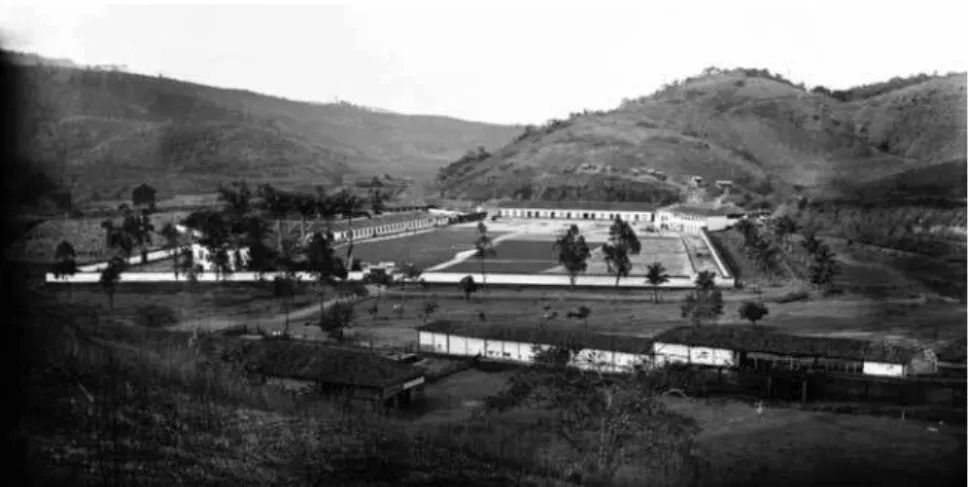
Figure 1 (theme 1) – Cachoeira Grande Plantation, Rio das Flores. Marc Ferrez, 1880s. Gilberto Ferrez Collection, IMS.
Aurea (1888) laws, the imperial government definitely broke with those who guaranteed its political support, though without having won a new social base.
The photograph which opens the article was taken by the French-Brazilian Marc Ferrez (1843-1923) between 1882 and 1885, in other words during the slavery crisis. It is part of an extensive visual series which portrays the produc-tion of coffee in the Paraíba Valley. Including duplicates, the set has 65 glass negatives belonging to the Gilberto Ferrez Collection, safeguarded in the Moreira Salles Institute (IMS). of these originals, it is known that at least ten were printed by Marc Ferrez & Cia. in a special edition containing authorship, stamped with the studio address, signature, and titles in French. Currently six of these examples are part of the Thereza Christina Maria collection in the National library, and four belong to the Wiener Collection, of the library of the French Ministry of Foreign Affairs (lago, 2001). Moreover, other images from the series became post-cards and circulated from the first decade of the twentieth century onwards (Muaze, 2014). Therefore, the large quantity of photographs produced, as well as the diversity of support, archives and collec-tions where they are found, demonstrates the widespread distribution, circula-tion, agency, and consumption which they had in different public and private spaces, both in Brazil and abroad.
Having said this, it should be asked: why produce such an extensive pho-tographic set of slaveholding plantations in the 1880s, when this world was starting to decline? What did these images intend to communicate about rural slavery at the end of the empire? To which public and social spaces where they addressed? What do they say about the society which produced them? To answer these questions within the limit of this article, I propose a reflection which describes the visual set in relation to its production, circulation, con-sumption, and action. For this investigative prism, the image stops being a mere repository of the message in itself, to become the support for the social relations established. Photography thus educates the ‘look’ and institutes its own time, not only as a (random and/or faithful) registration referring to the moment when the photo was taken, but also as a representation which operates with the constitutive elements of the visual culture in question (Mauad, 2004; Meneses, n.d.).
Marc Ferrez and the social circuit
of photography in the nineteenth century
The invention of photography in France at the end of the 1830s, was di-rectly related to the expansion of modern capitalism, to the growing social demand for images and for the need to give expression to individuality in a world in transformation. This artifact was thus born with an image concerned with consumption and involved in a commercial circuit dictated by the logic of the market (Fabris, 1998; Sontag, 2004). When it reached Brazil photogra-phy essentially spread in two forms: portraits, used as a means of social distinc-tion by members of the dominant class, and views or landscapes which helped in the preparation of an image of the Brazilian nation to be projected in the Western culture. Portraits were prepared in the visiting card (6 x 9.5 cm pho-tos, stuck on cardboard measuring 6.5 x 10.5 cm) and cabinet size (10 x 14 cm photo, stuck on 16.5 cm cardboard) formats and circulated among the wealthy who exchanged them, sent them by letter, put them in family albums or col-lections, and insisted on using the most prestigious ateliers for reasons of social differentiation (Vasquez, 2003; Fabris, 1998; Turazzi, 1995).
participating countries. In the former case, the photograph was an object to be collected, a souvenir of a journey, or touristic artifact, which could be sent to different locations. In the latter case, it fulfilled the function of divulging the attributes of modernity or the exoticism of the places and people registered. In aesthetic terms, despite the similarities of the canons of landscapism and ro-mantic painting (bi-dimensional and rectangular space, the search for sym-metry and beauty, proportionality), landscapes had their own language developed in harmony with the visual culture practices in vogue.
The majority of the photographic representations of slaves and freedmen in the nineteenth century were presented in the two specified modalities. In the case of portraits, a fundamental difference could be seen in relation to those photographed. First, there were those who appeared in the studio as customers. They were freedmen, descendants of slaves or domestic slaves who paid di-rectly for the photography or had it paid for by the ruling class families they worked for. The circulation of these images was restricted to the family and private sphere (Koutsoukos, 2010). Access of these social groups to photogra-phy was allowed after the invention and popularization of the visiting card which, by producing six images in one click, cheapened production and stimu-lated the opening of studios with more accessible prices. In these cases, the artifice of the pose and the mise-en-scène were not very different from those of the ruling class (Fabris, 1998).
previously discussed. Rather, it was a “portrait of the black for the white,” as Ana Maria Mauad defined (2000, p. 97). In the images of ‘human types,’ the registers of black bodies had a sale value, they were merchandise for public consumption due to their peculiarity, particularity, and exoticism. The differ-ences between the images which portrayed blacks as exotic types and those where they appeared as customers, the consumer of photographs, seeking to adapt them to a given social habitus, can be noted in Figures 2 and 3.
In this sense, although they adopt a focus, angle, direction, distance, and lighting differentiated between themselves, the portraits of ‘human types’ and the landscapes and view are similar in that they seek to meet the new morality of consumption inherent to modern society: tourism (Brizuela, 2012). Considered as an analogon of nineteenth century reality, photography permit-ted visual knowledge of distant places, people, and cultures, previously inac-cessible to the majority of the population, giving a feel of ‘approximating the world’ (Süssekind, 1990). With the advance of the tourism industry in the second half of the nineteenth century, many professionals sought to
Figure 3 – Militão Augusto de Azevedo, 1879. Museu Paulista (MP).
contemplate the new market niche of the so-called souvenir photos, and Marc Ferrez was not left behind. The themes he covered were various. However, without a doubt the city of Rio de Janeiro was his most photographed object (Ferrez, 1985). To represent it, Ferrez chose symbolic landmarks of the Carioca landscape and constructed, nationally and internationally, an image of the place where urbes and nature were integrated, transpiring harmony and with few social contrasts (Turazzi, 2000, p. 43).
Scholars of nineteenth century photography are unanimous in stating that Marc Ferrez was the professional who most dedicated himself to the landscapes of Brazil in the nineteenth century. In 1859, he started working in the re-nowned Casa Leuzinger (belonging to the photographer George leuzinger); six years later he would open Casa Marc Ferrez e Cia., his own atelier and soon would asvertise: “Brazilian Photography – specialty of views of Rio and sur-rounding of all dimensions. Views taken of chacras [sic], ships, monuments, etc. etc. of all sizes at resoable [sic] rates” (Jornal do Commercio, 6 Jun. 1869). With this english language advertising, he had the dual intention of attracting foreign buyers, those most interested in the photography of Rio de Janeiro’s landscapes, but also the ruling class in the capital and the provinces who want-ed to register their houses, palaces, plantations, and other places of memory.
To conquer clientele and compete with other professionals from the area, Ferrez developed his own technique. During his career, he invested in the improvement of chemicals and equipment, such as photographic machinery to get the panoramas he idealized, ordered from the Frenchman M. Brandom, and the first dry photosensitive plates manufactured by the lumière brothers, which he introduced to the Brazilian market. In the 1870s Ferrez achieved international recognition as a professional and researcher of photographic materials in tropical environments. His expertise earned him various commis-sions and important titles: photographer of the Imperial Navy (1877), photog-rapher of the Imperial Geological Commission, headed by Charles Frederick Hartt (1880), photographer of the Pedro II Railway and the Corcovado Railway (1882), photographer of the Paranaguá-Curitiba Railway (1886, whose album was incorporated in the collection of the Société de Géographie de Paris) and photographer of the Rio de Janeiro water supply works (1889). The accumu-lated experience guaranteed him seasonal contracts and consequently greater remuneration and prestige in comparison with photographers who mostly took portraits (Turazzi, 2000; Kossoy, 2002).
the country. The invitation for the work came from the Center of Agriculture and Commerce (Centro da Lavoura e do Comércio – ClC), founded in 1881 by important coffee producers and factors from the Southeast2 linked to the
slaveholding ruling class and willing to defend their political and economic interests. one of the objectives of the institution was to provide those visiting international exhibitions with a visualization of the productive process of Brazilian coffee to advertise the product and expand business. For Ferrez the project was of great interest, since it guaranteed him remuneration, profes-sional recognition, and opportunities to compete for photographic awards, as well as the selling as souvenirs the views and landscape which had the greatest national and foreign appeal.
The so-called universal exhibition had great projection during the sec-ond half of the nineteenth century, and acted as a “shop window for progress” (Neves, 1986). Its principal tonic was to diffuse the wonders of modernity developed by the principal western capitalist nations (Hardman, 2005; Pesavento, 1997). The first was held in Crystal Palace in london on 1 May 1851 with the presence of Queen Victoria and counted on an estimated total public of six million people. Definitely a mass event for the epoch. Brazil’s debut in these events was in 1862, during the second london exhibition. However, in 1878, in the Paris exhibition the imperial government cancelled new participations alleging budget cuts due to the Paraguay War. After that, the organization of the Brazilian pavilion was led by the Center of Agriculture and Commerce (ClC) whose organization of the Brazilian pavilion debuted in 1882.
exhibition, for example, images of the production of coffee beans, catalogues, and informative leaflets were all provided, while a winter garden was even put together for the free tasting of the best types of Brazilian coffee. These efforts were rewarded with the visit of Tsar Alexander III and the imperial family to the Brazilian stand (Muaze, 2014).
The choice of Marc Ferrez to register coffee production in the Paraíba Valley should be understood as yet another of ClC’s propagandistic efforts to increase exports and show that Brazil was part of the Western ‘civilizing march’ through the growing of rubiaceae. The international recognition and projection of the photographer, as well as the images exposed in large formats, were intended attract the attention of the visiting public and to add value to the Brazilian production it was intended to highlight in relation to the competition. As a result, the manner in which the coffee plantations and their workers were represented in the images was fundamental for those who contracted Ferrez to achieve the positive results expected from the public.
While the ClC administered the organization of the Brazilian pavilion, Ferrez won various awards representing the young nation: the Continental exhibition of Buenos Aires (1882, silver medal and merit prize); International exhibition of Amsterdam (1883, bronze medal with the “photography album of the principal bridges and construction works on the Pedro II Railway”); International exhibition of St. Petersburg (1884, received a prize for 24 pho-tographs of bridges in Rio de Janeiro, Santos, Petrópolis, and other places from the interior of Brazil); the Universal exhibition of Antwerp (1885, bronze medal for 31 views of Rio de Janeiro) and the International exhibition of Beauvais (1885). All these conquests increased Ferrez’s prestige, who also re-vived the title of Knight of the order of the Rose, granted by the emperor on 7 March 1885, and honors from José Maria da Silva Paranhos, the Baron of Rio Branco, during the 1889 Universal exhibition of Paris, when he was deco-rated with the gold medal and published Album de Vues de Brésil.
acceptance and circulation of Ferrez’s work indicates, however, that he not only fulfilled the prerogatives of the visual culture then in force, but also pro-duced it, constructing and shaping interpretations of Brazil and its peoples with a wide spectrum of action.
The photography of coffee plantation aimed to compose an image for Brazil which could be displayed in the national and international spheres. In the first case, he spoke to the dominant class, to the slave owners of the Paraíba Valley, the region with the highest concentration of captives in the empire in 1880. For them, the record made the slave system into a monu-ment through a nostalgic and romantic reading in relation to a time which would not return. A time threatened by the abolitionist movement, the Caifazes movement from São Paulo, mass flights of slaves, and the abolition already achieved in Ceará, in Amazonas, and in parts of Rio Grande do Sul (Machado, 2010). In the latter case, it was aimed at a wider and more diverse public which covered middle class urban sectors which strongly condemned slavery. After the American Civil War, with the increase of abolitionist move-ments and slave pressures, the economic, political, and humanitarian con-testation of slavery grew nationally and internationally. The binomial of slavery and civilization could no longer be supported. In the movement of this meaning, it was necessary to exercise a visual language which pointed to a future perspective of modernity.
As can be seen, the images in question were produced within a slave world with essential limits in relation to its reproduction. These presented a strong tension between the slave holding experience, interpreted as successful by the slave owners, but destined to end in the middle of the 1880s, and a horizon of expectations in which slave labor would disappear due to a series of internal and external factors (Koselleck, 2006). However, it was believed that the rural economic order could be maintained. For this, the images produced pointed to the monumentality of the constructions, new technologies, as well as the importance of Brazil as an agricultural exporting country, this being the per-spective of insertion in the modern world. This tension between the past and the future appears in the desire to register slavery, the world of slaves, and their masters. Ferrez immortalized slavery through photography and eternalized the memory of a past seen as glorious. However, the visual discourse produced camouflaged the marks of violence, the subjection of man by man, conditions of existence of the very system of slavery.
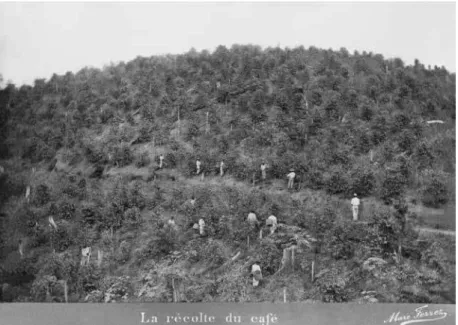
made in 1885 and another four photos related to the theme of ‘coffee harvest-ing,’ when male and female immigrants appear working in the fields. In none of these images do there appear slaves. Rather, Ferrez’s option was to valorize the few free coffee workers in the Fluminense Paraíba Valley and to remain silent about the extensive use of slave labor as a hegemonic alternative by the large landholders in the majority of properties in this region. Ultimately, his images projected a future, a horizon of expectations, in which the tensions of slaveholding society were absent from the photos.
What slavery is this?
The serial analysis of the 65 images allows a verification of how Marc Ferrez composed his visual narrative of slavery and coffee production in the Paraíba Valley. There is no prior organization of the images imposed by the photographer or anything inscribed on their backs which indicate their ar-rangements. What is known is that these images were archived containing the dates 1882, 1884, and 1885, as well as there being little information identifying the plantations, people, and places recorded. However, Ferrez’s choice of the agrarian space for his reference is striking. Also impacting is his preference of four guiding themes: (1) the functional quadrilateral: 37% of the images, with an emphasis on constructions linked to coffee production; (2) coffee harvest / coffee plantation: 32% of images, prioritization of planting and work spaces; (3) leaving for work: 13% of images, registering the departure of slaves to work in the fields; (4) oxcart / transport: 18% of images, highlighting the principal cargo transport used in the plantations.
the ample limits and the topography of the landscape, as van be seen in the example in Figures 4 and 6. The solution found was suited to the landscape views, using a representation resource that appears in other works and which permitted an overall vision highlighting the central object: the coffee plantation and its surrounds (Carvalho, 1998). As a result, the plantation as a constructed landscape became an object of aesthetic appreciation.
Figure 4 (theme 1) – Campo Alegre Plantation, Valença. Marc Ferrez, 1880s. Gilberto Ferrez Collection, IMS.
Figure 5 – Antinhas Plantation, Bananal. José de lima, oil on canvas, nineteenth century. Private collection of the Almeida/Vallim Family.
Available at the site of lahoi/UFF.
In technical terms, the immensity with which the constructions were rep-resented by Ferrez for theme 1 valorized productive capacity, technology, and the territorial expansion of the properties chosen, demonstrating all their eco-nomic potential in the present and in the future. To give the same effect, when possible Ferrez also included the available external machinery, for example wagons on rails for the internal transport of the product (Figure 1) or the system of suspended ducts for the removal and washing of beans. The Paraíba Valley was thus represented as a region with a solid and lasting agricultural structure, reinforcing its identity as a major global exporter of coffee, and demarcating its means of insertion in modern society.
Figure 6 (theme 1) – Santo Antônio do Paiol Plantation, Valença. Marc Ferrez, 1880s. Gilberto Ferrez Collection, IMS.
references. The effect extended human presence, and undermined the impor-tance of individual experiences, and mimetized the slaves in the environment portrayed. The (natural or constructed) landscape was privileged instead of man, with the clear intention of showing the grandeur of the buildings and the landscapes, based on the smallness of the human scale.
Figure 7 (theme 2) – Coffee harvest. Marc Ferrez, 1880s. Col. Thereza Christina Maria, BN.
In Figures 8 and 9 Ferrez made similar technical choices in terms of shot, distance, framing, and lighting. The theme of the coffee harvest is also the same, as well as the desire to register a form of labor that in a short time would be gone: slave labor. The ‘human type’ constructed in both images is the slave working in the fields. What strongly differentiates the two portraits is that the historic subjects posed for the scene. They exhibited distinct pos-tures, looks, and attitudes, which gives a specificity to each of the images and actors. In Figure 8, the two slaves do not look at the lens of the photographer and pretend that they have been caught in the act of their work, as if they had not noticed the presence of Ferrez, so strange to that environment of daily toil. In Figure 9, eight out of ten subjects portrayed look at the camera. Together they give the impression that they had stopped working for the photographic record. There are two women and eight men, some with Africanized turbans, who form a slave gang accompanied by their overseer, the only person of mixed blood in the photo to be located in the second rank, in a way that it is hard to notice. Whether intentionally or not, Ferrez im-mortalized in this and other images from the series, the form of labor called the gang system, in which slaves belonged to a small group supervised by an overseer who set the rhythms and cadence of daily work to achieve the pro-ductivity targets.3
Taken with technical mastery, the images studied were in harmony with the discourse of the dominant class in the empire to who they were ad-dressed. Their great capacity for circulation, consumption, and agency was based on the dual effect they produced. on the one hand, they enchanted foreign observers, accustomed to the language of souvenir photos, avid to get to know a distant reality which, having expropriated the marks of violence, aimed to emphasize the exoticism of those people, the grandeur of the terri-tory, and the exuberance of nature. on the other, it sought to maintain ev-erything in its place, preserving the master-slave hierarchy and seeking to represent the reality of slavery in the Paraíba Valley in a harmonious and orderly manner, protected from the political and social conflicts about the slavery question which exploded throughout the empire in the 1880s (Machado, 2010). For this, Ferrez produced a representation of slavery with-out violence, “a portrait of the black for white consumption,” very comfort-able for the owners of power.
However, the photographic act involves multiple actors and intentions. It “assumes consent, a tacit acceptance by the person photographed of the rules of the game of representation. At the same time that they are seen, the photo-graphed person exhibits themselves, assuming a pose resulting from negotia-tion” (Mauad, 2000, p. 97). In this “returned look” of photographed slaves there appears the indications of their pain, labor, expropriation, and sadness – in short, their humanity. Their eyes and bodies speak about their enslave-ment and make us think about the personal and collective histories experi-enced within the second slavery which in a short time would collapse (Tomich, 2011). While Ferrez’s solution for the tensions between past and future, be-tween the space of experience and the horizon of expectation (Koselleck, 2006), was the construction of the visual narrative of ‘pacified violence,’ it did not count on the connivance of those men and women who, when being repre-sented, could not remove what had identified them since birth, the condition of captive.
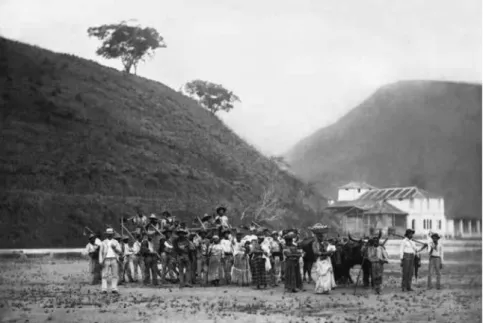
Figure 10 (theme 3) – Leaving for the coffee harvest. Marc Ferrez, 1880s. Col. Thereza Christina Maria, BN.
The image in evidence is constructed through the overseer (first on the left counting from the right) and slave hierarchy. Slightly in front, the former was the only man to use shoes, a symbol of liberty in imperial society. In art, as in the life of the individuals represented there, the relations of slavery ful-filled the role of separating and maintaining hierarchy. The tarmacked yard for drying coffee and the slave quarters in a line covered with roof tiles directs the eye to the technological advances introduced in the Valley and the solidity of that rural complex. In turn, the conditions of the slave dwellings, arranged in cubicles, with only one doorway and facing the yard, were minimized by the large volume of people in front of the construction. In the upper part of the photograph worn out and eroded soil can be seen on the hills, highlighting the need for new fertile lands from time to time to maintain production high (Stein, 1961).
(Florentino; Góes, 1997; Slenes, 1999; Salles, 2008). In the scenes portrayed (Figures 10 and 11) it is possible to see babies in the arms of their slave moth-ers, in straw baskets, tied to bodies in the African fashion, or children holding on to the skirts of their parents, a gesture which perhaps indicates apprehen-sion in relation to an act that was not at all common in the daily life of planta-tions: posing for a photo. Men were a majority of the workers portrayed. Many carried baskets, scythes, hoes, sieves, sticks, and other agricultural tools. The ages of the slaves was very varied, with a considerable number of children and old people appearing, legitimating what Ricardo Salles has called ‘mature slav-ery,’ since the Fluminense Paraíba Valley had achieved stability in the slave birth rate in the 1860s, which guaranteed it labor even after the end of the slave trade in 1850 (Salles, 2008).
Figure 11 – Marc Ferrez, 1880s. Gilberto Ferrez Collection, IMS.
present in the representational space. In relation to the slave-owners and over-seers, the series analysis demonstrated that they appeared in 12 of the 65 ima-gens (18% of the total), always in the themes ‘functional quadrilateral’ and ‘leaving for work.’ The pose assumed places them in an outstanding place, as also occurs with the artifacts carried. In the case of the slave-owners, these were riding boots, umbrellas, Panama hats, top hats, canes, and well-cut clothes, which acted as signs of power differentiating them from the mass of slaves and occasional poor free workers recorded. To the contrary of the slaves, for the slave-owners the act of being photographed was customary and was part of the habitus of the ruling class in the empire, in other words, it was of a second nature, shared by the individuals who composed the ‘best families’ (elias, 1993; Muaze, 2008). It can also be noted that women from this group do not appear in the photographs analyzed. This choice silenced the role of women in the functioning of plantations, reinforcing the generation of wealth as a male and patriarchal task, and affirmed this as a visual project which emphasized the productive universe rather than the domestic or family sphere in which women had greater autonomy (Mauad; Muaze, 2004).
By choosing ‘leaving for work’ as one of the four themes of his series about the Paraíba Valley, Marc Ferrez immortalized a daily act also described by numerous foreign travelers, in which every morning, at the sound of a bell, male and female slaves were paraded in front of the slave quarters to be count-ed (Figure 10), receive food mostly consisting of coffee, manioc, and corn, get their work tools, and form the so-called ‘gangs’ which left accompanied by their respective overseers for their extenuating toil. As the lands closest to the functional quadrilateral were already mostly eroded and with diminished pro-ductivity in the 1880s, the slave gangs moved to the coffee plantations on foot or on oxcarts, as shown in Figure 11. Both records also had a nostalgic tone which sought to materialize in images a time which – as is known – would shortly collapse.
Figure 12 (theme 4) – Oxcart in Minas. Marc Ferrez, 1880s. Thereza Christina Maria Collection, BN.
and for this was chosen for reproduction with the photographer’s signature, sale, and greater publicity by Marc Ferrez & Cia. In the other two photographs, someone always turns their head, slipping away from the ideal representation. Thus, as in the portraits from the urban studios or travelling professionals who circulated in the Paraíba Valley in the nineteenth century, the pose and the different positioning in the figuration space were essential for the construction of the representation desired both by the photographer and the person photo-graphed, notwithstanding the hierarchy of power existing between them.
Figure 14 – Unidentified plantation. Marc Ferrez, 1880s. Gilberto Ferrez Collection, IMS.
and hoes. Their various poses sought to convey an atmosphere of tranquility, with children beside their mothers and pairs talking, but also of work, with slaves carrying sacks and baskets with coffee. However, the artificiality of both is denounced by details: the good clothes worn by the slaves (the use of jackets and blazers used on festive days or when it was cold), the rigidity of the bodies, the embarrassed gestures of children and the bewilderment in the faces of some who, looking straight at the camera, let it appear how much the act of posing was strange to their daily life of extenuating labor.
The few alterations between the two images prove the strength of the pose in nineteenth century visual culture. one photograph is almost a repetition of the other, except the lower head of the slave-owner at the exact moment of the first register. like the ‘spot the difference’ game, it is possible to perceive that it is not just this. There are other alterations between the constructed scenes. Various slaves change the direction of their heads, their faces, their bodies. Some turn their backs, others take small steps forwards or change places, such as the slave with the baby who appears in the foreground, on the edge of the yard, looking towards the camera in the first photo, and who turns her back, hiding her face, in the image reproduced here. These acts explain that it was not always possible for the photographer to exert control and the slaves ap-proved these intrinsic limits on the photographic act by looking for their own expression.4
productive space of the coffee complex, to these buildings and the natural landscape which, once monumentalized, justified the continuity of Brazil in the civilized world through its agro-exporting role of primary foodstuffs.
The artificiality of the visual discourse of a ‘pacified slavery’ for the 1880s is even more evident when contextualized with other printed sources and the research of historians of abolition who point to the fierce struggle of abolition-ists and the radicalization of slave actions at that moment, including the in-subordination of the rules of work, the abandonment of plantations, occupation of waste lands, and individual and mass flights (Machado, 2010). Notwithstanding the context of the struggles for abolition in which the images are inserted, Ferrez’s photographs are silent about all and any imminent con-flict. Rather, he dialogued strongly with the discourse of the slave-owners, ignoring the drastic changes in the constituted social organization, and not recognizing other social agents in dispute which aimed to construct a new real-ity through the end of slavery.
However, not everything can be controlled in the photographic act. By letting themselves be photographed, the slaves also left their mark in the figura-tion space of the photo by constituting their own self-image through gestures, objects carried, clothes, positioning, and subtle looks. It is them who speak about the slave family, the division of tasks according to gender, the influence of African culture, the experience with children in the work space, and mater-nity in the space of captivity, themes never touched by Ferrez, but which can be traced by historians. In this way, while Marc Ferrez’s images strongly com-plied with the political function of shaping and forming a given memory about slavery of interest to the ruling class in the empire, they also provide informa-tion about important captive experiences when the ‘returned look’ of the pho-tographed slaves is analyzed.
ReFeReNCeS
AZeVeDo, Paulo César; lISSoVSKY, Maurício. Escravos brasileiros do século XIX na fotografia de Christiano Jr. São Paulo: libris, 1988.
BRIZUelA, Natalia. Fotografia e Império: paisagens de um Brasil moderno.São Paulo: Companhia das letras; IMS, 2012.
CARVAlHo, Vânia Carneiro de. A representação da Natureza na pintura e na Foto-grafia Brasileiras do Século XIX. In: FABRIS, Annateresa (org.) Fotografia: usos e funções no século XIX. São Paulo: edusp, 1998. pp. 199-231.
CUNHA, Manuela Carneiro da. olhar escravo, ser escravo. In: NeGRo de corpo e alma. (Catálogo, “Mostra do Redescobrimento”, org. emanoel Araujo). São Paulo: Fundação Bienal de São Paulo; Associação Brasil 500 Anos Artes Visuais, 2000. elIAS, Norbert. Processo civilizador. São Paulo: JZe, 1993. v.I, II.
eRMAKoFF, George. O negro da Fotografia Brasileira do século XIX. Rio de Janeiro: Casa editorial G. ermakoff, 2004.
FABRIS, Annateresa. A invenção da fotografia: repercussões sociais. In: _______. Fo-tografia: usos e funções no século XIX. São Paulo: edusp, 1998.
FeRReIRA, Marieta de Moraes. A crise dos comissários de café do Rio de Janeiro. Ni-terói: ICHF/UFF, 1977.
FeRReZ, Gilberto. O Rio de Janeiro do fotógrafo Marc Ferrez. 2.ed. São Paulo: libris, 1985.
FloReNTINo, Manolo; GÓeS, José Roberto. A paz das senzalas. Rio de Janeiro: Ci-vilização Brasileira, 1997.
HARDMAN, Francisco Foot. Trem-fantasma: a ferrovia Madeira-Mamoré e a moder-nidade na selva.São Paulo: Companhia das letras, 2005.
KoSelleCK, Reinhart. Futuro passado: contribuição à semântica dos tempos histó-ricos. Rio de Janeiro: Contraponto; ed. PUC-RJ, 2006.
KoSSoY, Boris. Dicionário histórico-fotográfico brasileiro: fotógrafos e ofício da foto-grafia no Brasil (1833-1910). São Paulo: Instituto Moreira Sales, 2002.
KoUTSoUKoS, Sandra Sofia Machado. Negros no estúdio do fotógrafo: Brasil, segunda metade do século XIX.Campinas: ed. Unicamp, 2010.
lAGo, Pedro Corrêa do. Marc Ferrez nas coleções do Quai d’Orsay. Rio de Janeiro: Contra Capa, 2001.
loUReNÇo, Thiago C. P. O Império dos Souza Breves nos Oitocentos: política e es-cravidão nas trajetórias dos Comendadores José e Joaquim de Souza Breves. Dis-sertação (Mestrado em História) – Universidade Federal Fluminense. Niterói, 2010. MACHADo, Maria H. O Plano e o Pânico: os movimentos sociais na década da
Abo-lição. São Paulo: edusp, 2010.
165-188, jul./dez. 2005. Available at: http://www.scielo.br/scielo.php?script=sci_ar ttext&pid=S0101-47142005000200006.
MARQUeSe, Rafael de Bivar. A paisagem da cafeicultura na crise da escravidão: as pinturas de Nicolau Facchinetti e Georg Grimm.Revista do IEB, São Paulo, n.44, pp. 55-76, fev. 2007. Available at: http://www.revistas.usp.br/rieb/article/ viewFile/34562/37300.
_______.; ToMICH, Dale. o Vale do Paraíba escravista e a formação do mercado mundial do café no século XIX. In: MUAZe, Mariana; SAlleS, Ricardo. O Vale do Paraíba e o Império do Brasil nos quadros da segunda escravidão. Rio de Janeiro: 7letras; Faperj, 2015.
MATToS, Ilmar. O Tempo Saquarema. Rio de Janeiro: Access, 1986.
MAUAD, Ana Maria. As fronteiras da cor: imagem e representação fotográfica na sociedade escravista imperial. Locus, Revista de História, Juiz de Fora, v.6, n.2, pp. 83-98, 2000. Available at: https://locus.ufjf.emnuvens.com.br/locus/article/ view/2363.
_______. Poses e flagrantes. Niterói: eduff, 2008.
_______. Ver e conhecer: o uso da fotografia nos Anais do MHN. Anais do Museu Histórico Nacional, Rio de Janeiro, v.36, pp. 117-142, 2004.
_______.; MUAZe, Mariana. A escrita da intimidade: história e memória no diário da viscondessa do Arcozelo. In: GoMeS, Ângela de Castro (org.) Escrita de si, escrita da história. Rio de Janeiro: ed. FGV, 2004.
MeNeSeS, Ulpiano T. Bezerra de. A fotografia como documento: Robert Capa e o miliciano abatido na espanha: sugestões para um estudo histórico. Tempo, Rio de Janeiro, n.14, pp. 131-151, s.d.
MUAZe, Mariana. A escravidão no Vale do Paraíba pelas lentes do fotógrafo Marc Ferrez. In: CARVAlHo, José Murilo de; BASTo, lúcia. Dimensões e fronteiras do Estado Brasileiro no Oitocentos. Rio de Janeiro: ed. Uerj, 2014.
_______. As memórias da Viscondessa: família e poder no Brasil Império. Rio de Ja-neiro: Zahar, 2008.
_______. Novas considerações sobre o Vale do Paraíba e a dinâmica Imperial. In: MUAZe, Mariana; SAlleS, Ricardo (org.) O Vale do Paraíba e o Império do Brasil nos quadros da segunda escravidão. Rio de Janeiro: 7letras, 2015.
NeVeS, Margarida de Souza. As vitrines do progresso. Rio de Janeiro: ed. PUC, 1986. PeSAVeNTo, Sandra J. Exposições universais, espetáculo da modernidade do século
XIX. São Paulo: Hucitec, 1997.
SAlleS, Ricardo. E o Vale era escravo. Rio de Janeiro: Civilização Brasileira, 2008. SleNeS, Robert. Na senzala uma flor. Campinas: ed. Unicamp, 1999.
SoNTAG, Susan. Sobre fotografia. São Paulo: Companhia das letras, 2004.
SÜSSeKIND, Flora. O Brasil não é longe daqui: o narrador, a viagem. São Paulo: Com-panhia das letras, 1990.
SWeIGART, Joseph earl. Financing and making Brazilian exportation agriculture: the coffee factors of Rio de Janeiro, 1850-1888. Dissertation (Ph.D. in History) – Uni-versity of Texas. Texas, USA, 1980.
ToMICH, Dale. Sob o prisma da escravidão: trabalho, capitalismo e economia mundial. São Paulo: edusp, 2011.
TURAZZI, Maria Inês. Marc Ferrez. São Paulo: CosacNaify, 2000.
_______. Poses e trejeitos: a fotografia e as exposições na era do espetáculo. Rio de Ja-neiro: Funarte; Rocco, 1995.
VASQUeZ, Pedro Karp. O Brasil na fotografia oitocentista. São Paulo: Metalivros, 2003.
ZAlUAR, Augusto e. Peregrinações pela província de São Paulo (1860-1861). São Pau-lo: edusp; Itatiaia, 1975.
Documentos
Breve notícia sobre a primeira exposição do Café do Brasil. Rio de Janeiro: Clube da lavoura e do Comércio, 1882 (document belonging to the IHGB Archive).
Le Brésil à l’Exposition Internacionale de St. Petersbourg. St. Petersbourg: Imprimerie Trenké et Fusnot, 1884 (document belonging to the IHGB Archive).
Folha Nova, 1 jun. 1884. Available at: http://www. hemerotecadigital.bn.br; Accessed on: 1 May 2013.
NoTeS
1 This research received support from the Faperj Young Scientist of our State and the
CNPq Human Science Call for Research Proposals. I would like to thank the Moreira Sal-les Institute, the National library, the Museu Paulista, and the National History Museum for the freely ceding the images used in this article.
2 The Center of Agriculture and Commerce was founded to “resist this anarchy which has
economic support were the municipal Agricultural Clubs (Clubes da Lavoura) which, through an organizational network structured in different locations, acted to maintain the constituted slave-holding order. However, with the growth of the abolitionist movement in the 1880s, there was a radicalization of the local Agricultural Clubs and many began to operate with armed militias to protect plantations, destroy quilombos, and intimidate abo-litionists (FeRReIRA, 1977; SWeIGART, 1980; MACHADo, 2010).
3 The gang system, a system of organizing slave labor in shifts, mostly used in the Paraíba
Valley, was different from the task system implemented in the South of the United States, in which workers had individual tasks to be fulfilled in a determined period.
4 Unfortunately, it was not possible to reproduce the other image describe because it was
being repaired. Some of the photos analyzed in this series were part of the exhibition
Emancipation, inclusion, and exclusion. Challenges of the Past and Present – photographs from the collection of the Moreira Salles Institute, under the curatorship of Maria Helena Machado, lilia Moritz Schwarcz, and Sergio Burgi.