https://doi.org/10.1590/0004-282X20170112
CONSENSUS
Brazilian consensus on Duchenne muscular
dystrophy. Part 1: diagnosis, steroid therapy
and perspectives
Consenso brasileiro sobre distrofia muscular de Duchenne - Parte 1 diagnóstico,
corticoterapia e perspectivas
Alexandra P. Q. C. Araujo1; Alzira A. S. de Carvalho2; Eduardo B. U. Cavalcanti3, Jonas Alex M. Saute4, Elmano Carvalho5, Marcondes C. França Junior6, Alberto R. M. Martinez6, Monica de M. M. Navarro5,
Anamarli Nucci6, Maria Bernadete D. de Resende7, Marcus Vinicius M. Gonçalves8, Juliana Gurgel-Giannetti9, Rosana H. Scola10, Cláudia F. da R. Sobreira11, Umbertina C. Reed7, Edmar Zanoteli7
1Universidade Federal do Rio de Janeiro, Faculdade de Medicina, Rio de Janeiro, RJ, Brasil;
2Faculdade de Medicina do ABC, Santo André SP, Brasil;
3Rede Sarah de Reabilitação, Ambulatório de Doenças Neuromusculares, Brasília DF, Brasil;
4Hospital de Clinicas de Porto Alegre, Serviço de Genética Médica, Porto Alegre RS, Brasil;
5RedeSARAH de Hospitais de Reabilitação,, Equipe de Doenças Neuromusculares, Belo Horizonte MG, Brasil;
6Universidade Estadual de Campinas, Departamento de Neurologia, Campinas SP, Brasil;
7Universidade de São Paulo, Faculdade de Medicina, Departamento de Neurologia, São Paulo SP, Brasil;
8Universidade da Região de Joinville, Joinville SC, Brasil;
9Universidade Federal de Minas Gerais, Faculdade de Medicina, Belo Horizonte MG, Brasil;
10Universidade Federal do Paraná, Serviço de Doenças Neuromusculares, Curitiba PR, Brasil;
11Universidade de São Paulo, Faculdade de Medicina de Ribeirão Preto, Departamento de Neurociências e Ciências do Comportamento, Ribeirão Preto SP, Brasil.
On behalf of the Brazilian Academy of Neurology, Neuromuscular Disease Department
Correspondence: Alexandra P. Q. C. Araujo; Av Américas, 700 / bloco 3 / sala 202; 22640-100 Rio de Janeiro RJ, Brasil; E-mail: [email protected] Conflict of interest: There is no conflict of interest to declare.
Support: Genzyme, GSK, PTC, Biomarin, Biogen, Roche. Those do not influence the content of this work. Received 08 March 2017; Accepted 03 April 2017.
ABSTRACT
Significant advances in the understanding and management of Duchenne muscular dystrophy (DMD) took place since international guidelines were published in 2010. Our objective was to provide an evidence-based national consensus statement for multidisciplinary care of DMD in Brazil. A combination of the Delphi technique with a systematic review of studies from 2010 to 2016 was employed to classify evidence levels and grade of recommendations. Our recommendations were divided in two parts. We present Part 1 here, where we describe the guideline methodology and overall disease concepts, and also provide recommendations on diagnosis, steroid therapy and new drug treatment perspectives for DMD. The main recommendations: 1) genetic testing in diagnostic suspicious cases should be the first line for diagnostic confirmation; 2) patients diagnosed with DMD should have steroids prescribed; 3) lack of published results for phase 3 clinical trials hinders, for now, the recommendation to use exon skipping or read-through agents.
Keywords: muscular dystrophy, Duchenne; practice guideline; consensus; diagnosis; genetic testing; drug therapy; glucocorticoids; utrophin.
RESUMO
Avanços na compreensão e no manejo da distrofia muscular de Duchenne (DMD) ocorreram desde a publicação de diretrizes internacionais em 2010. Nosso objetivo foi elaborar um consenso nacional baseado em evidências de cuidado multidisciplinar dos pacientes com DMD no Brasil. Utilizamos a técnica de Delphi combinada com revisão sistemática da literatura de 2010 a 2016 classificando níveis de evidência e graus de recomendação. Nossas recomendações foram divididas em duas partes. Apresentamos aqui a parte 1, descrevendo a metodologia utilizada e conceitos gerais da doença, e fornecemos recomendações sobre diagnóstico, tratamento com corticosteroides e novas perspectivas de tratamentos medicamentosos. As principais recomendações: 1) testes genéticos deveriam ser a primeira linha para confirmação de casos suspeitos; 2) pacientes com diagnóstico de DMD devem receber corticosteroides; 3) por enquanto, a falta de publicações de resultados dos ensaios clínicos de fase 3, dificulta recomendações de uso medicamentos que “saltam exons” ou “passam” por código de parada prematura.
Duchenne muscular dystrophy (DMD), the most common childhood muscular dystrophy, leads to severe disability and early death in the late teenage years if untreated. Duchenne muscular dystrophy is an X-linked degenerative disease and
afects approximately one in 3,500 to 5,000 live male births1.
he condition is characterized by progressive loss of mus -cle strength with some boys presenting with delayed motor milestones with or without intellectual disability. Diagnosis
is generally suspected by the age of ive, as physical ability
divergent from their peers becomes evident. Females are usually asymptomatic, but some female carriers present with milder forms of the disease, generally associated with chromosomal rearrangements2. Duchenne muscular
dystro-phy occurs as a result of mutations in DMD (locus Xp21.2),
that codes for the protein dystrophin3. Mutations that lead to
dystrophin absence result in irreversible degeneration of the muscle tissue, accounting for the DMD phenotype1,3. Other
mutations that lead to partial dystrophin expression are less
severe, leading to milder dystrophinopathy phenotypes, such as Becker muscular dystrophy4.
International guidelines for DMD care were published in
2010, with recommendations for DMD management, assess -ment and intervention4,5. hose guidelines were generated
by an international group of experts, mainly from Europe
and the United States of America, based on literature review
and expert opinion. hey divided their work into the follow -ing topics: diagnosis, rehabilitation, orthopedic, psychoso-cial, cardiac, pulmonary, gastrointestinal/nutritional and steroid management4,5. Nevertheless, signiicant advances
in the understanding and management of DMD since then grant paramount importance for an update review of the pre-vious guidelines. Improvements in general care, steroid treat-ment, noninvasive ventilatory support, cardiomyopathy and
scoliosis management may signiicantly change the course of DMD. herefore, a review of the previous guidelines is nec
-essary, while some new speciic guidelines are underway, or
have been recently published6,7.
Evidence-based practice has been heralded as the most
appropriate way of ensuring that patients receive the most
efective care possible.
Evidence-based practice involves much more than locating, analyzing, and appraising the best evidence avail
-able on the efectiveness of an intervention. Levels of evi -dence are based on study design and the methodological quality of individual studies. It is also important to make a judgment about the relevance and applicability of the evi-dence to the targeted patient group for the guideline, the consistency of the evidence, and the likelihood of clinical impact with the intervention. Finally, a link has to be made between the strength of the available evidence and the grade of the recommendation8.
he need to review the guidelines published in 2010 in
the light of the more recent publications, with a
method-ology that minimizes expert opinion, and with a focus on
regional feasibility, was the motivation for the present work. Our objective was to produce an evidence-based consensus statement on the main management issues in DMD that can
be used as an excellence guide for health practitioners who
follow these patients.
METHODS
A combination of the Delphi technique and evidence-based
level recommendations were followed. he Delphi tech -nique is an approach used to gain consensus among a
panel of experts9. his is normally achieved through a series
of rounds where information is fed back to panel members using questionnaires.
his working group started with the invitation of members of the Neuromuscular Disorders Department of the Brazilian Academy of Neurology. hose who accepted were able to nom -inate other participants; either medical doctors or health pro-fessionals who had been involved, in the last two years, in DMD
care or research (having followed at least 10 patients). At the end of this process, the working group comprised 25 members, divided into ive categories (diagnosis, corticosteroid treat -ment, rehabilitation, systemic care, future perspectives), with
an overall coordinator (APQCA). he group comprised adult
neurologists, child neurologists, medical geneticists, physical therapists, pediatricians and cardiologist.
he members could choose one of the following topics:
diagnosis, corticosteroid therapy, rehabilitation, systemic care, or future perspectives.
After that, members had to perform a systematic review
of the literature of articles published from 2010 through 2016
regarding their chosen topic.
We searched Medline, the Cochrane Database of Systematic Reviews, Cochrane Central Register of Controlled Clinical Trials, Web of Science, Database of Abstracts of
Reviews of Efects, and Science Citation Index, and refer -ences of selected articles and review articles.
he key words used in the search were a combination of
“Muscular Dystrophy, Duchenne” with any one of the follow-ing alone or in combination: “Practice Guideline”, “Diagnosis”,
“Genetic Testing”, “Pathology”, “Drug herapy”, “Glucocorticoids”, “herapeutics”, “herapy”, “Ataluren”, “Utrophin”, “Physical herapy Modalities”, “Exercise”, “Rehabilitation”, “Noninvasive Ventilation”, “Cognition”, “Quality of Life”, “Orthotic Devices”, “Muscle Stretching Exercises”, “Tracheostomy”, “Vital Capacity”,
“Respiratory Function Tests”, “Cardiomyopathies”, “Heart Failure”, “Nutrition Disorders”, and “Nutritional Support”.
he eligibility criteria of the publications were deined
by each working group member. Most chose not to include
narrative reviews, expert opinion or single case reports. he English language was also selected as a ilter by most.
A irst round of anonymous, independent work began
understanding of the experts’ views on the speciic selected topic: “Based on your literature review and on your expertise
following DMD patients, how do you reach the diagnosis, or how and when do you use a corticosteroid, or what are the future therapy perspectives?”.
he coordinator then listed all the answers, removing any
repeated material and constructed the second-round struc-tured questionnaire.
Again, independent answers were given to each item of
this structured questionnaire. Each participant was asked,
at this time, to determine for each item the level of evidence, retrieving the reference for this attribution, and its national and regional feasibility.
Levels of evidence and recommendation level used in this
study are shown in Table 1.
Finally, in a group meeting, all divergent classiications
were discussed until a consensus decision was reached.
Only when no study speciically addressed a given question, was the expert opinion of the group taken into account.
RESULTS
In Part 1 of this work we focused on diagnosis, steroid
therapy and future perspectives. he items listed by the
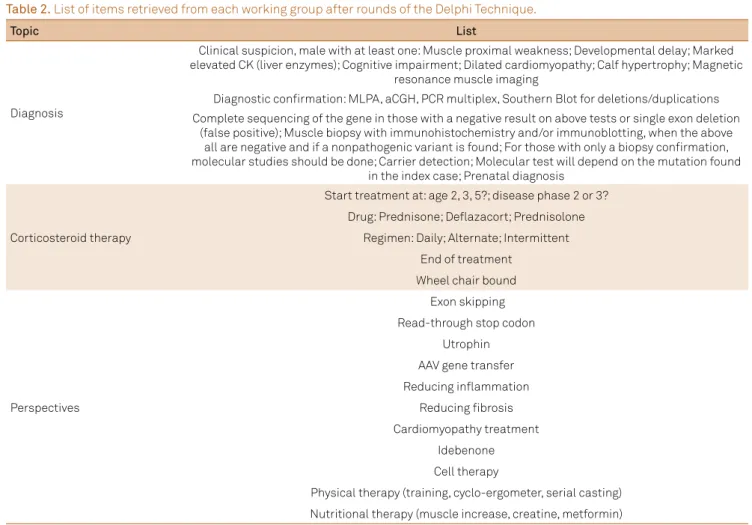
members in each of these working groups, which formed the structured questionnaire, are shown in Table 2.
Diagnosis
Performing an accurate diagnosis is one of the main
stan-dards of care related to DMD. Diagnosis conirmation allows
the initiation of proper interventions and provision of edu-cational and support information, and adequate genetic counseling for families. Although, ideally, a specialist in neu-romuscular diseases who can clinically assess the child and also order and interpret appropriate studies should make the diagnosis, investigation will often start with clinical suspicion
Table 1. Level of evidence and corresponding recommendation grade.
Study type Level of evidence Recommendation
Randomized clinical
trials/systematic review 1 A
Cohort studies 2 B
Case control 3 B
Case series 4 C
Expert opinion 5 D
Table 2. List of items retrieved from each working group after rounds of the Delphi Technique.
Topic List
Diagnosis
Clinical suspicion, male with at least one: Muscle proximal weakness; Developmental delay; Marked elevated CK (liver enzymes); Cognitive impairment; Dilated cardiomyopathy; Calf hypertrophy; Magnetic
resonance muscle imaging
Diagnostic confirmation: MLPA, aCGH, PCR multiplex, Southern Blot for deletions/duplications Complete sequencing of the gene in those with a negative result on above tests or single exon deletion
(false positive); Muscle biopsy with immunohistochemistry and/or immunoblotting, when the above all are negative and if a nonpathogenic variant is found; For those with only a biopsy confirmation, molecular studies should be done; Carrier detection; Molecular test will depend on the mutation found
in the index case; Prenatal diagnosis
Corticosteroid therapy
Start treatment at: age 2, 3, 5?; disease phase 2 or 3? Drug: Prednisone; Deflazacort; Prednisolone
Regimen: Daily; Alternate; Intermittent End of treatment
Wheel chair bound
Perspectives
Exon skipping Read-through stop codon
Utrophin AAV gene transfer Reducing inflammation
Reducing fibrosis
Cardiomyopathy treatment Idebenone Cell therapy
Physical therapy (training, cyclo-ergometer, serial casting)
Nutritional therapy (muscle increase, creatine, metformin)
by pediatricians, general practitioners and other health care professionals, who also need to be aware of the condition and
its diagnosis. After the DMD diagnosis is conirmed, or dur -ing the diagnostic process, support from geneticists who can provide genetic counseling is paramount.
Diagnostic suspicion
Suspicion of a DMD diagnosis (Figure) should be considered in a boy, irrespective of family history with any of the following:
1) proximal weakness starting from age two to ive years (Level
of evidence: 2B, Class of Recommendation: B)10; 2) psychomotor
developmental delay including a delay in gait or speech
acqui-sition, intellectual deiciency or autism spectrum disorders (Level of evidence: 4, Class of Recommendation: C)11-13; 3) calf
hypertrophy (Level of evidence: 4, Class of Recommendation:
C)12; 4) marked creatine kinase (CK) increase,
deined as >2,000U/L (Level of evidence: 2B, Class of
Recommendation: B)14; or 5) incidental inding of increased
transaminases levels (aspartate and alanine aminotrans-ferases, which are also produced by muscle cells) above a
normal reference levels for age (Level of evidence: 4, Class
of Recommendation: C)15. If any of these criteria are present,
a screening evaluation of CK levels should be ordered. Ideally, both normal or marked increased CK levels should be
con-irmed in a second sample assay.
Diagnosis confirmation
If clinical suspicion of DMD is supported by a marked
increase in CK levels, then a conirmatory test should be ordered (Figure). he way of conirming the diagnosis may
vary according to the local availability of tests. Testing for DMD
mutation will always be necessary, even if the diagnosis was
conirmed by the absence of dystrophin protein expression
on muscle biopsy, to provide accurate information for genetic counseling and to allow the detection of mutation carriers.
Diferent types of mutations in DMD can be the genetic basis
for the disease. he most common mutation types are large
deletions and duplications followed by point mutation, small deletions or insertions and splice site mutations16. herefore,
irst-line genetic testing for DMD should be a technique that
+ Diagnostic suspicion
DMD should be suspecte in boys irrespective of family history with any of the following: • Proximal weakness starting from age 2 to 5 years-old
• Psychomotor developmental delaya
• Calf hypertrophy • CK markedly increaseadb
• Increased transaminases levels
Screenig CK markedly increasedb
DMD sequencing (NGS or Sanger)
Muscle biopsy: absence of dystrophin
Not-DMD
Consider alternative diagnosis
Diagnostic suspicion
Screening
Confirming diagnosis
DMD deletion / duplication testing (MLPA or aCGH)c
Dystrophinopathy diagnosis confirmed
Genetic counseling • Carriers detection • Reproductive options
• Preimplantatio genetic diagnosis +
– or d
+
–
–
a: Includes delay of gait or speech acquisition, intellectual deficiency or autism spectrum disorders; b: defined as CK levels > 2,000U/L; c: southern blot analysis and multiplex PCR of DMD are alternatives; d: single exon deletion on MLPA should be confirmed by a second method; aCGH: Comparative Genomic Hybridization microarray; CK: Creatine Kinase; DMD: Duchenne muscular dystrophy; MLPA: Multiplex Ligation-dependent Probe Amplification; NGS: next-generation sequencing; +: indicates abnormal results consistent with DMD diagnosis; -: indicates normal results.
evaluates copy number variation to detect large deletions
of one or more exons and duplications. Multiplex ligation-dependent probe ampliication (MLPA) and microarray-based comparative genomic hybridization (aCGH) are supe
-rior techniques to multiplex polymerase chain reaction (PCR)
for detecting large deletions/duplications in DMD. he MLPA
and aCGH allow the identiication of a greater number of large
deletions, and detect large duplications and provide a
bet-ter estimation of mutation breakpoints than multiplex PCR (Level of evidence: 1B, Class of Recommendation: A)12,17-20.
Special care should be taken when a single exon deletion is found on MLPA analysis. Apparently a single exon deletion on the MLPA can also occur due to point mutation or poly -morphisms in the probe binding site, and therefore a second
test, generally Sanger sequencing of the involved exon, should
be done to avoid a false positive results4,18,21. he accuracy of
an aCGH is slightly superior to MLPA of DMD due to its abil-ity to detect intronic rearrangements and also because this technique does not have the above-mentioned chance of false
positive results related to PCR-based techniques (Level of evidence: 3B, Class of Recommendation: B)22. he aCGH for
DMD is less available than MLPA and the associated costs are generally higher, therefore both an MLPA or an aCGH of DMD are considered irst-line tests for DMD diagnosis (Level
of evidence: 1B, Class of Recommendation: A)12,17-20. Southern
blot analysis and a multiplex PCR of DMD may also be
per-formed as irst-line tests in centers where these are the only
available technologies.
If analysis by one or more of these techniques allows the
identiication of DMD mutation, then no further testing is required. If deletion/duplication testing is negative, then
DMD sequencing should be done to look for point mutations
or small deletions/insertions. he DMD is one of the larg
-est human genes with 79 exons in total16, which makes
con-ventional Sanger sequencing very diicult, laborious and expensive. Next-generation sequencing, which allows massive
and parallel sequencing of DNA fragments can now be con-sidered the test of choice for DMD sequencing (Level of evi
-dence: 3B, Class of Recommendation: B)23,24. Next-generation
sequencing technologies; however, are not widely available and, therefore, there is a need for national or regional-based networks to support the DMD diagnosis in this phase.
If large deletions/duplications and sequencing analysis of
DMD are negative, then a muscle biopsy should be ordered to
conirm DMD or to consider an alternative diagnosis. he key
tests done in muscle biopsy for DMD are immunohistochemis-try and immunoblotting for dystrophin, which should be
inter-preted by an experienced neuromuscular pathologist (Level
of evidence: 4, Class of Recommendation: C)25. Additionally,
when variants without deined pathogenicity are found on the next-generation sequencing of DMD, conirmation of
the DMD diagnosis by muscle biopsy with
immunohisto-chemistry will also be required (Level of evidence: 5, Class of Recommendation: D, Expert opinion).
Electromyography and nerve-conduction studies were not considered by the expert panels to be indicated for spe
-ciic assessment of DMD, except in exceptional cases (Level of evidence: 5, Class of Recommendation: D, Expert opinion).
Muscle magnetic resonance imaging was not included as
a conirmatory or screening test for DMD in this guideline. he expert panel considered that, currently, this method only has a clinical research role (Level of evidence: 5, Class of Recommendation: D, Expert opinion).
Carriers’ detection
Detection of adult female carriers of DMD should be
performed with molecular testing. he method of choice will depend on the identiied mutation in the index case, generally MLPA or aCGH for large deletions/duplications
and Sanger sequencing for point mutations, small
dele-tions or inserdele-tions and splice site mutadele-tions (Level of evi -dence: 2B, Class of Recommendation: B)18,19,20. It is important
to emphasize that multiplex PCR cannot detect heterozy -gous carriers for large deletions or duplications and, there-fore, it is not recommended for carrier detection12. When
the DMD diagnosis has only been conirmed by muscle
biopsy with immunohistochemistry (no mutation found
in the index case), serial CK measures (generally three
dif-ferent samples) may be used to estimate the probability of
the individual being a carrier (Level of evidence: 2B, Class of
Recommendation: B)26,27. Of note, more recent studies have
shown that up to 47% of carriers of DMD and up to 70% of
carriers of the Becker muscular dystrophy mutation have normal CK levels28, indicating that counselors should be very
cautious in assessing a carrier status based only on CK levels.
Prenatal and preimplantation diagnosis
A prenatal diagnosis of DMD can be performed with
molecular analysis of the mutation identiied in the family after amniocentesis or chorionic villus sampling18. However,
considering that the current Brazilian criminal code prohibits
pregnancy interruption due to DMD or other degenerative dis-orders, and that there is no prenatal or early neonatal interven-tion for DMD, a prenatal diagnosis of DMD is not currently
jus-tiied in Brazil (Level of evidence: 5, Class of Recommendation: D, Expert opinion). Recommendations regarding prenatal diagnoses of DMD will vary according to each country’s abor -tion legisla-tion. Preimplanta-tion diagnoses with embryo
selec-tion can be ofered to women carriers of the DMD mutation
(Level of evidence: 4, Class of Recommendation: C)29,30. A
pre-implantation diagnosis is an expensive procedure that is not available in the Uniied Health System (Sistema Único de Saude, SUS) of Brazil. Of note, genetic counseling and discus -sion with couples of the many reproductive options (adoption,
embryo sexing, egg donation, etc.) should be the irst step in
the reproductive care of families, before following any of the
Steroid Therapy
Since the early 1970s, several studies have been published pointing to the beneits of glucocorticoids on the motor
function of patients with DMD31. However, some practical
issues regarding the best therapeutic schemes remain con-troversial. In order to clarify some hallmarks of glucocorti-coid therapy for DMD patients, this working group proposed some pivotal topics of recommendation.
Are glucocorticoids recommended for DMD patients?
All patients diagnosed with DMD should have
glu-cocorticoids prescribed (Level of evidence: 1A, Class of
Recommendation: A)32. Comparisons between the natural
history studies in the pre-glucocorticoid era and those after
glucocorticoid therapy have demonstrated beneits in the
motor function, giving longer independent gait, better core
stabilization and upper limb function, prevention of spine
deformities, and delaying the settlement of lower limb defor-mities32-39. he use of glucocorticoids is also responsible for
nonmotor beneits, particularly in preserving respiratory
function, preventing cardiomyopathy, improving quality of life parameters and prolonging life itself38,40,41.
When to start glucocorticoids for DMD patients?
Glucocorticoid therapy is recommended for those boys with
DMD in the two- to ive-year-old age group, preferably in the pla
-teau phase of motor deicits (also known as phase 2) or even in the decline phase of motor function (known as phase 3), and for all boys over the age of ive no matter what the functional status is (Level of evidence: 4C, Class of Recommendation: C)4,42,43.
he wide availability of genetic testing for high diag -nostic suspicion patients has made the earlier diagnosis of
DMD possible. Some examples are cases with familial history
and/or early postnatal serum CK testing. However, due to immunological immaturity and the possibility of a precocious closure of the epiphyseal plate, a glucocorticoid prescription
should not be ofered to boys under the age of two years old,
and should be carefully discussed with the family for those in the two- to three-year age group, taking into account the
installation of a signiicant functional impairment involving the acquisition of motor skills (Level of evidence: 5, Class of Recommendation: D, Expert opinion).
Which glucocorticoid should be prescribed and what dose is recommended?
he irst studies focusing on glucocorticoid therapy
for DMD boys have demonstrated that prednisone, in a
dose of 0.75/mg/Kg/daily, can achieve substantial efects on motor function in a six-month period4,6,43. Later stud
-ies have demonstrated that diferent drugs with an equiv
-alent dose show similar efects: prednisone or prednis
-olone 0.75mg/Kg daily (Level of evidence: 1A, Class of
Recommendation: A)35 or delazacort 0.9 to 1mg/Kg daily
(Level of evidence: 3C, Class of Recommendation: C)44,45.
Several diferent drug regimens have been evaluated, but not as extensively as the above daily schemes44,45,46,47,48. hese
diferent regimens aim to minimize side efects and/or improve
the treatment adherence. Similar results to the standard glu-cocorticoid doses have been reached with intermittent doses
of prednisolone 0.75mg “10 days on and 10 days of ” regimen and prednisone 5mg/Kg on each weekend day (Level of evi -dence: 2B, Class of Recommendation: B)33. A slightly reduced
efect on motor function was also observed with the regimen of prednisone 0.3mg/Kg daily, but with fewer side efects49.
herefore, the recommended irst-line plan would be prednisone 0.75mg/kg or prednisolone 0.75mg/Kg on a daily
basis, followed by prednisone or prednisolone in intermittent
doses (10 days on and 10 days of), with the alternative being the use of delazacort 0.9–1 mg/Kg daily.
Which parameters, and how often, should they be monitored while a DMD patient is on glucocorticoids?
Since DMD patients have, in general, a lifelong prospect of glucocorticoid usage, an optimal follow-up schedule is
neces-sary for monitoring possible side efects6. An ideal outline of
rou-tine consultations takes into account three relevant factors: the
patient’s age, the type of glucocorticoid prescribed and the drug
regimen adopted. As a general rule, we recommend a
reevalua-tion in periods no longer than six months. Boys under the age of ive and/or using an intermittent regimen (10 days on and 10 days of) should be seen three or four times a year, and those
boys who are older, or on the other regimens, twice a year. Several clinical parameters should routinely be moni-tored no matter which glucocorticoid therapy was chosen.
Blood pressure, heart rate, oxygen saturation levels, height,
wingspan, weight, Cushingoid features and ophthalmological evaluations are strongly recommended. Radiological
assess-ment for bone age evaluation is important at the very irst
visit for proper follow-up6. (Level of evidence: 5D, Class of
Recommendation: D, Expert opinion)
When should corticosteroid therapy be ended?
All patients with DMD should remain on glucocorticoid
therapy as long as there are no side efects severe enough to
justify its interruption. Although this is one question that remains unanswered6, indirect evidence suggests it should
be continued throughout life (Level of evidence: 5D, Class of Recommendation: D, Expert opinion). Signiicant side efects
should be properly managed during regular clinical reassess-ments and a regimen shift is recommended in those patients
with signiicant side efects6.
here are some special situations that require a dose adjustment considering the metabolic modiications during
chronic glucocorticoid therapy. Stressful situations usually require a dose increment, as in the case of infectious diseases
that require a three-day dose doubling. he same holds true
Should corticosteroids be prescribed to nonambulant DMD patients?
here are few studies that speciically address the useful
-ness of glucocorticoids for nonambulant DMD boys. hree
studies recommend the continuation of glucocorticoid
ther-apy for the wheelchair-bound stage of the disease (Level of evidence: 3B, Class of Recommendation: B)40,50,51. For these
patients, the aim of glucocorticoid therapy is to preserve heart, lung and upper limb function as much as possible40,50,51.
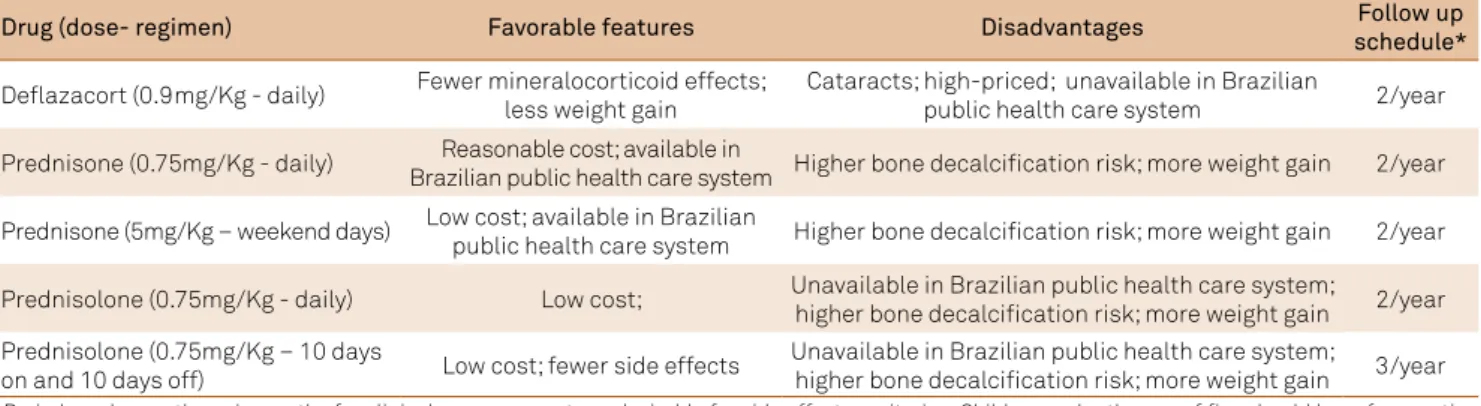
he above recommendations are summarized in the Table 3.
Future drug therapy perspectives
A number of promising molecular targeted therapies have been developed and some of them have gone from pre-clinical to pre-clinical trials in the present century. For this topic, clinicaltrials.gov, new drugs online, and the regulatory
agen-cies sites were also reviewed. By December 2016, there were 12 interventional studies listed as completed, and 33 phase 3 studies (clinicaltrials.gov); however, not all those listed are indeed phase 3 studies.
herapies directed toward cardiac protection, supple -mentation, corticosteroids or physical therapy interventions were not included, although initially listed by this working
group, as they will be topics in the Part 2 article. he recom
-mendations in this section are made based on phase 3 clinical
study publications. However, as DMD is a rare and incapaci-tating disease, phase 2 studies with relevant results between treated and placebo groups have also been considered.
International regulatory agencies have been handling some new DMD drug submissions and a quick overview of their statements follow.
Exon skipping agents
Drisapersen is an oligonucleotide (given by subcutaneous route) that alters the splicing of the dystrophin mRNA
tran-script, eliminating exon 51 and restoring the reading frame of
DMD for some speciic exon deletions and allowing the pro
-duction of shorter, but functional, dystrophin. he phase 3
trial was completed, but results were not published at our
last search. Results of a phase 2 study were published with positive results52. he submitted data of phase 2 and 3 stud -ies were not approved by the Food and Drug Administration
(FDA), which considered that substantial evidence of efec -tiveness had not been met53. In May 2016, the marketing
authorization application to the European Medicines Agency
for drisapersen was withdrawn by the sponsoring pharma-ceutical company 54
Eteplirsen is a morpholino antisense oligomer, with a
similar mechanism of action to drisapersen, but
adminis-tered intravenously. he FDA gave accelerated approval of eteplirsen in September 2016, based on a phase 2 trial and its extended study comparing matched historical controls55,56.
his has raised discussion and concern57. At the time of our
last search, there had been no European Medicines Agency
approval for eteplirsen58
Read-through agent
Ataluren is an oral drug that acts at the ribosome level inducing reading-through premature stop codons due to
non-sense mutations. A phase 3 trial of ataluren has been com -pleted, but the results were not published at the time of our search. Results of a phase 2 have been published59. Ataluren
received conditional marketing authorization from the European Commission to treat ambulatory DMD patients, aged ive years and older with DMD nonsense mutation,
considering its risk-beneit ratio60. A management plan with
detailed activities and interventions has been developed to
ensure that ataluren is used as safely as possible. Every year, the European Medicines Agency will review any new infor -mation that becomes available and an update will follow. At our last search, there was no FDA approval for ataluren61.
Antioxidants
Idebenone is a potent antioxidant agent with a similar structure to coenzyme Q10 that has been tested for a variety of neurologic disorders (e.g. Alzheimer’s disease, Friedreich’s ataxia, mitochondrial disorders, etc.) and, most recently, for DMD. Although nonspeciic for DMD, the working group
Table 3. Steroid therapy drugs and regimens.
Drug (dose- regimen) Favorable features Disadvantages Follow up
schedule*
Deflazacort (0.9mg/Kg - daily) Fewer mineralocorticoid effects; less weight gain
Cataracts; high-priced; unavailable in Brazilian
public health care system 2/year
Prednisone (0.75mg/Kg - daily) Reasonable cost; available in
Brazilian public health care system Higher bone decalcification risk; more weight gain 2/year
Prednisone (5mg/Kg – weekend days) Low cost; available in Brazilian
public health care system Higher bone decalcification risk; more weight gain 2/year
Prednisolone (0.75mg/Kg - daily) Low cost; Unavailable in Brazilian public health care system;
higher bone decalcification risk; more weight gain 2/year Prednisolone (0.75mg/Kg – 10 days
on and 10 days off) Low cost; fewer side effects
Unavailable in Brazilian public health care system;
higher bone decalcification risk; more weight gain 3/year
considered it to be worthy of mention. A phase 3 trial was completed, and results were published. he studies aimed
at patients who were not taking steroids, and the authors used pulmonary function tests as the primary endpoints52.
he drug is not approved by the FDA63 (but is authorized
for use in the European community for Leber’s hereditary
optic neuropathy64.
A summary of the exon skipping and read-through stud -ies can be found in Table 4.
he working group considered that the strength of evi
-dence of prospective drugs was not suicient for a formal
recommendation at this point. However, this statement should be reviewed in the near future after publication of
known completed phase 3 clinical trials.
References
1. Emery AE. Population frequencies of inherited neuromuscular diseases: a world survey. Neuromuscul Disord. 1991;1(1):19-29. https://doi.org/10.1016/0960-8966(91)90039-U
2. Quan F, Janas J, Toth-Fejel S, Johnson DB, Wolford JK,
Popovich BW. Uniparental disomy of the entire X chromosome in a female with Duchenne muscular dystrophy. Am J Hum Genet. 1997;60(1):160-5.
3. Hoffman EP, Brown RH Jr, Kunkel LM. Dystrophin: the protein product of the Duchenne muscular dystrophy locus. Cell. 1987;51(6):919-28. https://doi.org/10.1016/0092-8674(87)90579-4
4. Bushby K, Finkel R, Birnkrant DJ, Case LE, Clemens PR, Cripe L et al. Diagnosis and management of Duchenne muscular dystrophy, part 1: diagnosis and pharmacological and psychosocial management. Lancet Neurol. 2010;9(1):77-93. https://doi.org/10.1016/S1474-4422(09)70271-6
5. Bushby K, Finkel R, Birnkrant DJ, Case LE, Clemens PR, Cripe L et al. Diagnosis and management of Duchenne muscular dystrophy, part 2: implementation of multidisciplinary care. Lancet Neurol. 2010;9(2):177-89. https://doi.org/10.1016/S1474-4422(09)70272-8 Table 4. Main findings of clinical trials for the new agents directed at specific DMD mutations.
Molecule Action Target
population
Sample size – study phase – duration
Primary / Secondary
endpoint Conclusion
Drisapersen52
2’-O-methyl– Phosphorothioate RNA
oligonucleotide that facilitates exon 51 skipping in dystrophin
pre-mRNA
DMD ≥ 5 years; time to rise from floor
≤ 7 s; mutation correctable by skipping
exon 51
53 patients (18 continuous once a week; 17 intermittent with 9 doses in 10 weeks; 18 placebo) – phase
2 – 48 weeks
Change in 6MWD at week 25
At week 25, 6MWD was higher for continuous treatment
(p = 0.014).
Change in 6MWD at week 49; muscle strength, timed tests, NSAA, dystrophin levels
at muscle biopsy
At week 49 no significant difference was observed between groups. Other secondary endpoints were not statistically different in treated and control groups.
Eteplirsen55
Phosphorodiamidate morpholino oligomer (PMO); facilitates skipping of exon 51
during pre-mRNA splicing
DMD with mutations correctable by skipping
exon 51
12 treated and 13 historical controls –
phase 2 – 3 years
Change in 6MWD
Slower rate of decline in ambulation (p < 0.01) Rate of loss of
independent ambulation; relative stability of pulmonary function
Ataluren59
Small molecule that promotes translational
read-through of premature stop codons
DMD patients
≥ 5 years with nonsense
point mutation
174 patients (57 on 40 mg/kg/day; 60 on 80 mg/kg/day;
57 on placebo) – phase 2 – 48 weeks
Change in 6MWD at week 48
Mean decline in 6MWD at week 48: difference of 29.7 m
between 40mg/kg/day and placebo (p = 0.149). Difference
between 80 mg/kg/day and placebo was negligible. Patients with 6MWD < 350m
treated with 40mg/kg/day: 6MWD mean at week 48 was
68.2m better than placebo (p = 0.0053)
Timed function tests, functional test method grading, at home activity,
myometry, patient/ caregiver-reported accidental falls, PedsQL physical functioning and psychological domains
Timed function tests: group 40mg/kg/day trended toward
less decline in muscle function compared with placebo. However they met
the threshold for clinically meaningful differences.
6. Gloss D, Moxley RT 3rd, Ashwal S, Oskoui M. Practice guideline update summary: corticosteroid treatment of Duchenne muscular dystrophy: report of the Guideline Development Subcommittee of the American Academy of Neurology. Neurology. 2016;86(5):465-72. https://doi.org/10.1212/WNL.0000000000002337
7. Topaloglu H, Gloss D, Moxley RT 3rd, Ashwal S, Oskoui M. Practice guideline update summary: corticosteroid treatment of Duchenne muscular dystrophy: report of the Guideline Development Subcommittee of the American Academy of Neurology. Neurology. 2016;87(2):238. https://doi.org/10.1212/01.wnl.0000489553.99227.18
8. Hadorn DC, Baker D, Hodges JS, Hicks N. Rating the quality of evidence for clinical practice guidelines. J Clin Epidemiol. 1996;49(7):749-54. https://doi.org/10.1016/0895-4356(96)00019-4
9. Hsu C-C, Sandford BA. The Delphi technique: making sense of consensus. Pract Assess, Res Eval. 2007;12(10):1-8.
10. Bushby KM, Hill A, Steele JG. Failure of early diagnosis in symptomatic Duchenne muscular dystrophy. Lancet. 1999;353(9152):55-78. https://doi.org/10.1016/S0140-6736(98)05279-9
11. Mirski KT, Crawford TO. Motor and cognitive delay in Duchenne muscular dystrophy: implication for early diagnosis. J Pediatr. 2014;165(5):1008-10. https://doi.org/10.1016/j.jpeds.2014.07.006
12. Manjunath M, Kiran P, Preethish-Kumar V, Nalini A, Singh RJ, Gayathri N. A comparative study of mPCR, MLPA, and muscle biopsy results in a cohort of children with Duchenne muscular dystrophy: a first study. Neurol India. 2015;63(1):58-62. https://doi.org/10.4103/0028-3886.152635
13. Cuisset JM, Rivier F. [Central manifestations of dystrophinopathies]. Arch Pediatr. 2015;22(12 Suppl 1):12S58-62. French.
https://doi.org/10.1016/S0929-693X(16)30010-0
14. Mendell JR, Shilling C, Leslie ND, Flanigan KM, Dahhak R, Gastier-Foster J et al. Evidence-based path to newborn screening for Duchenne muscular dystrophy. Ann Neurol. 2012;71(3):304-13. https://doi.org/10.1002/ana.23528
15. McMillan HJ, Gregas M, Darras BT, Kang PB. Serum transaminase levels in boys with Duchenne and Becker muscular dystrophy. Pediatrics. 2011;127(1):e132-6. https://doi.org/10.1542/peds.2010-0929
16. Bladen CL, Salgado D, Monges S, Foncuberta ME, Kekou K, Kosma K et al. The TREAT-NMD DMD Global Database: analysis of more than 7,000 Duchenne muscular dystrophy mutations. Hum Mutat. 2015;36(4):395-402. https://doi.org/10.1002/humu.22758
17. Khordadpoor-Deilamani F, Akbari MT, Nafissi S, Zamani G. Dystrophin gene mutation analysis in Iranian males and females using multiplex polymerase chain reaction and multiplex ligation-dependent probe amplification methods. Genet Test Mol Biomarkers. 2011;15(12):893-9. https://doi.org/10.1089/gtmb.2011.0057
18. Kerr R, Robinson C, Essop FB, Krause A. Genetic testing for Duchenne/ Becker muscular dystrophy in Johannesburg, South Africa. S Afr Med J. 2013;103(12 Suppl 1):999-1004. https://doi.org/10.7196/SAMJ.7274
19. Dastur RS, Kachwala MY, Khadilkar SV, Hegde MR, Gaitonde PS. Identification of deletions and duplications in the Duchenne muscular dystrophy gene and female carrier status in western India using combined methods of multiplex polymerase chain reaction and multiplex ligation-dependent probe amplification. Neurol India. 2011;59(6):803-9. https://doi.org/10.4103/0028-3886.91355
20. Chen C, Ma H, Zhang F, Chen L, Xing X, Wang S et al. Screening of Duchenne muscular dystrophy (DMD) mutations and investigating its mutational mechanism in Chinese patients. PLoS One. 2014;9(9):e108038. https://doi.org/10.1371/journal.pone.0108038
21. Hegde MR, Chin EL, Mulle JG, Okou DT, Warren ST, Zwick ME. Microarray-based mutation detection in the dystrophin gene. Hum Mutat. 2008;29(9):1091-9. https://doi.org/10.1002/humu.20831
22. Ishmukhametova A, Khau Van Kien P, Méchin D, Thorel D, Vincent MC, Rivier F et al. Comprehensive oligonucleotide array-comparative genomic hybridization analysis: new insights into the molecular pathology of the DMD gene. Eur J Hum Genet. 2012;20(10):1096-100. https://doi.org/10.1038/ejhg.2012.51
23. Wang Y, Yang Y, Liu J, Chen XC, Liu X, Wang CZ et al. Whole dystrophin gene analysis by next-generation sequencing: a comprehensive genetic diagnosis of Duchenne and Becker muscular dystrophy. Mol Genet Genomics. 2014;289(5):1013-21. https://doi.org/10.1007/s00438-014-0847-z
24. Wei X, Dai Y, Yu P, Qu N, Lan Z, Hong X et al. Targeted next-generation sequencing as a comprehensive test for patients with and female carriers of DMD/BMD: a multi-population diagnostic study. Eur J Hum Genet. 2014;22(1):110-8. https://doi.org/10.1038/ejhg.2013.82
25. Takeshima Y, Yagi M, Okizuka Y, Awano H, Zhang Z, Yamauchi Y et al. Mutation spectrum of the dystrophin gene in 442 Duchenne/Becker muscular dystrophy cases from one Japanese referral center. J Hum Genet. 2010;55(6):379-88. https://doi.org/10.1038/jhg.2010.49
26. Percy ME, Andrews DF, Thompson MW. Serum creatine kinase in the detection of Duchenne muscular dystrophy carriers: effects of season and multiple testing. Muscle Nerve. 1982;5(1):58-64. https://doi.org/10.1002/mus.880050111
27. Percy ME, Andrews DF, Brasher PM, Rusk AC, Reyolds JF. Making the most of multiple measurements in estimating carrier probability in Duchenne muscular dystrophy: the Bayesian incorporation of repeated measurements using logistic discrimination. Am J Med Genet. 1987;26(4):851-61. https://doi.org/10.1002/ajmg.1320260412
28. Hoogerwaard EM, Bakker E, Ippel PF, Oosterwijk JC, Majoor-Krakauer DF, Leschot NJ et al. Signs and symptoms of Duchenne muscular dystrophy and Becker muscular dystrophy among carriers in The Netherlands: a cohort study. Lancet. 1999;353(9170):2116-9. https://doi.org/10.1016/S0140-6736(98)10028-4
29. Malcov M, Ben-Yosef D, Schwartz T, Mey-Raz N, Azem F, Lessing JB et al. Preimplantation genetic diagnosis (PGD) for Duchenne muscular dystrophy (DMD) by triplex-nested PCR. Prenat Diagn. 2005;25(13):1200-5. https://doi.org/10.1002/pd.1317
30. Ye Y, Yu P, Yong J, Zhang T, Wei X, Qi M et al. Preimplantational genetic diagnosis and mutation detection in a family with duplication mutation of DMD gene. Gynecol Obstet Invest. 2014;78(4):272-8. https://doi.org/10.1159/000365083
31. Drachman DB, Toyka KV, Myer E. Prednisone in Duchenne muscular dystrophy. Lancet 1974;2(7894):1409-12. https://doi.org/10.1016/S0140-6736(74)90071-3
32. Matthews E, Brassington R, Kuntzer T, Jichi F, Manzur AY. Corticosteroids for the treatment of Duchenne muscular dystrophy. Cochrane Database Syst Rev. 2016;(5):CD003725. https://doi.org/10.1002/14651858.CD003725.pub4
33. Ricotti V, Ridout DA, Scott E, Quinlivan R, Robb SA, Manzur AY et al. Long-term benefits and adverse effects of intermittent versus daily glucocorticoids in boys with Duchenne muscular dystrophy. J Neurol Neurosurg Psychiatry. 2013;84(6):698-705. https://doi.org/10.1136/jnnp-2012-303902
34. Parreira SL, Resende MB, Zanoteli E, Carvalho MS,
Marie SK, Reed UC. Comparison of motor strength and function in patients with Duchenne muscular dystrophy with or without steroid therapy. Arq Neuropsiquiatr. 2010;68(5):683-8. https://doi.org/10.1590/S0004-282X2010000500002
35. Matthews DJ, James KA, Miller LA, Pandya S, Campbell KA, Ciafaloni E et al. Use of corticosteroids in a population-based cohort of boys with duchenne and becker muscular dystrophy. J Child Neurol. 2010;25(11):1319-24. https://doi.org/10.1177/0883073810362762
36. Silva EC, Machado DL, Resende MB, Silva RF, Zanoteli E, Reed UC. Motor function measure scale, steroid therapy and patients with Duchenne muscular dystrophy. Arq Neuropsiquiatr 2012;70(3):191-5. https://doi.org/10.1590/S0004-282X2012000300007
38. Moxley RT 3rd, Pandya S, Ciafaloni E, Fox DJ, Campbell K. Change in natural history of Duchenne muscular dystrophy with long-term corticosteroid treatment: implications for management. J Child Neurol. 2010;25(9):1116-29. https://doi.org/10.1177/0883073810371004
39. Lebel DE, Corston JA, McAdam LC, Biggar WD, Alman BA. Glucocorticoid treatment for the prevention of scoliosis in children with Duchenne muscular dystrophy: long-term follow-up. J Bone Joint Surg Am. 2013;95(12):1057-61. https://doi.org/10.2106/JBJS.L.01577
40. Connolly AM, Florence JM, Zaidman CM, Golumbek PT, Mendell JR, Flanigan KM et al. Clinical trial readiness in non-ambulatory boys and men with duchenne muscular dystrophy: MDA-DMD network follow-up. Muscle Nerve. 2016;54(4):681-9. https://doi.org/10.1002/mus.25089
41. Sato Y, Yamauchi A, Urano M, Kondo E, Saito K. Corticosteroid therapy for Duchenne muscular dystrophy: improvement of psychomotor function. Pediatr Neurol. 2014;50(1):31-7. https://doi.org/10.1016/j.pediatrneurol.2013.07.022
42. McDonald CM, Han JJ, Mah JK, Carter GT. Corticosteroids and Duchenne muscular dystrophy: does earlier treatment really matter? Muscle Nerve. 2012;45(6):777-9. https://doi.org/10.1002/mus.23304
43. Merlini L, Gennari M, Malaspina E, Cecconi I, Armaroli A, Gnudi S et al. Early corticosteroyd treatment in 4 Duchenne muscular dystrophy patients: 14-year follow-up. Muscle Nerve. 2012;45(6):796-802. https://doi.org/10.1002/mus.23272
44. Hoffman EP, Reeves E, Damsker J, Nagaraju K, McCall JM, Connor EM et al. Novel approaches to corticosteroid treatment in Duchenne muscular dystrophy. Phys Med Rehabil Clin N Am. 2012;23(4):821-8. https://doi.org/10.1016/j.pmr.2012.08.003
45. Biggar WD, Harris VA, Eliasoph L, Alman B. Long-term benefits of deflazacort treatment for boys with Duchenne muscular dystrophy in their second decade. Neuromuscul Disord. 2016;16(4):249-55. https://doi.org/10.1016/j.nmd.2006.01.010
46. Griggs RC, Herr BE, Reha A, Elfring G, Atkinson L,
Cwik V et al. Corticosteroids in Duchenne muscular dystrophy: major variations in practice. Muscle Nerve. 2013;48(1):27-31. https://doi.org/10.1002/mus.23831
47. Connolly AM, Schierbecker J, Renna R, Florence J. High dose weekly oral prednisone improves strength in boys with Duchenne muscular dystrophy. Neuromuscul Disord. 2002;12(10):917-25. https://doi.org/10.1016/S0960-8966(02)00180-3
48. Escolar DM, Hache LP, Clemens PR, Cnaan A, McDonald CM, Viswanathan V et al. Randomized, blinded trial of weekend vs daily prednisone in Duchenne muscular dystrophy. Neurology. 2011;77(5):444-52. https://doi.org/10.1212/WNL.0b013e318227b164
49. Beytía ML, Vry J, Kirschner J. Drug treatment of Duchenne muscular dystrophy: available evidence and perspectives. Acta Myol. 2012;3(1)1:4-8.
50. Pane M, Fanelli L, Mazzone ES, Olivieri G, D’Amico A, Messina S et al. Benefits of glucocorticoids in non-ambulant boys/men with Duchenne muscular dystrophy: a multicentric longitudinal study using the performance of upper limb test. Neuromuscul Disord. 2015;25(10):749-53. https://doi.org/10.1016/j.nmd.2015.07.009
51. Barber BJ, Andrews JG, Lu Z, West NA, Meaney FJ, Price ET et al. Oral corticosteroids and onset of cardiomyopathy in Duchenne muscular dystrophy. J Pedriatr. 2013;163(4):1080-4.e1. https://doi.org/10.1016/j.jpeds.2013.05.060
52. Voit T, Topaloglu H, Straub V, Muntoni F, Deconinck N, Campion G et al. Safety and efficacy of drisapersen for the treatment of Duchenne muscular dystrophy (DEMAND II): an exploratory, randomised, placebo-controlled phase 2 study. Lancet Neurol. 2014;13(10):987-96. https://doi.org/10.1016/S1474-4422(14)70195-4
53. Drugs.com. Kyndrisa approval status. 2017 [cited 2017 May 15]. Available from: https://www.drugs.com/history/kyndrisa.html
54. European Medicines Agency. Science Medicines Health.
Withdrawal of the marketing authorisation application for Kyndrisa (drisapersen). 2016 [cited 2017 May 15]. Available from: http:// www.ema.europa.eu/docs/en_GB/document_library/Medicine_ QA/2016/06/WC500209339.pdf
55. Mendell JR, Goemans N, Lowes LP, Alfano LN, Berry K, Shao J et al. Longitudinal effect of eteplirsen versus historical control on ambulation in Duchenne muscular dystrophy. Ann Neurol. 2016;79(2):257-71. https://doi.org/10.1002/ana.24555
56. Drugs.com. Exondys 51 approval history. 2017 [cited 2017 May 15]. Available from: https://www.drugs.com/history/exondys-51.html
57. Kesselheim AS, Avorn J. Approving a problematic muscular dystrophy drug: implications for FDA policy. JAMA. 2016;316(22):2357-8. https://doi.org/10.1001/jama.2016.16437
58. European Medicines Agency. Science Medicines Health. EMEA-001722-PIP01-14-M01: Etepilrsen. 2016 [cited 2017 May 15]. Available from: http://www.ema.europa.eu/ema/index. jsp?curl=pages/medicines/pips/EMEA-001722-PIP01-14-M01/ pip_001413.jsp&mid=WC0b01ac058001d129
59. Bushby K, Finkel R, Wong B, Barohn R, Campbell C, Comi GP et al. Ataluren treatment of patients with nonsense mutation dystrophinopathy. Muscle Nerve. 2014;50(4):477-87. https://doi.org/10.1002/mus.24332
60. European Medicines Agency. Science Medicines Health. Translarna: ataluren. 2017 [cited 2017 May 15]. Available from: http://www.ema.europa.eu/ema/index.jsp?curl=pages/ medicines/human/medicines/002720/human_med_001742. jsp&mid=WC0b01ac058001d124
61. Drugs.com. Translarna approval status. 2017 [cited 2017 May 15]. Available from: https://www.drugs.com/history/translarna.html
62. McDonald CM, Meier T, Voit T, Schara U, Straathof CS,
D’Angelo MG et al. Idebenone reduces respiratory complications in patients with Duchenne muscular dystrophy. Neuromuscul Disord. 2016;26(8):473-80. https://doi.org/10.1016/j.nmd.2016.05.008
63. Drugs.com. Idebenone approval status. 2017 [cited 2017 May 15]. Available from: https://www.drugs.com/history/idebenone.html