e42
Gender, Age, Social Level and Cardiovascular Risk Factors:
Considerations on the Brazilian Reality
Carlos Scherr
1,2and Jorge Pinto Ribeiro
3,4Universidade Gama Filho1, Rio de Janeiro, RJ; Instituto do Coração e do Diabetes2, Rio de Janeiro, RJ; Serviço de Cardiologia do Hospital de Clínicas de Porto Alegre3, Porto Alegre, RS; Faculdade de Medicina da Universidade Federal do Rio Grande do Sul4, Porto Alegre, RS, Brasil
Recent data show a decrease in U.S. deaths from coronary artery disease (CAD). Almost 150,000 deaths (approximately 44% of the total) between 1980 and 2000 are estimated to have been prevented thanks to the control of risk factors (RF) such as hypercholesterolemia, systolic hypertension, smoking and sedentary lifestyle1. Based on data from the AFIRMAR study, we can also verify that most of the RF for AMI in Brazil are preventable2.
The association between the presence of RF from adolescence through middle age and the presence of coronary atherosclerotic plaques later in life has also been demonstrated. Likewise, the early control of RF also seems to positively affect further development of CAD3. Therefore, diagnosing and combating these factors is of the utmost importance from a public health standpoint, in order to tackle deaths from cardiovascular diseases (CVD) in Brazil. According to the most recent data from the Ministry of Health, CVD account for a large proportion of deaths in Brazil, corresponding to 31% of the total, and are proportionally higher among women in relation to men. If only the age range from 40 years and older is considered, this proportion corresponds to almost the sum of the three subsequent causes (neoplasia, respiratory and external causes)4. In relation to the world situation, 2/3 of the CVD deaths are estimated to occur in developing countries such as Brazil, corresponding to double the amount found in developed countries5. Additionally, CAD have been demonstrated to have a high cost both for the public and the private sectors, and comparatively higher than in developed countries6. In this manuscript, we discuss the findings from some Brazilian observational studies that can have implications on preventive strategies.
There is a great influence of biological and social factors on the risk profile of individuals, and this can lead to a higher incidence of CVD in some segments of the society3. In a study of 343 school children, we verified a probable influence of the social class on lipid profile. Statistically significant differences were found for mean cholesterol levels of school children
Mailing Address: Carlos Scherr •
Avenida Visconde de Pirajá, 595 Sl. 1204 – Ipanema - 22410-003 – Rio de Janeiro, RJ, Brasil
E-mail: [email protected]
Manuscript received September 25, 2008; revised manuscript received November 27, 2008; accepted January 06, 2009
Key Words
Risk Factors; Gender Identify; Age; Biological Factors; Social Class; Brazil.
from private schools (171 mg/dL) in comparison to those of school children from public/philanthropic schools (136mg/dL) for both genders, and also for LDL7. Based on these results, it was hypothesized that children from a lower socioeconomic class “could be relatively protected by this fact”, perhaps because the food available to them is more dependent on the school lunch, which is supervised by nutritionists, and possibly because they practice more physical activities while playing. They also probably walk more, which results in more intense and constant activity in comparison to their peers, who most frequently use cars or public transportation.
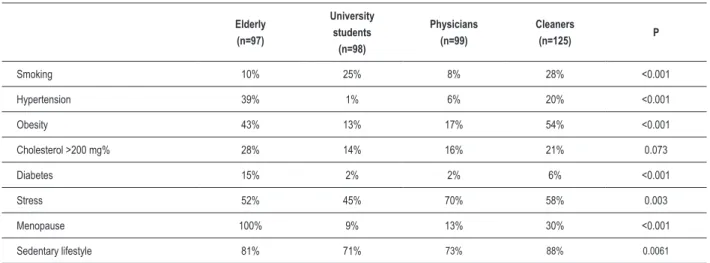
Following the line of primary prevention, we assessed the presence of RF in the female gender8. For this purpose, 419 women were interviewed. Of these, 97 were elderly women from a nursing home, 98 were university students, 99 were physicians, and 125 were cleaners working in hospitals. The mean age was 43 years, higher than when the group of postmenopausal women was excluded. Blood pressure was taken and cholesterol was determined. As expected, the older women had a higher prevalence of cardiovascular RF such as hypertension, diabetes, obesity, and hypercholesterolemia (Table 1). However, it was among the cleaners that we found the most significant alterations, although their age range was similar to that of the physicians and university students. In this group, cholesterol levels higher than 200 mg/dL and the presence of hypertension were similar to those found in the elderly; however, smoking, obesity and sedentary lifestyle were more prevalent in relation to the other groups, and diabetes only in relation to the group of physicians and university students. Thus, we came to the conclusion that the socioeconomic level probably had a negative influence on the presence of RF for CVD. In the case of underprivileged children, we can speculate that the poverty condition leads them to a better risk profile for heart diseases. When they grow up, however, they have some possibility to make decisions in relation to their life habits. This fact, associated with lack of information, makes them lose that initial protection and start to face a higher risk8. This is, therefore, another group that requires early intervention.
Table 1 - Prevalence of risk factors in women.
Elderly (n=97)
University students
(n=98)
Physicians (n=99)
Cleaners
(n=125) P
Smoking 10% 25% 8% 28% <0.001
Hypertension 39% 1% 6% 20% <0.001
Obesity 43% 13% 17% 54% <0.001
Cholesterol >200 mg% 28% 14% 16% 21% 0.073
Diabetes 15% 2% 2% 6% <0.001
Stress 52% 45% 70% 58% 0.003
Menopause 100% 9% 13% 30% <0.001
Sedentary lifestyle 81% 71% 73% 88% 0.0061
Statistical tests used: chi square test and Student’s t test
Table 2 - Prevalence of risk factors by gender
Women %
Men
% P
Hypertension 73 54 < 0.0001
Family history 59 50 < 0.0001
Former smoking 30 50 < 0.0001
Dyslipidemia 54 44 < 0.0001
Sedentary lifestyle 55 42 < 0.0001
Diabetes 24 20 0.026
Obesity 22 10 < 0.0001
Smoking 9 11 0.10
Peripheral vascular disease 1 2 0.51
> 2 risk factors 63 41 < 0.0001
Student’s t test for independent samples or Mann-Whitney test
Age < 55 years %
Age > 65 years %
Family History 58 46 0.005
Former smoking 56 46 0.028
Obesity 15 8 0.008
Smoking 15 5 < 0.0001
Hypertension 56 56 0.93
Dyslipidemia 51 52 0.77
Sedentary lifestyle 47 42 0.45
Diabetes 20 22 0.59
Peripheral cascular disease 3 2 few cases
> 2 risk factors 51 42 0.049
Table 3 - Prevalence of risk factors by age range.
Student’s t test for independent samples or Mann-Whitney test between smoking and diabetes, and between smoking and
hypercholesterolemia10. Among those who develop CAD at an early age, it seems that the assessment is easier because of the presence of several RF in the same patient, which permits a possibly more efficient primary prevention. We should remember that CAD in this group is usually more severe due to the rapid progression of atherosclerosis and its preferential localization in the anterior descending artery in 67% of 114 patients hospitalized with history of ACS10.
With the purpose of including a greater number of patients from a wider age range, we conducted a cross-sectional evaluation of a population of 2337 coronary patients treated on an outpatient basis, with ages ranging from 26 to 89 years, of whom 61% were men11. In this
sample, we found a higher prevalence of RF among women. Likewise, the prevalence of individuals with three or more RF was also higher among women (Table 2). When individuals aged 55 years or younger were compared to those aged 65 years or older, we verified a significantly higher frequency of family history, former smoking, obesity, current smoking, and presence of three or more risk factors in the first group (Table 3)12.
When these data are analyzed together, it seems that adults with lower economic power have a higher cardiovascular risk due to the higher prevalence of RF, which does not occur during childhood. We can conclude that, in this case, better information/education could influence and modify this situation. In relation to gender and age, it seems easier to identify those who are more likely to develop
Arq Bras Cardiol 2009; 93(3) : e42-e44
Scherr & Ribeiro Gender, age, social level and CV risk factors
e43
1. Ford ES, Ajani UA, Croft JB, Critchley JA, Labarthe DR, Kottke TE, et al. Explaining the decrease in U.S. deaths from coronary disease, 1980-2000. N Engl J Med. 2007; 356: 2388-98.
2. Piegas LS, Avezum A, Pereira JC, Neto JM, Hoepfner C, Farran JA, et al. AFIRMAR Study Investigators. Risk factors for myocardial infarction in Brazil. Am Heart J. 2003; 146: 331-8.
3. McGill HC Jr, McMahan CA, Gidding SS. Preventing heart disease in the 21st century: implications of the Pathobiological Determinants of Atherosclerosis in Youth (PDAY) study. Circulation. 2008; 117: 1216-27.
4. Ministério da Saúde. Datasus: informações de saúde. [Acesso em 2008 Nov 25]. Disponível em: http://tabnet.datasus.gov.br/cgi/tabcgi. exe?idb2007/c04.def
5. Laurenti R, Buchalla CM. Os mitos a respeito das doenças cardiovasculares. Arq Bras Cardiol. 2001; 76: 99-110.
6. Ribeiro RA, Mello RG, Melchior R, Dill JC, Hohmann CB, Lucchese AM, et al. Annual cost of ischemic heart disease in Brazil: public and private perspective. Arq Bras Cardiol. 2005; 85: 3-8.
References
7. Scherr C, Magalhães CK, Malheiros W. Lipid profile analysis in school children. Arq Bras Cardiol. 2007; 89: 65-70.
8. Scherr C, Magalhães CK, Silva LJD, Anello A, Sá MR. Fatores de risco para coronariopatia no sexo feminino. Arq Bras Cardiol. 2000; 74 (supl 1): 25.
9. Scherr C, Loyola LH, Rivas MBS, Ferreira MF. Análise da prevalencia dos fatores de risco em adultos jovens coronariopatas: estudo retrospectivo. Rev SOCERJ. 1997; 10 (supl A): 13.
10. Scherr C, Pontes PV, Alves PM. Cardiopatia Isquêmica até os 45 anos: análise da prevalência de fatores de risco coronariano. Arq Bras Cardiol. 1992; 59 (supl I): 125.
11. Scherr C, Abitibol RA, Noe R. Fatores de risco para doença coronariana - um problema ainda não solucionado. Rev Soc Cardiol Estado de São Paulo. 2005; 15: 94.
12. Scherr C. Impacto de um programa de controle de fatores de risco para doença arterial coronária obstrutiva. São Paulo: Editora Best Point; 2005.
13. Ciorlia LA, Godoy MF. Cardiovascular risk factors and mortality: long-term follow-up (up to 20 years) in a preventive program carried out by occupational medicine. Arq Bras Cardiol. 2005; 85: 20-5.
atherosclerosis by considering the greater accumulation of RF among women and younger individuals. We should remember that these are the groups with the worst outcome when presenting CAD.
Studies have demonstrated the benefits of RF control, as is the case of Ciorlia and Godoy’s study13 with follow-up of follow-up to 20 years. In this context, we can conclude that there is a high possibility of changing the incidence of, and perhaps mortality from, CAD using awareness and prevention campaigns, such as those for breast cancer, dengue and AIDS.
Potential Conflict of Interest
No potential conflict of interest relevant to this article was reported.
Sources of Funding
There were no external funding sources for this study.
Study Association
This study is not associated with any post-graduation program.
Arq Bras Cardiol 2009; 93(3) : e42-e44
Scherr & Ribeiro
Gender, age, social level and CV risk factors