Arq Neuropsiquiatr 2008;66(2-A):264-267
264
DURAL ARTERIOVENOUS FISTULA
PRESENTING AS ThALAmIc DEmENTIA
Mariangela Barbi Gonçalves
1, Orlando Maia Jr
2, Jorge Luiz Amorim Correa
3,
Sávio Boechat Primo de Siqueira
4, Daniel de Holanda Christoph
4, José Alberto Landeiro
5DEmêNcIA TALâmIcA SEcUNDáRIA A FISTULA ARTERIOVENOSA DURAL
Serviço de Neurocirurgia do Hospital de Força Aérea do Galeão, Rio de Janeiro RJ, Brasil (HFAG): 1Médica Residente do Serviço de Neurocirurgia do
HFAG, Mestre em Neurociências pela Universidade Federal do Estado do Rio de Janeiro, Brasil (UNIRIO); 2Neurocirurgião Endovascular do Serviço de
Neurocirurgia do HFAG; 3Médico Assistente do Serviço de Neurocirurgia do HFAG; 4Médico Residente do Serviço de Neurocirurgia do HFAG; 5Chefe
do Serviço de Neurocirurgia do HFAG, Professor Adjunto da Disciplina de Neurocirurgia da Universidade Federal Fluminense, Brasil (UFF). Received 11 December 2007. Accepted 27 February 2008.
Dra. Mariangela Barbi Gonçalves – Rua Nina Rodrigues 72/602 - 22461-100 Rio de Janeiro RJ - Brasil. E-mail: [email protected]
Dementia implies the decline of intellectual abilities or cognitive function. It is also characterized by behav-ioral abnormalities and changes in personality1. One
un-usual cause of dementia, characterized mainly by amnes-tic syndrome, apathy, speech and language disturbances, hypersomnia, vigilance disorder and vertical gaze palsy, is due to thalamic lesion that led to the term “thalamic dementia”2-4. This is related to the known thalamic
con-nections with cortical nucleus concerned with memory process, cognition and behavior, the thalamo-fronto-lim-bic loops5,6. Intracranial dural arteriovenous istula (AVF)
with venous drainage into internal cerebral veins and con-sequently venous hypertension is uncommon and may be associated with thalamic injury. Dural AVF consists of ab-normal shunting of blood between the meningeal branch-es or rarely cortical branchbranch-es of the external, internal ca-rotid or vertebral arteries, and the venous system, embed-ded in the dural lealets of a venous sinus to form the ni-dus7-10. Capillary beds usually interposed are lacking7.
In-tracranial dural AVF represent approximately 10% to 15% of all intracranial vascular malformations8,9,11-13.
Since the posterior fossa dural AVF and subsequent venous hypertension is important to be considered in the different diagnosis of thalamic lesions14, we report an
unique case of thalamic dementia associated with venous hypertension in the bilateral thalamus due to a dural AVF that was successfully treated by endovascular procedures.
cASE
A 43-year-old man, air professional, coursing political sci-ence master, presented subacute onset of apathy and memory deicit. Initially, the symptoms were stress misdiagnosed. Nev-ertheless, his symptoms worsened progressively. On admission, the patient was awake but confuse in time. There was neither headache, neither visual impairment nor vomits. The thorough neurological examination revealed critical sense mild compro-mised and amnesia, predominately of recent events. No signii-cant medical history was related.
The optic fundi were normal. There was no signal of
Arq Neuropsiquiatr 2008;66(2-A)
265 Thalamic dementia: arteriovenous istula Gonçalves et al.
cranial hypertension, and the neurological symptoms were re-stricted to cognitive dysfunction. The blood pressure was nor-mal. Thus, investigation of another cause of dementia began. The laboratories exams such as endocrinology and inlammato-ry tests, syphilis antibody and complex B vitamin dosage were normal. No infection preceding the onset of symptom was re-lated. A computed tomography (CT) scan of the brain was com-patible with a major arachnoid cyst, that involved the right
fron-tal and temporal lobes, with little shift of midline and osseous remodeling.
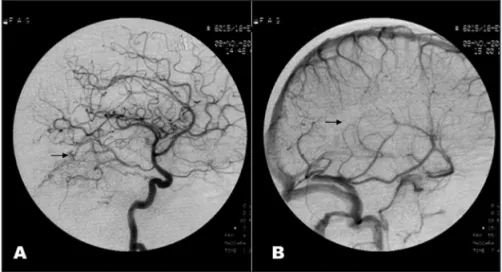
Magnetic resonance image (MRI) showed FLAIR-high signal lesions in both thalamic areas (Fig 1A), with no alterations on diffusion or perfusion sequences. Cerebral angiography (Fig 2A) showed a tentorial dural AVF, type IIa+IIb according to the Cog-nard classiication and type II according to the Borden classiica-tion, fed by the meningo tentorial branches of the right internal
Fig 2. Cerebral angiography of the right inter-nal carotid artery, lateral projection, on the ar-terial fase (A) shows a dural AVF (arrow), and on the venous fase (B) a poor profund venous drainage (arrow), without visualization of the internal cerebral veins, draining to supericial and petrouses veins.
Fig 3. Cerebral angiography of the right exter-nal carotid artery, lateral projection, shows (A) a dural istula (arrow), feeding a dural venous aneurysm (arrowhead). (B) Selective catheter guide on the occipital artery, with microcath-eter ultra low on the origin of the dural is-tula (arrow).
Arq Neuropsiquiatr 2008;66(2-A)
266
Thalamic dementia: arteriovenous istula Gonçalves et al.
carotid artery and meningeal branches of the occipital artery of the right external carotid artery (Fig 3A). Retrograde low through the basal cortical veins, the internal cerebral veins and the vein of Galen with straight sinus arterialization was evident (Fig 2B). Accordingly, the diagnosis of bithalamic venous infarction secondary to increased deep venous pressure around the bas-al ganglia and consequently dificult of venous drainage due to arteriovenous istula was done.
Considering the cerebral angiography indings, endovascu-lar embolization was performed as treatment. By means of se-lective arterial microcatheterism, ultra low microcatheter was navigated into the right occipital artery and into as many ar-teries supplying the tentorial dural AVF as possible (Fig 3B). The dural AVF was then completely occluded with a liquid adhe-sive embolic agent (OnyxTM - MTI) via the right external carot-id artery approach (Fig 4A). Post-embolization angiography re-vealed angiographic occlusion, with marked devascularization of the dural AVF (Fig 4B). The tentorial draining veins immedi-ately reopened, and the low through deep cerebral venous sys-tems was restored. There was no thrombosis of venous system, but venous congestion.
Three months after the interventional therapy, MRI showed absence of FLAIR-high signal thalamic lesions (Fig 1B). Clinical evaluation revealed a completely improvement of memory and cognitive status. The patient also returned to work and study.
Approval was obtained from the hospital’s Ethics Commit-tee and the patient’s informed consent for publication of this case report.
DIScUSSION
Progressive dementia caused by venous congestion in bilateral thalamic areas associated with dural AVF is rare14.
The so-called thalamic dementia, when secondary to an intracranial dural AVF as in our patient is considered a reversible dementia as symptoms recover after interven-tional therapy4,14.
Dural AVF can be presented through multiple clinical symptoms depending on the location, size of the lesion, low, and venous drainage of the dural AVF7,15,16. Memory or
behavior impairment may occur, as shows our patient, due to retrograde low into the tentorial veins leading to venous hypertension, which can result in cerebral edema and associ-ated neurological deicits due to bilateral thalamic lesions15,16.
Venous congestion in the thalamus of our patient may have been caused by tentorial venous relux to the straight sinus, vein of Galen and consequently to the internal ce-rebral veins and the basal vein. The thalamic veins from the superior and medial portions of the thalamus drain into the internal cerebral or great veins, and those from the inferior and lateral portions of the thalamus drain into the basal vein or its tributaries17. So the drainage of the
is-tula to the thalamus produces a decrease in the arteriove-nous pressure gradient and ischemia8. This is explained by
chronic passive congestion following retrograde increase in venous pressure toward the thalamic venous drainage territory4,14. If venous thrombosis were the primary disease
we should not expect normal sinus blood low immedi-ately after the occlusion of the dural AVF.
In the setting of subacute cognitive deicit, the diagno-sis of deep cerebral vein thrombodiagno-sis must be considered when neuroimage exams show bilateral thalamic changes. Accordingly, the patient was submitted to a cerebral an-giography, gold standard for evaluation of dural AVF9, via
transarterial approach. This angiography demonstrated tentorial dural AVF fed by the right internal (meningo tentorial branches) and external carotid artery (occipital artery) and drained by the straight sinus and the internal cerebral veins. The straight sinus originates behind the splenium of the corpus callosum at the union of the infe-rior sagittal sinus and the great vein. It continues posteri-orly and downward in the junction of the tentorium and falx. It may drain into either transverse sinus, but most commonly drains predominantly into the left transverse sinus17. Those angiographic indings were correlated with
our patient clinical presentation of the tentorial dural AVF and conirm that the thalamic symptoms were related to the venous character and depended on the territory of the draining veins of the dural AVF.
In this case, with arterialization of the straight sinus that becomes dysplastic, increment of venous pressures can promote the formation of venous aneurysms, thereby augmenting the potential for intracranial hemorrhage7,18.
On the basis of researchers’ indings, it is now generally accepted that the venous drainage prototype of dural AVF is the most predictive factor that predispose to the risk of these aggressive dural AVF symptoms, with focal neu-rologic deicits or hemorrhage12.
Although several classiication systems have been de-veloped to enable prediction of dural AVF risks with the purpose of better decision about treatment, those devised by Cognard et al.12 and Borden et al.19 are the most
common-ly used11. This case, type IIa+IIb according to the Cognard
classiication and type II according to the Borden classiica-tion, was at risk to present potentially devastating venous hypertension due to high low dural AVF drainage into a si-nus with insuficient antegrade venous drainage and relux. Pathophysiologic mechanism of the thalamic demen-tia of this patient is venous hypertension of the thalamus. Retrograde arterial low into the venous system promotes high pressure that is thought to be a signiicant cause of venous congestion8.
There is a general agreement that embolization have become the irst-line treatment8,15. Venous drainage is the
Arq Neuropsiquiatr 2008;66(2-A)
267 Thalamic dementia: arteriovenous istula Gonçalves et al.
goal is complete occlusion15. In that case the strategy of
embolization is to catheterize and embolize the origin of the istula until it is obliterated20, as we have done.
Bilateral thalamic lesions have a poorer neurobehavior-al prognosis than unilaterneurobehavior-al one. Persistent dementia and severe amnesia often occurs rather than improvement of cognitive and behavioral functions21. Nevertheless, our
pa-tient postoperative neurological evaluation revealed an im-provement of memory and cognitive status, that is probably correlated to functional outcome of venous better than ar-terial infarctions22. The improvement in clinical symptoms
and MRI indings would propose that the thalamic lesions reveal venous hypertension, differing from infarction16.
Bilateral lesions of the thalamus characteristically present with speciic neurological and neuropsychologi-cal patterns, like mood and behavior changes and memory dysfunction2,6. Impairment of the thalamus caused by
ve-nous hypertension must be differentiating from infarction as the cause of the neurological symptoms. In such cases, while venous occlusion involves anticoagulation treat-ment, which might lay the patient with dural AVF at con-siderable complications risk. As a result, the association between thalamic dementia and dural AVF should be con-sidered. Interventional therapy can lead to angiographic occlusion and resolution of the symptoms.
REFERENcES
1. Victor M, Rooper A. Dementia and the amnesic (Korsakoff) syndrome. In Victor M, Rooper A (Eds). Adams and Victor´s principles of neurol-ogy. 7.Ed. New York; McGraw Hill 2001;21:444-461.
2. Carrera E, Bogousslavsky J. The thalamus and behavior: effects of an-atomically distinct strokes. Neurology 2006;66:1817-1823.
3. Schmahmann JD. Vascular syndromes of the thalamus. Stroke 2003;34: 2264-2278.
4. Tamamoto F, Nakanishi A, Takanashi T, et al. Unexpected accumula-tion of thallium-201 in bilateral thalamic venous infarcaccumula-tion induced by arteriovenous istula in the posterior fossa: report of a case. Ann Nucl Med 2003;17:239-243.
5. Cargioli-Vila MV, Carriquiry-Berner F, Vargas-Cañas A. Demencia se-cundaria a infarto talámico: comunicación de un caso. Rev Neurol 2004;38:443-445.
6. Kumral E, Evyapan D, Balkir K, Kutluhan S. Bilateral thalamic infarc-tion: clinical, etiological and MRI correlates. Acta Neurol Scand 2001; 103:35-42.
7. Holland MC, Holland EC, Martin NA. Clinical presentation and diag-nostic evaluation of intracranial arteriovenous malformations. In Tin-dall, Cooper, Barrow (Eds). The practice of neurosurgery. Baltimore: Williams & Wilkins 1996;2(6-3):142.
8. Li J, Ezura M, Takahashi A, Yoshimoto T. Intracranial dural arterio-venous fistula with arterio-venous reflux to the brainstem and spinal cord mimicking brainstem infarction-case report. Neurol Med Chir (Tokyo) 2004;44:24-28.
9. Tantuwaya LS, Bailes JE. Surgical management of cranial dural arterio-venous istulas. Neurosurgical operative atlas 1997;6:75-83. 10. Awad IA. Dural arteriovenous malformations. In Tindall, Cooper,
Bar-row (Eds). The practice of neurosurgery. Baltimore: Williams & Wilkins 1996;2(6-3):144.
11. Kiyosue H, Hori Y, Okahara M, et al. Treatment of intracranial dural ar-teriovenous istulas: current strategies based on location and hemody -namics, and alternative techniques of transcatheter embolization. Ra-dioGraphics 2004;24:1637-1653.
12. Cognard C, Gobin YP, Pierot L, et al. Cerebral dural arteriovenous is -tulas: clinical and angiographic correlation with a revised classiication of venous drainage. Radiology 1995;194:671-680.
13. Lucas CP, Prandini MN, Caldas JGMP. Analyses of the best therapeu-tic alternative for intracranial dural arteriovenous malformations. Arq Neuropsiquiatr 2005;63:605-613.
14. Ito M, Sonokawa T, Mishina H, Sato K. Reversible dural arteriovenous malformation-induced venous ischemia as a cause of dementia: treat-ment by surgical occlusion of draining dural sinus: case report. Neu-rosurgery 1995;37:1187-1192.
15. Kuether TA, Nesbit GM, Barnwell SL. Dural arteriovenous malforma-tions of the transverse and sigmoid sinuses. Neurosurgical Operative Atlas 1999;8:57-68.
16. Greenough GP, Mamourian A, Harbaugh RE. Venous hyperten-sion associated with a posterior fossa dural arteriovenous istula: an -other cause of bithalamic lesions on MR Images. Am J Neuroradiol 1999;20:145-147.
17. Rhoton AL. The cerebral veins. Neurosurgery 2002;51(Suppl 1):S159-S205. 18. Troffkin NA, Graham III CB, Berkmen T, Wakhloo AK. Combined trans-venous and transarterial embolization of a tentorial-incisural dural ar-teriovenous malformation allowed by primary stent placement in the associated stenotic straight sinus J Neurosurg 2003;99:579-583. 19. Borden JA, Wu JK, Shucart WA. A proposed classiication for spinal and
cranial dural arteriovenous istulous malformations and implications for treatment. J Neurosurg 1995;82:166-179.
20. Purdy PD, Batjer HH, Samson DS. Intracranial arteriovenous malfor-mations: endovascular treatment. In Tindall, Cooper, Barrow (Eds). The practice of neurosurgery. Baltimore: Williams & Wilkins 1996;2(6-3):148. 21. Krolak-Salmon P, Montavont A, Hermier M, Milliery M, Vighetto A. Thalamic venous infarction as a cause of subacute dementia. Neurolo-gy 2002;58:1689-1691.