sector: 1995 to 2010
Beni Trojbicz
Universidade Federal do ABC / Center for Engineering, Modeling and Applied Social Sciences São Bernardo do Campo / SP — Brazil
his paper examines changes in oil revenue management in the period from the market-oriented reforms of the 1990s to the new oil sector regulatory framework introduced in 2010. Grounded on a combination of the long-term view aforded by historical institutionalism and the tools for modelling agents’ behaviour ofered by rational choice institutionalism, it stresses the importance of ideas and associated interests in the policy outcome, considering stakeholder interaction in the process, the institutional framework, the new critical juncture, and the new domestic and international setting. he result indicates that the Brazilian oil policy follows the ideas path during the 1990s and 2000s, relecting the dominant interests in each phase. As well, the domestic economic outlook was critical to determine the extent to which the government had to follow international agencies policy recommendations.
Keywords: public policy; political economy; institutionalism; oil; Brazil; Petrobras.
Ideias e economia nas reformas das políticas públicas do setor de petróleo brasileiro: 1995 a 2010
Este trabalho examina as mudanças no gerenciamento das receitas petrolíferas desde os anos 1990, período das reformas orientadas para o mercado, até o novo marco regulatório do petróleo aprovado em 2010. Baseado na combinação da perspectiva de longo-prazo do institucionalismo histórico e nas ferramentas para modelar o comportamento dos agentes do institucionalismo da escolha racional, o estudo sublinha a importância das ideias e dos interesses no resultado da política pública, considerando a interação dos atores no processo, o marco institu-cional, novas conjunturas críticas e conigurações nacionais e internacionais. Os resultados indicam que a política pública de petróleo no Brasil segue uma trajetória calcada nas ideias vigentes durante o período, reletindo os interesses dominantes em cada fase. Além disso, a situação econômica doméstica teve papel-chave ao determinar a necessidade de seguir as recomendações de políticas econômicas das organizações inanceiras internacionais.
Palavras-chave: política pública, economia política, institucionalismo, petróleo, Brasil e Petrobras.
Ideas y economía en las reformas de las políticas públicas del sector de petróleo brasileño: 1995 a 2010
Este trabajo examina los cambios en la gestión de los ingresos petroleros desde el período de las reformas orientadas al mercado de los años 1990 hasta el nuevo marco regulatorio del petróleo aprobado en 2010. Basado en la combi-nación de la perspectiva a largo plazo del institucionalismo histórico y en las herramientas del institucionalismo de la elección racional para modelar el comportamiento de los agentes, el estudio subraya la importancia de las ideas e intereses en el resultado de la política pública, considerando la interacción de los actores en el proceso, el marco institucional, nuevas coyunturas críticas y coniguraciones nacionales e internacionales. Los resultados indican que la política pública de petróleo en Brasil siguió la trayectoria de las ideas durante el período, relejando los intereses dominantes en cada fase. Además, la situación económica doméstica desempeñó un papel clave al determinar la necesidad de seguir las recomendaciones de políticas económicas de las organizaciones inancieras internacionales.
Palabras clave: política pública; economía política; institucionalismo; petróleo; Brasil; Petrobras.
DOI: http://dx.doi.org/10.1590/0034-7612158380
1. INTRODUCTION
In her inaugural speech, President Dilma Roussef referred to Brazil’s pre-salt oil deposits1 as a source
of revenue for improving public services, reducing poverty and conserving the environment:
My government will have the responsibility of turning the enormous wealth obtained in the pre-salt beds into long-term saving able to provide present and future generations with the better part of that wealth, converted over time into efective investments in quality public services, poverty reduction and environmental value enhancement. We will shun hasty spending, which reserves only debts and despair to future generations. [Brazil, 2011]
his discourse clearly leans towards social democracy, premised as it is on the social distribution of outcomes from economic growth (Przeworski, 1991). By no coincidence it echoes elements of the regulatory framework introduced in 2010, given that Dilma Roussef, as a highly inluential minister of the Lula government, was the main architect of the new policy. Meanwhile, both the speech and the new regulatory framework contrast with the essence of the previous regulatory framework approved in 1997, which was more liberal.
his paper examines changes in Brazil’s oil revenue management model in the period from 1995, when the Constitution was amended to permit passage of the 1997 Oil Law, to 2010, when new laws reshaping the sector’s new regulatory framework were enacted. It aims at explaining the pathway between these two legal frameworks, considering that each represents a diferent regulatory model.
In order to explain this pathway, it will be shown that ideas are central to explaining these changes, not only because they ofered novel solutions to existing problems, but also because of how they were adapted to interests (Hall, 1993). he economic context is also a constraint on public policy outcomes: a key element in the government’s remaining in power was its ability to generate economic success in order to provide social spending. To achieve that in a globalized economy, however, it depended on international actors for investment (Sola, 2011). Considering the institu-tional framework, the new critical juncture and the new domestic economic and political settings, this study seeks to show the process in which those variables interacted to generate the two new regulatory frameworks.
From an empirical standpoint, this analysis is interesting for at least three reasons. he irst relates to oil sector processes. he Brazilian case is an example of movement towards sector deregulation in the 1990s and then increasing State intervention in the 2000s, indicating reform processes that can serve as parameters for understanding changes in other countries. In addition, ater oil was discovered in ultra-deep waters on Brazil’s Continental Shelf, the oil sector became increasingly important to the future of Brazilian industry and to the national economy. In that respect, this study contributes to an improved understanding of Brazil’s development prospects. Lastly, the study makes it possible to
1 ‘Geological location of rocks and oil reservoirs beneath the Earth’s crust under the salt layer with ocean subsoil depths ranging from
understand and situate a leading Brazilian corporation — Petrobras, Brazil’s national oil enterprise — in the present scenario, in terms of its role and inluence on the new legislation and of how it is inluenced by related outcomes.
his last point needs some qualiication as Petrobras turned the center of an extensive corruption scandal, that created a disorder in the Brazilian political system. hus, the study objective is both historical and analytical. Historical in the sense that it provides a public policy perspective into a subject that is generally approached through technical or economic lenses, modelling the agenda setting and policy formulation in a diferent way. his leads to the analytical realm, as the study of-fers a perspective that organizes the oil policy path in Brazil in a way that can only be achieved with time-distanced perspective. In this regard, the study is an update in Brazil oil policy only to the extent that consistent policy analysis can aford. However, as there are important updates on this sector since 2010, this work’s conclusion will point to the post-2010 changes, in order to indicate how fortune reversals afected the 2010 Oil Act elements.
From the theoretical standpoint, this analysis illustrates the dynamic in which the comprehensive view of new historical institutionalism is combined with the tools of rational choice institutionalism, which make it possible to understand moments of change.
he methodology and theoretical frame of reference applied in this study are described in the next section. In the analysis section, the theoretical model is used as a guide in identifying the components to be included in the study. he section begins by describing the development of the economic ideas, given that they were fundamental in determining oil policy outcomes. hen, drawing on the inde-pendent variables indicated by the chosen theoretical framework, it gives an account of the factors inluencing the formulation of the 1997 and 2010 regulatory frameworks. Lastly, the conclusion sets out some implications of the study results.
2. METHODS
his study adopts a within-case methodology, nourished by process-tracing analysis. Information is based both on primary and secondary sources — the in-depth interviewees list is in the Appendix.
he within-case methodology as the analysis strategy is due to its advantages for dealing with processes that includes critical-junctures, as it allows a detailed and holistic process evaluation which helps understanding how causal mechanisms operates in speciic contexts. his is more accurate for the case studies that adopts process tracing analysis in order to explain unique events, uncovering variables that are not evident (George and Bennett, 2005). Moreover, within-case studies are better indicated for research objectives that include hypothesis formulation, searching for internal validity, and where the causality is based on mechanisms (Gerring, 2007).
In the other hand, process tracing is indicated to identify intervenient mechanisms (Mahoney et al., 2007), being crucial for small samples analysis (Tilly, 1997), because it highlights diferences between causal mechanisms correlations (Mahoney, 2003).
yield increasing returns (‘positive feedbacks’). hese concepts relating to the establishment of long-term trajectories ofer the possibility of including the impacts that institutions cause long in advance of the moment under analysis, as well as the processes that institutions set in motion. However, one relevant criticism is that NIH fails to explain the choice of actors, because it deals with ‘critical junc-ture’ periods, such as moments of contingency, when choices taken have momentous, but almost completely unpredictable, impacts on the future (Mahoney, 2005).2
One solution for explaining moments of heightened contingency would be to use the new Rational Choice Institutionalism (RCI), which ofers tools for modelling actors’ choices at critical junctures. In that regard, actors’ choices are instrumental decisions consciously taken on the basis of existing institutional arrays, making it possible to explain options, potential payofs and actors’ preferences. RCI theories suited to this kind of use would meet certain requirements. First, they should operate in terms of bounded rationality, but they should not exclude the use of inductive method in determining actors’ goals. Second, they should make it possible to understand situations of critical juncture and the concept of path dependence, as perceived by NHI theories (Mahoney, 2005). hat is, it is necessary to use rational choice theories that are not at odds with a historical understanding of the situation, and admit the use of inductive method, but also allow moments of change to be understood as periods when decisions taken tend to be diicult to alter, as well as having relatively greater future impacts.
To summarise, the theoretical pathway combines the complementarity between RCI and NIH. While NIH identiies critical junctures at which actors’ choices entail embarking on long-term tra-jectories that are diicult to modify, RCI makes it possible to analyse strategic decisions taken in times of change. he combination of the two approaches gives a more complete understanding of long-term processes, including mechanisms by which actors make choices at decisive moments. In this way, RCI is used to complement NIH in order to model actors’ behaviour at critical junctures.
Speciically, the Institutional Analysis and Development Framework (IAD), an analytical tool developed by Ostrom (2007), will be used for the RCI analysis in keeping with two principles. Firstly, it is the actors’ proclivity that decides which of the available behavioural options will be taken. In addition, decisions are understood using the actor’s subjective view at the moment the decision is taken. his recommendation, assumes that values which the actor attributes to the elements of the model do not relect any objective reality, but rather the actor’s own subjective view (Mahoney, 2005).
IAD is a theoretical framework within the RCI ield, developed in order to study how political science paradigms afected the way public administration and metropolitan organisations were conceptualised (Ostrom, 2007:46), and was used to study common-pool resources, in areas relating to irrigation, forest resources and, more recently, ecological systems, biodiversity preservation, co-operatives, isheries and others.
he IAD model, as outlined in igure 1, is made up of three parts. he irst comprises the model’s three independent variables: status quo, culture and institutions. he second is the dependent variable, comprising three interrelated components: ‘action arenas’, through which ‘patterns of interactions’ lead to ‘outcomes’. Finally, the model also includes the possibility of using ‘evaluative criteria’ on both the ‘patterns of interactions’ and the ‘outcomes’.
It should be outlined that culture, as an independent variable, encompasses ample visions of reality that condition the way ideas evolve, and shape public policy pattern in the long run. In this regard, as explicit in igure 2 and 3, culture includes ideas and ideology, but is not limited to it.
FIGURE 1 INSTITUTIONAL ANALYSIS AND DEVELOPMENT FRAMEWORK
Status quo (physical and material conditions)
Culture (attributes of the
community)
institutions (rules in use)
Arena of action
Situation of action
Actors
Patterns of interaction
Evaluation criteria
Outcomes
Source: Ostrom (2007).
Rather briely, IAD is a multi-level conceptual map, in which the core of the analysis consists in ‘action arenas’, which indicate the social space where the individuals interact, exchange goods and services, solve problems, dominate one another or ight (Ostrom, 2007:28). Action arenas are conditioned by the existing status quo, culture and institutions and, in the action arena, patterns of interactions are generated which lead to outcomes. IAD proposes applying evaluative criteria to both patterns of interactions and outcomes. he evaluative criteria highlight the components that guide actors’ decisions. Lastly, the outcomes afect both the action arena and its conditioning factors: status quo, culture and institution.
pol-icy formulation, it starts with culture (or ideas) as the independent variable. However, it does not preclude the inverse causality.
3. ANALYSIS
3.1 ECONOMIC IDEAS IN BRAZIL
As this study argues for the importance of ideas in oil policymaking in Brazil, that will be the starting point of the analysis. As is well known, between 1930 and 1980, Brazil pursued a devel-opment policy that included substantial State intervention in markets. hat period ended with the debt crisis of 1982, a milestone in contemporary Latin American history, because it interrupted a period of economic prosperity based on a model where the State played a key role in promoting development. Highly-indebted countries that, like Brazil, had heavily borrowed from commercial banks during the 1970s were the most hard-hit, as the recession reduced their capacity to generate foreign exchange, while higher interest rates increased the strain of debt service (Almeida, 2001; Arienti, 2010; Portela, 1994).
In contrast with the multilateral institutions’ orthodox recommendations for tackling the crisis, the guidelines that prevailed in Brazil’s 1988 Federal Constitution included a number of national-de-velopmentalist provisions. hese constitution features became stumbling blocks to the process of market-oriented reforms initiated by the Fernando Henrique Cardoso (FHC) government and raised calls for constitutional amendments. It was not until the Real Plan3 had assured monetary stability that
structural reforms were introduced to reshape relations between State and society. hose reforms — including market deregulation, privatisation of State assets and economic openness — were carried out during the irst FHC administration (1994-98) (Couto and Abrucio, 2003:277).
From the 2000s, a slow decline in neoliberal hegemony initiated, evidenced by the failure of the 1990s neoliberal reforms, greater economic growth in countries that — like China and India — had taken diferent paths, and the rise of progressive or centre-let governments in Latin American coun-tries. Moreover, there was now mounting evidence of the need for the State to regulate the market, especially in the light of the 2008 inancial crisis and China’s growing importance in the world econ-omy: its increasing demand for commodities galvanised a number of countries (especially Brazil) and aforded greater latitude in adopting novel ideas of how the economy was to be conducted (Miguel, 2011; Gaitán, 2011; Evans, 1993; Rodrik, 2007; Diniz, 2011; Boschi, 2011; Loureiro, 2012:17; Barros de Castro, 2008).
Ideas do not materialise from the void; instead, they appear as solutions to existing problems and are anchored in concrete, material political interests. Peter Hall (1993:275-276) illustrates this dynamic in the United Kingdom, where in the late 1970s Margaret hatcher reoriented the nation’s macroeconomic policy in line with the monetarist paradigm. By advocating a diferent economic
3 he Real Plan was a successful stabilisation plan introduced in Brazil in 1994, that was able to end an era of very high inlation. he
paradigm, she managed — besides accommodating pressure from interest groups — to transfer to herself, in political terms, what the monetarist model promised economically. One example was curbing the power of the trade unions, a prior condition for maintaining the Conservative Party in power (Hall, 1993): the demise of the preceding Labour and Conservative governments was regarded as having resulted from their lack of control over union-led strikes (Gourevitch, 1986). In addition, the new canon was supported by the English media and by the inancial sector, its main direct benei-ciary (Hall, 1993:286-290). In short, this example shows how the process in which these ideas gained legitimacy was linked to the demand for solutions, but also to party political preferences (reducing the power of the trade unions), political interests (electoral victory), economic beneits (inancial sector) and support from sectors of society that would beneit from the changes (media and inancial sector). his attests to the fact that ideas do not lourish to the detriment of interests, but rather in combination with them.
French economic policy of the early 1980s is particularly useful to illustrate the Brazilian case. Unlike other advanced capitalist countries, France actually turned away from the post-war social democratic consensus to adhere to a more letist economic programme. he departure from the norm attempted in the irst year of Mitterrand’s administration represented an escalation of the trend. However, recessive world conditions stemming from the United States’ restrictive macro-economic policy adopted in 1981 prevented the continuity of this movement, as France’s interna-tional economic integration made it dependent on foreign capital for its exports and investments (Gourevitch, 1986).
he similarities between this and the Brazilian case rest on how important the country’s interna-tional placement was to its policymaking. As the 1997 Oil Act analysis will show, during the Cardoso administration, Brazil endured a barely satisfactory economic situation and depended on validation by multilateral bodies to gain the conidence of foreign investors. hus, its international position signiicantly inluenced the government’s receptiveness to ideas advanced by multilateral bodies (Loureiro, 2012; Oliveira and Turolla, 2003, Kugelmas, 2011).
he intention here is to underscore that Brazil’s vulnerable economic situation during the 1990s made it dependent on foreign investment to generate growth and, accordingly, dependent on the inter-national organisations’ approval in order to increase the capital low into the country. he constraints that globalisation imposed on the economic dimension, their inluence relected in the government’s potential to meet public demands and in its approval ratings, pointed to the need to apply measures aligned with the international organisations’ recommendations not just as economic imperatives, but also as a strategy for maintaining the incumbent government in power, as will be shown below.
3.2 EMERGENCE OF THE 1997 OIL LAW
FIGURE 2 EMERGENCE OF 1997 OIL LAW
Stabilisation agenda widely supported
International neoliberal hegemonyl
Unstable isical and exchange situation
Foreign currency reserves low
Unstable foreign settings
Heavy foreign indebtedness
Medium-sized oil reserves
Support for FHC
Constraint on developmentalist
polices
Economic liberalisation to attract foreign
capital
Extract oil as quickly as possible
Arenas of Action
Oil Law
CA9
CA6
Vargas legislation
Petrobras monopoly
Status quo Culture Institutions
Captions
Source: Elaborated by the authors.
he rise of neoliberal ideology had great inluence on Brazilian public oil policy outcomes in the 1990s: this was the period when the liberalisation then ongoing was structured substantially in Brazil and succeeded in removing constitutional hurdles, which had never been achieved before (Couto and Abrucio, 2003).
his structuring is connected with the international position Brazil came to assume ater the 1982 debt crisis, when it became more vulnerable to pressure from the multilateral bodies, which in turn were dominated by the interests of the central capitalist countries, especially the United States and its inancial sector (Portella, 1994; Arienti, 2010).
Since the debt issue was not settled until the early 1990s, throughout the 1980s Brazil was a debtor to the multilateral bodies and, as a result, had very little public and foreign investment. Actually, this was the key factor accounting for its low economic growth rates, which afected the government’s capacity to provide well-being to the population, in addition to contaminating the government’s popularity ratings (Sola, 2011).
insur-mountable barriers. For most of the FHC administration, relations between the government and the legislature were not based on the Executive’s isolation or autonomy, as is evidenced by its need to negotiate to approve the new legal framework. hus, even though the Executive did play a pivotal role in setting the agenda of reforms to align State and market (Almeida, 1999:2), the Legislative managed to impose its preferences (Souza and Pereira, 2013:50).
Still in the realm of ideas, it is worth stressing that, for Brazil, the Real Plan represented a change in cognitive framework, in that the stabilisation it achieved was almost unanimously viewed as a public good to be preserved. Under that inluence, the government was unable to introduce developmentalist goals onto its agenda. By the same token, the popularity of the stabilisation agenda accounted for a substantial part of the support for President FHC, both in electoral terms and as regards his ability to retain the support of a broad coalition in Congress (Couto and Abrucio, 2003).
Two elements are thus worth highlighting as regards the efects of the Real Plan on public poli-cymaking for the oil sector. In the irst place, the Real Plan was widely supported by both public and politicians, and that support was transferred to FHC as the ‘father’ of the plan, allowing him greater room for political manoeuvring. Secondly, the very success of the Real Plan also limited the scope of the economic policies to be implemented, preventing growth targets from being introduced onto the agenda. In other words, the existing coniguration constrained the action of the economic policymakers.
Inlation control was the predominant concern throughout the period: achieving single-digit in-lation both met a basic, necessary condition for any strategy to advance the country and transferred legitimacy to the president, which was used to promote market-oriented reforms. Other concerns related to this basic core were iscal adjustment, poor economic growth and the State’s lack of in-vestment capacity. he need for iscal adjustment is related to a weakly performing balance of trade and poor economic growth, while the State’s deicient investment capacity was the obverse of iscal adjustment. hese elements in combination made the policymakers’ case for attracting private capital: the State was unable to invest enough to optimise outcomes in the various reformed sectors. In the speciic case of oil, there were claimed to be no State or Petrobras funds available to invest adequately to meet the sector’s demands (Couto and Abrucio, 2003; Diniz, 2011).
Another constraint worth noting is the size of Brazil’s oil reserves at the time the Oil Law was enacted. his clariies a point where opinions diverge as to whether or not it was appropriate to introduce the new regulatory framework ater the discovery of the pre-salt oil deposits. One of the features of the 1997 regulatory framework was a iscal regime based on concessionary license agree-ments.4 he 2010 regulatory framework introduced the possibility of adopting a iscal regime based
on production-sharing agreements5 in strategic exploration areas, which the pre-salt deposits were
considered to be. To those advocating the production-sharing model, Brazil’s new status as a holder of major oil reserves was a good reason to introduce the change (Bercovici, 2011).
he size of the deposits was an important factor in the 1997 legislation, which set the remuner-ation to be ofered to concession holders. he Brazilian government’s take6 from concession regime
4 Oil iscal regime based on exploration concessions with taxes and royalty payments. he oil extracted belongs to the concession holder.
5 Oil iscal regime where the concession holder shares the proits with the State ater exploration costs are amortised. he oil is property
of the State ater extraction.
agreements is among the lowest internationally. his relects the high risk involved in exploration, that is, as exploration in a given territory may oten result in dry wells, the exploration regime must ofer returns attractive enough to encourage companies to incur such risk. In this way, Brazil’s endowment with oil reserves afected the regulatory framework. Secondly, medium-sized deposits meant a situation where oil was not exactly strategic to Brazil. Hence, the government — given the prospect of a fall in oil prices at that time (Siqueira, 2013:249), exacerbated by the world’s rising awareness of renewable energy source use — had designed a regulatory framework with a view to extracting the deposits as quickly as possible (Bercovici, 2011), so as to activate the economy and provide the State with revenues that were likely to result from increased exploration. hirdly, in the concession regime, investment in exploration is wholly funded by the concession holder, while the State begins to appropriate mineral rents immediately ater production; accordingly, that regulatory framework was consistent with a iscal situation where the State lacked inancing capacity. Supporting rapid oil extraction would also yield higher iscal revenues from associated sectors, inlows of oil exploration venture capital would increase and Brazil’s oil production chain would be strengthened, as ensured by minimum local content clauses. hese components inlu-enced policymakers, who — believing that oil extraction values would decline in future — provided higher incentives for immediate exploration than for keeping the reserves untapped underground (Bercovici, 2011; Siqueira, 2013).
he institutional framing for the oil industry consisted of legislation dating from 1938, which — despite amendments under a more liberal government (1946-1951) and during the military period (1967 Federal Constitution) — upheld the basic nationalistic features (Bercovici, 2011). In addition, detailed provisions regarding public policies entrenched in the Federal Constitution (Couto and Abru-cio, 2003) meant that reform of the sector would require constitutional amendments (Bercovici, 2011). Two constitutional amendments are of interest here: Constitutional Amendment No. 6 (CA 6) and Constitutional Amendment No. 9 (CA 9), which were necessary for the reform goals to become law.
CA 6 changed the concept of ‘national company’, giving equal treatment to all national and foreign capital companies domiciled in Brazil. A second step toward the reform was to liberalise the Petro-bras monopoly of oil-related operations written into the 1988 Federal Constitution. CA 9 withdrew the power granted to Petrobras of being the sole operator of the monopoly, though the Union still retained the monopoly over this natural resource (Bercovici, 2011:252).
CA 6 and CA 9 combined to allow foreign companies to participate in oil exploration in Brazil and ended Petrobras’s monopoly over oil exploration. Constitutional ties had been thus removed to allow the sector to be liberalised and regulated by the Oil Law.
he 1997 Oil Law features four key components, with difering levels of impact and importance. he irst component, relating to the ‘downstream’ portion of oil production,7 deregulated the prices
of oil, oil by-products and natural gas. his move was considered critical to attracting investments in the sector and was a prerequisite for building an environment attractive to private investment. he process was conducted gradually, eliminating pricelists and equating with regional prices, bringing
7 he oil production chain is considered in two stages, downstream and upstream. Downstream comprises reining, transporting,
an end to subsidies and lowering barriers to companies’ entering the distribution and selling arenas (Zylbersztajn and Agel, 2013:56).
he second component was the new dynamics of oil exploration and production, with Petrobras losing its monopoly and the regulatory National Oil Agency (Agência Nacional do Petróleo, Gás Natural e Biocombustíveis, ANP) taking on the role of public policy driver and regulator for the sector, in line with the prevailing model of State reform. Upstream actions were based on two political commit-ments. he irst was to restructure the State’s actions in the sector, with the ANP, the regulatory body, endowed with administrative and inancial autonomy. he second was to keep Petrobras under State control and operating throughout the whole oil production chain (Pires et al., 2013:84-85).
he third component introduced the concession regime in Brazil. In this system, the concession holder/licensee acquires the right to explore an area speciied by the ANP in a bidding process or ‘bidding rounds’. It then invests in that area and, in case oil struck, pays royalties and special takes to the Brazilian State in accordance to the ield’s location and productivity. he concession holder is fully responsible for investment costs and is not eligible for any kind of reimbursement or indemniication should exploration fail. he Brazilian concession model also changed payment of government and third-party shares into oil exploration rents.8
Lastly, the National Energy Policy Council (Conselho Nacional de Política Energética, CNPE), a body reporting to the Brazilian Presidency, was set up to ensure that Brazil’s energy resources are used rationally, speciically by setting national energy policy goals (Article 1). However, the CNPE was not regulated until 2000, which goes to show that its role was insigniicant during the Cardoso administration, a situation that changed under the Lula government.
As a result of the new model, oil went from 2.75% of Brazil’s GDP in 1997 to 10.5% in 2005 (Felipe, 2010:91). Moreover, Petrobras was strengthened (to which its State-owned, vertical and integrated company status contributed) and was able to preserve its autonomy and inluence, which were used to leverage its position in the new competitive setting (Felipe, 2010:275-276) and substantively increase its proitability in upstream activities, which in 2008 were worth in excess of 37 billion Brazilian re-als (BRL). he ANP, responsible for regulating the oil industry, was a key building block in the new institutional framework. One major initial challenge it faced was to replace Petrobras as the State’s agent in the sector, while at the same time regulating the national oil enterprise (Zylbersztajn and Agel, 2013:59-60).
he period following introduction of the new legislation was one of soaring oil prices, with most exporting countries managing to increase their share in oil rents. In Brazil that did not happen, however, because the concession model in place was regressive. Meanwhile, production was concen-trated in Petrobras, enabling the company to appropriate a large part of the positive earnings from oil exploration in Brazil, accounting for its signiicantly higher earnings (Felipe, 2010:272). hat is, one
8 Formerly, in addition to the taxes levied on production, royalty payments were limited to 5%. he rate now ranged from 5% to
explanation for the company’s increased value is premised on signiicant appropriation of the surplus generated by oil exploration in Brazil. However, the surplus it appropriated caused the appropriations by the Brazilian State to dwindle. he appreciation in the company’s worth ater enactment of the Oil Law can thus be said to have occurred to the detriment of Brazil’s public appropriation of oil rents. Another important consequence of the new model was that the substantial increase in oil production also substantially boosted the amounts redistributed to subnational entities in royalties and special participation payments, ultimately leading to a federative war over appropriation of these revenues.
A last word is in order about Petrobras as an actor. Even though the company had been shorn of its political monopoly of oil exploration in Brazil, it actively took part in fashioning the new law and as a result managed to maintain an economic monopoly in the sector. his was because it continued vertically integrated ater passage of the new law. In addition, according to sources interviewed for this study (complete list in the Appendix), Petrobras’s dominance in training highly skilled personnel for the sector meant that the details of the law were drated in the company’s favour, as was relected in its inancial success ater 1997.
3.3 THE 2010 PRE-SALT REGULATORY FRAMEWORK
his section reports the genesis of the 2010 regulations, starting from discovery of the pre-salt de-posits as a critical juncture that modiied the industry, ater which it considers the importance of the waning hegemony of neoliberal ideas, the favourable economic situation that Brazil was enjoying, as well as the institutional changes and the political context. It then points to the importance of the actions of President Lula and Minister Dilma Roussef. Lastly, the main points of the new legislation are detailed. hese items are outlined in igure 3, which ofers a visual summary of the emergence of the 2010 oil regulatory framework.
he new regulatory framework introduced for pre-salt exploration responded to the mismatch between the existing framework and the new situation of abundant oil reserves (Bercovici, 2011; Gobetti, 2011). It also responded to party political interests, which included replacing the previous government’s public policy, opposed by the Workers’ Party (PT) government9 (Zylbersztajn and Agel,
2013; Lucas, 2013; Pires et al., 2013).
At the same time, the new regulatory framework was formulated at a time when neoliberal ideology was falling into disarray in Brazil. As mentioned earlier, this process had to do with disappointment at the uninspiring results of the institutional reforms of the 1990s (Miguel, 2011; Evans, 1993), which in Brazil was associated with the Cardoso government’s poor economic growth record and loss of credibility on account of the 2001 energy crisis (Barros de Castro, 2008). hese speciic factors were inluential in the PT’s rise to the Presidency — a phenomenon paralleled in other countries that had implemented equally frustrating market-oriented reforms. Lastly, gestation of Brazil’s new oil regu-latory framework also proceeded under the inluence of the 2008 inancial crisis, which contributed further to the decline of neoliberal ideas (Boschi, 2011; Diniz, 2011).
9 he centre-let Workers’ Party (PT) won the 2003 presidential elections, succeeding the Social Democratic Party (PSDB), which had
FIGURE 3 EMERGENCE OF 2010 PRE-SALT REGULATORY FRAMEWORK
Weakening of neoliberal ideas
2008 inancial crisis Disappointment with market-oriented reforms
Widely supported social agenda Increased State activism
Confortable iscal and exchange situation
Commodities´shock
Foreign currency reserves high Fiscal pressure under control End of foreign debt Domestic debt high
Government with majority coalition
Vast oil reserves
Petrobras strengthened CNPE
EPE Dilma as Chief of Staff
Emphasis on energy matters Process centralised in the Executive (vs. Legislative)
Mineral resourcecurse Norwegian model
Arena of Action
Situation of Action
Actors Weak ANP
Lula strengthened
Status quo Culture Institutions
Captions
Source: Elaborated by the authors.
Brazil’s new status as a major holder of oil reserves reduced oil exploration risk to much lower levels than during drating of the 1997 Oil Law, requiring a more modest range of beneits to attract investments. On the other hand, the extraction of ever-increasing volumes of oil is a major potential source of destabilisation (identiied in the literature as the ‘resource curse’), something that Lula administration surely took into account when formulating the new oil policy.
he national economic context was beneitting from greater economic growth, largely due to major expansion in the volume and value of Brazil’s commodity exports, which in turn made it pos-sible to ease iscal pressure. Inlation had been under control for some time, allowing more room for measures to spur development. he State was thus better equipped in terms of investment capacity, which translated into greater leeway to adopt slightly more interventionist policies and to participate in investments (Barros de Castro, 2008; Filgueiras e Gonçalves, 2007; Miguel, 2011).
during the Cardoso government, regained inluence and came to dominate the process leading to the drating of the new legislation. Outcomes such as the agreement on onerous transfer of rights (cessão onerosa) and mandatory participation by Petrobras in all pre-salt exploration are seen by several sources interviewed for this study as evidence that the company was re-strengthened.
During the Lula administrations, two developments — besides the greater use being made of Petrobras as a public policy instrument — ofset the relegation of the ANP: the CNPE gained in importance and an Energy Planning Company (Empresa de Planejamento Energético, EPE) was set up. he CNPE, which had been instituted by the Oil Law, was not regulated until 2000 (three years later), relecting the lack of priority given to its role. Under the Lula government, the CNPE gained in importance and took over oil sector strategic planning, while the ANP was assigned operational activities only (Almeida, 2011). Along the same lines, the EPE — also operating in a space previously occupied by ANP — was set up in 2004 for the purpose of providing data on supply and demand in energy inputs on the domestic market (Almeida, 2011:126).
From the institutional point of view it is also imperative to consider the role of the private sec-tor. he Oil Law succeeded in boosting the Brazilian oil chain, one highlight being the founding of national oil companies, including OGX and Queirós Galvão Exploração e Produção (QGEP). he foreign companies that entered the country ater enactment of the Oil Law were not found to have inluenced the new regulatory framework. he new policy does not ofer them any advantages in comparison with the previous situation. On the contrary, in the pre-salt regulatory framework, only Petrobras can operate during the exploration phase, leaving private oil companies only a funding role in exploration.
he pre-salt regulatory framework was approved during President Lula’s second term of oice, when the government coalition was strengthened by the adhesion of the PMDB.10 President Lula
relied on the resulting large majority in Congress to pass proposals, such as the new oil regulatory framework. he dynamics underlying approval of the Oil Law was largely determined by the federal Executive. he second Lula administration was characterised by the President’s great popularity and, ater the PMDB allied with the government, his personal intervention, oten required to surmount the heterogeneity of the government’s congressional support base. Coupled with the weakening of the political parties as a result of the electoral law, this further heightened the concentration of power (Sallum, 2008).
A key role was reserved to the then Presidential Chief of Staf, Dilma Roussef, in drating the new oil legislation. Having been Minister of Mines and Energy and with a public service track record in the energy sector, Minister Roussef retained her inluence over the Ministry of Mines and Energy ater she was sworn in as Chief of Staf and even managed to elevate the importance of energy on the government’s agenda.
Discovery of the pre-salt deposits prompted the Executive to drat four bills, which became three laws. Law No. 12,276, of June 30th, 2010, ‘authorises the onerous transfer, from the Union to
Petro-bras, of rights to oil and natural gas surveying and exploration activities in non-licensed areas of the
pre-salt’. his led to an increase in the Union’s capital share in Petrobras, substantially capitalised the company and enabled it to appropriate considerable rents.
Law No. 12,304, of August 2nd, 2010, authorised the Executive to set up the Brazilian Oil and
Natural Gas Administration Enterprise (Empresa Brasileira de Administração de Petróleo e Gás Nat-ural — Pré-Sal Petróleo S.A., PPSA), a state-owned company reporting to the Ministry of Mines and Energy, whose duties are to engage in management and supervision and to represent the Union in all production-sharing contracts signed by the Ministry of Mines and Energy, but do not include operational functions. Lastly, Law No. 12,351, of December 22nd, 2010, instituted the Social Fund and
stipulated that exploration and production of pre-salt deposits would be under the production-sharing regime (Bercovici, 2011).
Law No. 12,351 introduced the production-sharing regime for the exploration of the pre-salt deposits and provided establishment of an investment fund, to which part of mineral rents will be channelled. he Social Fund is intended to:
constitute a source of revenues for social and regional development in the form of programmes and projects to ight poverty and for development speciically in the areas of education, culture, sport, public health, science and technology, environment, and climate change mitigation and adaptation.
he new regulatory framework fosters a clear increase in the State’s take from the oil sector, irst-ly by instituting PPSA, with mandatory participation in all exploration consortia and, secondirst-ly, by relying more heavily on Petrobras as a public policy tool. he latter became the operator of all the consortia, in which it must hold a minimum 30-percent share, and it is steadily capitalised through onerous transfer of rights and exempt from payments to the government on production originating in areas so transferred (Gobbeti et al., 2011:21).
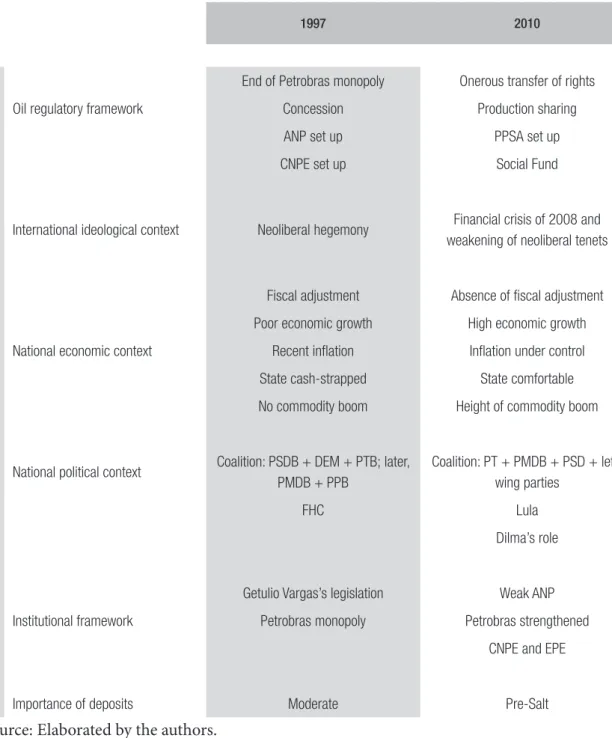
FIGURE 4 CHANGE IN STUDY VARIABLES
1997 2010
Dependent v
a-riable
End of Petrobras monopoly Onerous transfer of rights
Oil regulatory framework Concession Production sharing
ANP set up PPSA set up
CNPE set up Social Fund
Independent v
ariables
International ideological context Neoliberal hegemony Financial crisis of 2008 and weakening of neoliberal tenets
Fiscal adjustment Absence of iscal adjustment
Poor economic growth High economic growth
National economic context Recent inlation Inlation under control
State cash-strapped State comfortable
No commodity boom Height of commodity boom
National political context Coalition: PSDB + DEM + PTB; later, PMDB + PPB
Coalition: PT + PMDB + PSD + left-wing parties
FHC Lula
Dilma’s role
Getulio Vargas’s legislation Weak ANP
Institutional framework Petrobras monopoly Petrobras strengthened
CNPE and EPE
Importance of deposits Moderate Pre-Salt
Source: Elaborated by the authors.
4. CONCLUSION
institu-tionalism with the ability to examine actors from the perspective of rational choice instituinstitu-tionalism. his helped analysis of the actors’ decision making in a long-term process. Meanwhile, the backdrop of theoretical debate was given by the discussion of relations between institutions and agency, i.e., how actors and institutions afect change.
Together with the interests they represent, ideas constitute a key variable in the change in legal framework at two turning points: the 1997 Oil Law and the 2010 pre-salt regulatory framework. In the irst case, the hegemony of neoliberal ideology made market-oriented reforms central elements of government programmes during the 1990s. In the case of Brazil, that hegemony was further strengthened by the country’s international position, its economy too weak to aford governments independence from the positions of multilateral bodies, the loci from which the hegemonic position radiated. At the same time, the stabilisation agenda had strong support, bolstering President Fernando Henrique Cardoso’s authority and narrowing the space for potential public policy options. Finally, the volume of existing oil reserves and the outlook for the oil industry guided the legislation towards a structure of incentives that assumed the deposits would be quickly depleted.
Discovery of the pre-salt deposits was framed by an entirely diferent situation. In the realm of ideas, the hegemony of neoliberal ideology was in decline as a result of the meagre growth resulting from neoliberal economic reforms, assisting the centre-let political elites in their rise to power. Nonetheless, these elites were able to shit their administrations’ ideological bias only because of the greater independence granted by the more favourable economic setting. his possibility translated into public policies, including the pre-salt regulatory framework, in which components providing for greater State intervention (production sharing and onerous transfer of rights, and the creation of
Pré-Sal Petróleo S.A.) provided the basis for structuring the Pre-Salt Social Fund for the purpose of social sharing of oil revenues.
Lastly, some elements regarding the oil regulation evolution ater the 2010 act are in order. Since 2013, strong waves of turbulence afected the Brazilian political system: in June 2013, massive street protests changed President Dilma high approval rates, starting a process that led to her impeach-ment. here are two changes that relate to the oil regulation worth underlying. he irst one regards the distribution of public resources derived from oil exploration, enacted right on September 2013, under popular pressure for an increase on budget resources for Education and Health. Law No. 12,858, approved on September 9th, 2013 established that resources originated on oil royalties and
special participation, should be directed to Education and Health budgets in a ratio of 75% and 25% respectively. his afected not only the Federal resources, but also State and Municipal ones, for all the ields that became commercial ater December 3rd, 2012 (this date relates to prior presidential
veto on a horizontal federal dispute around those resources).
he second one aims to change the Law No. 12,351, that introduced the production-sharing regime. According to this change, Petrobras will no longer be compelled to hold at least 30% of the explora-tion consortium, and the company will no longer be the only elegible to operate the pre-salt ields.
REFERENCES
ALMEIDA, Lucila Gabriel de. As duas faces da Pe-trobras: a persistente dinâmica da empresa estatal no arranjo institucional brasileiro. Dissertation (Master degree in Law) — Escola de Direito do Estado de São Paulo, Fundação Getulio Vargas, São Paulo, 2011.
ALMEIDA, Maria Hermínia T. de. Negociando a reforma: a privatização de empresas públicas no Brasil. Dados, v. 42, n. 3, p. 421-451, 1999.
ALMEIDA, Maria Hermínia T. de. Pragmatismo por necessidade: os rumos da reforma econômica no Brasil. Dados, v. 39, n. 2, p. 213-234, 1996.
ALMEIDA, Paulo Roberto de. O Brasil e as crises inanceiras internacionais, 1929-2001. Cena Inter-nacional, Brasília, v. 3, n. 2, p. 89-114, 2001.
ALMEIDA, Paulo Roberto de. O Brasil e o FMI de 1944 a 2002: um relacionamento feito de altos e baixos. Cena Internacional, Brasília, v. 4, n. 2, p. 87-112, 2002.
ARIENTI, Patrícia F. F.; INÁCIO, Janypher Marcela. Instabilidade, desregulamentação inanceira e a crise do sistema inanceiro atual. Cadernos Cedec, n. 90, p. 1-22, Nov. 2010.
BARROS DE CASTRO, Antonio. From semi-stag-nation to growth in a Sino-centric Market. Brazilian Journal of Political Economy, v. 28, n. 1 (109), p. 3- 27, Jan./Mar. 2008.
BERCOVICI, Gilberto. Direito econômico do petróleo e dos recursos minerais. São Paulo: Quartier Latin, 2011.
BOSCHI, Renato. Instituições, trajetórias e desenvol-vimento: uma discussão a partir da América Latina. In: BOSCHI, Renato (Org.). Variedades de capita-lismo, política e desenvolvimento na América Latina. Belo Horizonte: Editora UFMG, 2011. p. 7-30.
BRAZIL. Discurso de posse de Dilma Roussef. 2011. Available at: <www.brasil.gov.br/governo/2011/01/ leia-integra-do-discurso-de-posse-de-dilma-rousse-f-no-congresso>. Acessed on: 17 July 2017.
ECLAC. Latin American and the Caribbean: op-tions to reduce the debt burden. Santiago: United Nations, 1990.
COUTO, Cláudio G.; ABRUCIO, Fernando. O segundo governo FHC: coalizões, agendas e
instituições. Tempo social, São Paulo, v. 15, n. 2, p. 269-301, 2003.
CUNHA, Rosani; CÂMARA PINTO, Bruno. O Pro-grama Bolsa Família como estratégia para redução da pobreza e os processos de cooperação e coorde-nação intergovernamental para sua implementação. Brasília, 2008. Mimeo.
DINIZ, Eli. Depois do neoliberalismo: rediscutindo a articulação Estado e desenvolvimento no novo milênio. In: BOSCHI, Renato (Org.). Variedades de capitalismo, política e desenvolvimento na Amé-rica Latina. Belo Horizonte: Editora UFMG, 2011. p. 31-56.
DRAIBE, Sônia. A política social no período FHC e o sistema de proteção social. Tempo Social, São Paulo, v. 15, n. 2, p. 63-101, 2003.
DRAIBE, Sônia. As políticas sociais do regime militar brasileiro: 1964-84. In: DILLON SOARES, Gláucio Ary; D’ARAUJO, Maria Celina. 21 anos de regime militar: balanços e perspectivas. Rio de Janeiro: Editora da Fundação Getulio Vargas, 1994. p. 271-309.
EVANS, Peter. O Estado como problema e solução.
Lua Nova, São Paulo, n. 28-29, p. 107-157, Apr. 1993.
FAGNANI, Eduardo. A política social do Governo Lula (2003-2010): perspectiva histórica. Revista SER Social, [S.l.], v. 13, n. 28, p. 41-80, Nov. 2011.
FELIPE, Ednilson S. Mudanças institucionais e estra-tégias empresariais: a trajetória e o crescimento da Petrobras a partir da sua atuação no novo ambiente competitivo (1997-2010). Doctoral thesis (economi-cs) — Institute of Economics, Rio de Janeiro Federal University, Rio de Janeiro, 2010.
FILGUEIRAS, Luiz; GONÇALVES, Reinaldo. A economia política do governo Lula. Rio de Janeiro: Contraponto, 2007.
GAITÁN, Flavio. O desenvolvimento esquivo e as tensões do desenvolvimentismo: relexões sobre a América Latina na hora atual. In: BOSCHI, Renato (Org.). Variedades de capitalismo, política e desenvol-vimento na América Latina. Belo Horizonte: Editora UFMG, 2011. p. 56-85.
GERRING, John. he case study: what it is and what it does. In: BOIX, Charles; Susan C. STOKES (Ed.).
he Oxford handbook of comparative politics. New York: Oxford University Press, 2007. p. 90-122.
GOBETTI, Sérgio Wulf. Federalismo iscal e petróleo no Brasil e no mundo. Discussion paper 1669. Rio de Janeiro: Ipea, 2011.
GOBETTI, Sérgio Wulf. Política iscal e Pré-Sal: como gerir as rendas do petróleo e sustentar o equi-líbrio macroiscal do Brasil. Monograph awarded the National Treasury 14th Public Finances Prize, heme I — Fiscal Policy and Public Debt. 2009.
GOBETTI, Sérgio Wulf; VALENTE SERRA, Ro-drigo. Novo marco regulatório do petróleo: desaios na transição do regime de concessão para o regime de partilha. National Treasury 16th Public Finances Prize, heme III — Special Topics in Public Finan-ces. 2011.
GOUREVITCH, Peter. Politics in hard times. New York: Cornell University Press, 1986.
HALL, Peter A. Policy Paradigms, social lear-ning, and the State: the case of economic poli-cymaking in Britain. Comparative Politics, v. 25, n. 3, p. 275-296, 1993.
HUNTER, Wendy; POWER, Timothy J. Rewarding Lula: Executive Power, social policy, and the Bra-zilian elections of 2006. Latin American Politics & Society, v. 49, n. 1, p. 1-30, 2007.
KUGELMAS, Eduardo. As transformações recentes do sistema inanceiro internacional. In: SOLA, Lour-des; LOUREIRO, Maria Rita. Democracia, mercado e Estado: o B de Brics. Rio de Janeiro: Editora FGV, 2011. p. 99-117.
LOUREIRO, Maria Rita. Mudanças na política de previdência social na Argentina, Brasil e Chile em contexto de democratização e inserção na economia global. In: ANNUAL MEETING OF ANPOCS, 36th, Oct. 2012 Caxambu.
LOUREIRO, Maria Rita; SANTOS, Fábio P. dos; GOMIDE, Alexandre de Á. Democracia, arenas decisórias e política econômica no governo Lula.
Revista Brasileira de Ciências Sociais, v. 26, n. 76, p. 63-76, 2011.
LUCAS, Luiz Paulo V. A derrota de um modelo de sucesso. In: GIAMBIAGI, Fábio; LUCAS, Luiz Paulo
V. (Org.). Petróleo: reforma e contrarreforma do setor petrolífero. Rio de Janeiro: Elsevier, 2013. p.125-152.
MAHONEY, James. Combining institutionalisms: liberal reform and critical junctures in Central America. In: KATZNELSON, Ira; WEINGAST, Barry (Ed.). Preferences and situations: points of intersection between historical and rational choice institutionalism. New York: Russell Sage Foundation, 2005. p. 313-334.
MAHONEY, James. Knowledge accumulation in comparative historical research: the case of de-mocracy and authoritarianism. In: MAHOMEY, James; RUESCHEMEYER, Dietrisch. Comparative historical analysis in the social sciences. New York: Cambridge University Press, 2003. p.131-176.
MAHONEY, James; VILLEGAS, Celso M. Historical enquiry and comparative politics. In: BOIX, Charles; STOKES, Susan C. (Ed.). he Oxford handbook of comparative politics. New York: Oxford University Press, 2007. p. 73-89.
MIGUEL, Paulo P. Globalização na década de 2000 e perspectivas para o mundo em desenvolvimento. In: SOLA, Lourdes; LOUREIRO, Maria Rita. Democra-cia, mercado e Estado: o B de Brics. Rio de Janeiro: Editora FGV, 2011. p. 21-74.
OLIVEIRA, Gesner; TUROLLA, Frederico. Política econômica do segundo governo FHC: mudança em condições adversas. Tempo Social, São Paulo, v. 15, n. 2, p. 195-217, 2003.
OSTROM, Elinor. Institutional Rational Choice: An Assessment of the Institutional Analysis and Deve-lopment Framework. In: SABATIER, Paul A. (Ed.).
heories of the policy process. Boulder: Westview Press, 2007. p. 21-64.
PALERMO, Vicente. Os caminhos da reforma na Argentina e no Brasil. Lua Nova, São Paulo, n. 45, p. 131-162, 1998.
PEDROTI, Paula M. Entre a estrutura institucional e a conjuntura política: o Programa Nacional de Produção e uso do Biocombustível (PNPB) e a com-binação inclusão social-participação. hesis (doctor in public administration and government) — São Paulo Business Administration School, Getulio Vargas Foundation, São Paulo, 2011.
In: GIAMBIAGI, Fabio; LUCAS, Luiz Paulo V. (Org.). Petróleo: reforma e contrarreforma do setor petrolífero brasileiro. Rio de Janeiro: Elsevier, 2013. p. 81-103.
PIRES, Adriano et al. Conclusões e propostas para o setor. In: GIAMBIAGI, Fabio; LUCAS, Luiz Paulo Vellozo (Org.). Petróleo: reforma e contrarreforma do setor petrolífero brasileiro. Rio de Janeiro: Else-vier, 2013. p. 312-334.
PORTELLA FILHO, Petrônio. Ajustamento na Amé-rica Latina: críticas ao modelo de Washington. Lua Nova, São Paulo, n. 32, p. 101-132, 1994.
PRZEWORSKI, Adam. Capitalismo e socialdemocra-cia. São Paulo: Companhia das Letras, 1991.
RODRIK, Dani. One economics, many recipes: globalization, institutions, and economic growth. Princeton: Princeton University Press, 2007.
SALLUM JR., Brasílio. La especiicidad del gobierno Lula: hegemonía liberal, desarrollismo y populismo.
Nueva Sociedad, n. 217, p. 155-171, 2008.
SINGER, André. Raízes sociais e ideológicas do lulismo. Novos estudos — Cebrap, São Paulo, n. 85, p. 83-102, 2009.
SIQUEIRA, Ana. O que aconteceu com a Petrobras? In: GIAMBIAGI, Fabio; LUCAS, Luiz Paulo Vellozo (Org.). Petróleo: reforma e contrarreforma do setor petrolífero brasileiro. Rio de Janeiro: Elsevier, 2013. p. 239-257.
SOUZA, Amaury de; PEREIRA, Carlos. A lexibi-lização do monopólio do petróleo no contexto das reformas dos anos 1990. In: GIAMBIAGI, Fabio; LUCAS, Luiz Paulo Vellozo (Org.). Petróleo: reforma e contrarreforma do setor petrolífero brasileiro. Rio de Janeiro: Elsevier, 2013. p. 39-54.
TILLY, Charles. Means and ends of comparison in macrosociology. Comparative Social Research, v.16, p. 43-53, 1997.
TROJBICZ, Beni. Mudanças não incrementais em contextos de neo institucionalismo histórico: expli-cando “conjunturas críticas”. Revista Administração Pública e Gestão Social, v. 8, p. 76-84, 2016.
ZYLBERSZTAJN, David; AGEL, Sonia. A reforma do setor de petróleo de 1997: racionalidade, con-cepção e implementação. In: GIAMBIAGI, Fábio; LUCAS, Luiz Paulo Vellozo (Org.). Petróleo: reforma e contrarreforma do setor petrolífero. Rio de Janeiro: Elsevier, 2013. p. 55-80.
Beni Trojbicz
APPENDIX — LIST OF INTERVIEWEES
N. 1 — former employee of Petrobras, advisor to the lower house of Congress. Interviewed in January 2012.
N. 2 — research and planning specialist with Ipea and employee of the Ministry of Finance; oil specialist. Interviewed in January 2012.
N. 3 — advisor to the lower house of Congress. Interviewed in May 2014.
Adriano Pires — advisor to the general director of the ANP, oil import and export superintendent and ANP supply superintendent during the Fernando Henrique Cardoso government. Interviewed in January 2012.
Gilberto Bercovici — professor of Economic Law and Political Economy, São Paulo University Law School, oil specialist. Interviewed in December 2011.
Helio Tollini — budget consultant to the lower house of Congress and responsible for analysis of the bill that established the Social Fund. Interviewed in January 2012.
Ildo Sauer — former director of Petrobras, and now director of the São Paulo University Energy and Environment Institute (IEE-USP). Interviewed in December 2011.
Paulo Springer de Freitas — legislative consultant to the upper house of Congress, specialist in mines and energy. Interviewed in December 2011.
Philippe Henri Reischstul — president of Petrobras from March 1999 to December 2001; respon-sible for restructuring the enterprise. Interviewed in December 2012.