RBGN
Review of Business Management
DOI: 10.7819/rbgn.v18i62.2743
633
Received on
10/04/2015
Approved on
06/28/2016
Responsible editor:
Prof. Dr. Ivam Ricardo Peleias
Evaluation process: Double Blind Review
Actor networks in specialized accounting
inspection: an analysis in the light of the
Actor-Network Theory
Eduardo Vinícius Bassi Murro
Federal University of Paraná, Applied Social Sciences Sector, Accounting Department, Curitiba, Brazil
Ilse Maria Beuren
Federal University of Santa Catarina, Socio-Economic Center, Florianópolis, Brazil
Abstract
Purpose – his study investigated the coniguration of human and
non-human actor networks that are formed in the process of specialized accounting inspection from the Actor-Network heory perspective.
Design/methodology/approach – he population of the survey
comprised 593 accounting experts registered in Expert Associations from the Brazilian states of Minas Gerais, Paraná, Rio de Janeiro, Rio Grande do Sul and São Paulo, and the sample is made up of 102 valid questionnaires. Five judges and ive accounting experts from Curitiba (state of Paraná) were also interviewed. hrough Structural Equation Modeling, the translation process indicated statistical signiicance, except in the relationship between human accounting actors, non-human actors and problematization.
Findings – Based on this research, we concluded that the establishment
of networks in the ield of specialized accounting inspection depends on numerous translations between agents, since they have an impact on the performance of activities and the stabilization of relationships. he quality of the expert report and technical report and the competence of accounting experts were pointed out as performance indicators. Accounting experts and accounting experts assistant’s experience, the period of experience and the relationship with judges were identiied as drivers of stable and lasting relationships between specialized accounting inspection actors.
Originality/value – he study is relevant given the lack of research
involving the Actor-Network heory and accounting, particularly Accounting Inspection, both nationally and internationally. herefore, contribute to investigate how the actors interact, create and modify relationships, through the perception of accountants and judges.
Keywords – Actor-Network heory; specialized accounting inspection;
1
Introduction
Specialized accounting inspection is made up of numerous factors that need to be considered if it is to be properly carried out. In the judicial sphere, inspection activities are driven by interactions between the parties involved, such as judges, lawyers, related parties and the accounting expert (Santos, Cunha, Tanquella, & Valentim, 2013). According to the authors, accounting experts, professional who are qualiied to carry out inspection activities, depend on the interactions between the parties involved to develop activities in a qualitative and credible way.
he role of each actor within relationships in the ield of inspection, of accounting experts, reports prepared and of the judicial sphere all provide and limit the quality of specialized accounting inspection services (Ferreira, Miranda, Meira, & Santos, 2012). Stable and trusting relationships between professionals involved in the ield of inspection ease the solution of processes, when supported by quality inspection reports. On the other hand, unstable and unsuccessful interactions between reports, accounting experts, lawyers and judges can result in inconsistent decisions and afect the completion of the process (Nogueira, 2006).
The relationships among human and non-human actors in the process of specialized accounting inspection, capable of boosting the performance of inspection activities by accounting professionals, can be studied from the perspective of the Actor-Network heory. his theoretical line, according to Pollack, Costello and Sankaran (2013), includes actors and networks in a constant process of creation, adaptation, stabilization and reformulation. his theory suggests a dynamic coniguration, with heterogeneous characteristics between actors (Latour, 2005).
Based on the above, it is necessary to understand how networks are formed in the context of inspection. We assumed that the role of non-human actors is as essential as that of other human actors involved in the establishment of networks in inspection, since, through materiality, mainly represented by expert reports, decisions are made by the judges. herefore, based on
the Actor-Network heory, it is necessary to demonstrate how heterogeneity and symmetry permeate the investigated context, and how the relationships created generate efects and impact on the organizing of reality (Law, 1992).
Based on the argument that relationships formed between human and non-human actors in the ield of inspection activities interfere in activities performed by accounting professionals, this research is guided by the following question: What is the coniguration of the networks of human and non-human actors that are formed in the process of specialized accounting inspection from the perspective of the Actor-Network heory? hus, the goal of this study is to identify the coniguration of the networks of human and non-human actors that are formed in the process of specialized accounting inspection from the perspective of the Actor-Network heory.
This research is justified because it expands, based on empirical research, the concepts proposed in the Actor-Network heory, especially with regard to the heterogeneity of relationships. Considering only human actors is not enough to understand the reality of specialized accounting inspection. hus, the study provides theoretical knowledge about an eminently pragmatic and technical ield of activity. It is also relevant given the lack of research involving the Actor-Network heory and accounting, particularly specialized accounting inspection, both nationally and internationally.
he Actor-Network heory applied to accounting and related ields has been studied more in foreign literature, investigating aspects of information systems (Bloomfield & Best, 1992), economic markets (Callon, 1998) and organizational studies (White & Bradshaw, 2004; Czarniawska & Hernes, 2005; Woolgar, Coopmans, & Neyland, 2009; Steen, 2010; Pollack, Costello, & Sankaran, 2013), than in Brazil, which investigated as to information technology (Martins, 2011), process management (Albuquerque, 2012), governance and strategic outcomes (Montenegro & Bulgacov, 2014).
in the Brazilian academic sphere (Oliveira, 2012; Neves Jr., Moreira Ribeiro & Silva, 2013). According to Peleias, Ornelas, Henrique and Wefort (2011), only a few studies exist involving the ield of specialized accounting inspection when compared to other fields of research. Although there are signiicant contributions to the collection of research in the ield, “the need for work in this particular ield of knowledge is huge, because there were few who, at some point, made their contribution to those who begin in this career” (Santos, Schmidt & Gomes, 2006, p. 4).
Besides, no studies were found investigating the performance of human and non-human actors in building the reality of the inspection context at the same level, based on the Actor-Network heory. According to Montenegro and Bulgacov (2014), the materiality in relationships is relevant to understanding networks among humans, because they involve objects that will act and generate relections on the networks created. hus, we sought to contribute to investigation as to how non-human actors (reports, opinions, questions) and other inspection actors are able to interact, create and modify relationships with other actors, corroborating the understanding of the construction of reality.
The field of specialized accounting inspection, though little investigated by academy, requires technical accounting improvement (Oliveira, 2012). Internationally, studies on accounting inspection highlight the growth of the profession and of the demand for specialized accounting inspection services (Koh, Arokiasamy, Suat & 2009; Okoye & Akenbor, 2009). hus, this study is relevant because it ofers an empirical and social contribution to accounting professionals willing to work or already working in inspection, because it reveals the interactions in the profession from the relationship between human and non-human actors of the inspection ield, through the perception of accountants and judges.
2
heoretical framework
2.1
Actor-Network heory perspectives
According to the Actor-Network heory, reality is entirely driven by mechanisms of action, in which any component, material or immaterial, may interact with other active or not components (Callon, 1999). In this perspective, any human and non-human aspect should be treated with equal circumstances, and the social dimension should be characterized as a simultaneous creation of collective practices involving interaction among people, mediated by objects (Christensen & Skaerbaek, 2007; McFall, 2009).
One of the basic and most important premises of the Actor-Network Theory is symmetry. Mattedi, Grisotti, Spiess and Bennertz (2009) consider it as one of the main contributions of this theory, which introduced a symmetrical approach of the relationship between society, technology and science. Another significant milestone refers to the construction of knowledge, which, according to Callon (1986) exceeds the human brain, while being distributed in material devices. One of the central elements of the Actor-Network heory is the network of existing actors in a reality, that is, the combination of agent and structure or context, in which both are created through interdependency relationships and perceived among actors (Green, Hull McMeekin, & Walsh, 1999).
Thus, the translation of actors has to occur so as to understand human and non-human agents in a common base language, mediated by translation tools (Latour, 1999). Since the Actor-Network heory treats human and non-human agents equivalently in terms of importance in a given reality and that they are possible actors in a network based on the principle of heterogeneity (Hardy & Williams, 2008), makes it especially attractive and relevant to verify relationships between actors in the ield of specialized accounting inspection.
a social context depend on associations among agents, of establishing equivalences and of translations made by heterogeneous actors (Callon, 1986). According to Albuquerque (2012), the translation process denotes how human and non-human actors are conigured and make alliances in a socio-technical network, i.e. allows to understand how the agents of a heterogeneous network are drawn into stable and unstable networks (Law, 1992).
he process of translation, according to Maia and Serain (2012), binds to the planning and stabilization process of a set of elements that can be dissociated. Without the organizing power of the translation, the agents would walk in any direction. Thus, the process of translation – subdivided in four stages, called problematization, interessement, enrollment and mobilization – is a scaled interaction in which
the agents construct equivalent deinitions and meanings, list representatives and cooperate with each other to meet the proposed objectives (Feigenbaum, 2010).
Finding out how the networks are conigured it is necessary to follow the actors in the establishment of relationships and interactions with other agents in order to identify how the alliances occur and the collectivity among the elements (Latour, 2005). On the other hand, it is also possible to investigate relationships following facts and artifacts based on their past history, when it is not possible to trace their characters in action, through interviews, reports, articles, quotes, documents, among others (Latour, 1996).
In order to elucidate the aspects of this theoretical model, in Table 1 the main concepts of the Actor-Network heory are summarized.
Table 1
Summary of the main concepts of the Actor-Network heory
Concepts Description
1 Actor Any entity capable of generating efect or leaving traces, represented by humans and, through semiotics, by non-human (Latour, 2001). Law (1992, p. 380) suggests that “society, organizations, agents and machines are all efects generated in networks of various materials.”
1.1 Actor-Network “A network with a particular pattern of heterogeneous and distinct relationships, or an efect caused by certain network.” (Law, 1992, p. 5). 1.2 Black box Set of stable alliances around a single actant (Latour, 1988).
1.3 Spokesmen Seen as representative of the actants, the spokesman is tasked to expand the events so as to include non-human actors in the relationships (Latour, 2001).
1.4 Actor-focal
Aims at balancing diferent interests and making actors become allies, towards a common target, supporting the establishment of the relationships of a given situation or context (Martins, 2011). To perform certain role, the actor starts to behave as a mediator of the relationships, interfering, mobilizing and directing other actors for a proper coniguration of the networks (Martins, 2011).
1.5 Obligatory passage point Refers to the obligation of the actors to go through a given point in the network (Callon, 1986).
2 Translation he translations allow the actants to relate and associate among themselves, generating strong or weak interactions, composed of discourse chains through which the agents are modiied and translate their various interests (Latour, 2001) in an attempt to form a cohesive whole (Callon & Latour, 1981).
2.1 Problematization Refers to the determination of the actors of the networks and their identities, establishing an obligatory passage point in the establishment of networks (Callon, 1986).
2.2 Interessement Seeks to attract the interest of agents so that they can build robust alliances, through a series of artifacts and appealing mechanisms (Callon, 1986).
2.3 Enrollment Refers to assignment and coordination of potential roles to actors listed in problematization (Callon, 1986).
2.4 Mobilization of allies Some methods are used so that the main interests of the focal actors are not separated from the initial purpose and do not seek new possibilities to solve a given issue (Callon, 1986). 3 Hybrid relationships Refers to alliances between human and non-human actors in a certain context (Latour, 1999).
3.1 Action at a distance To portray a fact, a reality or an event, actants need to act at a distance, in order to form alliances, causing efect relationships among the elements involved (Latour, 1988). 3.2 Fait faire Enables investigation as to the causal relationships enabled by objects (Latour, 1999).
Table 1 presents the main elements proposed by the Actor-Network Theory. According to Law (2009), they have as main core the formation of heterogeneous networks from various types of actors. In this study, the relationships in the process of specialized accounting inspection are contemplated, based on the perception of professional experts and judges.
2.2
Specialized accounting inspection
and networks
One of the main types of specialized accounting is the one that happens in the Judiciary, called specialized accounting inspection. According to Pires (2007), it is through expert’s evidences that the truth about the disputed facts is sought. It is expected, therefore, to support the decision-making process of judges from inspections and examinations carried out by qualiied expert professionals, who are appointed to investigate possible irregularities existing in a given fact (Oberherr & Nikolay, 2013).
In the field of specialized accounting inspection, many individuals act in the establishment process of the relationships, based on the demand of a judge, when seeking technical support of a professional to support his decision. Among the human actants of accounting inspection, the expert appointed by the judge and the technical assistant of the parties outstand. Neves Jr, Moreira, Ribeiro and Silva (2013) state that the quality of the services provided is linked to the quality of the professional appointed and to the trust in the relationship between the appointed expert and the judge. Expert accountants may adversely afect the network coniguration in case they do not have the requirements to perform the inspection activities with quality and reliability (Oliveira, 2012).
Regarding the technical assistant, the accounting expert’s assistant, hired by one of the parties, has the task of advising the contractor for further clariication, in order to ensure the safety and accuracy of the information evaluated by the expert appointed by the judge (Miguel, 2009). It is also within the expert’s assistant’s competence to assist the parties when drafting the questions,
monitoring the activities performed by the expert appointed by the judge and, ultimately, deliver an opinion about the expert’s report prepared (Santana, 1999).
Regarding the actors of the judicial sphere, specialized accounting inspection, when linked to the judiciary, occurs upon the request of a judge because of the need and interest in clariications regarding certain process. The judge has the duty to request expert’s evidence when required, appointing the accounting expert – both in the discovery phase before the sentence is delivered, and after the inal judgment of the sentence, if it is the case – to provide an expert’s report on the events that occurred between the parties (Carvalho & Marques, 2005). In this process, it is up to the judge to act with impartiality, transparency, integrity and dignity to seek the truth of the facts.
In the judicial units where judges are assigned there are relevant information to the experts qualiied to perform specialized services, available to interested parties. This existing database in the courts instigates competition among expert accountants to be appointed by the judge (Peleias & Ornelas, 2013), generating potential impacts on the establishment of networks among human actors in the ield of specialized accounting inspection.
he accounting expert’s report, according to Oliveira (2012), should include all the information needed to convince the decision-making instance of the process of the legal certainty regarding the facts. It is a detail and planned report presenting conclusions of the inspection (Sá, 2010). herefore, the expert’s report is one of the main parts of the specialized accounting inspection, as it represents one of the legal bases for the judge to decide the litigation in question (Neves Jr. et al., 2013).
he technical opinion is relevant object in the process of specialized accounting inspection, according to Moraes (2000), since it aims to detail the opinion of the accounting expert’s assistant on the steps taken and give an opinion about the report prepared by the expert. However, the expert’s assistant responsible for the opinion and the expert responsible for the report can act jointly in the inspection, planning the activities to be carried out in order to minimize and avoid potential disagreements over certain fact (Miguel, 2009).
We inferred that stable and trusting relationships between the professionals involved in the inspection ield facilitate the processes completion, supported by expert’s reports prepared with quality. Unstable and unsuccessful interactions among the report prepared, the accounting expert, lawyers and judges, can hinder the completion of the process (Nogueira, 2006). Therefore, the relationships between human and non-human actors in the process of specialized accounting inspection can inluence the performance of inspection activities and the coniguration of networks actants.
3
Methodology
3.1
Population and sample
he population of the survey comprised professional accountant experts registered in the Experts Associations of the Brazilian states of Rio Grande do Sul, Paraná, Rio de Janeiro, São Paulo and Minas Gerais. According to the National Council of Justice Report of 2013, the Division of Justice of these states is considered to be larger. It can be assumed that in these states there is a greater capacity for judging cases, since
the higher the number of cases, the greater the need for inspection evidence.
Data on expert accountants were obtained at the website of the Association of Financial Experts of each state. hus, the population of the research included 593 expert accountants registered and their full contact information was available. he survey sample consists of 102 respondents, 18% of the total population, who responded to the survey instrument. We decided to send the questionnaire to this actor member of the networks in the ield of specialized accounting inspection, characterized as an accounting expert, to investigate the main aspects of the networks formation process in the field of specialized accounting inspection.
For the interviews, ive judges and ive expert accountants who work in courts of the city of Curitiba, PR were conveniently selected. he judges interviewed are professionals who require accounting expert’s evidence. Regarding the interviews with experts, they were relevant professionals in the accounting inspection area of the city of Curitiba, owners of accounting services companies, specialized in accounting inspection, for the understanding of the network coniguration in the ield of specialized accounting inspection. It is noteworthy that the amount of inspection activities in Curitiba is certainly smaller than in larger centers, such as São Paulo, and, therefore, the availability of experts to work on inspections is lower. Due to these characteristics, it is not possible to generalize the indings of the study carried out.
3.2
Research tools
ive questions, which include assertions regarding the network coniguration process in the ield of
specialized accounting inspection, as shown in Table 2.
Table 2
Design of the applied questionnaire
Constructs Questions Assertives Description
Human accounting actors 1 1.1, 1.2 e 1.3
Identify the key elements of the networks in the ield of specialized accounting inspection.
Human inspection actors 1 1.4 e 1.5
Non-human actors 1 1.6 a 1.8
Problematization of networks formation 2 2.1 a 2.7 Verify the relevant initial procedures for the formation of relationships.
Interessement of human actors 3 3.1 a 3.9 Verify factors that drive the formation of robust alliances among the actors.
Interessement of non-human actors 3 3.10 a 3.14
Enrollment of human actors 4 4.1 a 4.9 Investigate the competences and attributions of the
roles of each actor in the ield of specialized accounting inspection.
Enrollment of non-human actors 4 4.10 a 4.13
Mobilization of allies 5 5.1 a 5.9 Find out about the consolidation and stabilization of
the relationships and performance of the specialized accounting inspection activities.
Performance of activities 5 5.10 a 5.12
Stabilization 5 5.13 a 5.15
In Table 2, the assertions of Question 1 sought to identify the main human and non-human actors involved in the network establishment process in the ield of specialized accounting inspection. The assertions of the translation process, contained in questions 2, 3, 4 and 5, identified the existing networks among the actors in the specialized accounting inspection. Finally, the final assertions of the questionnaire enabled understanding the process of consolidation and stabilization of the relationships between the identiied elements and the performance of the activities carried out. he seven-point Likert scale (1 = extremely low; 7 = extremely high) was used because, according to Churchill and Peter (1984), the reliability of a scale becomes more certain with the increase in the number of responses categories in a questionnaire.
For the interviews with judges and experts, two interview scripts were created, each made up of 10 questions based on the questionnaire applied to accounting experts. Information about the procedures related to the performance of the inspection, from the process of appointment of the expert to the criteria used to evaluate the performance of the activities performed were collected from judges. Procedures regarding entry
into the ield of specialized accounting inspection and planning and execution of inspection activities, in the position of expert appointed by the judge or expert’s assistant hired by the parties were investigated with the experts.
3 . 3
Procedures for collecting and
analyzing data
In the survey, sending the questionnaires by e-mail to the 593 professionals who made up the population took place from June to September, 2014, through Survey Monkey. Regarding the interviews, contact was made by email and by phone with the accounting experts and the judicial assistants, scheduling each interview. he interviews took place from August to November 2014, and all together lasted about 15 hours.
this statistical technique is not limited to analysis of simultaneous dependence of the data, but provides a transition from the exploratory analysis to a conirmatory perspective.
For the interviews, the technique of content analysis was used. According to Bardin (1977), this is a research technique that aims at objective, systematic and quantitative description of the manifest content of the communication. Recorded interviews were all listened to, and the sections considered relevant, and that at irst could complement the quantitative analysis, were transcribed after the questions of the interview script. After that, through interpretive category analysis, each transcribed section was linked to speciic aspects of the Actor-Network heory and allocated to data analysis. hus, the interviews enabled us to strengthen the quantitative analysis of the process of coniguration of actor networks within the ield of specialized accounting inspection.
4
Description and analysis of
results
4.1
Validity and reliability of constructs
In this research, the latent variables are the accounting human actors (AHC), inspection
human actors (AHJ) and non-human actors (ANH). In addition to these, there are the four stages of the translation process: (i) Questioning (Problem); (ii) Interessement of Human Actors (AI HC), Interessement of Inspection Human Actors (AI HJ) and Interessement of Inspection Non-Human Actors (AI NH); (iii) Enrollment of Human Actors (Recr AH) and Enrollment of Non-Human Actors (Recru ANH); and (iv) Mobilization of Allies (Mobili). he structural model also includes as latent variables the Inspection Performance (Desem) and Stabilization of relationships (Estab).
In the convergent validity of the model formed by the constructs (Table 3), it is possible to verify the reliability indicators of the model to be used in the formation process of actor networks, being them the analysis of the variance extracted (AVE) and the composite reliability. he objective of these indicators is to demonstrate that the assertions listed are suicient to represent their respective latent variables (Hair Jr, Anderson,Tatham, & Black, 2005). The recommended value for AVE is 0.50 and 0.70 for composite reliability.
Table 3
Model adequacy indices
Variables AVE Composite Reliability R Square Commonality Redundancy
Human accounting actors 0.6168 0.8262 0 0.6168 0
Human inspection actors 0.514 0.7587 0.1502 0.514 0.0794
Non-human actors 0.5594 0.7823 0.3736 0.5594 0.1992
Problematization 0.5002 0.8255 0.3502 0.5002 0.0374
Interessement of accounting human actors 0.5479 0.7835 0.0303 0.5479 0.0157
Interessement of inspection human actors 0.5504 0.7016 0.2208 0.4504 0.0616
Interessement of non-human actors 0.5623 0.7151 0.2479 0.4623 0.0591
Enrollment of human actors 0.5629 0.7255 0.2378 0.2629 0.0469
Enrollment of non-human actors 0.6756 0.8617 0.3197 0.6756 0.1426
Mobilization of allies 0.5032 0.7399 0.2679 0.3032 0.0591
Performance of inspection activities 0.5838 0.8057 0.4109 0.5838 0.2374
We can noticed in Table 3 that, for the Analysis of Variance Extracted (AVE), there are no values lower than 0.50, contributing to the acceptance of the model. Regarding the composite reliability coeicients, all indicators are above 0.70. hus, besides representing 50% of the variance, considering the sample size of 102 respondents, values are signiicant at 5%, as recommended by Hair Jr. et al. (2005).
he criterion of Gaski and Nevin (1985) was used to test discriminant validity, which uses the correlation of the matrix and of the composite reliability values to check the validity or not of
the model. We found that the model reveals discriminant validity. To inalize the adequacy of the model, the calculation of Goodness-of-Fit Index proposed by Tenenhaus, Chatelin and Lauro (2005) was used, which reached a rate of 0.37, therefore, above the minimum of 0.36 recommended by Wetzels, Odekerken-Schröder and Van Oppen (2009).
4.2
Model proposed for the study
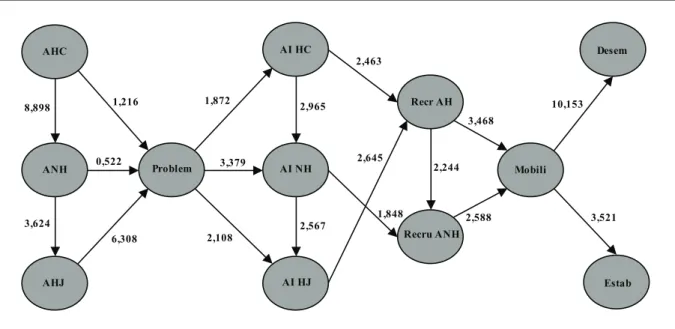
he tested structural model, indicating the relationships estimated by path of coeicients, is shown in Figure 1.
AHC
ANH
AHJ
Problem
AI HC
AI NH
AI HJ
Recr AH
Recru ANH
Mobili
Desem
Estab 8,898
3,624
6,308 0,522
1,216 1,872
3,379
2,108
2,965
2,567
2,645
1,848
2,244
2,588 3,468
10,153
3,521 2,463
Figure 1. Structural model of relationships in specialized accounting inspection.
he test of the structural model of the specialized accounting inspection relationships is evaluated according to the adjustment indicator and coeicients obtained by the PLS calculations. The obtained coefficients show significance based on the values corresponding to t test for the path (path), generating significant value for each variable. Bootstrapping was analyzed,
Table 4
Coeicients of paths and signiicance of relationships
Relationships Original Sample
Sample Mean
Standard Deviation
Standard Error
T Statistics (|O/
STERR|) P Value
AHC -> ANH 0.6113 0.621 0.0687 0.0687 8.8978 0.0000*
ANH -> AHJ 0.3876 0.3968 0.107 0.107 3.6241 0.0003*
AHC -> Problem 0.1317 0.123 0.1083 0.1083 1.216 0.2243
ANH -> Problem 0.0486 0.0525 0.0931 0.0931 0.5217 0.6020
AHJ -> Problem 0.5002 0.5155 0.0793 0.0793 6.3082 0.0000*
Problem -> AI HC 0.174 0.1901 0.093 0.093 1.8716 0.0616**
Problem -> AI HJ 0.2686 0.2587 0.1274 0.1274 2.1082 0.0353*
Problem -> AI NH 0.3519 0.35 0.1041 0.1041 3.3793 0.0008*
AI HC -> AI NH 0.2963 0.3073 0.0999 0.0999 2.9652 0.0031*
AI NH -> AI HJ 0.2921 0.3195 0.1138 0.1138 2.5674 0.0104*
AI NH -> Recru ANH 0.3198 0.3009 0.173 0.173 1.8481 0.0649**
AI HC -> Recr AH 0.3036 0.3087 0.1233 0.1233 2.4626 0.0140*
AI HJ -> Recr AH 0.289 0.3187 0.1093 0.1093 2.6448 0.0083*
Recr AH -> Recru
ANH 0.3304 0.3591 0.1472 0.1472 2.2439 0.0251*
Recr AH -> Mobili 0.3484 0.3794 0.1005 0.1005 3.4677 0.0005*
Recru ANH -> Mobili 0.2475 0.2348 0.0957 0.0957 2.5877 0.0098*
Mobili -> Desem 0.641 0.6613 0.0631 0.0631 10.1526 0.0000*
Mobili -> Estab 0.3369 0.3721 0.0957 0.0957 3.5207 0.0004*
Note: * Signiicant at 5% ** Signiicant at 10%
We can verify in Table 4 that, except for the relationships among the Accounting Human Actors, Non-human Actors and Problematization, all other relationships were statistically signiicant at the level of 5% or 10%. Non-signiicance was expect for these two relationships, as in the initial process of network formation the inspection human actors are mainly responsible for triggering the relationships, indicating the expert to be appointed, the questions formulated by the parties and responsibilities to be met within the expert’s activities (Carvalho & Marques 2005). Below, there is a description of the aspects of the direct relationships of the actants of specialized accounting inspection, with excerpts of the interviews.
4.3
Human and non-human actants in
specialized accounting inspection
he human and non-human actors in relationships, according to Montenegro and
Bulgacov (2014), are equally relevant, and should be considered in the process of social study and investigation. In the sphere of the specialized accounting inspection, the human actors, represented by the accounting expert, expert’s assistant, judge and courts, are the main actants of the relationships, acting in the design of networks. As for the non-human actors of the specialized accounting inspection, the expert’s report prepared by the expert appointed by the judge, the technical opinion of the expert’s assistant and the questions within the process are the main actants, capable of forming networks among themselves and with the human actors of the specialized accounting inspection.
signiicance of 5%, the construct Non-Human Actors (ANH), with p-value of 0.0000. hus, there is the formation of hybrid alliances in the ield of inspection, corroborating with the literature on the Actor-Network heory (Latour, 1999). his author states that hybrid alliances do not make restrictions on the types and forms of agents involved in the interactions. Any actant may form relationships with other agents, whether human or non-human, in a particular context. his result is supported by an excerpt of the interview of one of the experts:
Over the years, considering the expert’s experience and continuous improvement in terms of technical qualiications, I believe that the expert’s reports presented relect the expert’s proile and are positively or negatively impacted by the experience of the professional appointedby the judge [Expert 1].
Accounting human actors act at a distance before non-human actors, given that when alliances and robust interactions are found among the actors, there is an action at a distance. According to Latour (1988), to depict a fact, a reality or an event, actants act at a distance to form alliances, causing relationships of efect between the elements involved. In the ield of inspection, experts appointed by the judge generate efects on the expert’s report, as well as the assistants impact the technical opinion. here is a relevance of non-human actors in the network formation process, as they cease to be mere artifacts used by man and become active agents in everyday actions, able to incite changes and to inluence other actants (Latour, 2005).
he relationship between constructs Non-Human Actors (ANH) and Inspection Non-Human Actors (AHJ) was signiicant (p-value 0.0003), at a level of 5%. his relationship indicates that the materiality generates efects and impacts on the inspection human actors, especially on judges and on courts in which they work. In this sense, according to the respondents to the questionnaire, the structure of the court in which the process
is represents a relevant inspection human actor, which generates impacts on the inspection relationships. his result is reinforced by answer of one of the judges interviewed:
In each court there is a database containing the list of possible experts to be appointed. In accounting matters, the civil courts have considerably presented greater demand for specializes accounting inspection, which ultimately contributes to a more assiduous work of the accounting experts [Judge 1].
Another judge interviewed about the role of the courts in the relationships reported that:
he expert must not have any kind of privilege within the court or the registry. I believe that the expertise and technical skills should take precedence to any kind of prior relationship the expert might have with the court in which he is registered [Judge 3].
According to the perspectives of the Actor-Network heory, when analyzing the inluences and efects caused by the non-human actors, the heory proposes the notion of fait faire, which
makes it possible to investigate the causality relationships established by objects (Latour, 1999). herefore, the accounting expert’s report and the opinion of the expert’s assistant, for being part of the materiality of relationships, come with an attitude of fait faire before inspection human actors (judges and courts), generating efects and impacts of diferent magnitudes and contributing to the consolidation of networks between actants.
whose objective is to guide and direct the design and the action of the other actors within the specialized accounting inspection.
We can infer that, if the judge had no need for a technical depth on a particular matter, there would not be inspection and, consequently, the relationships among the actants. In this sense, a network among the inspection actors comes into existence, since there is need for expert’s evidence, based mainly on trusting relationships among the actors. he excerpt of the answer of a judge conirms this result:
A trusting relationship between the expert and the judge is essential. In the court where I act there is a list of registered experts who can be appointed. When the need to appoint an expert arises, I look for trust or recommendations of other judges, or I take into account the fact of already knowing the work of a particular expert. Trust is one of the key pillars in inspection [Judge 5].
After identifying the actors of the specialized accounting inspection, it is detailed below, as a sequence of the analysis of the structural model developed in the study, the establishment of the relationships from the four stages of the translation process, which begins with the Problematization. We emphasized that the determination of the actors described previously, according to Callon (1986), is also part of this irst stage, however, in this study we decided to separate the identiication of the actors in order to facilitate the understanding of the structural model.
4.4
Relationships in specialized accounting
inspection from the translation process
In the perspectives of the Actor-Network heory, according to Callon and Latour (1981), translations enable actants to promote interactions and associations among themselves, forming relationships and strong or weak connections, composed of discursive chains through which the actors change and translate its various interests to create a cohesive whole. In the irst stage of the
translation process, i.e., at the stage of questioning following the design of the actants, needs and objectives to be achieved arise.
According to the structural model, this variable showed signiicant relationships at the level of 5%, with the variables Interessement of Inspection Human Actors (AI HJ) (p-value 0.0353) and Interessement of Non-Human Actors (AI NH) (p-value 0.0008), and at the level of 10%, with the variable Interessement of Accounting Human Actors (AI HC) (p-value 0.0616). hese relationships reveal that it is from the identiication of the actors of specialized accounting inspection and from the exposure of the problem to be solved by the agents that the interests of each actor are drawn to form their respective networks.
After designating the inspection and its scope, deining the questions and the experts’ assistants, if it is the case, the expert is presented to the main problem to be solved and how his actions can help solve it. We noticed that the judge is an important actor in the initial phase of the establishment of the networks in the ield of inspection, and there is no way forward without going through it, without his intervention as to whether there is need or not of an expert’s evidence or appointment of an accounting expert. he veriication process of an expert’s evidence by the judge represents a compulsory passage point in relationships between actants.
According to the Actor-Network heory, the need of actors going through a given point in the network is called obligatory passage point (Callon, 1986). For the author, in the initial phase of the translation process, the focal actor deines this mandatory context, through which the actors are required to pass so that objectives set can be met. herefore, when there is the need for the appointment action of an accounting expert to provide an expert’s evidence of accounting matters, the networks among the inspection actors starts to be formed, between human and non-human actors.
presenting the questions presented by the parties, which are represented by their respective lawyers, to the expert appointed by the judge. In this study, approximately 67% of the experts who answered to the questionnaire reported that the questions presented by the lawyers do not have the expected due clarity. his result is consistent with the study by Neves Jr. et al. (2013), in which the majority of the respondents of the sample investigated reported that objectivity, accuracy and clarity are aspects to be improved at the time of elaboration of the questions. his positioning is also mentioned by one of the judges interviewed, according to the following passage:
here are questions submitted by lawyers which are not relevant. here are cases where, sometimes, the party attempts to prolong the process through impertinent questions. In some situations the expert himself, at the time of fee proposal, indicates that a particular question is not an accounting technical matter [Judge 3].
Following the problematization stage, there is the second stage of the translation process, the interessement. In the structural model, we veriied that the interessement variables showed signiicant direct relationships with each other and with the next variables of the translation process. In both causality relationships of the Interessement of Human Accounting Actors in the Interessement of Non-Human Actors (p-value 0.0031) and in Enrollment of Human Actors (p-value 0.0140), the interests of the material elements, such as the objectives to be met by the expert’s reports and technical opinions, are impacted by the interests of accounting human actors, whether they are experts appointed by the judge or assistants of the parties, especially in the process of appointing professionals.
In this situation, aspects related to the expected basis of the reports during the process are relections, many times, of how the expert seeks to be appointed by the judge or how the expert’s assistant acts to be hired by one of the parties of the process, due to the existence of a competition
scenario among the accountants to work in the ield of investigation. hese aspects referring to how the actants act to attract their interests were expressed by the research participants. On the establishment of possible networks and future robust alliances, 80% of the respondents said that to achieve their goals, especially regarding the appointment for inspections, experts use legal and ethical mechanisms to be appointed by the judges. his issue was discussed during the interviews and relects what happens in expert practice, as the following excerpt:
he appointment of an expert occurs in an ethical and legal way. In my opinion, an expert should not have facilities during the selection process of an expert to act in a given process. I have a list of experts who are of my trust, but I always alternate my appointment, even in pro bono cases [Judge 5].
As for the impact of Interessement of Non-Human Actors (AI NH) on the Interessement of the Inspection Human Actors (AI HJ) (p-value 0.0104) and on the Enrollment of the Non-Human Actors (Recru ANH) (p-value 0.0649), it can be noticed that the materiality of the actants’ relationships also involves looking for ways to attract interest in order to form robust alliances among the agents. In this regard, especially the expert’s report and the opinion of the expert’s assistant need to be attractive enough to corroborate and meet the needs of the other human actants involved.
judge. In order to meet their interests, the judges use criteria to appoint an accountant to act as an expert in a court case. For the majority of the survey participants (91%), the appointment of the expert by the judge depends on trust, quality of services and how well he knows the expert.
he judge’s trust in the expert is relected on the report presented, giving credibility in the relationships among the actants, contributing to future appointments. Moreover, this trust in experts is disseminated through the networks formed among the judges of diferent courts, who often appoint professionals they consider to be of quality to each other. hese results are in line with the report of one of the interviewees:
It is very common for a judge to ask for another judge’s aid, especially for the recommendation of an expert for a speciic case. [...] If there is an expert of my trust and conidence and I am transferred to another court or city, I will certainly continue to appoint him in other cases [Judge 1].
In the third stage of the translation process, called enrollment, the roles of the elements that make up the network are highlighted. In the structural model, besides the significant relationships with the variables of Interessement, there was a signiicance level of 5%, directly among the variables Enrollment of Human Actors (Recr AH) and Mobilization of Allies (Mobili) (p-value of 0, 0005), Enrollment of Non-Human actors (Recru ANH) and Mobilization of Allies (Mobili) (p-value 0.0098) and Enrollment of Human Actors (Recr AH) and Enrollment of Non-Human actors (Recru ANH) (p-value of 0.0251). These relationships denote that the allocation and coordination of the roles of the actors in the enrollment stage generate impacts on the mobilization of allies and, consequently, on the stabilization of the relationships and performance of the expert’s activities.
In the enrollment of the main expert accounting human actors, we found in this study that, among the roles of the experts and technical
assistants, the professionals are responsible for delivering information in a clear and objective manner, and preparing the expert’s reports that meet the courts and interested parties’ needs. According to Dantas and Mendonça (2013), the expert is responsible for clarifying and elucidating the facts that the judge cannot interpret regarding the accounting matters. When these roles are not fulilled as expected, the networks formed among the actors may face instabilities and even be discontinued.
Similar results were found by Neves Jr. et al. (2013), in which, in the opinion of the judges in the sample, experts respond adequately to the dispute questions, demonstrate conidence in the work performed, ofer clear and objective answers to the questions presented, and demonstrate calculations clearly and of easy understanding. hese authors point out that those who do work with low quality are excluded from its Court’s list of experts, hindering future appointments.
Regarding the main role of the inspection human actors, in the legal sphere the judge is responsible for determining the need for expert’s evidence, appointing an accounting expert and judging based on the report prepared by the expert (Santos et al., 2013). Among the main aspects regarding the roles of the inspection human actors, the inluence of judges on the work to be performed by the expert can be observed, as in demands for further clariication on the contents of the report.
According to the survey, approximately 75% of the experts stated that the judge inluences on the progress of the expert’s activities, and makes decisions based on the expert’s reports prepared. Ferreira, Miranda, Meira and Santos (2012) also noticed in their study that 75% of the judges who participated of the study believe that the report is key artifact for the judges’ decision making process.
he courts are places of great circulation of actors in the ield of specialized accounting inspection, called centers of calculation according to the Actor-Network heory. here are certain courts or calculation centers with higher demand for expert inancial services, so there is greater circulation of actors in the networks. In this sense, the excerpt of the comment of the judges interviewed is highlighted:
The civil courts require specialized accounting inspectionin a daily basis and believe it is one of the ields that need accounting expert’s evidences the most. In a civil court, it is very rare a day in which less than ive or six accounting experts are appointed to cases involving banking agreements, chattel mortgage, leasing, accountability, revision actions, among others. [...] Similarly, in labor justice the demand for the accounting expert’s work is also intense [Judge 1].
On the roles assigned to the Non-Human actors, special attention is given to the experts’ reports, which need to meet the needs of the judges and have the quality expected for the judicial review. According to Santos, Cunha, Tanquella and Valentim (2013), the preparation of an expert’s report should not be restricted to respond to the proposed questions, it should clarify the truth of the controversial facts. he fulillment of the expert’s report role is essential to create stable, consistent and sustainable networks among actants, mainly due to the negative impacts that may arise from poorly executed work, leading to the appointment of another expert to replace the one who did not meet the judge’s needs.
After outlining the roles of each actor in the enrollment phase, in order to engage the actants and strengthen the networks, the main difficulties and obstacles are overcome and, because of this, allies can mobilize and stabilize certain relationships. hus, in the fourth stage of the translation process, methods are applied so the interessement of the focal-actors do not distort the original purpose and not seek new solutions to the matter (Callon, 1986).
In the structural model presented, besides generating significant relationships with the variables Enrollment of Human Actors (Recr AH) and Enrollment of Non-Human (Recru ANH), the variable Mobilization of Allies (Mobili) generates direct impacts on the variables Performance (Desem) (p-value of 0.0000) and Stabilization (Estab) (p-value 0.0004), at a significance level of 5%. These relationships show that the last stage of the translation process and the previous ones, together, represent the establishment of the networks among the actors in the ield of specialized accounting inspection, afect the performance of the expert’s activities and enable the stabilization and consolidation of the relationships among the actants.
In the phase of mobilization of allies, through the assignment of spokesmen and mediators, the human and non-human actors can move and be gathered in one spot, making, if necessary, adjustments in the formulation of networks (Latour, 1988). Considering the aspects listed in each of the stages of the translation process, it can be inferred that the lawyers hired are the spokesmen for the parties involved and of the questions presented, the expert appointed by the judge is a spokesmen of the accounting matters and of the accounting report prepared, and the technical assistants spokesmen of the parties involved in the process from the technical opinion presented. However, according to Latour (1988), the role of the spokesmen is not perfect, given the simpliications in the role of representing what the actors assigned them to represent.
require improvements, especially regarding clarity, objectivity and poorly done calculations, since the work performed by the expert with these characteristics will negatively impact on the understanding of the judge to reach a decision.
Another important aspect in the last stage of the translation process is the closeness of relationships among the judge, which acts as a focal actor in the networks, and the expert and technical assistants, who are spokesmen of the relationships. We found, based on the experts’ perception, that the interrelationship among these three main actants contributes to the progress and execution of the expert’s activities. his issue was also addressed and exempliied by one of the interviewed experts:
The appointment to a specialized accounting inspection depends on the relationship with the judge. he judge does not appoint an expert without knowing him and his work. I was appointed for a long time by a judge who is now retired and now his three children appoint me for accounting inspection. [...] On one occasion I prepared a report to a case that had seven technical assistants in the plaintif party and were required in the process. We worked together in the preparation of the report for 30 days and, in the end, all agreed on the report prepared, without exception. This proximity in some cases can contribute to the execution of the activities [Expert 3].
Therefore, the results of this study, demonstrated by the structural model presented, indicate that the establishment of networks in the ield of specialized accounting inspection depends on numerous translations and interactions among the agents involved, and impacts on the performance and stabilization of the relationships. he performance of the expert’s activities, as veriied in the structural model presented, is impacted by the networks formed among the actants, depending on how these networks were formed. According to the opinion of the experts, the quality of the expert’s report and
of the technical opinion, and the technical and theoretical competence of the accounting professionals outstand as performance indicators. Other expertise performance factors were reported by one of the judges interviewed:
In order evaluate the performance of the investigation activity we should consider the expert’s technical expertise, meeting the deadline, quality of the report prepared – by reading two or three reports I can easily notice who has good knowledge on the matter in question and who doesn’t – impartiality and experience of the professional [Judge 4].
hese results are in line with the study of Neves Jr. et al. (2013), in which we found that, for most of the interviewed judges, clarity, objectivity, accuracy and arguments are attributes to be evaluated in the expert’s work. These authors point out that an argument poorly supported cause weakness to expert’s evidence, providing challenges to the calculations, and also delaying the process. It can be inferred that the strengthening of the networks between the focal actor of the investigation and the spokesmen indicated in the mobilization of allies stage positively contributes to the performance of activities in the ield of expertise.
Both the work of an expert for the same judge and the work of a technical assistant for a same party last for many years. here are judges who are transferred to other districts and take us with them. Many years ago, I was appointed to an inspection by a judge in the state of Paraná and after a while he was transferred to another district. When he left the countryside and came to Curitiba he continued to appoint me and, by recommendation, the countryside district kept me as an expert. It’s your job going around, because of the quality and a trust created over time [Expert 5].
he credibility of accounting and legal human actors, through the quality and reliability of the work performed, enables the relationships to intensify over time and become lasting. Stable and lasting relationships among the same actors in inspection, such as among an expert and a judge and an assistant and a same party, represent black boxes (black boxes), created from an intense and continuous process of translation.
It can be inferred that the results of this study, especially detailed by the structural model presented, reinforce substantially one of the main concepts of the Actor-Network heory, represented by the symmetry in relationships. we found that, through hybrid relationships of certain central actants with other human and non-human actors, networks and relationships are being created in an intense process of overcoming interest conlicts (Montenegro & Bulgacov, 2014). hrough the four stages of the translation process, the problems to be faced and the objectives to be achieved are exposed; the main actors and their interests are identiied; the attribution and roles of each element are outlined; and the allies are mobilized to then form networks among the actants in the ield of specialized accounting inspection.
5
Conclusions
The objective of this research was to identify the coniguration of the networks of human and non-human actors that are formed in the process of specialized accounting inspection
from the perspective of the Actor-Network heory. Among the human actors, we found that the accounting expert, the expert’s assistant, the judge (focal actor of the relationships) and the courts are the main actants of the relationships, which act in a relevant way in the design of networks. As for the non-human actors of specialized accounting inspection, we found that the expert’s report prepared by the judge’s expert, the technical opinion of the technical assistant and the questions contained in the process are the main non-human actants capable of forming networks with each other and with the human actors of the specialized accounting inspection. hese are, therefore, active actors in everyday actions, able to lead to changes and to inluence other actants (Latour, 2005).
In the structural model developed at a signiicance level of 5%, we found that the construct Accounting Human Actors (AHC) impacts on the construct Non-Human Actors (ANH) (p-value 0.0000), which, in turn, impacts the variable Inspection Human Actors (p-value 0.0003), indicating the formation of hybrid alliances among the actors. We noticed that quality expert’s reports and the technical opinion produce efects and contributions to the judge of a respective case, and thus, contemplate a fait faire attitude facing human inspection actors. In
the research of Ferreira et al. (2012), most of the investigated judges answered that the accounting expert’s report is supported, clear and precise, and is used as a key tool to reaching a judgment.
without going through it, especially without its intervention as to whether or not an expert’s evidence and the performance of an accounting expert, an obligatory passage point.
In the second stage of the translation process, called Interessement, we found that the competition among professionals to work in the specialized accounting inspection area is relevant and, therefore, generates impacts on the formation of the relationships, especially the on the entry of new professionals. Moreover, the trust and the pursuit for quality of the service provided by expert should be part of the means to attract the interests of judges. Regarding the objects of the relationships, reports and opinions must be supported and accurate, to support the judge’s decision making and enable new future appointments and relationships with the actants.
In the stage of Enrollment, which refers to the assignment of roles of actors in networks, we concluded that accounting human actors should convey clear and objective information, prepare inspection reports that meet the needs of the judge and of the parties. As for the inspection human actors, they have the responsibility to check whether the expert’s evidence is necessary or not, appoint experts and judge based on the reports prepared. Among the duties of the non-human actors, there is the expert’s report, which gathers the information necessary for the judge’s decision-making in the sentence. hese results are consistent with the study of Ferreira et al. (2012), where 75% of the judges who participated of the research believe that the report is an essential artifact to the decision making process of the judges.
In the inal stage of the translation process, called Mobilization of Allies, we found that lawyers act as spokesmen of the parties and questions, judge’s experts representing the accounting matters and the expert’s report prepared, and the technical assistants are spokesmen of the parties involved from the opinion presented. Another important aspect is the closeness of the relationship among the judge, the expert and
the technical assistants. We found, based on the perception of experts, that the interrelationship among these three main actants contributes to the development of inspection activities.
As for the aspects linked to the performance of the expert’s activities and stabilization of the relationships, we found that the quality of the expert’s report and the technical opinion, besides the technical and theoretical competence of the accounting professionals, are important performance indicators. hese results are in line with the study of Neves Jr. et al. (2013), which for most of the interviewed judges, clarity, objectivity, accuracy and arguments are attributes to be evaluated in the expert’s work.
We also found in the structural model that the process of translation, as well as impacting the performance of the activities, causes a statistically significant effect on the stabilization of the network. he experience of the expert and of the expert’s assistant, as well as the time of experience and relationship with judges, favor the hiring of new inspection services. We inferred that stable and lasting relationships among the same actors in inspection, such as among an expert and the same judge and an assistant and the same party, represent black boxes (black boxes), created from an intense and continuous translation.
the networks formation process in specialized accounting inspection be carried out, to verify how these actants inluence the performance of the expert’s activities.
References
Albuquerque, J. P. (2012). Flexibilidade e modelagem de processos de negócio: Uma relação multidimensional. Revista de Administração de Empresas, 52(3), 313-329.
Bardin, L. (1977). Análise de conteúdo (3 ed.). Lisboa: Edições 70.
Bloomield, B. P., & Best, A. (1992). Management consultants: Systems development, power and the translation of problems. he Sociological Review, 40(3), 533-560.
Callon, M. (1986). Some elements of a sociology of translation: Domestication of the Scallops and the Fishermen. In: J. Law (org.), Power, action and belief: A new sociology of knowledge? (pp. 196-223).
London: Routledge & Kegan.
Callon, M. (1998). The embeddedness of economic markets in economics. he Laws of the Markets. Oxford: Blackwell Publishers.
Callon, M. (1999). Actor-network theory–the market test. he Sociological Review, 47(1),
181-195.
Callon, M., & Latour, B. (1981). Unscrewing the big leviathan: How actors macrostructure reality and how sociologists help them to do so. In: K. K. Cetina, & A. Cicourel (org.). Advances in social theory and methodology: Toward an integration of micro and macro sociologies (pp. 277-303). London: Routledge & Kegan.
Carvalho, E. B., & Marques, C. (2005). Perícia contábil nas relações de trabalho em processos judiciais. Enfoque: Relexão Contábil, 24(2), 36-52.
Christensen, M., & Skærbæk, P. (2007). Framing and overlowing of public sector accountability
innovations: A comparative study of reporting practices. Accounting, Auditing & Accountability Journal, 20(1), 101-132.
Churchill, G. A., & Peter, J. P. (1984). Research design efects on the reliability of rating scales: A meta-analysis. Journal of Marketing Research, 21(4), 360-375.
Czarniawska, B., & Hernes, T. (2005). Actor-network theory and organizing. Herndon:
Copenhagen Business School Press.
Dantas, B. J. P. F., & Mendonça, A. A. D. (2013). A qualidade do laudo pericial elaborado pelo perito contador na visão dos magistrados de Sergipe. Ideias e Inovação-Lato Sensu, 1(3), 39-45.
Feigenbaum, A. (2010). Concrete needs no metaphor: Globalized fences as sites of political struggle. Ephemera, 10(2), 119-133.
Ferreira, T. B., Miranda, L. C., Meira, J., Santos, A. A. (2012). Qualidade do laudo pericial contábil trabalhista: Percepção dos magistrados das varas trabalhistas do Recife. Registro Contábil, 3(3),
54-70.
Gaski, J. F., & Nevin, J. R. (1985). he diferential efects of exercised and unexercised power sources in a marketing channel. Journal of Marketing Research, 22(2), 130-142.
Green, K., Hull, R., McMeekin, A., & Walsh, V. (1999). he construction of the techno-economic: Networks vs. paradigms. Research Policy, 28(7), 777-792.
Hair Jr, J. F., Anderson, R. E., Tatham, R. L., & Black, W. C. (2005). Análise multivariada de dados
(5a ed.). Porto Alegre: Bookman.
Hardy, C. A., & Williams, S. P. (2008). E-government policy and practice: A theoretical and empirical exploration of public e-procurement.
Koh, A. N., Arokiasamy, L., & Suat, C. L. (2009). A. Forensic accounting: Public acceptance towards occurrence of fraud detection. International Journal of Business and Management, 4(11), 145-149.
Latour, B. (1988). he pasteurization of France. Cambridge, Mass: Harvard University Press.
Latour, B. (1996). Aramis or the love of technology. Cambridge, Massachusetts: Harvard University Press.
Latour, B. (1999). On recalling ANT. The Sociological Review, 47(1), 15-25.
Latour, B. (2001). A esperança de pandora: Ensaios sobre a realidade dos estudos cientíicos. São Paulo: Edusp.
Latour, B. (2005). Reassembling the social: An introduction to Actor-Network-heory. New York: Oxford University Press.
Latour, B., & Woolgar, S. (2000). Ciência em ação: Como seguir cientistas e engenheiros sociedade afora.
São Paulo: Unesp.
Law, J. (1992). Notes on the theory of the actor-network: Ordering, strategy, and heterogeneity. Systems Practice, 5(4), 379-393.
Law, J. (2009). Actor network theory and material semiotics. In: B. S. Turner (org.). The new Blackwell companion to social theory (3rd ed., pp.
141-158). Oxford: Wiley-Blackwell.
Maia, A., & Seraim, S. (2012). Análise da Teoria Ator-Rede (TAR) e sua relação com os paradigmas de relações públicas. Contemporânea, 9(1),
122-137.
Martins, L. M. F. (2011). Uma perspectiva sociotécnica para a governança de tecnologia da informação baseada na Teoria Ator-Rede (Tese de doutorado). Universidade de Coimbra, Coimbra, Portugal.
Mattedi, M. A., Grisotti, M., Spiess, M. R., & Bennertz, R. (2009). A coperformação das ciências e da sociedade: Entrevista com Michel Callon. Política & Sociedade, 8(14), 383-408.
McFall, L. (2009). Devices and desires: How useful is the ‘new’ new economic sociology for understanding market attachment? Sociology Compass, 3(2), 267-282.
Melo, M. F. A. (2007). Seguindo as pipas com a metodologia da TAR. Revista do Departamento de Psicologia da UFF, 19(1), 169-185.
Miguel, M. A. B. (2009). O uso de atividades lúdicas no ensino da disciplina “perícia contábil”.
(Dissertação de mestrado), Universidade Federal de Santa Catarina, Florianópolis, SC, Brasil.
Montenegro, L. M., & Bulgacov, S. (2014). Relections on actor-network theory, governance networks, and strategic outcomes. Brazilian Administration Review, 11(1), 107-124.
Moraes, A. C. (2000). Perícia judicial e extrajudicial. Brasília: Editora Qualidade.
Morais, A. C. (2005). A busca da prova pericial contábil. Brasília: A. C. Morais.
Neves Jr, I. J., Moreira, S. A., Ribeiro, E. B., & Silva, M. C. (2013). Specialized accounting inspection: Study on the perception of the trial judges in the labor court system about the quality and relevance of the specialized investigation job of experts. Revista Brasileira de Gestão de Negócios, 15(47), 300-317.
Nogueira, M. F. (2006). O processo da comunicação pericial judicial contábil: Abordagem em relação aos ruídos. (Dissertação de mestrado), Fundação
Escola de Comércio Álvares Penteado, São Paulo, SP, Brasil.
técnico. Revista Eletrônica do Curso de Ciências Contábeis, 1(3), 1-20.
Okoye, E. I., & Akenbor, C. O. (2009). Forensic accounting in developing economies: Problems and prospects. he University Advanced Research Journal, 1(1), 1-13.
Oliveira, A. T. (2012). A relação entre o tipo penal e a prova pericial contábil: Evidências nos laudos contábeis da perícia criminal federal sobre o crime de apropriação indébita previdenciária. (Tese de doutorado). Universidade de São Paulo, São Paulo, SP, Brasil.
Peleias, I. R., Ornelas, M. M. G., Henrique, M. R. & Wefort, E. F. J. (2011). Perícia contábil: Análise das condições de ensino em cursos de Ciências Contábeis da Região Metropolitana de São Paulo. Educação em Revista, 27(3), 79-108.
Peleias, I. R., & Ornelas, M. M. G. (2013). Conversando com o perito: Um olhar sobre o quotidiano da atividade pericial contábil no Poder Judiciário Paulista. Revista Brasileira de Contabilidade, 1(1), 89-100.
Pires, M. A. A. (2007). Fundamentos da prova pericial. Aracaju: Publicações Periódicas.
Pollack, J., Costello, K., & Sankaran, S. (2013). Applying Actor–Network heory as a sensemaking framework for complex organizational change programs. International Journal of Project Management, 31(8), 1118-1128.
Sá, A. L. (2010). Perícia contábil (9a ed.). São Paulo: Atlas.
Santana, C. M. S. (1999). A perícia contábil e sua contribuição na sentença judicial: Um
estudo exploratório. (Dissertação de mestrado).
Universidade de São Paulo, São Paulo, SP, Brasil.
Santos, J. L., Schmidt, P., & Gomes, J. M. M. (2006). Fundamentos de perícia contábil. São Paulo: Editora Atlas.
Santos, V. D., Cunha, P. R. D., Tanquella, M., & Valentim, I. (2013). Ruídos no processo de comunicação de perícias contábeis: Um estudo na Região do Alto Vale do Itajaí – SC. Sociedade, Contabilidade e Gestão, 8(3), 55-72.
Steen, J. (2010). Actor-network theory and the dilemma of the resource concept in strategic management. Scandinavian Journal of Management, 26(3), 324-331.
Tenenhaus, M., Chatelin, Y. M., & Lauro, C. (2005). PLS path modeling. Computational Statistics & Data Analysis, 48(1), 159-205.
Wetzels, M., Odekerken-Schroder, G., & Van Oppen, C. (2009). Using PLS path modeling for assessing hierarchical construct models: Guidelines and empirical illustration. MIS Quarterly, 33(1), 177-195.
White, R., & Bradshaw, M. (2004). Business in action: Framing and overflowing in the logistics of an Australian company. Journal of Sociology, 40(1), 5-20.
Woolgar, S., Coopmans, C., Neyland, D. (2009). Does STS mean business? Organization, 16(1), 5-30.
Zanna, R. D. (2007). Prática de perícia contábil