Tedesco et al.: Surf-Zone diatoms in Brazilian coast
Low-latitude accumulation of the surf-zone diatoms Anaulus australis
Drebes & Schulz and Asterionellopsis glacialis (Castracane) Round
species complex in the eastern coast of Brazil
Erik Costa Tedesco
1*, Sylvia Maria Moreira Susini Ribeiro
1, Mayza Pompeu
2,
Salvador Airton Gaeta
2, Kaoli Pereira Cavalcante
11 Universidade Estadual de Santa Cruz.
(Rodovia Jorge Amado, Km 16, Salobrinho, 45662-900 Ilhéus, BA, Brasil)
2 Universidade de São Paulo - Instituto Oceanográico Departamento de Oceanograia Biológica. (Praça do Oceanográico, 191, Cidade Universitária, 05508-120 São Paulo, SP, Brasil)
*Corresponding author: [email protected]
BJOCE
Note /
Nota
High concentrations of diatom cells (high primary production) had been observed in numerous exposed sand beaches at temperate and hot-temperate latitudes (CAMPBELL; BATE, 1988; ODEBRECHT et al., 2010).
These results disagree with the idea that those regions
are dominated by heterotrophic organisms (BROWN;
MCLACHLAN, 1990). Several surf zones in sand beaches
worldwide have persistent and visible dark-brown patches that result from the accumulation of diatom cells, generally from one or two diatom species (ROMER; MCLACHLAN, 1986; TALBOT et al., 1990). Only seven species have previously been linked to this phenomenon, including Anaulus australis Drebes & Schulz, Asterionellopsis glacialis (Castracane) Round (but see revised species complex in KACZMARSKA et al., 2014) Asterionellopsis socialis (Lewin & Noris) Crawford & Gardner, Attheya armata (West) Crawford, Aulacodiscus johsonii Arnott,
Aulacodiscus kittonii Arnott and Aulacodiscus petersii Ehrenberg (ODEBRECHT et al., 2014).
Previous studies (LEWIN; SCHAEFER, 1983; LEWIN et al., 1989) have indicated that this phenomenon is natural and does not result from water pollution or any other anthropogenic cause (BATE; MCLACHLAN, 1987). These patches are formed from the accumulation of
cells in the surface foam, which results from the abilities of these diatoms to rise to the surface. Once on the surface,
these diatoms can be trapped in air bubbles that are formed when waves break (LEWIN; SCHAEFER, 1983). Beach topography, minimal length, hydrology, wind direction, wind speed, nutrient supply and rainfall are important for the accumulation of these diatoms (LEWIN; SCHAEFER, 1983; TALBOT et al., 1990). Surf diatom accumulations have been reported in 15 countries in about 90 sandy
beaches located at latitudes between 47°55’N and 42°10’S (CAMPBELL, 1996; ODEBRECHT et al., 2014). Records for the South American Atlantic coast extend from Ceará (Brazil, 3°44’S) to Peuhen-Co (Argentina, 39°S) (ODEBRECHT et al., 2014).
Dark-brown patches have been observed by ishermen along the Brazilian eastern coast for more than 30 years and are regionally known as “slime”. Despite their odd appearance, ishermen have reported that certain ish species are attracted to these patches, especially mullet
(Mugil spp.). Thus, ishermen frequently ish in these areas. The aim of this work was to study the occurrence of patches caused by the accumulation of diatoms in the surf zones in Ilhéus, eastern coast of Brazil and the possible factors that condition their presence.
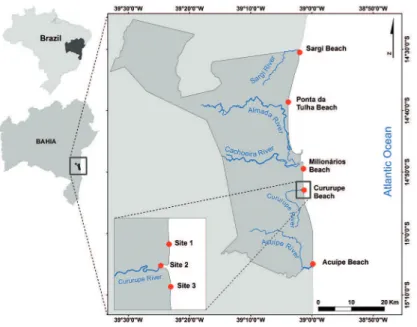
The study area is the Municipality of Ilhéus, State of Bahia, eastern Brazilian coast. It extends from Sargi Beach to the Acuípe River, an approximately 67 km long coastline of exposed sandy beaches (Figure 1). The estuaries formed by Almada River and Cachoeira River are important components of this landscape. The Cururupe River is subjected to low-scale exploitation for
tourism, with cottages and hotels at its mouth. Prior to
2003, a waste disposal unit operated 1 km upstream in the margins of this river, which potentially resulted in some environmental disturbance (ALVES; SOUZA, 2005).
The annual rainfall in this region is always greater
than 1,900 mm, with an annual average of 2,000 mm.
September and October are the driest months of the year and March and April are the wettest (BAHIA, 2001). Various physical forcing mechanisms (e.g., wind, continental water inlow and ocean interaction) afect the dynamics in water mass and sediment circulation over the continental shelf. Atmospheric circulation throughout the
Figure 1. Map of study area with sampling points.
year mainly consists of northeastern and eastern winds during the spring-summer and southeastern and eastern during autumn-winter, altered by the inlow of cold fronts with winds from the southern and southeastern quadrant (BITTENCOURT et al., 2000). This circulation system is responsible for the general pattern of wave fronts reaching the coastline and the sediment dispersion along the coast of Bahia (DOMINGUEZ et al., 1992).
Sampling was conducted biweekly at Cururupe Beach between December 03, 2004 and August 18, 2005, to determine the factors that may be associated with the occurrence of the surf-diatom patches. Surf-zone surface water samples were collected with a bucket at three stations (Figure 1). Air temperature, rainfall, and wind velocity/direction were considered for the sampling date and the two preceding days. These data were provided by the weather station of Ilhéus Airport (INFRAERO,
at ca. 7 km from the sampling points). Salinity (optical refractometer) and temperature (mercury-in-glass
thermometer) of the water were measured in situ. To determine the dissolved inorganic nutrient concentrations,
water samples were collected, iltered through a Whatman GF/F iberglass ilter, and analysed according to the methods of STRICKLAND; PARSONS (1972) for nitrate, GRASSHOF et al. (1983) for nitrite, SOLÓRZANO (1969) for ammonium, KOROLEFF (1983a) for phosphate and KOROLEFF (1983b) for silicate. Chlorophyll-a and
phaeopigments were estimated with the luorometric method according to LORENZEN (1967). Phytoplankton
quantitative analysis was performed with an inverted microscope (UTERMÖHL, 1958) on water samples preserved with a neutral formaldehyde solution (0.4% inal concentration). Net samples (20 µm mesh) were also sampled for qualitative analysis of the microplankton. Diatom identiication followed classical and modern
revisions. Asterionellopsis glacialis was identiied as a species complex based on recent taxonomic revision, which showed there are at least ive cryptic species into this group (KACZMARSKA et al., 2014).
Occasionally, dark patches were sampled to verify the extent of this phenomenon and to determine the species involved in the formation of the patches. These samples were collected along the Ilhéus coast by the local community (i.e., ishermen and the beachfront bar owners that observed the sea daily). Simple collection “kits” were distributed containing 125 mL bottles with formaldehyde neutralized to 4% inal concentration and a plastic cup to collect the surface water on the dark patches. Samples were periodically sent to the laboratory for qualitative and quantitative analysis (UTERMÖHL, 1958).
Tedesco et al.: Surf-Zone diatoms in Brazilian coast
by a two-way cluster analysis, using Bray-Curtis distance and taxa with frequency of occurrence higher than 15% in the dataset. This analysis was performed in PC-ORD 6 program.
During this study, hydrologic conditions in the Cururupe beach showed considerable oscillations, especially for temperature (24–30°C; mean=27.55±1.65°C) and salinity (24–37; mean=33.77±2.39). The reduced water column in the surf zone made this environment more susceptible to variations. Lower water temperatures during winter (mean=25.89±1.08°C) resulted from the greater inlow of cold fronts. Lower salinity values in station 2 during the summer (mean=31.17±4.12) were associated to the freshwater inlow from the Cururupe River.
We detected a high oscillation in the concentrations of nitrate (below detection to 1.13 mg/L; mean=0.20±0.26µg/L), nitrite (below detection to 0.26 µg/L; mean=0.05±0.07 µg/L), ammonium (0.18–4.56 µg/L; mean=0.18±4.56 µg/L), silicate (0.21–45.38 µg/L; mean=7.41±7.04 µg/L) and phosphate (below detection to 0.38 µg/L; mean=0.18±0.10 µg/L). These concentrations are considerably lower relative to the values recorded in exposed sandy beaches around the world (e.g., GAYOSO; MUGLIA, 1991; MCLACHLAN; LEWIN, 1981; ODEBRECHT et al., 2010; RÖRIG et al., 2006) and likely relected the inluence of the oligotrophic tropical water of
the Brazil Current in this region.
Chlorophyll-a concentrations (1.54–106.5 µg/L; mean=16.25±22.77 µg/L), phaeopigment (below the detection to 88.78 µg/L; mean=10.88±19.66 µg/L) and the relative contribution of phaeopigments to total chlorophyll (22–100%; mean=48%) showed high variability in Cururupe beach. In spite of the variations of chlorophyll-a, the mean concentration in this study
was lower than those observed in the Brazilian southern
beaches: Cassino beach, state of Rio Grande do Sul, with 36.1 µg/L (ODEBRECHT et al., 2010) and 50.2 µg/L (RÖRIG; GARCIA, 2003); Navegantes beach, state of Santa Catarina, with 11,080.21 µg/L (RÖRIG et al., 1997).
The PCA results from the environmental variables
explained 50.73% of the total variance (Figure 2). The irst axis was linked to the climatic variables in the region and its inluence on the local hydrology. In general, samples located at the negative side of axis I (especially the lower, left quadrant) were related to the high hydrodynamic periods, linked to intense S-SE winds, while units located on the positive side were related to warmer and calm periods, when the inluence of the Cururupe River
water plume was more noticeable. The second axis was potentially associated with the autotrophic biomass, in which the most of samples with dark patches were plotted in the positive side.
As strong southern and southeastern winds revolve
the bottom sediment and resuspend nutrients in the water column, chlorophyll-a and nutrient contents increased
during cold fronts and decreased during calm periods. In Cururupe beach, low coastal hydrodynamism due to weak winds favoured a high riverine inlow on the surf-zone
and higher concentrations of silicate were associated with
rainfall (Figure 2). Another relevant aspect is the presence of “spillways” along of Ilhéus coast. These waterways impact the low of continental waters and part of the coastal rain drainage. Little is known about the pattern of drainage, morphodynamic behavior, spatial distribution and the inluence on the balance of sedimentary spillways.
Nevertheless, its has been recognized as an erosive agent,
carrying and setting down on the coastal system (SILVA et al., 2003) and the rainfall rates may represent an important factor on nutrient input from the spillways.
In Cururupe beach, dark patches were observed ive times in the surf-zone, which corresponded to 28% of the samples. A. glacialis species complex and/or A. australis cell were numerically dominant (104–106 cells/L) at 44% of the samples, but patches were not evident. The highest
densities of A. glacialis species complex (6.72 x 10⁷ cells/L) and A. australis (2.2 x 10⁷ cells/L) were observed at site 1 on August 18, 2005. The highest chlorophyll-a concentrations were recorded between April and August, which corresponded to the peak of phytoplankton abundance (Figure 3). Peaks of phaeopigments corresponded to the highest cell concentrations of A. glacialis species complex.
Figure 2. Principal components analysis: position of the samples in the factorial plan I-II according to environmental variables. AMO: ammonium, ATE: air temperature, CHL: chlorophyll, RAI: rainfall, NAT: nitrate, NIT: nitrite, PHA: phaeopigments, PHO: phosphate, SAL: salinity, SIL: silicate, WIN: wind intensity and WTE: water temperature. The large circles represent the samples with the occurrence of visible patches.
Figure 3.Anaulus australis and Asterionellopsis glacialis species complex cell number and
Chlorophyll a variation during the biweekly sampling in Cururupe beach.
high reproduction rates (MARAÑÓN, 2015). Under the high hydrodynamism conditions of the surf-zone (due to the passing of cold fronts), this study indicated that episodes of high microplankton peaks mainly resulted
from increased diatom cell concentrations of A. australis
and A. glacialis species complex.
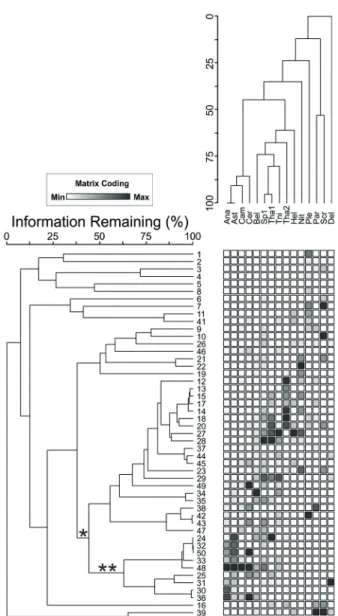
The total of 154 microplankton taxa was identiied in the net samples, including 109 diatoms, 23 tintinnids, 20 dinolagellates and 2 cyanobacteria. The two-way cluster analysis showed a clear group of units sampled at turbulent periods (strong winds) at 46.1% of information remaining (Figure 4). This group was associated with
ticoplanktonic or benthic species, such as A. australis, A. glacialis species complex, Campylosira cymbelliformis (A.Schmidt) Grunow ex Van Heurck, Cerataulus turgidus
(Ehrenberg) Ehrenberg, Bellerochea malleus (Brightwell)
Van Heurck, and Thalassionema nitzschioides (Grunow) Mereschkowsky. Into this group, visible dark patches were grouped at 65.5% of information remaining, which are closely related to A. glacialis species complex and A. australis abundance.
In ten dark patches analysed along the Ilhéus coast, A. glacialis species complex and A. australis were present
Tedesco et al.: Surf-Zone diatoms in Brazilian coast
Figure 4. Dendrogram derived from two-way cluster analysis of the phytoplankton data in Cururupe beach. Only the taxa that were present in
more than 15% of the samples were considered. ANA=Anaulus australis,
AST=Asterionellopsis glacialis species complex, BEL=Bellerochea malleus, CAM=Campylosira cymbeliformis, CER=Cerataulus turgidus, DEL=Delphineis sp., HEL=Helicotheca tamesis, NIT=Nitzschia longissima, PAR=Paralia sulcata, PLE=Pleurosigma sp., SCR=Scrippsiella
sp., SP1=unidentiied centric diatom, THA1=Thalassiosira sp. 1,
THA2=Thalassiosira sp. 2 and TNI=Thalassionema nitzschioides. *
indicates the group of samples under inluence of strong winds. ** indicates the subgroup with visible patches.
total number of cells for these two species in the patches ranged from 3.2 x 10⁷ (May 18) to 2.6 x 10⁹ cells/L (April
24). The minimum cell concentrations for A. glacialis species complex (1.8 x 10⁹ cells/L) and A. australis (7.8 x
108 cells/L) were also observed on April 24, 2003.
The frequent occurrence of A. glacialis species complex, Thalassionema nitzschioides and Pseudo-nitzschia spp. was
veriied as a characteristic of the phytoplankton community
in the surf-zone at Pontal do Sul beach in the State of Paraná,
Local Date Anaulus australis (%) Asterionellopsis glacialis (%)
Sargi Beach* 24.04.03 66 34
Milionários Beach* 24.04.03 30 70
Milionários Beach* 18.05.03 12 88
Milionários Beach* 26.06.03 1 99
Cururupe Beach 19.04.05 2 98
Cururupe Beach 19.05.05 31 69
Cururupe Beach 03.06.05 11 89
Cururupe Beach 17.06.05 58 42
Cururupe Beach 18.08.05 21 79
Ponta da Tulha Beach 12.10.05 99 1
Table 1. Percentage of Anaulus australis and Asterionellopsis glacialis species complex collected in visible patches along the coast of
Ilhéus.
Brazil (VILLAC; NORONHA, 2008). These diatoms form
chains of elongated frustules, which elevate their
surface-volume ratio. This process is considered as an important strategy for survival in waters with high hydrodynamism (SMAYDA; REYNOLDS, 2001). VILLAC; NORONHA (2008) observed the dominance or co-dominance
tendencies of A. australis and A. glacialis species complex in surf-zones of exposed beaches. In despite their high
concentrations (106 cells/L), the formation of patches was not detected. Our results suggest that densities from 3 x
107 cells/L become visible to the naked eye.
In southern Brazil, the occurrence of diatom cell
patches was mainly associated with the presence of A. glacialis species complex. The irst recorded patches occurred along Cassino beach, State of Rio Grande do Sul, where dense and frequent accumulations were primarily treated with classic blooms (AGUIAR; CORTE-REAL, 1973; ROSA; AGUIAR, 1973). Later, studies that were more speciic were conducted regarding the seasonal patterns of the patches and their associations with precipitation and onshore winds (GIANUCA, 1983; ODEBRECHT et al., 1995). Along Navegantes beach, State of Santa Catarina, RÖRIG et al. (1997) observed
the co-occurrence of A. australis and A. glacialis species complex. This co-occurrence was similar to that observed
along beaches in South Africa (TALBOT et al., 1990).
RÖRIG et al. (2006) discussed the role of temperature
in the distribution and co-dominance of A. australis and
A. glacialis species complex. They proposed that A. australis was dominant at higher temperatures and that A. glacialis species complex was dominant at lower temperatures along the Brazilian coast. In addition, these authors proposed that these species were co-dominant in waters of intermediate temperature. In the coast of Ilhéus, which is relatively warm throughout the year, the
dominance of either A. australis or A. glacialis species
complex does not seem to be related to temperature. The maximum value that was recorded for A. glacialis species complex (1.81 x 10⁹ cells/L) in the patches along the coast of Ilhéus was similar to the maximum
value that was observed along the beaches of Atlantic
South America (1.0 x 10⁸ cells/L – ODEBRECHT et al., 2010; 1.30 x 10⁸ cells/L – ABREU et al., 2003; 4.40 x 10⁸ cells/L – RÖRIG; GARCIA, 2003). The average
cell count of A. glacialis species complex in the patches of Ilhéus region (7.23 x 10⁶ cells/L) was slightly lower than the values that were recorded by RÖRIG; GARCIA (2003) along Cassino beach (2.53 x 10⁷ cells/L). In the Navegantes beach surf zone, RÖRIG et al. (1997) recorded the presence of 1.44 x 10¹⁰ cells/L of Anaulus sp. in patches. This value exceeds the maximum value that was observed for this species in this study (7.78 x 10⁸ cells/L). However, patches in Ilhéus coast was mixed with high concentrations of A. glacialis species complex (1.81 x 10⁹ cells/L). High concentrations of phaeopigments observed at same time that high
concentrations of A. glacialis species complex may be associated to the process of resuspension of debris and
organic material of the bottom that are adhered to the cell chains.
Beach morphodynamics, metereological regime and nutrient availability were decisive factors in controlling
the formation and maintenance of diatom accumulations
in ca. 90 surf zones studied until now (ODEBRECHT et al., 2014). Among these mechanisms, high wind intensity associated with cold fronts and inlow of nutrients from continental drainage appears to be determinant for the occurrence of patches containing A. glacialis species complex and A. australis in the region of Ilhéus.
Tedesco et al.: Surf-Zone diatoms in Brazilian coast
the complexity of the Ilhéus coast surf zone environment, some patterns appear as a sudden local interference on the gradual succession of the coastal phytoplankton, being the cold fronts passage the main interference factor.
ACKNOWLEDGEMENTS
We thank INFRAERO for providing meteorological data; E.C. Tedesco thanks CAPES for granting the scholarship; P.C.O.V. Abreu (FURG) for supporting and giving directions on the development of this study; M.F.L. Souza (UESC), A. Schiavetti (UESC), L.F. Rezende (UESC), L. Rörig (UFSC) and A.C.S. Andrade (UFS) for their scientiic support and suggestions; and for the bibliographic material and help provided.
REFERENCES
ABREU, P. C.; RÖRIG, L. R.; GARCIA, V.; ODEBRECHT, C.; BIDDANDA, BB. Decoupling between bacteria and the surf-zone diatom Asterionellopsis glacialis at Cassino Beach, Brazil. Aquat. Microb. Ecol., v. 32, p. 219-228, 2003.
AGUIAR, L. W.; CORTE-REAL, M. Sobre uma loração de
Asterionella japonica Cleve (1878) na costa do Rio Grande
do Sul. Iheringia, Sér. Bot., v. 17, n. 1, p. 18-27, 1973.
ALVES, C. P.; SOUZA, M. F. L. Hydrochemistry of two small estuaries: Cururupe and Acuipe Rivers (Ilhéus, BA, Brazil).
Acta Limnol. Bras., v. 17, n. 4, p. 409-418, 2005.
BAHIA. Superintendência de Recursos Hídricos. Programa de recuperação das bacias dos rios Cachoeira e Almada. Ilhéus:
SHR/UESC, 2001. v. 1, t. I.
BATE, G. C.; MCLACHLAN, A. Surf zone discoloration by phytoplankton: The consequence of pollution? Mar. Pollut. Bull., v. 18, n. 2, p. 65-67, 1987.
BITTENCOURT, A. C. S. P.; DOMINGUEZ, J. M. L.; MARTIN, L.; SILVA, I. R. Patterns of sediment dispersion coastwise the State of Bahia - Brazil. An. Acad. Bras. Ciênc., v. 72, n. 2, p.
271-287, 2000.
BROWN, A. C.; MCLACHLAN, A. The ecology of sandy shores. San Diego: Academic Press, 1990.
CAMPBELL, E. E. The global distribution of surf accumulations.
Rev. Chil. Hist. Nat., v. 69, p. 495-501, 1996.
CAMPBELL, E. E.; BATE, G. C. The estimation of annual primary production in a high energy surf-zone. Bot. Mar., v. 31, n. 4, p. 337-343, 1988.
DOMINGUEZ J. M. L.; BITTENCOURT, A. C. S. P.; MARTIN, L. Controls on Quaternary coastal evolution of the east-northeastern coast of Brazil: roles of sea level history, trade winds and climate.
Sediment. Geol., v. 80, n. 3-4, p. 213-232, 1992.
GAYOSO, A. M.; MUGLIA, V. H. Blooms of the surf-zone diatom Gonioceros armatum (Bacillariophyceae) on the
South Atlantic coast (Argentina). Diatom Res., v. 6, n. 2, p.
247-253, 1991.
GIANUCA, N. M. A preliminary account of the ecology of sandy beaches in southern Brazil. In: MCLACHLAN,
A.; ERASMUS, T. (Eds.). Sandy beaches as ecosystems. Dordrecht: Springer Netherlands, 1983. p. 413-419. GRASSHOF, K; EHRHARDT, M.; KREMLING, K. (Eds.).
Methods of seawater analysis. 2nd ed. Weinheim: Verlag Chemie, 1983.
KACZMARSKA, I.; MATHER, L.; LUDDINGTON, I. A.; MUISE, F.; EHRMAN, J. M. Cryptic diversity in a cosmopolitan diatom known as Asterionellopsis glacialis
(Fragilariaceae): Implications for ecology, biogeography, and taxonomy. Am. J. Bot., v. 101, n. 2, p. 267-286, 2014.
KOROLEFF, K. Determination of nutrients. 1. Phosphorus. In: GRASSHOF, K.; ERHARDT, M.; KREMLING, K. (Eds.). Methods of seawater analysis. 2nd ed. Weinheim/ Deerfield Beach: Verlag Chemie, 1983a.
KOROLEFF, K. Determination of nutrients. 6. Silicon. In: GRASSHOF, K.; ERHARDT, M.; KREMLING, K. (Eds.).Methods of seawater analysis. 2nd ed. Weinheim/ Deerfield Beach: Verlag Chemie, 1983b.
LEWIN, J.; SCHAEFER, C. T. The Role of Phytoplankton in Surf Ecosystems. In: MCLACHLAN, A.; ERASMUS, T. (Eds.). Sandy beaches as ecosystems. Dordrecht:
Springer Netherlands, 1983. p. 381-389.
LEWIN, J.; SCHAEFER, C. T.; WINTER, D. F. Surf-zone ecology and dynamics. In: LANDRY, M. R.; HICKEY, B. M. (Eds.). Coastal oceanography of Washington and Oregon. Amsterdam: Elsevier, 1989.p. 567-594.
LORENZEN, C. J. Determination of chlorophyll and pheo-pigments: spectrophotometric equations. Limnol. Oceanogr., v. 12, n. 2, p. 343-346, 1967.
MARAÑÓN, E. Cell size as a key determinant of phytoplankton metabolism and community structure. An. Rev. Mar. Sci., v. 7, p. 241-264, 2015.
MCLACHLAN, A.; LEWIN, J. Observations on surf phytoplankton blooms along the coasts of South Africa.
Bot. Mar.,v. 24, n. 10, p. 553-557, 1981.
ODEBRECHT, C.; BERGESCH, M.; RÖRIG, L. R.; ABREU, P. C. Phytoplankton interannual variability at Cassino Beach, southern Brazil (1992-2007), with emphasis on the surf zone diatom Asterionellopsis glacialis. Estuar. Coast., v. 33, n. 2, p. 570-583, 2010.
ODEBRECHT, C.; DU PREEZ, D. R.; ABREU, P. C.; CAMPBELL, E. E. Surf zone diatoms: A review of the drivers, patterns and role in sandy beaches food chains.
Estuar. Coast. Shelf Sci., v. 150, pt. A, p. 24-35, 2014.
ODEBRECHT, C.; SEGATTO, A. Z.; FREITAS, C. A. Surf-zone chlorophyll a variability at Cassino Beach, southern Brazil. Estuar. Coast. Shelf Sci., v. 41, n. 1, p. 81-90, 1995.
REZENDE, K. R. V.; BRANDINI, F. P. Variação sazonal do fitoplâncton na zona de arrebentação da praia de Pontal do Sul (Paranaguá, Paraná). Nerítica, v. 11, p. 50-78,
1997.
ROMER, G. S.; MCLACHLAN, A. Mullet grazing on surf diatom accumulations. J. Fish Biol., v. 28, n. 1, p.
93-104, 1986.
RÖRIG, L. R.; ALMEIDA, T. C. M.; GARCIA, V. M. T. Structure and succession of the surf-zone phytoplankton in Cassino Beach, Southern Brazil. J. Coast. Res., v. 2004, n. 39, p. 1246-1250, 2006.
de acumulação da diatomácea Anaulus sp. na zona de
arrebentação da Praia de Navegantes (Santa Catarina), Brasil. In: ABSALÃO, R. S.; Esteves, A. M. (Eds.). Oecologia Brasiliensis III: Ecologia de Praias Arenosas do Litoral Brasileiro. Rio de Janeiro: UFRJ, 1997. p. 29-43.
RÖRIG, L. R.; GARCIA, V. M. T. Accumulations of the suf-zone diatom Asterionellopsis glacialis (Castracane) Round in Cassino Beach, Southern Brazil, and its relationship with environmental factors. J. Coast. Res., n. sp 35, p. 167-177, 2003.
ROSA, Z. M.; AGUIAR, L. W. Diatomáceas da costa do Rio Grande do Sul, Brasil: I – Praia do Cassino – Rio Grande. Iheringia, Ser. Bot.,
v. 21, p. 103-128, 1973.
SILVA, R. P.; CALLIARI, L. J.; TOZZI, H. A. M. The inluence of washouts on the erosive susceptibility of the Rio Grande do Sul coast between Cassino and Chuí Beaches, Southern Brazil. J. Coast. Res., n. sp 35, p. 332-338, 2003.
SMAYDA, T. J.; REYNOLDS, C. S. Community assembly in marine phytoplankton: application of recent models to harmful dinolagellate blooms. J. Plankton Res., v. 23, n. 5, p. 447-461, 2001.
SOLÓRZANO, L. Determination of ammonia in natural waters by the phenolhypochlorite method. Limnol. Oceanogr., v. 14, n. 5, p. 799-801, 1969.
STRICKLAND, J. D. H.; PARSONS, T. R. A practical handbook of seawater analysis. v. 167, 2nd ed. Ottawa: Fisheries Research Board of Canada, 1972.
TALBOT, M. M. B.; BATE, G. C.; CAMPBELL, E. E. A review of the ecology of surfzone diatoms, with speciic reference to Anaulus australis. Oceanogr Mar Biol Annu Rev., v. 28, p. 155-175, 1990.
UTERMÖHL, H. Zur Vervollkommnung der quantitativen Phytoplankton-Methodik. Mitt. Int. Verein. Theor. Angew. Limnol.,
v. 9, p. 1-38, 1958.
VILLAC, M. C.; NORONHA, V. A. P. C. The surf-zone Phytoplankton of the State of São Paulo, Brazil. I. Trends in space-time distribution with emphasis on Asterionellopsisglacialis and Anaulus australis