Sao Paulo Med J. 2015; 133(6):517-20 517
SHORT COMMUNICATION
DOI: 10.1590/1516-3180.2014.9071412Urinary tract infection and indwelling urinary catheters:
prospective study in gynecological surgery with
antibiotic prophylaxis
Infecção do trato urinário e cateter vesical de demora: um estudo prospectivo em
cirurgia ginecológica com antibioticoproilaxia
José Carlos Carraro-Eduardo
I, Daniela da Silva Alves
II, Ingrid Ellis Hinden
II, Ivan Penaloza Toledano
II, Sarah Gomes Freitas
II,
Pedro Juan José Mondino
III, José Rodrigo de Moraes
IV, Carlos Augusto Faria
VNephrology and Gynecology Services, Hospital Universitário Antônio Pedro, Universidade Federal Fluminense (UFF), Niterói,
Rio de Janeiro, Brazil
ABSTRACT
CONTEXT AND OBJECTIVES: Urinary tract infections are the most common cause of hospital-acquired infections, and the use of indwelling urinary catheters is a predisposing factor for their development. The aims of this study were to estimate the frequency of pre and postoperative bacteriuria, identify the microorganisms involved, count the colony-forming units, determine the antibiotic sensitivity proile and compare the results from pre and postoperative urinalyses among women undergoing gynecological surgery with implantation of a urinary catheter.
DESIGN AND SETTING: Non-controlled prospective observational single-cohort epidemiological study carried out at a university hospital.
METHODS: Urine samples were collected before and 24 hours after catheterization for urinalysis, cultur-ing and antibiotic sensitivity testcultur-ing. Pre and postoperative urinalyses were compared uscultur-ing Wilcoxon and McNemar non-parametric tests.
RESULTS: Fifty-one women participated in the study. Escherichia coli grew in six preoperative samples (11.8%) and Klebsiella pneumoniae in one (1.9%), but bacterial growth did not occur in any postopera-tive sample. Urinalysis showed lower number of pus cells in the postoperapostopera-tive urine samples (P < 0.05). There were no diferences in red blood cell counts or in the nitrite and leukocyte esterase tests, between the samples.
CONCLUSION: Bacteriuria was found in 13.7% of the preoperative samples. Gram-negative bacteria sensi-tive to most antibiotics were identiied. In the postoperasensi-tive samples, no bacterial growth was observed. Urinalysis only showed signiicant reduction of leukocyturia in the postoperative period.
RESUMO
CONTEXTO E OBJETIVOS: As infecções urinárias são a causa mais comum de infecções hospitalares, e o uso de cateteres de demora é fator predisponente para o seu desenvolvimento. Os objetivos deste estudo foram estimar a frequência de bacteriúria pré e pós-operatória, identiicar os germes encontrados, a conta-gem de unidades formadoras de colônias e o peril de sensibilidade aos antibióticos, além de comparar os resultados dos exames de urina pré- e pós-operatórios em mulheres submetidas a cirurgias ginecológicas com cateterismo vesical.
TIPO DE ESTUDO E LOCAL: Estudo epidemiológico, observacional, de coorte única, prospectivo, não controlado, realizado em hospital universitário.
MÉTODOS: Amostras de urina foram colhidas antes da cateterização e após 24 horas para urinálise, cultura e antibiograma. Os resultados da urinálise no pré- e pós-operatório foram comparados utilizando-se os testes não paramétricos de Wilcoxon e McNemar.
RESULTADOS: Participaram do estudo 51 mulheres. Houve crescimento de Escherichia coli em seis amostras pré-operatórias (11,8%) e de Klebsiella pneumoniae em uma (1,9%), mas não houve crescimen-to bacteriano em nenhuma amostra pós-operatória. A urinálise mostrou menor quantidade de piócicrescimen-tos na amostra de urina pós-cirúrgica (P < 0,05). Não houve diferença quanto ao número de hemácias e às reações para nitrito e leucocitesterase, entre as amostras.
CONCLUSÃO: Houve bacteriúria em 13,7% das amostras pré-operatórias, sendo identiicadas bactérias Gram-negativas sensíveis à maioria dos antibióticos. Não foi observado crescimento bacteriano nas amos-tras pós-operatórias. A urinálise mostrou somente redução signiicativa da leucocitúria no pós-operatório. IMD, MSc, PhD. Associate Professor, Department
of Internal Medicine, School of Medicine, Universidade Federal Fluminense (UFF), Niterói, Rio de Janeiro, Brazil.
IIUndergraduate Medical Student, Department of Internal Medicine, School of Medicine, Universidade Federal Fluminense (UFF), Niterói, Rio de Janeiro, Brazil.
IIIMD, MSc. Adjunct Professor, Department of Pathology, School of Medicine, Universidade Federal Fluminense (UFF), Niterói, Rio de Janeiro, Brazil. IVMSc, PhD. Adjunct Professor, Statistics Department, Institute of Mathematics and Statistics, Universidade Federal Fluminense (UFF), Niterói, Rio de Janeiro, Brazil.
VMD. Adjunct Professor, Mother-Child Department, School of Medicine, Universidade Federal Fluminense (UFF), Niterói, Rio de Janeiro, Brazil.
KEY WORDS:
Urinary tract infections. Bacteriuria.
Urinary catheterization. Antibiotic prophylaxis.
Gynecologic surgical procedures.
PALAVRAS-CHAVE:
Infecções urinárias. Bacteriuria. Cateterismo urinário. Antibioticoproilaxia.
SHORT COMMUNICATION | Carraro-Eduardo JC, Alves DS, Hinden IE, Toledano IP, Freitas SG, Mondino PJJ, Moraes JR, Faria CA
518 Sao Paulo Med J. 2015; 133(6):517-20 INTRODUCTION
he use of indwelling urinary catheters is the single most sig-niicant predisposing factor for the development of urinary tract infections (UTIs) in hospitalized patients, and the duration of catheterization is the most signiicant risk factor for this.1-3 UTIs
occur more frequently in the postoperative period when urinary catheters are used and lead to greater morbidity and mortality, as well as increased hospitalization time and costs.4-6
Intraoperative, pre-incision antibiotic prophylaxis is highly efective in preventing surgical site infection.7 In addition, some
studies have suggested that antibiotic prophylaxis may also reduce the risk of catheter-related UTIs, although it is not rec-ommended for this purpose.8,9
Most studies on catheter-related UTIs deine bacteriuria as the primary outcome; in fact, this term is oten used as a syn-onym for UTI. However, the diference between the two is clini-cally relevant, since catheter-related asymptomatic bacteriuria is seldom associated with adverse outcomes and generally does not require treatment.10
Asymptomatic bacteriuria is deined as the presence of more than 105 colony-forming units/ml (CFU/ml) of uropathogenic
bacteria in a urine culture.11 However, in patients with urinary
catheters, it is deined as the presence of more than 102 CFU/ml
of any one microorganism.12
Women who have undergone genital interventions generally receive urinary catheters for at least 24 hours. he possible cor-relation between preoperative asymptomatic bacteriuria and the occurrence of a UTI in such cases has not been well established, nor have the efects of intraoperative antibiotic prophylaxis on preventing UTIs.
OBJECTIVE
he aims of the present study, conducted with a single cohort of women who underwent elective gynecological surgery and short-term urinary catheterization, were irst, to estimate the frequency of pre and postoperative bacteriuria, with identiication of the microorganisms involved, counting of CFUs and determination of the antibiotic sensitivity proile, and second, to compare the results from pre and postoperative urinalyses.
METHODS
his study was approved by the Research Ethics Committee of Fluminense Federal University.
A prospective, observational, epidemiological, single-cohort, non-controlled study was conducted on a convenience sample from April 2010 to September 2011. Women admitted to the hospital for elective gynecological surgery including bladder catheterization were invited to participate in the study, and those who agreed signed an informed consent form. here was no sample calculation.
Participants with a diagnosis of a UTI, those using antibiotics with potential efectiveness against UTIs within 24 hours before urinary catheterization and patients younger than 18 years old were excluded from the study.
Two urine samples were collected from each participant. The first sample was collected at the hospital ward during spontaneous urination. After transfer to the operating room, a Foley catheter was inserted following the standard technique. All participants were given pre-incision antibiotic prophylaxis with cefazolin, clindamycin or ciprofloxacin at a dose of two grams, intravenously. No participant was given further doses of antibiotics.
he postoperative urine sample was collected directly from the drain at the bottom of the collecting bag, 24 hours ater cath-eter placement. Any bacterial count higher than 1,000 CFUs was taken into consideration.
he following variables were considered for analysis: age, urinalysis results (pH, speciic gravity, nitrite, leukocyte esterase, hematuria and leukocyturia), urine culture results, surgical indi-cation leading to catheterization, presence of UTI symptoms and type of antibiotic prophylaxis at surgery.
Comparison of the pre and postoperative urinalyses of participants who exhibited bacteriuria in their preoperative sample was done using McNemar’s test and the Wilcoxon signed-rank test. The significance level was set at 5% in all tests, which were performed using the Statistical Package for the Social Sciences software for Windows, version 17.0 (SPSS, Chicago, IL, USA; Microsoft, Redmond, WA, USA).
RESULTS
A total of 61 women met the inclusion criteria, but three declined to participate, and seven were excluded because the second urine sample could not be collected.
he participants’ ages ranged from 18 to 77 years, with a mean of 48.23 ± 11.19 years of age. No participant presented symptoms of UTIs.
he antibiotics used were cefazolin, in 49 patients, and cipro-loxacin and clindamycin in one patient each. Most patients under-went abdominal surgery (47 cases), but four of them underunder-went vaginal surgery. he frequency of bacteriuria was 13.7% in the pre-operative samples (7 cases). Klebsiella pneumoniae was found in 1 case and Escherichia coli in 6, and the CFU counts ranged from 2,000 to 100,000. he antibiotic sensitivity test revealed that all of the bacteria isolated were sensitive to the antibiotic administered for prophylaxis. Bacterial growth did not occur in any of the urine samples collected ater surgery.
Urinary tract infection and indwelling urinary catheters: prospective study in gynecological surgery with antibiotic prophylaxis | SHORT COMMUNICATION
Sao Paulo Med J. 2015; 133(6):517-20 519
Hematuria was detected in 8 preoperative and 14 postopera-tive samples. Leukocyturia was detected in 8 preoperapostopera-tive sam-ples, 3 of which exhibited bacterial growth, and in 9 samples col-lected 24 hours ater catheter placement.
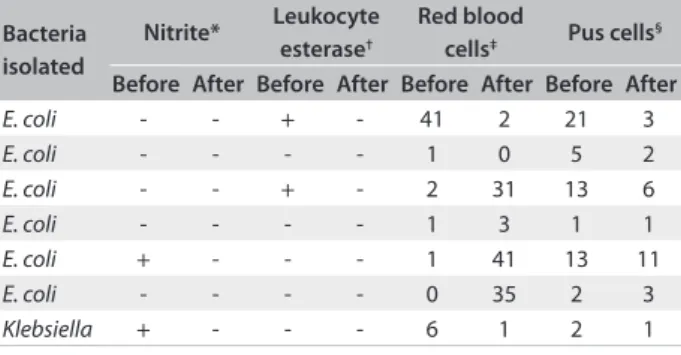
he comparison of the results from the pre and postopera-tive urinalyses of the participants who exhibited bacteriuria in the irst sample is described in Table 1.
DISCUSSION
In this study, the indings from urinalysis were similar to those in other reports on UTIs in the literature.13,14 Hematuria was detected
in the preoperative samples of eight participants, and only one urine culture tested positive for bacteriuria. Since these samples were collected during spontaneous urination, the probable causes of hematuria were the clinical conditions that led to the indications of surgery, such as bleeding uterine leiomyomatosis. Hematuria was detected in the postoperative samples from 14 participants, possibly due to traumatic injury during catheter insertion.
Our indings for nitrite did not difer from reports in the lit-erature and exhibited low sensitivity and high speciicity.13 It is
worth noting that enterobacteria were isolated from all of the positive culture samples, since these bacteria are characteristi-cally able to reduce nitrate to nitrite. he leukocyte esterase test was positive in 5% of the samples, although bacterial growth was detected in cultures from only 20% of them, thus indicating low sensitivity and speciicity.
here are divergent opinions regarding treatment of asymp-tomatic bacteriuria in patients with a urethral indwelling cath-eter, and antibiotic prophylaxis is not indicated for patients with long-term catheterization due to the risk of inducing microbial resistance.12 In addition, there is limited evidence indicating that
antibiotic prophylaxis reduces the rate of bacteriuria in surgery patients who undergo postoperative urethral catheterization for at least 24 hours.15
In this study, in which the criterion used was stricter, it was found that preoperative urine cultures tested positive for bacteria sensitive to the antibiotic administered for prophylaxis in seven cases, and no bacterial growth occurred in the postoperative samples. Similarly, another study found that none of the urine samples from patients who underwent bladder catheterization during elective surgical pro-cedures, 94% of whom were given antibiotic prophylaxis to prevent surgical wound infection, tested positive. However, the criterion used to establish the presence of a UTI was ≥ 100,000 CFU/ml of urine.16 Another study conducted in women who underwent
gyne-cological surgery found that 23.6% of the urine samples collected up to 24 hours ater catheter removal tested positive on culturing, with 2.4% of these patients requiring antibiotic treatment.17
Since the beneits of antibiotic prophylaxis to prevent surgical site infection are undeniable, it is not possible to include a con-trol group in studies in which prophylaxis is not provided. his, together with the small sample size, is the main limitation of our study. However, the inding that none of the women with asymp-tomatic bacteriuria before surgery developed clinical or labora-tory signs of a UTI despite urinary catheterization is important, particularly because the criterion selected for diagnosis was more sensitive (> 100 CFU/ml). Although the procedures for asepsis and the use of closed sterile collecting bags certainly contrib-uted towards preventing the occurrence of bacterial growth in the samples collected ater surgery, and although the natural his-tory of bacteriuria in such cases is unknown, this inding might be also attributable to the antibiotic prophylaxis.
CONCLUSIONS
he frequency of preoperative bacteriuria in this group of women undergoing gynecological surgery was 13.7%. Gram-negative bacteria sensitive to most antibiotics were identiied, and the CFU counts ranged from 2,000 to 100,000. Bacterial growth did not occur in any postoperative sample. Urinalysis showed signif-icant reduction of leukocyturia in the postoperative period, but no diference was found in the red blood cells count or in the nitrite and leukocyte esterase tests.
REFERENCES
1. Smyth ET, McIlvenny G, Enstone JE, et al. Four country healthcare
associated infection prevalence survey 2006: overview of the results.
J Hosp Infect. 2008;69(3):230-48.
2. Stamm AMNF, Coutinho MSSA. Infecção do trato urinário relacionada
ao cateter vesical de demora: incidência e fatores de risco [Urinary
tract infection with indwelling bladder catheter: incidence and risk
factors]. Rev Assoc Med Bras (1992). 1999;45(1):27-33.
3. Chang R, Greene MT, Chenoweth CE, et al. Epidemiology of
hospital-acquired urinary tract-related bloodstream infection at a university
hospital. Infect Control Hosp Epidemiol. 2011;32(11):1127-9. Table 1. Pre and postoperative urinalyses of participants who
exhibited bacteriuria in their preoperative samples
Bacteria isolated
Nitrite* Leukocyte esterase†
Red blood
cells‡ Pus cells §
Before After Before After Before After Before After
E. coli - - + - 41 2 21 3
E. coli - - - - 1 0 5 2
E. coli - - + - 2 31 13 6
E. coli - - - - 1 3 1 1
E. coli + - - - 1 41 13 11
E. coli - - - - 0 35 2 3
Klebsiella + - - - 6 1 2 1
SHORT COMMUNICATION | Carraro-Eduardo JC, Alves DS, Hinden IE, Toledano IP, Freitas SG, Mondino PJJ, Moraes JR, Faria CA
520 Sao Paulo Med J. 2015; 133(6):517-20
4. Ghafourian S, Sekawi Z, Neela V, et al. Incidence of extended-spectrum
beta-lactamase-producing Klebsiella pneumoniae in patients with
urinary tract infection. Sao Paulo Med J. 2012;130(1):37-43.
5. Guggenbichler JP, Assadian O, Boeswald M, Kramer A. Incidence
and clinical implication of nosocomial infections associated
with implantable biomaterials – catheters, ventilator-associated
pneumonia, urinary tract infections. GMS Krankenhaushyg
Interdiszip. 2011;6(1):Doc 18.
6. Nero DC, Lipp MJ, Callahan MA. The inancial impact of
hospital-acquired conditions. J Health Care Finance. 2012;38(3):40-9.
7. Bowater RJ, Stirling SA, Lilford RJ. Is antibiotic prophylaxis in surgery a
generally efective intervention? Testing a generic hypothesis over a
set of meta-analyses. Ann Surg. 2009;249(4):551-6.
8. Hooton TM, Bradley SF, Cardenas DD, et al. Diagnosis, prevention,
and treatment of catheter-associated urinary tract infection in adults:
2009 International Clinical Practice Guidelines from the Infectious
Diseases Society of America. Clin Infect Dis. 2010;50(5):625-63.
9. de Oliveira LC, Lucon AM, Nahas WC, Ianhez LE, Arap S.
Catheter-associated urinary infection in kidney post-transplant patients. Sao
Paulo Med J. 2001;119(5)165-8.
10. Tambyah PA, Maki DG. Catheter-associated urinary tract infection
is rarely symptomatic: a prospective study of 1,497 catheterized
patients. Arch Intern Med. 2000;160(5):678-82.
11. Nicolle LE. Asymptomatic bacteriuria: review and discussion of the
IDSA guidelines. Int J Antimicrob Agents. 2006;28 Suppl 1:S42-8.
12. Nicolle LE, Bradley S, Colgan R, et al. Infectious Diseases Society of
America guidelines for the diagnosis and treatment of asymptomatic
bacteriuria in adults. Clin Infect Dis. 2005;40(5):643-54.
13. dos Santos JC, Weber LP, Perez LR. Evaluation of urinalysis parameters
to predict urinary-tract infection. Braz J Infect Dis. 2007;11(5):479-81.
14. Yoshida CS, Irie MMT, Pádua RAF, et al. Análise do desempenho da prova
de nitritos das tiras reativas de urina para triagem de infecção bacteriana
do trato urinário. [Analysis of the acting of the test of nitrite of the test
strip of urine for screen of the urinary tract bacterial infection]. Revista
Brasileira de Análises Clínicas. 2006;38(4):255-8. Available from: http://
sbac.org.br/rbac/005/65.pdf. Accessed in 2015 (Jan 8).
15. Lusardi G, Lipp A, Shaw C. Antibiotic prophylaxis for short-term
catheter bladder drainage in adults. Cochrane Database Syst Rev.
2013;7: CD005428.
16. Souza Neto JL, Oliveira FV, Kobaz AK, et al. Infecção do trato urinário
relacionada com a utilização do catéter vesical de demora: resultados
da bacteriúria e da microbiota estudadas [Urinary tract infection
related to the use of catheter-delay bladder: results of bacteriuria and
microbiota studied]. Rev Col Bras Cir. 2008;35(1):28-33.
17. Hinrichsen SCA, Souza ASR, Amorim MMR, Hinrichsen MGML,
Hinrichsen SL. Fatores associados à bacteriúria após sondagem
vesical na cirurgia ginecológica [Factors associated with bacteriuria
after indwelling urethral catheterization in gynecologic surgery]. Rev
Assoc Med Bras (1992). 2009;55(2):181-7.
Sources of funding: None Conlict of interests: None
Date of irst submission: June 5, 2014 Last received: October 23, 2014 Accepted: December 14, 2014
Address for correspondence: José Carlos Carraro-Eduardo
Estrada Francisco da Cruz Nunes, 8.100 — casa 503 — Condomínio
Jardim Ubá IV
Itaipu — Niterói (RJ) — Brasil
CEP 24350-310
Tel. (+55 21) 2629-9169