Sao Paulo Med J. 2015; 133(6):457-9 457
EDITORIAL
DOI: 10.1590/1516-3180.2015.13360510Stroke is still a neglected disease in Brazil
Acidente vascular cerebral permanece doença negligenciada no Brasil
Paulo Andrade Lotufo
IFaculdade de Medicina da Universidade de São Paulo (FMUSP), São Paulo, Brazil
Data from the Brazilian Ministry of Health show that the absolute number of deaths due to cor-onary heart disease surpassed the number of some fatal cerebrovascular events in Brazil only in 2011, for all ages. Higher risk of death due to heart disease than due to cerebrovascular diseases is the pattern in the Western hemisphere. However, as pointed out ten years ago in this Journal, Brazil had the highest age-adjusted stroke death rate of all Latin-American countries.1 Despite
the decline in stroke death rate throughout this country,2 the risk of premature death due to
stroke in Brazil is one of the highest in the world.
To prove this statement, we take data from the Global Burden of Disease 2013 study relating to mortality and years of life lost (YLL) due to premature death.3,4 First, we compare the years of
life lost due to coronary heart disease (CHD) and stroke in South America (except Guyana and Suriname). Second, we compare the YLL of Brazil with that of 18 other selected countries (total of 19 countries). For both comparisons, there is an average value and there are places that can be described as presenting three situations: signiicantly higher than the mean; indistinguishable from the mean and considerably lower than the mean.
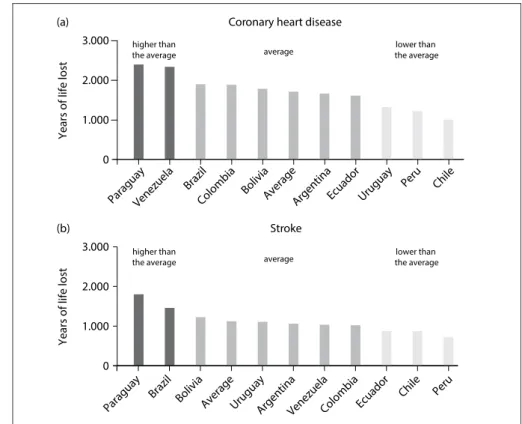
he YLL due to CHD is higher in Venezuela and Paraguay, and Brazil is ranked third, but with values indistinguishable from the mean (Figure 1a). However, the YLL for cerebrovascular diseases is considerably higher in Paraguay and Brazil (Figure 1b).
IMD, DrPH. Full Professor, Department of Internal
Medicine, Faculdade de Medicina da Universidade de São Paulo (FMUSP), São Paulo, Brazil.
1.000
ParaguayVenezuela Brazil
Colombia BoliviaAverageArgentinaEcuador Uruguay
Peru Chile
Paraguay Venezuela
Brazil
Colombia BoliviaAverage
Argentina Ecuador Uruguay
Peru Chile 2.000
3.000
1.000 2.000 3.000 0
0
Coronary heart disease
Stroke
Ye
a
rs o
f life
lost
Ye
a
rs o
f life
lost
(a)
(b)
higher than
the average average
lower than the average
higher than
the average average
lower than the average
EDITORIAL | Lotufo PA
458 Sao Paulo Med J. 2015; 133(6):457-9
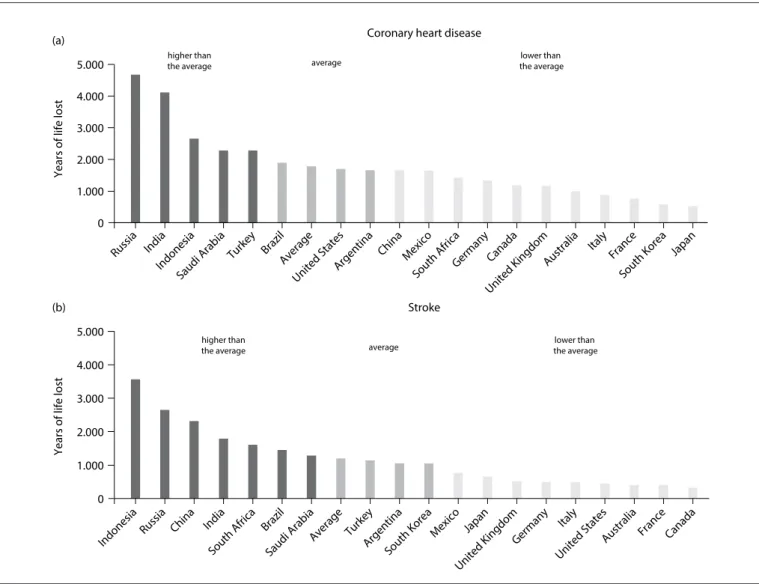
Comparison among the selected countries reveals that the YLL due to CHD in Brazil is situated at the mean of the other countries (Figure 2a). On the other hand, for YLL due to cere-brovascular diseases, Brazil is ranked seventh out of 19 countries, with values signiicantly higher than the mean (Figure 2b).
he Global Burden of Disease study established an innova-tive analytical approach towards the oicial health statistics.3,4
However, comparison of health statistics among countries has two main limitations. One is nosological, relating to the cover-age of the mortality system and quality of the death certiication, which can weaken these comparisons. he other relates to the fact that mortality information systems based on the underlying cause of death have a primary limitation with regard to compet-ing causes of mortality between countries. For example, Bolivia and Ecuador have lower rates of CHD and stroke than Brazil. In contrast, the YLL due to respiratory infections and stom-ach cancer are signiicantly higher in Bolivia and Ecuador than in Brazil. Consequently, these Andean countries have lower
probability of cardiovascular death than that of Brazil or other South American countries like Argentina.
Apart from these important points, it is undeniable that the burden of stroke is still high in Brazil and that the cardiovascu-lar epidemiological transition in Brazil has been delayed by the burden of stroke mortality.5 One important factor in this regard
relates to the social, racial and regional diferences in stroke mor-tality in Brazil, in comparison with elsewhere, with high risk among the poorest segments, blacks and people living in north-ern and northeastnorth-ern Brazil.6-8
In relation to these two components of mortality, there is no conclusive data about their incidence in Brazil, but we can speculate that case fatality is declining because of the rise in the numbers of elderly people dying due to stroke sequelae.2 Moreover, the Brazilian
National Health Survey described point prevalences of self-reported stroke of 1.6% and 1.4%, among men and women, respectively. he prevalences of post-stroke disabilities were 29.5% for men and 21.5% for women.9
1.000 2.000 3.000 4.000 5.000
1.000 2.000 3.000 4.000 5.000 (a)
(b)
Coronary heart disease
Stroke
Years of life lost
Years of life lost
0
0
Russia India Indonesia
Saudi Arabia
Turkey BrazilAverage United States
Argentina China Mexico
South AfricaGermany Canada
United Kingdom Australia
Italy France
South Korea Japan
Indonesia
Russia China India
South Africa Brazil
Saudi Arabia
Average TurkeyArgentina South Korea
Mexico Japan
United Kingdom Germany
Italy
United States
Australia France Canada
higher than
the average average
lower than the average
higher than
the average average
lower than the average
Stroke is still a neglected disease in Brazil | EDITORIAL
Sao Paulo Med J. 2015; 133(6):457-9 459 Recently, an editorial in the journal Arquivos de
Neuro-Psiquiatria signed by Fernandes provided a very good summary of the situation of policies for halting the stroke burden in Brazil. Fernandes rightly stated that “we are doing badly due to delays and an inability to implement what is known (cost-efective prevention), causing sufering (morbidity), loss of many lives (mortality) and inancial loss.” Furthermore, he concluded that “…there has been insuicient investment in evaluating the efects of populational and non-pharmacological interventions, health services for people with CVD are poorly organized…”.10
he irst editorial about stroke as a neglected disease in Brazil was published in 2005. We are hoping to be invited in 2025 to write a narrative with a tentative title of “How Brazil did the right thing towards curbing stroke mortality”.
REFERENCES
1. Lotufo PA. Stroke in Brazil: a neglected disease. Sao Paulo Med J.
2005;123(1):3-4.
2. Lotufo PA, Goulart AC, Fernandes TG, Benseñor IM. A reappraisal
of stroke mortality trends in Brazil (1979-2009). Int J Stroke.
2013;8(3):155-63.
3. GBD 2013 Mortality and Causes of Death Collaborators. Global, regional,
and national age-sex speciic all-cause and cause-speciic mortality for 240
causes of death, 1990-2013: a systematic analysis for the Global Burden of
Disease Study 2013. Lancet. 2015;385(9963):117-71.
4. GBD 2013 DALYs and HALE Collaborators, Murray CJ, Barber RM.
Global, regional, and national disability-adjusted life years (DALYs)
for 306 diseases and injuries and healthy life expectancy (HALE) for
188 countries, 1990-2013: quantifying the epidemiological transition.
Lancet. 2015;pii:S0140-6736(15):61340-X.
5. Lotufo PA, Benseñor IM. Stroke mortality in Brazil: one example of delayed
epidemiological cardiovascular transition. Int J Stroke. 2009 (1):40-1.
6. Vincens N, Stafström M. Income Inequality, Economic Growth and
Stroke Mortality in Brazil: Longitudinal and Regional Analysis
2002-2009. PLoS One. 2015;10(9):e0137332.
7. Fernandes TG, Bando DH, Alencar AP, Benseñor IM, Lotufo PA. Income
inequalities and stroke mortality trends in Sao Paulo, Brazil, 1996-2011.
Int J Stroke. 2015 Jun 4. doi: 10.1111/ijs.12526. [Epub ahead of print].
8. Lotufo PA, Bensenor IJ. Raça e mortalidade cerebrovascular no
Brasil [Race and stroke mortality in Brazil]. Rev Saude Publica.
2013;47(6):1201-4.
9. Bensenor IM, Goulart AC, Szwarcwald CL, et al. Prevalence of stroke
and associated disability in Brazil: National Health Survey - 2013. Arq
Neuropsiquiatr. 2015;73(9):746-50.
10. Fernandes JG. Stroke prevention and control in Brazil: missed
opportunities. Arq Neuropsiquiatr. 2015;73(9):733-5.
Sources of funding: Not declared
Conlict of interest: Honoraria from Abbvie Brazil and Abbott Brazil for lectures.
Date of irst submission: October 5, 2015
Last received: October 5, 2015
Accepted: October 5, 2015
Address for correspondence:
Paulo Andrade Lotufo
Centro de Pesquisa Clínica e Epidemiológica, Hospital Universitário,
Universidade de São Paulo
Av. Prof. Lineu Prestes, 2.565
Butantã — São Paulo (SP) — Brasil
Tel. (+55 11) 3091-9300