Assessment of a glycated hemoglobin point-of-care analyzer
(A1CNow+) in comparison with an immunoturbidimetric
method: a diagnostic accuracy study
Avaliação de um aparelho de diagnóstico local para hemoglobina glicada
(A1CNow+) comparado com um método imunoturbidimétrico:
estudo de acurácia de teste diagnóstico
Aurélie Afret
I, Luiz Henrique Maciel Griz
II, Eduarda Ângela Pessoa Cesse
III, Yuri da Silva Specht
IV,
Eduardo Maia Freese de Carvalho
V, Annick Fontbonne
VIAggeu Magalhães Research Centre, Fundação Oswaldo Cruz (Fiocruz), and data were collected at the Department of Endocrinology,
Agamemnon Magalhães Hospital, Universidade de Pernambuco (UPE), Recife, Pernambuco, Brazil
ABSTRACT
CONTEXT AND OBJECTIVE: To monitor glycemic control in diabetic patients, regular measurement of glycated hemoglobin (HbA1c) is recommended, but this can be diicult in remote places without access to laboratories. Portable point-of-care testing devices can prove a useful alternative. Our study aimed to assess the performance of one of them: A1CNow+, from Bayer.
DESIGN AND SETTING: Cross-sectional accuracy study conducted at a university hospital in Brazil. METHODS: We made three successive measurements of capillary HbA1c using the A1CNow+ in 55 diabetic volunteers, while the same measurement was made on venous blood using the hospital reference method (Vitros 5,1 FS). We used the Bland-Altman graphical method to assess the A1CNow+ in relation to the Vitros 5,1 FS method. We also evaluated clinical usefulness by calculating the sensitivity and speciicity of A1CNow+ for detecting patients with HbA1c lower than 7%, which is the usual limit for good glycemic control. RESULTS: The coeicient of variation between repeat testing for the A1CNow+ was 3.6%. The mean difer-ence between A1CNow+ and Vitros 5,1 FS was +0.67% (95% coniddifer-ence interval, CI: +0.52 to +0.81). The agreement limits of our Bland-Altman graph were -0.45 (95% CI: -0.71 to -0.19) and +1.82 (95% CI: +1.52 to +2.05). The sensitivity and speciicity in relation to the 7% limit were respectively 100% and 67.7%. CONCLUSIONS: Although the A1CNow+ had good sensitivity, its accuracy was insuicient for use as a replacement for laboratory measurements of HbA1c, for glycemic control monitoring in diabetic patients.
RESUMO
CONTEXTO E OBJETIVO: Para monitorar o controle glicêmico dos diabéticos, é recomendado medir re-gularmente a hemoglobina glicada (HbA1c). Isso pode ser difícil em locais distantes sem acesso a labora-tórios. Uma alternativa é usar aparelhos portáteis à beira do leito do paciente. Nosso estudo visou avaliar o desempenho de um deles: A1CNow+, da Bayer.
TIPO DE ESTUDO E LOCAL: Estudo transversal de acurácia realizado em hospital universitário no Brasil. MÉTODOS: Medimos, com o A1CNow+, três vezes seguidas, a HbA1c capilar de 55 diabéticos voluntários, enquanto a mesma medida era feita em sangue venoso pelo método de referência do hospital (Vitros 5,1 FS). Usamos a análise gráica de Bland-Altman para avaliar o A1CNow+ em relação ao Vitros 5,1 FS. Veriica-mos a utilidade clínica através do cálculo da sensibilidade e da especiicidade do A1CNow+ para detectar pacientes com HbA1c abaixo de 7%, limite usual indicando glicemia controlada.
RESULTADOS: O coeiciente de variação entre testes repetidos do A1CNow+ foi de 3,6%. A diferença média entre o A1CNow+ e o Vitros 5,1 FS foi de +0,67% (95% intervalo de coniança, IC: +0,52 para +0,81). Os limites de concordância do gráico de Bland-Altman foram -0,45 (95% IC: -0,71 para -0,19) and +1,82 (95% IC: +1,52 para +2,05). A sensibilidade e a especiicidade em relação ao limite de 7% foram 100% e 67,7%, respectivamente.
CONCLUSÃO: Apesar da boa sensibilidade, o A1CNow+ não tem acurácia suiciente para ser utilizado no monitoramento do controle glicêmico de pacientes diabéticos em substituição das medidas da HbA1c em laboratório.
IBSc. Master’s Student in Nutrition, Department
of Nutrition and Associated Pathologies, Institut de Recherche pour le Développement (IRD), Universités Montpellier, Montpellier, France.
IIMD, PhD. Professor, Department of
Endocrinology, Agamemnon Magalhães Hospital, Universidade de Pernambuco, Pernambuco, Recife, Brazil.
IIIPhD. Epidemiology and Public Health Researcher,
Community Health Department, Aggeu Magalhães Research Center, Fundação Oswaldo Cruz (Fiocruz), Pernambuco, Recife, Brazil.
IVUndergraduate in Statistics, Community Health
Department, Aggeu Magalhães Research Center, Fundação Oswaldo Cruz (Fiocruz), Pernambuco, Recife, Brazil.
VMD, PhD. Epidemiology and Public Health
Researcher, Community Health Department, Aggeu Magalhães Research Center, Fundação Oswaldo Cruz (Fiocruz), Pernambuco, Recife, Brazil.
VIMD, PhD. Epidemiology and Public Health
Researcher, Department of Nutrition and Associated Pathologies, Institut de Recherche pour le Développement (IRD), Universités Montpellier, Montpellier, France.
KEY WORDS:
Hemoglobin A, glycosylated. Point-of-care systems.
Technology assessment, biomedical. Diabetes mellitus.
Primary health care.
PALAVRAS-CHAVE: Hemoglobina A glicosilada.
Sistemas automatizados de assistência junto ao leito.
Avaliação da tecnologia biomédica. Diabetes mellitus.
INTRODUCTION
Diabetes mellitus is a major public health issue all over the world. In the International Diabetes Federation (IDF) estimates for 2012,1 Brazil has a diabetes prevalence of 10.52%, which is
higher than in the United States, where the prevalence is 9.35%. he prevalence of self-reported diabetes in the populations of Brazilian state capitals over 18 years of age was 6.3% in 2010.2
From 1950 to 2007, mortality trends due to diabetes increased in most Brazilian state capitals.3,4 Part of this observed increase can
be attributed to improvements in access to diagnosis and death certiication, but it stresses the importance of improving diabetes prevention and control.4
To ight diabetes and other chronic diseases, Brazil is devel-oping strategies within its National Health System (Sistema Único de Saúde, SUS), one of the largest public health systems in the world.5 Within SUS, the Family Health Strategy (Estratégia Saúde
da Família, ESF) is in charge of most of Brazilian primary care. In 2001, the Brazilian Ministry of Health launched the “Plan for the Reorganization of Care for Arterial Hypertension and Diabetes Mellitus”.6 Among the interventions that it supported was regular
determination of glycated hemoglobin (HbA1c) levels at ESF pri-mary care units among patients with diabetes.
HbA1c provides clinicians with an indication of a patient’s average blood glucose level over the past two to three months and measurement of this parameter is recommended for assess-ment of diabetes control. HbA1c also helps estimate the risk of developing diabetes-associated micro and macrovascular com-plications. his was shown by the results obtained in the Diabetes Control and Complication Trial (DCCT) and United Kingdom Prospective Diabetes Study (UKPDS).7,8
Following these results, the American Diabetes Association (ADA) and other national bodies issuing guidelines for diabetes treatment recommended that one primary goal of therapy should be to maintain HbA1c below 7%.9 he ADA also recommended
that HbA1c testing should be performed at least biannually in all patients and quarterly for patients whose therapy has changed or who are not meeting treatment goals.9
Brazilian recommendations advise one measurement per patient every three months.6 However, in many regions of Brazil,
these recommendations are diicult to achieve because of a lack of medical analysis laboratories able to meet patients’ needs, especially in areas distant from urban centers. his is the case in the state of Pernambuco, in the northeastern region of Brazil, even though the ESF is well established there. Moreover, this sit-uation is not speciic to Brazil but can be found in many devel-oping countries where there are remote places with poor access to infrastructure and healthcare professionals. herefore, HbA1c measurement by means of point-of-care testing (PoCT), directly performed by primary care unit staf, could be a useful alterna-tive to measurement at a medical analysis laboratory.
OBJECTIVE
he aim of this study was to assess the performance of A1CNow+, a PoCT device from Bayer (São Paulo, Brazil), in comparison with the Vitros 5,1 FS method, an immunoturbidimetric labora-tory method used in a university hospital in Recife, Pernambuco. Speciically, the objective was to determine whether it could con-stitute a useful alternative to laboratory measurement, in order to monitor diabetes control in primary care units in remote areas. Our hypothesis was that values of HbA1c given by the PoCT device would be close enough to values given by the immunotur-bidimetric method to allow correct decision-making for blood glucose control, in terms of possible modiications of antidiabetic treatments (pharmacological or non-pharmacological).
METHODS
A cross-sectional accuracy study was conducted between June and July 2012 at the endocrinology department of one of the state university hospitals, in Recife, state of Pernambuco, northeastern region of Brazil. Outpatients or inpatients at the department were consecutively approached to be invited to participate, if they were 18 years of age or older, had known diabetes, had a prescription to undergo a venous blood test at the hospital with HbA1c measure-ment, were not pregnant (for women) and did not have any known hemoglobinopathy, anemia and/or end-stage renal failure.
Fity-ive patients accepted the invitation to participate. All of them provided informed consent and completed a short questionnaire to gather their baseline characteristics. hen, a venous blood test was performed by a hospital nurse and sent to the hospital laboratory for HbA1c to be measured using the Vitros 5,1 FS method, which was the current HbA1c mea-surement method used at the hospital and therefore used as the reference against which we evaluated the A1CNow+. he Vitros 5,1 FS method uses venous blood samples and is stan-dardized against the International Federation of Clinical Chemistry (IFCC) reference system for HbA1c and aligned to the DCCT standards through the National Glycohemoglobin Standardization Program (NGSP).10
To assess the reproducibility of A1CNow+ measurements, their coeicient of variation (deined as the ratio of the standard deviation to the mean) was calculated using the measurements performed on each patient. For this calculation, only results from patients from whom we obtained at least two valid HbA1c measurements were taken into consideration. We did not use weighted means because of their lack of impact in this study.
Bland and Altman analysis was used to assess agreement between the two methods.11 According to these authors, this
anal-ysis requires a sample size of at least 50 units, which determined our choice of number of patients. he diferences between the methods (A1CNow+ minus Vitros 5,1 FS) were plotted against the average of the two measurements. he size of the diferences and their distribution around zero were tested.
Finally, to assess the clinical usefulness of A1CNow+, its sensitivity and speciicity were calculated in relation to the threshold of 7%, which is the usually recommended limit for diabetes control.9 For both the agreement and the usefulness
analyses, only the irst HbA1c measurement obtained from each patient using the A1CNow+ was used in the calculation, since this is what would happen if the PoCT was used under routine clinical conditions.
Statistical analyses were performed using Epi Info 3.5.1 and the Statistical Package for the Social Sciences (SPSS), version 19 (SPSS Inc., Chicago, IL, USA). he study was approved by the Ethics Committee of the Aggeu Magalhães Research Center, Oswaldo Cruz Foundation (CPqAM/Fiocruz) and the Brazilian National Commission for Research Ethics (CONEP). All par-ticipating subjects were duly informed of the objectives and procedures of the study, and all of them signed an informed consent form.
RESULTS
Most of the patients were women (50 out of 55). Their mean age was 61.3 ± 13.0 years (range: 20-85). Their mean body mass index (BMI) was 27.8 ± 4.2 kg/m2, and 75% of the patients were
overweight (25 ≤ BMI < 30 kg/m2) or obese (BMI ≥ 30 kg/m2).
The mean duration of diabetes was 10.1 ± 8.6 years; 85.5% of the patients were using oral antidiabetic agents and 30.9% were taking insulin injections, alone or combined with oral antidiabetic therapy.
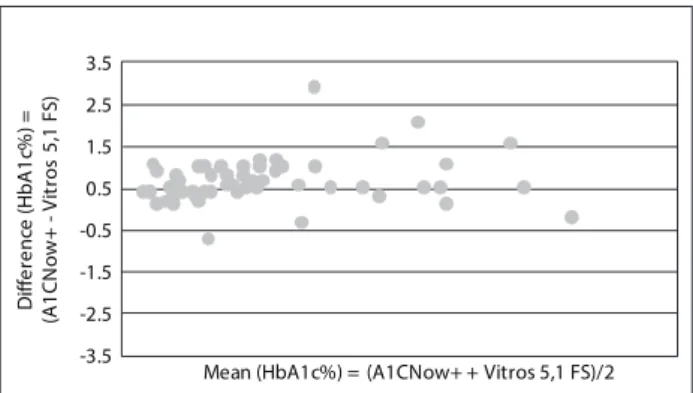
From the laboratory method, the mean for HbA1c measure-ments was 7.26 ± 1.87%. From A1CNow+, the mean for HbA1c measurements was 7.93 ± 1.97%, just considering the irst mea-surement, and 7.91 ± 1.89% considering all measurements. he coeicient of variation for repeated measurements on the same patient was 3.6%. Bland-Altman analysis of accuracy showed that the mean diference between the A1CNow+ and the Vitros 5,1 FS determinations was +0.67% (95% conidence interval, CI:
+0.52% to +0.81%) and the standard deviation of the diferences was 0.56%, such that A1CNow+ consistently gave higher mea-surements than the laboratory method (Figure 1). he lower and upper limits of agreement of the graph were -0.45% (95% CI: -0.71% to -0.19%) and +1.79 (95% CI: +1.52 to +2.05). he sen-sitivity was 100% and speciicity was 67.7% in relation to the 7% level (Table 1). It appeared that 18.2% of the patients (10 patients) were “incorrectly classiied” using the analyzer. All of them were “false positive”: they had HbA1c ≥ 7% with A1CNow+, whereas their HbA1c was < 7% with the Vitros 5,1 FS method.
DISCUSSION
PoCT has been advocated with the objective, among others, of promoting faster professional decisions and facilitating patients’ adherence to medical counseling.12 Indeed, in case of diabetes,
studies have shown the beneits of rapid HbA1c results at the time of the patient’s visit by improving glucose control through intensiication of therapy,13,14 although controversy currently
exists regarding this evidence and the analytical quality relative to laboratory testing.15
Another potential advantage of PoCT is as a replacement for laboratory measurements in contexts in which laboratory facili-ties are scarce and oten concentrated in urban areas, thus lim-iting access to populations and jeopardizing quality of care.16,17
his is the case in many developing countries, and Brazil, with its continental dimensions, is no exception.
Figure 1. Bland-Altman diference plot comparing the A1CNow+ versus the Vitros 5,1 FS method.
-3.5 -2.5 -1.5 -0.5 0.5 1.5 2.5 3.5
D
iff
e
re
n
ce
(
H
b
A
1
c%
) =
(A
1
C
N
ow
+
- V
it
ros
5
,1
F
S
)
Mean (HbA1c%) = (A1CNow+ + Vitros 5,1 FS)/2
Table 1. Patients’ distribution according to their HbA1c results from the A1CNow+ and Vitros 5,1 FS methods, in relation to the 7% level
Laboratory method (Vitros 5,1 FS) HbA1c ≥ 7% HbA1c < 7%
A1CNow+ HbA1c ≥ 7% 24 10
However, PoCT devices need to be proven to provide sui-ciently reliable measurements in order to be recommended for use in cases of lack of or diiculty in access to laboratory ser-vices.18 he present study investigated the analytical
perfor-mance of the PoCT A1CNow+, a device that has been approved for use in Brazil, comparing it with the Vitros 5,1 FS laboratory method. he latter acted as our reference method, since it is the method used in the state university hospital where we conducted this evaluation, which is the reference hospital for diabetes in the state of Pernambuco.
he coeicient of variation of the A1CNow+ device was found to be 3.6%. his result was in agreement with some pre-vious reports,19 and lower than other results.20 Although it has
been recommended that HbA1c assays should have a coei-cient of variation of < 2%,21 this criterion is very strict and
dif-icult to meet, even for certain laboratory-based methods.22 It
would therefore seem inappropriate to impose this goal on PoCT devices measuring HbA1c. Earlier reports recommended that HbA1c assays should have a coeicient of variation of < 5% (ide-ally < 3%),23 in which case our study revealed the A1CNow+
device to be satisfactory in terms of reproducibility.
However, in terms of accuracy, the Bland-Altman analy-sis did not demonstrate good agreement between the analyzer and the laboratory method: the results from the A1CNow+ device were systematically higher. he limits of agreement of the graph were -0.45% to +1.79%, thus not fulilling one of the required NGSP criteria, which is that the 95% CI of the difer-ence between the tested method and the NGSP be ± 0.75% of HbA1c.10 Although one study reported an even greater
discrep-ancy between A1CNow+ results and the reference method,20
others have shown better agreement, with mean diferences of between -0.20% and -0.10%, comparing A1CNow+ with the internationally accepted reference laboratory method of high-performance liquid chromatography (HPLC).19
In fact, the discrepancy that we found may possibly have been due to the Vitros 5,1 FS method, about which little information is available in the literature. his is indeed the most important lim-itation of this study: the A1CNow+ results were compared with those obtained from the Vitros 5,1 FS laboratory method and not the internationally accepted HPLC reference laboratory method, which was used in the DCCT and the UKPDS studies.7,8
Nonetheless, it is important to note that we compared A1CNow+ with the laboratory method that was used in the reference hospital for diabetes in Pernambuco, which ensures highly specialized care for diabetic patients from all over the state. Therefore, there is reason to suppose that the hospital would use a high-standard laboratory method for assessing one of the most important parameters for monitoring blood glucose control.
In keeping with the higher readings in relation to the labora-tory method, the A1CNow+ device had good sensitivity (100%). However, its speciicity was low (67.7%) in relation to the HbA1c level of 7%. his means that under clinical conditions, use of the A1CNow+ cannot be recommended: the false-positive rate was 10/55 (18.2%), and these patients consequently would have a risk of hypoglycemia if their treatment was intensiied using the results from this analyzer. hese results were quite similar to those obtained by Arrendale et al.,24 in which the
sensitiv-ity was 95% and the speciicsensitiv-ity was 74%. Accordingly, in addi-tion to the desirability of comparing our results with those of the HPLC method, it might also be interesting in further research to investigate whether A1CNow+ always gives higher results than any laboratory method, in a constant manner. If this were the case, as Arrendale et al. suggested in their study,24 it would still
be possible to use this analyzer by applying a correction to the data obtained from it, which would consist of a calculation of the following form: expected laboratory HbA1c = a + b [HbA1c from A1CNow+]. his would be important for diabetic patients living in remote areas with poor access to infrastructure and healthcare professionals, which is oten the case in Brazil. hese patients would beneit from adequate glycemic control monitor-ing (HbA1c measurement two to four times a year) when access to venous blood testing in laboratories is diicult. For such pur-poses, devices like A1CNow+ could become important tools in primary care services.
CONCLUSION
According to the results from our study, A1CNow+ cannot be recommended for replacing laboratory measurements of HbA1c for glycemic control monitoring among diabetic patients, because the accuracy and speciicity of its measurements were insuicient, compared with the method used in a reference uni-versity hospital. Further research is needed in order to compare its results with those obtained from a HPLC reference laboratory method, and/or to assess whether it could be used with the aid of a correction equation.
REFERENCES
1. International Diabetes Federation. IDF Diabetes Atlas. 5th ed., 2012
Update. Available from: http://www.idf.org/sites/default/iles/5E_
IDFAtlasPoster_2012_EN.pdf. Accessed in 2014 (Sep 10).
2. Brasil. Ministério da Saúde. Secretaria de Vigilância em Saúde.
Secretaria de Gestão Estratégica e Participativa. Vigitel Brasil 2010:
vigilância de fatores de risco e proteção para doenças crônicas por
inquérito telefônico/Ministério da Saúde, Secretaria de Vigilância
em Saúde, Secretaria de Gestão Estratégica e Participativa. Brasilia:
Ministério da Saúde; 2011. Available from: http://biavati.iles.
3. Cesse EA, Carvalho EF, Souza WV, Luna CF. Tendência da mortalidade
por diabetes melito no Brasil: 1950 a 2000 [Mortality trends by
the diabetes mellitus in Brazil: 1950 to 2000]. Arq Bras Endocrinol
Metabol. 2009;53(6):760-6.
4. Mattos PE, Luz LL, Santiago LM, Mattos IE. Tendência da mortalidade
por diabetes melito em capitais brasileiras, 1980-2007 [Trends in
mortality of diabetes mellitus patients in Brazilian capitals,
1980-2007]. Arq Bras Endocrinol Metabol. 2012;56(1):39-46.
5. Brasil. Portal da Saúde SUS. Cidadão, entenda o SUS. Available from:
http://portalsaude.saude.gov.br/index.php/cidadao/entenda-o-sus.
Accessed in 2014 (Dec 16).
6. Brasil. Ministério da Saúde. Secretaria de Políticas de Saúde.
Departamento de Ações Programáticas Estratégicas. Plano de
reorganização da atenção à hipertensão arterial e ao diabetes
mellitus: hipertensão arterial e diabetes mellitus/Departamento
de Ações Programáticas Estratégicas. Brasilia: Ministério da Saúde;
2001. Available from: http://bvsms.saude.gov.br/bvs/publicacoes/
miolo2002.pdf. Accessed in 2014 (Sep 10).
7. The efect of intensive treatment of diabetes on the development
and progression of long-term complications in insulin-dependent
diabetes mellitus. The Diabetes Control and Complications Trial
Research Group. N Engl J Med. 1993;329(14):977-86.
8. Intensive blood-glucose control with sulphonylureas or insulin
compared with conventional treatment and risk of complications in
patients with type 2 diabetes (UKPDS 33). UK Prospective Diabetes
Study (UKPDS) Group. Lancet. 1998;352(9131):837-53.
9. American Diabetes Association. Standards of medical care in
diabetes--2010. Diabetes Care. 2010;33 Suppl 1:S11-61.
10. National Glycohemoglobin Standardization Program. Harmonizing
Hemoglobin A1c Testing. More About HbA1c. Clinical use. Available
from: http://www.ngsp.org/ADA.asp. Accessed in 2014 (Sep 11).
11. Bland JM, Altman DG. Statistical methods for assessing agreement
between two methods of clinical measurement. Lancet.
1986;1(8476):307-10.
12. Price CP. Point of care testing. BMJ. 2001;322(7297):1285-8.
13. Cagliero E, Levina EV, Nathan DM. Immediate feedback of HbA1c
levels improves glycemic control in type 1 and insulin-treated type
2 diabetic patients. Diabetes Care. 1999;22(11):1785-9.
14. Miller CD, Barnes CS, Phillips LS, et al. Rapid A1c availability improves
clinical decision-making in an urban primary care clinic. Diabetes
Care. 2003;26(4):1158-63.
15. Gialamas A, St John A, Laurence CO, Bubner TK; PoCT Management
Committee. Point-of-care testing for patients with diabetes,
hyperlipidaemia or coagulation disorders in the general practice
setting: a systematic review. Fam Pract. 2010;27(1):17-24.
16. Yager P, Domingo GJ, Gerdes J. Point-of-care diagnostics for global
health. Annu Rev Biomed Eng. 2008;10:107-44.
17. Martin DD, Shephard MD, Freeman H, et al. Point-of-care testing
of HbA1c and blood glucose in a remote Aboriginal Australian
community. Med J Aust. 2005;182(10):524-7.
18. Martin CL. Quality control issues in point of care testing. Clin Biochem
Rev. 2008;29 Suppl 1:S79-82.
19. Bode BW, Irvin BR, Pierce JA, Allen M, Clark AL. Advances in hemoglobin
A1c point of care technology. J Diabetes Sci Technol. 2007;1(3):405-11.
20. Little RR, Lenters-Westra E, Rohling CL, Slingerland R. Point-of-care
assays for hemoglobin A(1c): is performance adequate? Clin Chem.
2011;57(9):1333-4.
21. Sacks DB, Arnold M, Bakris GL, et al. Executive summary: guidelines
and recommendations for laboratory analysis in the diagnosis and
management of diabetes mellitus. Clin Chem. 2011;57(6):793-8.
22. Lenters-Westra E, Slingerland RJ. Six of eight hemoglobin A1c
point-of-care instruments do not meet the general accepted analytical
performance criteria. Clin Chem. 2010;56(1):44-52.
23. Sacks DB, Bruns DE, Goldstein DE, et al. Guidelines and
recommendations for laboratory analysis in the diagnosis and
management of diabetes mellitus. Clin Chem. 2002;48(3):436-72.
24. Arrendale JR, Cherian SE, Zineh I, Chirico MJ, Taylor JR. Assessment
of glycated hemoglobin using A1CNow+ point-of-care device as
compared to central laboratory testing. J Diabetes Sci Technol.
2008;2(5):822-7.
Sources of funding: Conselho Nacional de Desenvolvimento Cientíico e Tecnológico – CNPq, grant # 563911/2010-7
Conlict of interest: None
Date of irst submission: June 13, 2014 Last received: August 7, 2014 Accepted: September 11, 2014
Address for correspondence: Annick Fontbonne
IRD, UMR 204 Nutripass
911 avenue d’Agropolis
B.P. 64501 - Cedex 5
34394 Montpellier - 95, France