Correspondence/Email: Patrícia Sodré Araújo
Universidade do Estado da Bahia Al. Praias do Descobrimento, 256, Edifício Trancoso, ap. 101 Boca do Rio 41705-710 Salvador, BA, Brasil Email: [email protected]
Received: 19 Apr 2016
Approved: 23 Jan 2017
How to cite: Araújo PS, Costa EA, Guerra Junior AA, Acurcio FA, Guibu IA, Álvares J, et al. Pharmaceutical care in Brazil’s primary health care. Rev Saude Publica. 2017;51 Suppl 2:6s.
Copyright: This is an open-access article distributed under the terms of the Creative Commons Attribution License, which permits unrestricted use, distribution, and reproduction in any medium, provided that the original author and source are credited.
http://www.rsp.fsp.usp.br/
Pharmaceutical care in Brazil’s primary
health care
Patricia Sodré AraújoI, Ediná Alves CostaII, Augusto Afonso Guerra JuniorIII,
Francisco de Assis AcurcioIII, Ione Aquemi GuibuIV, Juliana ÁlvaresIII, Karen Sarmento CostaV,VI,VII,
Margô Gomes de Oliveira KarnikowskiVIII, Orlando Mario SoeiroIX, Silvana Nair LeiteX
I Departamento de Ciências da Vida. Curso de Farmácia. Universidade do Estado da Bahia. Salvador, BA, Brasil II Instituto de Saúde Coletiva. Universidade Federal da Bahia. Salvador, BA, Brasil
III Departamento de Farmácia Social. Faculdade de Farmácia. Universidade Federal de Minas Gerais. Belo Horizonte, MG, Brasil
IV Faculdade de Ciências Médicas. Santa Casa de São Paulo. São Paulo, SP, Brasil
V Núcleo de Estudos de Políticas Públicas. Universidade Estadual de Campinas. Campinas, SP, Brasil VI Programa de Pós-Graduação em Saúde Coletiva. Departamento de Saúde Coletiva. Faculdade de Ciências
Médicas. Universidade Estadual de Campinas. Campinas, SP, Brasil
VII Programa de Pós-Graduação em Epidemiologia. Faculdade de Medicina. Universidade Federal do Rio Grande do Sul. Porto Alegre, RS, Brasil
VIII Faculdade de Ceilândia. Universidade de Brasília. Brasília, DF, Brasil
IX Faculdade de Ciências Farmacêuticas.Pontifícia Universidade Católica de Campinas. Campinas, SP, Brasil X Departamento de Ciências Farmacêuticas. Universidade Federal de Santa Catarina. Florianópolis, SC, Brasil
ABSTRACT
OBJECTIVE: To characterize the activities of clinical nature developed by pharmacists in basic health units and their participation in educational activities aiming at health promotion.
METHODS: his article is part of the Pesquisa Nacional sobre Acesso, Utilização e Promoção do Uso Racional de Medicamentos – Serviços, 2015 (PNAUM – National Survey on Access, Use and Promotion of Rational Use of Medicines – Services, 2015), a cross-sectional and exploratory study, of evaluative nature, consisting of a survey of information in a representative sample of cities,
stratiied by the Brazilian regions that constitute domains of study, and a subsample of primary health care services. he interviewed pharmacists (n=285) were responsible for the delivery of medicines and were interviewed in person with the use of a script. he characterization of the activities of clinical nature was based on information from pharmacists who declared
to perform them, and on participation in educational activities aiming at health promotion,
according to information from all pharmacists. he results are presented in frequency and their 95% conidence intervals.
RESULTS: From the interviewed subjects, 21.3% said they perform activities of clinical nature. Of these, more than 80% considered them very important; the majority does not dispose of speciic places to perform them, which hinders privacy and conidentiality in these activities. he main denominations were “pharmaceutical guidance” and “pharmaceutical care.” he registration of activities is mainly made in the users’ medical records, computerized system, and in a speciic document iled at the pharmacy, impairing the circulation of information among professionals. Most pharmacists performed these activities mainly along with physicians and nurses; 24.7% rarely participated in meetings with the health team, and 19.7% have never participated.
CONCLUSIONS: Activities of clinical nature performed by pharmacists in Brazil are still incipient. he diiculties found point out to the professionals’ improvisation and efort. he
small participation in educational activities of health promotion indicates little integration of
pharmacists with the health team and of pharmaceutical services with other health actions.
DESCRIPTORS: Pharmacists. Pharmaceutical Care. Pharmaceutical Services. Primary Health
INTRODUCTION
Drug-related morbidity and mortality has been pointed out as an important public health
problem around the world6,14,17. In Brazil, studies have shown the impact on society and on the Brazilian Uniied Health System (SUS)3,25. Among the drug-related problems, it is possible to highlight those related to indication, efectiveness, safety, and adherence. hese problems cause morbidity and mortality related to these technologies, which result in high social impact within the clinical, humanistic, and economic contexts. he main risk factors associated with the occurrence of these problems include age, presence of comorbidities,
and polipharmacotherapy10,14,25. Preventing and minimizing this impact require actions that
interfere in the process of use of medicines by users, by managing the drug therapy6,17. hese
are important challenges of the current pharmaceutical services agenda in Brazil.
In several countries5,7,9,21,23,27, pharmaceutical carea has been assumed as strategic policy for
reducing the impact of drug-related morbidity and mortality 6,12,17.In Brazil, it is part of the
Política Nacional de Assistência Farmacêutica (PNAF – National Policy of Pharmaceutical
Services). However, research on this subject are scarce, even in studies that discuss
pharmaceutical policies that prescribe these practices in their devices, as an example of
the specialized component of pharmaceutical services. he studies that investigate such activities take place in SUS and their results are also incipient.
The subject of pharmaceutical care finds some difficulties, especially regarding the understanding of its meaning. Worldwide, the deinition adopted by Hepler and Strand10 (1990) is considered a consensual milestone. However, in Brazil, what is called pharmaceutical care assumes diferent meanings in what could be called “world of science” and in how the policies in the ield of pharmaceutical services understand it. he diferences are in the
epistemological plan and are repeated during practice.
he names that have been widely used among pharmacists to designate services of clinical
nature are: cognitive pharmaceutical services, pharmaceutical consultation, pharmaceutical guidance, patient education, clinical pharmacy, and pharmaceutical care/drug therapy
follow-up/management of drug therapy. In several countries, the designation adopted for activities of clinical nature, the way they are performed, and the organizational aspects
translate (or not) the elements that reveal the philosophical basis, the modus operandi, and
the management aspects of these activities17,19.
Beyond the “cloudy weather”17 that involves what is called pharmaceutical care, in this study we understand as pharmaceutical activity of clinical nature all activities executed directly with
the user and that has the purpose to meet the patients’ needs regarding the use of medicines
and to express philosophical elements. According to Cipolle, Strand, and Morley6 (p. 73), “the
philosophy of pharmaceutical care includes several elements. It starts with the airmation of a social
necessity; it continues with a patient-centered approach to meet this need; it has as central element the care to another person by the development and maintenance of a therapeutic relationship, and concludes with a description of the professional’s actual responsibilities.”Furthermore, a process
of formal care, i.e., the modus operandi of care and management aspects.
here are, in Brazil, speciic pharmaceutical policies that attribute to the pharmacist the
exercise of activities of clinical nature – named in PNAF as pharmaceutical care. In addition, one can observe gaps regarding information on the performance or not of these activities in the primary care in SUS. Considering this, this study aimed to characterize the activities of clinical nature developed by pharmacists in basic health units of SUS and their participation in educational activities aiming at health promotion.
METHODS
This study is part of the Pesquisa Nacional sobre Acesso, Utilização e Promoção do Uso
Racional de Medicamentos – Serviços, 2015 (PNAUM – National Survey on Access,
Use and Promotion of Rational Use of Medicines – Services, 2015), whose goal was to
characterize the organization of pharmaceutical services in the primary health care of
SUS, aiming to promote the access and rational use of medicines, as well as to identify
and discuss factors that interfere in the consolidation of pharmaceutical services in the municipal scope.
PNAUM is a cross-sectional exploratory study, with evaluative nature, consisting of
a survey of information in a representative sample of primary health care services in
representative cities in the regions of Brazil. Several populations were considered in the sampling, with samples stratiied by the regions that constitute the domains of study. Face-to-face interviews were carried out with users, physicians, and those responsible
for the delivery of medicines in the primary health care services of SUS, in addition to
observation of pharmaceutical services and telephone interviews with the professionals responsible for pharmaceutical services and with the public administrators of the selected cities. he methodology of PNAUM, as well as the sampling process, are described in detail
by Álvares et al.1
In this article, only pharmacists were selected among those responsible for the delivery of medicines. his is a descriptive and exploratory study with selected variables.
he characterization of pharmaceutical activities of clinical nature occurred based on the information provided by pharmacists who informed to perform this activity when answering the following question: “Do you perform any activity of clinical character?” From the airmative to this question, we sought to identify the names and the importance attributed by pharmacists who declared to carry out the activity; among the others, the reasons for
not carrying out those activities.
he relationship of the names of the activities of clinical nature included in the interview scripts considered those most used in publications of literature review: pharmaceutical care, drug therapy follow-up, clinical pharmacy, pharmaceutical consultation, pharmaceutical guidance, pharmaceutical assistance. he script also had a space for “other names,” which were little used and were not analyzed in this article. Furthermore, we included questions aiming to set up the presence of philosophical elements6,16 of the mentioned activity and of the process of care provided to the user. In addition, elements
of a management system with human and material resources were organized, necessary
to carry out the activities.
Considering the diferent conceptions of activities of clinical nature2,6,17, the participation in educational activities/health promotion activities was sought, as they are activities of diverse nature of dispensation or management functions speciic to pharmaceutical activities.
he data were analyzed using the software SPSS® version 21. he analyses considered the sampling weights and the structure of the analysis plan for complex samples. A descriptive analysis of the variables used in the study was performed, presented according to the regions of Brazil with a 95% conidence interval.
PNAUM was approved by the National Research Ethics Committee, by Opinion no. 398.131/2013. All participants signed an informed consent form.
RESULTS
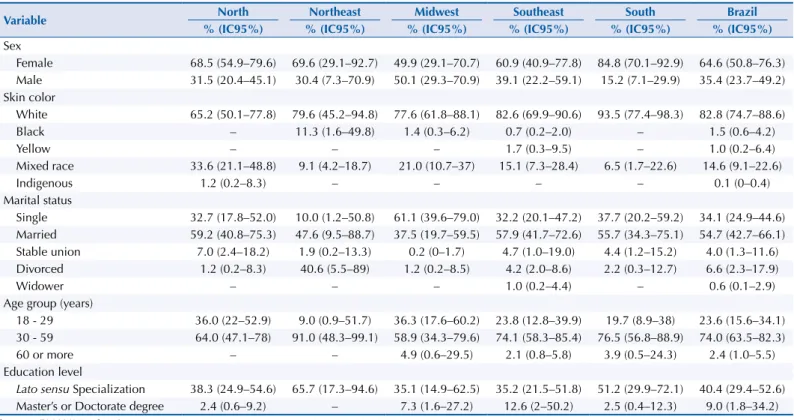
Among the 285 pharmacists interviewed, more than 3/4 were aged between 30 and 59 years; most were women (except in the Midwest); and most had latu sensu graduate level
(specialization addressed to professional practice), with the highest percentage in the
Northeast (Table 1).
Table 2 shows that, of the total pharmacists interviewed, just over 1/5 stated performing some activity of clinical nature. he highest percentage was achieved in the Northeast region (47.5%) and the lowest in the South (6.0%).
Table 1. Sociodemographic characteristics of pharmacists of primary health care according to the regions of Brazil. National Survey on Access, Use and Promotion of Rational Use of Medicines, 2015. (n = 285)
Variable North Northeast Midwest Southeast South Brazil
% (IC95%) % (IC95%) % (IC95%) % (IC95%) % (IC95%) % (IC95%)
Sex
Female 68.5 (54.9–79.6) 69.6 (29.1–92.7) 49.9 (29.1–70.7) 60.9 (40.9–77.8) 84.8 (70.1–92.9) 64.6 (50.8–76.3) Male 31.5 (20.4–45.1) 30.4 (7.3–70.9) 50.1 (29.3–70.9) 39.1 (22.2–59.1) 15.2 (7.1–29.9) 35.4 (23.7–49.2) Skin color
White 65.2 (50.1–77.8) 79.6 (45.2–94.8) 77.6 (61.8–88.1) 82.6 (69.9–90.6) 93.5 (77.4–98.3) 82.8 (74.7–88.6)
Black – 11.3 (1.6–49.8) 1.4 (0.3–6.2) 0.7 (0.2–2.0) – 1.5 (0.6–4.2)
Yellow – – – 1.7 (0.3–9.5) – 1.0 (0.2–6.4)
Mixed race 33.6 (21.1–48.8) 9.1 (4.2–18.7) 21.0 (10.7–37) 15.1 (7.3–28.4) 6.5 (1.7–22.6) 14.6 (9.1–22.6)
Indigenous 1.2 (0.2–8.3) – – – – 0.1 (0–0.4)
Marital status
Single 32.7 (17.8–52.0) 10.0 (1.2–50.8) 61.1 (39.6–79.0) 32.2 (20.1–47.2) 37.7 (20.2–59.2) 34.1 (24.9–44.6) Married 59.2 (40.8–75.3) 47.6 (9.5–88.7) 37.5 (19.7–59.5) 57.9 (41.7–72.6) 55.7 (34.3–75.1) 54.7 (42.7–66.1) Stable union 7.0 (2.4–18.2) 1.9 (0.2–13.3) 0.2 (0–1.7) 4.7 (1.0–19.0) 4.4 (1.2–15.2) 4.0 (1.3–11.6) Divorced 1.2 (0.2–8.3) 40.6 (5.5–89) 1.2 (0.2–8.5) 4.2 (2.0–8.6) 2.2 (0.3–12.7) 6.6 (2.3–17.9)
Widower – – – 1.0 (0.2–4.4) – 0.6 (0.1–2.9)
Age group (years)
18 - 29 36.0 (22–52.9) 9.0 (0.9–51.7) 36.3 (17.6–60.2) 23.8 (12.8–39.9) 19.7 (8.9–38) 23.6 (15.6–34.1) 30 - 59 64.0 (47.1–78) 91.0 (48.3–99.1) 58.9 (34.3–79.6) 74.1 (58.3–85.4) 76.5 (56.8–88.9) 74.0 (63.5–82.3)
60 or more – – 4.9 (0.6–29.5) 2.1 (0.8–5.8) 3.9 (0.5–24.3) 2.4 (1.0–5.5)
Education level
Lato sensu Specialization 38.3 (24.9–54.6) 65.7 (17.3–94.6) 35.1 (14.9–62.5) 35.2 (21.5–51.8) 51.2 (29.9–72.1) 40.4 (29.4–52.6) Master’s or Doctorate degree 2.4 (0.6–9.2) – 7.3 (1.6–27.2) 12.6 (2–50.2) 2.5 (0.4–12.3) 9.0 (1.8–34.2) Source: PNAUM – Services, 2015.
Table 2. Performance of activities of clinical nature, name, and importance given by pharmacists of primary health care, according to the
regions of Brazil. National Survey on Access, Use and Promotion of Rational Use of Medicines, 2015.
Dimension/Variable North Northeast Midwest Southeast South Brazil
% (IC95%) % (IC95%) % (IC95%) % (IC95%) % (IC95%) % (IC95%)
Activities of clinical nature
Perform them (n = 79) 29.8 (18.3–44.8) 47.5 (11.1–86.8) 20.2 (5.9–50.8) 21.2 (12.3–33.9) 6.0 (1.5–21.5) 21.3 (13.6–31.9) Do not perform them (n = 206) 69.7 (55.2–81.7) 52.5 (13.2–88.9) 79.8 (49.2–94.1) 78.8 (66.1–87.7) 94.0 (78.5–98.5) 78.6 (68.1–86.4) Reasons for not performing them (n = 206)
Do not possess the necessary physical space 56.0 (37.0–73.4) 82.8 (29.3–98.2) 56.3 (28.4–80.7) 42.1 (24.4–62.1) 43.7 (23.3–66.5) 46.7 (33.4–60.5) Do not have enough time 49.1 (29.9–68.7) 19.0 (2.3–70.5) 58.6 (36.8–77.5) 50.6 (30.9–70) 28.7 (15.9–46.2) 45.4 (32.0–59.6) Was never asked to perform them 44.1 (26.0–64.0) 84.4 (66.9–93.6) 58.1 (30.5–81.4) 49.9 (29.9–69.9) 52.7 (30.1–74.3) 53.0 (38.6–67.0) Other 7.9 (1.8–28.4) – 15.2 (5.6–35.2) 7.4 (2.7–18.9) 21.3 (9.2–41.8) 10.4 (5.8–17.8) Naming (n = 79)
Pharmaceutical care 61.4 (36.2–81.7) 2.0 (0.1–21.6) 29.4 (5.3–75.8) 45.8 (23.2–70.3) 35.4 (4.3–87.1) 36.2 (18.5–58.7)
Drug therapy follow-up 3.4 (0.5–21.2) – – 4.7 (0.8–22.8) – 3.1 (0.6–14.5)
Clinical pharmacy – 4.8 (0.4–41.5) – 1.4 (0.3–5.8) – 1.8 (0.5–6.2)
Pharmaceutical consultation 10.9 (1.6–48.4) 2.0 (0.1–21.6) 66.0 (19.1–94.1) 16.0 (6.2–35.4) – 17.1 (6.8–36.9) Pharmaceutical guidance 24.3 (10.4–47.2) 91.3 (53.0–99.0) 4.6 (0.4–34.9) 25.6 (9.6–52.6) 64.6 (12.9–95.7) 37.9 (17.2–64.2)
Pharmaceutical assistance – – – 6.5 (1.7–21.6) – 4.0 (1.1–13.9)
Importance (n = 79)
Very important 95.9 (75.4–99.5) 98.0 (78.4–99.9) 90.8 (56.9–98.7) 83.2 (62.1–93.8) 35.4 (4.3–87.1) 85.5 (69.6–93.8) Important 4.1 (0.5–24.6) 9.2 (1.3–43.1) 16.8 (6.2–37.9) 64.6 (12.9–95.7) 14.2 (6.0–30.0)
Not important – 2.0 (0.1–21.6) – – – 0.4 (0.1–2.8)
he main reasons alleged by pharmacists for not performing such activities were: never having been requested, not disposing of the physical space, and not having enough time. Other mentioned reasons include the absence of speciic training, lack of encouragement by the city, absence of physical structure, insuicient personnel on the pharmacy, among others. he main names assigned to these activities were: “pharmaceutical guidance” (Northeast and South) and “pharmaceutical care” (North and Southeast). In the Midwest region, the most frequent name was “pharmaceutical consultation”; the name “pharmaceutical assistance” was observed only in the Southeast; and “clinical pharmacy,” only in the South and Southeast. It was not possible to investigate the explaining factors of these diferences.
he most frequent functions performed at the same time with activities of clinical nature were: dispensing of medicines (93.6%), technical responsibility by the pharmacy (90.5%), supervision of other employees of the pharmacy (74.5%), and activities with the health
team (61.2%).
In the Northeast, 100% of the pharmacists who claimed to perform activities of clinical nature reported they also perform dispensing of medicines, while in the Midwest, dispensing was declared only by 32.9% of the pharmacists who performed clinical activities. When questioned about the importance they assigned to such activities, most pharmacists who performed activities of clinical nature considered them very important (85.5%) or important (14.2%).
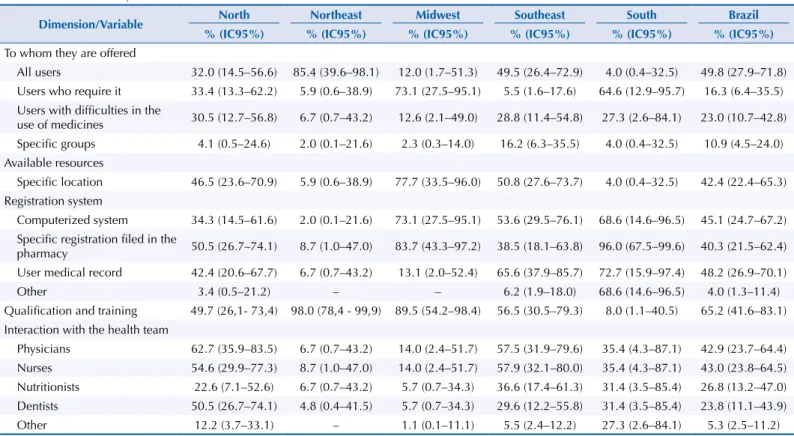
According to Table 3, the conditions and ways of conducting the pharmaceutical activities of clinical nature varied between regions. Most pharmacists said they perform such activities mainly along with physicians and nurses. Among all the pharmacists interviewed in the study, 1/4 of them stated they rarely participate in meetings with the health team and 1/5
said they have never participated (Table 5).
he study identiied that, in Brazil, the registration of activities of clinical nature is mainly made in the user’s medical record, in a computerized system, and in a speciic document iled at the pharmacy, in that order. he highest percentages of registration of these activities
Table 3. Characterization of the activities of clinical nature performed by pharmacists of primary health care, according to the regions of Brazil. National Survey on Access, Use and Promotion of Rational Use of Medicines, 2015. (n = 79)
Dimension/Variable North Northeast Midwest Southeast South Brazil
% (IC95%) % (IC95%) % (IC95%) % (IC95%) % (IC95%) % (IC95%)
To whom they are offered
All users 32.0 (14.5–56.6) 85.4 (39.6–98.1) 12.0 (1.7–51.3) 49.5 (26.4–72.9) 4.0 (0.4–32.5) 49.8 (27.9–71.8) Users who require it 33.4 (13.3–62.2) 5.9 (0.6–38.9) 73.1 (27.5–95.1) 5.5 (1.6–17.6) 64.6 (12.9–95.7) 16.3 (6.4–35.5) Users with difficulties in the
use of medicines 30.5 (12.7–56.8) 6.7 (0.7–43.2) 12.6 (2.1–49.0) 28.8 (11.4–54.8) 27.3 (2.6–84.1) 23.0 (10.7–42.8) Specific groups 4.1 (0.5–24.6) 2.0 (0.1–21.6) 2.3 (0.3–14.0) 16.2 (6.3–35.5) 4.0 (0.4–32.5) 10.9 (4.5–24.0) Available resources
Specific location 46.5 (23.6–70.9) 5.9 (0.6–38.9) 77.7 (33.5–96.0) 50.8 (27.6–73.7) 4.0 (0.4–32.5) 42.4 (22.4–65.3) Registration system
Computerized system 34.3 (14.5–61.6) 2.0 (0.1–21.6) 73.1 (27.5–95.1) 53.6 (29.5–76.1) 68.6 (14.6–96.5) 45.1 (24.7–67.2) Specific registration filed in the
pharmacy 50.5 (26.7–74.1) 8.7 (1.0–47.0) 83.7 (43.3–97.2) 38.5 (18.1–63.8) 96.0 (67.5–99.6) 40.3 (21.5–62.4) User medical record 42.4 (20.6–67.7) 6.7 (0.7–43.2) 13.1 (2.0–52.4) 65.6 (37.9–85.7) 72.7 (15.9–97.4) 48.2 (26.9–70.1)
Other 3.4 (0.5–21.2) – – 6.2 (1.9–18.0) 68.6 (14.6–96.5) 4.0 (1.3–11.4)
Qualification and training 49.7 (26,1- 73,4) 98.0 (78,4 - 99,9) 89.5 (54.2–98.4) 56.5 (30.5–79.3) 8.0 (1.1–40.5) 65.2 (41.6–83.1) Interaction with the health team
were found in the Southeast and Midwest. In the Northeast, the percentages of registration were negligible (2%; 8.7%; and 6.7%, respectively).
In Brazil, about half of the respondents reported that the pharmaceutical activities of clinical nature are ofered to all users of the health unit. his was the most common answer in the Northeast region. In the Midwest, these activities are more often ofered only to users who request them.
More than half of the interviewed pharmacists informed to have received some training. According to Table 4, the provision of information by pharmacists about the use and storage of medicines at home, at the moment of delivery, varies between regions. he Midwest region stands out for providing these information, while the Northeast presents the lowest percentages. he signiicant majority of pharmacists states that they inform users on the use of medicines, and just over half informs on storage at home. hus, the provision of information on use surpasses information on storage at home, which may indicate that pharmacists disregard the users’ lack of information about the care required to preserve the quality of the medicine.
Table 5 shows that, in Brazil, only about 1/3 of respondents reported participating in
other activities carried out in the health unit. In general, the participation of pharmacists
in these activities varies between regions. he Midwest presented the lowest percentage
of participation of pharmacists in other activities in the health unit. Despite this, the
percentages of participation in activities between them were more expressive when compared to other regions, except regarding the prevention and control of obesity. he Northeast is the region where pharmacists are less involved in family planning activities,
and not at all in physical activity programs.
he fact that activities of prevention and control of obesity and those to encourage physical activities have less participation of pharmacists draws attention, as they are the ones that least require the use of medicines for being more related to lifestyle. However, we observed in Brazil a relevant participation of pharmacists in activities that involve other sectors and
the community itself (Table 5), except in the Northeast. Such activities could be closer to health promotion.
Table 4. Information provided by pharmacists on the use and storage of medicines at the time of dispensing in primary health care, according to the regions of Brazil. National Survey on Access, Use and Promotion of Rational Use of Medicines, 2015. (n = 285)
Dimension/Variable
North Northeast Midwest Southeast South Brazil
% (IC95%) % (IC95%) % (IC95%) % (IC95%) % (IC95%) % (IC95%)
Information on the use of medicines
Always 93.1 (81–97.7) 71 (24.1–95.0) 97.6 (84.1–90.7) 76.1 (51.6–90.5) 82.3 (53.3–95) 79.5 (62.8–89.9)
Repeatedly – 24.3 (3.2–75.6) 2.4 (0.3–15.9) 2.2 (0.9–5.3) 3.6 (0.8–13.9) 4.2 (1.5–11.4)
Sometimes 3.6 (1.1–11.0) 0.9 (0.1–7.8) – 9.6 (3.9–22.1) 14.2 (3.0–47.0) 8.4 (3.0–17.1)
Rarely 3.2 (0.5–19.8) 0.9 (0.1–7.8) – 12.1 (1.9–49.5) – 7.6 (1.2–35.7)
Never – 2.8 (0.5–14.5) – – – 0.2 (0.1–1.1)
Information on the storage of medicines
Always 59.2 (43.3–73.4) 23.5 (5.7–60.9) 67.7 (46.3–86.4) 58.6 (39.8–75.2) 53.8 (32.5–73.7) 55.8 (43–67.8)
Repeatedly 2.4 (0.3–15.5) 8.7 (2.0–31.1) 5.9 (3.0–11.3) 0.2 (0–1.8) 4.7 (2.6–8.2)
Sometimes 18.0 (9.0–32.6) 47.5 (11.1–86.8) 5.7 (2.0–14.9) 34.6 (18.1–56.0) 36.6 (18.8–59.1) 32.4 (20.3–47.5)
Rarely 5.7 (2.0–14.9) 24.3 (3.2–75.6) 8.5 (2.1–29.2) 0.6 (0.2–1.6) 1.6 (0.2–11.1) 3.8 (1.2–11.4)
DISCUSSION
Although still incipient, activities of clinical nature occur in the Brazilian primary health care, but in unequal proportions in all regions.
In general, these activities require minimal resources for their accomplishment: conditions
that ensure privacy in the pharmacist/patient therapeutic relationship, criteria for the
provision of the service, documentation and training, among others6,11,15,21,24.
In this study, most pharmacists who claimed performing activities of clinical nature also stated not disposing of a speciic place to perform them, which is an essential condition to the preservation of privacy and conidentiality in the activities with the user. Privacy can be deined as the personal desire to keep secret facts closely linked to the person; the secrecy of information ensures conidentiality. he assurance of privacy and conidentiality contributes
to the therapeutic relationship to be more interactive and resolutive6,17.
We were able to identify a set of diiculties to the performance of these activities, according to the interviewed pharmacists. he reasons, in general, refer to structural problems or excess of activities under the responsibility of the pharmacist. hese same problems were also reported by those who declared to perform activities of clinical nature concomitantly with other functions.
Table 5. Participation of pharmacists in other activities in primary health care, according to the regions of Brazil. National Survey on Access, Use and Promotion of Rational Use of Medicines, 2015. (n = 285)
Dimension/Variable North Northeast Midwest Southeast South Brazil
% (IC95%) % (IC95%) % (IC95%) % (IC95%) % (IC95%) % (IC95%)
Participation in meetings of the health team
Always 46.9 (32–62.3) 19.4 (4.3–56.1) 26.2 (12.5–46.9) 43.6 (28.5–59.9) 41.9 (23.6–62.6) 39.6 (29.2–51.0)
Repeatedly 4.6 (1.1–16.7) – – 5.4 (2.3–12.2) 2.1 (0.4–9.8) 3.8 (1.8–7.9)
Never 21.4 (10.8–38.0) 4.7 (1.3–15.8) 23.5 (9.2–48.2) 18.3 (9.8–31.4) 30.6 (12.8–57.0) 19.7 (12.7–29.2) Sometimes 3.5 (0.8–13.9) 47.8 (11.3–86.9) 26 (9.2–54.9) 8.2 (3.4–18.5) 1.9 (0.3–12.9) 12.3 (6.1–23.0) Rarely 23.6 (13.3–38.5) 28.1 (4.7–75.7) 24.3 (11.5–44.3) 24.6 (10.3–48.0) 23.5 (10.4–44.9) 24.7 (14.1–39.5)
Participation in other activities in the health units
No 47.7 (32.9–93.0) 55.2 (15.8–89) 74.4 (54.1–87.8) 72.4 (59.0–82.7) 45.8 (25.8–67.1) 65.9 (55.5–75.0) Yes 52.3 (37.0–67.1) 44.8 (11–84.2) 25.6 (12.2–45.9) 27.6 (17.3–41.0) 54.2 (32.9–74.2) 34.1 (25–44.5)
Activities
With other sectors (education, social
services, environment etc.) 63.4 (39.6–82.1) 36.4 (6.7–82.0) 71.3 (41.2–89.9) 61.9 (40.2–79.7) 67.7 (36.1–88.6) 61.2 (30.2–56.5) Organizational activities of the community 44.1 (23.9–66.4) 12.0 (1.3–59.1) 77.6 (51.1–92) 37.6 (21.6–56.8) 40.4 (18.8–66.4) 38.8 (27–52.2) Joint effort to solve problems in the
community 67.8 (44.6–84.6) 41.4 (7.8–85.6) 89.1 (69.5–96.7) 32.1 (18.5–49.6) 44.5 (20.5–71.3) 42.9 (30.2–56.5) Preservation of nature 21.4 (8.1–45.6) 2.1 (0.2–17.5) 36.6 (12.7–69.7) 24.0 (11.9–42.5) 38.0 (15.7–66.9) 25.8 (15.9–38.9)
Prevention and control of obesity 47.4 (26.4–69.4) 5.1 (0.5–35.1) 17.9 (3.5–56.9) 28.7 (15.0–47.9) 45.4 (21.2–72.0) 30.5 (19.8–43.9) Physical activities 17.8 (5.6–44.2) – 25.1 (7.1–59.8) 22.2 (11.6–38.5) 31.3 (13.1–57.9) 21.9 (13.8–33.0) Prevention and control of hypertension
and diabetes 80.2 (54.9–93.1) 39.4 (7.4–84.1) 90.9 (71–97.6) 75.0 (37.6–91.0) 71.2 (37.6–91.0) 71.5 (53.8–84.4) Environmental control of diseases
(e.g. combating dengue fever) 47.9 (27.0–69.7) 93.7 (73.6–98.8) 90.7 (68.7–97.8) 30.3 (16.9–48.2) 46.0 (21.6–72.4) 47.1 (33.5–61.2) Prevention of cervical and uterine cancer 52.3 (30.4–73.3) 25.3 (4.0–73.1) 75.1 (45.6–91.6) 31.7 (18.0–49.5) 53.1 (26.8–77.8) 40.9 (28.6–54.4) Prevention of prostate cancer 37.4 (18.7–60.7) 25.3 (4.0–73.1) 65.6 (35.1–87.1) 28.3 (15.4–46) 56.1 (28.9–80.1) 38.3 (26.3–51.8)
Prevention of sexually transmitted diseases 65.2 (41.4–83.2) 83.8 (40.5–97.5) 86.9 (55.7–97.2) 53.1 (32.9–72.3) 58.6 (30.6–81.9) 61.3 (46.2–74.5)
he incipient institutionalization of pharmaceutical activities of clinical nature in the primary healthcare of SUS, associated with the deiciencies regarding the implementation of PNAF 4,
still limited in its guidelines, can explain the poor development of these activities. Although
most pharmacists recognize them as important, only few are currently performing them.
In several countries, an important aspect of the activities of clinical nature concerns the
organization of services with this purpose and the character of exclusive dedication by the person who performs these activities. Pharmacists who engage in these services are not
authorized by the health systems or class authorities to carry out other activities, to prevent
conlicts of interest, as well as to optimize the work they perform11,21,24.
Difficulties identified regarding the resources needed to carry out these activities,
in the Brazilian primary health care, indicate some improvisation that demands eforts by professionals, besides not having criteria that allow rationalizing the provision of those
activities on health services.
In several countries, qualiication and training are requirements for performing any pharmaceutical activity of clinical nature. Both initial and periodical training are needed, considering the uniqueness of required skills and abilities5,6,11,23,27. Furthermore, the unmet need of speciic training
of the pharmacists hinders the understanding of the philosophical principles established for the
activities of clinical nature, namely: the values, responsibilities, functions and activities, as well
as the modus operandi of the process of care and management of these activities6,13,19,27.
Concerning the criteria for providing the service, according to the literature, the most used
ones consider patients with higher risk of experiencing drug therapy problems and who present chronic medical conditions. his strategy directs resources and eforts to care for groups in which the impact of pharmaceutical interventions are larger6,11,24,27.
In this study, it was not possible to deepen the analysis of the various registration procedures of the activities of clinical nature. We observed that, in Brazil, the percentages of registration of the three modalities were very close, and it called our attention that, despite the Northeast
being the region that most declared performing activities of clinical nature, the percentages
of registration of these activities were insigniicant there.
It should be stressed that the speciic registration iled in the pharmacy may hinder the circulation of information among the professionals involved in the user’s care. he absence of registration indicates a low degree of institutionalization of these activities according to the philosophical premises required for a practice related to care, to meet the drug therapy
needs of health services’ users6,17.
he registration of pharmaceutical interventions and the exchange of information among
the professionals of the health team can contribute to the promotion of the safe and rational
use of medicines. he registration of pharmaceutical activities of clinical nature systematizes
the monitoring of the drug therapy employed by users and enables to evaluate the need,
safety, and efectiveness of the use of medicines, which provides more favorable results
during the drug therapy6,18.
he participation of diferent health professionals – among which is the pharmacist – in
clinical meetings usually indicates a recognition, by the health team, of the place of each
professional in the care provided to users. Interaction with other professionals in the health
team occurs in several models of clinical pharmaceutical practice and it is recommended6,12,19.
he philosophy of pharmaceutical care 2,6,17 reinforces the need for this interaction, for understanding that it contributes to ensure the completeness of care. he interaction between professionals is essential for all the required resources and expertise to be available to solve the population’s health problems. Furthermore, care is also based in diferent interdisciplinary decision-making processes and on the complementarity of knowledge to promote the most
In this study, the names assigned to the activities of clinical nature revealed that the
expressions “pharmaceutical guidance” and “pharmaceutical care” are the most used between pharmacists who performed these activities. However, apart from the issue of naming, we identiied in the respondents an understanding that the activities they carry out during dispensing would correspond to pharmaceutical activities of clinical nature. his may be related to the insuicient conceptual and philosophical discussion in Brazil on pharmaceutical care and to the disputes of the scientiic ield2,19,16,22,26.
In the Northeast, the fact that all pharmacists who claimed to perform activities of clinical
nature also declared performing the dispensation of medicines stands out. Given that dispensing includes guidance to users, it is possible that these pharmacists understand that the activities of clinical nature they claim to perform are mainly dispensing, because the
name most often attributed to those activities was “pharmaceutical guidance.”
Unlike the other regions, in the Midwest, dispensing was an activity reported by 32.9% of the pharmacists who claimed to develop activities of clinical nature. Since, in this region, the name most commonly attributed to the activities of clinical nature was “pharmaceutical consultation,” there may be, between these pharmacists, a clearer understanding of the
nature of these activities and of dispensing.
Dispensing requires pharmacists to report, guide, and educate on the use of medicines.
Such activity, particular to this professional – essential to the proper use of this technology
– does not necessarily imply that the pharmacist who practices dispensing should take responsibility for the results of the patient’s drug therapy, which is required from those who
perform the pharmaceutical care2,6,12,15,17,21.
In the Brazilian case, the choice for a deinition of pharmaceutical care that includes the
activities of dispensing, guidance, and education in health can hinder the understanding of
what characterizes what is proper or innovative regarding activities of clinical nature12,16,17,19.
In this study, we observed little participation of pharmacists in educational and health-related activities in primary health care services, which indicates that this professional is not yet well integrated into the health team and that pharmaceutical services are still isolated from other health actions. he involvement of pharmacists in less medicalized activities8 can be
related to the maintenance of the centrality of medicines in pharmaceutical practices.
With a view to promote the rational use of medicines, strategies that reduce the morbidity
and mortality related to these technologies may be clinical in nature and may also include
collective educational activities20. However, these actions cannot be confused with the
pharmaceutical activities of clinical nature observed in other countries2,17,19.
his study raises some questions not yet investigated and others that require further development. It is important to investigate how the implementation of these activities occurred in pharmaceutical policies of other countries and in Brazil, which were the structuring elements of these clinical activities, and how the working process of pharmacists performing such activities in SUS takes place. We sought to identify the presence of
philosophical elements, a process of care, and management aspects that could characterize
what we decided to call, for the purposes of this study, pharmaceutical activities of clinical nature. However, it is necessary to signal the limitations of the results, which did not allow
a better understanding of the regions and their pharmaceutical services, neither of the processes regarding the practices of clinical nature developed by the professional pharmacists.
he confrontation of drug-related morbidity and mortality14 has contributed to the reorganization of pharmaceutical practices. Although important pharmaceutical policies in Brazil have established pharmaceutical care as a guideline, it is necessary to undertake eforts to institutionalize these clinical activities, ensuring proper infrastructure, qualiication of professionals, funding, and assessment of the results so that pharmacists and public administrators are encouraged to ofer
REFERENCES
1. Álvares J, Alves MCGP, Escuder MML, Almeida AM, Izidoro JB, Guerra Junior AA, et al. Pesquisa Nacional sobre Acesso, Utilização e Promoção do Uso Racional de Medicamentos: métodos.
Rev Saude Publica. 2017;51 Supl 2:4s. https://doi.org/10.11606/S01518-8787.2017051007027
2. Angonesi D, Sevalho G. Atenção Farmacêutica: fundamentação conceitual e crítica para um modelo brasileiro. Cienc Saude Coletiva. 2010;15 Supl 3:3603-14. https://doi.org/10.1590/S1413-81232010000900035
3. Araújo ALA, Pereira LRL, Ueta JM, Freitas O. Perfil da assistência farmacêutica na atenção primária do Sistema Único de Saúde. Cienc Saude Coletiva. 2008;13 Supl:611-7. https://doi.org/10.1590/S1413-81232008000700010
4. Barreto JL, Guimarães MCL. Avaliação da gestão descentralizada da assistência farmacêutica em municípios baianos, Brasil. Cad Saude Publica. 2010;26(6):1207-20. https://doi.org/10.1590/S0102-311X2010000600014
5. Bussières JF, Roy P, Lebel D, Binette MC, Cambar J, Colombe, C. Profil de la pratique pharmaceutique de la France et du Québec et perspectives d’échange. Pharmactuel. 2002 [cited 2016 Mar 8];35(1):30-8. Available from: http://www.pharmactuel.com/index.php/ pharmactuel/article/view/405/72
6. Cipolle RJ, Strand LM, Morley PL. Pharmaceutical care practice: the clinician’s guide. 2.ed. New York: McGraw Hill; 2004.
7. Conill EM. A recente reforma dos serviços de saúde na província do Québec, Canadá: as fronteiras da preservação de um sistema público. Cad Saude Publica. 2000;16(4):963-71. https://doi.org/10.1590/S0102-311X2000000400015
8. Costa EA. Vigilância Sanitária: proteção e defesa da saúde. 2.ed. aum. São Paulo: Sobravime; 2005. 9. Dauti M, Alili-Idrizi E, Malaj L. Pharmaceutical care in community pharmacy In the Republic
of Macedonia: a compared study with EU countries. Eur Sci J. 2014 [cited 2016 Mar 8];3 Spec Ed:313-8. Available from: http://eujournal.org/index.php/esj/article/view/2951
10. Hepler CD, Strand LM. Opportunities and responsibilities in pharmaceutical care.
Am J Hosp Pharm. 1990;47(3):533-43.
11. Isetts BJ, Schondelmeyer SW, Artz MB, Lenarz LA, Heaton AH, Wadd WB, et al. Clinical and economic outcomes of medication therapy management services: The Minnesota experience.
J Am Pharm Assoc. 2008;48(2):203-14. https://doi.org/10.1331/JAPhA.2008.07108
12. Isetts BJ, Brummel, AR, Oliveira DR, Moen DW. Managing drug-related morbidity and mortality in the patient-centered. Med Care. 2012;50(11):997-1001.
https://doi.org/10.1097/MLR.0b013e31826ecf9a
13. Isetts BJ. Pharmaceutical care, MTM, & payment: the past, present, & future. Ann Pharmacother. 2012;46(4):S47-56. https://doi.org/10.1345/aph.1Q806
14. Johnson JA, Bootman JL. Drug related morbidity and mortality: a cost-of - illness model.
Arch Intern Med. 1995;155(18):1949-56. https://doi.org/10.1001/archinte.1995.00430180043006
15. Mastroianni PC, Machuca M. Conocimiento de la experiencia farmacoterapéutica de los pacientes como medio para resolver problemas farmacoterapéuticos causados por incumplimiento. Rev OFIL. 2012 [cited 2017 Feb 11];22 Nº Extr:38. FA5-oral. Available from: http://www.revistadelaofil.org/wp-content/uploads/2014/01/OFILn220.pdf
16. Oliveira DR, Varela ND. La investigación cualitativa en Farmacia: aplicación en la Atención Farmacéutica. Rev Bras Cienc Farm. 2008;44(4):763-72. https://doi.org/10.1590/S1516-93322008000400024
17. Oliveira DR. Atenção Farmacêutica: da Filosofia ao gerenciamento da terapia medicamentosa. São Paulo: RCN Editora; 2011.
18. Oliveira DR, Shoemaker SJ, Ekstrand M, Alves MR. Preventing and resolving drug therapy problems by understanding patients’ medication experiences. J Am Pharm Assoc. 2012;52(1):71-80.
https://doi.org/10.1331/JAPhA.2012.10239
19. Oliveira DR. Atenção Farmacêutica e serviços farmacêuticos. In: Acúrcio FA, organizador. Medicamentos: políticas, assistência farmacêutica, farmacoepidemiologia e farmacoeconomia. Belo Horizonte: Coopmed; 2013. p.197-227.
21. Pammett R, Jorgenson D. Eligibility requirements for community pharmacy medication review services in Canada. Can Pharm J(Ott). 2014;147(1): 20-4.
https://doi.org/doi:10.1177/1715163513514006
22. Pereira LRL, Freitas O. A evolução da Atenção Farmacêutica e a perspectiva para o Brasil.
Rev Bras Cienc Farm. 2008;44(4):601-12. https://doi.org/10.1590/S1516-93322008000400006
23. Perraudin C, Brion F, Bourdon O, Pelletier-Fleury N. The future of pharmaceutical care in France: a survey of final-year pharmacy students’ opinions. BMC Clin Pharmacol. 2011;11:6. https://doi.org/10.1186/1472-6904-11-6
24. Shoemaker SJ, Hassol A. Understanding the landscape of MTM programs for Medicare. Part D: Results from a study for the Centers for Medicare & Medicaid Services. J Am Pharm Assoc. 2011;51(4):520-6. https://doi.org/10.1331/JAPhA.2011.10210
25. Souza TT, Godoy RR, Rotta I, Pontarolo R, Fernandez-Llimos F, Correr J. Morbidade e mortalidade relacionadas a medicamentos no Brasil: revisão sistemática de estudos observacionais. Rev Cienc Farm Basica Apl. 2014 [cited 2017 Feb 10];35(4):519-32.
Available from: http://serv-bib.fcfar.unesp.br/seer/index.php/Cien_Farm/article/view/2971/1621 26. Vieira FS. Possibilidades de contribuição do farmacêutico para a promoção da saúde. Cienc
Saude Coletiva. 2007;12(1):213-20. https://doi.org/10.1590/S1413-81232007000100024
27. Yordanova S, Petkova V. Pharmaceutical care in some European countries, Australia, Canada and USA. World J Pharm Pharm Sci. 2013 [cited 2017 Feb 11];2(5):2291-308. Available from: http://www.wjpps.com/wjpps_controller/abstract_id/313
Funding: Department for Pharmaceutical Services and Strategic Health Supplies and Department of Science and Technology of the Secretariat of Science, Technology and Strategic Supplies of the Brazilian Ministry of Health (SCTIE/MS – Process 25000.111834/2, Decentralization of FNS Resources).
Authors’ Contribution: Conception, analysis, and interpretation of results; critical review of the content: PSA, EAC, AAG Jr., FAA, IAG, JA, KSC, MGOK, OMS, SNL. All authors declare to be responsible for all aspects of the
study, ensuring its accuracy and completeness.
Acknowledgements: To Prof. PhD. Djanilson Barbosa dos Santos for the review of the manuscript.