Workforce in the pharmaceutical services
of the primary health care of SUS, Brazil
Marselle Nobre CarvalhoI, Juliana ÁlvaresII,Karen Sarmento CostaIII,IV,V, Augusto Afonso Guerra JuniorII,Francisco de Assis AcurcioII, Ediná Alves CostaVI, Ione Aquemi GuibuVII, Orlando Mario SoeiroVIII,
Margô Gomes de Oliveira KarnikowskiIX, Silvana Nair LeiteX
I Departamento de Saúde Coletiva. Universidade Estadual de Londrina. Londrina, PR, Brasil II Departamento de Farmácia Social. Faculdade de Farmácia. Universidade Federal de Minas Gerais.
Belo Horizonte, MG, Brasil
III Núcleo de Estudos de Políticas Públicas. Universidade Estadual de Campinas. Campinas, SP, Brasil
IV Programa de Pós-Graduação em Saúde Coletiva. Departamento de Saúde Coletiva. Faculdade de Ciências Médicas. Universidade Estadual de Campinas. Campinas, SP, Brasil
V Programa de Pós-Graduação em Epidemiologia. Faculdade de Medicina. Universidade Federal do Rio Grande do Sul. Porto Alegre, RS, Brasil
VI Instituto de Saúde Coletiva. Universidade Federal da Bahia. Salvador, BA, Brasil VII Faculdade de Ciências Médicas. Santa Casa de São Paulo. São Paulo, SP, Brasil
VIII Faculdade de Ciências Farmacêuticas. Pontifícia Universidade Católica de Campinas. Campinas, SP, Brasil IX Faculdade de Ceilândia. Universidade de Brasília. Brasília, DF, Brasil
X Departamento de Ciências Farmacêuticas. Universidade Federal de Santa Catarina. Florianópolis, SC, Brasil
ABSTRACT
OBJECTIVE: To characterize the workforce in the pharmaceutical services in the primary care
of the Brazilian Uniied Health System (SUS).
METHODS: his is a cross-sectional and quantitative study, with data from the Pesquisa Nacional sobre Acesso, Utilização e Promoção do Uso Racional de Medicamentos – Serviços, 2015 (PNAUM – National Survey on Access, Use and Promotion of Rational Use of Medicines – Services, 2015). For the analysis, we considered the data stratiication into geographical regions. We analyzed the data on workers in the municipal pharmaceutical services management and in the medicine dispensing units, according to the country’s regions. For the statistical association analysis, we carried out a Pearson correlation test for the categorical variables.
RESULTS: We analyzed 1,175 pharmacies/dispensing units, 507 phone interviews (495 pharmaceutical services coordinators), and 1,139 professionals responsible for medicine delivery. he workforce in pharmaceutical services was mostly constituted by women, aged from 18 to 39 years, with higher education (90.7% in coordination and 45.5% in dispensing units), having permanent employment bonds (public tender), being for more than one year in the position or duty, and with weekly work hours above 30h, working both in municipal management and in medicine dispensing units. We observed regional diferences in the workforce composition in dispensing units, with higher percentage of pharmacists in the Southeast and Midwest regions. CONCLUSIONS: he professionalization of municipal management posts in primary health care is an achievement in the organization of the workforce in pharmaceutical services. However, signiicant deiciencies exist in the workforce composition in medicine dispensing units, which may compromise the medicine use quality and its results in population health.
DESCRIPTORS: Pharmaceutical Services, manpower. Patient Care Team. Workers. Primary Health Care. Health Services Research. Uniied Health System.
Correspondence: Silvana Nair Leite Departamento de Ciências Farmacêuticas
Universidade Federal de Santa Catarina – Campus Trindade 88.040-900
Florianópolis, SC, Brasil E-mail: [email protected]
Received: Apr 20, 2016 Approved: Nov 30, 2016
How to cite: Carvalho MN, Álvares J, Costa KS, Guerra Junior AA, Acurcio FA, Costa EA, et al. Workforce in the pharmaceutical services of the primary health care of SUS, Brazil. Rev de Saude Publica. 2017;51 Suppl 2:16s
Copyright: This is an open-access article distributed under the terms of the Creative Commons Attribution License, which permits unrestricted use, distribution, and reproduction in any medium, provided that the original author and source are credited.
INTRODUCTION
Since its implementation in the late 1980s, the Brazilian Uniied Health System (SUS) expanded the number of work posts in all health care levels, especially in primary health care (PHC). he expansion and diversiication of health workforce occurred with an increase in the number of doctors and nurses and the inclusion of new professional categories, such as physical therapists, pharmacists, nutritionists, speech and language therapists, physical education professionals, among others6.
SUS holds more than 60% of the health sector facilities, assists about 80% of the population, and absorbs about 80% of the sector’s workforce, which represents almost two millions jobs in the country. It is estimated that 52% of nurses, 44% of doctors, 27% of dentists, 11% of pharmacists, and 10% of psychologists are civil servants13.
With the objective of reorganizing SUS and meeting the principles of integrality, equity, and universality of health care, and having PHC as an organizer of the health services network, the Brazilian Ministry of Health implemented the Programa Saúde da Família
(PSF – Brazilian Family Health Program) in 1994, oriented to the reduction of maternal and infant mortality, especially in the North and Northeast of the country. In 2006, the government published the Política Nacional de Atenção Básica (PNAB – National Primary Health Care Policy), which transformed the PSF into the Estratégia Saúde da Família (ESF –
Brazilian Family Health Strategy), reairming its major role in the reorganization of PHC14.
Difering form the Family Health teams, comprised by doctors, nurses, dental surgeons, oral health assistants or technicians, nursing assistants or technicians, and community health agents, the Núcleos de Apoio à Saúde da Família (NASF – Family Health Support Centers) teams, implemented more recently, can be constituted by numerous professional categories, among which the pharmacists are6,15.
Around the world, as well as in Brazil, the publishing of the World Health Report 2006 highlighted the discussion on the health work in all sectors, including pharmacy, by pointing out the shortage of workers in the health sector and the unequal workforce distribution9.
Most Brazilian studies on health workforce refer to the nursing category in its diverse work
scenarios10. Compared to other higher education professional categories, there is still few studies, among which is the one by Carvalho et al.6 on the expansion and diversiication of the workforce in SUS’s Primary Health Care. In this study, the authors point out NASF as an important strategy for the insertion of other professional categories into PHC, especially physical therapists, psychologists, social assistants, nutritionists, and pharmacists.
During the implementation and organization of SUS, changes in funding and access to essential materials also occurred, notably the National Drug Policy, in 1998. he Política
Nacional de Assistência Farmacêutica (PNAF – National Policy of Pharmaceutical Services),
published by the Resolution no. 338 of the National Health Council, in 2004, reairmed the pharmaceutical services as an integral part of the health system, the speciic funding block creation oriented towards guaranteeing the policy’s execution in the country, and the need for human resources development for pharmaceutical services recognition4.
In 1998, the report from the consultative council of the WHO is a milestone for the reorientation of the pharmacist actions on health systems, shifting the actions focus from the medicines to the user. hus, the pharmacist was recognized as the best-qualiied professional to conduct actions for improving the access and promoting the rational use of medicines, being essential to organize the necessary services to the complete development
of pharmaceutical services1.
In this context, to know the pharmaceutical services’ workforce in primary health care in indispensable to the assessment of achievements and challenges in availability management, access, and medicines’ use in the country. his would allow the preparing and following of public policies, meeting the professionals’ real educational and qualiication needs for the development of pharmaceutical services and for the achievement of better health outcomes with pharmaceutical services.
he Pesquisa Nacional sobre Acesso, Utilização e Promoção do Uso Racional de Medicamentos –
Serviços, 2015 (PNAUM – National Survey on Access, Use and Promotion of Rational Use of Medicines – Services, 2015) aimed to characterize the organization of pharmaceutical services in SUS primary health care – for promoting the access and rational use of medicines –, as well as to identify and discuss the issues that interfere in the municipal pharmaceutical services consolidation.
his study is part of PNAUM – Services and aimed to characterize the pharmaceutical services workforce in the Brazilian primary health care networks.
METHODS
PNAUM is a cross-sectional, exploratory, and evaluative study, composed of an information gathering in a representative sample of primary health care services, in cities of Brazilian regions. Several study populations were considered in the sampling plan, with samples stratiied by regions, which constitute the study domains2. he Brazilian Ministry of Health’s Decree no. 2,077, of September 17, 2012, instituted the survey.
he sampling considered the cities’ regional representation: capitals; bigger cities, selecting the 0.5% biggest cities in the region; and smaller cities, totaling 120 cities by region. In each city, primary health care services were sampled according to the total number of services in that city. For this study, we analyzed the face-to-face interviews made with the professionals responsible for the medicines’ delivery in the SUS primary health care services, in addition to the observations of the pharmaceutical services facilities of all sampled services and phone interviews with those responsible for municipal pharmaceutical services (one in each city). he interview scripts comprised the pharmaceutical services organization in each city and health service, including professional practice, available structures, and work processes. he observation script for the health services facilities comprised a checklist and photographical register that were applied by trained professionals. he research team collectively built, pretested, and validated all survey instruments in health services in the state of Minas Gerais. he interviewers received speciic training for each applied instrument. he complete survey methodology description is available at Álvares et al.2
he data were collected from July to December 2014. For the analysis, we considered the data stratiication by geographical regions.
All data were analyzed with the assistance of the SPSS software, version 22, extracting the frequencies of the study variables. All analyses considered sample weights and the analysis plan structure for complex samples. For the statistical association analysis, the Pearson correlation test was carried out for categorical variables. he signiicance level adopted was p < 0.05. he results showed representativeness for the Brazilian geographical regions.
The participants signed the informed consent form. PNAUM – Services was approved by the National Research Ethics Committee of the National Health Council, by Opinion no. 398,131/2013.
RESULTS
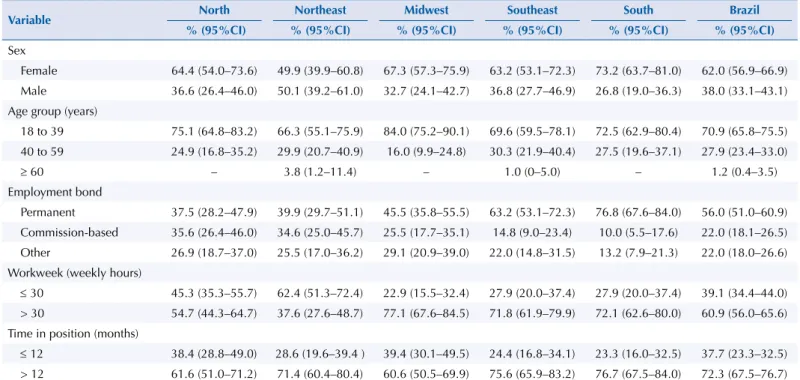
he workforce in the municipal pharmaceutical services management was mostly composed of women. he Northeast was the only region where men occupy 50.1% (95%CI 39.2-61.0) of the coordination posts (Table 1).
Concerning education level, most cities had managers with higher education degree. he Northeast region stands out by two important aspects: 22.2% (95%CI 14.4–32.8) of the cities had managers with specialization (lato sensu) and 3.8% (95%CI 1.2–11.4) had managers
with master’s or doctor’s degree (stricto sensu) in any knowledge area. All regions showed
predominance of pharmacists (> 80.0%) as coordinators of municipal pharmaceutical services (Table 1).
Concerning the type of employment bond, in the Southeast and South regions, cities with permanent managers predominated, whereas in other regions there was a certain similarity between permanent and commission-based workers. All regions showed prevalence of time in position higher than 12 months (> 70.0%). Excluding the Northeast, the managers of the other regions had weekly work hours higher than 30h (Table 1).
Pharmacists predominated in the composition of the management of municipal pharmaceutical services in all regions. More than 90.0% of the Brazilian cities had pharmacists in the coordination of pharmaceutical services (Figure 1).
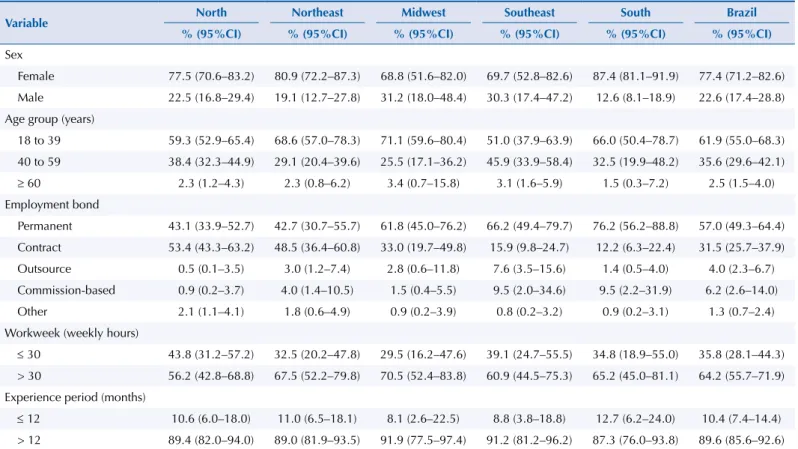
Women were the majority of workers in the medicine dispensing units of primary health care health services in all regions, notably in the Northeast and South, where women predominated in more than 80.0% of the cities (Table 2).
Concerning the workers’ age group, North and Southeast showed similar patterns: the groups from 18 to 39 years and from 40 to 59 years were virtually equivalent, i.e., the workforce was almost equally distributed in these age groups (Table 2).
In the Midwest, Southeast, and South, more than 60.0% of the cities had permanent workers, whereas in the North and Northeast, the percentage of public permanent and contracted workers was proportional. The Southeast, presented a significant percentage of cities with outsourced workers in the medicine dispensing units
Table 1. Characterization of municipal pharmaceutical services managers, Brazil and regions. National Survey on Access, Use and Promotion of Rational Use of Medicines – Services, 2015. (n = 507)
Variable North Northeast Midwest Southeast South Brazil
% (95%CI) % (95%CI) % (95%CI) % (95%CI) % (95%CI) % (95%CI)
Sex
Female 64.4 (54.0–73.6) 49.9 (39.9–60.8) 67.3 (57.3–75.9) 63.2 (53.1–72.3) 73.2 (63.7–81.0) 62.0 (56.9–66.9) Male 36.6 (26.4–46.0) 50.1 (39.2–61.0) 32.7 (24.1–42.7) 36.8 (27.7–46.9) 26.8 (19.0–36.3) 38.0 (33.1–43.1) Age group (years)
18 to 39 75.1 (64.8–83.2) 66.3 (55.1–75.9) 84.0 (75.2–90.1) 69.6 (59.5–78.1) 72.5 (62.9–80.4) 70.9 (65.8–75.5) 40 to 59 24.9 (16.8–35.2) 29.9 (20.7–40.9) 16.0 (9.9–24.8) 30.3 (21.9–40.4) 27.5 (19.6–37.1) 27.9 (23.4–33.0)
≥ 60 – 3.8 (1.2–11.4) – 1.0 (0–5.0) – 1.2 (0.4–3.5)
Employment bond
Permanent 37.5 (28.2–47.9) 39.9 (29.7–51.1) 45.5 (35.8–55.5) 63.2 (53.1–72.3) 76.8 (67.6–84.0) 56.0 (51.0–60.9) Commission-based 35.6 (26.4–46.0) 34.6 (25.0–45.7) 25.5 (17.7–35.1) 14.8 (9.0–23.4) 10.0 (5.5–17.6) 22.0 (18.1–26.5) Other 26.9 (18.7–37.0) 25.5 (17.0–36.2) 29.1 (20.9–39.0) 22.0 (14.8–31.5) 13.2 (7.9–21.3) 22.0 (18.0–26.6) Workweek (weekly hours)
≤ 30 45.3 (35.3–55.7) 62.4 (51.3–72.4) 22.9 (15.5–32.4) 27.9 (20.0–37.4) 27.9 (20.0–37.4) 39.1 (34.4–44.0) > 30 54.7 (44.3–64.7) 37.6 (27.6–48.7) 77.1 (67.6–84.5) 71.8 (61.9–79.9) 72.1 (62.6–80.0) 60.9 (56.0–65.6) Time in position (months)
(7.6%; 95%CI 3.5–15.6). Regarding the experience period and weekly work hours, all regions showed prevalence of more than one year in medicine dispensing and 30h weekly work hours (Table 2).
Source: PNAUM – Services, 2015. p-value = 0.023.
Figure 1. Education level and profession of the pharmaceutical services managers in the primary health care, Brazil and regions. National Survey on Access, Use and Promotion of Rational Use of Medicines – Services, 2014. (n = 507).
75% 80% 85% 90% 95% 100%
Higher education (pharmacist) Higher education (other) High school or incomplete higher education
North
Northeast Mid west
Southeast
South Brazil
Table 2. Characterization of workers in the medicine dispensing units in SUS primary health care, Brazil and regions. National Survey on Access, Use and Promotion of Rational Use of Medicines – Services, 2015. (n = 1,139)
Variable North Northeast Midwest Southeast South Brazil
% (95%CI) % (95%CI) % (95%CI) % (95%CI) % (95%CI) % (95%CI)
Sex
Female 77.5 (70.6–83.2) 80.9 (72.2–87.3) 68.8 (51.6–82.0) 69.7 (52.8–82.6) 87.4 (81.1–91.9) 77.4 (71.2–82.6) Male 22.5 (16.8–29.4) 19.1 (12.7–27.8) 31.2 (18.0–48.4) 30.3 (17.4–47.2) 12.6 (8.1–18.9) 22.6 (17.4–28.8) Age group (years)
18 to 39 59.3 (52.9–65.4) 68.6 (57.0–78.3) 71.1 (59.6–80.4) 51.0 (37.9–63.9) 66.0 (50.4–78.7) 61.9 (55.0–68.3) 40 to 59 38.4 (32.3–44.9) 29.1 (20.4–39.6) 25.5 (17.1–36.2) 45.9 (33.9–58.4) 32.5 (19.9–48.2) 35.6 (29.6–42.1)
≥ 60 2.3 (1.2–4.3) 2.3 (0.8–6.2) 3.4 (0.7–15.8) 3.1 (1.6–5.9) 1.5 (0.3–7.2) 2.5 (1.5–4.0) Employment bond
Permanent 43.1 (33.9–52.7) 42.7 (30.7–55.7) 61.8 (45.0–76.2) 66.2 (49.4–79.7) 76.2 (56.2–88.8) 57.0 (49.3–64.4) Contract 53.4 (43.3–63.2) 48.5 (36.4–60.8) 33.0 (19.7–49.8) 15.9 (9.8–24.7) 12.2 (6.3–22.4) 31.5 (25.7–37.9) Outsource 0.5 (0.1–3.5) 3.0 (1.2–7.4) 2.8 (0.6–11.8) 7.6 (3.5–15.6) 1.4 (0.5–4.0) 4.0 (2.3–6.7) Commission-based 0.9 (0.2–3.7) 4.0 (1.4–10.5) 1.5 (0.4–5.5) 9.5 (2.0–34.6) 9.5 (2.2–31.9) 6.2 (2.6–14.0)
Other 2.1 (1.1–4.1) 1.8 (0.6–4.9) 0.9 (0.2–3.9) 0.8 (0.2–3.2) 0.9 (0.2–3.1) 1.3 (0.7–2.4)
Workweek (weekly hours)
≤ 30 43.8 (31.2–57.2) 32.5 (20.2–47.8) 29.5 (16.2–47.6) 39.1 (24.7–55.5) 34.8 (18.9–55.0) 35.8 (28.1–44.3) > 30 56.2 (42.8–68.8) 67.5 (52.2–79.8) 70.5 (52.4–83.8) 60.9 (44.5–75.3) 65.2 (45.0–81.1) 64.2 (55.7–71.9) Experience period (months)
While the coordination was mostly constituted by women with higher education, especially graduated in Pharmacy, the medicine delivery to users was done by women with high school education level, essentially technicians or nursing assistants (Tables 1 and 2).
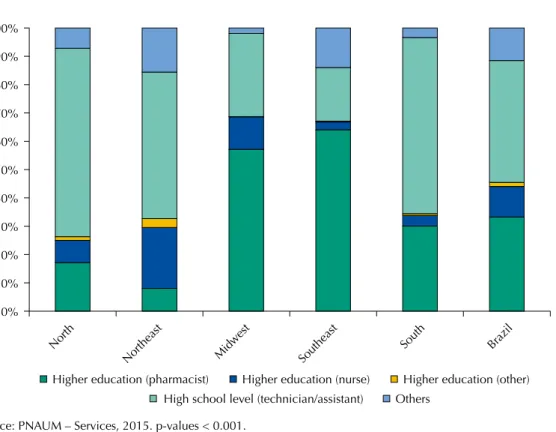
Figure 2 refers to the workforce in the medicine dispensing units of the health services in SUS primary health care: it was mainly composed of technicians or nursing assistants (n = 631; 43.0%; 95%CI 36.0–50.4; p< 0.001), followed by pharmacists (n = 291; 33.3%; 95%CI 26.4–40.9; p< 0.001). he worker’s education level and qualiication in the medicine delivery/dispensing units varied signiicantly according to the region. In the North, South, and Northeast regions, workers with high school education level (mostly technicians or nursing assistants) predominated, while the Midwest and Southeast had a higher number of pharmacists (57.1%, 95%CI 41.0–71.9; 64.1%, 95%CI 45.9–78.9; p< 0.001 respectively).
Besides pharmacists, nurses also performed activities in this type of unit (n = 108; 10.8%; 95%CI 7.2–15.7). In the Northeast, 21.5% (95%CI 12.6–34.0) of the cities had a nurse as a professional who delivered medicines in the primary care health units (Figure 2).
DISCUSSION
All cities that participated in PNAUM – Services had at least one pharmacist in the municipal health network. hey were concentrated in the municipal management activities and had been in the position for more than one year, showing a movement towards the consolidation of this sector in the municipal management structure.
PNAUM – Services data show that the pharmaceutical services workforce in the primary health care was mostly composed of women, aged from 18 to 39 years, with permanent employment bond, having been in the position for more than one year or having weekly work hours above 30h. he education level, in turn, varied according to the activity: higher education degree in coordination posts and technician or assistant level in the health units. Source: PNAUM – Services, 2015. p-values < 0.001.
Figure 2. Education level and profession of workers in the dispensing units of the primary health care, Brazil and regions. National Survey on Access, Use and Promotion of Rational Use of Medicines – Services, 2015. (n = 1,139).
Higher education (pharmacist) Higher education (nurse) Higher education (other)
High school level (technician/assistant) Others
0% 20% 40% 70% 90% 100%
North
Northeast Mid west
Southeast
South Brazil
10% 30% 60% 80%
The pronounced presence of women in the coordination activities of the municipal pharmaceutical services can be a result of the widening of access to higher education in Pharmacy and of the increase in the number of women in the pharmaceutical market. Women are also the majority among the dispensing units’ workers, whose predominant education level was high school (technician or assistant).
here are many explanations to the hegemonic presence of women in the workforce, among which notably is the increase of women in society and university. For some authors, the intensiication of women participation in the market is also because they are a cheaper workforce and accept to work in precarious conditions. In this context, the literature highlights the polarization of Brazilian female workers, in which, in one side, there are women with higher education and relatively high salaries considering the female workers group, and, on the other side, there are women with low qualiication, low salaries, and lesser social recognition7.
In the health area, besides the aforementioned reasons, the traditional “female jobs,” or the ones historically and socially identiied as “female-like” explain the major presence of woman as nurses, nutritionists, psychologists, social assistants, and midwives. However, we can already observe the insertion of women in male-dominated areas, such as medicine19. Indeed, the literature points out the expansion of female participation in male university careers, e.g., medicine, dentistry, and veterinary medicine; and the rising insertion of women in the health area market, where they already represents more than 70.0% of the workforce. In many undergraduate courses in health, including Pharmacy courses, women already occupy more than half of the openings. Among the high school level professionals, the feminization tendency seems stronger, representing 86.9% of technicians and nursing assistants7,12.
Wermelinger et al.19 bring up an interesting relection on the most feminine job in the health area: nursing. In a context in which technicality is well established and even explains the male work valuing, the nursing work is disqualiied by being a mostly female job. Its activities increasingly demand the mastering of new technologies, including hard ones, both within care and management. However, the nursing work social representation is associated to more human and less technical aspects of health care, which is mistakenly translated as less valuable work. his relection is important to the results presented in this study, which clearly show the presence of women with higher education in management positions and of women with technician education in medicine dispensing.
Overall, most of the management and health care workers have permanent employment bond (56.0% and 57.0%, respectively), i.e., they entered public administration by public tenders. Difering from the national outcome, the North and Northeast regions showed proportional distribution between permanent and commission-based workers in the municipal coordination of pharmaceutical services and predominance of contracted workers in dispensing units (53.4% and 48.5%, respectively).
In this context, it is important to highlight that around 35.0% of dispensing units’ workers are contracted or outsourced, which can indicate a tendency of lexibilization or even precarization of labor relations.
While permanent workers are the majority in the Midwest, Southeast, and South regions, the North and Northeast regions stand out by the predominance of contracted workers. Outsourcing represents 7.6% of the employment bonds in the Southeast region, probably due to many factors, among which are the limitations imposed by the Fiscal Responsibility Law.
Although other professional categories can take part in the management, structuring, and organization, pharmacists (90.7%) perform the municipal coordination of pharmaceutical services in all country’s regions, regionally varying from 84.7% in the Northeast to 95.0% in the South. his is probably due to many factors: from the existence of sector guiding policies, such as PNAF, to the pharmaceutical services reorientation actions in SUS and the structuring of pharmaceutical services in the cities4.
According to the world workforce report on Pharmacy9, in countries with low per capita income (e.g. Republic of the Congo and Haiti), the lack of pharmacists resulted in the dependence on high school level workers. In high per capita income countries (e.g. Australia,
United Kingdom, and Japan), pharmacists are the majority in the workforce composition. he participation of high school level workers, usually regulated and qualiied professionals to assist the pharmacist, varies from 43.2% in Europe to 28.4% in Americas, while in the Southeast Asia it represents 67.5% of the total pharmaceutical area workforce. It is important to highlight that these outcomes refer to the work market in general, without any speciic approach to the primary health care services in the analyzed countries.
In Brazil, the scenario seems favorable concerning the number of pharmacists. According to the Brazilian Ministry of Labor and Social Securitya, there was 5.4 pharmacists per 10,000 inhabitants in 2013, a number higher than in countries such as Mexico, India, and all African countries, but lower than in many European countries and in the United States of America. Considering all those who work under professional registration, in 2014, the Conselho Federal de Farmácia (CFF –
Federal Pharmacy Council) estimated nine pharmacists for each 10,000 inhabitants17.
he discussion on the pharmaceutical services workforce in SUS, however, is unique and deserves observation. Between 2008 and 2013, the number of pharmacists registered in the
Unidades Básicas de Saúde (UBS – Basic Health Units) grew 75.0% in the country. Excluding
the Northeast (45.0%), the growth rates were higher than 50.0% in the other regions; two factors possibly enabled it: the implementation of the Núcleo de Apoio à Saúde da Família
(NASF – Family Health Support Center) and the growth of pharmaceutical services in the country. Besides that, Brazil is one of the few countries who have a public pharmaceutical service model in which pharmacists coordinate all activities related to the medicine chain in government spheres, from selection to use4,6.
he pharmaceutical hegemony identiied in the municipal management of pharmaceutical services is not reproduced in dispensing units. he high school level workers, especially technicians and nursing assistants, occupied most of the work positions (43.0%), while pharmacists represented 33,3% of the workforce present in these units. When we veriied the technical responsibility for dispensing units, we veriied that 43.0% of them had pharmacists in charge (varying from 18.6% in the Northeast to 72.0% in the Southeast).
Despite the high growth rates, from 50.0% to 150.0% – as in the case of speech and language therapists (55.0%), pharmacists (75.0%), physical therapists (78%), nutritionists (83%), and physical education professionals (145.0%) –, these categories still have low percentage participation in the UBS’s workforce, varying from 0.1% to 3.0%. In 2008, pharmacists represented 2.9% of all UBS registered workers6.
Similar to the pattern in low and high-income countries, we also observed in Brazilian regions the hegemony shifting between pharmacists and high school level workers in dispensing units. he pharmacists’ participation varied from 8.1% in the Northeast to 64.1% in the Southeast, while technicians and assistants predominated in the North (66.6%) and represented 19.0% of the workforce in the Southeast. his is probably due to the same factors identiied in the world regions, among which are notably the courses ofer (high and technical education), Human Development Index (HDI), among other factors8,9.
In fact, the Southeast region concentrates the pharmaceutical education in the country: in 2013, there were 216 Pharmacy courses (50.0%), 14,475 students, and 7,626 graduated, while the North region had 27 courses, 1,802 students, and only 862 graduated. In addition, a Former Ministério do Trabalho
Southeast and South have the best HDIs. In this sense, it seems that the predominance of higher education professionals (especially pharmacists) depends on the ofer of higher education courses and on the conditions of health professionals’ ixation, which usually depend on the regional wealth level and developmentb,c.
It is also important to consider the type of organization of medicine dispensing units in the diferent regions. In the Southeast region, there is a higher concentration of centralized pharmacies and the consequent decrease in the number of dispensing units in the UBS. herefore, the decrease in units with medicine dispensing increases the proportion of units that have pharmacists, even though the absolute number of pharmacists does not show such diference.
Generally, pharmacists have been expanding their functions and responsibilities in primary health care all around the world, clearly focusing on direct patient care. Studies on the pharmaceutical workforce carried out in the United States of America identiied that service provision and patient assistance by pharmacists have increased. he sector of medicine supplier pharmacists who also care for patients went from 17.0% (2009) to 48.0% (2014). Nevertheless, the medicine suppliers’ maintenance in stable levels suggests the need to keep the pharmacists also involved in the medicine ofer as an essential activity to the good performance of health services16.
In conclusion, the professionalization of municipal management functions in the organization of the pharmaceutical services workforce in the SUS primary health care is an achievement. However, there are signiicant deiciencies in the workforce composition of medicine dispensing units, which may afect the quality of the medicine use and its results on health. Despite the representative sampling from all the regions and population ranges, study limitations may have created bias, such as in the municipal dispensing units’ sampling, since it presents many possibilities of organization and distribution in diferent ways among each other. he information registered here were gathered from interviews with the professionals responsible for the municipal pharmaceuticals services and with workers who, during data collection, identiied themselves as responsible for the medicine dispensing in the units, thus prone to interpretation bias.
REFERENCES
1. Angonesi D, Sevalho G. Atenção Farmacêutica: fundamentação conceitual e crítica para um modelo brasileiro. Cienc Saude Coletiva. 2010;15 Supl 3:3603-14.
https://doi.org/10.1590/S1413-81232010000900035
2. Álvares J, Alves MCGP, Escuder MML, Almeida AM, Izidoro JB, Guerra Junior AA, et al. Pesquisa Nacional sobre Acesso, Utilização e Promoção do Uso Racional de Medicamentos: métodos.
Rev Saude Publica. 2017;51 Supl 2:4s. https://doi.org/10.11606/S1518-8787.2017051007027 3. Alves SMP, Coelho MCR, Borges LH, Cruz CAM, Massaroni L, Maciel PMA. A flexibilização
das relações de trabalho na saúde: a realidade de um Hospital Universitário Federal.
Cienc Saude Coletiva. 2015;20(10):3043-50. https://doi.org/10.1590/1413-812320152010.11592014 4. Araújo ALA, Pereira LRL, Ueta JM, Freitas O. Perfil da assistência farmacêutica na atenção
primária do Sistema Único de Saúde. Cienc Saude Coletiva. 2008;13 Supl 6:11-7. https://doi.org/10.1590/S1413-81232008000700010
5. Arrais PSD, Barreto ML, Coelho HLL. Aspectos dos processos de prescrição e dispensação de medicamentos na percepção do paciente: estudo de base populacional em Fortaleza, Ceará, Brasil.
Cad Saude Publica. 2007;23(4):927-37. https://doi.org/10.1590/S0102-311X2007000400020 6. Carvalho MN, Dalla Costa EMO, Sakai MH, Gil CRR, Leite SN. Expansão e diversificação da
força de trabalho de nível superior nas Unidades Básicas de Saúde no Brasil, 2008 – 2013.
Saude Debate. 2016;40(109):154-62. https://doi.org/10.1590/0103-1104201610912 7. Guedes MC. A inserção dos trabalhadores mais escolarizados no mercado de
trabalho brasileiro: uma análise de gênero. Trab Educ Saude. 2010;8(1):55-75. https://doi.org/10.1590/S1981-77462010000100004
8. Hawthorne N, Anderson C. The global pharmacy workforce: a systematic review of the literature.
Hum Resour Health. 2009;7:48. https://doi.org/10.1186/1478-4491-7-48
9. International Pharmaceutical Federation. Global Pharmacy: workforce report, 2012. The Hague; 2012 [cited 2017 Jan 26]. Available from: http://www.fip.org/files/members/library/ FIP_workforce_Report_2012.pdf
10. Machado CR, Dal Poz MR. Sistematização do conhecimento sobre as metodologias empregadas para o dimensionamento da força de trabalho em saúde. Saude Debate. 2015;39(104):239-54.
https://doi.org/10.1590/0103-110420151040498
11. Marques APP. Reestruturação produtiva e recomposições do trabalho e emprego: um périplo pelas “novas” formas de desigualdade social. Cienc Saude Coletiva. 2013;18(6):1545-54.
https://doi.org/10.1590/S1413-81232013000600007
12. Matos IB, Toassi RFC, Oliveira MC. Profissões e ocupações de saúde e o processo de feminização: tendências e implicações. Athenea Digit. 2013 [cited 2017 Jan 26];13(2):239-44. Available from:
http://www.lume.ufrgs.br/bitstream/handle/10183/118035/000894801.pdf?sequence=1 13. Paim J, Travassos C, Almeida C, Bahia L, Macinko J. The Brazilian health system: history, advances,
and challenges. Lancet. 2011;377(9779):1778-97. https://doi.org/10.1016/S0140-6736(11)60054-8
14. Rizzotto MLF, Gil CRR, Carvalho M, Fonseca ALN, Santos MF. Força de trabalho e gestão do trabalho em saúde: revelações da Avaliação Externa do Programa Nacional de Melhoria do Acesso e da Qualidade da Atenção Básica no Paraná. Saude Debate. 2014;38 Nº Espec:237-51.
https://doi.org/10.5935/0103-1104.2014S018
15. Santos SFS, Benedetti TRB. Cenário de implantação do Núcleo de Apoio à Saúde da Família e a inserção do profissional de Educação Física. Rev Bras Ativ Fis Saude. 2012;17(3):188-94.
16. Schommer JC, Gaither CA, Doucette WR, Kreling DH, Mott DA. Pharmacist contributions to the U.S. Health Care System reported in the 2009 and 2014 National Pharmacist Workforce Surveys. Innov Pharm. 2015 [cited 2017 Jan 26];6(2):1-14. Available from: http://pubs.lib.umn.
edu/innovations/vol6/iss2/5
17. Serafin C, Correia Jr D, Vargas M. Perfil do farmacêutico no Brasil: relatório. Brasília (DF): Conselho Federal de Farmácia; 2015 [cited 2017 Jan 26]. Available from: http://www.cff.org.br/ userfiles/file/Perfil%20do%20farmac%C3%AAutico%20no%20Brasil%20_web.pdf
18. Veber AP, Diehl E, Leite SN, Prospero ENS. Pharmaceutical assistance in local public health services in Santa Catarina (Brazil): characteristics of its organization. Braz J Pharm Sci.
2011;47(1):75-80. https://doi.org/10.1590/S1984-82502011000100009
19. Wermelinger M, Machado MH, Tavares MFL, Oliveira ES, Moysés NMN. A Força de trabalho do setor de saúde no Brasil: focalizando a feminização. Divulg Saude Debate. 2010 [cited 2017 Jan
26];(45):55-71. Available from: http://www.ensp.fiocruz.br/observarh/arquivos/A%20Forca%20 de%20Trabalho%20do%20Setor%20de%20Saude%20no%20Brasil%20.pdf
Funding: Department for Pharmaceutical Services and Strategic Health Supplies and Department of Science and Technology of the Secretariat of Science, Technology and Strategic Supplies of the Brazilian Ministry of Health (SCTIE/MS – Process 25000,111843/2, Decentralization of FNS Resources).
Authors’ Contribution: MNC and SNL analyzed the data wrote the text. SNL, KSC, JA, AAG Jr., FAA, EAC, IAG, OMS, MGOK developed the research project, coordinated data collection, reviewed and approved the text. All authors declare to be responsible for all aspects of the study, ensuring its accuracy and completeness.