Correspondence/Email:
Ediná Alves Costa Instituto de Saúde Coletiva, Universidade Federal da Bahia Rua Basílio da Gama, s/nº - Canela 40.110-040 Salvador, BA, Brasil Email: [email protected]
Received: Apr 19, 2016
Approved: Nov 30, 2016
How to cite: Costa EA, Araújo PS, Penaforte TR, Barreto JL, Guerra Júnior AA, Acurcio FA, Guibu IA, et al. Conceptions on pharmaceutical services in Brazilian primary health care. Rev Saude Publica. 2017;51 Suppl 2:5s.
Copyright: This is an open-access article distributed under the terms of the Creative Commons Attribution License, which permits unrestricted use, distribution, and reproduction in any medium, provided that the original author and source are credited.
http://www.rsp.fsp.usp.br/
Conceptions on pharmaceutical services
in Brazilian primary health care
Ediná Alves CostaI, Patrícia Sodré AraújoII,Thais Rodrigues PenaforteIII, Joslene Lacerda BarretoIII,
Augusto Afonso Guerra JuniorIV, Francisco de Assis AcurcioIV, Ione Aquemi GuibuV, Juliana AlvaresIV,
Karen Sarmento CostaVI,VII,VIII, Margô Gomes de Oliveira KarnikowskiIX, Orlando Mario SoeiroX,
Silvana Nair LeiteXI
I Instituto de Saúde Coletiva. Universidade Federal da Bahia. Salvador, BA, Brasil
II Departamento de Ciências da Vida.Universidade do Estado da Bahia. Salvador, BA, Brasil
III Departamento do Medicamento. Faculdade de Farmácia. Universidade Federal da Bahia. Salvador, BA, Brasil IV Departamento de Farmácia Social. Faculdade de Farmácia. Universidade Federal de Minas Gerais. Belo Horizonte,
MG, Brasil
V Faculdade de Ciências Médicas. Santa Casa de São Paulo. São Paulo, SP, Brasil
VI Núcleo de Estudos de Políticas Públicas. Programa de Pós-Graduação em Saúde Coletiva. Universidade Estadual de Campinas. Campinas, SP, Brasil
VII Programa de Pós-Graduação em Saúde Coletiva. Departamento de Saúde Coletiva. Faculdade de Ciências Médicas. Universidade Estadual de Campinas. Campinas, SP, Brasil
VIII Programa de Pós-Graduação em Epidemiologia. Faculdade de Medicina. Universidade Federal do Rio Grande do Sul. Porto Alegre, RS, Brasil
IX Faculdade de Ceilândia. Universidade de Brasília. Brasília, DF, Brasil
X Faculdade de Ciências Farmacêuticas.Pontifícia Universidade Católica de Campinas. Campinas, SP, Brasil XI Departamento de Ciências Farmacêuticas. Universidade Federal de Santa Catarina. Florianópolis, SC, Brasil
ABSTRACT
OBJECTIVE: To identify and discuss the conceptions of pharmaceutical services in Brazilian Primary Health Care, according to diferent subjects.
METHODS: his study is part of the Pesquisa Nacional sobre Acesso, Utilização e Promoção do Uso Racional de Medicamentos – Serviços, 2015 (PNAUM – National Survey on Access, Use and Promotion of Rational Use of Medicines – Services, 2015), which is composed of an information survey in a representative sample of cities, stratiied according to Brazilian regions, and a subsample of primary health care services. Municipal secretaries of health, those responsible for pharmaceutical services, and those responsible for medicine delivery in pharmacies/dispensing units of the selected services were interviewed. he questionnaires included one question about the understanding of the interviewee regarding pharmaceutical services. he content analysis technique was used to apprehend, in the statements, the meanings attributed to pharmaceutical services, which were subsequently classiied into categories according to their main conceptions.
RESULTS: Among the wide diversity of conceptions on pharmaceutical services (PS), we highlight the ones focused on 1) logistic control of medicines with activities concerning guidance or information on their use and 2) guidance or information to users on the use of medicine. he indings reveal a shifting tendency from a medicine-focused conception to one that considers the users and their needs as the inal recipient of these actions. However, the lack of references to conceptions regarding care management and integrality point out the slowness of this change; after all, this is a social and historical process that comprises the production of meanings that transcend legal, logistic, and technical arrangements in pharmaceutical services.
CONCLUSIONS: he diversity of conceptions expresses the several meanings attributed to pharmaceutical services; we also identiied, in their reorientation process, a movement that relects a gradual shift in the technical paradigm, from the focus on medicine logistics to a user-oriented approach of health services.
INTRODUCTION
Since its regulation, in 1990, the Brazilian Uniied Health System (SUS) has been implementing several strategies to place pharmaceutical services (PS) as an essential public policy to health care integrality as a social right and duty of the State. Eforts show increases in population
access to medicines and the need for change in the organization of pharmaceutical services in the Countrya. Pharmaceutical services have a systemic and multidisciplinary nature
that covers multiple actions on the promotion, protection, and recovery of individual and collective health, aiming the access and rational use of medicines12,14.
According to Wiedenmayer et al.24, pharmacy services became more sophisticated by changing some roles and introducing new ones. We can identify changes in professional
practice, from a procedure more focused on the medicine to another that emphasizes
the shared responsibility between patients and pharmacists, which demands for the accountability of these professionals not only when it comes to the medicine dispensing but also on the needs of individuals.
Traditional roles, which comprise preparation, dispensing, or sale of medicines, are clearly
insuicient to characterize PS from an integral perspective regarding actions on health and sectoral policies. In this sense, PS must be established as a set of systematically carried out activities that considers the medicines, but is mainly focused on the patient12.
However, in Brazil, the main focus of pharmaceutical work is still limited to the control and distribution of medicines3,21.Over the past few decades, despite the strong tendency of
incorporating new practices, such as pharmaceutical care – which stimulates pharmacists to adopt a more inclusive approach in patient care –, this type of professional practice is
still very limited in health services. Hence, to achieve the goals of the Política Nacional de Assistência Farmacêutica (PNAF – National Policy of Pharmaceutical Services), there is
need to improve the quality of pharmaceutical services, which must not only consider the technical and practical aspects of the job, but also the subjective ones, since the perceptions
on PS are essential to change this professional paradigm24.
Only after ten years from the initial implementation processes of SUS, the irst initiatives to restructure PS were established. Despite being late, subsequent eforts were undertaken in the ield to ensure the access and rational use of medicines, having reorientation practices21 as a structural axis towards the improvement of management and pharmaceutical services. hus, PS must result from the combination of structure, people, and technologies, in a certain social context, to improve the quality of life of the population by implementing actions on health promotion, prevention, recovery, and rehabilitation15.
he elaboration of a theoretical and conceptual framework for PS represents a challenge, considering the complexity of the ield, which comes mainly from its several social life conigurations. Synthetically, we point out the focus on medicines in PS as an enhancing factor of this complexity, given that medicines are objects surrounded by science, the market, and
society, and that have several meanings18. However, in the context of health policies, it is possible to consider that medicine and PS policies are still very recent, contributing to the maintenance of a situation surrounded by old and new ideologies, conceptions, and worldviews on PS.
All this corroborates to the existence of several deinitions of PS that comprise diferent meanings/understandings/conceptions2,3. However, currently we have examples that show the break of technical standards and the emergence of a more social identity for pharmaceutical services – still very recent and conlicting in its formation20. We inferred the importance of discussing PS initiatives by identifying the diferent perspectives of their key-subjects, this way considering the characteristics that would allow us to develop a representational axis and an experience of professional practice.
This article aims at identifying and discussing the conceptions on PS in Brazilian
primary health care according to diferent subjects. We take conceptions on PS as social
representations11, understandings, worldviews, common senses, and ideas. his refers to a political exercise regarding the positioning and prioritization of PS by these subjects and in
the health system in which they carry out their technical, clinical, political, and administrative
practices with the meanings assigned to them.
METHODS
his study is part of the Pesquisa Nacional sobre Acesso, Utilização e Promoção do Uso Racional de Medicamentos – Serviços, 2015 (PNAUM – National Survey on Access, Use and Promotion of Rational Use of Medicines – Services, 2015), which aimed to characterize the organization
of pharmaceutical services in primary health care/SUS – for promoting the access and
rational use of medicines –, as well as to identify and discuss the factors that interfere in
the consolidation of pharmaceutical services in the cities. PNAUM is a cross-sectional study of exploratory and analytical nature, composed by an information survey in a sample of primary health care services, in representative cities of Brazilian regions. Several study populations were considered in the sampling plan; these samples were stratiied according
to the regions, which constitute the study domains1.
his is a descriptive and exploratory study that aimed to understand PS conceptions from the content analysis of reports given by the interviewees. Interviews were conducted with municipal secretaries of health (MSH), those responsible for pharmaceutical services (RPS) management of the selected cities from diferent regions, and those responsible for medicine delivery to patients in the pharmacies/dispensing units sampled in the cities. In this study, only pharmacists (PHARM) were selected among those responsible for medicine delivery.
The interviews were carried out with structured questionnaires that included the sociodemographic characteristics of the interviewees and a question on their understanding of PS. Municipal secretaries of health and those responsible for PS management were interviewed by phone and those responsible for medicine delivery, by direct interview. he answers of the interviewees were transcribed word by word.
For data analysis, the technique of content analysis was used10. Meaning units were organized from the criterion of similarity of meaning. A mixed model was adopted to deine the categories used in reports classiication10. From a literature review and an initial reading of the reports, irstly we deined three categories or meaning units: conception of PS focused
on medicines, conception of PS focused on activities destined to patients, and conception
of PS as part of the management of health policies of a certain city.
In the following step, each report was read as many times as it was necessary to understand its meanings and carry out its classiication. his operation, which was carried out by two researchers, led to the subdivision of previously deined categories, resulting in 12 categories containing the conceptions on PS. A set of reports with very distinct understandings was classiied in the category “other”. he software SPSS®, version 21, complex samples analysis
mode, was used to obtain conception frequencies, according to the interviewed subjects and Brazilian regions.
PNAUM was approved by the National Research Ethics Committee (Opinion no. 398.131/2013). he objectives of the research were explained to the interviewees, and they signed the informed consent form.
RESULTS AND DISCUSSION
which 285 were PHARM, in the 272 cities of the research. Considering the insuicient percentage of answers given by secretaries, it was not possible to include them in the results by region.
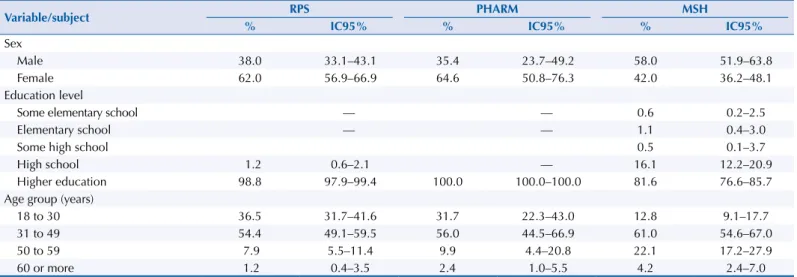
Table 1 shows the sociodemographic proile of the interviewees. he male sex not only predominates among MSH, but also represents the highest percentages in the age groups over 31 years. Regarding education level, almost all RPS had higher education degree, while MSH had about 80%.
Table 2 presents the conceptions on PS in Brazil, according to the understanding expressed by RPS, PHARM, and MSH. We observed diferences between participants concerning the understanding of PS. Among RPS and PHARM, we highlight PS conceptions focused
Table 1. Sociodemographic profile of those responsible for pharmaceutical services, pharmacists responsible for medicine dispensing in primary health care, and municipal secretaries of health, in Brazil. National Survey on Access, Use and Promotion of Rational Use of Medicines – Services, 2015.
Variable/subject RPS PHARM MSH
% IC95% % IC95% % IC95%
Sex
Male 38.0 33.1–43.1 35.4 23.7–49.2 58.0 51.9–63.8
Female 62.0 56.9–66.9 64.6 50.8–76.3 42.0 36.2–48.1
Education level
Some elementary school –– –– 0.6 0.2–2.5
Elementary school –– –– 1.1 0.4–3.0
Some high school 0.5 0.1–3.7
High school 1.2 0.6–2.1 –– 16.1 12.2–20.9
Higher education 98.8 97.9–99.4 100.0 100.0–100.0 81.6 76.6–85.7
Age group (years)
18 to 30 36.5 31.7–41.6 31.7 22.3–43.0 12.8 9.1–17.7
31 to 49 54.4 49.1–59.5 56.0 44.5–66.9 61.0 54.6–67.0
50 to 59 7.9 5.5–11.4 9.9 4.4–20.8 22.1 17.2–27.9
60 or more 1.2 0.4–3.5 2.4 1.0–5.5 4.2 2.4–7.0
RPS: those responsible for pharmaceutical services; PHARM: pharmacists responsible for medicine dispensing; MSH: Municipal Secretary of Health. Source: PNAUM – Services, 2015.
Table 2. Conceptions on pharmaceutical services in primary health care, according to the interviewed professionals. National Survey on Access, Use and Promotion of Rational Use of Medicines – Services, 2015.
Conceptions/Subjects RPS PHARM MSH
% (IC95%) % (IC95%) % (IC95%)
Focused on medicines:
In stages of medicine logistic cycle 8.7 (6.2–12.0) 6.8 (3.4–13.2) 8.4 (5.5–12.7)
In stages of logistic cycle with guidance/information to the user of medicines 16.7 (13.2–20.9) 25.7 (14.9–0.40) 12.3 (8.7–17.0)
In the provision/offer of medicines 5.2 (3.3–8.3) 3.6 (1.6–7.8) 11.0 (7.5–15.7)
In controlled provision/offer of medicines 4.5 (2.8–7.1) 2.2 (0.3–13.6) 7.4 (4.7–11.5)
As part of the medical or pharmaceutical care procedure
Activity performed by pharmacists in health care 1.5 (0.7–3.5) 0.4 (0.1–3.1) 0.6 (0.2–2.1)
As a complement or finalization of medical care, medicine dispensing, and user guidance 0.9 (0.3–2.7) 0.3 (0–2.1) 1.9 (0.7–4.6) Associated with assistance to the poor
As a way of assisting/supporting/helping deprived or low-income populations 0.2 (0–1.6) –– 4.0 (2.1–7.6) Associated with the care/activities with the user of medicines
Focused on the guidance/information to users on the use of medicines, with or without
reference to their rational use 18.5 (14.8–22.8) 36.8 (26.1–48.9) 6.0 (3.6–9.7)
As a way of assisting/supporting/taking care of users/patients or population with guidance/information 8.1 (5.7–11.4) 11.2 (6.1–19.5) 13.9 (10.1–18.9)
Associated with care integrality 2.0 (0.9–4.3) 0.5 (0.1–3.3) 1.0 (0.4–2.7)
As part of the city’s health system management
As a way of supporting/assisting management activities 2.3 (1.1–4.8) –– 4.7 (2.7–7.9)
As a way of organizing the services for the provision of medicines 2.4 (1.2–4.5) –– 6.4 (3.8–10.5)
Others 10.5 (7.8–14.0) 8.8 (4.6–16.1) 15.3 (11.3–20.5)
Did not know how to answer 0.4 (0.1–1.4) 1.3 (0.3–4.8) 3.0 (1.3–6.4)
Did not answer 18.1 (14.4–22.4) 2.5 (1.1–5.3) 4.2 (2.2–7.8)
on guidance/information to users on the use of medicines, with or without references to their rational use, followed by conceptions focused on logistic cycle stages with guidance/information to users.
The latter was also the second most frequent among MSH; in first place, there were conceptions on PS as a way of assisting/supporting/taking care of users or population. To following extracts illustrate these concepts:
PS is a set of actions and information that must be provided to the user to leave no doubts on the use of medicines, thus providing their rational use (PHARM).
PS is responsible for medicine acquisition, maintenance, distribution, and guidance to users (RPS). PS is a set of actions in the context of SUS users that provide assistance, guidance, and qualiied
monitoring (MSH).
Conceptions on PS regarding management and as a way of assisting/supporting/helping deprived or low-income populations were mainly expressed by MSH and were not found among pharmacists:
PS are important to assist the health management of cities (...) (MSH).
[hey are] a health block within management, really important for the functioning of the Secretariat
of Health, and serving as support (MSH).
(...) supporting people in need by ofering free medicines (MSH).
(...) aiding deprived people of a determined region (MSH).
he low percentages of PS conceptions associated with integrality of care among the
interviewees called our attention, indicating the distancing of PS from other health actions,
according to the perspectives of these subjects, and little understanding on PS as an essential component of SUS when it comes to integrality of health care. However, some interviewees reported understanding PS as a constituent of the health care process beyond medicines and perceptions that show some assimilation of the text of PNAF:
I see PS as a segment of patients’ integral care, as part of the care process in our network that implies
more than medicine acquisition and use (MSH).
hey are actions that favor the prevention, rehabilitation, and protection of individual and collective health. hey aim to promote the rational and correct use of medicines to improve the population’s quality of life (PHARM).
In my opinion, pharmaceutical services have the same objective as SUS. hey are a set of actions aimed at health promotion, protection, and recovery. It is worth to highlight that their focus is ensuring the
access to medicines and their rational use (…) (RPS).
he interviewees reported the most diverse conceptions on PS; some of them deined them using only few words or only one, such as “excellent”; “essential”; “very important”; “the basis of care service (MSH)”; “useful, necessary, and economically beneicial to the city (RPS),”
while others developed multiple meanings that did not allow us to categorize them within
this study. We observed a wider variety of understandings of PS among MSH, followed by RPS and, inally, by the PHARM that are responsible for medicine delivery.
his diversity can be associated with characteristics of these subjects and their position on the health system: among MSH, we found the most diverse formations and education levels
since elementary school; it was also among MSH that we found the highest percentage of
Furthermore, we highlight the limitations of the interviews, which could be: lack of disposition, motivation, or even inability of interviewees in answering appropriately; retention
of information out of fear of having their identity revealed; or even provision of false answers4,6.
Table 3 presents conceptions on PS according to RPS, PHARM, and the regions. Besides varying between regions, the frequencies of conceptions also varied between the two interviewed groups.
As expressed by two participants, conceptions centered on orientation or providing the
patient with information for medicines use, with or without reference to their rational use,
stood out in all regions, except in Northeast in the case of RPS.
hose responsible for pharmaceutical services, from all regions, were the only ones to express
conceptions that associate medicine provision with the notion of control and management,
which is possibly associated with their position in PS coordination. However, conceptions regarding health care integrality reached minimum percentages among these subjects and were only expressed by PHARM from the Southeast. As conirmed by active professionals of the public health system, these indings indicate that PS have not yet been incorporated as part of health care integrality, despite being a social right and a duty of the State. he highest percentage of interviewees who reported not knowing what PS meant was
among PHARM from the Northeast, region where we also noted the highest percentage of
PHARM who did not answer the question.
Table 3. Frequency of conceptions of pharmaceutical services in primary health care, according to those responsible for pharmaceutical services and pharmacists responsible for medicine dispensing, according to Brazilian regions. National Survey on Access, Use and Promotion of Rational Use of Medicines – Services, 2015.
Conception/subject North Northeast Midwest Southeast South RPS PHARM RPS PHARM RPS PHARM RPS PHARM RPS PHARM
Focused on medicines
In stages of medicine logistic cycle 11.2 15.8 7.7 8.3 5.3 28.1 7.4 1.9 11.0 13.2
In stages of logistic cycle with guidance or information to
medicine users 16.3 23.3 21.5 15.3 22.5 9.1 10.5 27.8 19.5 29.1
In provision or offer of medicines 2.3 4.4 8.8 3.4 –– 8.1 5.3 3.9 2.1 1.9
In controlled provision or offer of medicines 4.6 –– 2.6 4.2 –– –– 5.2 3.6 6.0 ––
As part of the medical or pharmaceutical care procedure
Activity performed by pharmacists in health care 1.1 –– –– –– –– –– 3.1 0.7 2.0 ––
As a complement or finalization of medical care, medicine
dispensing, and user guidance 2.6 –– 1.3 –– –– –– 1.1 –– –– 1.9
Associated with assistance to the poor
As a way of assisting/supporting/helping deprived or low-income
populations –– –– –– –– –– –– –– –– 1.0 ––
Associated with the care/activities with the user of medicines Focused on the guidance or information to users on the use of
medicines, with or without reference to their rational use 20.6 43.9 15.1 19.0 32.0 40.6 17.8 35.1 23.0 42.2 As a way of assisting/supporting/taking care of users/patients or
population with guidance/information 10.3 2.2 5.1 9.4 21.3 –– 11.6 12.0 6.1 9.7
Associated with care integrality 1.1 –– 2.5 2.1 –– –– 3.2 0.9 –– ––
As part of the city’s health system management
As a way of supporting/assisting management activities 1.1 –– 3.8 –– –– –– 2.1 –– 2.0 ––
As way of organizing the services for the provision of medicines 6.0 –– 2.6 3.1 –– –– 2.1 –– 1.0 ––
Others 13.8 10.4 5.0 12.5 7.0 5.9 16.8 11.1 7.2 2.1
Did not know how to answer 1.1 –– –– 1.0 1.1 8.1 –– 0.9 1.0 ––
Did not answer 7.7 –– 24.0 21.8 10.7 –– 13.7 2.3 18.1
It is worth to highlight that, in this study of exploratory character, it was not possible to deepen the analysis of the reports and their circumstances, such as the several contexts10,11, the production of statements on PS, sociopolitical contexts, advances in SUS implementation, and degree of institutionalization of PS in the cities of the interviewees.
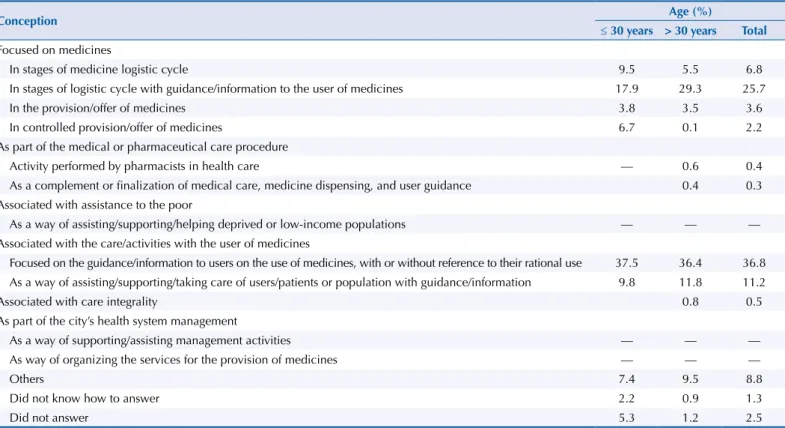
We attempted to verify if the new curricular guidelines would have been inluencing academic formation, and therefore changes in conceptions on PS. Table 4 presents the distribution of ideas expressed by PHARM of two age groups of up to 30 years old, considering that older pharmacists probably did not attend graduation courses that followed the Diretrizes Curriculares Nacionais de Farmácia (DCNF – National Curriculum Guidelines of Pharmacy), of 2002.
We observed a similarity in the distribution of the most frequent conceptions in these two groups and a tendency to higher frequency of conceptions on technical and administrative activities in younger pharmacists. Among the latter, we did not ind conceptions on PS
associated with integrality of care, although they had occurred in small percentages among
those with more than 30 years.
Within the limits of this study, we could not develop this question any further; however, our indings indicate that changes in professional formation introduced by the DCNF can be faster or slower depending on the changes in political-pedagogical processes and their association with the organization of services, which also require changes to meet the expectations within health policies.
Nicoline & Vieira16, when discussing the perspectives and challenges on pharmaceutical education concerning the PS category, consider the DCNF as wide and generic and, therefore, opened to several interpretations that do not ensure the formation of qualiied pharmacists in the context of medicines and PS. Moreover, part of the group under study realized a greater need for a closer association between professional formation and curricular contents on
management and planning of pharmaceutical services, in addition to the development of
adequate methodological teaching strategies16.
Table 4. Conceptions on pharmaceutical services in primary health care, according to pharmacists responsible for medicine dispensing, according to age group. National Survey on Access, Use and Promotion of Rational Use of Medicines – Services, 2015.
Conception Age (%)
≤ 30 years > 30 years Total
Focused on medicines
In stages of medicine logistic cycle 9.5 5.5 6.8
In stages of logistic cycle with guidance/information to the user of medicines 17.9 29.3 25.7
In the provision/offer of medicines 3.8 3.5 3.6
In controlled provision/offer of medicines 6.7 0.1 2.2
As part of the medical or pharmaceutical care procedure
Activity performed by pharmacists in health care –– 0.6 0.4
As a complement or finalization of medical care, medicine dispensing, and user guidance 0.4 0.3 Associated with assistance to the poor
As a way of assisting/supporting/helping deprived or low-income populations –– –– ––
Associated with the care/activities with the user of medicines
Focused on the guidance/information to users on the use of medicines, with or without reference to their rational use 37.5 36.4 36.8 As a way of assisting/supporting/taking care of users/patients or population with guidance/information 9.8 11.8 11.2
Associated with care integrality 0.8 0.5
As part of the city’s health system management
As a way of supporting/assisting management activities –– –– ––
As way of organizing the services for the provision of medicines –– –– ––
Others 7.4 9.5 8.8
Did not know how to answer 2.2 0.9 1.3
Did not answer 5.3 1.2 2.5
To synthesize the data, we gathered PS conceptions in six macro-conceptions, presented in the Figure.
Our results show a high frequency of PS conceptions focused on medicines, as well as conceptions concerning the care/activities with users of medicines that predominate among pharmacists, indicating a tendency to the expansion of PS understanding.
his inding is relevant to more efective practices, given that conceptions focused on the programmatic aspect of PS, with emphasis on the logistic cycle, exert a limiting efect on
the systemic and articulating character of PS rather than including the user of medicines
as participant of the health care process and its inal recipient. hus, essential actions for the rational use of medicines and the technical bases of PS and their strategic position in
health care are neglected, as well as other matters of SUS3,17.
The different reports expressed varied conceptions on PS and denoted a field under construction and consolidation of its services, practices, and references. Besides, they also can relect the inclusion and improvement of activities in the work process of pharmacists, who, despite still being focused on the logistic cycle of medicines, also embrace PS concepts that refer to practices aimed at patient care. his could represent the expectations of subjects
regarding changes in pharmaceutical practices within health services, in the current Brazilian
context of PS reorientation.
According to Wells et al.23, pharmacists’ actions and beliefs on a service are key factors to analyze their performance and how services work in real life. he indings of this study point to a
tendency of development in PS conceptions and also indicate that the process of consolidation
of a robust pharmaceutical policy – as all public health policy should be – involves a complex process of development, implementation, and monitoring of the several involved aspects.
However, despite the favorable tendency identiied, we still observed relevant frequencies
of PS conceptions focused on the logistic cycle of medicines, as well as conceptions that
emphasize guidance/information activities on the use of medicines. According to Perini17,
this tendency of understanding PS by only focusing on logistics is very limiting as it hinders the comprehension of PS as part of care integrality.
RPS: those responsible for pharmaceutical services; PHARM: pharmacists responsible for medicine dispensing; MSH: municipal secretaries of health
Source: PNAUM – Services, 2015.
Figure. Macro-conceptions of pharmaceutical services according to those responsible for pharmaceutical services, pharmacists responsible for medicine dispensing in primary health care, and municipal secretaries of health, in Brazil. National Survey on Access, Use and Promotion of Rational Use of Medicines – Services, 2015.
0 20 40 60
1. Focused on medicines
2. As part of the medical or pharmaceutical care procedure
3. Associated with assistance to the poor
4. Associated with the care/activities with the user of medicines
5. Associated with care integrality
6. As part of the city’s health system management
7. Others
8. Did not know
9. Did not answer
RPS PHARM MSH
As pointed out by Santos19, the discourse inherent in the systemic approach of PS refers to a set of articulated or sequential practices rather than health integrality structured by coordination, cooperation, and collaboration actions, as in the model proposed by Bradley, Ashcroft, and Noyce5.
Furthermore, the lack of understanding of PS as part of the management of the health system among PHARM suggests the limited experience of these professionals with managing
functions, compromising the conduction and maintenance of necessary changes regarding
organization. We observed an inverse tendency among MSH, which is probably due to their involvement with the health service patients’ demands, such as care, access, and beneits. In addition, we can also consider that the concept of PS is still under construction, as it can be seen in the terminology adopted in the Federal Act no. 3,916, of October 30, 1998, which
approves the Política Nacional de Medicamentos (PNM – National Drug Policy), and in the principles and strategic axes that should guide this segment of SUS, according to article number 1, subsection III, of the National Health Council resolution no. 338, of May 3, 2004,
which approves PNAF13.
Vigotski22, in his experimental investigation, showed that the functional employment of words acts towards the active guiding of comprehension and abstraction, both essential in the process of concept formation. he organization of experiences assumes the ways followed in concept formation, i.e., the exercise of understanding words is not static and isolated, but it communicates with the process of thinking.
Developing concepts or acquiring meanings from words result from intense and complex activities that include the association of the word with the object and reality. According to
Foucault8 (p. 55), “speeches are practices that systematically form the objects about which they speak.” hat is why it is reasonable to state the formulation of concepts is a social construct capable of producing meanings and of central role in consciousness development.
Language is a practical conscience18 that not only illustrates conlicts or domination systems, but also is the reason why we have something to ight for8.
FINAL CONSIDERATIONS
Given the results, it is possible to conclude that the variety of conceptions on PS relects an ongoing movement in the process of PS reorientation. We highlight that this movement occurs in diferent countries. In Brazil, both the National Drug Policy and PNAF have brought advances, establishing, among their guidelines, the reorientation of PS and the care to people, respectively. he reorientation process of PS in Brazil and other countries starts to take form
with the gradual change from its technical paradigm (medicines) to an approach more focused
on user-citizen patients7.hus, pharmaceutical policies have been encouraging pharmacists
to adopt a more multidisciplinary and collaborative attitude to achieve health care purposes. he multiple understandings of PS found in the reports of strategic subjects comprise not
only the meaning of the practices9,11, but also expose meaning disputes that exist in the area, which involve medicine, a complex object that produces meaning that is, at the same time, product, social good, health technology, and work environment.
here is need for theoretical and empirical studies on the subject; we suggest the deepening of the analysis of the subjects’ reports, considering their several contexts, and the expanded relection with the distinct subjects involved, including citizens-users of health services, on PS and the space of medicine in health practices. he several conceptions of PS found reveal the aspects of a ield under organization and consolidation of its services and practices, and also of its theoretical-conceptual references, showing a tendency of reversal logic based
on a more procedural conception, focused on the medicine, towards one more focused
REFERENCES
1. Álvares J, Alves MCGP, Escuder MML, Almeida AM, Izidoro JB, Guerra Junior AA, et al. Pesquisa Nacional sobre Acesso, Utilização e Promoção do Uso Racional de Medicamentos: métodos.
Rev Saude Publica. 2017;51 Supl 2:4s. https://doi.org/10.11606/S1518-8787.2017051007027
2. Araújo ALA, Freitas O. Concepções do profissional farmacêutico sobre a assistência farmacêutica na unidade básica de saúde: dificuldades e elementos para a mudança.
Rev Bras Cienc Farm. 2006;42(1):137-46. https://doi.org/10.1590/S1516-93322006000100015
3. Barreto JL, Guimarães MCL. Avaliação da gestão descentralizada da assistência farmacêutica em municípios baianos. Cad Saude Publica. 2010;26(6):1207-20. https://doi.org/10.1590/S0102-311X2010000600014
4. Barroso ALR. Instrumentos de pesquisa científica qualitativa: vantagens, limitações, fidedignidade e confiabilidade. EFDeportes Rev Dig. 2012 [cited 2017 Feb 4];17(172). Available from:
http://www.efdeportes.com/efd172/instrumentos-de-pesquisa-cientifica-qualitativa.htm 5. Bradley F, Ashcroft DM, Noyce PR. Integration and differentiation: a conceptual model
of general practitioner and community pharmacist collaboration. Res Soc Adm Pharm. 2012;8(1):36-46. https://doi.org//10.1016/j.sapharm.2010.12.005
6. Cavalcante RB, Calixto PCAL, Pinheiro MMK. Análise de conteúdo: considerações gerais, relações com a pergunta de pesquisa, possibilidades e limitações do método. Inf Soc Estud. 2014 [cited 2017 Feb 4];24(1):13-8. Available from: http://periodicos.ufpb.br/ojs2/index.php/ pbcib/article/view/22277
7. Edmunds J, Calnan MW. The reprofessionalisation of community pharmacy? An
exploration of attitudes to extended roles for community pharmacists amongst pharmacists and general practioners in the United Kingdom. Soc Sci Med. 2001;53(7):943-55.
https://doi.org/10.1016/S0277-9536(00)00393-2
8. Foucault M. A ordem do discurso: aula inaugural no Collège de France, pronunciada em 1970. São Paulo: Loyola; 1996. (Leituras Filosóficas,1)
9. Foucault M. A Arqueologia do saber. 7. ed. Rio de Janeiro: Forense Universitária; 2009. (Coleção Campo Teórico).
10. Laville C, Dionne J. A construção do saber: manual de metodologia em ciências humanas. Porto Alegre: Artes Médicas; Belo Horizonte: UFMG; 1999.
11. Minayo MCS. O desafio do conhecimento: pesquisa qualitativa em saúde. 3. ed. São Paulo: Hucitec; Rio de Janeiro: ABRASCO; 1994.
12. Ministério da Saúde (BR), Secretaria de Políticas de Saúde, Departamento de Atenção Básica. Política Nacional de Medicamentos. Brasília (DF); 2001. (Série C. Projetos, Programas e Relatórios, 25). 13. Ministério da Saúde (BR), Conselho Nacional de Saúde. Resolução nº 338, de 06 de maio de
2004. Aprova a Política Nacional de Assistência Farmacêutica. Diario Oficial Uniao. 20 mai 2004; Seção 1:52.
14. Ministério da Saúde (BR), Secretaria de Ciência, Tecnologia e Insumos Estratégicos,
Departamento de Assistência Farmacêutica e Insumos Estratégicos. Diretrizes para estruturação de farmácias no âmbito do Sistema Único de Saúde. Brasília (DF); 2009 [cited 2017 Feb 4]. (Série A. Normas e Manuais Técnicos). Available from: https://farmaciacidada.es.gov.br/Media/ farmaciacidada/Arquivos/anexo%201.pdf
15. Ministério da Saúde (BR), Secretaria de Ciências, Tecnologia e Insumos Estratégicos,
Departamento de Assistência Farmacêutica e Insumos Estratégicos. Assistência farmacêutica na atenção básica: instruções técnicas para sua organização. 2. ed. Brasília (DF); 2006 [cited 2017 Feb 4]. (Série A. Normas e Manuais Técnicos). Available from: http://www.ensp.fiocruz.br/portal-ensp/judicializacao/pdfs/283.pdf
16. Nicoline CB, Vieira RCPA. Assistência farmacêutica no Sistema Único de Saúde (SUS): percepções de graduandos em Farmácia. Interface (Botucatu). 2011;15(39):1127-44. https://doi.org/10.1590/S1414-32832011005000026
17. Perini E. Assistência farmacêutica: fundamentos teóricos e conceituais. In: Acurcio FA, organizador. Medicamentos e Assistência Farmacêutica. Belo Horizonte: COOPMED; 2003. p.10-31.
18. Pignarre P. O que é medicamento? Um objeto estranho entre ciência, mercado e sociedade. São Paulo: Editora 34; 1999.
Funding: Department for Pharmaceutical Services and Strategic Health Supplies and Department of Science
and Technology of the Secretariat of Science, Technology, and Strategic Supplies of the Brazilian Ministry of
Health (SCTIE/MS – Process 25000.111834/2, Decentralization of FNS Resources).
Authors’ Contribution: Conception, analysis, and interpretation of results; critical review of the content: EAC, PSA, TRP, JBL, AAG Jr, FAA, IAG, JA, KSC, MGOK, OMS, SNL. All authors contributed to the writing, approved the inal version of the manuscript, and declare to be responsible for all aspects of the study, ensuring its accuracy and completeness.
Conflict of Interest: KSC declares conlict of interest for being former director of the Brazilian Ministry of Health, the research funding institution. he other authors declare no conlict of interest.
20. Saturnino LTM, Perini E, Luz ZP, Modena CM. Farmacêutico: um profissional em busca de sua identidade. Rev Bras Farm. 2012 [cited 2017 Feb 4];93(1):10-16.
http://www.rbfarma.org.br/files/rbf-2012-93-1-2.pdf
21. Vieira FS. Qualificação dos serviços farmacêuticos no Brasil: aspectos inconclusos da agenda do Sistema Único de Saúde. Rev Panam Salud Publica. 2008;24(2):91-100.
https:/doi.org/10.1590/S1020-49892008000800003
22. Vigotski LS. Psicologia pedagógica. São Paulo: Martins Fontes; 2001.
23. Wells KM, Thornley T, Boyd MJ, Boardman HF. Views and experiences of community pharmacists and superintendent pharmacists regarding the New Medicine Service in England prior to implementation.
Res Soc Adm Pharm. 2014;10(1):58-71. https://doi.org/10.1016/j.sapharm.2013.03.003 24. Wiedenmayer K, Summers RS, Mackie CA, Gous AGS, Everard M. Developing pharmacy