National Survey on Access, Use
and Promotion of Rational Use of
Medicines: methods
Juliana ÁlvaresI, Maria Cecilia Goi Porto AlvesII, Maria Mercedes Loureiro EscuderII,
Alessandra Maciel AlmeidaIII, Jans Bastos IzidoroI, Augusto Afonso Guerra JuniorI,
Karen Sarmento CostaIV,V,VI, Ediná Alves CostaVII, Ione Aquemi GuibuVIII, Orlando Mario SoeiroIX,
Silvana Nair LeiteX, Margô Gomes de Oliveira KarnikowskiXI, Francisco de Assis AcurcioI
I Departamento de Farmácia Social. Faculdade de Farmácia. Universidade Federal de Minas Gerais.
Belo Horizonte, MG, Brasil
II Secretaria Estadual de Saúde de São Paulo. São Paulo, SP, Brasil
III Faculdade de Ciências Médicas de Minas Gerais. Belo Horizonte, MG, Brasil
IV Núcleo de Estudos de Políticas Públicas. Universidade Estadual de Campinas. Campinas, SP, Brasil
V Programa de Pós-Graduação em Saúde Coletiva. Departamento de Saúde Coletiva. Faculdade de Ciências Médicas.
Universidade Estadual de Campinas. Campinas, SP, Brasil
VI Programa de Pós-Graduação em Epidemiologia. Faculdade de Medicina. Universidade Federal do Rio Grande do Sul.
Porto Alegre, RS, Brasil
VII Instituto de Saúde Coletiva. Universidade Federal da Bahia. Salvador, BA, Brasil
VIII Departamento de Saúde Coletiva. Faculdade de Ciências Médicas. Santa Casa de São Paulo. São Paulo, SP, Brasil IX Faculdade de Ciências Farmacêuticas. Pontifícia Universidade Católica de Campinas. Campinas, SP, Brasil X Departamento de Ciências Farmacêuticas. Universidade Federal de Santa Catarina. Florianópolis, SC, Brasil XI Faculdade de Ceilândia. Universidade de Brasília. Brasília, DF, Brasil
ABSTRACT
he Pesquisa Nacional sobre Acesso, Utilização e Promoção do Uso Racional de Medicamentos –
Serviços (PNAUM – National Survey on Access, Use and Promotion of Rational Use of Medicines
– Services) aimed to characterize the organization of pharmaceutical services in the Primary Health Care of the Brazilian Uniied Health System (SUS). PNAUM – Services is a cross-sectional and evaluative study, with planned sample of 600 cities, held between 2014 and 2015, composed of a remote phase, with telephone interviews with health managers. Of these 600 cities, 300 were selected for a survey on health services. We selected the 27 capitals, the 0.5% largest cities of each region, and the remaining cities were drawn. he estimate of the representative national sample size considered three levels: cities, medicine dispensing services, and patients. he interviews were carried out with a structured questionnaire speciic for: municipal secretaries of health, professionals responsible for pharmaceutical services in the city, professionals responsible for the dispensing of medicines, physicians, and patients. he secondary data were obtained in oicial databases, in the latest update date. PNAUM – Services was the irst nationwide research aimed at the assessment and acquisition of national and regional indicators on access to medicines, as well as use and rational use, from the perspective of various social subjects.
DESCRIPTORS: Pharmaceutical Services. Health Services Research, methods. National Drug Policy. Uniied Health System.
Correspondence: Juliana Alvares
Departamento de Farmácia Social Faculdade de Farmácia. Universidade Federal de Minas Gerais
Rua Silvianópolis, 23 – Santa Tereza 31010-410 Belo Horizonte, MG, Brasil
E-mail: [email protected]
Received: Mar 14, 2016 Approved: Nov 30, 2016
How to cite:
Álvares J, Alves MCGP, Escuder MML, Almeida AM, Izidoro JB, Guerra Junior AA, et al. National Survey on Access, Use and Promotion of Rational Use of Medicines: methods. Rev Saude Publica. 2017;51 Suppl 2:4s.
Copyright: This is an open-access article distributed under the terms of the Creative Commons Attribution License, which permits unrestricted use, distribution, and reproduction in any medium, provided that the original author and source are credited.
INTRODUCTION
Pharmaceutical Services (PS) are one of the components of the Brazilian Uniied Health System (SUS), fundamental to its principle of care integrality. Even before they were established as a public policy3, they implemented the access and the rational use of medicines
in their conception.
In the search for strengthening and consolidation of PS in Brazil, the Política Nacional de Medicamentos (PNM – National Drug Policy)4 was approved in 1998 and, later, the Política Nacional de Assistência Farmacêutica (PNAF – National Policy of Pharmaceutical Services), in 2004.
Studies indicate the existence of a big gap between the legally established PS and the real primary PS of Brazilian cities. he problems range from the lack of essential medicines and bad conservation in the storage process to the total absence of guidance of proper use to the patient6.
Studies on the use, access, and rational use of medicines in national scale provide subsidies to governmental authorities to assess their policies of PS, investments in the selection and acquisition of medicines, as well as control of expenses.
Furthermore, it is essential that evaluative researches in the area of pharmaceutical services address the many issues related to the system as a whole, to the adequacy of services to the real needs of the patients, and that these people, in turn, be perceived as central subjects of the process.
In this perspective, the Pesquisa Nacional sobre Acesso, Utilização e Promoção do Uso Racional de Medicamentos (PNAUM – National Survey on Access, Use and Promotion of Rational Use of Medicines) was developed, established by Ordinance of the Brazilian Ministry of Health no. 2,077, September 17, 20125. PNAUM has been performed by two strategies, both with
national scope: a household survey and a component of services. PNAUM – Services aimed to characterize the organization of PS in the Primary Health Care of SUS, focusing on the access and promotion of the rational use of medicines, as well as to identify and discuss factors that interfere in the consolidation of PS in the Primary Health Care of the cities.
his article presents the methodology of PNAUM – Services, with details of the route and of the methodological procedures adopted in the planning and execution of the ield research.
METHODS
PNAUM – Services is a cross-sectional and exploratory study of evaluative nature. To respond to its goals, three thematic axes were conceived:
• Municipal management of PS, covering topics such as formal structure and organization of municipal pharmaceutical services, inancing and investment in pharmaceutical services, acquisition of medicines, health care waste management, mechanisms for popular participation and receiving of criticism and suggestions on management, information on the workforce that operates in pharmaceutical services, medicine selection and standardization, organization of places of storage and dispensing of medicines, advertising regulations and entry of representatives of pharmaceutical industries in primary health care services;
• Consumption, with themes such as the most used medicines by patients and reasons of use, self-medication, ofer of free samples, perception about prescription tracking and non-medicated guidelines, proile of the patients of the services, users’ perception about the existence of predeined tracer diseases, use and characteristics of care in the health system, medicine acquisition process, aspects related to the use and rational use of medicines, as well as to the quality and lifestyle.
Based on the main themes, the sampling plan was delineated (delimited to the study populations), and the processes of data collection were set.
Sampling plan
In the sampling plan, the following study populations were considered: municipal secretaries of health, professionals responsible for pharmaceutical services in the cities, medicine dispensers, physicians, and patients of health services.
We opted for the use of sampling in various stages of selection. In each stage, one or two of these populations were sampled and the estimates relating to them were made separately2.
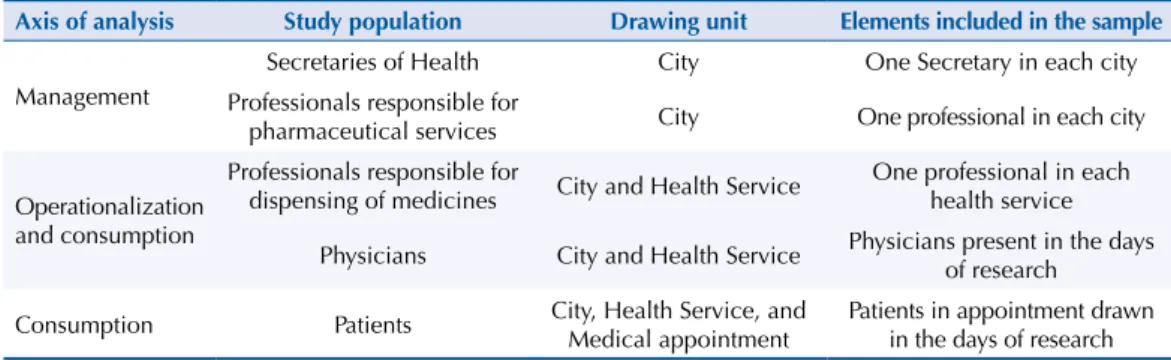
hus, in the drawn cities, secretaries of health and those responsible for pharmaceutical services were accessed (two people from each cities, except when there was accumulation of both functions) and in health services, those responsible for the dispensing (one person per service). In these services, patients and physicians were also sampled (Table 1). herefore, three samples were drawn: of cities, services, and patients. In the irst, the cities were the single drawing units, since there is only one secretary of health and one person responsible for PS in each city, in a procedure equivalent to the sampling of elements. In the second, these cities became conglomerates (primary sampling units), in which the services that composed the sample were drawn. And in the third, the services became secondary sampling units, in which the patients were drawn.
he study populations were stratiied per region: North, Northeast, South, Southeast, and Midwest, and these strata constituted the study domains.
Considering the goal of estimating various proportions, the sample size was calculated by using the algebraic expression: n0 = P (1 - P)
(d/z)2 , where P = 0.50 is the ratio of elements (secretaries of health, professionals responsible for pharmaceutical services, professionals responsible for the dispensing of medicines, and patients) to be estimated as it is the one that leads to greater sample size; z = 1.96 is the normal curve value reduced to the level of conidence of 95% of the conidence intervals; def is the design efect, and d is the sampling error in percentage points2. he sample sizes adopted in each region were: 112 secretaries of health/professionals
responsible for pharmaceutical services in the cities (def = 1.2 and d = 0.10); 300 professionals responsible for the dispensing of medicines in health services (def = 2 and d = 0.08), and 534 patients (def = 2 and d = 0.06), values rounded to 120, 300, and 540. Compared with the sample of patients, the need to get estimates for smaller subgroups was considered and thus the sample
Table 1. Axes of analysis, study populations, drawing unit, and elements of the sample. National Survey
on Access, Use and Promotion of Rational Use of Medicines – Services, 2015.
Axis of analysis Study population Drawing unit Elements included in the sample
Management
Secretaries of Health City One Secretary in each city
Professionals responsible for
pharmaceutical services City One professional in each city
Operationalization and consumption
Professionals responsible for
dispensing of medicines City and Health Service
One professional in each health service
Physicians City and Health Service Physicians present in the days of research
Consumption Patients City, Health Service, and Medical appointment Patients in appointment drawn in the days of research
of 1,800 patients (n = 540/0.30) was planned. We considered, therefore, groups that included at least 30% of the entire population as the object of analysis, maintaining the desired precision.
Regarding physicians, we planned to include in the sample the ones present in the days of data collection of patients (estimated based on the size of the patient sample), for believing that the number of physicians present in the services is proportional to the number of patients. he number of physicians in the services should be noted, if necessary the introduction of weights.
To compose the sample of cities, 120 cities were drawn in each region, in which should be interviewed the secretaries of health and the professionals responsible for pharmaceutical services he list used to draw the cities was extracted from the Departamento de Informática do SUS (Datasus – Department of Informatics of SUS), with the resident population estimated for 2012 by the Brazilian Institute of Geography and Statistics (IBGE).
To ensure the inclusion in the sample of all the capitals and cities considered large in each region, the following strata were constituted: capitals; larger cities (the 0.5% of the largest cities in the region), and smaller cities. he irst two were considered certain strata, in which there was no drawing of units. In the stratum of smaller cities, the selection was carried out by systematic draw, with the cities ordered by population size.
he sampling fraction1 corresponding to the draw of cities, in each stratum, was: ƒ = a
A , where a is the number of cities in the sample and A, the number of existing cities. In the irst two strata (capital and larger cities) the sampling fraction corresponded to the unit.
he sample of health services, in which medicine dispensers should be interviewed, was drawn in two stages1: cities and services. In the irst stage, 60 cities were drawn from the 120
cities selected previously. he total of the capitals and larger cities and of other cities was taken; the remaining number to complete 60 was drawn among the smaller cities.
In the second stage, in each city, health services relating to primary health care facilities were drawn, registered in the Cadastro Nacional de Estabelecimentos de Saúde (CNES – National Registration of Health Establishments) as being of the following types: health clinic, health center or basic health unit, and mixed unit. River and land mobile units were excluded.
For the draw, the small cities were divided into two groups: with one or two health services and with three or more health services. In the irst group, with one or two services, there was no draw. he services were distributed in the strata settling 100 services in stratum 1 (capitals), to obtain separate estimates for the capitals.
he sampling fraction used was: ƒ = a
A b B
. , where a and A are, respectively, the numbers
of cities in the sample and in the population;b and B are the averages per city of services in the sample and in the population, estimated by b = n
a and B = B
a , being B the number of services in the cities of the sample.
For the draw of the sample of physicians and patients, sampling was used in three stages: city, health service, and physician or patients.
We established that 1,800 patients would be interviewed per region of the country. Considering the occurrence of a non-response percentage of 15% (refusal, impossibility of carrying out the full interview etc.), 2,100 patients were drawn. In each region, this number of patients was proportionally distributed by the strata, according to the frequency of services sampled in each of them.
he sampling fraction used to draw patients in services was: f3 = c
C where c is the average of patients drawn by service, given by the ratio between the total number of patients and the number of sample services, and C is the daily average of patients seen in medical appointment in the services, estimated by: C = cs
ns , where Cs is the total of monthly
For this estimation, we used data regarding the medical appointments made per service from July to December 2013 and in May 2014 in people over the age of 17 years, according to list provided by the Secretariat of Primary Health Care of the Brazilian Ministry of Health.
he denominators of the sampling fractions in the services (c/C1 ) for each stratum and region corresponded to the drawing interval in the services. hus, by applying these fractions to the number of patients in each service, the numbers of patients to be interviewed in these services were determined.
For patients, the global sampling fraction was: ƒ = a
A b B
. c
C
. = n
N
he drawn of patients in each service cannot be performed from lists of patients, as it would be expected in probability sampling. We opted to establish criteria for the selection of patients that would not allow interviewers to choose patients to compose the sample, approximating the selection to a random drawing.
Interviewers were instructed to verify the number of interviews to be conducted in each service and estimate the number of days required to complete these interviews. In the health service, after obtaining the consent of the coordinator of the service for the collection of data required for research, the names of all physicians should be surveyed in each day that the interviewer remained in the service. he names would be listed alphabetically in the planning worksheet of the draw and the interviews would be distributed by the physicians of the worksheet according to the alphabetical order. After this stage, the irst patient should be identiied for interview on the agenda of any physician of the sample: it would be the last patient to be seen among those who were already present in the service.
Regarding physicians, those who were in the service in the days of interviews should be included in the sample.
As a result of the use of diferent probabilities of selection in the draw of the sample units, the estimates obtained in this study were weighed and the weight of each research unit corresponded to the inverse of its sampling fraction.
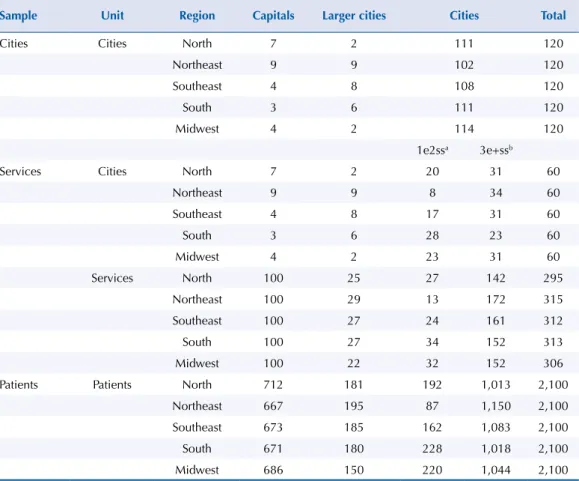
Table 2 shows the sampling plan according to strata.
Processes for Data Collection
We adopted, for data collection,surveys in loco in the primary health care services selected randomly, by applying direct observation guidelines and interviews (patients, professionals responsible for the dispensing of medicines, and prescribers), as well as telephone interviews with municipal health managers using semi-structured questionnaires. Also, we performed an investigation of data from secondary sources, to characterize the cities.
he interviews were carried out using a structured questionnaire for each study population: municipal secretary of health, professional responsible for PS in the city, professional responsible for the dispensing of medicines, physician, and patient. he interviews lasted 30 minutes on average. However, for patients, this time varied according to the number of comorbidities presented and medicines used. Personal information were collected from all respondents, in addition to the speciic questions of the study.
The questionnaires for the municipal secretaries of health and for the professionals responsible for pharmaceutical services were applied by telephone interview. Questionnaires for physicians were self-applicable and questionnaires for patients and dispensers of medicines were applied in person in the primary health care services.
All questionnaires presented open-ended questions to evaluate the performance and factors related to the functioning of the health services.
Observation and Photographic Record of the Services of Dispensing of Medicines
he observation guideline with photographic record was used to evaluate pharmacies/public dispensing units of medicines for the primary health care, being them either inside or outside the health services. he places of storage and dispensing were observed, to investigate the conditions under which the dispensing or delivery of medicines is performed, in addition to the fractionation and storage conditions, the record of the activities, the physical availability of the medicines selected, the existence of expired medicines, and the management of medicines unsuitable for use.
After collecting information about the operation, registration, and infrastructure of the unit, the observer photographed diferent areas: counter/balcony/window of dispensing of medicines, internal area of the pharmacy, pharmacy inventory area (if there was any), medicines’ shelves (panoramic and with proximity to identiication of products, from the place of storage of controlled medicines). he observer also obtained copies, when available, of the standard operating procedures used in the dispensing sector.
After the development of the research instruments, we deined the lowchart of the ield research, to guide and standardize the conduct of the interviewers. he main stages of the study are presented in the Figure.
A manual for each instrument of research and a glossary of technical terms were developed. After the stages of elaboration and alignment, a pretest was carried out, involving the cities of diferent sizes of populations: a capital of a federal unit of the country, a large city, and a
Table 2. Sample planned according to strata. National Survey on Access, Use and Promotion of Rational
Use of Medicines – Services, 2015.
Sample Unit Region Capitals Larger cities Cities Total
Cities Cities North 7 2 111 120
Northeast 9 9 102 120
Southeast 4 8 108 120
South 3 6 111 120
Midwest 4 2 114 120
1e2ssa 3e+ssb
Services Cities North 7 2 20 31 60
Northeast 9 9 8 34 60
Southeast 4 8 17 31 60
South 3 6 28 23 60
Midwest 4 2 23 31 60
Services North 100 25 27 142 295
Northeast 100 29 13 172 315
Southeast 100 27 24 161 312
South 100 27 34 152 313
Midwest 100 22 32 152 306
Patients Patients North 712 181 192 1,013 2,100
Northeast 667 195 87 1,150 2,100
Southeast 673 185 162 1,083 2,100
South 671 180 228 1,018 2,100
Midwest 686 150 220 1,044 2,100
a Cities with 1 or 2 health services b Cities with 3 or more health services
7s
PN
A
UM – Services: Methods
Álv
ares J et al.
PS: pharmaceutical services Source: PNAUM – Services, 2015.
Figure. Flowchart of the field research of the National Survey on Access, Use and Promotion of Rational Use of Medicines – Services, 2015. YES YES YES YES NO Municipal Secretariat of Health
Telephone call from MSH (Ombudsman) informing
about the research
Occupation of MSH informing about
the research
Secretary informed
about PNAUM research in the Congress Presentation of the of CONASEMS
Contract of the staff responsible for the research
requiring approval from the secretary NO NO NO NO City excluded from the research
Is the municipal health manager available to give
an interview right now?
Secretary signs informed consent form and sends it to the person responsible
for the research
The city has a person responsible for PS
The health manager gives documents
according to the checklist
An appointment for the interview is scheduled
The municipal health manager answers the questionnaire of the
PS coordinator
The municipal health manager answers the specific
questionnaire PS Coordinator Contact to schedule the interview is made. The municipal coordinator of PS
answers the questionnaire
Contact to schedule a meeting with the manager
of the basic health unit (UBS) is made
Is the city medium or large?
Research team goes to the selected UBSs
Research team is introduced to the manager/professional responsible for the UBS
UBS
Filling of the script with the manager
There are medicines in the UBSs
Handover of questionnaires for physicians to answer
Questionnaires of physicians filled
Interviews with the patients
Questionnaires of patients filled
Pharmacy/ dispensary
Interviewer introduces himself to the professional responsible
for the pharmacy
Filling of the Observation Script with photographic
record Interviewer obtains
the Pharmacy's address
Interview with the pharmacist or dispenser
small one. he objective, during the in loco application, was to discover potential problems and to identify opportunities to improve and adjust the instruments.
Interviewers were trained and informed about the fundamental aspects of the research and standardization of data collection procedures. he whole interview was preceded by information to the person interviewed about the objectives of the research and by the signature of the informed consent form. Research results will be published in aggregate form, ensuring the anonymity of participants.
PNAUM was approved by the National Research Ethics Committee of the National Health Council, under Opinion no. 398,131/2013. All participants signed the informed consent form.
Secondary Data
he secondary data were obtained on oicial databases, according to their availability and considering the latest update date. We consulted IBGE, DATASUS [Sistema de Informação sobre Mortalidade (SIM – Mortality Information System); Sistema de Informação sobre Nascidos Vivos (SINASC – Live Birth Information System); Sistema de Informações Hospitalares do SUS (SIH/SUS – Hospital Information System of SUS); Sistema de Informação de Agravos
de Notiicação (SINAN – Notiiable Diseases Information System); Sistema de Informação da
Atenção Básica (SIAB – Primary Health Care Information System)], Sistema de Informações sobre Orçamentos Públicos em Saúde (SIOPS – Information System on Public Health Budgets), and CNES. Also, we evaluated, when available, the municipal health plan and the agreements of the intermanagement committees (bi- and tripartite).
Secondary data included indicators of demographic proile of each city and state; socioeconomic proile; mortality indicators; morbidity indicators; vaccination coverage; prenatal coverage; quantity of professionals and services in the cities; characterization of the municipal health system (information focused on sanitary surveillance, coverage and legal questions of management, such as reports and contracts). hey also included other secondary information related to PS, such as the percentage of Núcleos de Apoio à Saúde da Família (NASF – Family Health Support Centers) with a pharmacist in the city; total number of public establishments with pharmacy or medicine dispensing units in the city; medicines and standardized protocols; agreement, existence, and normative aspects about the Pharmacy and herapeutics Committee and municipal health plan; funds received and invested in pharmaceutical services in diferent components and in the popular pharmacy program; accountability; folders, newsletters, and campaigns; laws, ordinances, or resolutions concerning the area.
CONCLUSIONS
his is the irst nationwide research focused on access and use of medicines in Brazil. With a well designed sampling plan, our intention is to enable analyses related to the various dimensions of access and the study of indicators of rational use and degree of following of prescriptions in relation to adherence to treatment and care with high-prevalence diseases, such as hypertension and diabetes.
hus, we expect that the results of PNAUM can contribute to the improvement of health policies and to the consolidation of SUS, aiming to improve health conditions and, consequently, the quality of life of the Brazilian population.
REFERENCES
2. Kish L. Survey sampling. New York: John Wiley & Sons; 1965.
3. Ministério da Saúde (BR), Conselho Nacional de Saúde. Resolução nº 338, de 06 de maio de 2004. Aprova a Política Nacional de Assistência Farmacêutica. Brasília (DF); 2004 [cited 2017 Jan 23]. Available from: http://bvsms.saude.gov.br/bvs/saudelegis/cns/2004/ res0338_06_05_2004.html
4. Ministério da Saúde (BR). Portaria nº 3.916, de 30 de outubro de 1998. Aprova a Política Nacional de Medicamentos e dá outras providências. Brasília (DF); 1998 [cited 2017 Jan 23]. Available from: http://bvsms.saude.gov.br/bvs/saudelegis/gm/1998/prt3916_30_10_1998.html 5. Ministério da Saúde (BR). Portaria Nº 2.077, de 17 de setembro de 2012. Institui a Pesquisa
Nacional sobre Acesso, Utilização e Promoção do Uso Racional de Medicamentos no Brasil (PNAUM). Brasília (DF); 2012 [cited 2017 Jan 23]. Available from: http://bvsms.saude.gov.br/bvs/ saudelegis/gm/2012/prt2077_17_09_2012.html
6. Oliveira LCF, Assis MMA, Barboni AR. Assistência Farmacêutica no Sistema Único de Saúde:
da Política Nacional de Medicamentos à Atenção Básica à Saúde. Cienc Saude Coletiva.
2010;15 Supl 3:351-7. https://doi.org/10.1590/S1413-8123201000090003
Funding: Department for Pharmaceutical Services and Strategic Health Supplies and Department of Science
and Technology of the Secretariat of Science, Technology and Strategic Supplies of the Brazilian Ministry of Health (SCTIE/MS – Process 25000.111834/2, Decentralization of FNS Resources).
Authors’ Contribution: Contributed to the conception and planning of the study: JA, MCGPA, MML, AAG Jr.,
EAC, IAG, OMS, SNL, MGOK, FAA. Prepared or reviewed the manuscript: JA, MCGPA, MML, JBI. Approved the inal version to be published: JA, MCGPA, MML, AAG Jr., KSC, FAA. All authors declare to be responsible for all aspects of the study, ensuring its accuracy and completeness.
Conflict of Interest: KSC declares conlict of interest for being former director of the Brazilian Ministry of