Giovâni Firpo Del DucaI Elaine ThuméII
Pedro Curi HallalIII
I Programa de Pós-Graduação em Educação
Física, Universidade Federal de Santa Catarina. Florianópolis, SC, Brasil
II Faculdade de Enfermagem e Obstetrícia.
Universidade Federal de Pelotas. Pelotas, RS, Brasil
III Programa de Pós-Graduação em Educação
Física. Escola Superior de Educação Física. Universidade Federal de Pelotas. Pelotas, RS, Brasil
Correspondence: Giovâni Firpo Del Duca
Coordenadoria de Pós-Graduação em Educação Física
Campus Universitário Trindade 88040-900 Florianópolis, SC, Brasil E-mail: [email protected] Received: 12/22/2009 Approved: 6/6/2012
Article available from: www.scielo.br/rsp
Prevalence and factors
associated with home care
among older adults
ABSTRACT
OBJECTIVE: To estimate the prevalence of home care among older adults and to identify associated factors.
METHODS: Population-based cross-sectional study including 598 individuals aged ≥ 60 years. Subjects were selected through a two-stage cluster sampling strategy in the city of Pelotas, Southern Brazil, between 2007 and 2008. Home care was defi ned as a positive answer to the following question: “Do you have someone here in your home to take care of you?” Data on potential associated factors for home care were collected using a standardized questionnaire. Poisson regression models with robust variance were used in the crude and in the adjusted analyses. The analysis took into account the clustering of the sample.
RESULTS: The prevalence of home care was 49.5% (95%CI: 44.5;54.5). Among those who have a caretaker, 39.5% reported to be cared for by their spouse, while 4.7% of subjects reported having a professional caretaker. In the adjusted analysis, home care was positively associated with male sex, having a partner, increased age and disability for instrumental activities of daily living. Home care was inversely associated with schooling and physical activity levels.
CONCLUSIONS: The high prevalence of home care observed may overburden family members responsible for the most of the care provided. These fi ndings are important for the planning of health interventions aimed the assistance of the elderly and their families. Particular attention should be paid to individuals with advanced age, low educational level and with disability for activities instrumental to daily living.
DESCRIPTORS: Aged. Caregivers. Home Nursing. Personal Autonomy. Family Relations. Socioeconomic Factors. Cross-Sectional Studies.
INTRODUCTION
The demographic and epidemiologic transitions have generated debate on the challenge of fi nding alternatives for the care of a growing number of older adults. This issue merits special attention in developing countries, where the rapid process of population aging is not accompanied by socioeconomic development.a
The more frequent occurrence of chronic diseases,3 falls15 and disability,7
often make these individuals require permanent and continuous care for the adequate clinical management of their diseases and are among the main health concerns related to longevity. Therefore, older adults also use more health services, are more often admitted to hospitals and experience longer stays.4 To
generate new fi ndings for living in advanced age, health policies for the elderly must consider certain aspects: functional capacity, the need for autonomy, care and social participation.16
The Brazilian health system considers the family as the basic social unit of communities and implements multisector health actions to establish partnerships between health services, the family and the social support network.14 It is recognized that the informal
support system (or the informal care) provided by parents, neighbors, friends or community institutions, still constitute the most important social support mechanism in communities. It is estimated that families provide between 80% and 90% of the care for elderly members, including medical and nursing care, daily tasks such as transportation and domestic activities and purchases, in addition to being responsible for initiating and maintaining connections with health services.1,8,9
The literature on social support has not focused much on home care of older adults. Therefore the objective of the present study was to estimate the prevalence of home care provided to the elderly and to identify associated factors.
METHODS
The cross-sectional study was performed with elderly residents in an urban zone of Pelotas municipality, Southern Brazil, from October 2007 to January 2008. The cluster sampling process was done in two stages, with the primary sample units consisting of census units as defi ned by the most recent census of the Instituto Brasileiro de Geografi a e Estatística b and
with households as the secondary sample units. The census sectors were listed in increasing order, accor-ding to the head of household’s average income, and the total number of households was calculated. By dividing the total number of households in the city by the amount of census sectors to be selected, the fi rst value was established, which represented the parti-cipating household from the fi rst census sector. The other sectors were systematically listed. On average 11 households were selected per sector, and eligible individuals were ≥ 60 years old.
For data collection, a pre-coded questionnaire was utilized. Interviews were performed face-to-face by 30 trained interviewers. Interviews were considered losses/refusals when they could not be performed after three attempts on different days and times. Data quality control was performed through a second visit to 10% of the sample members and administration of a shortened version of the tool.
b Instituto Brasileiro de Geografi a e Estatística. Cartograma municipal dos setores censitários: situação 2000. Rio de Janeiro; 2000. [CD-ROM]. c Associação Brasileira de Empresas de Pesquisa. Critério de Classifi cação Econômica Brasil. São Paulo; 2003[cited 2007 Jun 16]. Available
from: http://www.abep.org/codigosguias/ABEP_CCEB_2003.pdf
The outcome of house care was obtained through a posi-tive or negaposi-tive response to the following question: “Do you have someone here in your home to take care of you?” The independent variables were sex, age, educa-tion, marital status, economic level,c tobacco use, body
mass index (BMI – corresponding to the categories of underweight/normal, overweight and obese) 17 and
self-perceived health (Table 1). The level of physical activity was obtained from the International Physical Activity Questionnaire.6 The degree of disability for basic
activities of daily living was determined by the Katz Index,11 based on the need of partial or total assistance
for at least one basic activity analyzed: eating, bathing, dressing, using the restroom, laying down, getting out of bed and/or chair and control of urination and/or evacuation. Disability in activities essential to daily living was defi ned according to the Lawton Scale,13
when partial or total assistance was needed for at least one essential activity investigated: telephone use, use of transport to go to distant locations, making purchases, house cleaning, washing clothes, food preparation, taking medication and managing money. The duration of care provided and the family relationship of the person responsible for the home care were sought by the question: “How many hours does (s)he stay with you?” In cases where the older person was incapable of answering the questionnaire, the information was obtained by proxy as reported by the caregiver. For the categorical variables, a 95% confi dence interval (95%CI) was used, in addition to measures of centrality, amplitude and standard deviation (SD) for numerical values. In the crude and adjusted analysis, a Poisson regression model with a robust variance was utilized, and the results were expressed in terms of prevalence.2
The data analysis accounted for the cluster sampling design and the hierarchy of factors possibly associated with outcome. A backward selection strategy and signifi cance level of p≤0.20 were adopted for statistical modeling to improve consistency in the model, and p values ≤0.05 were considered statistically signifi cant. The effect of sampling design on the outcome of home care was 1.50 and considered in statistical analysis by the “svy” command in the Stata software.
Given the number of individuals in each category and the prevalence of home care, the study power could identify prevalence rate ratios above 1.3 as potential risk factors. All the calculations were done a posteriori
The study protocol was approved by the Ethics Research Committee of the Faculdade de Medicina da Universidade Federal de Pelotas (Process 084/2007).
RESULTS
Of the 644 eligible elderly people, 46 were losses or refusals, corresponding to a non-response percentage of 7.1%. Of the 598 people interviewed, 91.8% answered the questionnaire alone, and the others were helped by a caregiver or somebody else responsible for the elderly person.
The majority of elderly people was woman (69.2%), with an age from 60 to 104 years (mean=70.4, SD=8.7). Formal education was absent among 18.6% of the elderly. The majority of the interviewed (51.6%) had a companion, did not smoke (56.8%), presented overweight (41.7%), was inactive (53.9%) and reported their health as regular (42.4%). The occurrence of functional disability was present in 26.8% and 28.8% of the elderly, respectively. The characteristics of the total sample and stratifi ed by sex are presented in Table 1. The prevalence of home care was 49.5% (95%CI: 44.5;54.5). Figure 1 describes the caretaker, predomi-nantly a spouse. The option of a contracted caretaker was reported by 4.7% of the individuals in the sample. Regarding the duration of home care, the median was 24 hours/day. When categorized, the variable for duration
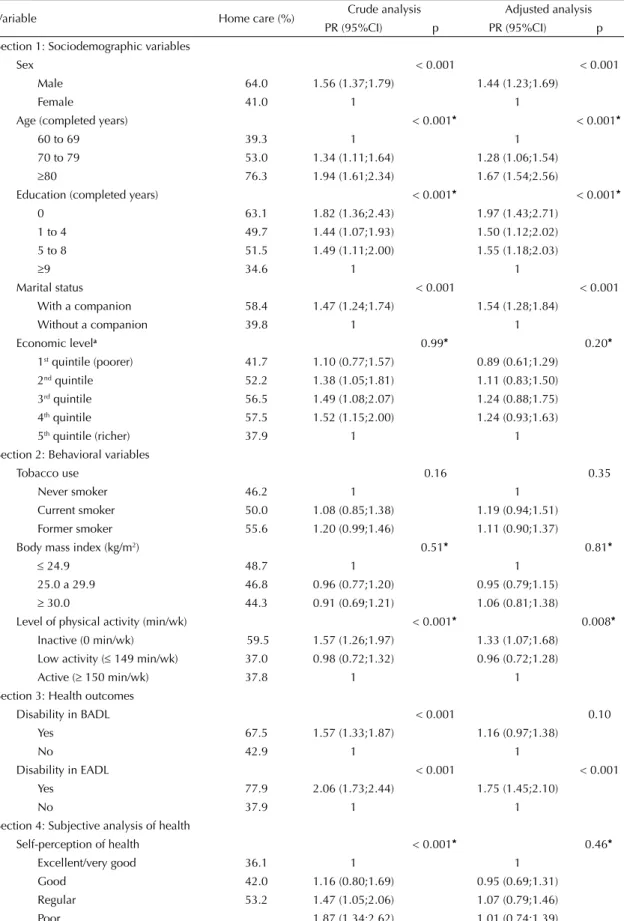
of care showed the following distribution: until ten hours (5.7%), 11 to 20 hours (12.8%), 21 to 24 hours (65.3%) and without established hours (16.2%). In the crude analysis, it was observed that care provided in the home was signifi cantly associated with: male sex, having a spouse and with disability in basic and essen-tial activities of daily living. A direct association was also observed with home care and age, and an inverse relationship was seen with education, level of physical activity and self-perceived health (Table 2).
In the adjusted analysis, men showed a 44% greater probability than women of being cared for in their home (Table 2). Age and disability in activities essen-tial to daily living maintained direct associations with the outcome, after adjusting for potential confounding factors (p<0.001). Individuals with a companion had a 1.5 times greater probability of home care than people who live without a companion. Education (p<0.001) and level of physical activity (p=0.008) were inversely associated with the occurrence of home care.
There was an interaction observed between sex and age group for the occurrence of home care (Figure 2). Men from 60 to 69 years had a 1.9 times greater probability of reporting home care when compared to women of the same age group (95%CI 1.48;2.52). Among men from 70 to 79 years, the probability decreased to 1.72 (95%CI 1.30;2.27) compared to women in their seven-ties. Among the elderly aged ≥ 80 years, no statistically signifi cant difference was observed between the sexes (p=0.26).
Figure 1. Characteristics of caregivers for the elderly. Pelotas, Southern Brazil, 2008.
23.7% 16.2%
4.7%
15.9%
39.5%
Spouse only
Child only
Child and other relation
Contracted caregiver
Other
Figure 2. Prevalence of informal home care, according to sex and age group. The p value was obtained by Fisher’s exact test. Pelotas, Southern Brazil, 2008.
Age (completed years)
Home care (%)
70 - 79 60 - 69
0 10 20 30 40 50 60 70 80 90 100
≥ 80
56.3 p <0.001
p <0.001
p = 0.26
29.1 69.1
40.2
86.4 73.3
Table 1. Sample distribution by sex, according to independent variables. Pelotas, Southern Brazil, 2008.
Variable
Men (n= 222)
Women (n= 376)
Total (n=598)
n % n % n %
Age (years)
60 – 69 119 53.6 199 52.9 318 53.2
70 – 79 81 36.5 102 27.1 183 30.6
≥ 80 22 9.9 75 20.0 97 16.2
Education (years completed)
0 22 9.9 89 23.7 111 18.6
1 to 4 69 31.1 122 32.6 191 32.0
5 to 8 70 31.5 95 25.3 165 27.6
≥ 9 61 27.5 69 18.4 130 21.8
Current marital status
With companion 178 80.2 130 34.7 308 51.6
Without companion 44 19.8 245 65.3 289 48.4
Economic level in quintilesa
1st quintile (poorer) 37 17.1 83 22.6 120 20.5
2nd quintile 43 19.8 91 24.7 134 22.9
3rd quintile 41 18.9 74 20.1 115 19.7
4th quintile 54 24.8 59 16.0 113 19.3
5th quintile (richer) 42 19.4 61 16.6 103 17.6
Tobacco use
Never smoker 72 32.4 268 71.2 340 56.8
Current smoker 41 18.5 39 10.4 80 13.4
Former smoker 109 49.1 69 18.4 178 29.8
Body mass index (kg/m2)b
≤ 24.9 80 37.6 109 39.2 189 38.5
25.0 to 29.9 94 44.1 111 39.9 205 41.7
≥ 30.0 39 18.3 58 20.9 97 19.8
Physical activity level (min/wk)
Inactive (0 min/wk) 120 54.6 201 53.6 321 53.9
Low activity (≤ 149 min/wk) 28 12.7 45 12.0 73 12.3
Active (≥ 150 min/wk) 72 32.7 129 34.4 201 33.8
Disability in BADL
Yes 49 22.1 111 29.5 160 26.8
No 173 77.9 265 70.5 438 73.2
Disability in EADL
Yes 53 23.9 119 31.7 172 28.8
No 169 76.1 256 68.3 425 71.2
Self-perception of health
Excellent/very good 22 10.0 50 13.4 72 12.1
Good 86 38.9 114 30.7 200 33.7
Regular 93 42.0 157 42.2 250 42.2
Poor 20 9.1 51 13.7 71 12.0
a Wealth score used by the Brazilian Association of Research Companies.
b Variable with the most number of ignored values for men and women: 9 and 100, respectively.
Table 2. Crude and adjusted analysis of home care among the elderly, according to independent variables. Pelotas, Southern Brazil, 2008.
Variable Home care (%) Crude analysis Adjusted analysis
PR (95%CI) p PR (95%CI) p
Section 1: Sociodemographic variables
Sex < 0.001 < 0.001
Male 64.0 1.56 (1.37;1.79) 1.44 (1.23;1.69)
Female 41.0 1 1
Age (completed years) < 0.001* < 0.001*
60 to 69 39.3 1 1
70 to 79 53.0 1.34 (1.11;1.64) 1.28 (1.06;1.54)
≥80 76.3 1.94 (1.61;2.34) 1.67 (1.54;2.56)
Education (completed years) < 0.001* < 0.001*
0 63.1 1.82 (1.36;2.43) 1.97 (1.43;2.71)
1 to 4 49.7 1.44 (1.07;1.93) 1.50 (1.12;2.02)
5 to 8 51.5 1.49 (1.11;2.00) 1.55 (1.18;2.03)
≥9 34.6 1 1
Marital status < 0.001 < 0.001
With a companion 58.4 1.47 (1.24;1.74) 1.54 (1.28;1.84)
Without a companion 39.8 1 1
Economic levela 0.99* 0.20*
1st quintile (poorer) 41.7 1.10 (0.77;1.57) 0.89 (0.61;1.29)
2nd quintile 52.2 1.38 (1.05;1.81) 1.11 (0.83;1.50)
3rd quintile 56.5 1.49 (1.08;2.07) 1.24 (0.88;1.75)
4th quintile 57.5 1.52 (1.15;2.00) 1.24 (0.93;1.63)
5th quintile (richer) 37.9 1 1
Section 2: Behavioral variables
Tobacco use 0.16 0.35
Never smoker 46.2 1 1
Current smoker 50.0 1.08 (0.85;1.38) 1.19 (0.94;1.51)
Former smoker 55.6 1.20 (0.99;1.46) 1.11 (0.90;1.37)
Body mass index (kg/m2) 0.51* 0.81*
≤ 24.9 48.7 1 1
25.0 a 29.9 46.8 0.96 (0.77;1.20) 0.95 (0.79;1.15)
≥ 30.0 44.3 0.91 (0.69;1.21) 1.06 (0.81;1.38)
Level of physical activity (min/wk) < 0.001* 0.008*
Inactive (0 min/wk) 59.5 1.57 (1.26;1.97) 1.33 (1.07;1.68) Low activity (≤ 149 min/wk) 37.0 0.98 (0.72;1.32) 0.96 (0.72;1.28)
Active (≥ 150 min/wk) 37.8 1 1
Section 3: Health outcomes
Disability in BADL < 0.001 0.10
Yes 67.5 1.57 (1.33;1.87) 1.16 (0.97;1.38)
No 42.9 1 1
Disability in EADL < 0.001 < 0.001
Yes 77.9 2.06 (1.73;2.44) 1.75 (1.45;2.10)
No 37.9 1 1
Section 4: Subjective analysis of health
Self-perception of health < 0.001* 0.46*
Excellent/very good 36.1 1 1
Good 42.0 1.16 (0.80;1.69) 0.95 (0.69;1.31)
Regular 53.2 1.47 (1.05;2.06) 1.07 (0.79;1.46)
Poor 1.87 (1.34;2.62) 1.01 (0.74;1.39)
* Linear trend.
DISCUSSION
The prevalence of home care (49.5%) was less than the fi ndings reported in other works.9,10 Nonetheless,
this comparison should be restricted to specifi c issues, such as target population, as well as criteria for the defi nition of home care. A considerable portion of studies opt to investigate the existence of informal home care among elderly that are already debilitated or living with chronic diseases. For example, in studies of individuals with Alzheimer9 and cerebral vascular
accident,10 respective prevalences of 78% and 98% for
informal home care been reported.
A considerable proportion of older people report being the caretaker for their spouse, and the option of a contracted caretaker was rarely reported by these indi-viduals. A study10 performed in São Paulo, Southeastern
Brazil, with adults who lost their independence found results similar to this study, showing that care was mostly provided by women (93%), mostly wives (44%) and daughters (31%). Another study,8 performed
in Canada with people living with chronic diseases, shows that families provided 78% of general care. Among adult accident victims age 50 or greater, 98% of caretakers were family members.10 The agreement
between the results demonstrates the important role of family in home care provided to the elderly.
Older adults with disabilities in activities essential to daily living showed a strong association with the receipt of home care, even after adjusting for potential confounding factors. This association was not observed in the case of disabilities for basic activities in daily living, which demonstrated signifi cance in the crude analysis, but the effect reduced when adjusting for disability within the essential domain in the hierarchical analysis model. In the National Policy for Health of Elderly People,d individuals that present diffi culty in
performing essential activities are considered at risk of developing fragility related to diminished functional capacity and increased dependence for activities of daily living and utilization of health services. More vulnerable elderly adults, therefore, require specifi c attention by health professionals.
In the present study, an association was not observed between economic level and home care. By investiga-ting every manifestation of home care reported by the elderly, this study found a considerable proportion of elderly in lower economic levels, who were informally cared for by family members. Therefore the economic component that could infl uence the contracting of formal caregivers was weakened. A study12 performed
in the United States showed that the utilization of formal care increases and the utilization of informal care decre-ases according to increased income of the elderly. The association of home care with lower physical acti-vity levels, as well as disability in activities essential to daily living, should be interpreted with caution. Since this is a cross-sectional study, causes and effects can not be distinguished, which impedes the develo-pment of hypotheses based on causal mechanisms. Nonetheless, the study fi ndings reinforce the impor-tance of physical activity as a marker for independence, autonomy and better health and quality of life among elderly, since it is known that regular physical activity plays an important role in the prevention of obesity, arterial hypertension, depression, osteoporosis, cogni-tive defi cit and premature mortality. 5,e
In the study by Kemper,12 the number of disabilities in
activities of daily living was strongly associated with the probability of receiving home care, principally provided by family members residing in the same house. The probability of receiving informal care was 37% greater for elderly that needed assistance in fi ve basic activities of daily living compared to those that did not require assistance.
One of this study’s strong points is the representative-ness of the sample of older adults, since a large part of studies investigate home care in individuals with specifi c characteristics, such as presence of chronic disease or disability. In addition, the small percentage of loses/refusals and data collection with the help of the caregiver in cases where the older adult was unable to respond to questions, helped reduce the possibility of selection bias and contributed to internal validity. Among the limitations, not including institutionalized individuals in the study may have underestimated the prevalence of the outcome studied. Nonetheless, this decision was taken due to the logistics of fi eldwork. Also, according to the Municipal Health Department of Pelotas, there are approximately 400 institutionalized adults, which is only 1% of the older age group in the municipality.
In conclusion, the high prevalence of home care (49.5%) and the probable overburdening of family members, responsible for the majority of care provided, are important indicators for the planning of health actions directed to the elderly and their family members. Support programs can be directed to the main caregiver or even to various family members and can be operationalized through individual or group meetings, involving the exchange of experiences
d Ministério da Saúde. Portaria nº 2.528, de 19 de outubro de 2006. Aprova a Política Nacional de Saúde da Pessoa Idosa. Diario Ofi cial
Uniao 13 dez 1999; Seção 1:20 [cited 2010 Aug 1]. Available from: http://portal.saude.gov.br/portal/arquivos/pdf/2528%20aprova%20a%20 politica%20nacional%20de%20saude%20da%20pessoa%20idosa.pdf
e United States. Department of Health and Human Services. Physical activity guidelines for Americans: be active, healthy, and happy!
and the provision of practical advice regarding care procedures. Specifi c attention should be directed to individuals, who share the characteristics of the study
participants that experienced a greater occurrence of home care: advanced age, low education and disability in activities essential to daily living.
The authors declare that there are no confl icts of interest. 1. Angelo M. O contexto domiciliar. In: Duarte Y, Diogo
M, editors. Atendimento domiciliar: um enfoque gerontológico. São Paulo: Atheneu; 2005. p.27-31.
2. Barros AJ, Hirakata VN. Alternatives for logistical regression in cross-sectional studies: an empirical comparison of models that directly estimate the prevalence ratio. BMC Med Res Methodol. 2003;3(1):21. DOI:10.1186/1471-2288-3-21
3. Barros MBA, César CLG, Carandina L, Torre GD. Desigualdades sociais na prevalência de doenças crônicas no Brasil, PNAD-2003. Cienc Saude
Coletiva. 2006;11(4):911-26.
DOI:10.1590/S1413-81232006000400014
4. Cavalcanti M, Saad P. O idoso na Grande São Paulo. São Paulo: Fundação Sistema Estadual de Análise de Dados; 1990. Os idosos no contexto da saúde pública; p. 181-205.
5. Chodzko-Zajko W, Proctor DN, Fiatarone Singh MA, Minson CT, Nigg CR, Salem GJ, et al. American College of Sports Medicine position stand. Exercise and physical activity for older adults. Med Sci
Sports Exerc. 2009;41(7):1510-30. DOI:10.1249/
MSS.0b013e3181a0c95c
6. Craig CL, Marshall AL, Sjöström M, Bauman AE, Booth ML, Ainsworth BE, et al. International physical activity questionnaire: 12-country reliability and validity. Med Sci Sports Exerc. 2003;35(8):1381-95. DOI:10.1249/01.MSS.0000078924.61453.FB
7. Del Duca G, Silva M, Hallal PC. Incapacidade funcional para atividades básicas e instrumentais da vida diária em idosos. Rev Saude Publica. 2009;43(5):796-805. DOI:10.1590/S0034-89102009005000057
8. Fast J, Keating N, Otfi nowski P, Derksen L.
Characteristics of family/friend care networks of frail
seniors. Can J Aging. 2004;23(1):5-19. DOI:10.1353/ cja.2004.0003
9. Kamenski G, Fink W, Maier M, Pichler I, Zehetmayer S. Characteristics and trends in required home care by GPs in Austria: diseases and functional status of patients. BMC Fam Pract. 2006;7:55. DOI:10.1186/1471-2296-7-55
10. Karsch UM. Idosos dependentes: famílias e cuidadores.
Cad Saude Publica. 2003;19(3):861-6. DOI:10.1590/
S0102-311X2003000300019
11. Katz S, Ford AB, Moskowitz RW, Jackson BA, Jaffe MW. Studies of Illness in the Aged. Tthe Index of Adl: a standardized measure of biological and psychosocial function. JAMA. 1963;185(12):914-9.
12. Kemper P. The use of formal and informal home care by the disabled Elderly. Health Serv Res. 1992;27(4):421-51.
13. Lawton MP, Brody EM. Assessment of older people: self-maintaining and instrumental activities of daily living. Gerontologist. 1969;9(3):179-86.
14. Serapioni M. O papel da família e das redes primárias na reestruturação das políticas sociais. Cienc Saude
Coletiva. 2005;10(Suppl):243-53.
DOI:10.1590/S1413-81232005000500025
15. Siqueira FV, Facchini LA, Piccini RX, Tomasi E, Thumé E, Silveira DS, et al. Prevalência de quedas em idosos e fatores associados. Rev Saude Publica. 2007;41(5):749-56. DOI:10.1590/S0034-89102007000500009
16. Veras R. Envelhecimento populacional
contemporâneo: demandas, desafi os e inovações.
Rev Saude Publica. 2009;43(3):548-54. DOI:10.1590/
S0034-89102009005000057
17. World Health Organization. Obesity: preventing and managing the global epidemic. Geneva; 2000. (WHO technical report series, 894)