RESUMO
Estudo transversal que teve como objeivos descrever as caracterísicas sociodemográi -cas e clíni-cas e analisar o conhecimento de pacientes com diabetes mellitus sobre o tra-tamento após cinco anos do término de um programa educaivo. Foram entrevistados, em 2010, 40 pacientes que, em 2005, haviam paricipado de programa de educação em diabetes, oferecido por um período de 12 meses, em um serviço de atenção primária. Uilizou-se formulário contendo: conceito, isiopatologia e tratamento da doença, exer -cício ísico, alimentação, cuidados com os pés, automonitorização da glicemia capilar no domicílio, hipoglicemia, complicações crônicas, situações especiais e apoio familiar. Os resultados mostraram que foram incor -porados conhecimentos em relação a con -ceito, isiopatologia e tratamento da doença, aividade ísica, cuidado com os pés, auto -monitorização, cuidados com hipoglicemia, complicações crônicas e situações especiais. Por outro lado, alimentação e apoio familiar necessitam de maior incremento. Concluiu-se que, decorridos cinco anos do processo educaivo, houve retenção da maior parte dos conhecimentos ministrados.
DESCRITORES Diabetes mellitus Educação em saúde Atenção Primária à Saúde Enfermagem em saúde pública
Patients’ knowledge of Diabetes five years
after the end of an educational program
O
riginal
a
rticle
ABSTRACT
We present a cross-secional study that aims to describe the sociodemographic and clini -cal condiions of individuals with diabetes mellitus and to analyze their knowledge of
treatment ive years ater the end of an edu -caional program in which they took part. In 2010, 40 individuals who had paricipated in a diabetes educaional program for 12 months in 2005 at a primary care service were interviewed. A form was used for data collecion that included their knowledge of the noion, physiopathology, and treatment of the disease; exercise; nutriion; foot care; self-monitoring of capillary blood glucose at home; hypoglycemia; chronic complica -ions; special situa-ions; and family support. The results showed that the volunteers in -corporated the informaion about the no -ion, physiopathology, and treatment of the disease; exercise; foot care; self-monitoring; care associated with hypoglycemia; chronic complicaions; and special situaions. In con -trast, nutriion and family support require further reinforcement. It is concluded that ive years ater the end of the educaional program, the paricipants kept most of the informaion provided.
DESCRIPTORS Diabetes mellitus Health educaion Primary Health Care Public health nursing
RESUMEN
Estudio transversal que tuvo como objeivos: describir las caracterísicas socio-demográi -cas y clíni-cas, y analizar el conocimiento de pacientes con diabetes mellitus acerca del tratamiento después de cinco años de cul -minado un programa educaivo. En el 2010, fueron entrevistados 40 pacientes que ha -bían paricipado en el 2005, de un progra -ma de educación en diabetes, ofrecido por un período de 12 meses, en un servicio de atención primaria. Se uilizó un formulario que contenía: concepto, isiopatología y tra -tamiento de la enfermedad, ejercicio ísico, alimentación, cuidados con los pies, auto-monitorización de la glicemia capilar en el domicilio, hipoglicemia, complicaciones cró -nicas, situaciones especiales y apoyo familiar. Los resultados mostraron que fueron incor -porados conocimientos relacionados con el concepto, isiopatología y tratamiento de la enfermedad, acividad ísica, cuidado con los pies, auto-monitorización, cuidados con la hipoglicemia, complicaciones crónicas y situaciones especiales. Por otra parte, la ali -mentación y el apoyo familiar necesitan de mayor desenvolvimiento. Se concluye que, después de cinco años del proceso educai -vo, hubo retención de la mayor parte de los conocimientos brindados.
DESCRIPTORES Diabetes mellitus Educación en salud Atención Primaria de Salud Enfermería en salud pública
Izabel Alves das Chagas1, Josana Camilo2, Manoel Antônio dos Santos3, Flávia Fernanda Luchetti Rodrigues4, Clarissa Cordeiro Alves Arrelias5, Carla Regina de Souza Teixeira6, Liudmila Miyar Otero7, Maria Lúcia Zanetti8
CONHECIMENTO DE PACIENTES COM DIABETES SOBRE TRATAMENTO APÓS CINCO ANOS DO TÉRMINO DE UM PROGRAMA EDUCATIVO
CONOCIMIENTO DE PACIENTES CON DIABETES SOBRE EL TRATAMIENTO DESPUÉS DE CINCO AÑOS DE CULMINADO UN PROGRAMA EDUCATIVO
INTRODUCTION
Health education is acknowledged to be a crucial component of the treatment of patients with diabe -tes mellitus (DM). Education affords patients access to tools that are useful for the development of self-care skills and aims at increasing their level of knowledge, improving their ability to manage their disease. The ac -quisition of such skills is rated as an effective strategy to strengthen their motivation to comply with the dietary plan, increase their physical activity, care for their feet, measure their capillary blood glucose level at home on a regular basis, prevent episodes of hypoglycemia and chronic complications, and manage their disease under special circumstances. In addition, the patients’ family must be included as a care unit(1).
Diabetes educaion is a permanent process that should evolve in a gradual, coninuous, interacive, and appropriate manner that takes the students’ charac -terisics into consideraion in a wide scope of circum -stances and environments by applying individual and/ or group-based strategies of assistance. This process al -lows for the construcion of knowledge that is favorable to self-care, promoing the paients’ au
-tonomy in their quest to achieve saisfac -tory metabolic control and a consequently healthier life(2).
Based on the assumption that dia -betes education is an effective strategy to achieve metabolic control, a follow-up study was conducted over 12 months with patients with DM in a municipality at the interior of the state of São Paulo
in 2005 using the protocol Staged Diabetes Manage-ment (SDM). The results showed that the educational program contributed to improving the participants’ metabolic control and to increasing their knowledge of disease(3). Following the end of the study, the par
-ticipants were referred back to their original health -care institutions, with the recommendation to continue their treatment according to the orientation received. However, there is a knowledge gap about the long-term maintenance of the positive results achieved by the program after its end.
There are few Brazilian studies on the long-term maintenance of the positive effects of structured ed -ucational programs(4-6). Therefore, the present study
sought to assess whether the knowledge acquired dur -ing the educational program was maintained five years after its end.
The aims of the present study were to describe the sociodemographic and clinical characteristics of pa -tients with DM and to assess their knowledge on the treatment of disease five years after the end of an edu
-cational program. The results are expected to provide sound grounds for understanding the challenges posed to the long-term effectiveness of interventions in DM.
METHOD
This was a cross-secional study conducted at a prima -ry care service in a city located in the interior of the state of São Paulo from September to December 2010. The study populaion comprised the 54 individuals with DM who had paricipated in the 2005 diabetes educaion pro -gram with a 12-month follow up. The study thus included adults with types 1 and 2 DM who had paricipated in the 2005 study and agreed to paricipate in the present study. Fourteen individuals were excluded: ten because their telephone numbers were wrong or the line was reported as out of service, two who had died, one who was hos -pitalized, and one who traveling. Thus, the inal sample comprised 40 volunteers with DM.
The data collecion was performed using two instru-ments elaborated by Otero in 2005. One was a form com-prising sociodemographic (gender, age, marital status,
educaional level, occupaional status, and family income) and clinical data (type of DM, ime since diagnosis, length of treat-ment, pharmacological and non-pharma-cological treatment, hospital admissions, reported chronic complicaions and comor-bidiies, health insituion where treatment is performed, random capillary blood glu-cose, systolic and diastolic arterial pressure, and body mass index – BMI). The other in-strument is a form used to collect data on the paient’s knowledge of disease and treatment that comprises 34 closed-ended quesions distributed along nine secions. The irst secion is devoted to their general knowledge of the disease, the second to physical acivity, the third to nutriion, the fourth to foot care, the ith to knowledge of clinical parameters, the sixth to knowledge of hypoglyce-mia, the seventh to knowledge of chronic complicaions, the eight to special situaions, and the ninth to family sup-port. These variables were selected as a funcion of their relevance for the prevenion of chronic and acute compli-caions along the treatment of DM.
For the purpose of data collecion, the volunteers were iniially contacted by telephone to invite them to paricipate in the study based on a registraion list avail -able at the invesigated service. A minimum of three to a maximum of nine telephone calls were made per vol -unteer. A visit to the service was scheduled for the vol -unteers who agreed to paricipate. In the cases where it was diicult or impossible to visit the service, a home visit was scheduled. Thus, 20 volunteers were inter -viewed at the service (seven at the irst meeing, six at
There are few Brazilian
studies on the
long-term maintenance of the positive
effects of structured
the second, and seven at the last), and 20 volunteers were interviewed at home. Two days before the date sched -uled for the interviews, the invesigator called the volun -teers by telephone to remind them of the appointment.
To address the data collecion and aim at its accuracy, the interviews were conducted with a small group of vol -unteers per visit, up to a total of three visits. The nature, aim and procedures of the study were explained, and the paricipants who agreed and were available to paricipate were requested to sign an informed consent form.
Next, the measurement of the volunteers’ arterial pressure, body weight, and random capillary blood glu -cose was performed, which was followed by interviews where the abovemenioned instruments were applied. The data collecion was performed in a private seing both at the service and home visits and lasted 90 minutes on average.
In the assessment of the arterial pressure, the recom -mendaions for adults with DM by the American Diabetes Associaion(7) were used, according to which the values
must be 130/80 mmHg. The BMI was assessed based on the values recommended by the World Health Organiza-ion(8). The random capillary blood glucose was assessed
according to the recommendaions of the Brazilian Diabe -tes Society, according to which the upper level of normal is 140 mg/dl(9).
To organize the data, a database was generated us -ing the statistical software SPSS (Statistical Package for Social Sciences) for Windows, modules Base and Exact Test version 14.0, where the data were entered twice. The data were expressed as absolute and percent val -ues. In the analysis of the volunteers’ responses related to their knowledge of the treatment, the nine sections of the questionnaire were analyzed separately. A score of one (1) was attributed to each correct answer, and
thus, the maximum scores for each section were as fol -lows: notion, physiology, and treatment – 28; physical activity – 14; nutrition – 14; foot care – 13; self-mon -itoring – 3; hypoglycemia – 20; chronic complications – 8; special situations – 11; and family support - 5, to a global maximum score of 116.
The absolute values described relative to the pa -tients’ knowledge correspond to the sum of the scores of each item. As a result, the maximum scores of each section were as follows: notion, physiology, and treat-ment – 1,120; physical activity – 560; nutrition – 520; foot care – 520; glucose self-monitoring – 120; hypogly -cemia – 800; chronic complications – 320; special situa -tions – 440; and family support – 200.
The study was approved by the research ethics com -mittee of the Nursing School of Ribeirão Preto, Univer -sity of São Paulo, protocol no. 1151/2010.
RESULTS
DOf the 40 (100%) volunteers, 32 (80.0%) were fe -male, and the median age of the sample was 66 years old. A total of 24 (60.0%) volunteers were married or lived with a partner, 19 (47.5) were reired, and 18 (45.0%) were homemakers. Twenty-ive paricipants had not in -ished elementary school (62.5%), and 30 (75%) had a fam -ily income that was equivalent to one to four imes the minimum wage, with a median of three imes the mini -mum wage.
Twenty-nine (72.5%) paricipants reported having type 2 DM, type 1 was reported by two (5%), and nine (22.5%) were not able to report the type of DM they had. The ime since the diagnosis of disease varied from 9 to 49 years, being 16 to 20 years in 11 (27.5%) cases. The length of treatment varied from 4 to 40 years.
A total of 22 (55%) volunteers reported compliance with the dietary plan, while 21 (52.5%) reported that they did not to adhere to the physical acivity program. A total of 29 (72.5%) paricipants used oral hypoglycemic drugs, alone in 18 (45%) cases and combined with insulin in 11 (27.5%) cases. The use of insulin alone was reported by seven (17.5%) paricipants, while four (10%) used no med -icaion whatsoever. A total of 36 volunteers (90%) also coninuously used medicaion against arterial hyperten -sion, dyslipidemia, and other condiions.
In the past ive years, 14 (35%) paricipants were ad -mited to hospitals, with an average of 10 days of hospi -talizaion. The most frequent reason for hospitalizaion was cholecystectomy. Twenty (50%) volunteers sought as -sistance at urgent and emergency services, mostly due to episodes of hyperglycemia.
With regard to the chronic complicaions of DM, reinopathy was reported by nine volunteers (22.5%), foot problems by nine (22.5%), heart problems by nine (22.5%), neuropathy by eight (20%), and nephropathy by ive (12.5%). With regard to comorbidiies, 30 (75%) had arterial hypertension, 23 (57.3%) were obese, 11 (27.5%) had dyslipidemia, and 14 (35%) reported other problems. It is worth noing that 90% of the sample exhibited at least one chronic complicaion of their DM.
Seventeen (42.5%) paricipants were followed up at Basic Health Units (Unidade Básica de Saúde - UBS), three (7.5%) at District Basic Health Units (Unidade Básica Dis -trital de Saúde - UBDS), four (10%) in the outpaient clinics of a university hospital, fourteen (35%) at health insur -ance clinics, and one (5%) at a private pracice, while the disease was not monitored by one (5%) volunteer.
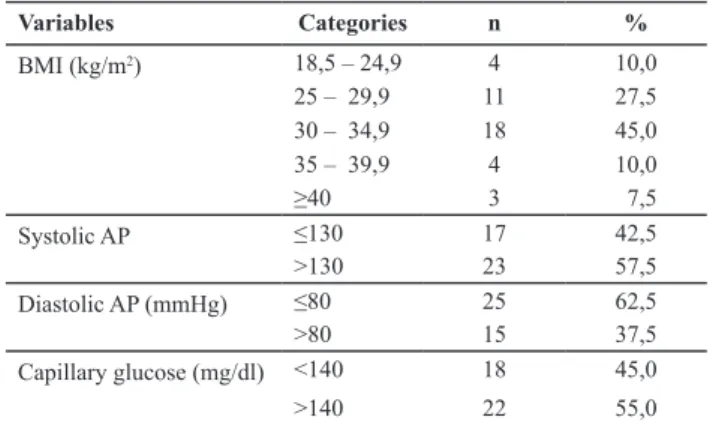
146.7 mm Hg. The average diastolic arterial pressure (DAP) was 72.5 mm Hg, it was higher than 80 mmHg in 15 (37.5%) participants, and it was less than or equal to 80 mm Hg in most of the sample (25 individuals, 62.5%). Twenty-two (55%) volunteers exhibited a ran-dom capillary blood glucose that was higher than 140 mg/dl (Table 1).
Table 1 - Distribution of individuals with DM according to BMI,
arterial pressure, and glucose level - Ribeirão Preto, SP, Brazil, 2011
Variables Categories n %
BMI (kg/m2) 18,5 – 24,9 4 10,0
25 – 29,9 11 27,5
30 – 34,9 18 45,0
35 – 39,9 4 10,0
≥40 3 7,5
Systolic AP ≤130 17 42,5
>130 23 57,5
Diastolic AP (mmHg) ≤80 25 62,5
>80 15 37,5
Capillary glucose (mg/dl) <140 18 45,0
>140 22 55,0
With regard to the paricipaion of the volunteers in other educaional programs, only two (5%) had re -mained in diabetes educaional groups in spite of the posiive results achieved.
Paricipants’ knowledge of DM ive years ater the end of the educaional program
Table 2 describes the number of right answers that were given by the participants to each investigated item: the notion, physiopathology, and treatment of DM; physical activity; nutrition; foot care and examina -tion; hypoglycemia; chronic complications; special situ -ations; and family support. The four sections with the highest number of right answers were the ones related to chronic complications – 246 (76.8%), foot care – 397 (76.3%), self-monitoring of capillary blood glucose – 87 (72.5%), and the notion, physiopathology, and treat -ment of DM – 807 (72.0%).
Table 2 - Distribution of the right answers given by the
parti-cipants according to the investigated disease features - Ribeirão Preto, SP, Brazil, 2011
Knowledge of DM-related features n %
Diabetes mellitus: notion,
physiopathology and treatment 807 72,0%
Hipoglycemia 526 65,7%
Foot care and examination 397 76,3%
Special situations 312 70,9%
Chronic complications 246 76,8%
Nutrition 205 36,6%
Self-monitoring 87 72,5%
Family support 51 25,5%
With regard to the paricipaion of the volunteers in other educaional programs, only two (5%) had remained in diabetes educaional groups.
DISCUSSION
The results of the present study show that the par -icipants exhibited abnormal values of arterial pressure, BMI, and random capillary blood glucose. These indings point to the need for permanent monitoring at primary care services if the beneits achieved by paricipaion in a structured program on diabetes educaion are to be maintained. From a longitudinal perspecive, healthcare services might apply systemaized educaional strategies that enable the maintenance of the educaional program during the course of the treatment, complying with the Uniied Health System (Sistema Único de Saúde - SUS).
Regular monitoring allows one to reassess the insi -tuted treatment and to manage the paients’ diiculies to comply with the nutriional and exercise plans. In addi -ion, the construcion of a glycemic proile contributes to the ideniicaion of the aitudes of individuals with DM to acute and chronic complicaions(10).
The quesions on the paricipants’ knowledge of the noion, physiopathology, and treatment of DM exhibited a remarkable percentage of posiive answers. These data indicate that the volunteers incorporated the informaion on the physiopathology and treatment of disease provided by the program they had atended ive years earlier. This inding corroborates the results of another study, which demonstrated the relevance of the knowledge acquisiion to the prevenion of complicaions, self-care, and mainte -nance of the metabolic control(11).
The scores relaive to the paients’ knowledge of physical acivity indicate that such an important pillar of non-pharmacological treatment was not theoreically in -corporated by the paricipants as a component of their treatment. There is sill a long way to go before physi -cal exercise is efecively adopted, despite the consistent evidence for its beneicial efects on metabolic control in DM, including the improvement of glycemic control, the reducion of the cardiovascular disease risk, the reducion of the body weight, and an increase in self-esteem(12). In
this regard, systemaic follow up at healthcare units might reinforce the relevance of that domain of knowledge and contribute to the implementaion of strategies to simu -late adherence to exercise.
With regard to the paricipants’ knowledge of nu -triion, the low scores found agree with the results of other studies(13-14). Despite the low frequency of cor
adherence(2). Data have shown that compliance with the
nutriional plan poses one of the greatest challenges to diabetes educaion. In this regard, healthcare services ought to acknowledge the relevant role of nutriionists to the orientaion of paients with DM relaive to their dietary intake, as well as to implemening innovaive strategies based on paricipaive methods to simulate the acquisiion of the knowledge needed to manage the nutriional plan.
The answers given by the paricipants show that they incorporated the knowledge needed to perform the basic care associated with the prevenion of diabeic foot. This inding points to an improvement compared to the results of a previous study(15), according to which the individu
-als with DM were not aware of the actual risks associated with the omission of foot care. The results of the present study show that the paricipants were able to keep the knowledge acquired on basic care for the prevenion of dia -beic foot over a long period of ime. Addiionally, another study found that individuals subjected to an educaional program incorporated the knowledge and skills related to foot care(16). These data therefore indicate that the gap be
-tween the paients’ knowledge and behavior ideniied by the literature(7) is not insurmountable, but must be faced by
healthcare professionals as a challenge that may be over -come through educaional programs.
As for the self-monitoring of capillary blood glucose (SMCBG) at home, the level of knowledge of the paricipants was saisfactory when one keeps in mind that the required equipment was made available at the public healthcare net -work quite recently. Especially when combined with diabetes educaion, SMCBG is acknowledged as a relevant educaion -al tool for the adjustment of the nutriion-al plan, exercise, and pharmacological treatment, as it allows the paients to achieve glycemic control in real ime(17).
However, healthcare services must sill check systemai -cally whether the paients use the equipment in an appro -priate manner and make the means available to help in the interpretaion of results at home, aiming at a beter manage -ment of the disease. Systemaic follow up might strengthen the paients’ autonomy in self-care, according to the expec-taions of the healthcare professionals.
Relaive to the paricipants’ knowledge on hypoglyce -mia, the scores show that they mastered its noion, signs and symptoms, and prevenive measures. The paricipants also showed they are aware of the chronic complicaions of DM, as well as of special situaions, such as travel and social events. In contrast, the family support secion exhibited the lowest score. Family support is crucial to achieving metabolic control. One study showed that the help and support of rela -ives are important resources to reinforce the eforts of in -dividuals with DM to comply with their treatment(18). There
-fore, healthcare professionals must include the paients’ relaives as allies during the follow up of treatment.
The fact that only two paricipants remained in diabetes educaional groups allows us to infer that the paients were
generally not encouraged to paricipate in educaional pro -grams or that such pro-grams were not ofered by healthcare services. Indeed, individuals with DM should be moivated by their relaives and the healthcare staf to locate the places where such programs are available within municipal health -care networks.
Diabetes educaion is considered to provide powerful support for developing an awareness of the relevance of self-care as a means to prevent the occurrence of complicaions and improve the quality of life(18). The reason for this link is
that diabetes educaion facilitates the paients’ acceptance of the disease as well as their understanding of the behav -ioral changes needed to have an acive paricipaion in their own treatment(19).
Acknowledgments by healthcare professionals of the rel -evance of the paients’ knowledge about their disease might increase the eicacy and eiciency of the care provided to individuals with chronic diseases. Such knowledge enables the paients to assimilate the informaion relevant to their disease so that they might use the primary care services in an appropriate manner.
CONCLUSION
Analysis of the knowledge of individuals with DM about their disease ive years ater the end of an educaional pro -gram showed that the features with the highest percentages of right answers were the ones relevant to chronic compli -caions, foot care, the self-monitoring of capillary blood glu -cose, and the noion, physiopathology, and treatment of DM. In contrast, the features relevant to nutriion and family sup -port require greater reinforcement.
To summarize, the results of the present study show that in spite of the paricipaion of the volunteers in a systemaic diabetes educaional program ive years ear -lier, coninuous reinforcement of the gains in knowledge is needed for the paients to adopt long-term self-care behaviors. That is to say, the educaional process must unfold on a steady basis to ensure the consolidaion of the knowledge acquired by the paients.
The present study is clinically relevant because of its originality, the length of the paients’ follow up, and the acknowledgment of the relevance of coninuous educaion provided by healthcare professionals at healthcare services. The results showed that a systemaic diabetes educaional program may have long-standing efects relaive to the pa -ients’ knowledge of their disease.
REFERENCES
1. Landim CAP, Zanei ML, Santos MA, Andrade TAM, Teixeira CRS. Self-care competence in the case of Brazilian paients with diabetes mellitus in a muliprofessional educaional pro
-gramme. J Clin Nurs. 2011;20(23-24):3394-403.
2. Otero LM, Zanei ML, Ogrizio MD. Knowledge of diabeic paients about their disease before and ater implement
-ing a diabetes educaion program. Rev Laino Am Enferm. 2008;16(2):231-37.
3. Zanei ML, Otero LM, Peres DS, Santos MA, Guimarães FPM, Freitas MCF, et al. Progress of the paients with diabetes mel
-litus who were managed with the staged diabetes manage
-ment framework. Acta Paul Enferm. 2007;20(3):338-44.
4. Otero LM, Arrelias CCA, Lima YCI, Pena FPS, Santos MA, Teixei
-ra CRS, et al. Seguimento de pacientes com diabetes mellitus em serviço de atenção básica: parâmetros clínicos e laborato
-riais. Rev Enferm UERJ. 2010;18(3):423-8.
5. Correr CJ, Pontarolo R, Wiens A, Rossignoli P, Melchiors AC, Radominsk R, et al. Avaliação econômica do seguimento farmacoterapêuico em pacientes com diabetes melito ipo 2 em farmácias comunitárias. Arq Bras Endocrinol Metab. 2009;53(7): 825-33.
6. Malfai CRM, Assunção NA. Hipertensão arterial e diabetes na Estratégia de Saúde da Família: uma análise da frequên
-cia de acompanhamento pelas equipes de Saúde da Família. Ciênc Saúde Coleiva. 2011;16(1 Suppl):1383-88.
7. American Diabetes Associaion (ADA). Standard of medical care in diabetes – 2011 (Posiion Statement). Diabetes Care. 2011;34 Suppl 1:S62-9.
8. World Health Organizaion (WHO). Obesity: prevening and managing the global epidemic. Report on a WHO Consulta
-ion. Geneva: WHO; 2000.
9. Sociedade Brasileira de Diabetes (SBD). Diretrizes da Socie
-dade Brasileira de Diabetes: 2012-2013. São Paulo; 2012.
10. Torres HC, Franco LJ, Stradioto MA, Hortale VA, Schall VT. Evaluaion of group and individual strategies in a diabetes educaion program. Rev Saúde Pública. 2009; 43(2):291-8.
11. Assunção TS, Ursine PGS. Estudo de fatores associados à adesão ao tratamento não farmacológico em portadores de diabetes mellitus assisidos pelo Programa Saúde da Família, Ventosa, Belo Horizonte. Ciênc Saúde Coleiva. 2008;13(2 Suppl):2189-97.
12. Knuth AG, Bielemann RM, Silva SG, Borges TT, Del Luca GF, Kremer MM, et al. Conhecimento de adultos sobre o papel da aividade ísica na prevenção e tratamento de diabetes e hipertensão: estudo de base populacional no Sul do Brasil. Cad Saúde Pública. 2009;25(3):513-20.
13. Ribas CRP, Santos MA, Zanei ML. Representações sociais dos alimentos sob a óica de pessoas com diabetes mellitus. Interam J Psicol. 2011;45(2):255-62.
14. Ponieri FM, Bachion MM. Crenças de pacientes diabéicos acerca da terapia nutricional e sua inluência na adesão ao tratamento. Ciênc Saúde Coleiva. 2010; 15(1):151-60.
15. Rocha RM, Zanei ML, Santos MA. Comportamento e con
-hecimento: fundamentos para prevenção do pé diabéico. Acta Paul Enferm. 2009;22(1):17-23.
16. Marin IS, Beraldo AA, Passeri SM, Freitas MCF, Pace AE. Causas referidas para o desenvolvimento de úlceras em pés de pessoas com diabetes mellitus. Acta Paul Enferm. 2012;25(2):218-24.
17. Veras VS, Araujo MFM, Rodrigues FFL, Santos MA, Dama
-sceno MMC, Zanei ML. Assessment of metabolic control among paients in a capillary glucose self-monitoring pro
-gram. Acta Paul Enferm. 2012;25(3):453-58.
18. Baquedano IR, Santos MA, Teixeira CRS, Marins TA, Zanei ML. Factors related to self-care in diabetes mellitus paients atended at Emergency Service in Mexico. Rev Esc Enferm USP [Internet]. 2010 [cited 2012 Mar 19];44(4):1017-23. Available from: htp://www.scielo.br/pdf/reeusp/v44n4/ en_23.pdf
19. Torres HC, Souza ER, Lima MHM, Bodstein RC. Educaional intervenion for self-care of individuals with diabetes mel