Corresponding author: Dra. Liléia Diotaiuti. Laboratório de Referência em Triatomíneos e Epidemiologia da Doença de Chagas/CPqRR/FIOCRUZ. Av. Augusto de Lima 1715, Barro Preto, 30190-002 Belo Horizonte, Minas Gerais, Brasil.
Phone: 55 31 3349-7762; Fax: 55 31 3295-3115
e-mail:diotaiut@cpqrr.fi ocruz.br Received 24 March 2015
Accepted 18 June 2015
History of insecticide resistance of Triatominae vectors
Grasielle Caldas DÁvila Pessoa
[1],
Pedro Albajar Vinãs
[2],
Aline Cristine Luiz Rosa
[1]and Liléia Diotaiuti
[1][1]. Laboratório de Referência em Triatomíneos e Epidemiologia da Doença de Chagas, Centro de Pesquisas René Rachou, Fundação Oswaldo Cruz, Belo Horizonte, Minas Gerais, Brasil. [2]. Organização Mundial de Saúde, Genebra, Suiça.
ABSTRACT
In the last 15 years, different types of Triatominae resistance to different insecticides have been reported; thus, resistance may be more widespread than known, requiring better characterization and delimitation, which was the aim of this review. This review was structured on a literature search of all articles from 1970 to 2015 in the PubMed database that contained the keywords
Insecticide resistance and Triatominae. Out of 295 articles screened by title, 33 texts were selected for detailed analysis. Insecticide resistance of Triatomines is a complex phenomenon that has been primarily reported in Argentina and Bolivia, and is caused by different factors (associated or isolated). Insecticide resistance of Triatominae is a characteristic inherited in an autosomal and semi-dominant manner, and is polygenic, being present in both domestic and sylvatic populations. The
toxicological profi le observed in eggs cannot be transposed to different stages of evolution. Different toxicological profi les exist
at macro- and microgeographical levels. The insecticide phenotype has both reproductive and developmental costs. Different
physiological mechanisms are involved in resistance. Studies of Triatomine resistance to insecticides highlight three defi ciencies
in interpreting the obtained results: I) the vast diversity of methodologies, despite the existence of a single guiding protocol; II)
the lack of information on the actual impact of resistance ratios in the fi eld; and III) the concept of the susceptibility reference
lineage. Research on the biological and behavioral characteristics of each Triatominae species that has evolved resistance is required in relation to the environmental conditions of each region.
Keywords: Insecticide resistance. Triatominae. Chagas disease.
INTRODUCTION
For over a century since its discovery, Chagas disease (CD), or American trypanosomiasis, remains a serious public health problem, and represents the main cause of cardiac lesions in young and adult people economically productive(1).
Chagas disease, caused by Trypanosoma cruzi Chagas 1909, affects about 6-7 million people, mostly in Latin America(2).
The geographical distribution of human Chagasic infection, including wild reservoirs and vectors are primarily found in the Americas, roughly from 46º N to 46º S, except for species of the genera Linchosteus and Rubrofasciata complex. The genera
Linshcosteus is found only in the Indian subcontinent and,
Triatoma rubrofasciata is recorded from port areas throughout the tropics and subtropics, and a small group of seven related species of Triatoma are recorded from eastern Asia. The primary form of transmission of CD (~70%) in most Latin American areas remains vectorial, being dependent on this form
(e.g. oral transmission). Considering the large number of animal reservoirs of T. cruzi and the lack of drugs that may be used at a large scale, it is not possible to control the sources of infection through eradication schemes. The lack of immunizing do enables the control for the protection of susceptible populations. Thus, the only way
to fi ght the vector is to improve the conditions at high risk sites by
making domestic units impervious to the colonization of Triatomines (physical control), in parallel to the regular and systematic use of insecticides in infested dwellings (chemical control). Control programs in Latin American have traditionally focused on spraying insecticides on houses and household annexes(3) (4)..
In the 1920s, Brazil made the fi rst prophylactic attempts to
control domestic Triatomines, but with unsatisfactory results. Subsequently, experiments were carried out using pyrethrum
powder, cyanide gas, fl amethrowers, and caustic soda. However,
these techniques were not used systematically because of the
diffi culty of large-scale application and their low residual effect
on household annexes(5). By the 1940s, little progress had been
made in control of Chagas disease vectors. Thus, the discovery of synthetic insecticides represented a new possibility for vector control. Between the 1950s and the 1990s, various biological alternatives were tested to control Triatomines, but with no success. Examples included the use of nematodes, fungi, and hymenoptera egg predators(6).
The fi rst insecticides that were used to control Triatomine
trials were conducted using dichloro-diphenyl-trichloroethane
(DDT). Through fi eld experiments, Lent & Wygodzinsky(8)
demonstrated that the toxic action of this chemical was much more rapid in adult than in juvenile insects. This difference occurred because of the slow penetration of the product into the tegument of the nymph, with no ovicidal action. Consequently, DDT only protected dwellings against Triatomine reinfestation
for three to four months. Dias & Pellegrino(9) demonstrated that
DDT was ineffective at controlling insects through experiments on the susceptibility of Triatomines with DDT sprayed on different substrates, and by assessing the logistics of its large-scale use. In contrast to DDT, hexachlorobenzene (HCB) was found to be effective at controlling Triatomines.
In 1947, Busvine & Barnes(10) observed signifi cant mortality
of Rhodnius prolixus exposed to HCB under laboratory
conditions, but with little residual action. In fi eld experiments, Dias & Pellegrino(9) found that HCB treatment was effective
at eliminating Triatomine infestation for up to 5 months when applied at a dosage of 1g of active ingredient/m2, with at least in
two spraying cycles at intervals of 30-60 days. In mid-1954, the National Malaria Service in Brazil tested dieldrin as a possible
substitute for HCB. However, fi eld experiments revealed high
toxicity to handlers and domestic animals, as well as high cost, resulting in its use being discontinued(11). In 1959, propoxur, a
carbamate insecticide, was introduced to control Triatomines, because of its proven efficacy and ovicidal properties(12).
Bendiocarb, another insecticide from the same group, was
also effective, and the World Health Organization (WHO) has
previously suggested the combined use of the two products(13).
In 1973, the organophosphate malathion was assessed, and its use was recommended mainly because of its ovicidal action(14) (15) (16). However, in addition to its short persistence in
the environment, this product required higher application doses than those used for HCB and dieldrin organochlorines.
In the 1980s, various pyrethroids proved to be effective insecticides, and have since been used to control of Chagas
disease vectors. Pyrethroids are fi rst-choice products because of
their biodegradability, low-dose and easy application, and great residual action, lasting for almost one year in intra-domiciliary preserved conditions(17). Theoretically, microencapsulated
formulations enhance the residual action of insecticides;
however, these expectations have yet to be confi rmed(18) (19).
Given the specifi city of Triatomine occurrence in household
annexes, but the absence of colonization, alternative means of vector control have been tested, including repellents(20), lining,
and/or impregnated curtains(21) (22) (23). However, the effectiveness
of these alternatives requires rigorous assessment. The invasion of Triatomines could potentially be controlled by physical barriers (since these insects are attracted to light), such as screens impregnated with insecticides.
Synthetic insecticide applications since the 1940s has advanced control of Chagas disease Triatomine vectors in domestic settings(24). However, recently, areas with persistent
reinfestation of Triatomines have been documented. This situation leads to two distinct, but equally concerning, scenarios. First, operating failures may hinder the control of
Triatomine populations, indicating an urgent need to: I) revise,
in a systematically and strictly scientifi c manner, the tools and
strategies of chemical control that have been available and/ or are in use since the discovery of Chagas disease until now; II) assess the triatomicide effect of diverse insecticides (chemical and formulation) so that they achieve the quality required to accomplish their purpose effectively; and III) invest in the training and development of health agents related to activities
for the chemical control of Triatomines. Second, diffi culty in
controlling the disease may be due to the intrinsic features of Triatomine bugs, which makes them resistant to chemical agents. Thus, a better understanding of the biological, biochemical, molecular, and behavioral components of phenotype of resistance is required, which is the focus of the present review.
METHODS
This review was structured around a search of the peer-reviewed literature available on the PubMed database (http://www.ncbi. nlm.nih.gov) between 1970 and April 2015, using the keywords
Insecticide resistance and Triatominae. All articles, monographs, master`s theses, and doctoral dissertations had an abstract in English, Portuguese, or Spanish. The exclusion criteria were: I)
reinfestation and diffi culties of control vector strategies in the fi eld
without conducting laboratory bioassays; and II) residual bioassays
evaluating the effi cacy of different insecticides and/or formulations.
RESULTS
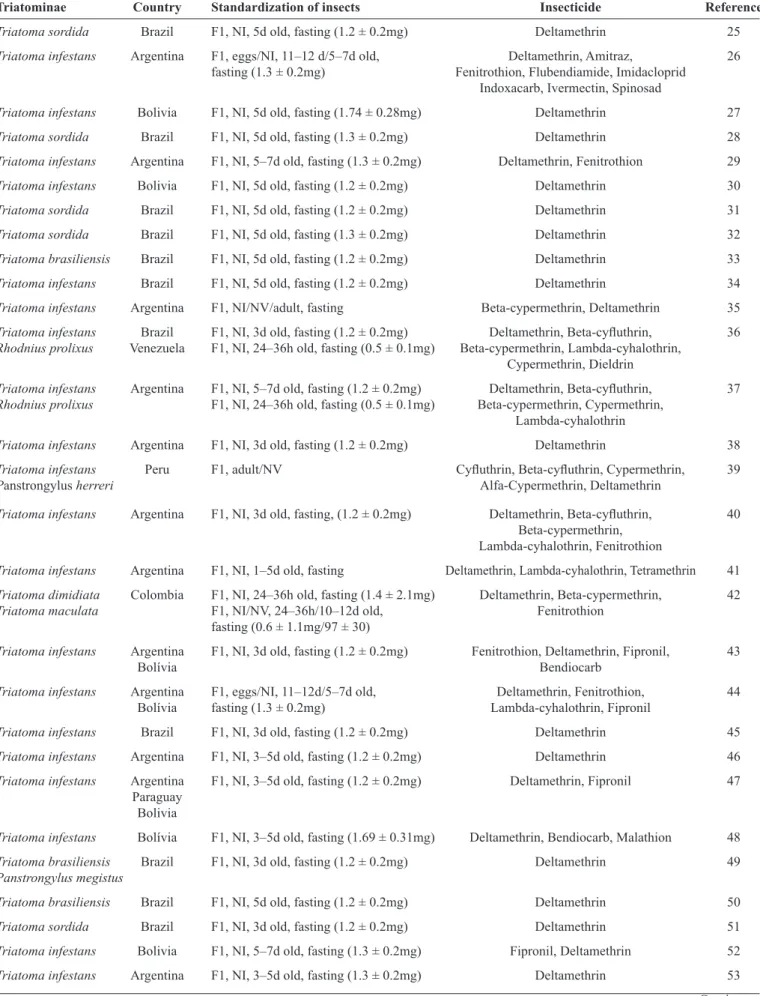
The search located 295 articles that were screened by title to select only those referring to laboratory bioassays. Out of the 295 articles, 262 were discarded based on the selection criteria. In all, 33 articles were retained for detailed analysis: qualitative/diagnostic dose bioassays(25) (26) (27) (28) (29) (30) (31) (32) (33) (34) (35) and quantitative/
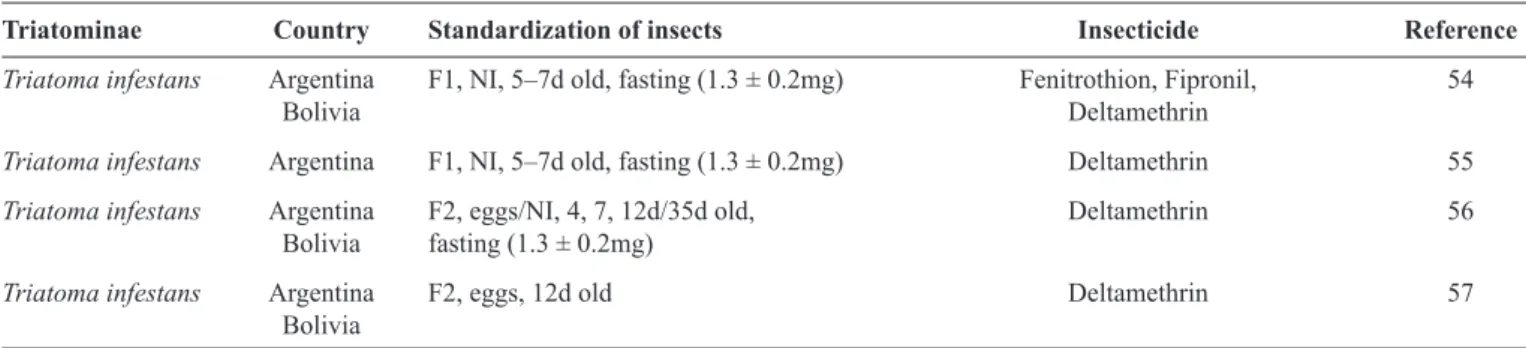
dose-response bioassays(25) (26) (27) (28) (29) (30) (31) (32) (33) (34) (35) (36) (37) (38) (39) (40) (41) (42) (43) (44) (45) (46) (47) (48) (49) (50) (51) (52) (53) (54) (55) (56) (57)(Table 1).
HISTORY OF TRIATOMINAE RESISTANCE TO INSECTICIDES
Even a ninety decade, insecticide resistance of Triatomines was considered to be ad hoc and unlikely to occur because of their long life cycle (so even if resistant individuals exist, the selection process is expected to be very slow) and low genetic variability, which imply a low probability of individuals being less susceptible to insecticides genetically(58). However, in
the last 15 years there have been several reports of different Triatomine species exhibiting resistance to several insecticides
(Table 1). This observation indicates that this phenomenon more widespread than expected, requiring better characterization and delimitation. Most available published studies refer to Triatoma infestans populations with high resistance ratios 50% (RR50) in Bolivia and Argentina, which are areas where vector control
is diffi cult (~RR50 > 50.0). Research on the susceptibility of Triatomines in Venezuela, Colombia, and Paraguay remain ad hoc, focusing on the vector control of Rhodnius prolixus, T. infestans, T. maculata, T. dimidiata, and Panstrongylus herreri. In Brazil, increasing numbers of studies are investigating the susceptibility of Triatomines to insecticides and have been focused on
TABLE 1 - Reports of Triatominae resistance to insecticides.
Triatominae Country Standardization of insects Insecticide Reference
Triatoma sordida Brazil F1, NI, 5d old, fasting (1.2 ± 0.2mg) Deltamethrin 25
Triatoma infestans Argentina F1, eggs/NI, 11–12 d/5–7d old, Deltamethrin, Amitraz, 26 fasting (1.3 ± 0.2mg) Fenitrothion, Flubendiamide, Imidacloprid
Indoxacarb, Ivermectin, Spinosad
Triatoma infestans Bolivia F1, NI, 5d old, fasting (1.74 ± 0.28mg) Deltamethrin 27
Triatoma sordida Brazil F1, NI, 5d old, fasting (1.3 ± 0.2mg) Deltamethrin 28
Triatoma infestans Argentina F1, NI, 5–7d old, fasting (1.3 ± 0.2mg) Deltamethrin, Fenitrothion 29
Triatoma infestans Bolivia F1, NI, 5d old, fasting (1.2 ± 0.2mg) Deltamethrin 30
Triatoma sordida Brazil F1, NI, 5d old, fasting (1.2 ± 0.2mg) Deltamethrin 31
Triatoma sordida Brazil F1, NI, 5d old, fasting (1.3 ± 0.2mg) Deltamethrin 32
Triatoma brasiliensis Brazil F1, NI, 5d old, fasting (1.2 ± 0.2mg) Deltamethrin 33
Triatoma infestans Brazil F1, NI, 5d old, fasting (1.2 ± 0.2mg) Deltamethrin 34
Triatoma infestans Argentina F1, NI/NV/adult, fasting Beta-cypermethrin, Deltamethrin 35
Triatoma infestans Brazil F1, NI, 3d old, fasting (1.2 ± 0.2mg) Deltamethrin, Beta-cyfl uthrin, 36 Rhodnius prolixus Venezuela F1, NI, 24–36h old, fasting (0.5 ± 0.1mg) Beta-cypermethrin, Lambda-cyhalothrin,
Cypermethrin, Dieldrin
Triatoma infestans Argentina F1, NI, 5–7d old, fasting (1.2 ± 0.2mg) Deltamethrin, Beta-cyfl uthrin, 37 Rhodnius prolixus F1, NI, 24–36h old, fasting (0.5 ± 0.1mg) Beta-cypermethrin, Cypermethrin,
Lambda-cyhalothrin
Triatoma infestans Argentina F1, NI, 3d old, fasting (1.2 ± 0.2mg) Deltamethrin 38
Triatoma infestans Peru F1, adult/NV Cyfl uthrin, Beta-cyfl uthrin, Cypermethrin, 39
Panstrongylus herreri Alfa-Cypermethrin, Deltamethrin
Triatoma infestans Argentina F1, NI, 3d old, fasting, (1.2 ± 0.2mg) Deltamethrin, Beta-cyfl uthrin, 40
Beta-cypermethrin, Lambda-cyhalothrin, Fenitrothion
Triatoma infestans Argentina F1, NI, 1–5d old, fasting Deltamethrin, Lambda-cyhalothrin, Tetramethrin 41
Triatoma dimidiata Colombia F1, NI, 24–36h old, fasting (1.4 ± 2.1mg) Deltamethrin, Beta-cypermethrin, 42
Triatoma maculata F1, NI/NV, 24–36h/10–12d old, Fenitrothion
fasting (0.6 ± 1.1mg/97 ± 30)
Triatoma infestans Argentina F1, NI, 3d old, fasting (1.2 ± 0.2mg) Fenitrothion, Deltamethrin, Fipronil, 43
Bolívia Bendiocarb
Triatoma infestans Argentina F1, eggs/NI, 11–12d/5–7d old, Deltamethrin, Fenitrothion, 44 Bolívia fasting (1.3 ± 0.2mg) Lambda-cyhalothrin, Fipronil
Triatoma infestans Brazil F1, NI, 3d old, fasting (1.2 ± 0.2mg) Deltamethrin 45
Triatoma infestans Argentina F1, NI, 3–5d old, fasting (1.2 ± 0.2mg) Deltamethrin 46
Triatoma infestans Argentina F1, NI, 3–5d old, fasting (1.2 ± 0.2mg) Deltamethrin, Fipronil 47 Paraguay
Bolivia
Triatoma infestans Bolívia F1, NI, 3–5d old, fasting (1.69 ± 0.31mg) Deltamethrin, Bendiocarb, Malathion 48
Triatoma brasiliensis Brazil F1, NI, 3d old, fasting (1.2 ± 0.2mg) Deltamethrin 49
Panstrongylus megistus
Triatoma brasiliensis Brazil F1, NI, 5d old, fasting (1.2 ± 0.2mg) Deltamethrin 50
Triatoma sordida Brazil F1, NI, 3d old, fasting (1.2 ± 0.2mg) Deltamethrin 51
Triatoma infestans Bolivia F1, NI, 5–7d old, fasting (1.3 ± 0.2mg) Fipronil, Deltamethrin 52
TABLE 1 - Continuation.
Triatominae Country Standardization of insects Insecticide Reference
Triatoma infestans Argentina F1, NI, 5–7d old, fasting (1.3 ± 0.2mg) Fenitrothion, Fipronil, 54
Bolivia Deltamethrin
Triatoma infestans Argentina F1, NI, 5–7d old, fasting (1.3 ± 0.2mg) Deltamethrin 55
Triatoma infestans Argentina F2, eggs/NI, 4, 7, 12d/35d old, Deltamethrin 56 Bolivia fasting (1.3 ± 0.2mg)
Triatoma infestans Argentina F2, eggs, 12d old Deltamethrin 57 Bolivia
F1: fi rst generation; F2: second generation; NI: fi rst instar nymph; NV: fi fth instar nymph; d: days; mg: milligrams; h: hours.
in areas with reports of persistent triatominic infestations. Of note, triatominic populations in Brazil have shown low RR (RR50 < 8.0) to date.
Insecticide resistance results in a decrease in the mortality observed in a population subjected to continuous treatment. This characteristic is expressed by a greater number of specimens that tolerate lethal doses compared with specimens considered sensitive during the initial application of the product, leading to selection pressure in populations. This phenomenon is based on the genetic variability of natural populations. Consequently, this variability combined with insecticide pressure results in the selection of certain phenotypes and the subsequent increase in their frequencies(59).
Insecticide resistance of Triatominae is a characteristic that is inherited in an autosomal and semi-dominant manner. There is evidence that a polygenic number of genes involved in the resistance phenomenon(46). The maintenance of different
insecticide susceptibility profi les in Brazilian T. sordida fi eld
populations, collected in areas with continue insecticide pressure, was demonstrated by Pessoa(25) (28).This phenomenon
may be related to the long life cycle of T. sordida, the occurrence of colonies originating from a small number of specimens, and
reduced genic fl ow between populations. Like other biological
models, the dynamics of the evolution of resistance depend on the population biology of a given species, the level of exposure
to the insecticide, and the number of individuals infl uenced
by these factors without coming into contact with the active
ingredients of the chemical, including gene fl ow between
populations in the treated and non-treated areas.
Germano et al.(60) investigated the reproductive and
developmental costs of deltamethrin resistance in T. infestans
from the Argentinean Gran Chaco eco-region in Araguary, Province of Salta. In an environment without insecticides, reproductive cost was expressed as lower fecundity, while developmental cost was expressed as a shorter duration of the
second and third nymphal stages and an extension of the fi fth
nymphal stage.
Several authors have demonstrated that the same triatominic population exhibits different toxicological profiles when exposed to the same chemical class of insecticide. In Argentina, high levels of resistance to deltamethrin, beta-cypermethrin,
beta-cyfl uthrin, and lambda-cyhalothrin were detected in four
T. infestans populations from El Chorro, El Sauzal, Salvador Mazza, and La Toma, without noticeable involvement of monooxygenases in the resistance phenotype(40). However, no
population was resistant to fenitrothion. Sfara et al.(41) assessed the
toxicity of deltamethrin, lambda-cyhalothrin, and tetramethrin on
T. infestans populations collected from El Chorro and La Toma, in addition to the effect of these insecticides on insect locomotor activity. The test populations exhibited cross-resistance to the three pyrethroids, while deltamethrin caused hyperactivity. Despite the resistance to the tested pyrethroids, sensory processing of repellency caused by N,N-Diethyl-meta-toluamide (DEET) appeared to remain unchanged in these populations.
Different toxicological profi les were also observed when
populations were exposed to different chemical classes of insecticides. Santo Orihuela et al.(43) characterized the
susceptibility of Argentinean (Salta and La Rioja) and Bolivian (Yacuiba) populations of T. infestans to deltamethrin,
fenitrothion, fi pronil, and bendiocarb. All populations were
resistant to deltamethrin (RR50 14.09-154.4) only, without any noticeable involvement of monooxygenases in the resistance phenotype. However, some studies assessing the susceptibility of T. infestans to insecticides belonging to a different class demonstrated cross-resistance. Carvajal et al.(26) assessed the
toxicity of different insecticides on deltamethrin susceptible and resistant populations of T. infestans from El Malá. Both populations proved susceptible to fenitrothion and imidacloprid, but were resistant to amitraz, flubendiamide, ivermectin, indoxacarb, and spinosad. Lardeux et al.(48) characterized
the susceptibility of 50 Bolivian populations of T. infestans
to deltamethrin, malathion, and bendiocarb. All populations showed significant levels of resistance to deltamethrin (RR50 6.0-491.0). However, resistance to bendiocarb (RR50 1.8) and malathion (RR50 1.2) was not observed. For populations resistant to deltamethrin, tests using inhibitors of monooxygenases failed to completely reverse the observed resistance, suggesting that other mechanisms are involved in the resistance phenotype.
The toxicological profi le observed in eggs cannot be transposed to fi rst instar nymphs, demonstrating the intrinsic characteristics of
the different developmental stages. Toloza et al.(44) characterized
(NI) of Argentinean (Salvador Mazza and Valle Viejo) and Bolivian (Mataral, Sucre, and Yacuiba) populations of T. infestans to different insecticides. At the egg stage, only the Salvador Mazza population was resistant to lambda-cyhalothrin (RR50 14.2), but was susceptible to fi pronil and fenitrothion. In comparison, the Mataral and Sucre (Bolivia) populations were
susceptible to all insecticides. However, the fi rst instar nymphs
(NI) of the Salvador Mazza populations was highly resistant to lambda-cyhalothrin (RR50 106.2), but these populations were susceptible to the other insecticides. All Bolivian populations were susceptible to all insecticides, except the nymphs of Sucre,
which were highly resistant to fi pronil (RR50 585.5). Germano et al.(54) identifi ed different toxicological profi les in Argentinean
(Acambuco) and Bolivian (Mataral and Entre Rios) populations of T. infestans to deltamethrin, fi pronil, and fenitrothion. Tests
with NI revealed that all populations were resistant to all insecticides, except for the population from Entre Rios, which
was susceptible to fi pronil. Conversely, tests performed with
eggs using deltamethrin showed resistance in all populations, with esterases being involved in the resistance phenotype. Roca-Acevedo et al.(56) assessed the susceptibility of developing
eggs and newly hatched nymphs in the regions of Campo Largo (Argentina) and Entre Rios (Bolivia), which were suspected
of insecticide resistance. In both populations, the fi rst instar
nymphs were resistant to deltamethrin (RR50 1,108 Campo Largo and RR50 173.0 Entre Rios). Compared with the Susceptibility
Reference Lineage (SRL), the effi cacy of deltamethrin was
significantly lower on the eggs. Santo-Orihuela et al.(57)
characterized the susceptibility of T. infestans eggs collected from wild and domestic areas of Argentina (Salta) and Bolivia (Potosi, Cochabamba, and Tarija) to deltamethrin. The RR50 values ranged from 0.5-44.9. In resistant populations, esterase did not appear to be involved in the resistance phenotype.
The toxicity profi le observed in nymphs cannot be applied to
triatomines belonging to different developmental stages. Zerba et al.(35) assessed the susceptibility of two Argentinean
populations of T. infestans, at different stages of development to beta-cypermethrin and deltamethrin. Beta-cypermethrin had a
better effect on fi fth instar nymphs (NV), whereas deltamethrin
had a better effect on adults. The results showed the equivalent
effi cacy of beta-cypermethrin to control T. infestans infestation when applied at 50mg/m2 compared with deltamethrin applied
at 25mg/m2. Reyes et al.(42) characterized baseline susceptibility
to deltamethrin, beta-cypermethrin, and fenitrothion to
T. maculata from San Jose and T. dimidiata from San Joaquin (Colombia). Studies with the NI of T. maculata obtained a Lethal Dose 50% (LD50) of 0.07, 0.05, and 4.12ng a.i./treated nymphs for deltamethrin, beta-cypermethrin, and fenitrothion, respectively, a Lethal Dose 99% (LD99) of of 1.08, 0.37, and 17.89, respectively. Studies with the NI of T. dimidiata obtained a LD50 of 0.44, 0.46, and 16.45ng a.i./treated nymphs for deltamethrin, beta-cypermethrin, and fenitrothion, respectively, and a LD99 of 2.22, 1.97, and 36.07, respectively. For the NV of T. dimidiata, studies obtained a LD50 of 510.72, 1,623.59, and 838.91ng a.i./treated nymphs for deltamethrin, beta-cypermethrin, and fenitrothion, respectively, and a LD99 of 9,607.50, 11,717.91, and 1,525.0 respectively.
Toxicological profi les differ across regions and even within the
microgeography of the same location. Germano et al.(55) assessed the
susceptibility of Triatomine populations collected from two domestic units in Acambuco (Argentina) to deltamethrin. Pessoa et al.(31) (33) (34)
investigated the susceptibility of different Brazilian populations of T. sordida (RR50 0.72-6.8), T. infestans (RR50 1.74-3.26), and
T. brasiliensis (RR50 0.32-1.21) to deltamethrin collected in areas with persistent triatominic infestations, despite the existence of chemical control, characterizing them as susceptible to the tested insecticide.
The different susceptibility profi les in different domestic units
from the same localities suggest that the geographical structuring of the resistance phenotype differs between sites and within sites at the microgeographical level. These differences are caused by
differences in the resistant foci profi les of T. infestans, indicating the occurrence of independent evolutionary processes. Despite the reduced triatominic dispersion capacity, these observations demonstrate the inadequacy of transposing results from one population to another, even when geographically near to one another.
The toxicological profi les shown by sylvatic populations of
T. infestans represent natural or wild toxicological phenotypes, and may be used to determine tolerance to different insecticides. Roca Acevedo et al.(52) characterized the susceptibility profi le
of four wild T. infestans populations collected from the Andean valleys of Bolivia (Mataral, Kirus-Mayu, 20 de Octubre, and
Ilicuni), to deltamethrin and fi pronil. All populations were
resistant to deltamethrin (RR50 1.9-17.4), with no indication that monooxygenases were present in resistant populations. In
trials with fi pronil, the susceptibility of a domestic population
of T. infestans collected from Mataral was also assessed; the RR50 ranged from 0.5 to 45.6 in the wild populations and ranged from 139.2 in the domestic population. Depickére et al.(27) characterized the susceptibility of 20 Bolivian populations
collected from La Paz, Cochabamba, Potosi, Santa Cruz, and Tarija (12 wild populations and 8 domestic populations) to deltamethrin. The dose-diagnostic tests revealed that all wild populations were susceptible to deltamethrin, except for the Julo Grande population (Toro-Toro/Potosi). Among the domestic populations, only three were susceptible to deltamethrin. The populations that were indicative of resistance were subjected to dose response trials, revealing wide variation in susceptibility (RR50 3.8-818.0). Gomez et al.(30) assessed the susceptibility of
9 populations from Gran Chaco and the Inter-Andean valleys of Bolivia (5 wild populations and 4 domestic populations) to deltamethrin. The wild populations showed low variation in susceptibility (RR50 0.62-4.24), whereas wide variation in susceptibility was detected for the domestic populations (RR50 2.9-129.1). The geographical origin and distribution epicenter of T. infestans is located in the Cochabamba Valley (Bolivia)(60) (61) (62); thus, it is possible that the toxicological
profi le of the sylvatic populations from Cochabamba represents its ancestral toxicological profi le. Therefore, T. infestans from different geographical areas may exhibit different toxicological phenotypes, even in the absence of insecticide selection. Consequently, this variation may determine differences in
T. infestans susceptibility to insecticides. Germano et al.(47)
surrounding regions with resistance to pyrethroids in Bolivia (Tarija), Argentina (Salta, Catamarca, Santiago Del Estero, Chaco, and Santa Fe), and Paraguay (Boquerón). The Tarija populations were highly resistant to deltamethrin (RR50 247.4-541.6), whereas those in Argentina had moderate RR50 (RR50 0.1-39.0), and those in Paraguay had a low change in susceptibility (RR50 3.7). The Argentinean populations were
susceptible to fi pronil (RR50 1.09-3.0), whereas the profi les from
Argentina were varied (RR50 0.19-92.7), being mostly resistant.
MECHANISMS INVOLVED WITH INSECTICIDE RESISTANCE IN TRIATOMINAE
The mechanisms involved with Triatomines resistance to insecticides are related to changes in one or several toxicokinetic/ toxicodynamic steps occurred during the interaction between insect-insecticide, isolated or associated, being: I) changes in the local of the chemical active penetration; II) increase in its
enzymatic detoxifi cation; and III) changes in the action(63).
Physiological resistance is associated with a reduction in the penetration of insecticides because of changes to the insect cuticle and/or in their ability to store/excrete the insecticide(64).
Mougabure Cueto et al.(64) compared the insecticide activity of
1-dodecanol on the development of the cuticle in R. prolixus T. infestans. The authors found that recently hatched fi rst
instar nymphs (1-3h old) were more vulnerable than older ones (24-36h old). Pedrini et al.(65) used scanning electronic
microscopy to show that Argentinean populations of T. infestans resistant to deltamethrin have thicker exoskeletons
(32.1 ± 5.9μm) than susceptible populations (17.8 ± 5.4μm).
Thicker cuticles enriched in hydrocarbons probably restrict deltamethrin penetration in resistant insects. These studies indicate that the cuticle is an important variable in the intoxication of insects, representing the first barrier to insecticides before reaching target sites within the insect body(66).
Biochemical resistance corresponds to a significant
increase in the activities of detoxifi cation enzymes, especially
monooxygenases and esterases(36) (37) (38) (40) (43) (48). Vassena and
Picollo(42) assessed the susceptibility of a R. prolixus population
from Carabobo (Venezuela) and a T. infestans population from Rio Grande do Sul (Brazil) to deltamethrin, beta-cypermethrin,
beta-cyfl uthrin, lambda-cyhalothrin, and cypermethrin. The
R. prolixus population had an RR50 of 3.0-12.4, whereas that of the T. infestans population was lower, ranging from 0.92 to 7.0. In both cases, there was an increase in monooxygenases related to the Susceptibility Reference Lineage (SRL). Gonçalves Audino et al.(43) characterized the toxicological profi le to deltamethrin
of 4 T. infestans populations from Mendoza, Catamarca, Salta and San Luis to deltamethrin, and obtained RR50 ranging from 2.0 to 7.8. For the population with RR50 7.8, biochemical tests indicated the possible involvement of esterases and monooxygenases in the observed phenotype. Studies developed by Pessoa(28) using T. sordida populations with different
susceptibility profi les to deltamethrin (RR50 1.22-6.5) showed an increase in esterase and monooxygenase activity. This increased activity may contribute to the lower susceptibility of Triatomines to deltamethrin. Despite the results obtained by different studies, a limited number of substrates was used in the enzymatic assays,
particularly when compared to the great diversity present in insects, in addition to the fact that many of the assessed enzymes are multifunctional. Therefore, the populations may detoxify certain pesticides by activating different enzymes from the same class. This issue was investigated by Saavedra-Rodrigues et al.(67) using the microarray technique, in which the authors
used a large number of substrates in population studies of Aedes aegypti exhibiting different susceptibility profi les to permethrin.
This characteristic has the potential of generating different
specifi c responses around the interaction of each population with each insecticide, preventing what is defi ned as a general
diagnostic profi le related to resistance. Moreover, these studies showed the absence of a numeric correlation between the RR50 values of the populations in response to deltamethrin and the change in the percentage of various detoxifying enzymes.
Concerning changes to the insecticide site of action in Triatominae, Fabro et al.(53) and Capriotti et al.(68) reported the
existence of two punctual mutations (L1014F and L925I) in the second domain of the sodium channel gene protein in two different Argentinean populations of T. infestans with high resistance levels. Mutation L9251I seems to be associated with much higher RR50 than that observed for mutation L1014F.
METHODOLOGICAL DIFFICULTIES
Three major obstacles have been identifi ed when interpreting
the results obtained by studies on Triatomines resistance to insecticides; namely: I) a wide range of methodologies,despite the existence of a single guiding protocol(27) (36) (38) (42) (43) (46) (47) (53) (55) (56);
II) a lack of information about the real impact of resistance ratios
in the fi eld; and III) the concept of the Susceptibility Reference Lineage (SRL). The fi rst shortcoming of studies on Triatominae
resistance to insecticides is that, at present, there is only one guiding protocol for studies on insect susceptibility to insecticides,
i.e., the one provided by the WHO(69). However, a large variety of
methodologies has been used, preventing the direct comparison of results and, in a more practical way, a clear comprehension of
the real impact of these results in fi eld vector control strategies.
Consequently, Pessoa et al.(32) redefi ned the following technical
details: place to apply insecticide on insects (abdomen, dorsal or ventral position), age (1, 3, and 5 days after hatching) and insect generation (F1 and F2), appropriate moment to perform mortality record (24-96h), and appropriate diagnostic dose to detect resistance in laboratory qualitative testing (1x and 2x LD99 of SRL). Bioassays
are not infl uenced by the place of insecticide application or by
the generation of the study population. Furthermore, 3-day-old nymphs are less susceptible to treatment with insecticides, which is probably attributed to their energy reserves and the complete
formation of the exoskeleton. The protocol proposed by WHO(69)
recommends that the mortality reading should be performed 72h after treatment with pyrethroid. Many of the published studies performed the mortality reading with 24h,disregarding the knockdown effect – momentary paralysis, which may or may not be followed by full motor recovery(70). Thus, mortality may
chemical groups, because only pyrethroids have a knockdown effect. Therefore, when using pyrethroids, the mortality record must be performed 72h after treatment to allow for knockdown recovery.
The diagnostic-dose (DD) is a tool that allows population vigor to be determined in the field compared with the susceptibility reference lineage. In studies with triatomines, although the use of 1xLD99 was recommended by WHO(69), some
authors adopted 2xLD99(71), as recommended for mosquitoes.
The results with DD 2xLD99 invariably generated 100% mortality, resulting in the high mortality of insects with altered susceptibility. However, the studies performed by Pessoa(32)
demonstrated that the use of 1xLD99 is more appropriate, because it allows a positive correlation to be established between the detected mortality and population susceptibility, indicated by the resistance ratios. Furthermore, the results indicating resistance in the tests using the diagnostic-dose may be false-positive, i.e.,
laboratory tests indicate possible resistance that is not confi rmed in fi eld trials; however, the opposite was not observed.
Sample size also presents another relevant issue regarding the
use of DD as a screening tool for possible fi eld populations with
altered susceptibility. The use of 10 nymphs is recommended for each test, in triplicate(69).Yet, Amelotti et al.(72) demonstrated that a
single female, kept isolated throughout its life cycle, has the potential to generate more resistant offspring when younger, and more susceptible descendants as it ages. This issue reveals the complexity of genetic variability at the individual level; thus, providing insights about the impact of such variation in the population context.
The RR is also subject to two interpretations. Zerba and Picollo(73) suggest that populations with RR
50 > 2.0 are resistant,
whereas the Pan-American Health Organization (PAHO)(74)
states that populations with RR50 > 5.0 are resistant. The RR is calculated from SRL lethal doses; thus, the resistance level obtained may consequently interfere, in the future developments to be adopted by the managers involved with Triatominae
control in the fi eld. As an example, the RR50 observed by Obara et al.(51) for T. sordida populations treated with deltamethrin
allowed the study population to be classifi ed as susceptible to
the tested insecticide, leading to the recommendation of time line monitoring. However, if the authors had used the SRL adopted by Pessoa(31), the RR
50 would have increased nine fold.
Under this scenario, the populations would have been classifi ed
as resistant, and the insecticide used should have been replaced with an insecticide with a different action mode.
Therefore, it is important to adopt a single SRL per species that should be used by all research groups. However, it is not possible to maintain this SRL in the laboratory ad infi nitum without the inclusion of external material. Furthermore, such
criteria are highly arbitrary and empirical, with insuffi cient
theoretical and practical grounding. Therefore, it is necessary to perform simultaneous and complementary laboratory and
fi eld bioassays to correlate the two. It would then be possible
to set cut-offs to distinguish susceptibility from resistance. In
the fi eld, Triatomine susceptibility must be reviewed on a time
line, considering the continuous pressure of selection in areas requiring continuous chemical treatments.
The fi nal issue is the methodological criteria recommended by PAHO to choose a SRL - a colony with more than fi ve
generations in the laboratory, without contact with insecticides and no inclusion of external material and/or the colony collected from a location where there was no treatment with insecticide whatsoever(74). The meeting of fi eld populations
more susceptible than the SRL(25) (28) (30) (33) reveal the fragility
of this criteria.
FACTORS ASSOCIATED WITH INSECTICIDE RESISTANCE
Triatominae resistance to insecticides may be linked to: I) the behavioral characteristics of these insects associated with their numerous peridomestic refuges; II) the characteristics
of pyrethroid insecticides; and III) operational fl aws, such as
incorrect insecticide dosage, frequency, and application time. The persistence of some Triatomine specimens, mainly in the peridomestic environment, despite successive insecticides spraying on the timeline, may be related to the behavior of these insects. The peridomicile presents a wide variety of ecotopes that
correspond to an infi nite number of hiding places associated with
different sources of food for T. sordida, such as chickens, dogs, pigs, and cats. Spraying the peridomicile is exhausting work, with the unstacking all accrued material being operationally
impossible for responsible fi eld agents(75).
Pyrethroids provide limited residual effect on the peridomicile, with lethal doses on treated surfaces being highly transitory(17). This outcome is expected, as the most used
conventional formulations are wettable powders and suspension concentrates, which represent the only a vehicle for active ingredients and do not provide protection against a wide range of agents. Such agents include air, ultraviolet radiation, moisture, or physical factors, such as rain, wind, and other agents, including humans and domestic animals, which promote the erosion of the surfaces treated by removing deposited insecticides. The chemical loss of pyrethroids is expected on highly alkaline surfaces or when exposed to ultraviolet radiation. Furthermore, according to the nature of various structures (porosity and alkalinity), different penetration mechanisms and insecticide absorption may be observed. On porous surfaces, the chemical ingredient is deposited and seems to lose activity faster than on other surfaces, such as wooden boards and ceramic tiles.
These environmental variables directly infl uence the insecticide
degradation rate and the consequent need for reapplication to maintain domestic units that are free of triatomine infestation. However, during routine activity, a point-to-point assessment
of these variables is not possible, in which specifi c treatment frequencies could be reset for each region. Thus, the infl ow of
triatomines from external sources, triatomine survivors from previous applications, and the hatching of eggs leads to the recolonization of houses, as well as an increase in population genetic diversity and possible resistance. Migration into the area may also lead to the possible dilution of the observed resistance ratios, which may be underestimated.
Finally, operational failures may cause the observed
for technical improvement of the fi eld team in charge. Control failures may be caused by a lack of effi cacy of the insecticide,
by operational failures, and/or environmental conditions. The
lack of effi cacy of the insecticide is related to the poor quality of
the active ingredient and/or inadequate formulation. Operational failures include insecticide dilution errors, application failure, and problems with spraying machines. There may also be a lack of continuity in spraying cycles, due to administrative, budgetary, and logistical reasons(74).
Yet, the disjointed overlap of endemic control programs (malaria, leishmaniasis, Chagas disease) and use of insecticides for agriculture or domestic purposes may generate selection pressure on Triatomine populations, favoring the survival of the most resistant individuals(76) (77).
CONCLUSIONS
Even a ninety decade, insecticide resistance of triatomines was considered ad hoc and unlikely to occur, due to their long life cycle and low genetic variability. However, in the last 15 years, several studies have reported the resistance of different Triatomine species to several insecticides; thus, this phenomenon is more widespread than previously assumed, requiring better characterization and delimitation. Insecticide resistance of Triatominae is a characteristic inherited in an autosomal and semi-dominant manner, and has been detected in both in domestic and sylvatic populations. There is evidence that a polygenic number of genes are involved in resistance. The insecticide phenotype has reproductive and developmental
costs to Triatominae. The toxicological profi le observed in
eggs cannot be transposed to different developmental stages.
There are different toxicological profi les at the macro- and microgeographical level. The toxicological profi les exhibited
by sylvatic populations of T. infestans can represent natural and wild toxicological phenotypes that determine tolerance to different insecticides. There are various physiological resistance mechanisms, including: I) reduced penetration of insecticide resulting from changes to insect cuticle; II) changes in the activity of different enzymes, with variation
in the proportions and combinations, but with a signifi cant
increase in monooxygenases and esterases; and III) two point mutations (L1014F and L925I) in the second domain of the sodium channel gene protein. Studies of Triatomine resistance to insecticides highlight 3 limitations in the interpretation of results; namely, I) there is wide diversity in methodologies, despite the existence of a single guiding protocol; II) there is a lack of information about the actual impact of resistance
ratios in the fi eld; and III) the viability of the methodological
criterion used for choosing the susceptibility reference lineage, since some field populations are more susceptible to the SRL(25) (28) (30) (33). Because it is a complex phenomen and most
often multifactorial, we believe that insecticides resistance in triatomine should be evaluated by the eco-epidemiological and
environmental context in which Triatomine belong. If identifi ed
early, the resistance can be managed through different strategies (eg. insecticides substituition) to minimize or even reverse the observed phenotype.
The authors declare that there is no confl ict of interest.
CONFLICT OF INTEREST
FINANCIAL SUPPORT
Financial support was provided by the Conselho Nacional de
Desenvolvimento Científi co e Tecnológico (CNPq), Fundação de Amparo a Pesquisa do Estado de Minas Gerais (FAPEMIG),
Centro de Pesquisas René Rachou (CPqRR), Fundação Oswaldo Cruz (FIOCRUZ), Secretaria de Vigilância em Saúde
(SVS), Ministério da Saúde (MS) - Brazil, -and World Health
Organization (WHO).
REFERENCES
1. Moncayo A, Silveira AC. Current epidemiological trends for Chagas disease in Latin America and future challenges in epidemiology, surveillance and health policy. Mem Inst Oswaldo Cruz 2009; 104:17-30.
2. World Health Organization (WHO). Chagas disease (American trypanosomiasis) (Internet). WHO; 2015 (Accessed 2015 March 11). Available at http://www.who.int/mediacentre/ factsheets/fs340/en/
3. Coura JR, Dias JCP. Epidemiology, control and surveillance of Chagas disease – 100 years after its discovery.Mem Inst Oswaldo Cruz 2009; 104:31-40.
4. Coura JR, Viñas PA. Chagas disease: a new worldwide challenge. Nature 2010; 465:S6-S7.
5. Dias JCP. O controle da doença de Chagas no Brasil. In: Silveira AC, editor. O controle da doença de Chagas nos países do Cone Sul da America: uma iniciativa internacional. Organização Pan-Americana da Saúde/Faculdade de Medicina do Triângulo Mineiro; 2002. p. 145-250.
6. Dias JCP, Schofi eld CJ. The evolution of Chagas disease (American Trypanosomiasis) control after 90 years since Carlos Chagas Discovery. Mem Inst Oswaldo Cruz 1999; 94:103-121.
7. Pinchin R, Oliveira Filho AM, Pereira ACB. The fl ushing-out activity of pyrethrum and synthetic pyrethroids on Panstongylus megistus. Trans Roy Soc Trop Med Hyg 1980; 74:801-803. 8. Lent H, Wygodzinsky PW. Revision of the Triatominae (Hemiptera,
Reduviidae), and their signifi cance as vectors of Chagas' disease. Bull Amer Nat Hist 1979; 163:article 3.
9. Dias E, Pellegrino J. Alguns ensaios com o “Gamexanne” no combate aos transmissores da doenca de Chagas. Brasil Medico 1948;62:185-190.
10. Busvine J, Barnes M. Observations on mortality among insects exposed to dry insecticidal fi lms. Bull Ent Res 1947; 38:81-90. 11. Perlowagora-Szumlewicz A. A efi cácia do expurgo domiciliário
com dieldrin no controle do vetor da doença de Chagas. Rev Bras Malar D Trop 1956; 8:289-304.
12. Shenone H, Zomosa E, Villarroel F, Rojas A, Alfaro E, Queiroz M. Acción de 7 formulaciones de insecticidas sobre Triatoma infestans
criados em laboratório. Biol Chileno Parasit 1972; 27:14-22. 13. Pinchin R, Fanara DM, Oliveira Filho AM. A village scale trail of
14. Sherlock I, Muniz TM. Combate ao Panstrongylus megistus com o malathion concentrado. Rev Soc Bras Med Trop 1975; 9:289-296. 15. Sherlock I, Muniz TM, Guitton N. A ação do malathion sobre os
ovos de triatomíneos vetores de doença de Chagas. Rev Soc Bras Med Trop 1976; 10:77-84.
16. Fox I, Bayona Ig, Orozco HI. The toxicity of DDT, Dieldrin, Malathion and Fenthion to Rhodnius prolixus in laboratory. Bull World Health Organ 1966; 35:974-976.
17. Santos MAT, Areas MA, Reyes FGR. Piretróides: uma visão geral. Alim Nutr 2007; 18:339-349.
18. Dias JCP, Jemmio A. Sobre uma pintura inseticida para o controle de Triatoma infestans na Bolivia. Rev Soc Bras Med Trop 2008; 41:79-81.
19. Maloney KM, Ancca-Juarez J, Salazar R, Borrini-Mayori K, Niemierko M, Yukich JO, et al. Comparison of insecticidal paint and deltamethrin against Triatoma infestans (Hemiptera: Reduviidae) feeding and mortality in simulated natural conditions. J Vect Ecol 2013; 38:6-11.
20. Diotaiuti L, Penido CM, Araujo HS, Schofi eld CJ, Pinto CT. Excito-repellency effect of Deltamethrin on Triatomines under laboratory conditions. Rev Soc Bras Med Trop 2000; 33:247-252. 21. Herber O, Kroeger A. Pyretroid-impregnated curtains for Chaga`s
disease control in Venezuela. Acta Tropica 2003; 88:33-38. 22. Levy MZ, Quispe-Machaca VR, Ylla-VElasquez JL, Lance AW,
Richards JM, Tath B, et al. Impregnated netting slows infestation by Triatoma infestans. Am J Trop Med Hyg 2008; 79:528-534. 23. Wood E, Licastro SA, Casabe N, Picollo MI, Alzogaray R,
Zerba EN. A new tactic for Triatoma infestans control: fabrics impregnated with beta-cypermethrin. Rev Panam Salud Publica 1999; 6:1-7.
24. Dias JCP, Machado EMM, Borges EC, Moreira EF, Gontijo C, Azeredo BVM. Doença de Chagas em Lassance, MG. Reavaliação Clínico – epidemiológica 90 anos após a descoberta de Carlos Chagas. Rev Soc Bras Med Trop2002; 35:167-176.
25. Pessoa GCD. Monitoramento da suscetibilidade ao piretróide deltametrina em populações de Triatoma sordida Stål, 1859
(Hemiptera: Reduviidae). 2008. 95 p. (Master´s Dissertation). Centro de Pesquisas René Rachou da Fundação Oswaldo Cruz; 2008. Belo Horizonte.
26. Carvajal G, Mouganbure-Cueto G, Toloza AC. Toxicity of non-pyrethroid insecticides against Triatoma infestans (Hemiptera: Reduviidae). Mem Inst Oswaldo Cruz 2012;107:675-679.
27. Depickère S, Buitrago R, Siñani E, Baune M, Monje M, Lopez R, et al. Susceptibility and resistance to deltamethrin of wild and domestic populations of Triatoma infestans (Reduviidae: Triatominae) in Bolivia: new discoveries. Mem Inst Oswaldo Cruz 2012; 107:1042-1047.
28. Pessoa GCA. Perfi l da suscetibilidade a deltametrina em populações de Triatoma sordida (Hemiptera: Reduviidae) do Estado de Minas Gerais procedentes de áreas com infestação persistente. 2012. 179 p.(Doctor´s Thesis). Universidade Federal de Minas Gerais; 2012. Belo Horizonte.
29. Germano M, Picollo MI, Spillmann C, Mougabure-Cueto G. Fenithrothion: an alternative insecticide for the control of deltamethrin-resistant populations of Triatoma infestans in northern Argentina. Med Vet Entomol 2014; 28:21-25.
30. Gomez MB, Pessoa GCD, Orellana ALG, Cortez MR, Rosa ACL, Noireau F, et al. Susceptibility to deltamethrin of wild and domestic populations of Triatoma infestans of the Gran Chaco and the Inter-Andean Valleys of Bolivia. Parasit Vectors 2014; 7:497-503. 31. Pessoa GCD, Dias LS, Diotaiuti L. Deltamethrin pyrethroid
susceptibility characterization of Triatoma sordida Stal, 1859
(Hemiptera: Reduviidae) populations in the Northern Region of Minas Gerais, Brazil. Rev Soc Bras Med Trop 2014; 47:426-429. 32. Pessoa GCD, Pinheiro LC, Ferraz ML, Mello BV, Diotaiuti L.
Standartization of laboratory bioassays for the study of Triatoma sordida susceptibility to pyrethroid insecticides. Parasit Vectors 2015; 8:109.
33. Pessoa GCD, Trevizani NAB, Dias LS, Melo BV, Diotaiuti L. Toxicological profi le of deltamethrin in Triatoma brasiliensis
(Hemiptera: Reduviidae) in State of Ceará, Northeastern Brazil. Rev Soc Bras Med Trop 2015; 48:39-43.
34. Pessoa GCD, Rosa ACL, Bedin C, Wilhelms T, Mello F, Coutinho HS, et al. Susceptibility characterization of residual Brazilian populations of Triatoma infestans Klug, 1834 (Hemiptera: Reduviidae) to deltamethrin pyrethroid. Rev Soc Bras Med Trop 2015; 48:157-161.
35. Zerba EM, Wallace G, Picollo MI, Casabe N, Licastro S, Wood E, et al. Evaluación de la ß-cipermetrina para el control de Triatoma infestans. Pan Am J Public Health 1997; 1:133-137.
36. Vassena CV, Picollo MI, Zerba EN. Insecticida resistance in Brazilian Triatoma infestans and Venezuelan Rhodnius prolixus. Med Vet Entomol 2000; 14:51-55.
37. Vanessa CV, PicolIo MI. Monitoreo de resistencia a insecticidas en poblaciones de campo de Triatoma infestans y Rhodnius prolixus, insectos vectores de la efermedad de Chagas. (Internet). Rev Toxicologia en Linea (RETEL) 2003. 21 p. (Acessed 2007 May 12). Available at: http://www.sertox.com.ar/retel/n03/004.pdf
38. González-Audino P, Vassena C, Barrios S, Zerba EN, Picollo MI. Role of enhanced detoxication in a deltamethrin-resistant Population of Triatoma infestans (Hemiptera, Reduviidae) from Argentina. Mem Inst Oswaldo Cruz 2004; 99: 335-339.
39. Yon FC, Balta R, Garcia N, Troyes A, Cumpa H, Valdivia A. Susceptibilidad y resistência de Triatoma infestans y Panstrongylus herreri a lós insecticidas piretroides, Peru 2001. Rev Peru Med Exp Salud Publica 2004; 21:179-182.
40. Picollo MI, Vassena C, Orihuela PS, Barrios S, Zaidemberg M, Zerba E. High resistence to pyrethroid insecticides associated with ineffective fi eld treatments in Triatoma infestans (Hemipetra: Reduviidade from Northern Argentina. J Med Entomol 2005; 42:637-642.
41. Sfara V, Zerba EM, Alzogaray RA. Toxicity of pyrethroids and repellency of diethyltoluamide in two deltamethrin-resitant colonies of Triatoma infestans Klug, 1834 (Hemiptera: Reduviidae). Mem Inst Oswaldo Cruz 2006; 101:89-94.
42. Reyes M, Angulo VM, Sandoval CM. Efecto tóxico de beta-cipermetrina, deltametrina y fenitrotión en cepas de Triatoma dimidiata (Latreille, 1811) y Triatoma maculata (Erichson, 1848) (Hemiptera, Reduviidae).Biomédica 2007; 27 (suppl I):75-82. 43. Santo-Orihuela PL, Vassena CV, Zerba EN, Picollo MI. Relative
Contribution of Monooxygenase and Esterase to Pyrethroid Resistance in Triatoma infestans (Hemiptera: Reduviidae) from Argentina and Bolivia. J Med Entomol 2008; 45: 298-306. 44. Toloza AC, Germano M, Cueto GM, Vassena C, Zerba E, Picollo
MI. Differencial patterns of insecticide resistance in eggs and fi rst instar of Triatoma infestans (Hemiptera: Reduviidae) from Argentina and Bolivia. J Med Entomol 2008; 45:421-426.
45. Sonoda IV, Pessoa GCD, Cortez MR, Dias JC, Romanha AJ, Diotaiuti L. Susceptibility of Triatoma infestans to deltamethrin in Rio Grande do Sul, Brazil. Mem Inst Oswaldo Cruz 2009; 104:668-670.
46. Germano MD, Vassena CV, Picollo MI. Autosomal inheritance of deltamethrin resistance in fi eld populations of Triatoma infestans
47. Germano MD, Acevedo GR, Mougabure Cueto GA, Toloza AC, Vassena CV, Picollo MI. New fi ndings of insecticide resistance in Triatoma infestans (Heteroptera: Reduviidae) from the Gran Chaco. J Med Entomol 2010; 47:1077-1081.
48. Lardeux F, Depickère S, Cuchon S, Chaves T. Insecticide resistance of Triatoma infestans (Hemiptera, Reduviidae) vector of Chagas disease in Bolivia. Trop Med Int Health 2010; 15:1037-1048. 49. Obara TM. Caracterização da resistência a inseticidas em
populações da subfamília Triatominae (Hemiptera: Reduviidae), vetores de Trypanosoma cruzi Chagas, 1909. 2010. 246 p. (Doctors Thesis). Centro Universidade de São Paulo; 2010; São Paulo. 50. Sonoda IV, Dias LS, Bezerra CM, Romanha AJ, Diotaiuti L.
Susceptibility of Triatoma brasiliensis from State of Ceará, Northeastern Brazil, to the pyrethroid deltamethrin. Mem Inst Oswaldo Cruz2010; 105:348-352.
51. Obara MT, Otreta VCG, Gurgel RG, Santos JP, Santalucia M, Rosa JA, et al. Monitoring the susceptibility of Triatoma sordida
Stal, 1859 (Hemiptera: Reduviidae) to deltamethrin insecticide, in Central-Western Brazil. Rev Soc Bras Med Trop 2011; 44:206-212. 52. Roca-Acevedo G, Mougabure Cueto GA, Germano M, Orihuela
PS, Cortez MR, Noireau F, et al. Susceptibility of sylvatic Triatoma infestans from Andeans Valleys of Bolivia a deltamethrin and fi pronil. J Med Entomol 2011; 48:830-835.
53. Fabro J, Sterkel M, Capriotti N, Mougabure-Cueto G, Germano M, Rivera-Pomar R, et al. Identifi cation of a point of mutation associated with pyrethroid resistance in the para-type sodium channel of Triatoma infestans, a vector of Chagas disease. Infect Genet Evol2012; 12:487-491.
54. Germano MD, Santo-Orihuela P, Roca-Acevedo G, Toloza AC, Vassena C, Picollo MI, et al. Scientifi c evidence of three different insecticide-resistant profi les in Triatoma infestans (Hemiptera: Reduviidae) populations from Argentina and Bolivia. J Med Entomol 2012; 49:1355-1360.
55. Germano MD, Picollo MI, Mouganbure-Cueto GS. Microgeographical study of insecticide resistance in Triatoma infestans from Argentina. Acta Tropica 2013; 128:561-565. 56. Roca-Acevedo G, Piollo MI, Santo-Orihuela. Expression of
insecticide resistance in immature life stages of Triatoma infestans
(Hemiptera: Reduviidae). J Med Entomol 2013; 50:816-818. 57. Santo-Orihuela PL, Carvajal G, Picollo MI, Vassena CV.
Analysing deltamethrin susceptibility and pyrethroid esterase activity variations in sylvatic and domestic Triatoma infestans at the embryonic stage. Mem Inst Oswaldo Cruz 2013; 108:1031-1036. 58. Brow AQ, Paul R. Insecticide resistance in arthopods. WHO
Monogr Geneva Ser 38. Geneva: World Health Organization; 1971. 59. Tabashink BE, Roush RT. Introduction. In: Roush RT, Tabashnik
BE, editors. Pesticide resistance in arthropods. New York: Chapman and Hall; 1990. p. 1-3.
60. Germano MD, Picollo MI. Reproductive and developmental costs of deltamethrin resistance in Chagas disease vector Triatoma infestans. J Vector Ecol 2015; 40:1-7.
61. Bermudéz H, Valderrama F, Torrico F. Identifi cation of sylvatic foci of Triatoma infestans in Central Bolívia. Am J Trop Med Hyg 1993; 49:371-375.
62. Panzera F, Ferrandis I, Callero L, Lucero C, Ferreiro MJ, Panzera Y, et al. Aportes recientes de lacitogenetica al estúdio de lós vectores de la enfermedad de Chagas. In: Arias AR, Maldonado M,
editors. Taller Del Cono Sur, actualización de la Tripanosomiasis Americana. Paraguay; 2007. p.233.
63. Brogdon WG, Mcallister JC. Insecticide resistance and vector control. Emerg Infec Diseases 1998; 4:605-613.
64. Mouganbure Cueto G, Zerba E, Picollo MI. Biological effect of 1-dodecanol in teneral and post-teneral Rhodnius prolixus
and Triatoma infestans (Hemiptera: Reduviidae). Mem Inst Oswaldo Cruz 2005; 100:59-61.
65. Pedrini N, Mijailovsky SJ, Girotti JR, Stariolo R, Cardozo RM, Gentile A, et al. Control of Pyrethroid-Resistant Chagas disease vectors with entomopathogenic fungi. PLoS Negl Trop Dis 2009; 3:1-11.
66. Yadav AD, Singh PK, Shrivastava VK. Pyrethroid resistance in Chagas disease vectors: The case of Triatoma infestans cuticle. Review. Indian J Entomol 2010; 68:213-216.
67. Saavedra-Rodriguez K, Suarez AF, Salas IF, Strode C, Ranson H, Hemingway J, et al. Transcription of detoxifi cation genes after permethrin selection in the mosquito Aedes aegypti. Insect Mol 2011; 21:61-77.
68. Capriotti N, Mougabure-Cueto G, Rivera-Pomar R, Ons S. L925I Mutation in the Para-type soddium channel is associated with pyrethroid resistance in Triatoma infestans from the Gran Chaco Region. PLoS Negl Trop Dis 2014; 8:e2659.
69. World Health Organization. Taller sobre la evaluación de efecto insecticida sobre triatominos. In: Workshop on the insecticide
effect evaluation in Triatomines. Buenos Aires, Argentina. Acta Toxicol Argentina1994; 2:29-33.
70. Milani R. Comportamento mendeliano de la resistenza alta azione abbattante del DDT: correlazione abbattimento e mortalid in
Musca domestica. L Riv Parasitol 1954; 15:513-542.
71. World Health Organization (WHO). Criteria and meaningu of testes for determining the susceptibility or resistance of insecticides. VBC/81.6. WHO; 1981. 6p.
72. Amelotti I, Catalá S, Gorla DE. Experimental evaluation of insec-ticidal paints against Triatoma infestans (Hemiptera: Reduviidae), under natural climatic conditions. Parasit Vectors 2009; 2:30. 73. Zerba EN, Picollo MI. Resistencia a insecticidas piretroides
en Triatoma infestans. Buenos Aires, Argentina: Centro de Investigaciones de Plagas e Insecticidas (CIPEIN) CITEFA-CONICET; 2002.
74. Panamerican Organization of Health (PAHO). II Reunion técnica latinoamericana de monitoreo de resistencia a insecticidas en triatominos vectores de Chagas. Panamá: PAHO; 11 al 13 de abril de 2005. 20 p.
75. Diotaiuti L, Azeredo BVM, Busek SCU, Fernandes AJ. Controle do Triatoma sordida no Peridomicílio Rural do Município de Porteirinha, Minas Gerais, Brasil. Rev Pan Salud Publica 1998; 3:21-25.
76. Ministério da Saúde. I Seminário sobre técnicas e ferramentas de controle de doenças transmitidas por vetores. Brasília: Superintendência de Vigilância em Saúde; 2003.