INTRODUCTION
Corresponding author:Dra.Thaís Gomes Verzignassi Silveira. Depto. de Análises Clínicas e Biomedicina/UEM. Av. Colombo 5790, Jardim Universitário, 87020-900 Maringá, Paraná, Brasil.
Phone: 55 44 3011 4878; Mobile: 55 44 9972 7526 e-mail: [email protected]
Received 4 March 2015 Accepted 29 June 2015
Evaluation of the reference value
for the Montenegro skin test
Cissiara Manetti Skraba
[1], Tatiane França Perles de Mello
[1], Raíssa Bocchi Pedroso
[1],
Érika Cristina Ferreira
[1], Izabel Galhardo Demarchi
[1], Sandra Mara Alessi Aristides
[2],
Maria Valdrinez Campana Lonardoni
[2]and Thaís Gomes Verzignassi Silveira
[2][1]. Programa de Pós-Graduação Stricto Sensu em Ciências da Saúde, Universidade Estadual de Maringá, Maringá, Paraná, Brasil. [2]. Departamento de Análises Clínicas e Biomedicina, Universidade Estadual de Maringá, Maringá, Paraná, Brasil.
ABSTRACT
Introduction: The Montenegro skin test (MST) has good clinical applicability and low cost for the diagnosis of American tegumentary leishmaniasis (ATL). However, no studies have validated the reference value (5mm) typically used to discriminate positive and negative results. We investigated MST results and evaluated its performance using different cut-off points.
Methods: The results of laboratory tests for 4,256 patients with suspected ATL were analyzed, and 1,182 individuals were
found to fulfi ll the established criteria. Two groups were formed. The positive cutaneous leishmaniasis (PCL) group included
patients with skin lesions and positive direct search for parasites (DS) results. The negative cutaneous leishmaniasis (NCL) group
included patients with skin lesions with evolution up to 2 months, negative DS results, and negative indirect immunofl uorescence
assay results who were residents of urban areas that were reported to be probable sites of infection at domiciles and peridomiciles.
Results: The PCL and NCL groups included 769 and 413 individuals, respectively. The mean ± standard deviation MST in the
PCL group was 12.62 ± 5.91mm [95% confi dence interval (CI): 12.20-13.04], and that in the NCL group was 1.43 ± 2.17mm (95% CI: 1.23-1.63). Receiver-operating characteristic curve analysis indicated 97.4% sensitivity and 93.9% specifi city for a cut-off of 5mm and 95.8% sensitivity and 97.1% specifi city for a cut-off of 6mm. Conclusions: Either 5mm or 6mm could be
used as the cut-off value for diagnosing ATL, as both values had high sensitivity and specifi city.
Keywords: Cutaneous leishmaniasis. Montenegro skin test. Cut-off value. Diagnosis.
Leishmaniasis can affect the skin, mucous membranes, and internal organs in humans and other mammals. There are 310 million people in 6 countries at risk of infection, with 1 million cases of cutaneous leishmaniasis reported in the last 5 years, 300,000 estimated cases of visceral leishmaniasis,
and over 20,000 deaths annually(1). In the Americas, cutaneous
leishmaniasis occurs in the geographic area ranging from southern United States to northern Argentina, with the exception of Chile and Uruguay.
American tegumentary leishmaniasis (ATL) is widely distributed from northern to southern Brazil. From 1990 to 2013, 635,399 cases of ATL were reported in Brazil, 13,889 from the southern region and 95% from the State of Paraná, from
276 of the 399 municipal districts(2) (3). Deforestation,
urbanization, and the consequent invasion of vectors in the
peridomicile have increased the incidence of ATL(4). The main
species of Leishmania that cause ATL in Brazil are Leishmania
(Viannia) braziliensis, Leishmania (Viannia) guyanensis, and
Leishmania (Leishmania) amazonensis(4).
The diagnosis of ATL is based on epidemiological, clinical, and laboratory data, including parasitological and
immunological techniques(5) (6) (7). An association between two
or more techniques provides a more valid diagnosis of ATL. The direct search (DS) for parasites is performed by identifying amastigote forms in smears of the lesion. However, sensitivity decreases with lesion progression. The immunological methods include the Montenegro skin test (MST) to detect delayed
hypersensitivity and indirect immunofl uorescence (IIF) and enzyme immunoassay (EIA) to search for antibodies. The antibody search tests are sensitive and specifi c, but they are
associated with cross-reactivity with other diseases, mainly
Chagas disease and visceral leishmaniasis(6) (7).
The MST was introduced in 1926 by Montenegroto to
diagnose ATL with good clinical applicability and low cost(8).
The antigen is inoculated in the forearm of the patient, and the
reaction is read after 48h(5). The reaction is characterized by
induration at the inoculation site due to abundant infi ltration
RESULTS
DISCUSSION METHODS
in cases in which the parasites are scarce or absent (i.e., when the ATL lesion has undergone more than 2 months of evolution)
and in epidemiological surveys in endemic areas(5).
The criteria for defi ning a positive result on skin tests for
delayed hypersensitivity vary among authors, but a positive test
result is considered when the induration diameter is ≥5mm(10).
Similarly, with the MST, authors have considered diameters
≥5mm as a positive test result(8) (9) (11) (12) (13) (14) (15) (16) (17). Reaction diameters ≥6mm have also been reported(18) (19). However, no
studies have validated the reference value (5mm) that is typically used to discriminate positive and negative MST results for ATL. The objective of the present study was to analyze MST results and evaluate different cut-off values for the diagnosis of ATL.
In this retrospective, descriptive, analytical study, we
analyzed laboratory test results of patients with suspected American tegumentary leishmaniasis (ATL) who were referred
by the 15th Regional Health Division of the State of Paraná and
attended the Laboratório de Leishmanioses of the Laboratório
de Ensino e Pesquisa em Análises Clínicas, Universidade Estadual de Maringá (LEPAC/UEM) between June 1999 and February 2014. The available epidemiologic data included sex, age, place of residence and work (rural or urban), lesion characteristics, number of lesions, and duration of lesion evolution. The tests used for laboratory diagnosis included DS
for parasites by microscopy, IIF, and the MST.
The DS was performed with tissue obtained by scarifi cation of
the edge of the lesion, which was smeared on a slide and stained
with Giemsa. Indirect immunofl uorescence was performed with L. (V.) braziliensis promastigotes and anti-human immunoglobulin
G conjugated to fl uorescein, with positive titers considered as ≥40. The MST used dead L. (L.) amazonensis promastigotes that contained 40µg protein nitrogen/mL supplied by the
Centro de Produção e Pesquisa em Imunobiológicos (CPPI), State of Paraná, Brazil. Briefl y, 0.1mL of the antigen was intradermally
injected into the anterior surface of the forearm. The induration diameter at the injection site was measured 48h later using a
millimeter-graduated ruler and ballpoint pen(6).
Statistical analysis
For analysis, patients who underwent the MST were selected based on the presence of skin lesions. To evaluate the cut-off point for the MST, two groups were formed based on laboratory results and clinical and epidemiological data according to
criteria that defi ne the epidemiologic characteristics of ATL in
Northwestern Paraná(20). The positive ATL [positive cutaneous
leishmaniasis (PCL)] group included patients with skin lesions and positive DS results. The negative ATL [negative cutaneous leishmaniasis (NCL)] group included patients with skin lesions of an evolution up to 2 months, negative DS results, and negative
IIF results who were residents in urban areas and reported to
be probable sites of infection at domiciles and peridomiciles. The data were plotted in Microsoft Excel 2010 spreadsheets. Quantitative data are described using mean ± standard deviation.
was used to compare proportions. Sensitivity and specifi city values were used to construct receiver-operating-characteristic (ROC)
curves to analyze different reference values (cut-off values) for all of the patients. Statistical analysis was performed using Statistica
8.0 software, with a 5% level of signifi cance (p< 0.05).
Ethical considerations
The procedures followed the Resolution 466/2012 of the
National Health Council of the Brazilian Ministry of Health,
and ethical approval was obtained from the Comitê Permanente
de Ética em Pesquisa Envolvendo Seres Humanos of the Universidade Estadual de Maringá (Report 744.556, July
14, 2014). The procedures followed were in keeping with the Helsinki Declaration of 1964, as revised in 1975, 1983, 1989, 1996, and 2000.
Of the 4,256 patients initially evaluated, 1,182 were
selected for inclusion (Figure 1) based on the epidemiological
data and laboratory results. These patients had a mean age of 40.34 ± 17.80 years and mean MST induration diameter of
8.71 ± 7.27mm (Table 1). Patient age in the PCL group (n = 769)
was 39.58 ± 16.38 years (range, 1-86 years) and that in the NCL group (n = 413) was 41.76 ± 20.12 years (range, 1-90 years). The MST induration diameters of the PCL and NCL groups were 12.62 ± 5.91mm (range, 0-44mm) and 1.43 ± 2.17mm
(range, 0-15mm), respectively (p< 0.01).
The PCL group had more men (632/769) than women
(137/769; p< 0.01). The mean age of the men (39.82 ± 15.83 years)
was similar to that of women (38.50 ± 18.76 years; p = 0.32). The mean induration diameter in men (12.51 ± 5.73mm) was also similar to that of women (13.11 ± 6.67mm; p = 0.28). The numbers of men and women in the NCL group were similar (210/413 and 203/413, respectively; p = 0.68), as were the mean ages of men and women (42.05 ± 20.20 years and 41.45 ± 20.10 years; p = 0.76). The
mean induration diameter in men (1.65 ± 2.57mm) was signifi cantly
different from that in women (1.20 ± 1.64mm; p = 0.03).
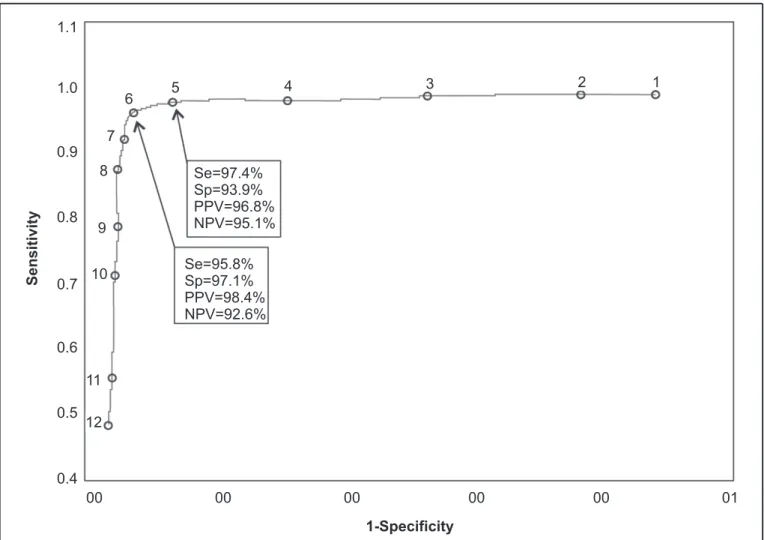
Based on ROC curve analysis (Figure 2), the sensitivity
and specifi city for a 5mm cut-off value were 97.4% and 93.9%, respectively. The sensitivity and specifi city for a 6mm cut-off
value were 95.8% and 97.1%, respectively.
Receiver-operating-characteristic curves are shown
according to sex in Figure 3. The best curve was found for
women who had higher specifi cities for the two cut-off points.
Figure 4 shows the ROC curves according to age (0-14 years,
15-29 years, 30-49 years, and ≥50 years). The best curve was
observed for patients who were 0-14 years old.
Since June 1999, LEPAC/UEM has performed the MST with an antigen from the Brazilian Ministry of Health that is produced in large scale according to good-practice standards
Data bank n = 4,256
Cutaneous lesions Perfomed DS, MST and IIF from June 1999 to February 2014
Positive cutaneous leishmanisis
DS positive Performed MST
Female n = 137
Male n = 632
Female n = 203
Male n = 210 Negative cutaneous
leishmaniasis Lesion up to 2 months old
DS negative; IIF negative Performed MST Resident in urban area
Reported infection at domicile/peridomicile
n = 413 n = 769
FIGURE 1 - Selection of groups after analysis from Laboratório de Leishmanioses of the LEPAC/UEM in Maringá, State of Paraná, Brazil, 1986 to 2014. DS: direct search of parasite; MST: Montenegro skin test; IIF: indirect immune fl uorescence; LEPAC/UEM: Laboratório de Ensino e Pesquisa em Análises Clínicas, Universidade Estadual de Maringá.
of the Secretaria de Estado da Saúde do Paraná, Brazil. The
importance of standardizing the application and reading of the MST has been highlighted by several authors. The test must be performed by a trained technician to ensure comparable results and avoid common causes of variation in the execution and
interpretation of the tests(22) (23). Patients who attend LEPAC/
UEM always undergo a standard protocol that ensures the quality of test performance.
American tegumentary leishmaniasis is known to affect more individuals who live in rural areas. Ninety percent of patients have lesion times up to 2 months, during which time most patients show positive MST and DS results. Thus, the PCL group consisted of patients with positive DS results, and the NCL group consisted of patients with a lesion time up to 2 months
and negative DS and IIF results who resided in urban areas.
This strategy for the NCL group was employed because the
MST, which applies Leishmania antigens, is not recommended
for normal individuals; it could lead to sensitization and
false-positive results if the MST is required in the future. In healthy
subjects who underwent the MST and had tested negative in
a previous study, 50% had a positive test when the MST was
performed again after 90 days, and γ-IFN produced by peripheral
blood mononuclear cells stimulated with Leishmania antigens
was detected in 78% of subjects 360 days after the initial MST(24).
However, other authors observed no positivity with the MST with
a ≥1-year interval between two tests(22).
Comparisons between the PCL and NCL groups showed differences in the mean age of the individuals and the induration diameter. The latter was expected because the PCL group had
a parasitological diagnosis of ATL. In addition, the PCL group
consisted of more men than women, which is consistent with the literature that indicates that men engage in more rural leisure
activities, such as fi shing, than women(20) (25). Within the PCL
group, the mean age and mean induration diameter were not different between the sexes. Similarly, the number of men and women and their mean ages were similar within the NCL group; however, the mean induration diameter was higher in men.
The ROC curve that was constructed for the PCL and
1. 1
Se=97.4% Sp=93.9% PPV=96.8% NPV=95.1%
Se=95.8% Sp=97.1% PPV=98.4% NPV=92.6% 1.0
0.9
0.8
0.7
0.6
12 11 10
9 8 7
6 5 4
3 2 1
0.5
0.4
Sensitivity
1-Specificity
00 00 00 00 00 01
FIGURE 2 - Receiver-operating-characteristic curve for 1,182 patients in the positive cutaneous leishmaniasis and negative cutaneous leishmaniasis groups who attended LEPAC/UEM between June 1999 and February 2014. Se: sensitivity; Sp: specifi city; PPV: positive predictive value; NPV: negative predictive value; LEPAC/UEM: Laboratório de Ensino e Pesquisa em Análises Clínicas, Universidade
Estadual de Maringá.
TABLE 1 - Characteristics of 1,182 patients (PCL and NCL groups) according to sex, age, and diameter with the Montenegro skin test. Age (years) Induration (mm)
Groups
range mean ± SD 95% CI range mean ± SD 95% CI
PCL (n = 769) 1-86 39.58 ± 16.38 38.42-40.74 0-44 12.62 ± 5.91 12.20-13.04
women (n = 137) 3-86 38.50 ± 18.76 35.33-41.67 1-44 13.11 ± 6.67 11.11-14.23 men (n = 632) 1-81 39.82 ± 15.83 36.58-41.06 0-42 12.51 ± 5.73 12.07-12.96
NCL (n = 413) 1-90 41.76 ± 20.12 39.81-43.70 0-15 1.43 ± 2.17 1.23-1.63
women (n = 203) 1-90 41.45 ± 20.10 38.67-44.23 0-9 1.20 ± 1.64 0.97-1.42 men (n = 210) 4-84 42.05 ± 20.20 39.30-44.80 0-15 1.65 ± 2.57 1.30-2.00
Total (n = 1,182) 1-90 40.34 ± 17.80 39.33-41.36 0-44 8.71 ± 7.27 8.3-9.12
Se=95.1% Sp=99.0% PPV=98.5% NPV=99.0%
Se=98.5% Sp=98.0% PPV=97.1% NPV=98.0%
Se=97.2% Sp=91.4% PPV=97.2% NPV=91.4% Se=98.4% Sp=87.7% PPV=95.6% NPV=87.7% 1.0
1.0 0.9
0.9 0.8
0.8 0.7
0.7 0.6
0.6 12
12 11 10
9 8
7
6 5 4 3 2 1
11 10 9 8 7
6 5 4 3
2 1
0.5
0.5 0.4
0.4
0 0.05 0.10 0.15 0.20 0.25 0.30 0.35 0.40 0.45 0.50
Sensitivity
Sensitivity
1-Specificity
1-Specificity
00 00 00 00 00 01 1.1
1.1
FIGURE 3 - Receiver-operating-characteristic curve for 1,182 patients in the positive cutaneous leishmaniasis and negative cutaneous leishmaniasis groups who attended LEPAC/UEM between June 1999 and February 2014 for (A) women (n = 340) and (B) men (n = 842). Se: sensitivity; Sp: specifi city; PPV: positive predictive value; NPV: negative predictive value; LEPAC/UEM: Laboratório de Ensino
e Pesquisa em Análises Clínicas, Universidade Estadual de Maringá .
A
1.1 1.1 1.1 1.1 Se=100.0% Sp=97.9% PPV=98.2% NPV=100.0% Se=97.4% Sp=89.2% PPV=94.9% NPV=94.3% Se=96.1% Sp=91.9% PPV=96.1% NPV=91.9% Se=97.5% Sp=92.4% PPV=96.9% NPV=93.7% Se=96.6% Sp=96.6% PPV=97.5% NPV=95.3% Se=94.1% Sp=99.3% PPV=99.5% NPV=92.4% Se=96.6% Sp=96.5% PPV=98.6% NPV=92.1% Se=96.3% Sp=100.0% PPV=100.0% NPV=96.0% 1.0 1.0 1.0 1.0 0.9 0.9 0.9 0.9 0.8 0.8 0.7 0.7 0.8 0.8 0.6 0.6 0.7 0.7 0.5 0.5 0.6 0.6 0.4 0.4 0.5 0.5 0.3 0.4 0.4 12 12 11 10 9 8 7
6 5 4 3 2 1
11 10 9 8
7 6
5 4 3 2 1
0.2 12 12 11 10 9 8 7
6 5 4 3 2
1 11 10 9 8 7
6 5 4 3 2 1
0 0.05 0.10 0.15 0.20 0.25 0.30 0.35 0.40 0.45 0 0.10 0.20 0.30 0.40 0.50 0.60
0 0.10 0.20 0.30 0.40 0.50 0.60 0 0.05 0.10 0.15 0.20 0.25 0.30 0.35 0.40
Sensitivity Sensitivity Sensitivit y Sensitivi ty 1-Specificity 1-Specificity 1-Specificity 1-Specificity
FIGURE 4 - Receiver-operating-characteristic curve for 1,182 patients in the positive cutaneous leishmaniasis and negative cutaneous leishmaniasis groups who attended LEPAC/UEM between June 1999 and February 2014 for patients aged: A. 0-14 years (n = 102); B.
15-29 years (n = 228); C. 30-49 years (n = 502), and D. ≥50 years (n = 350). Se: sensitivity; Sp: specifi city; PPV: positive predictive value; NPV: negative predictive value; LEPAC/UEM: Laboratório de Ensino e Pesquisa em Análises Clínicas, Universidade Estadual de Maringá.
A B
C D
(95.8% sensitivity and 97.1% specifi city). Previous studies that
were conducted by our research group using a 6mm cut-off value for MST found 96% sensitivity among patients with positive DS results and 95.1% sensitivity among patients with positive
MST, DS, and IIF results(19). Comparatively, 90.5% sensitivity
was reported in patients with a positive DS(14), and 78.2%
sensitivity and 77.4% specifi city were reported in patients
who attended a hospital in Peru(26). Positive MST results were
found in 93.3% of patients who had positive direct microscopic
examination(27) and 84.4% of confi rmed ATL cases from State
of Paraná(28).
In the NCL group, six (1.5%) patients had induration diameters ≥10mm with the MST. In endemic areas, a
positive MST can be interpreted as prior leishmaniasis, prior injection of the antigen used in the test, exposure to the parasite without disease (infection), allergy to the test dilution agent, or cross-reactions with other diseases (e.g., Chagas disease, sporotrichosis, Virchowian leprosy, tuberculosis,
chromomycosis, or others)(6). Patients with sporotrichosis (12%)
had an induration diameter ≥10mm with the MST(29). In a
non-endemic region, almost 30% of the individuals had positive
reactions with the MST(30).
For lesions lasting up to 1 month, the sensitivity was 97.5% (5mm cut-off) or 94.9% (6mm cut-off). For durations of 1 and 2 months, the sensitivity was 98.6% (5mm cut-off) or 97.1% (6mm cut-off). Previous studies have reported 78% sensitivity for cutaneous lesions with a duration of up to 2 weeks and 94% and 98% sensitivities for durations of 4 and 6 weeks, respectively, in patients with positive parasitological tests; however, the MST was repeated every 7 days until a positive reaction was obtained (5mm cut-off)(15). Nine (1.2%) patients and 11 (1.4%) patients with lesion
durations >2 months presented negative MST results, depending on the cut-off (5mm and 6mm, respectively). A negative response with the MST after 2 months of disease evolution might be related
with a defect of the host immune response(23).
The ROC curves that were constructed according to sex showed higher sensitivity for men, which supports the fi ndings
women for both cut-off points. Regarding the positive and
negative predictive values, our results agree with this previous study, with higher predictive values in women. The superior
specifi city and positive predictive value in women is reported to
be the result of fewer false-positive results(26). This is supported by the fi ndings in the NCL group in the present study, in
which 18 (8.6%) men and 7 (3.3%) women had induration
diameters ≥ 5mm with the MST.
The ROC curves for the different age groups showed that
the 0-14 years old had a better curve, and both cut-off values (5 and 6mm) could be used. The individuals in this age group were likely not to have encountered many antigens yet, which would
provide a more specifi c response with the MST. In a previous study, a 63.2% sensitivity for patients <12 years of age, 100% for patients 12-18 years of age, and 60% for patients ≥65 years
of age have been reported(26). Although the age stratifi cation
was different, our results using a cut-off of 5mm showed higher
sensitivities for the specifi c age groups (100% for patients 0-14
years old, 97.4% for patients 15-18 years old, 97.5% for patients
30-49 years old, and 96.6% for patients ≥ 50 years old).
The present study evaluated the response to the MST in a population from an ATL endemic area in the northern and northwestern regions of the State of Paraná, Brazil. The results
showed 97.4% sensitivity and 93.9% specifi city for the 5mm cut-off and 95.8% sensitivity and 97.1% specifi city for the 6mm cut-off, with higher sensitivity in men, higher specifi city and
predictive values in women, and the best curves for both the 5 and 6mm cut-off values in 0-14 years old. Considering the
need to balance sensitivity and specifi city, both cut-off values (5 and 6mm) could be used in this population. It would also
be interesting to investigate the cut-off values for the MST in populations from other ATL endemic areas.
ACKNOWLEDGMENTS
The authors declare that there is no confl ict of interest.
CONFLICT OF INTEREST
FINANCIAL SUPPORT
REFERENCES
We offer our deepest thanks to the institutions that provided technical support for the development and implementation of this study, especially to the pharmaceutical-biochemical Eneide Aparecida Sabaini Venazzi and Paulo Donizeti Zanzarini.
This work received financial support from Fundação
Araucária, Conselho Nacional de Desenvolvimento Científi co
e Tecnológico (CNPq), Coordenação de Aperfeiçoamento de Pessoal de Nível Superior (CAPES) and Laboratório de Ensino e Pesquisa em Análises Clínicas of the Universidade Estadual de Maringá (LEPAC/UEM).
1. World Health Organization (WHO). Leishmaniasis. Geneva, Swirtzerland: WHO; 2012. (Accessed 2014 May 6). Available at: http://www.who.int/leishmaniasis/en
2. Ministério da Saúde. Casos de Leishmaniose Tegumentar Americana. Brasil, Grandes Regiões e Unidades Federadas. 1990 a 2013. Brasília: Ministério da Saúde; 2014. (Accessed 2014 September 15). Available at: http://portalsaude.saude.gov.br/ images/pdf/2014/setembro/09/LT-Casos.pdf
3. Lima AP, Minelli L, Communello E, Teodoro U. Distribuição da leishmaniose tegumentar por imagens de sensoriamento remoto orbital, no Estado do Paraná, Sul do Brasil. An Bras Dermatol 2002; 77:681-692.
4. Marzochi ACA, Marzochi KBF. Tegumentary and visceral leishmaniasis in Brazil – emerging anthropozoonosis and possibilities for their control. Cad Saude Publica 1994; 10 (supl II):359- 375. 5. Andrade BB, Boaventura V, Barral-Neto M, Barral A. Métodos
Diagnósticos da leishmaniose tegumentar: fatos, falácias e perspectivas. Gaz Med Bahia 2005; 75:75-82.
6. Ministério da Saúde, Secretaria de Vigilância em Saúde, Departamento de Vigilância Epidemiológica. Manual de vigilância da leishmaniose tegumentar americana. 2nd ed. Brasília: Ministério
da Saúde; 2013. p. 180.
7. Gontijo B, Carvalho MLR. Leishmaniose tegumentar americana. Rev Soc Bras Med Trop 2003; 36:71-80.
8. Montenegro J. Cutaneous reaction in leishmaniasis. Arch Dermatol Syphilol 1926; 13:187-194.
9. Carvalho EM, Correia Filho D, Bacellar O, Almeida RP, Lessa H, Rocha H. Characterization of the immune response in subjects with self-healing cutaneous leishmaniasis. Am J Trop Med Hyg 1995; 53:273-277.
10. Sokal JE. Measurement of delayed skin-test responses. New Eng J Med 1975; 293:501-502.
11. Hailu A, Berthe N, Ali A, Gemetchu T. Use of Leishmania major
derived leishmanin skin test surveys of visceral leishmaniasis in Ethiopia. East Afr Med J 1997; 74:41-45.
12. Arana BA, Roca M, Rizzo NR, Mendoza CE, Kroeger A. Evaluation of a standardized leishmanin skin test in Guatemala. Trans R Soc Trop Med Hyg 1999; 93:394-396.
13. Basano AS, Camargo LMA. Leishmaniose tegumentar Americana: histórico, epidemiologia e perspectivas de controle. Rev Bras Epidemiol 2004; 7:328-337.
14. Sadeghian G, Momeni A, Siadat AH, Yousefi P. Evaluation of leishmanin skin test and its relationship with the clinical form and duration of cutaneous leishmaniasis. Dermatol Online J 2006; 12:3. 15. Manzur A, Bari A. Sensitivity of leishmanin skin test in patients
of acute cutaneous leishmaniasis. Dermatol Online J 2006; 12:2. 16. World Health Organization (WHO). The control of the leishmaniases.
WHO Technical Report Series n 949. Geneva, Swirtzerland: WHO; 2010. (Accessed 2014 October 8). Available at: http://www.who.int/ leishmaniasis/research/978924129496_pp67_71.pdf?ua=1
DA, Dias MLG. Avaliação da intradermorreação de Montenegro: comparação entre dois antígenos de diferentes procedências. Rev Unimar 1991; 13:5-19.
19. Silveira TGV, Arraes SMAA, Bertolini DA, Teodoro U, Lonardoni MVC, Roberto ACBS, et al. Observações sobre o diagnóstico laboratorial e a epidemiologia da leishmaniose tegumentar no Estado do Paraná, sul do Brasil. Rev Soc Bras Med Trop 1999; 32:413-423.
20. Curti MCM, Silveira TGV, Arraes SMAA, Bertolini DA, Zanzarini PD, Venazzi EAS, et al. Epidemiological and clinical characteristics of cutaneous leishmaniasis and their relationship with the laboratory data, south of Brazil. Braz J Infec Dis 2011; 15:12-16.
21. Centro de Produção e Pesquisa de Imunobiológicos (CPPI). Antígeno de Montenegro. Bula do antígeno; Paraná; 2008. (Accessed 2014 September 14). Available at: http://www.saude. pr.gov.br/arquivos/File/CPPI/bulas/montenegro.pdf
22. Weigle KA, Valderrama L, Arias AL, Santrich C, Saravia NG. Leishmanin skin test standardization and evaluation of safety, dose, storage, longevity of reaction and sensitization. Am J Trop Med Hyg 1991; 449:260-271.
23. Antonio LF, Fagundes A, Oliveira RVC, Pinto PG, Bedoya-Pacheco SJ, Vasconcellos ECF, et al. Montenegro skin test and age of skin lesion as predictors of treatment failure in cutaneous leishmaniasis. Rev Inst Med Trop São Paulo 2014; 56:375-380.
EM. Avaliação do poder sensibilizante da reação de Montenegro. Rev Soc Bras Med Trop 2001; 34:537-542.
25. Murback NDN, Nascimento RAF, Dorval MEMC, Hans Filho G, Nakazato KRO. Leishmaniose tegumentar Americana: estudo clínico, epidemiológico e laboratorial realizado no Hospital Universitário de Campo Grande, Mato Grosso do Sul, Brasil. An Bras Dermatol 2011; 86:55-63.
26. Boggild AK, Ramos AP, Espinosa D, Valencia BM, Veland N, Miranda-Verastegui C, et al. Clinical and Demographic Stratifi cation of Test Performance: A Pooled Analysis of Five Laboratory Diagnostic Methods for American Cutaneous Leishmaniasis. Am J Trop Med Hyg 2010; 83:345-350.
27. Hashemi SN, Mohebali M, Mansouri P, Bairami A, Hajjaran H, Akhoundi B, et al. Comparison of Leishmanin Skin Test and Direct Smear for the Diagnosis of Cutaneous Leishmaniasis. Acta Med Iran 2011; 49:136-141.
28. Pontello Jr R, Gon AS, Ogama A. American cutaneous leishmaniasis: epidemiological profi le of patients treated in Londrina from 1998 to 2009. An Bras Dermatol 2013; 88:748-753.
29. Barros MBL, Schubach A, Francesconi-Dovalle AC, Gutierrez-Galhardo MC, Schubach TMP, Conceição-Silva F, et al. Positive Montenegro skin test among patients with sporotrichosis in Rio de Janeiro. Acta Trop 2005; 93:41-47.