Abstract
Resumo
This work developed experimental tests and numerical models able to represent the mechanical behavior of prisms made of ordinary and high strength concrete blocks. Experimental tests of prisms were performed and a detailed micro-modeling strategy was adopted for numerical analy-sis. In this modeling technique, each material (block and mortar) was represented by its own mechanical properties. The validation of numerical models was based on experimental results. It was found that the obtained numerical values of compressive strength and modulus of elasticity
difer by 5% from the experimentally observed values. Moreover, mechanisms responsible for the rupture of the prisms were evaluated and com -pared to the behaviors observed in the tests and those described in the literature. Through experimental results it is possible to conclude that the numerical models have been able to represent both the mechanical properties and the failure mechanisms.
Keywords: numerical simulation, concrete prisms, prisms failure modes.
No presente trabalho desenvolveram-se ensaios experimentais e modelos numéricos capazes de representar o comportamento mecânico de prismas confeccionados com blocos de concreto comuns e de alta resistência. Foram realizados ensaios experimentais de prismas e, para a análise numérica, adotou-se como estratégia de modelagem, a micromodelagem detalhada, onde cada material (bloco e argamassa) foi repre-sentado por suas propriedades mecânicas. A validação dos modelos numéricos foi realizada com base em resultados experimentais realizados.
Veriicou-se que os valores obtidos numericamente de resistência à compressão e módulo de elasticidade diferem 5% em relação aos valores
observados experimentalmente. Ainda foram avaliados quais os mecanismos responsáveis pela ruptura dos prismas, comparando-se tanto com
o comportamento veriicado nos ensaios, quanto com os descritos na literatura. Por meio dos resultados experimentais conclui-se que os mode -los numéricos foram capazes de representar tanto as propriedades mecânicas quanto os mecanismos responsáveis pela ruptura.
Palavras-chave: simulação numérica, prismas de concreto, modos de ruptura prismas.
a Escola de Engenharia de São Carlos, São Carlos, SP, Brasil; b Universidade Federal de Viçosa, Viçosa, MG, Brasil;
c Professor Titular, Universidade Federal de Minas Gerais, MG, Belo Horizonte, Brasil; d Universidade Federal de Lavras, Viçosa, MG, Brasil.
Received: 02 Jun 2016 • Accepted: 30 Ago 2016 •Available Online: 17 Apr 2017
C. F. R. SANTOS a
R. C. S. S. ALVARENGA b [email protected]
J. C. L. RIBEIRO b [email protected]
L. O. CASTRO b [email protected]
R. M. SILVA c [email protected]
A. A. R. SANTOS d [email protected]
1. Introduction
Masonry structure is a building system with elements that perform both
structural and sealing functions, thus allowing a greater rationalization. As this system has been increasingly used in the construction sector, there is a need for innovative materials in the industry.
According to (Castro [1]), the use of minerals (silica fume, calcined clay) and plasticizing admixtures has proportioned blocks of greater strength and lower permeability, thus named high strength blocks. Despite the development of new materials and the use of much more slender struc-tures, codes have not undergone many changes to follow such a big development. The main reason is the lack of experimental and math-ematical models that explain the complex behavior of units and mortar working together as a composite material.
As an experimental program with wall testing is expensive, most of the authors agree that is possible to establish a relation between the load and failure mode of the walls, studying the prisms behavior. It would allow the reduction of testing costs. Still regarding the possibility of cost
reduction, an alternative widely used to study speciic phenomena is the
numeric simulation. Since well calibrated, it is able to supply information about the structural behavior and provides subsidy to determine, with safety, the parameters to be used in project/codes.
In order to obtain a reliable and accurate numerical model, a complete description of the material must be made based on experimental results. Once calibrated the model, it is possible to vary the desired parameters
and verify the isolated efect of each component. According to (Oliveira
[2]), mortar joints represent planes of weakness and are responsible by most of the nonlinear phenomena that occur on the structure, which behavior makes the computer modeling process more complex. Considering this context, the goal of this work is to present the cali-bration of prisms’ numerical models, based on the experimental results obtained by (Oliveira [2]) and also by the authors of this work. With the
numerical modeling results, a study will be conducted to compare the mechanisms responsible by failure to the behavior observed during the tests.
2. Context
In order to base the discussion of the results (item 4), some conclu-sions about prisms obtained by other researchers will be presented.
2.1 Behavior of mortar in the prisms
When the masonry is submitted to a vertical loading, the generated state of stress causes horizontal stresses on the mortar joint due to existing adhesion between the unit and the mortar. So, in a prism or wall, the mortar is subjected to a triaxial state of stress,
present-ing a behavior diferent from that observed in uniaxial testpresent-ing. It is
noted that when the mortar is subjected to a triaxial state of stress, changes occur in its mechanical properties, such as: compressive
strength, Young’s modulus, and Poisson’s ratio. According to (Mo
-hamad [3]) and (Khoo [4]), the study of the behavior of conined
mortar is essencial to understand the failure mechanisms of prisms and walls, either by reaching the block’s tensile strength, or occur-ring the block’s localized crushing, or happening the mortar bed joints crushing. Thus, both authors studied the increase of mortar
compressive strength due to the increase of the conining pres -sure, obtaining the failure envelope. The equations ( 1 ) and ( 2 )
correspond to the failure envelope proposed by (Mohamad [3]) and
(Khoo [4]) to mortar 1:1:6, respectively.
(1)
arg arg
2,6
tmf
*=
f
+
×
f
(2)
arg arg
2,3
tmf
*=
f
+
×
f
Figure 1
(Riddington[5]).
(3)
where:u
t
is the shear strength of horizontal or vertical joint;0
v
f
is the shear strength by initial adherence, also named cohesion;σ
is the normal pre-compression stress acting across the joint;φ
is the friction angle of the material.2.3 Rupture modes of the prisms
There is a consensus among researchers that the rupture mode of prisms and walls is function of the mechanical properties of their con-stituent materials, such as Young’s modulus and compressive strength. The studies led by (Hamid e Drysdale [6]) suggest that the mecha-nism of rupture of masonry occurs due to the biaxial
tensile-com-pressive stress state, in consequence of the low stifness of the
mortar. According to the authors, the units prevent the lateral
de-formation of the mortar, resulting in lateral conining stresses on
it, so the mortar strength is considerably increased. Analyzing the experimental results, the authors concluded that when the loads
reach approximately 80% of the ultimate load, some microcracking
occurs along the entire length of the prisms.
As done by other authors, (Mohamad [3]) performed experimental
tests on prisms of concrete units with face shell mortar bedding. In the rupture, they observed the development of tensile stresses on the lateral face caused by rotation and crushing of the supports. This rupture mechanism is similar to the beams’, in which the mor-tar’s lateral crushing induces horizontal stresses that cause the material to fail in bending, as can be seen in Figure 1.
In his tests, (Romagna) [7] evaluated the mechanical behav-ior of concrete prisms under compression. The author noted the development of intense cracking at the intersection of the blocks’ face shells and webs, and also crumbling at the block’s surface. The author also reported that there were cracks in
spe-ciic points of the block’s walls due to the loss of mortar
load-carrying capacity, causing the units’ overlapping and their con-sequent crushing.
In this context, the research carried out by (Cheema e Klingner [8] apud Juste [9]) can be also mentioned. They developed math-ematical expressions able to predict the compressive load related to the occurrence of each kind of rupture of ungrouted prisms (by transverse block splitting, block crushing or mortar crushing), de-pending on the relationship between the elasticity modulus of mor-tar and blocks. Based on some expressions it was possible to plot the graph shown in Figure 2. When
E
argE
b≥
0.66
the ruptureoccurs, preferably, by mortar crushing (region 2 of the Figure 2). When
E
argE
b≤
0.66
the rupture occurs by transverse blocksplitting (region 1 of the Figure 2).
3. Materials and methods
This paper performed a numeric simulation of some prisms tested by the authors of this work and others by (Oliveira [2]). In both cases, the prisms were produced using face shell mortar bedding and con-crete blocks. The authors of this study used high strength blocks and (Oliveira [2]) used common blocks. For calibration and validation of
Table 1
Experimental results, Authors
Experimental data (Authors)
Blocks* Prism** Mortar*
Dimensions (cm) fbm (MPa) Ecm (MPa) ftb,ind (MPa) fpm (MPa) Epm (MPa) fm (MPa) Em (MPa)
15 x 19 x 29 35.19 35.37 1.76 10.60 8006.00 11.80 9293.05
* Results related to the net area; ** Data related to the gross area
Figure 2
numerical models the authors used the experimental results and the
description of the rupture modes experimentally certiied.
3.1 Materials
Table 1 and Table 2 present experimental results used in the con-struction and validation of the numerical models, obtained by the authors and (Oliveira [2]), respectively.
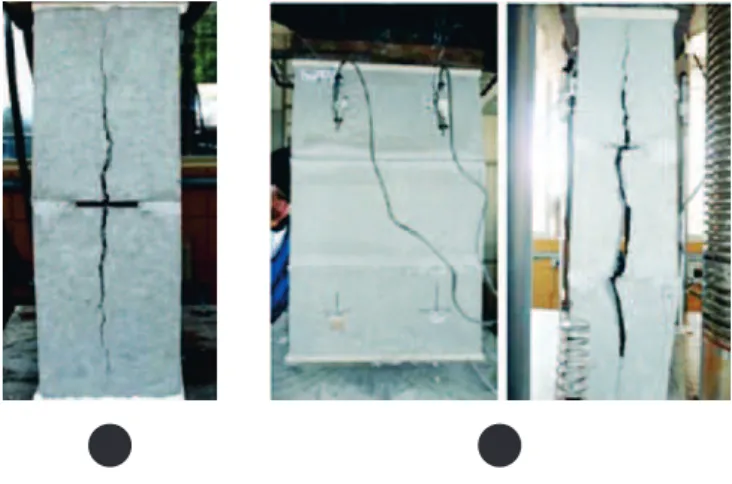
Figure 3ab presents the rupture modes displayed in the
experimen-tal tests performed by the authors and (Oliveira [2]), respectively. It should be emphasized that the commercial software ABAQUS was used to perform the numerical modeling, by Finite Element
Method.
3.2 Methods
A detailed micro-modeling strategy was adopted for numerical modeling of the prisms. In this technique, each component of the prism was represented by its own mechanical properties and di-mensions. It was also necessary to supply parameters for com-plete discrimination of block/mortar interface (item 3.5).
3.3 Description of the models
The inite element used to generate the mesh that represents
blocks and mortar was C3D8, which is a solid element of eight nodes with linear interpolation and complete integration, able to represent the translations in x, y and z-axis, once the element has three degrees of freedom per node.
In order to facilitate the description of the numerical models, they
were identiied as PA and PO, which are related to the experimen -tal results used for calibration and validation obtained by the pres-ent authors and (Oliveira [2]), respectively.
When performing meshing tests, it was decided to use, for PA mod -el, elements with dimensions of 1 cm for the blocks and 5 mm for
the mortar. For PO model, elements with 2 cm for the blocks and
5 mm for the mortar proved to be more appropriate. The meshing
Table 2
Experimental results, (Oliveira [2])
Experimental Data (Oliveira [2])
Blocks* Prism** Mortar*
Dimensions (cm) fbm (MPa) Ecm (MPa) ftb,ind (MPa) fpm (MPa) Epm (MPa) fm (MPa) Em (MPa)
14 x 19 x 39 18.65 18.10 0.91 4.49 8420.00 3.52 6800.00
* Results related to the net area; ** Data related to the gross area
Figure 3
Failure mode of concrete block prisms, Authors
and (Oliveira [2])
A B
Figure 4
diference between the two models occurs due to the lowest num
-ber of interfaces in the PA model, allowing further reinement of the
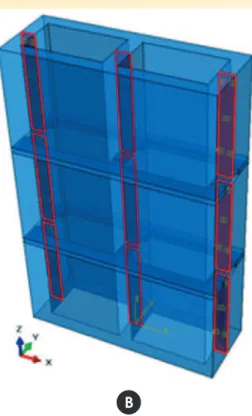
block mesh, still having a reasonable computational cost. In Figure 4, the general aspects of the meshes of the models are presented. In respect to the loading, it was decided to apply a prescribed displacement (1,0 cm) to the entire top surface, thus all nodes of the surface were subjected to a rigid body motion. The analysis method for the models was the Static General, Newton Rapson. For the supports, both models have had the same boundary condi-tions, shown in Figure 5abc. They where: a) z-axis translational
restraint at the base of the block, Figure 5a; b) x-axis displace
-ment restraint for both block(1) and mortar(2), Figure 5b; c) y-axis
displacement restraint for both block (1) and mortar (2), Figure 5c. Both x and y restraints of blocks and joints were imposed to all of the model's blocks and joints.
3.4 Constitutive model
The constitutive model used to represent the mechanical behavior
of blocks and mortars was the Concrete Damaged Plasticity. Ac -cording to (Kmiecik and Kaminski [10]), this model is an adaptation
of the Drucker-Prager model, which is also used to represent the
mechanical behavior of brittle materials.
In Concrete Damaged Plasticity (CDP), the equation that deines
Figure 5
Boundary conditions of the prisms
B B B
A B1 B2
Figure 6
Continuation of the boundary conditions of the prisms
B B
the surface of Drucker Prager is modiied by a Kc parameter equal
to 2/3, Figure 7. Note that this model has been proposed by (Lub-liner et al. [11]).
Still about the constitutive model, it is necessary to deine some
essential calibration parameters to make it be useful:
3.4.1 Behavior under uniaxial compression in the inelastic region
In the CDP constitutive model, elastic and inelastic deformation
(
ε
el andε
inel, respectively) are calculated independently, and subsequently summed to obtain the total deformation (ε
).ε
eldepends only on the materials’ modulus of elasticity and Poisson’s
ratio and
ε
inel is obtained from their stress-strain curve.In many cases, it is diicult to obtain stress-strain curves experi
-mentally. Some authors and codes present empirical formulations, in which the researcher only includes parameters that are gener-ally easy to determine.
The compression’s stress-strain curve used in this paper was
pro-posed by (Guo [12]). It considers the elastic region until 30% of the
ultimate load, where the modulus of elasticity is the slope of the
stress-strain diagram. The inelastic region is deined by the for -mulation proposed by (Guo [12]). Figure 8 presents his schematic stress-strain curve.
As described above, the curve is composed by two regions. The formulation that composes each region is given by equations ( 4 ), ( 5 ),( 6 ),( 7 ),( 8 ) e ( 9 ):
- Elastic region:
(4)
c
E
cms
=
×
e
- Inelastic region:
(5)
(6)
2
1
( 1)
bm cd
f
x
x
x
s
a
=
>
-where:
(7)
1c
x
e
e
=
(8)
1
cm a
c
E
E
a =
(9)
1.5
£
a
d£
3
Figure 7
Influence of the K
cparameter on the shape of the yield surface.
Source: Aguiar (2014)
Figure 8
and:
-
E
cm is the initial modulus of elasticity (considering a stress of 0,3f
bm);-
E
c1is the secant modulus of elasticity (considering the maximum stress).The parameter
α
d afects the descendant portion of the curve, as shown in Figure 9, and must be calibrated.The program requires the portion of deformation of the stress-strain curve related to the inelastic deformation independently. Then, it is necessary to subtract the elastic deformation of the total deformation, by using the equation (10):
(10)
c inel
cm
E
s
e
= -
e
Applying this equation to calculate a new deformation for each point of the described stress-strain curve, it is possible to build the curve that supplies the software, Figure 10.
The parameters values necessary to build the analytical stress-strain curve of blocks and mortar are shown in Table 3 and Table 4. The values of αd were obtained from the experimental curves obtained by (Oliveira [2]). For the experimental curves obtained in this study, the same αdobtained by (Oliveira [2]) was adopted.
3.4.2 Behavior under uniaxial tensile in the inelastic region
As done for compression, it is necessary to indicate the behavior of the material under tensile. Thus, it is necessary to provide the tensile’s stress-strain curve, that also has an elastic and an inelas-tic portion, (Guo [12]), Figure 11. The elasinelas-tic region is described by
Figure 9
Parameter range
Source: Guo (2014)
Figure 10
Stress-inelastic strain curve, generic curve
Table 4
Input parameters for stress-strain curve, Authors
Table 3
Input parameters for stress-strain curve, (Oliveira [2])
(Oliveira [2])
Blocks* Mortar
fbm (MPa)
Ecm
(MPa) αd εc1 (‰)¹ εcu (‰)
fbm
(MPa) Ecm (MPa) αd εc1 (‰)¹ εcu (‰)
18.64 18115.0 2.3 2.24 30 3.52 6796.7 0.4 1.883 10
* Block properties related to the net area; ¹ the strain at peak load was determined based on the stress-strain curve experimentally obtained.
Authors
Blocks* Mortar
fbm (MPa)
Ecm
(MPa) αd εc1 (‰)¹ εcu (‰)
fbm
(MPa) Ecm (MPa) αd εc1 (‰)¹ εcu (‰)
35.37 35459.14 2.3 2.3 30 11.80 9293.05 0.4 1.9 30
equation (11) and the inelastic deformation is described by equa-tions ( 12 ), ( 13 ), ( 14 ) e ( 15 ).
- Elastic region:
(11)
btm cm
f
=
E
×
e
-Inelastic region:
(12)
[ ]
1,71
t btm t
x
f
x
x
s
a
=
-
+
where:
(13)
0.312
t
f
btma =
×
(14)
ct
x
e
e
=
(15)
btm ct
cm
f
E
e =
and:
-
E
cm is the initial tangent modulus of elasticity;-
f
btmis the tensile strength of material.For concrete, the (ABNT NBR 6118:2014 [17]) estimates the ten-sile strength as
f
ctm=
0.3 (
⋅
f
ck)
2/3. However, there is no specii-cation for tensile strength of blocks and mortar. Then, equation (16) was adopted:
Figure 11
Stress-inelastic strain curve, tensile generic curve
Table 5
Input parameters for tensile stress-strain curve, (Oliveira [2])
Table 6
Input parameters for tensile stress-strain curve, Authors
(Oliveira [2])
Blocks* Mortar
fbtm
(MPa) Ecm (MPa) εc1 (‰)¹ εcu (‰)
fat
(MPa) Ecm (MPa) εc1 (‰)¹ εcu (‰)
2.11 18115.1 0.1164 0.9 0.7 6796.7 0.1021 0.9
* Block properties related to the net area.
Authors
Blocks* Mortar
fbtm
(MPa) Ecm (MPa) εc1 (‰)¹ εcu (‰)
fat
(MPa) Ecm (MPa) εc1 (‰)¹ εcu (‰)
3.23 35459.14 0.0912 0.9 1.97 9293 0.2 0.9
* Block properties related to the net area.
Figure 12
(16)
2/30.3 (
)
btm bm
f
=
×
f
As done for compression, it is necessary to calculate the portion of deformation related to the inelastic one, in order to build the stress-strain curve shown in (Figure 11). Again, the elastic deformation was subtracted of the total deformation, as done to obtain equation (10). The input parameters used in the modeling are presented in Table 5 and Table 6.
3.4.3 Stifness degradation of the material
When applied the load and exceeded the elastic region, a stifness
degradation occurs due to the appearance of plastic deformation. This degradation can be determined by unloading the material, cal-culating the unloading modulus of elasticity, and comparing it to
the initial modulus of elasticity. As a simpliication, it was assumed
that this behavior occurs just in the postpeak stress–strain curve, Figure 13.
The decrease of the slope is ruled by two independent variables,
c
d
(damage in uniaxial compression) andd
t (damage in uniaxial tensile). It ranges from zero for an undamaged material to one for the total loss of load-bearing capacity. According to (Cardoso [14]),those variables can be deined using the equations (17) and (18):
(17)
1
c c bmd
f
s
=
-(18)
1
t t ctmd
f
s
=
-3.4.4 Parameters of the constitutive model Concrete Damaged Plasticity
Besides the previously mentioned parameters, it is necessary to provide to ABAQUS some other ones, which are responsible for allowing to apply the equations of the behavior of materials under
uniaxial state of stress to materials under multiaxial state of stress (Aguiar [15]):
n
0
/
0b c
σ
σ
: Parameter that describes the ratio between the yieldstrength in biaxial and uniaxial state. This study adopted the
value of 1.16 given by ABAQUS, (SIMULIA [13]) as a default
value.
n Dilation angle
( )
ψ
: According to (Cardoso [13]), thisparam-eter is related to the slope that the plastic potencial reaches
un-der higher conining stress. (Kmiecik and Kaminski [10]) deine
the dilation angle as the concrete’s angle of internal friction and recommend the adoption of
ψ
= °
36
.n Viscosity parameter
( )
µ
: Parameter whose function is facili-tate process of numerical models, regulating the constitutive equations through the viscoplasticity study. In this work, a value of
µ
=
10
−6 was adopted, based on a preliminary study that looked for the lower value of viscoplasticity that facilitated theconvergence process, without afecting the results.
n Eccentricity parameter
ρ
: According to the theory of DruckerPrager, the yield surface in the meridian planes has the form of a
straight line (
ρ =
0
). However, the experimental trials indicate that the yield surface takes the shape of a hyperbole close to the hydrostatic axis (ρ
=
0.1
). In this study, it was adoptedρ =
0
.3.5 Description of the block/mortar interface
To make block and mortar interact together in the model, it was
necessary to deine the relationship between them. The Inter-actions moduleof ABAQUS was used to do this. The contact between the surfaces was established through the option called surface-to-surface contact, where three contact properties
were deined: Hard, Tangential Behavior, Cohesive Behavior and Damage.
n The Hard contact has the ability to prevent a surface penetrates
other surface and also allows a separation between them, after the contact is established.
n The Tangential Behavior contact can reproduce the friction that
oc-curs on the connection between the materials. It is deined by the static friction coeicient ϕ. It obeys the Coulomb law, in which the shear strength increases due to the increase of the compression
Figure 13
Degradation of the material’s stiffness, SIMULIA [13]
Source: Simulia (2012)
stress. Two features in this contact must be taken into consideration:
the irst one is that part of the cohesion is despised, and the sec -ond one is the possibility of establishing a critical shear stress
t
máx . When the shear stress reaches this critical value, the slipping be-tween the surfaces will occur without an increase in shear strength, regardless of the magnitude of the compressive stress, Figure 14.n The Cohesive Behavior works like a zero thickness rubber, for
which you can specify the normal stifness
K
nn and the tan-gential stifnessK
ss,K
tt of the interface. This kind of contact causes a stifness degradation called Damage, in which it isonly necessary to provide the interface’s fracture energy.
The input parameters to deine the interface properties are pre -sented in Table 7 and Table 8.
The interfaces locations on the prisms models are shown in Fig-ure 15ab and FigFig-ure 16ab. The positions of the interfaces were
deined from the experimental results, and correspond to those
where the cracks occured.
4. Results and discussion
4.1 Compressive strength and modulus
of elasticity
The results obtained from the numerical models are presented
below and compared to the experimental results presented at the item 3.1. Once the numeric models are validated for each case, the possible failure modes will be discussed. The properties of blocks and mortars used in the numerical modeling of the prisms were obtained from the mechanical characterization experimentally per-formed.
Remembering the convention used to identify the numerical
model: PO is related to the numerical modeling of the prisms test
-ed by (Oliveira [2]) and PA is relat-ed to the modeling of the prisms
tested by the authors of this paper.
In Table 9 and Table 10, comparisons between experimental and numerical results of the (Oliveira [2]) and this authors’ prisms are presented. The data include values for uniaxial compressive
stresses and modulus of elasticity, calculated between 0.5 MPa and 30% of the failure load.
It is noted from Table 9 and Table 10 that the numerical models of the prisms represented well the mechanical behavior obtained experimentally for both failure mode and modulus of elasticity. The
biggest diference between experimental and numerical results was around 5%. However, it is worthwhile to also make a compari -son of the failure modes in order to verify the behavior compatibil-ity between the experimental and numerical model. The principal stresses state at the moment of the rupture will be checked.
4.2 Principal stresses in the blocks
Figure 17ab shows the maximum principal stresses state that was acting (only on the blocks) at the time of the rupture, for the models
PO and PA.
Figure 17a and Figure 17b show that, at the time of the rupture, the indirect tensile stress (related to the net area) experimentally
obtained (0.91 MPa for blocks of this authors and 1.47 MPa for [2])
had already been exceeded. This behavior was mainly noted at the blocks’ face shells, which were subjected to bending due to the face shell mortar bedding. Such behavior was also demonstrated in the experimental tests, according to the authors and [2]. Based on the Figure 17ab, at the time of the rupture, the blocks’ face shells supported tensile stresses higher than the indirect ten-sile stresses of the blocks. This behavior is due to the stress gener-ated by the tendency of expulsion of the mortar’s outer edges (due to the vertical load), so that the shear strength between blocks and mortar was not exceeded, due to the friction between them. In the
Figure 14
Tangential Behavior, SIMULIA [13]
Source: Simulia (2012)
Table 7
Input parameters adopted to define the interface properties, (Oliveira [2])
Table 8
Input parameters adopted to define the interface properties, Authors
(Oliveira [2]) – Interface properties
Tangential behavior Cohesive behavior – N/m Damage initiation – MPa Damage evolution
ϕ tmax
(MPa) Knn Kss Ktt tn° ts° tt° Ef (Nm)
0.5 10.5 5000 2.1 106 2.1 106 0.91 0.23 0.23 50
(Authors) – Interface properties
Tangential behavior Cohesive behavior – N/m Damage initiation – MPa Damage evolution
ϕ tmax
(MPa) Knn Kss Ktt tn° ts° tt° Ef (Nm)
outer part of the mortar joint, the conining efect is smaller. Conse -quently, the mortar tends to present a greater deformation, causing
the described efect. In this study, the occurrence of rupture of the
block’s walls was observed during the tests, thus indicating those
tensile efects.
Figure 18ab presents the minimum principal stress state that was
act-ing in the blocks at the time of the rupture, for the models PO e PA.
Based on Figure 18a and Figure 18b, at the time of the rupture, the lowest block’s minimum principal stress have already presented values close to those obtained in the uniaxial compression test and
related to the block’s net area (18.64 MPa to PO and 35.37 MPa to PA). In both models, the blocks’ face shells presented stress -es close to their compr-essive strength, which indicat-es that the loads tend to concentrate in there. In the experiments performed
Figure 15
Location of the interfaces with Coesive Behavior
B
B
A
B
Figure 16
Location of the interfaces with Tangential Behavior and Hard contact
B
B
Table 9
Comparison between experimental and numerical results, PO
Table 10
Comparison between experimental and numerical results, PA
Comparison between experimental results obtained by (Oliveira [2]) and numerical ones obtained by the authors
ID Prisms compressive strength (fp) MPa**
Modulus of elasticity (GPa)**
Prisms compressive strength (fp) MPa***
Modulus of elasticity (GPa)***
PO – Exp. 5.16 8.17 9.42 14.92
PO – Num. 5.02 7.97 9.17 14.55
Difference %¹ - 3% - 3% - 3% - 3%
** Results related to the gross area; *** Results related to the net area; ¹ Related to the experimental results.
Comparison between experimental and numerical results obtained by the authors
ID Prisms compressive strength (fp) MPa**
Modulus of elasticity (MPa)**
Prisms compressive strength (fp) MPa***
Modulus of elasticity (GPa)***
PA – Exp. 10.60 8006.40 18.47 13948.43
PA – Num. 10.11 7790.80 17.61 13572.82
Difference %1 - 5% - 3% - 5% - 3%
** Results related to the gross area; *** Results related to the net area; ¹ Related to the experimental results.
Figure 17
Maximum principal stress numerically obtained, in Pa – only blocks: a) PO model; b) PA model
B
B
by the authors, immediately after the peak load, intense cracking occurred on the blocks’ face shells, causing their disintegration.
In the Figure 18b, the model PA shows that the most solicited
part of the block was the intersection between its face shells and
webs. It happens because the mortar is under high coninement in
this region, preventing displacements of the central portion of the
mortar joint to both sides. This phenomenon did not occur in the
model PO, in which the ratio of mortar and blocks’ modulus of elas -ticity and the friction developed between the components are not
suicient to maintain a high conining pressure at the central por
-tion of the mortar joint. To understand better this efect, the mortar’s
stress state will be checked.
Figure 18
Minimum principal stress numerically obtained, in Pa – only blocks: a) PO model; b) PA model
B
B
A
B
Figure 19
a) Maximum principal stress; b) Minimum principal stress – both numerically obtained, in Pa – only mortar:
PO model
B
B
4.3 Principal stresses in the mortar joints
In Figure 19ab and Figure 20ab, the principal stresses in the
mortar joints are presented, for the models PO and PA.
Analyzing the Figure 19a (model PO), it is possible to observe that
mortar is completely compressed in its two directions due to the
conining efect. In the model PA (Figure 20a), the mortar joint is
not completely subjected to a triaxial state of compression, since
its external part is subjected to a 0.9 MPa tensile stress. Then, the
mortar is under low coninement in this region of the joint. This efect was not realized in the model PO, due to the lower ratio of
mortar and blocks’ modulus of elasticity (
E
arg/
E
b=
0.375
).Based on Figure 19b, all the mortar joint points were subjected to compressive stresses higher than the compressive strength
ob-tained from the uniaxial compression test (PO – 3.52 MPa). The
same behavior was observed in the Figure 20b, where all the black area corresponds to stresses higher than those obtained in the
uniaxial compression test (PA – 11.80 MPa). In both cases this situ
-Figure 20
a) Maximum principal stress; b) Minimum principal stress – both numerically obtained, in Pa – only mortar:
PA model
B
B
A
B
Table 11
Failure envelopes, PO – Mortar
Table 12
Failure envelopes, PA – Mortar
Comparison Comparison Comparison
fa¹ (MPa) ftm (MPa) fa* (MPa) fa* (MPa) fa* (MPa) ftm² (MPa)
3.52
1.00 6.12 5.82
24.16 11.40
2.50 10.02 9.27
5.00 16.52 15.02
7.50 23.02 20.77
10.00 29.52 26.52
12.50 36.02 32.27
¹ The uniaxial compressive strength of mortar was experimentally obtained by Oliveira [2];
² The confining strength was obtained by considering the average value of the vertical stresses acting close to the higher minimum principal stress, check [3].
Mohamad [3] Khoo [4] Numerical result
fa¹ (MPa) ftm (MPa) fa* (MPa) fa* (MPa) fa* (MPa) ftm² (MPa)
11.8
1.00 2.60 2.30
64.17 21.27
5.00 13.00 11.50
10.00 26.00 23.00
15.00 39.00 34.50
20.00 52.00 46.00
35.00 91.00 80.50
¹ The uniaxial compressive strength of mortar was experimentally obtained by Castro [1];
ation is due to the conining efect, since the compressive strength of the material increases signiicantly when considering its actual
triaxial stress state.
Assuming the equation ( 1 ) proposed by (Mohamad [3]) and the
equation ( 2 ) obtained by (Khoo [4]), the failure envelope will be reproduced, in order to verify if the lower minor principal stress (obtained numerically) exceeds the envelope, at the rupture’s load
level. The main point is to verify if the conined mortar’s crushing
did happen.
Using the equations e knowing that the lower minor principal stress
is equal to 24.16 MPa and 64.17 MPa, for PO and PA, respectively,
the failure envelopes were built in Table 11 and Table 12, Figure 21 and Figure 22 show the failure envelopes for both studied models.
Considering Figure 21 and Figure 22, it is possible to airm that at the time of the rupture, PO model presented the lower minor prin -cipal stress close to the maximum mortar’s triaxial compressive
strength. For PA model, the lower minor principal stress had already
exceeded the two failure envelopes. Note that these envelopes,
obtained by (Mohamad [3]) and (Khoo [4]), are only estimates. For
better assessment, it is recommended to carry out studies about the mortar triaxial behavior, as those performed by the authors and [Oliveira 2]. However, their failure envelopes can be considered as tools to assist in the determination of possible failure modes.
4.4 Avaliation of failure modes
Based on the itens 4.2 and 4.3, it is possible to say that the
rup-ture of prisms PO occurred due to a combination of factors. They presented large lexural cracks in their walls, and also block and
mortar crushing. The transverse block splitting was the more evi-dent rupture mode in the experimental test. Comparing the model proposed by (Chema e Klinger [8]) at the item 2.3 to the results obtained numerically, the ratio
E
arg/
E
b=
0.375
would indicate ablock’s tensile failure, which was veriied in the numerical analysis. In PA model, at the time of the rupture, some points of the mortar had already exceeded its compressive strength under conining
pressure, causing the localized crushing of the mortar joint. This behavior was observed in some points of the prisms during the re-search. According to (Chema e Klinger [8]), the localized crushing of the mortar can cause some stress concentration, leading to the
appearance of block’s cracks by compression. Figure 17 indicates that the blocks’ lower minor principal stress exceeded the value of their uniaxial compression strength, indicating the localized crush-ing in the blocks.
Thus, the failure mode of PA prism consisted of the simultaneous
occurrence of webs rupture, due to the bending caused by the face shell mortar bedding (inducing tensile stresses), and localized crushing of the mortar joint, which induced blocks’ localized crush-ing. Comparing the model proposed by (Chema e Klinger [8]) with the numerical results, for the ratio
E
arg/
E
b=
0, 46
(indicated in the item 2.3) the rupture would be given by a block’s tensile failure. This behavior was also obtained in the numerical analysis.5. Conclusions
Based on the presented results, it is possible to conclude that nu-merical models are able to reproduce the mechanical behavior and the failure mechanisms of prisms of ordinary and high strength
concrete blocks. The diference between the compressive strength
and the modulus of elasticity obtained numerically and
experimen-tally was around 3% for the PO model and 5% for the PA model. In addition, the rupture of PO and PA prisms occurred due to a
combination of factors. Block’s web tensile failure happened in both of the models, due to the face shell mortar bedding, and was
the most signiicant failure mode of both experimental and numeri -cal point of view.
Although both models showed the bending efect on the langes,
each one presented some peculiarities when achieved the maxi-mum supported load, due to the mechanical properties of its own components.
In the PO model, the friction developed between block and mortar was enough to keep the mortar completely conined. However, in
the imminence of block’s crushing resulted of the localized crush-ing of the mortar, the transverse block splittcrush-ing occurred.
In the PA model, the region close to the inner face of the blocks
presented a localized crushing of the mortar followed by the local-ized crushing of the blocks. In the outer face, there were tensile stresses in both block and mortar, due to the expulsion of the
mor-tar. Such efect was not observed in the PO model, due to the lower
ratio of the mortar and block’s modulus of elasticity.
Figure 21
Rupture failure, PO – Mortar
Figure 22
6. Acknowledgements
The authors thank the Brazilian agencies Research Support
Foun-dation of Minas Gerais (FAPEMIG) and Coordination for the Im
-provement of Higher Education Personnel (CAPES), and also the
Departament of Civil Engineering of the Federal University of Vi-cosa, for the support provided to this study.
7. References
[1] CASTRO, L. O. Avaliação experimental da interação de paredes de blocos de concreto de alta resistência sob ações verticais. 2015. Dissertação (mestrado) – Universidade Fed-eral de Viçosa, Viçosa, 2015.
[2] OLIVEIRA, L. M. F. Estudo teórico e experimental do com -portamento das interfaces verticais de paredes interconecta-das de alvenaria estrutural. 2014. 272f. Tese (Doutorado),
Escola de Engenharia de São Carlos, São Paulo, 2014. [3] MOHAMAD, G. Mecanismos de ruptura da alvenaria de blo
-cos à compressão. 2007. 290f. Tese (Doutorado), Escola de Engenharia, Universidade do Minho, Portugal, 2007.
[4] KHOO, C.L. A failure criterion for brickwork in axial
com-pression. Ph.D. Thesis, University of Edinburgh, Edinburgh,
Scotland, 1972.
[5] RIDDINGTON, J. R., FONG, K. H.; JUKES, P. Numerical study of failure initiation in diferent joint shear tests. Uni
-versity of Sussex. Masonry international Journal, vol, 11,
Nº 2, 1997.
[6] HAMID, A. A.; DRYSDALE R. G. Suggested failure crite -ria for grouted concrete masonry under axial compression.
American Concrete Institute- Journal Proceedings. Vol. 76
(n. 10):1047-1062. Out. 1979.
[7] ROMAGNA R. H. Resistência à compressão de prismas
de blocos de concreto grauteados e não grauteados. 2000.
195f. Dissertação (Mestrado), Universidade Federal de San
-ta Ca-tarina, Florianópolis, San-ta Ca-tarina, 2000.
[8] CHEEMA, T.S.; KLINGNER, R. E. Compressive strength of a
concrete masonry prism. American Concrete Institute Jour-nal. January-February, 1986. p. 88-97.
[9] JUSTE, A.E. Estudo da resistência e da deformabilidade da alvenaria de blocos de concreto submetida a esforços de
compressão. 2001. 255f. Dissertação (Mestrado), Escola de Engenharia de São Carlos, São Paulo. 2001.
[10] KMIECIK P.; KAMINSKI, M. Modelling of Reinforced Con -crete Structures and Composite Structures with Con-crete Strength Degradation Taken Into Consideration. Archives of
Civil and Mechanical Engineering, vol. Vol.-XI, No. 3, 2011.
[11] LUBLINER J., OLIVER J., OLLER S, OÑATE E. A plastic-damage model for concrete, International Journal of Solids and Structures. Vol. 25, 1989, pp. 299–329.
[12] GUO, Zhenhai. Principles of Reinforced Concrete. 1ª edição.
Oxford, Elsevier, 2014. 587 f.
[13] SIMULIA Software ABAQUS 6.12. Dassault Systèmes,
USA, 2012.
[14] CARDOSO, H. S (2014). Estudo Teórico-Experimental de Parafusos Utilizados como Dispositivos de Transferência de
Carga em Pilares Mistos Tubulares Preenchidos com Con
-creto. Dissertação (Mestrado). Escola de Engenharia, Uni
-versidade Federal de Minas Gerais, Belo Horizonte, 2014. [15] AGUIAR, O. P. Estudo do comportamento de conectores
Crestbond em pilares mistos tubulares preenchidos com concreto. 230 f. Escola de Engenharia, Universidade
Fed-eral de Minas Gerais, Belo Horizonte, 2015.
[16] COMITÉ EURO-INTERNATIONAL DU BETÓN. CEB-FIP
mode code 2012. Bulletin d’Information, 2012.
![Figure 17a and Figure 17b show that, at the time of the rupture, the indirect tensile stress (related to the net area) experimentally obtained (0.91 MPa for blocks of this authors and 1.47 MPa for [2]) had already been exceeded](https://thumb-eu.123doks.com/thumbv2/123dok_br/18861715.418072/10.892.56.845.848.958/figure-figure-rupture-indirect-tensile-experimentally-obtained-exceeded.webp)