Factors Afecting Kinetics of Strain Aging in S275JRC Steel
Ahmet Bülbüla, Ramazan Kaçara*
Received: July 1, 2016; Revised: October 4, 2016; Accepted: November 21, 2016
The materials parameter i.e. microstructure as well as the processing factors i.e. aging time and
temperature, the amount of plastic deformation, and residual stresses afecting the kinetic of strain
ageing in the S275JRC steel were investigated in detail. For this purpose, 5 % pre-strained steel was aged at 160oC for diferent intervals. The ageing behavior was determined for the as-received (AR)
and homogenization & normalizing heat treated (H+N heat treated) conditions. The yield stresses
before and after aging process and, the hardness values of the aged steels were considered to calculate strain aging progress. It was shown that a noticeable increase in the yield strength, tensile strength and
hardness values was observed for aged AR and H+N heat treated specimens. Moreover, the repetitive
increase in the yield and ultimate tensile strength was believed to be a result of strain ageing.
Keywords: S275JRC steel, static strain ageing, mechanical properties
* e-mail: [email protected]
1. Introduction
The time-temperature dependent changes in mechanical properties of plastically deformed metals and alloys are usually
deined as strain ageing. It is well described in literature1-6,
that the materials and processing factors are signiicant parameters that afect the kinetics of strain ageing in steel. The chemical composition, microstructure, difusion rate of
solute atoms, grain size and crystal system may be considered the most important materials factors, while the aging time and temperature, the amount of plastic deformation, and residual stresses after mechanical operations can be regarded as the processing parameters1.
General structural mild steels are used various industries due to their attractive strength, ductility and good weldability. The properties of these steel can be controlled by termo-mechanical methods7,8. These structural mild steels are generally preferred in civil engineering and industry of machinery manufacturing9.
Remarkable researches have been carried out on the strain aging of ultra-low carbon, interstitial free; bake hardenable,
dual phase and various stainless steel9-18. As relatively
inconclusive study is available in the literature, a work is
needed to investigate the materials and processing factors
that are signiicant parameters afecting the kinetics of strain
ageing of S275JRC steel which is preferred for manufacturing heavy vehicle steel wheel rim. This paper focuses mainly on examining the changes in the ultimate tensile and yields strength. The rise in the yield strength due to strain ageing,
hardness of AR and H+N heat treated specimens that are
aged at a temperature of 160oC for diferent aging intervals
is primary indings in this study.
2. Experimental procedure
2.1. Materials and experimental procedure
The commercially available S275JRC steel used in this
study is a plate with a thickness of 6 mm. The chemical
composition of S275JRC steel is given in Table 1. The standard tensile test pieces were prepared according to TS EN ISO 6892-1. The rectangular specimens were
machined from the as-received blanks (Figure 1). A group of test samples were kept for AR condition for strain ageing.
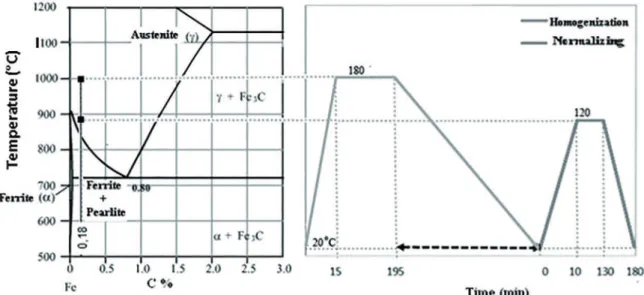
In order to obtain homogenized structure, another group of test specimens were heat treated in a furnace for 3 h at 1000 ± 2oC followed by quenching in the furnace at room temperature. The homogenized test specimens were subjected to normalizing heat treatment for 2 h at 890 ± 2oC followed by quenching in air at room temperature. The normalizing heat treatment process is considered as solution heat treatment. The schematic of heat treatment process is given in Figure 2.
The AR/H+N heat treated tensile test specimens were
pre-strained for 5% in tension. The amount of pre-strain to
which each specimen was subjected was measured by marking
a gauge length of 32 mm on the specimen and straining was continued until this gauge length extended to 33.6 mm for 5% pre-strain. By considering manufacturing and service condition in which cold deformed heavy duty vehicle wheel rim steel can be heated up to 200oC temperature due to friction
lining especially in summer period. To fulill the conditions, the AR/H+N heat treated and 5% pre-strained specimens were artiicially age hardened at 160oC for periods of 10, 20, 30, 45, 60, 90, 120, 150 and 180 minutes in a furnace and subsequently cooled in air. Finally, they were tested using a Schimadzu tensile testing machine at a crosshead speed of 2 mm.min-1. At least three specimens were tensile a Department of Manufacturing Engineering, Technology Faculty, Karabük University, Karabük, 78050,
Table 1: The chemical composition of S275RC steel
Elements (% weight)
DIN EN 10025-2:2004 C Mn P S Cu Si Ni V Cr
S275JRC 0.182 0.949 0.012 0.0002 0.052 0.069 0.025 0.003 0.017
Figure 1: The tensile test sample
Figure 2: The schematic representation of heat treatment processes
tested for each ageing temperature and average values were
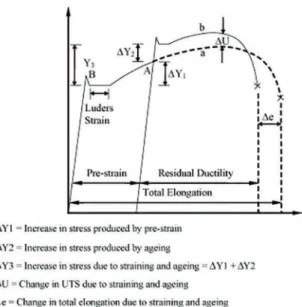
calculated and used in graphic. The increase in low stress as a result of restraining was taken as the strain ageing, ΔY2, which is illustrated in Figure 3. For samples, pre-strained in
tension, ΔY2 was determined with single specimen by the
diference between lower yield stress after ageing and the low stress at the end of the pre-straining16,17. In this study,
ΔY2 is an increase in the yield strength due to strain aging. It is calculated from an increase or decrease disparity between the strength 5% pre-strained sample and yield strength of aged sample.
The hardness measurement of aged test specimens was
carried out using a Universal Hardness Tester (HV1). In order
to eliminate experimental error, ive hardness readings were
performed per specimens to determine their average hardness.
The microstructure of AR/H+N heat treated and 5 %
pre-strained aged test specimens were evaluated through a
Nikon Eclipse L150 microscope. The fractured surfaces of
specimens were also analyzed using Carl Zeiss Ultra Plas
FESEM trade-mark scanning electron microscope (SEM). The
grain size of aged test specimens were measured according to the requirements of the main linear intercepts method. The volume fraction of ferrite phase was also calculated by the point counting method.
3. Results and Discussion
3.1. Strain ageing results
In order to study the efect of the materials parameter
such as, the microstructure, and processing factors such as, ageing time and temperature on the ultimate tensile strength
(UTS), yield strength (YS), the increase in yield strength due to strain aging (ΔY2), and hardness of steel were evaluated. The result of the mechanical properties, the volume fraction of phases and the grain sizes of aged steels are given in Table 2.H+N heat treatment process enhanced the yield strength
of the S275JRC steel as it should be minimum 275MPa. The mechanical properties are also presented in Figure 4 a) and b).
The values -10oC and 0oC temperature on the X axis
refers to the AR/H+N heat treated and 5% pre-strained AR/H+N heat treated samples respectively in Figure 4 a) and b). The variations in UTS, yield strength (YS), strain ageing (ΔY2) and hardness for varying intervals between 10-180 minutes at 160oC are given in Table 2 and shown in
Fig. 4 a) and b) for AR & 5 % pre-strained and H+N heat
ageing (ΔY2) and hardness are observed when the specimen was aged for 20 minutes at the temperature of 160oC in the
form of AR and 5 % pre-strained (Figure 4 a). However, UTS, yield strength, (ΔY2) and hardness were determined for specimen which was aged for 30 minutes at the temperature of 160oC for H+N heat treatment and 5 % pre-strained
(Figure 4 b). The strain ageing (ΔY2) and hardness of test
specimens increased approximately by 29MPa and by 12 HV1, respectively for AR & 5 % pre-strained specimens which were aged at 160oC for 20 minutes while, the strain
ageing (ΔY2) and the hardness increased approximately by
59MPa in strength and by 22HV1 in hardness, respectively
for H+N heat treated & 5 % pre-strained specimens which
were aged at 160oC for 30 minutes. An increase in tensile
strength, yield strength and (ΔY2) could be explained by the
difusion of interstitial atoms such as C and N, by creating
a Cottrell atmosphere by which mobile dislocations are
locked4,15,18-21. The strengthening efect in S275JRC steel could be also explained as a result of interference with the motion of dislocation due to the presence of secondary phase particles such as Fe3C, nitrides and carbonitrides of alloying elements1,14 which could be responsible for increasing the matrix hardness.
In this study, the yield and tensile strength, strain ageing
(ΔY2) and hardness of the AR and H+N heat treated & 5 %
Figure 3: Stress–strain curve for low carbon steel strained to point
A, unloaded, and then restrained immediately (curve a) and after ageing (curve b).
Table 2: The mechanical properties of static strain aged AR&5% pre-strained and H+N heat treated &5% pre-strained samples
Sample Ageing
time
Yield
Strength
(min) UTS (MPa) ΔY2 (MPa)
Ferrite
Phase (%)
Ferrite grain size
(µm)
Pearlite grain size
(µm)
As-received 262 404 - 72 8 6.5
AR&5% pre-strain 10 366 416 4 76 9 5,6
AR&5% pre-strain 20 391 439 29 68 7,8 4,5
AR&5% pre-strain 30 341 391 -21 81 9,4 4,1
AR&5% pre-strain 45 330 379 -32 79 8,6 5,6
AR&5% pre-strain 60 360 408 -2 80 10,8 4,9
AR&5% pre-strain 90 371 425 9 82 9,6 4,4
AR&5% pre-strain 120 378 430 16 74 9,7 5,7
AR&5% pre-strain 150 361 408 -1 75 9,1 5
AR&5% pre-strain 180 350 394 -12 79 9,1 5,5
As-received 262 404 - 72 8 6.5
H+N treated Hom+Nor. 276 415 - 76 10 4,7
H+N treated &5% pre-strain 10 300 344 -52 74 9,6 6,3
H+N treated &5% pre-strain 20 395 412 43 70 8,3 6,3
H+N treated &5% pre-strain 30 411 430 59 61 8,9 6,4
H+N treated &5% pre-strain 45 375 414 23 77 9,1 6
H+N treated &5% pre-strain 60 349 400 -3 76 8,8 4,9
H+N treated &5% pre-strain 90 387 417 35 71 9,1 6,1
H+N treated &5% pre-strain 120 379 415 27 75 6,2 9,5
H+N treated &5% pre-strain 180 369 390 16 77 10 6
Note: ΔY2 is an increase in the yield strength due to strain aging. It is calculated from an increase or decrease disparity between the strength
5% pre-strained sample and yield strength of aged sample
that as the aging time increases at the temperature of 160oC,
a continuous increase in UTS, yield strength (YS), strain ageing (ΔY2) and hardness is noticed. Peaks in UTS, yield
Figure 4: a) UTS, yield strength, (ΔY2) and hardness versus aging time for AR b) H+N heat treated strain aged test samples
pre-strained test specimens were also studied with ageing
time by up to 20 and 30 minutes, respectively. The diference
in ageing time, i.e. 10 minutes, introduced a strengthening
efect in aged AR test specimens. This efect could be
explained by the residual stresses emerging after mechanical
working that increases the ageing rate and improves strength
reached by conventional ageing by providing homogeneously distributed nucleation sites for precipitation in the matrix1. Wilson and Russell22 also indicated that in low carbon steel, the increase in strain ageing during the early stages of precipitation is approximately proportional to the number of solute atoms segregating to unit length of dislocation, and is insensitive to the dislocation density. But at higher segregate concentrations continued segregation is less
efective in increasing strain ageing, also the strain ageing
tends to increase with dislocation density. Since the cold
deformation increases an activation energy for difusion
of solute atoms and the distorted crystal structure leads to
locking of mobile dislocations, therefore, the strain ageing (ΔY2) and the hardness increases.
The 5 % pre-strain applied prior to ageing to AR and H+N heat treated specimens resulted in marked improvements in (ΔY2) and hardness. The amount of deformation is also one
of the main process parameters afecting the kinetics of strain
aging23,24. Therefore, the higher strength of pre-strained and
aged sample (AR and H+N heat treated) can be attributed
to the presence of homogenously distributed precipitates in the matrix25-28.
Further increase in the aging time beyond the 20 and 30 minutes at 160oC temperature reduced the UTS, yield
strength, (ΔY2) and hardness of the steel. As seen Table 2,
the (ΔY2) of test specimens decreased approximately by
-32MPa for AR and 5% pre-straining conditions, which were
aged at 160oC for 45 minutes while, the (ΔY
2) decreased
approximately by -3MPa for H+N heat treated and 5 %
pre-strained specimens, which were aged at 160oC for 60
minutes. The decrease in the (ΔY2) and hardness could be
due to coalescence of the precipitates into larger particles and dissolution of precipitates which cause fewer obstacles to the movement of dislocation, and also due to annealing out of the defects.
The repetitive increase in the yield strength, tensile
strength, (ΔY2) and hardness of the AR and H+N heat treated and 5 % pre-strained test specimen were also determined by ageing time up to 120 and 90 minutes, respectively.
The (ΔY2) and hardness of test specimens for AR & 5 % pre-strained then aged at 160oC for 120 minutes increased
approximately by 16 MPa and 7 HV1 respectively, while
the (ΔY2) and hardness of test specimen H+N heat treated & 5 % pre-strained then aged at 160oC for 90 minutes
increased approximately by 35 MPa, 14 HV1, respectively.
This repetitive increase in (ΔY2) values of specimens could be attributed to the type of microstructure i.e. the cementite phase in pearlite and the precipitate in dislocation line in S275JRC steel can dissolve during the longer ageing time. The dissolved cementite and precipitates such as carbides
of alloying elements can supply solute atoms by backing up the difusion process for solid solution1. The solute atoms in the solid solution acts on dislocations therefore, the strength of sample increases repetitively.
Due to over-aging, a further increase in the ageing time
(150-180 minutes) caused marked decrease in tensile strength (UTS), yield strength, strain ageing (ΔY2) of the steel.
The Figure 5 a) and b) indicates that H+N heat treated
test specimens showed slightly higher strength properties than AR test specimens for all ageing intervals. It could be attributed to the homogenization and normalization heat treatment followed by air quenching by which dissolved precipitates and cementite during the solution heat treatment
(normalization) supplied higher amount of solute atoms in
solid solution. The precipitates and cementite could have
not found suicient time to form again. So, the degree of
irregularity in the lattices will cause an increase in the
Figure 5: a) Stress-strain curves of AR sample b) H+N sample
that aged at 160oC temperature for diferent interval
The Figure 5 a) indicates that AR test specimens have
shown discontinuous yielding behavior due to lamellar
pearlitic structure. In other words, the Luder strain is almost
suppressed in this steel due to its pearlitic structure as shown in Figure 6. It was reported that in lamellar pearlite, the ferrite layers are too thin to easily allow dislocation multiplication.
This causes the Luder strain is reduced or even disappeared
as the pearlite volume fraction increases1. Sylwestrowicz
and Hall29 have studied deformation and ageing of the mild steel. They reported that in heavy tensile specimen a complex
series of Luder bands may arise, but in thin wire specimens
it was shown that only single bands were formed.
However, the Figure 5.b) indicates that H+N heat treated
and then aged test specimens showed a continuous yielding
Figure 6: The microstructure of S275JRC steel a) AR, b) H+N condition
behavior comparable to the AR specimens. Especially, the high nitrogen content has a major impact on reappearance of yield point because of its high atomic mobility and larger solubility at low temperatures as compared to carbon30-32. It is believed that too much solute atoms entrapped in the
solution during the H+N heat treatment. The Snoek ordering
that is short range ordering of interstitial atmosphere, might be also operative during the strain ageing. This phenomenon could explain the return of yield point in a short interval33. The Figure 6 and Table 2 also noticeably indicates
that the yield strength of the H+N heat treated specimens increased approximately by 14 MPa when compared to the
AR test specimens. It is also believed that the homogenized
microstructure (see Figure 6 b), rather than iner grain size (see Table 2) is responsible for the increasing the yield strength. It is well known that the microstructure and grain
size are considered to be the most important material factors
efecting strain aging.
In general, the strengthening efect of strain ageing in both AR and H+N heat treated specimens was found to be
quite low when compared to dual phase carbon steel11,14. This
is because of the efect of carbide formers that reduces the
interstitial atoms in solid solution. It was reported that the alloying with chromium reduced the rate of strain ageing by ~ 2 times in comparison with non-alloyed low carbon steels34. The carbide and nitride formers like aluminum as a strong nitride former as well as chromium, vanadium, titanium and niobium as carbide/nitride formers can also
afect the strain ageing behavior by reducing carbon and
nitrogen atoms in solid solution17,32,35.
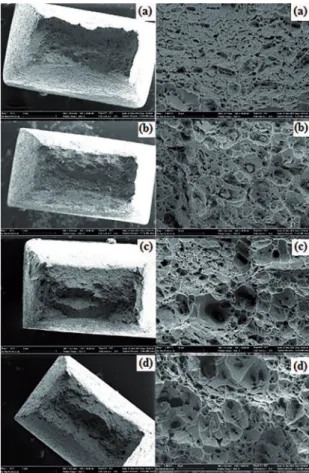
In addition, the fracture surface of aged test specimen
was also investigated in detail. Figure 7 a) - d), shows the
fracture surface of AR test piece and aged specimens at 160oC for a period of 20, 45, 120 and 180 minutes while, Figure 8
a) – d) shows the fracture surface of H+N heat treated and
5 % pre-strained test specimen and then aged at 160oC for a period of 30, 60, 90 and 180 minutes.
As seen in Figure 7 and 8, AR and H+N heat treated test
Figure 7: a) The fracture surface of AR test piece aged at 160oC
for b) 20, c) 45, d) 120 minutes Figure 8: a) The fracture surface of H+N test piece aged at 160
oC
for b) 30, c) 60, d) 90 minutes
that the fracture is mixed type when the steel was aged at 160oC for a period of 20 and 30 min, respectively. The reduction in cross-sectional area also decreased at 160oC for 20 and 30 minutes ageing time, which corresponds to the embrittlement due to ageing resulting from the interaction
between dislocation and precipitate particles. However, AR and H+N heat treated test specimens showed certain surface
appearance which is typical of ductile fracture and surface was microscopically covered by dimples of several sizes that were observed after ageing at 160oC for a periods of 45 and 60 minutes, respectively. This leads to an increase in elongation percentage due probably to the coarsening of
the precipitates on dislocations. Moreover, the repetitive increase in the tensile strength (UTS), yield strength (YS), strain ageing (ΔY2) and hardness at the 120 and 90 min
ageing time for AR and 5 % pre-strained and also H+N heat treated and 5 % pre-strained specimens, afecting the
fracture characteristic of aged steel.
4. Conclusions
The signiicance of this study results for steel user is that
the S275JRC steel used also manufacturing heavy vehicle
wheel rim steel can be afected from static load and heats
which are generated by friction lining, weld thermal cycles during the manufacturing process, post weld heat treatment,
paint baking or galvanization process. By considering the service condition, an efect of the static strain ageing on the
behavior of dynamic load of S275JRC steel should also be investigated.
The conclusions derived from this study can be summarized as follows:
• The material parameters such as microstructure, iner grain size and its distribution, crystal structure and
the difusion rates of solute atoms and processing
factors such as ageing time, temperature, quenching
rate, pre-straining (amount of plastic deformation)
and residual stresses play very important roles in static strain ageing.
• An increase in the tensile strength, yield strength,
rising in the yield stregth due to strain ageing (ΔY2)
and hardness of AR and H+N heat treated and 5%
pre-strained S275JRC steel with an increase in aging time can be explained by a distortion of lattice planes and obstruction of dislocation movement by solute atoms or precipitates.
• The repetitive increase in UTS, yield strength and
times. This repetitive increase in strain ageing
(ΔY2) values of specimens could be attributed to S275JRC steel microstructure in which cementite in pearlite and precipitates in dislocation lines can dissolve during the longer ageing time. The dissolved cementite and precipitates such as, carbides supply
solute atoms by backing up difusion for solid
solution. The solute atoms in the solid solution act on dislocations and therefore, the strength of sample is repetitively increased.
• Further increase in ageing time decreases the tensile
strength, yield strength, strain ageing (ΔY2) and hardness of the alloy. This could be due to the coalescence of the precipitates into larger particles which will cause fewer obstacles to prevent the movement of dislocation and hence the mechanical properties begin to diminish.
• Specimens (H+N heat treated and 5% pre-strained) aged at 160oC for some intervals showed higher strength properties than AR aged test pieces for all ageing intervals. It could be attributed to the dissolution of precipitates during the homogenization and following the normalizing heat treatment. So, the more solute atoms in solid solution can cause a degree of irregularity in the lattices.
• In general, the strengthening efect of strain ageing
in both AR and H+N heat treated specimens was found to be quite low due to an efect of carbide
formers in the S275JRC steel that reduces the interstitial atoms in solid solution.
• Fractographic analysis showed that AR and H+N heat treated test specimens showed dimples and cleavage facets, indicating that the fracture is a mixed type when the alloy was aged at 160oC for a periods of 20 and 30 minutes respectively.
5. Acknowledgements
The authors would like to also thank Karabük University, Scientiic project oice for the supporting of this project.
6. References
1.Serajzadeh S. Static strain ageing. In: Colás R, Totten GE, eds.
Encyclopedia of Iron, Steel and Their Alloys. Boca Raton: CRC Press; 2013. p. 57-78.
2. Baird JD. Strain Aging of Steel; A Critical Review. Iron Steel. 1963;36:186-192, 326-334, 368-374.
3. Baird JD. The efects of strain-aging due to interstitial solutes
on mechanical properties of metals. Metallurgical Reviews.
1971;16(1):1-18.
4. Cottrell AH, Bilby BA. Dislocation Theory of Yielding and Strain
Ageing of Iron. Proceedings of the Physical Society. Section
A. 1949;62(1):49.
5. Wilson DV, Russel B. The contribution of precipitation to strain aging in low carbon steels. Acta Metallurgica.
1960;8(7):468-479.
6. Graf S, Forest S, Strudel JL, Prioul C, Pilvin P, Béchade
JL. Strain localization phenomena associated with static and
dynamic strain ageing in notched specimens: experiments
and inite element simulations. Materials Science and
Engineering A. 2004;387-389:181-185.
7. CEN. Eurocode 3 – Design of steel structures – Part 1–2: General rules – Structural ire design. Brussels: CEN; 2005.
8.Qiang X, JiangX, Bijlaard FSK, KolsteinH. Mechanical
properties and design recommendations of very high strength
steel S960 in ire. Engineering Structures. 2016;112:60-70.
9. Ślęzak T, Śnieżek TA. Comparative LCF Study of S960QL High
Strength Steel and S355J2 Mild Steel. Procedia Engineering.
2015;114:78-85.
10. Lee LW. The Properties and Uses of Mild Steel. eHow. Available
from: < http://www.ehow.com/facts_6961115_properties-uses-mild-steel.html>. Acess in: 30/11/2016.
11. Karahan T, Emre HE, Tümer M, Kaçar R. Strengthening of
AISI 2205 duplex stainless steel by strain ageing. Materials & Design. 2014;55:250-256.
12. Buono VTL, Gonzales BM, Andrade MS. Strain ageing of AISI
430 ferritic stainless steel. Scripta Materialia. 1997;38(2):185-190. 13. Gündüz S, Demir B, Kaçar R. Efect of aging temperature and
martensite by volume on strain aging behaviour of dual phase steel. Ironmaking and Steelmaking. 2008;35(1):63-68.
14. Herman WA, Erazo MA, Patto LR, Sekizawa M, Pense AW.
The strain aging behaviour of microalloyed steels. Welding Research Council Bulletin. 1987;322:1-13.
15. Park DB, Lee JW, Lee YS, Park KT, Nam WJ. Efects of the
annealing temperature and time on the microstructural evolution and corresponding the mechanical properties of cold-drawn steel wires. Metals and Materials International. 2008;14:59.
16. Gündüz S. Static strain ageing behaviour of dual phase steels. Materials Science and Engineering: A. 2008;486(1-2):63-71. 17. Türkmen M, Gündüz S. Martensite morphology and strain
aging behaviours in intercritically treated low carbon steel.
Ironmaking and Steelmaking. 2011;38(5):346-352.
18. Soenen B, De AK, Vandeputte S, De Cooman BC. Competition
between grain boundary segregation and Cottrell atmosphere
formation during static strain aging in ultra low carbon bake
hardening steels. Acta Materialia. 2004;52(12):3483-3492.
19. Tsuchida N, Baba E, Nagai K, Tomota Y. Efects of interstitial
solute atoms on the very low strain-rate deformations for an IF steel and an ultra-low carbon steel. Acta Materialia.
2005;53(2):265-270.
20. Kim JG, Hong S, Anjabin N, Park BH, Kim SK, Chin KG, et
al. Dynamic strain ageing of twinning-induced plasticity
(TWIP) steel in tensile testing and deep drawing. Materials Science and Engineering: A.2015;633:136-143.
21. Leslie WC. Interstitial atoms in alpha iron. In: Leslie WC. The Physical Metallurgy of Steels. New York: McGraw-Hill;
22. Wilson DV, Russell B. The contribution of atmosphere locking
to the strain-ageing of low carbon steels. Acta Metallurgica.
1960;8(1):36-45.
23. Abbaschian R, Abbaschian L, Reed-Hill RE. Physical Metallurgy
Principles. 4th ed. Boston: Cengage Learning; 2008.
24. Hosseini S, Heidarpour A, Collins F, Hutchinson CR.
Efect of strain ageing on the mechanical properties of partially
damaged structural mild steel. Construction and Building Materials. 2015;77:83-93.
25. Cassada WA, Shilet GJ, Starke EA. Mechanism of Al2CuLi
(T1) nucleation and growth. Metallurgical Transactions A.
1991;22(2):287-297.
26. Cassada WA, Shilet GJ, Starke EA. The efect of plastic
deformation on Al2CuLi (T1) precipitation. Metallurgical Transactions A. 1991;22(2):299-306.
27. Kim JD, Park JK. Efect of stretching on the precipitation
kinetics of an Al-2.0Li-2.8Cu-0.5 Mg (-0.13Zr) alloy.
Metallurgical Transactions A. 1993;24(12):2613-2621.
28. Curtin WA, Olmsted DL, Hector Jr LG. A predictive mechanism
for dynamic strain ageing in aluminium-magnesium alloys. Nature Materials.2006;5:875-880.
29. Sylwestrowicz W, Hall EO. The deformation and ageing of
mild steel. Proceedings of the Physical Society. Section B. 1954;64(6):495.
30. Kok S, Bharathi MS, Beaudoin AJ, Fressengeas C, Ananthakrishna G, Kubin LP, et al. Spatial coupling in jerky low using polycrystal
plasticity. Acta Materialia. 2003;51(13):3651-3662.
31. Aboulfadl H, Deges J, Choi P, Raabe D. Dynamic strain aging studied at the atomic scale.Acta Materialia. 2015;86:34-42.
32. Karimi Tahiri A, Maccagmo TM, Jonas JJ. Dynamic strain
ageing and the wire drawing of low carbon steel rods. ISIJ International. 1995;35(12):1532-1540.
33. Mandziej ST. The efect of nitrogen and strain aging on C-Mn steel
welds. Scripta Metallurgica et Materialia. 1992;27(7):793-798. 34. Evans JT, Douthwaite RM. Snoek ordering and rapid strain ageing
in iron-nitrogen alloys. Acta Metallurgica.1973;21(1):49-54.
35. Pereloma EV, Bata V, Scott RI, Smith RM. Efect of Cr on Strain
Ageing Behaviour of Low Carbon Steel. Materials Science