Translation and validation of Hyperhidrosis Disease Severity Scale
ANDREA YASBEK MONTEIRO VARELLA1, JULIANA MARIA FUKUDA1*, MARCELO PASSOS TEIVELIS1, JOSÉ RIBAS MILANEZDE CAMPOS1,2,
PAULO KAUFFMAN1,2, GABRIEL GRIZZO CUCATO1, PEDRO PUECH-LEÃO2, NELSON WOLOSKER1,2
1Vascular Surgery Department, Hospital Israelita Albert Einstein, São Paulo, SP, Brazil
2Vascular Surgery Department, Hospital das Clínicas, Faculdade de Medicina da Universidade de São Paulo, São Paulo, SP, Brazil
S
UMMARYStudy conducted at Hospital Israelita
Albert Einstein (HIAE) and at Hospital das Clínicas, Faculdade de Medicina da
Universidade de São Paulo (HC-FMUSP), São Paulo, SP, Brazil
Article received: 1/15/2016
Accepted for publication: 1/18/2016
*Correspondence:
Address: Av. Albert Einstein, 627, bloco
A1, 4º andar, sala 423 São Paulo, SP – Brazil
Postal code: 05652-000 [email protected]
http://dx.doi.org/10.1590/1806-9282.62.09.843
Introduction: The evaluation of patients with hyperhidrosis (HH) can be ac-complished, among other ways, through questionnaires and scales. The Hyper-hidrosis Disease Severity Scale (HDSS) has been used as a simple and quick tool to perform this evaluation. Although HDSS has been well established in several languages, it has not been translated into Portuguese, restricting its specific use for Brazilian patients. The aim of this study was to translate HDSS into Portu-guese and validate it in a sample of Brazilian subjects.
Method: 290 Brazilian patients (69% women, with a mean age of 28.7±9.6 years
and BMI 22.4±3.9 kg/m2) diagnosed with HH were evaluated using HDSS,
Qual-ity of Life Questionnaire (QLQ) and Sweating Evolution Questionnaire (SEQ) before and after a five-week oxybutynin treatment. Regarding validation, an association between HDSS results and two other questionnaires was performed. To analyze HDSS sensitivity, evaluation of effects pre- and post-treatment with
oxybutynin was conducted. Furthermore, HDSS reproducibility was analyzed in a subsample in which the scale was applied again after 7 days of the first fol-low-up appointment.
Results: There was statistical correlation between HDSS and QLQ and between HDSS and SEQ before treatment and after 5 weeks. Additionally, HDSS was reproducible and sensitive to clinical changes after the treatment period.
Conclusion: The Portuguese version of HDSS has been validated and shown to be reproducible in a Brazilian sample. Therefore it can be used as a tool to im-prove medical assistance in patients with HH.
Keywords: hyperhidrosis, scales, questionnaires, translations, validation studies.
I
NTRODUCTIONHyperhidrosis (HH) is a somatic disorder characterized by local excess sweating in specific regions of the body due to hyperfunction of eccrine sweat glands, often re-lated to an emotional distress.1
There are several ways to diagnose and predict out-comes of HH. In general, objective measures such as tran-sepidermal water loss measurement are used to estimate the amount of sweat of each suspected site affected by HH. However, this approach is expensive and limited by its daily-based measures,2,3 resulting from measurements
acquired at a particular time of the day and not allowing the analysis of sweating during longer periods.
Hence, questionnaires and scales have been developed to evaluate HH.4 The main advantages of their use include
low cost, simplicity, potential self-filling and large-scale application.5 Recently, the Hyperhidrosis Disease
Sever-ity Scale (HDSS – International Hyperhidrosis Society®) was developed as a quick method,6 since it presents only
Despite its global acceptance, HDSS has not been validated or translated into Portuguese, preventing its use in Brazil. Thus, the aim of this project was to translate and validate the Portuguese version of the HDSS, in order to use it as an important scale in Brazilian patients with HH.
M
ETHODSample
A convenience sample of 290 patients of both genders was recruited to this study. After a clear explanation of all pro-cedures, those who agreed to participate in the research protocol signed a consent form. This study was approved by the Local Research Ethics Committee (Approval number at Plataforma Brasil: CAAE40512414.7.0000.0071). Inclu-sion criteria comprised individuals at the age of 18 years or older with a clinical diagnosis of palmar, axillary, or any association of these two forms of HH. All the patients in-cluded in the study had the palmar or axillary form of HH, or an association of both. Patients with compensatory sweating were excluded.
Study design
After translation and back-translation, HDSS was applied before and after 5 weeks of treatment with oxybutynin. All patients followed the same protocol. Oxybutynin was taken in progressively higher doses: starting at 2.5 mg once daily, which was increased to twice daily after one week, and 5 mg twice daily at the third week. If necessary and tolerated, for patients weighing more than 40 kg, the total dose was increased to 20 mg/day. For patients weigh-ing less than 40 kg, the total dose was not increased after 3 weeks.
In addition, the Quality of Life Questionnaire (QLQ) and the Sweating Evolution Questionnaire (SEQ) were applied. In order to analyze the reproducibility of the Portuguese version of HDSS, a subsample was recruited and reassessed using HDSS 7 days after the first appoint-ment.
Hyperhidrosis Disease Severity Scale translation
A native qualified Portuguese-speaking professional, spe-cialized in technical translations and fluent in English, as well as experienced with medical literature, carried out the translation. Following the translation there was a trial phase where the understanding of the Portuguese version of HDSS scale was checked out by an additional sample of 40 patients with HH. They outlined major areas for improvement to make it more coherent and under-standable. Later, experts evaluated HDSS to make sure its content included all the necessary elements for
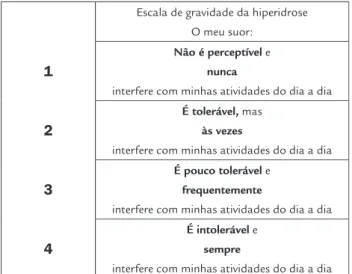
satis-factory evaluation of the disease, in the light of Brazilian culture, and included the modifications suggested by the patients. After applicable and convenient changes, the “new” HDSS scale (Portuguese version) was back trans-lated into English by another professional with the same skills, who had no access to the original scale (in English). The “new” HDSS scale (in Portuguese) and its classical version in English were compared, and discrepancies were corrected, preserving semantic and idiomatic equiva-lences to compose a straightforward scale (Figure 1).
Hyperhidrosis Disease Severity Scale
HDSS consists of a simple and straightforward question with four available answers (grades 1 through 4) related to patient tolerance of HH symptoms and the negative implications of body perspiration to their everyday lives. Patients are asked to indicate a HDSS score specifically for each site of HH.
In our study, we evaluated only palmar and axillary symptoms, and patients could indicate different site-spe-cific HDSS scores, according to the impairment of quality of life caused by excessive sweating in each area. Patients answered this scale twice: in the first appointment (before starting treatment, week 0), and in the end of the five-week treatment (week 5). Answer graded as 1 meant no percep-tible sweating and lack of interference in everyday life; grade 2, tolerable sweating with seldom interference in everyday life; grade 3, little tolerable sweating with frequent interfer-ence in everyday life, and grade 4, intolerable sweating with constant interference in everyday life.
FIGURE 1 Translation of Hyperhidrosis Disease Severity Scale (HDSS) into Portuguese.
Escala de gravidade da hiperidrose O meu suor:
1
Não é perceptível e nunca
interfere com minhas atividades do dia a dia
2
É tolerável, mas às vezes
interfere com minhas atividades do dia a dia
3
É pouco tolerável e frequentemente
interfere com minhas atividades do dia a dia
4
É intolerável e sempre
For data purposes, the analysis yielded a delta of im-provement on HDSS. For example: Pre-treatment (week 0) minus post-treatment (week 5) = delta. Thus, delta = 0 or 1 was considered no improvement; delta = 2 was con-sidered slight improvement, and delta = 3 was concon-sidered good improvement. For example, if the patient reported at the first appointment HDSS = 4 (intolerable sweating with high interference in everyday life) and after 5 weeks reported HDSS = 1 (not noticeable sweating and lack of interference in routine activities), delta was 3 (good im-provement).
Quality of Life Questionnaire
The QLQ is a 20-question form divided into five domains. Each of these domains or group of actions has five levels of answers based on tables that admit a single response. The sum of all points varies between 20 and 100. Quality
of life was rated as: much better (20-35), slightly better (36-51), and no improvement (52-100).7,8
Sweating Evolution Questionnaire
The SEQ is based on a scale from 0 to 10, in which 0 means no sweating improvement and 10 refers to total resolution of symptoms. It was applied 5 weeks after treatment in the follow-up medical appointment. Patients chose a score from 0 to 10, according to the degree of symptomatic improve-ment. Results were classified as: no improvement (0-4), slight improvement (5-7) and great improvement (8-10).9-13
Statistical analysis
To determine an association between the HDSS respons-es and the other two qurespons-estionnairrespons-es (QLQ and SEQ), chi-square test was used. Kappa coefficient was performed to examine the reproducibility of HDSS scale. Finally, sensitivity to treatment was calculated using the Wil-coxon test. Statistical analysis was performed using SPSS software (v. 17, SPSS Inc. Chicago, IL). P-values lesser than 0.05 were considered statistically significant.
R
ESULTSPatients’ demographics are summarized in Table 1. Re-garding general characteristics of the sample population, 69% were female. Patients were young, with an average age of 28.7 years [standard deviation (SD) 9.6; range 18-60]. Additionally, mean body mass index (BMI) was 22.4 kg/m2 (SD 3.9; range 10.6-35.4).
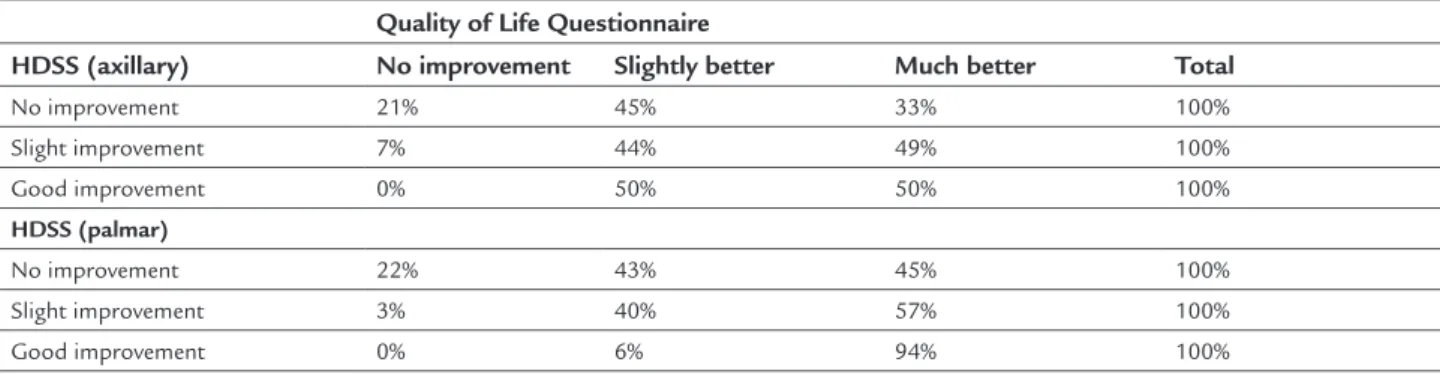
Table 2 shows the association between responses ob-tained with HDSS and QLQ. There was a significant as-sociation between the responses obtained with HDSS and QLQ in the palmar group (p<0.001), and 94% of patients
who reported good improvement in HDSS were more likely to report much better results with QLQ. There was no significant correlation between HDSS and QLQ in the axillary group.
Table 3 shows the association between responses ob-tained with HDSS and SEQ. There was a significant as-sociation between the responses obtained with HDSS and SEQ in both axillary (p<0.01) and palmar groups (p<0.01). As in SEQ, 92 and 96% of patients who reported good
improvement with HDSS (delta = 3) in the axillary and palmar groups, respectively, showed to be more likely to report great improvement with SEQ (in both regions).
In a subsample of 34 patients, we conducted HDSS test-retest after a seven-day interval for patients with axillary HH. This resulted in a kappa index = 0.65 (0.29 to 0.97, CI 95%), showing moderate levels of agreement. In this group, 94% of patients reported the same values at the first appointment and after a seven-day follow-up. In addition, we carried out HDSS test-retest in a subsa-mple of 58 patients with palmar HH, with a resulting kappa index of 0.84 (0.61 to 1.00, CI 95%), showing sub-stantial degree of agreement. In this group, 96% of patients reported the same values at the first appointment and after 7 days.
Finally, to evaluate the degree of change in the HDSS scale, we analyzed the patients’ responses in the pre-treat-ment period and after 5 weeks of oxybutynin intake. Wil-coxon values showed differences in median values of HDSS pre- and post-treatment, and turned out to be significant for both groups, palmar (z=-11.1 and p<0.01) and axillary (z=-8.7 and p<0.01), respectively.
D
ISCUSSIONThe aim of this study was to translate and validate the HDSS for Brazilian patients with HH. Results showed that its Portuguese version has good reliability, reproducibility, and is sensitive to changes after clinical treatment, therefore being useful for management of patients with HH.
Currently, there are several ways to evaluate and pre-dict HH prognosis. In our institution, patient follow-up is now performed using two independent questionnaires: one assesses the degree of improvement in sweating after treatment, and another evaluates the changes in quality of life before and after treatment. These two have been used in different studies,7,8 but we believe that the HDSS
TABLE 1 Demographic characteristics of patients.
Palmar Axillary Total
Gender Female 70% 68% 69% Male 30% 32% 31% Age
(years)
Average±SD 26.5±9.0 31.2±9.8 28.7±9.6
Range 18-59 18-60 18-60 BMI
(kg/m2)
Average±SD 22.4±3.9 23.8±3.8 22.4±3.9
Range 10.6-35.0 13.4-35.4 10.6-35.4 SD: standard deviation; BMI: body mass index.
TABLE 2 Association between responses from Hyperhidrosis Disease Severity Scale (HDSS) and Quality of Life Questionnaire for patients with axillary (N=115) and palmar hyperhidrosis (N=175).
Quality of Life Questionnaire
HDSS (axillary) No improvement Slightly better Much better Total
No improvement 21% 45% 33% 100%
Slight improvement 7% 44% 49% 100%
Good improvement 0% 50% 50% 100%
HDSS (palmar)
No improvement 22% 43% 45% 100%
Slight improvement 3% 40% 57% 100%
Good improvement 0% 6% 94% 100%
TABLE 3 Association between responses from Hyperhidrosis Disease Severity Scale (HDSS) and Sweating Evolution Questionnaire for patients with axillary (N=115) and palmar hyperhidrosis (N=175).
Sweating Evolution Questionnaire
HDSS (axillary) No improvement Slight improvement Great improvement Total
No improvement 28% 25% 47% 100%
Slight improvement 0% 11% 89% 100%
Good improvement 8% 0% 92% 100%
HDSS (palmar)
No improvement 28% 25% 47% 100%
Slight improvement 0% 11% 89% 100%
Good improvement 0% 6% 94% 100%
To assess the reliability of the Portuguese version of the HDSS, an association was made between its results and those obtained through QLQ and SEQ. By compar-ing data from HDSS and SEQ, we found significant as-sociation between the palmar and axillary groups.
On the other hand, comparing responses obtained with HDSS and QLQ, we verified that there was a signif-icant association only in patients with palmar HH. One possible cause for the absence of association in patients with axillary HH is that QLQ is based on questions relat-ed to issues regarding excessive sweating in hands, which
affects the evaluation of patients with primary axillary HH. Because SEQ is wider on its assessment with an ex-tensive evaluation of other body parts, a positive associ-ation between HDSS and SEQ could be due to this fact.
More than association analyses, a comprehensive investigation to evaluate the degree of change in the HDSS scale pre- and post-oxybutynin treatment was performed. This study showed statistical evidence that both palmar and axillary HH improved in the HDSS, expressing its sensitivity to demonstrate changes in patients’ symptoms over time under treatment.
Finally, we conducted in a subsample a test-retest 7 days after the first follow-up. Results showed satisfactory reproducibility rates, with 94 and 96% of axillary and palmar HH patients, respectively, reporting the same HDSS values when comparing first and second queries.
evaluations of HH (e.g. sudorometer) are required to validate these results.
As can be seen from our results, we believe that the translation and validation process of HDSS into Portu-guese was successful. It showed significant statistical correlation with other questionnaires (construct valida-tion), good reproducibility rates and sensitivity to chang-es after clinical treatment. Thus, we can confidently state that the Portuguese version of the HDSS can be used in clinical practice to evaluate the degree of sweating and patient outcomes, as well as manage the treatment of patients with HH, in both palmar and axillary HH.
C
ONCLUSIONThe Portuguese version of the HDSS showed reliability and reproducibility in a Brazilian sample and can be used as healthcare tool in patients with HH.
R
ESUMOTradução e validação da Hyperhidrosis Disease Severity Scale
Objetivo: a avaliação de pacientes com hiperidrose (HH) pode ser realizada, entre outras maneiras, por questioná-rios e escalas. O Hyperhidrosis Disease Severity Scale (HDSS) tem sido utilizado como uma forma simples e rápida. Embora o HDSS seja utilizado em outros idiomas, ainda não foi traduzido para o português, limitando sua utilização em pacientes brasileiros. O objetivo deste estu-do foitraduzir o HDSS para o português e validá-lo em uma amostra brasileira.
Método: duzentos e noventa(290) pacientes brasileiros (69% mulheres, idade média de 28,7±9,6 anos e IMC
mé-dio de 22,4±3.9 kg/m2) com HH foram avaliados pelo
HDSS, pelo Questionário de Qualidade de Vida (QQV) e pelo Questionário de Evolução da Sudorese (QES) antes e após 5 semanas de tratamento com oxibutinina. Para a validação de constructo do HDSS, foi realizada a associa-ção entre seus resultados com os dos outros dois ques-tionários. Para analisar a sua sensibilidade, foi realizada a análise do efeito pré e pós-tratamento com oxibutinina. Além disso, foi analisada a sua reprodutibilidade em uma
subamostra, na qual a escala foi aplicada novamente após 7 dias da primeira consulta.
Resultados: observamos correlação estatística entre o HDSS e o QQV e entre o HDSS e o QES antes do trata-mento e após 5 semanas. O HDSS demonstrou ser repro-dutível e sensível em relação ao efeito do tratamento.
Conclusão: a versão em português da escala HDSS apre-sentou validade e reprodutibilidade em amostra brasilei-ra e pode ser utilizada como instrumento na assistência à saúde de pacientes com HH.
Palavras-chave: hiperidrose, escalas, questionários, traduções, estudos de validação.
R
EFERENCES1. Vorkamp T, Foo FJ, Khan S, Schmitto JD, Wilson P. Hyperhidrosis: evolving concepts and a comprehensive review. Surgeon. 2010; 8(5):287-92. 2. Ishy A, de Campos JRM, Wolosker N, Kauffman P, Tedde ML, Chiavoni CR,
et al. Objective evaluation of patients with palmar hyperhidrosis submitted to two levels of sympathectomy: T3 and T4. Interact Cardiovasc Thorac Surg. 2011; 12(4):545-9.
3. Tetteh HA, Groth SS, Kast T, Whitson BA, Radosevich DM, Klopp AC, et al. Primary palmoplantar hyperhidrosis and thoracoscopic sympathectomy: a new objective assessment method. Ann Thorac Surg. 2009; 87(1):267-74; discussion 274-5.
4. Hamm H. Impact of hyperhidrosis on quality of life and its assessment. Dermatol Clin. 2014; 32(4):467-76.
5. Ritti-Dias RM, Gobbo LA, Cucato GG, Wolosker N, Jacob Filho W, Santarém JM, et al. Translation and validation of the Walking Impairment Questionnaire in Brazilian subjects with intermittent claudication. Arq Bras Cardiol. 2009; 92(2):136-49.
6. Solish N, Bertucci V, Dansereau A, Hong HC-H, Lynde C, Lupin M, et al.; Canadian Hyperhidrosis Advisory Committee. A comprehensive approach to the recognition, diagnosis, and severity-based treatment of focal hyperhidrosis: recommendations of the Canadian Hyperhidrosis Advisory Committee. Dermatol Surg. 2007; 33(8):908-23.
7. Amir M, Arish A, Weinstein Y, Pfeffer M, Levy Y. Impairment in quality of life among patients seeking surgery for hyperhidrosis (excessive sweating): preliminary results. Isr J Psychiatry Relat Sci. 2000; 37(1):25-31. 8. de Campos JR, Kauffman P, Werebe EC, Andrade Filho LO, Kusniek S,
Wolosker N, et al. Quality of life, before and after thoracic sympathectomy: report on 378 operated patients. Ann Thorac Surg. 2003; 76(3):886-91. 9. Wolosker N, de Campos JR, Kauffman P, de Oliveira LA, Munia MA, Jatene
FB. Evaluation of quality of life over time among 453 patients with hyperhidrosis submitted to endoscopic thoracic sympathectomy. J Vasc Surg. 2012; 55(1):154-6.
10. Wolosker N, Teivelis MP, Krutman M, de Paula RP, de Campos JR, Kauffman P, et al. Long-term results of oxybutynin treatment for palmar hyperhidrosis. Clin Auton Res. 2014; 24(6):297-303.
11. Wolosker N, Teivelis MP, Krutman M, de Paula RP, Kauffman P, de Campos JR, et al. Long-term results of the use of oxybutynin for the treatment of axillary hyperhidrosis. Ann Vasc Surg. 2014; 28(5):1106-12.
12. Wolosker N, Teivelis MP, Krutman M, Campbell TPD de A, Kauffman P, de Campos JR, et al. Long-term results of oxybutynin use in treating facial hyperhidrosis. An Bras Dermatol. 2014; 89(6):912-6.