rev bras ortop.2017;52(1):111–114
SOCIEDADE BRASILEIRA DE ORTOPEDIA E TRAUMATOLOGIA
w w w . r b o . o r g . b r
Case
report
Simultaneous
bilateral
patellar
tendon
rupture
夽
Diogo
Lino
Moura
∗,
José
Pedro
Marques,
Francisco
Manuel
Lucas,
Fernando
Pereira
Fonseca
CentroHospitalareUniversitáriodeCoimbra,DepartamentodeOrtopedia,Coimbra,Portugal
a
r
t
i
c
l
e
i
n
f
o
Articlehistory:
Received22March2016
Accepted28March2016
Availableonline22June2016
Keywords:
Patellarligament
Rupture,spontaneous
Tendoninjuries
Steroids Rehabilitation
a
b
s
t
r
a
c
t
Bilateralpatellartendonruptureisarareentity,oftenassociatedwithsystemicdiseases
andpatellartendinopathy.Theauthorsreportararecaseofa34-year-oldmanwith
simul-taneousbilateralruptureofthepatellartendoncausedbyminortrauma.Thepatientis
aretiredbasketballplayerwithnopastcomplaintsofchronickneepainandahistoryof
steroiduse.Surgicalmanagementconsistedinprimaryend-to-endtendonrepairprotected
temporarilywithcerclagewiring,followedbyashortimmobilizationperiodandintensive
rehabilitationprogram.Fivemonthsaftersurgery,thepatientwasabletofullyparticipate
insportactivities.
©2016SociedadeBrasileiradeOrtopediaeTraumatologia.PublishedbyElsevierEditora
Ltda.ThisisanopenaccessarticleundertheCCBY-NC-NDlicense(http://
creativecommons.org/licenses/by-nc-nd/4.0/).
Rupturas
bilaterais
simultâneas
dos
tendões
patelares
Palavras-chave:
Ligamentopatelar
Rupturaespontânea
Traumatismosdostendões
Esteroides Reabilitac¸ão
r
e
s
u
m
o
Asrupturasbilateraisdostendõespatelaressãoumaentidaderara,muitasvezesassociadas
comdoenc¸assistêmicasetendinopatiapatelar.Apresentamosumcasorarodeumhomem
de34anoscomroturabilateralsimultâneadostendõespatelarescausadaportraumaleve.
Opacienteéumjogadordebasquetebolaposentado,semqueixasdedorcrônicadojoelhoe
comhistóriadeconsumodeesteroides.Otratamentocirúrgicoconsistiunareparac¸ão
tendi-nosaprimáriadepontaaponta,protegidatemporariamentecombandadecerclage,seguida
decurtotempodeimobilizac¸ãoeprogramaintensivodereabilitac¸ão.Aoscincomesesapós
acirurgia,opacienteeracapazdeparticiparsemrestric¸õesematividadesdesportivas.
©2016SociedadeBrasileiradeOrtopediaeTraumatologia.PublicadoporElsevierEditora
Ltda.Este ´eumartigoOpenAccesssobumalicenc¸aCCBY-NC-ND(http://
creativecommons.org/licenses/by-nc-nd/4.0/).
夽
WorkperformedattheOrthopedicsDepartment,CoimbraHospitalandUniversityCenter,Coimbra,Portugal.
∗ Correspondingauthor.
E-mails:[email protected],[email protected](D.L.Moura).
http://dx.doi.org/10.1016/j.rboe.2016.03.006
2255-4971/©2016SociedadeBrasileiradeOrtopediaeTraumatologia.PublishedbyElsevierEditoraLtda.Thisisanopenaccessarticle
112
rev bras ortop.2017;52(1):111–114Introduction
Disruptionofknee’sextensormechanismisnotunusualand
affectsthepatellabonemorefrequently.1,2Bilateral
simulta-neousruptures ofthepatellar tendonsare rarelyseenand
haveonlybeendocumentedincasereports.1,3,4
Case
presentation
Wepresenta34-year-oldblackmalethatafterasudden
run-ningstopwithbothkneesinslightflexionassociatedwitha
twistingmovement,heexperiencedfailuresensationand a
severesharppaininbothknees.Hefelltothegroundandwas
unabletostandandwalk.
At the emergency orthopedic department the patient
referredbilateralkneepainandtenderness.Bothknees
dis-played some superficial abrasions and a mild effusion. A
bilateral infrapatellar gap with cephalic migration of both
patellaecouldbefelt.Activestraightlegraisingtestwas
nega-tiveforbothextremitiesandthepatientwasunabletoperform
activeextensionofbothknees.Neurovascularexamination
wasunremarkable.
Thepresumptiveclinicaldiagnosisofbilateralruptureof
thepatellartendonwasmade.
Thepatienthadbeenaprofessionalbasketballplayerfrom
18to25yearsoldandpracticedcompetitiveweightliftinguntil
30yearsold.Headmittedhavingtakenafewcycles oforal
andinjectablesteroidsduringtheweightliftingcompetitive
practicetime.Currently,heisabouncerandarecreational
weightlifting practitioner. The patient assured not having
taken steroidsorany other supplements forthe last three
years.Hereportednopreviousinjuriestohiskneesanddenied
chronickneepain.Atthetimeofthetrauma,thepatientbody
typewasathletic,weighing120kgandwas192cmtall.
TheX-raysshowedcephalicpatellarmigrationandsmall
calcification avulsions of the inferior poles of both
patel-lae.Anisolatedundisplacedspiralfractureoftheleftfibular
Fig.1–Lateralprojectionkneeradiographsafterbilateral patellartendonrupture,showingcephalicpatellar migration(“patellaalta”),avulsionfracturesofinferior polesofbothpatellaeandanisolatedundisplacedspiral fractureoftheleftfibularneck(leftside).
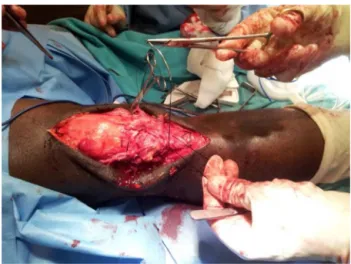
Fig.2–Bilateralpatellatendonruptureatsurgery: monofilamentloopsuturethatallowed,byitspassagein themiddleoftheloop,apropertendonsuturetension.
neckwasalsoidentified(Fig.1).Ultrasoundconfirmedtotal
bilateralruptureofthepatellartendons.Intraoperativelywe
foundbothtendonstornintheirsubstanceneartheinferior
patellarpoles,withsomesegmentsavulsedfromthe
patel-lar insertion. Lateraland medial retinacula were disrupted
bilaterally.Anend-to-endprimaryKessler-typetendonrepair
reinforcedwithintraosseoussutureswasperformedinboth
knees.Wetemporarilyprotecteditwithcerclagewiring,
fol-lowedbyimmobilizationwithalegcylindercast.Wechose
a nonabsorbable monofilamentloop suturethat alloweda
propertendonsuturetension,byitssecondpassagethrough
themiddleoftheloop(Fig.2).Thetensionwithinstitcheswas
carefullyadjustedtoavoidshorteningofinfrapatellarlength,
according tothe patellaeposition. Theruptured retinacula
wererepairedwithVicrylsutures.Thestrengthoftherepair
wastestedbycarefulflexionofbothknees(Fig.3).Cerclage
wiringwasappliedinafigure-of-eighttensionbandrunning
aroundthesuperiorpoleofthepatellae,passinginfrontof
the tendon,fixedwithatransversescrewthroughthetibia
tubercleandtiedataverage60◦ofkneeflexion(Fig.4).
rev bras ortop.2017;52(1):111–114
113
Fig.4–Cerclagewiringapplicationineightformtension bandbetweenthedistalquadricipitaltendonanda transversalscrewintheanteriortibialtuberosity.
Thepostoperativecoursewasuneventfulandradiographic
controlwassatisfactory(Fig.5).Thecastimmobilizationwas
removedatthethirdpostoperativedayandthepatientbegan
ambulationwithcrutches usingextensionkneebracesand
fullweight-bearingallowedastolerated.Atthe2rd
postop-erativeweekhebeganperiodicremovalofkneebracesanda
dailyrehabilitationprogram,initiallyconsistinginisometric
musclestrengtheningandkneeflexionexercisesrestrictedto
60◦,complementedwithperipatellarsofttissuemassage.At
the4thweekthepatientcouldwalkwithoutcrutches,hadno
painandattained40◦ofmaximumbilateralactiveknee
flex-ion.Atthe6thweekhehad60◦offlexionandthekneebraces
were discontinued.Atthe8th postoperativeweek, the
cer-clagewirewasremovedandthepatientcontinuedthedaily
physiotherapyprogramwithprogressiontofullkneeflexion
allowed and emphasis on muscle strengthening exercises.
Stationary bicycle was introduced atthe 9th week. Eleven
weeks after surgery, the patient presented 100◦ maximum
bilateralkneeflexionandreturnedtowork.Onexamination
5monthsaftersurgery,thepatientpresentedasatisfactory
range of motionof bothknees (135◦ flexion, 0◦ extension)
goodquadricepsstrengthandnosignsofmuscularatrophies
orextensorlag(fig.6).Hedeniedanysenseofinstabilityor
swelling,andthereforehereturnedtorecreational sportive
activities.Hereportedfeelingthathiskneeswereasstrongas
theywerepriortothelesionsandhewasabletorun,squat,
andhopinplacewithoutdifficulty.
Discussion
Patellartendonrupturesaremostlyassociatedwithunhealthy
patellartendons.1Thispatienthadanabolicsteroid
consump-tionhistory,whichcouldbeheldaccountablefordegenerative
changes that weaken the structural tendon integrity with
a higher risk for rupture, even in the context of minor
trauma.1,2,4–8 In addition, the patient’s heavy body weight
andthepreviousparticipationinhigh-levelcompetitivesport
activitiesmighthaveinflictedchronicdegenerativechanges
to hispatellar tendons,as wecan supposebecause ofthe
inferiorpatellapolecalcifications,despitehisdenialforany
chronic knee pain or discomfort compatible with patellar
tendinopathy.9
Fig.5– Twoweeksaftersurgery:radiographiccontrol.
114
rev bras ortop.2017;52(1):111–114Primary tendon repair should be performed assoon as
possibletoavoidproximalpatellarretraction,scarring,
com-plicatedrepairand diminishedlong-termfunction.1,6 Local
repairsecured by a tension band wire technique to
coun-teracttheforcesgeneratedacrosstheextensormechanism,
diminishing tension at the repair sites and permitting an
uneventfulhealing. Althoughthe use ofcerclage wiringin
bilateral patellar tendon ruptures is still controversial, we
believethisallowedallthebenefitsofaminimalcast
immobi-lizationandanearlycontrolledphysiotherapybeginningtwo
weekspostoperatively,whichwasimportanttoavoid
quadri-cepsatrophy.Therehabilitationprogramprescribedallowed
fastamplitudegainingandanearlierreturntoworkandsport
activitieswhencomparedwithreportsintheliterature.1,6,9,10
Inconclusion,wepresentabilateralpatellartendon
rup-turecaselikelyassociatedwithanabolicsteroidsintakeand
repetitivelocalstress.Thebilateralinjurynaturecanmake
rehabilitationdifficult.Webelievethemainreasons forthe
excellentandearlyfunctionalresultswere:earlytendonrepair
and propersuturetensionand strength;cerclage wireuse;
minimalcastimmobilizationtime;intensive,controlledand
specializedphysiotherapyprogramandastronglycommitted
patient.
Conflict
of
interests
Theauthorsdeclarenoconflictofinterests.
r
e
f
e
r
e
n
c
e
s
1.KellersmannR,BlattertTR,WeckbachA.Bilateralpatellar tendonrupturewithoutpredisposingsystemicdiseaseor steroiduse:acasereportandreviewoftheliterature.Arch OrthopTraumaSurg.2005;125:127–33.
2.EnadJG.Patellartendonruptures.SouthMedJ.1999;92:563–6.
3.SplainSH,FerenzC.Bilateralsimultaneousinfrapatellar tendonrupture:supportforDavidsson’stheory.OrthopRev. 1988;17:802–5.
4.StinnerDJ,OrrJD,HsuJR.Fluoroquinolone-associated bilateralpatellartendonrupture:acasereportandreviewof theliterature.MilMed.2010;175:457–9.
5.CarsonWGJr.Diagnosisofextensormechanismdisorders. ClinSportsMed.1985;4:231–46.
6.RosePS,FrassicaFJ.Atraumaticbilateralpatellartendon rupture.Acasereportandreviewoftheliterature.JBone JointSurgAm.2001;83:1382–6.
7.VanGlabbeekF,DeGroofE,BoghemansJ.Bilateralpatellar tendonrupture:casereportandliteraturereview.JTrauma. 1992;33:790–2.
8.KannusP,JózsaL.Histopathologicalchangespreceding spontaneousruptureofatendon.Acontrolledstudyof891 patients.JBoneJointSurgAm.1991;73:1507–25.
9.RosenbergJM,WhitakerJH.Bilateralinfrapatellartendon ruptureinapatientwithjumper’sknee.AmJSportsMed. 1991;19:94–5.