Rev Bras Anestesiol. 2013;63(3):258-261
Offi cial Publication of the Brazilian Society of Anesthesiology www.sba.com.br
REVISTA
BRASILEIRA DE
ANESTESIOLOGIA
Abstract
Background and objective: To compare the effect of prophylactic administration of normal saline against the hypotensive effect of propofol in female patients booked for gynecological procedures.
Method: Sixty nine ASA (I, II) patients were randomly allocated into two groups, group 1 received 5 mL.kg-1 of 0.9% normal saline 10 minutes before induction, whereas group 2 received nothing (control). Anesthesia was induced with propofol and fentanyl then maintained with propofol and remifentanil. We measured hemodynamic variables pre and post general anesthesia induction. Results: Both groups had signifi cant drops in post induction mean arterial blood pressure (P < 0.001). Also both groups had signifi cant drops in post induction heart rate ((P < 0.02 in sample group and P < 0.001 in control group), and 35% of patients in the control group had more than 25% drop in the pre induction mean arterial blood pressure, compared with only 17% of patients in the saline group (P < 0.04).
Conclusion: The prophylactic administration of normal saline could decrease the percentage of patients who had a signifi cant drop in their blood pressure after propofol induction of general anesthesia.
© 2013 Sociedade Brasileira de Anestesiologia. Published by Elsevier Editora Ltda. All rights reserved.
Effect of Normal Saline administration on circulation
stability during general anesthesia induction with propofol in
gynecological procedures - Randomised-controlled study
Daher Rabadi*
11. Department of Anesthesiology, Jordan University of Science & Technology, Irbid, Jordan Received fromJordan University of Science & Technology, Irbid, Jordan.
Submitted on April 1, 2012. Approved on May 8, 2012.
Keywords: Isotonic Solutions; Anesthesia; Propofol; Blood Pressure; Heart Rate.
SCIENTIFIC ARTICLE
*Corresponding author: Assistant Professor and anesthesiology consultant. Department of Anesthesiology, Jordan University of Science & Technology, P.O. Box: 3030, Irbid (22110), Jordan.
E-mail: [email protected]
ISSN/$ - see front metter c 2013 Sociedade Brasileira de Anestesiologia. Published by Elsevier Editora Ltda. All rights reserved.
Introduction
Propofol is a rapidly acting intravenous hypnotic agent commonly used for the induction and maintenance of short and ambulatory general anesthesia (GA). It has many ad-vantages over the older hypnotic agents for its rapid acting, short recovery and antiemetic effect. However it is often
associated with a decrease in blood pressure, which could be a signifi cant problem in elderly and medically compro-mised patients.
259 Effect of Normal Saline administration on circulation stability during general anesthesia induction with propofol
in gynecological procedures - Randomised-controlled study
Normal saline is a cheap and safe crystalloid fl uid that could decrease this undesirable side effect of propofol usage. The study aimed to determine the effi cacy of normal saline administration before GA induction against the anticipated hypotensive effect of propofol.
Method
After obtaining approval from the hospital ethics committee and informed consent from the patients, 69 female ASA (I, II) patients undergoing elective gynecological procedures were enrolled in this study. Patients did not receive any premedication and were randomized into two groups based on computer generated numbers: group 1 received 5 mL.kg-1 0.9% normal saline 10 minutes before induction and group 2 did not receive any fl uid. The investigators who collected vital signs from the patients were blinded to the randomi-zation process. Exclusion criteria were age below 18 years and pregnancy.
Blood pressure was measured pre induction and post induction (3 minutes post airway manipulation) using a non-invasive automated method with appropriate-sized cuff at admission area. A 25% drop in mean arterial blood pressure was considered to be signifi cant.
All patients were anesthetized in a standard protocol by a senior anesthesiologist. GA was induced with propofol 1% 2-2.5 mg.kg-1 over 30 seconds, fentanyl 2 µg.kg-1, and rocuronium 0.6 mg.kg-1 to facilitate tracheal intubation. Total intravenous anesthesia (TIVA) started with propofol and remifentanil immediately upon loss of verbal contact with the patients.
The number of patients required for the study was calcu-lated from previous studies 4,5. Using Altman’s nomogram for a study with a power of 0.90, 65 patients would be needed to demonstrate a difference in the mean arterial blood pres-sure of 15 mm Hg, when the level of statistical signifi cance was set to 5%.
Parametric data were analyzed with t-test. Non-parametric data were analyzed with Mann-Whitney U test. Categorical data were analyzed by chi square test or Fisher’s exact test, as appropriate. A P value of less than 0.05 was considered signifi cant.
Results
There were 35 patients in group 1 and 34 patients in group 2. The two groups were comparable with respect to age, weight and the physical classifi cation system. Table 1 showed patient characteristic data. There were no statistical differ-ences in baseline blood pressures between the two groups (Table 2).
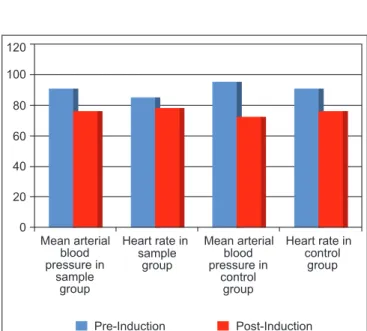
The mean pre induction arterial blood pressure in the study group was 90 mm Hg ± 8.8; and dropped to 76 mm Hg ±
10 after induction. In the control group it was 95 mm Hg ± 15 and fell to 73 mm Hg ± 13. These changes were signifi cant (P < 0.001). Furthermore, both groups had signifi cant drops in post induction heart rate (P < 0.02 in sample group and P < 0.001 in control group). Figure 1 summarized these changes.
Table 1 Patients’ demographic features.
Sample group (35 patients)
Control group (34 patients)
Age in years (mean ± SD) 33 ± 13 35 ± 12 Weight in kg (mean ± SD) 74 ± 11 72 ± 15
ASA I 24 27
ASA II 11 7
Table 2 – Patients’ vital signs at admission.
Sample group Control group p-value
Systolic blood pressure, mm Hg (mean ± SD)
118.6 ± 8.5 123 ± 16.4 0.2
Diastolic blood pressure, mm Hg (mean ± SD)
76.9 ± 7.8 76.1 ± 9.7 0.7
Mean Arterial pressure, mm Hg (mean ± SD)
90.8 ± 6.7 91.7 ± 11.5 0.7
Heart rate (mean ± SD)
84 ± 10.1 84.7 ± 12.5 0.8
120
100
80
60
40
20
0
Pre-Induction Post-Induction
Mean arterial Heart rate in Mean arterial Heart rate in blood
pressure in sample
group
blood pressure in
control group sample
group
control group
Figure 1 Pre and post induction changes in average mean
arterial blood pressure and heart rate in both groups.
260 D. Rabadi
Figure 2 Percentage of signifi cant drop in mean arterial
blood pressure in both groups.
Discussion
In this prospective randomized study we did not fi nd normal saline administration to be helpful in preventing the drop in blood pressure after propofol induction of GA. Both the studied and control groups had statistically signifi cant drops in average mean arterial blood pressure after propofol induction of anesthesia. However there were statistically signifi cant differences in post induction blood pressure drops between both groups.
Propofol has nearly replaced most of the traditional hyp-notic agents. It has many advantages over older medications such as its onset, duration and recovery time, maintenance of anesthesia as well as its anti-emetic property. However, the possible serious side effect of drop in blood pressure is still noted in daily anesthesia practice with propofol 6,7.
The mechanism of propofol-induced hypotension is probably due to a decrease in systemic vascular resistance secondary to arterial and venous vasodilation and a decrease in myocardial contractility 1,6. To counteract this effect, sym-pathomatic medications or fl uid infusion can be used.
Many authors have used ephedrine to reverse this effect. Gamlin et al. 2 studied the hemodynamic effects of propo-fol in combination with ephedrine in forty patients using different doses of ephedrine. They found a dose of 15 mg ephedrine or higher to be effective in reducing the drop of blood pressure during inductionwithpropofolin ASA I patients who underwent gynecological procedures. In another study Michelson et al (1) found ephedrine at 0.2 mg.kg-1 to be su-perior to 0.1 mg.kg-1 dose in controlling the reduction in blood pressure and heart rate, however even with this high dose of ephedrine it did not completely abolish the decrease in blood pressure associated with propofol induction. We think ephedrine in such dose could cause serious complications like: vomiting, cerebral infarction and arrhythmias.
The use of crystalloid fl uid preload to prevent hypotension after propofol induction of anesthesia hasn’t been thoroughly evaluated. In fasting patients, fl uid administration is more likely to remain intravascular than to be distributed into the interstitial and the intracellular spaces, thus, raising venous return and increasing cardiac output that may attenuate hypotensive effect.
The hypotensive property of propofol is dose depend-ent 8 and more obvious in elderly patients 9. There is some evidence that the use of fentanyl with propofol induction may potentiate the hypotensive effect of propofol 10. These factors are unlikely to bias our results.
Both groups in our study had anesthesia according to standard protocol by one anesthesiologist. There were no signifi cant differences in age as well as propofol, fentanyl and ramifentanil dose between the sample and control group.
Although propofol-induced hypotension is usually well tolerated in patients with stenotic coronary artery dis-ease, 11,12 it may occasionally cause cardiovascular collapse and death 13. Propofol anesthesia is associated with a sig-nifi cant decrease in cardiac oxygen consumption, and the global myocardial oxygen supply-demand ratio is therefore well-preserved 11,12. However, despite an increase in the global oxygen supply-demand ratio, arterial hypotension may occasionally lead to local myocardial ischemia in areas supplied by a stenotic artery 11. Arterial hypotension may also jeopardize cerebral perfusion in patients with a signifi cant stenosis in carotid or intracerebral arteries. These seri-ous complications are defi nitely more important when the mean arterial blood pressure drop signifi cantly, especially in such medically compromised patients. Vital organs’ auto-regulation is often maintained within mean arterial blood pressure of 60-160 mm Hg; therefore, any critical drop below this level will be hazardous.
Different authors reported variable results on the effect of propofol on the heart rate. Our data was consistent with Michelsen et al. 1 study where induction of anesthesia with propofol was followed by a decrease in heart rate. In con-trast, Gamlin et al. 2 found no effect of propofol on heart rate, whereas Turner et al. 4 found increase in heart rate. These confl icting results can be explained by the different methods of anesthesia maintenance performed in these studies.
In summary, we did not fi nd administration of 0.9% normal saline before propofol induction of GA in gynecological pro-cedures to be valuable in preventing a drop in post induction mean arterial blood pressure. However, it was effective in decreasing the percentage of patients with a signifi cant drop as defi ned by 25% decrease in pre induction mean arterial pressure.
References
1. Michelsen I, Helbo-Hansen HS, Køhler F, Lorenzen AG, Rydlund E, Bentzon MW - Prophylactic ephedrine attenuates the hemodynamic response to propofol in elderly female patients. Anesth Analg. 1998;86:477-481.
2. Gamlin F, Vucevic M, Winslow L, Berridge J - The haemodynamic effects of propofol in combination with ephedrine. Anaesthesia. 1996;51:488-491.
40
35
30
25
20
15
10
5
0
Control Sample
261 Effect of Normal Saline administration on circulation stability during general anesthesia induction with propofol
in gynecological procedures - Randomised-controlled study
3. Gamlin F, Freeman J, Winslow L, Berridge J, Vucevic M - The haemodynamic effects of propofol in combination with ephedrine in elderly patients (ASA groups 3 and 4). Anaesth Intensive Care. 1999;27:477-480.
4. Turner RJ, Gatt SP, Kam PC, Ramzan I, Daley M - Administration of a crystalloid fl uid preload does not prevent the decrease in arterial blood pressure after induction of anaesthesia with propofol and fentanyl. Br J Anaesth. 1998;80:737-741. 5. Fairfi eld JE, Dritsas A, Beale RJ - Haemodynamic effects of
propofol: induction with 2.5 mg kg-1. Br J Anaesth. 1991;67:618-620.
6. Marik PE - Propofol: therapeutic indications and side-effects. Curr Pharm Des. 2004;10:3639-649.
7. Searle NR, Sahab P - Propofol in patients with cardiac disease. Can J Anaesth. 1993;40:730-747.
8. Vuyk J, Engbers FHM, Lemmens HJM et al. - Pharmacodynamics of propofol in female patients. Anesthesiology. 1992;77:3-779.
9. Smith C, McEwan E, Jhaveri R et al. - The interaction of fentanyl on the Cl’50 of propofol for loss of consciousness. Anesthesiology. 1994;81:820-828.
10. Lindholm P, Helbo-Hansen HS, Jensen B, Bülow K, Nielsen TG - Effects of fentany1 or alfentanil as supplement to propofol anaesthesia for termination of pregnancy. Acta Anaesthesiol Stand. 1994;38:545-549.
11. Stephan H, Sonntag H, Schenk HD et al. - Effects of propofol on cardiovascular dynamics, myocardial blood fl ow, and myocardial metabolism in patients with coronary artery disease. Br J Anaesth. 1986;58:969-975.
12. Vermeyen KM, De Hert SG, Erpels FA, Adriaensen HF - Myocardial metabolism during anaesthesia with propofol: low dose fentanyl for coronary artery bypass surgery. Br J Anaesth. 1991;66:504-S.