E‐ISSN ‐ 0
Between Gentlemen, Sambas and
Beers: the discursive construction
of the
easy mulatto woman
in Brazil
Amanda Braga Universidade Federal da Paraíba, UFPB – João Pessoa/PB, Brazil
ABSTRACT – Between Gentlemen, Sambas and Beers: the discursive construction of the easy mulatto woman in Brazil – This article aims to undertake a reading of the discourses that deal with the imaginary about easy mulatto woman in Brazil (Freyre, 2006 [1933]), considering its historical and se-miological density. That aim is based on statements that emerge on that mulatto woman in slavery peri-od, discussing how it is put to the test during the twentieth century and, finally, analysing the updates and appropriations of that memory nowadays. The starting point is a discourse analysis derived from Michel Pêcheux, but also incorporates the contributions of Michel Foucault, as well as current discus-sions undertaken by Jean-Jacques Courtine, especially those concerning to the Historical Semiology. Keywords: Discourse. Semiotics. Memory. Enslavement. Easy Mulatto Woman.
RÉSUMÉ – Parmi Messieurs, Sambas et Bières: la construction discursive de la mulâtresse facile
au Brésil – Cet article vise à entreprendre une lecture des discours qui traitent de l'imaginaire sur la
mulâtresse facile au Brésil (Freyre, 2006 [1933]), compte tenu de sa densité historique et sémiologique. Ce but est lancé à partir des déclarations qui émergent sur cette mulâtresse au période d’esclavage, de discuter la façon dont elle est mise à l'épreuve au cours du XXe siècle et, enfin, analyser les mises à jour et des appropriations de cette mémoire de nos jours. Le point de départ est une analyse du discours dé-rivé de Michel Pêcheux, mais intègre également les contributions de Michel Foucault, ainsi que les dis-cussions actuelles menées par Jean-Jacques Courtine, en particulier celles qui concernent la sémiologie historique.
Mots-clés: Discours. Sémiotique. Mémoire. Asservissement. Mulâtresse Facile.
RESUMO – Entre Senhores, Sambas e Cervejas: a construção discursiva da mulata fácil no Brasil – O artigo tem por objetivo empreender uma leitura dos discursos que versam sobre o imaginário da
mulata fácil no Brasil (Freyre, 2006 [1933]) considerando sua densidade histórica. O intuito é partir dos enunciados que irrompem no período escravocrata sobre essa mulata, discutir a forma como ela é colo-cada à prova no decorrer do século XX e, por fim, analisar as atualizações e apropriações dessa memória na atualidade. Para tanto, parte-se de uma Análise do Discurso derivada de Michel Pêcheux, mas que incorpora as atuais discussões empreendidas por Jean-Jacques Courtine, principalmente aquelas que dizem respeito à Semiologia Histórica.
E‐ISSN ‐ 0
Esse branco ardido está fadado porque não é com lábia de pseudo-oprimido que vai aliviar seu passado. Olha aqui meu senhor: Eu me lembro da senzala e tu te lembras da Casa-Grande e vamos juntos escrever sinceramente outra história Digo, repito e não minto: Vamos passar essa verdade a limpo porque não é dançando samba que eu te redimo ou te acredito: Vê se te afasta, não invista, não insista! Meu nojo! Meu engodo cultural! Minha lavagem de lata! Porque deixar de ser racista, meu amor, não é comer uma mulata!
(Lucinda, 2006, p. 184-185)
In an interview with El País Brasil in July 2016,the researcher and
ac-tivist Djamila Ribeiro talks about the need to discuss why black women
comprise the highest number of rape victims in Brazil1. It is about
question-ing not only the male chauvinism (as if it was very little thquestion-ing), but chau-vinism combined with racism: instances that work together in maintaining a discourse that objectifies and hyper sensualizes the body of the black woman, in an attempt to justify the violence that it suffers.
According to the researcher, the data pointing to this reality denounce not only a phenomenon or an isolated event, but an entire structure: a structure that has its roots in the way the relations between masters and black slaves during the 300 years of slavery in Brazil were organized: “[...] in the slavery period, black women were raped systematically by slave masters. When we talk about rape culture, it is necessary to make this direct rela-tionship between rape culture and colonization” (Ribeiro, 2016, online).
con-E‐ISSN ‐ 0 sion of Gilberto Freyre (2006 [1933]), and take a reading of statements that, after the slavery period, preserved and seized on this memory, opening doors for her to still find emergency conditions today.
Therefore, this article is organized into four parts. The first one con-cerns the theoretical and methodological tools that we will use in the pro-ject proposed here. It is a brief discussion about Discourse Analysis founded on Michel Pêcheux, and more specifically, about the discussions currently undertaken by Jean-Jacques Courtine regarding the Historical Semiology. Subsequent to this discussion, the analysis of three sequential historical moments will be in focus: first of all, we will present how the image of the
easy mulatto was created and verbalized during the colonial period, report-edly surrendered to the master's wishes. Then, we will be interested in beauty contests promoted by black associations throughout the twentieth century, which put into question this image and appear in an attempt to build another place for black women. Finally, in a scenario of affirmative actions, we will analyze the updates of these discourses, how they are set in contemporary media, and the effects of meaning produced from the body of black woman.
As a corpus to be analyzed in each of these steps, we will use not only
newspaper ads of the nineteenth and twentieth centuries, but also visual statements, taken here as preterit performances. About it, although they are, considering the time period when they developed, only “[...] poor reflec-tion, deafened echo of a pleasure staunched forever” (Medeiros, 2005, p. 165), we will take them as representativeness condition of a scenic expres-sion, able to put into play the rapprochement between life and the art me-diated by the body. Such representation is in communion with the func-tions held by Schechner (2003, p. 39) for performance, including: “select or change identity, make or encourage a community”. Thus, among the statements analyzed here and artistic performances, we can find the centrali-ty of the body, the (re) construction of identities, as well as the production, maintenance and update of speeches can be found.
It is following the steps of performative records of a certain easy
mulat-to that this article is presented, noting a plot that involves continuities and
E‐ISSN ‐ 0
From Discourse Analysis to Historical Semiology
Considering that our purpose requires a retrospective look at the way that black women body was transformed into discourse in Brazil, for the purposes of analysis, we will use the theoretical and methodological per-spective pointed by Michel Pêcheux and, especially, the updates brought by Jean-Jacques Courtine. In this confluence of thought we hope to find sup-port to analyze the meanings attributed to the body of the black woman in its historical dimension, as well as in its semiotic and performative composi-tion, given the instance of the body.
The foundation of discourse analysis takes place during the 1960s in the heart of French structuralism. The new field was made up as a current of interdisciplinary studies involving language, subject and history, in a tense relationship with Saussure (by rereading Pêcheux), Freud (reread by Lacan) and Marx (by constant influence of Althusser). Linguistics, Psycho-analysis and Historical Materialism were therefore at the heart of a project
aiming to build a materialist theory of discourse, as well as a political project
that would intervene in class conflict (Braga, 2013). The aim was to analyze
the effects of meaning produced by written political discourse, considering the subject-position occupied by the one who produced it.
So, to discuss Michel Pêcheux's project would be, first of all, to keep in mind the link established, in its epistemological basis, between science and politics. According to Maldidier (2003, p. 57), in a first moment, from 1969 to 1975, the theory appeared directly governed by politics, and Pêcheux led, with the Althusserians, the theoretical and political struggle against reformism. For this reason, while it was possible to glimpse a muta-tion in French politics during the 1980s, a transformamuta-tion in theory also became urgent. At that time, a supposed crisis in Linguistics emerged, as well as an irreversible crisis in Marxism and Structuralism.
The 1980s is, in the words of Courtine (1999), the time to remove
Marxism from the linguistic theory and humanities in general. It is when it will appear a new configuration of political message: as a result of social,
po-litical and technological turbulences, the verbal corpora collected and
E‐ISSN ‐ 0 political language and a discursive composition increasingly heterogeneous implanted another discourse as they offered new ways to say and to make sense. The mainstream media was protagonist of this process: the primacy of images was settled, so texts received a syncretic treatment: more than lis-tening to their word, it was necessary to see (and to make mean) their imag-es. The verbal discourse, that received privileged place since the emergence of Discourse Analysis, gave rise to texts of many types (Braga, 2016). It was necessary to be careful, in short, with
[...] a truly audio-visual revolution, with the exponential of media that in-stalled the reign of images, and of syncretic texts that amalgamate several ma-terialities (linguistic and visual). It was time to incorporate to the analysis the wind language of media, the ordinary discourse, and the new materiality of the post-modern world that materialized in the discourse (Gregolin, 2008, p. 27).
To undertake a discourse analysis from the 1980s would mean, then, to consider not only its initial steps, with regard to its alliance between Lin-guistics and History, but would mean, above all, to consider the theoretical discontinuities articulated in its scope, and the political rearrangements that happened at that time. It was from crisis states that it was necessary to insist on the project of an analysis of political discourse and to rethink it from re-strictions that were significant in the theory of discourse. New configura-tions of political message, especially regarding to its fugacity, its multimodal composition, and its transmission by the most rapid and varied media sup-ports, interrogate us about a theoretical basis to defy these changes. How can we understand them and, especially, how can we analyze them consid-ering their historical importance? To Courtine (2006), if we want to keep the project of a discourse analysis that restores to the discourse its historical dimension, Discourse Analysis can no longer limit the scope of its sight, undertaking analyzes that articulate discourses, images and practices (Braga, 2016).
E‐ISSN ‐ 0
connected to facial expression, where text becomes unreadable out of con-text, where one cannot separate language from image (Courtine, 2006, p. 57).
To look over the image becomes, in this scenario, something funda-mental. The role of new media and audiovisual technologies in the process of production and circulation of syncretic texts sharpens, definitively, the need to examine how images produce meaning nowadays. About this, Courtine (2011; 2013) will point a possible way, the search for a semiotic apparatus to discourse studies in order to give the field a methodological perspective to assist it in the analysis of discourses composed of syncretic, multimodal texts, consisting of different semiotic systems, as the political discourse is presented nowadays. Courtine calls this perspective Historical Semiology (Braga, 2016).
This Semiology makes necessary a discontinuity regarding to the at-tachment of the textual dimension of discourses. The imminent arrival of the images reign was celebrated, so that the change of discursivities, attract-ed by the development of audiovisual apparatus, could be seen. Therefore, it would be necessary to consider that the textual materialization process oc-curs through a variety of means, manifesting itself in the words of Piovezani
(2009), in a multisemiotic way. According to the author, a possible
defini-tion for textual unit could be a “[...] symbolic unit that is formulated in one, two or in more languages, in the form of a given discursive genre, pro-duced in certain historical production conditions and materialized in a sup-port” (Piovezani, 2009, p. 208). Therefore, it is necessary that we, discourse analysts, consider, in our analysis, the textual dimension by the languages in which it is founded in order not to produce analyzes based purely on text snippets (Braga, 2016).
Moreover, the historical dimension that Courtine links to the
semio-logic dimension does not represent a mere attractive syntagma, in the words
of Piovezani (2009). Integrating the historical character to Semiotics,
Cour-tine intended to expand the reach of the discourse look, offering new life
and new challenges to the project that proposed to restore to discourse its
historical density, opposing to a trend of discourse grammaticalization,
sym-E‐ISSN ‐ 0 bolic production and historical dimension, the Semiology proposed by Courtine also establishes the rescue of this sphere (Braga, 2016).
Based on the postulates of Courtine's historical Semiology, we aim at a cer-tain rehabilitation of the historical density that goes through each discourse, in order to inscribe our object of reflection and analysis at the intersection of multiple durations of history and consider, even briefly, the historicity of memories that it updates, the resources it uses for its formulation, and the shape of the cultural object through which it manifests itself materially and circulates in society (Piovezani, 2009, p. 204).
Thus, we could say that the proposal of a Historical Semiology,before
being attached to the foundation of a discipline, is linked to the construc-tion of a theoretical perspective that suggests the desire not only to review the historical density of discourses, but, likewise, to consider a textual unit based on the syncretic character that builds it (Braga, 2016). According to Courtine (2011, p. 152), we must always consider this perspective when we want to ask ourselves “[...] about what makes sense in the sign and look fields for individuals in a given historical moment, every time we try to re-build what they interpret of what they see, but also what remains invisible to them”. Also, according to Courtine (2011, p. 152), it is still the perspec-tive offered by the historical Semiologia that appears as an alternaperspec-tive “[...] every time we ask ourselves about the historicity of images” (Braga, 2013).
Thus, it is based on this scenario and these theoretical and methodo-logical notes that this article is presented, in an attempt to analyze, in a his-torical and semiotic dimension, the discourses that speak about the body of
a mulatto woman supposedly easy: it is a look that goes beyond the textual
surface and the immediacy of current events. In short, it is a look concerned about the effects of meaning produced by the performative expression of the body in a historical chain. Therefore, as mentioned earlier, we will be held at how discourses emerge during the slavery period and how they are later woven by history, in a plot that involves memories, exclusions and re-captures.
The Emergence of an Easy Mulatto
E‐ISSN ‐ 0 and used as a sexual object, enunciated in the plots of enslavement? How did it produce sense? We will see.
Speaking about Brazil is speaking necessarily about a miscegenation that goes beyond physical attributes. The black presence in Brazil is not on-ly visible in body, but in body and soul, as Gilberto Freyre would say (2006
[1933]). It is in all true expressions of life: in our drumbeats, in our religion,
in our language, in our dishes. We all have – in the body, blood, soul or memory – a little of the black slaved woman who softened life before
offer-ing it, sugared, to the mouth of the young master2. From food to words,
eve-ry taste was chewed by the black woman, hence the sweet Portuguese devel-oped here: ‘[...] words that almost disintegrate in our mouth”, for example,
dodói, bumbum, papá, mimi, cocô... (Freyre, 2006 [1933], p. 414). It was among the maid's arms that the white boy met affection and docility, strange feelings for the European people (Braga, 2013).
Many Brazilian boys of the slavery period were entirely raised by maids. One not breastfed by a black woman was something rare. One who did not learn to talk more to the slave than to his father and mother. One who did not live among black boys. Playing with black boys. Learning naughtiness with them and with the black women of the kitchen. And losing his virgini-ty early. Virginivirgini-ty of the body. Virginivirgini-ty of the mind (Freyre, 2006 [1933], p. 433).
According to Freyre (2006 [1933], p. 367), it was the contact with the black woman that offered to the white boy "the first full sense of being a
man": the principles of physical love in a system that discursively created the
imaginary of the easy mulatto, surrendered to the master's whims and desires.
He was instigated to begin sexual life early – since a chaste son was not good
for the casa-grande3 – and the lust for sex since adolescence, incited him to
the search for black boys and pets. It was a prelude to the great problem of
flesh. Freyre (2006 [1933]) tells cases not only about predilection for the color, but exclusiveness also: marriages where the man could not be satisfied with his white women, or consecrated marriages where the man needed to be provided with clothes of his black lover in his married evenings (Braga, 2013).
There are many places where we can glimpse, in this context, the
E‐ISSN ‐ 0
master and black slave – so intense and so fleeting – were spoken, for
exam-ple, by many popular songs that accompanied the slave labor: Meu
bran-quinho feiticeiro/ doce ioiô meu irmão/ adoro teu cativeiro/ branbran-quinho do meu coração// Pois tu chamas de irmãnzinha/ a tua pobre negrinha/ que estremece de prazer/ e vai pescar à tardinha/ mandi, piau e corvina/ para a negrinha comer
(Freyre 2006 [1933], p. 424). It is from statements like this that we can pay attention on probable incestuous relationships in that period. The presence
of terms such as brother and little sister refers to an eroticism that exceeds
the limit of the flesh. In this song, they are, possibly, people of the same blood loving each other: the white son and his mulatto stepsister, accusing the wide offspring of illegitimate children within the system (Braga, 2013).
The scene portrayed by the song was recurrent in slaveholding Brazil. Accompanied by black and mulatto women since early, the boy learned in childhood about the pleasures – and the facilities – of flesh. Motivated by
personal status, the young master noticed immediately the body of the
mu-latto in the kitchen, and saw in procreation with slaves a way to cause prof-itability to the system. Illegitimate children were many, incestuous relation-ships, sexual witchcraft, crimes of jealousy, and even the spread of syphilis: all excessively (Braga, 2013).
And it is worth mentioning that not only the masters made use of these established power relations. Priests and friars, beyond an alleged reli-gious moralism, ‘[...] roll up their cassocks for the performance of almost patriarchal functions and even for libertine excesses with black and mulatto women” (Freyre, 2006 [1933], p. 532). The sexual life of religious figures, for example, in the lithography below (Figure 1), by Henry Fleiuss and
da-ting from 18714 (Braga, 2013).
E‐ISSN ‐ 0 “Often behind the most seraphic names of this world – Divine Love, Assumption, Mount Carmel, Immaculate Conception, Rosary – [...] flour-ished formidable stallions” (Freyre, 2006 [1933], p 532.). The scene above shows (and denounces) this practice. Characterized by both the title of li-thography and the cassock, the presence of the Father is presented as a sat-ire, a critique and, at the same time, a denunciation of the behavior of that period. In a rural environment perceived by its vegetation, far away from any sacralized place, the religious with his back to the viewer, is flirting with the mulatto, accompanied by a tool. With a slight smile, the mulatto wom-an, lying in a hammock, is also facing the religious, as someone who is ac-cepting his approach (Braga, 2013).
In the expression of the bodies, we must also notice the gesture that the mulatto suggests with her dress: while one of her hands suspends and holds her face, the other holds the dress and suggests to lift it, leaving a
glimpse of her foot and leg, in an supposed attempt to attract one who is
flirting with her and singing about her. On the right side of the statement, at the same time the scene is developed, there are at least two faces peering out from behind the trees the probable couple. One of them, much larger than the printed proportions in lithography, suggests the wide eyes of a society that was alert to the event, suggesting the fact that it was current and known, the relationship between priests and mulatto women, shown as lov-ers without any shame. Not coincidentally, Freyre (2006 [1933]) points out that the power of the Religious Company never interceded in favor of the black woman, it never objected to their irregular conditions of sexual life, as it did for the Indian women (Braga, 2013).
E‐ISSN ‐ 0
In 1830, the Diário de Pernambuco published: “Any single man who is
in circumstances of needing a servant for all needed service [...]” (Diário de
Pernambuco, 01/30/1830)5. And in 1859: “For sale a female slave who is
good cooker, irons and soaps well, with a 3-year-old child, very beautiful
piece, good for pampering her [...]” (Diário de Pernambuco, 04/28/1859)6.
And until the late nineteenth century there were advertisements in which
slaves for sale were described as a beautiful figure, a healthy body, with no
de-fects. Beside these ones, there were also those reporting the search for
fugi-tive slaves: these ones were also a beautiful figure, able to be kind and good
cook, leaving in the announcement the vestige of a wishful master (Braga, 2013).
Some mammy or mumbanda of 'pretty figure', raised almost free and that ran away perhaps with the mulatto of her passion, leaving the white master alone, missing her affection, kindness and delicacies. It is about the little black girl Luísa, with thin lips, large eyes, small feet, tall body, standing breasts, who ran away in 1833 from Ruas das Violas, here in São Cristóvão (Jornal do Commercio, 01/08/1833 apud Freyre, 2010 [1963], p. 112).
Thus, understanding that, in the period the advertisements were pro-duced, they were more concerned with describing the slave's body than with her ability to work, we can say, as Freyre underlines (2006 [1933]), that there was a process of eugenic and aesthetic selection for obtaining slaves. The preference has always been for slaves with beautiful body and face, tall and with all teeth. Slaves from Guinea, Cape and Sierra Leone, for example, although having the fame of bad slaves, were among those consid-ered with the most beautiful body, especially the women. Not coincidental-ly, they had preference when it came to slaves for domestic work. “It is easy to imagine – emphasizes Freyre (2006 [1933], p 384.) – that also for con-cubines or simple love of master and slave in which colonial patriarchy was made” (Braga, 2013).
Therefore, the accurate selection of slaves for the work in the
E‐ISSN ‐ 0 people in a slavery Brazil, which was always crossed by body, sex and
imag-ination of the easy mulatto. Following we will see how the twentieth century
will work this memory (Braga, 2013).
The Reeducated Mulatto
Following the Lei Áurea [the Law that decreed the end of slavery in
the country] in 1888, it would be necessary to analyze the way the memo-ries produced earlier were kept or discarded, that is, the way the twentieth century organized them, separating them as subject of contestation, maintenance or finally, oblivion. The purpose was then to inaugurate a new moment for the black population of the country: numerous newspapers and African-Brazilian recreational associations claimed, then, a second abolition. In this context, we can hear the voice of a black person to another: with
po-litical, educational and aesthetic concern. It was necessary to reeducate the
people, put an end to the stereotypes attributed to black people by the pre-vious centuries. An appeal to morals and good habits, cultivated at that
time, was becoming visible. As a symbol of this counter-image proposed, we
can mention beauty contests organized by the black population, which helped to build a concept of black beauty, and also presented themselves as a response to the image of the promiscuous mulatto, built in the slavery pe-riod (Braga, 2013).
At that time, in many beauty contests promoted, what we see is a con-cept of beauty based on the precon-cepts of morality: the goal was to reward the
lady who best represented the civility codes dictated by time. To portray this
period, we could cite a number of contests held throughout the twentieth
century: Concurso de Belleza, offered by the newspaper O Menelick in
Janu-ary 1916; contest to elect the Rainha Negra, promoted by the newspaper A
voz da raça in March 1934; election of the Rainha das mulatas, promoted
by the Teatro Experimental de Negros in September 1947; or contest Miss
Progresso, by the newspaper Progresso in January 1930. Unable to present all
of them, we will take as an example the contest Boneca de Pixe, promoted
by the Teatro Experimental de Negros in May 1950.
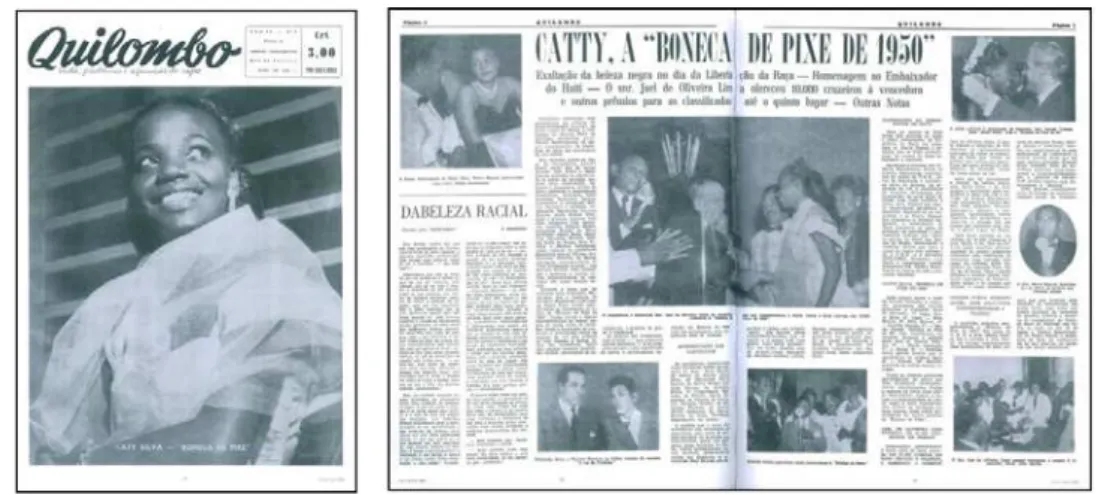
The edition number 9 of O Quilombo (Figure 2), published in May
E‐ISSN ‐ 0
for her victory. In a big article, the newspaper highlighted the black beauty
crowned on that May 13 (Braga, 2013).
Figure 2 – Catty, the ‘boneca de pixe de 1950’. Source: O Quilombo (1950).
During the unprecedented spectacle that was the ball for electing the
Boneca de Pixe of 1950, there was a crowd of enthusiasts without any class distinction, so that it was possible to find from housekeepers to writers and sociologists, as well as poets, journalists, photographers, conductors,
actress-es, dancers, and lawyers. The event peak, however, according to O
Quilom-bo, was the candidates’ presentation: a total of 12 women, and each one
re-ceived the sympathy of the audience, not only because of their black beauty,
but also because of the clothing they were wearing (Braga, 2013):
All had beautiful dresses, also highlighting in elegance the ladies Nely San-tos, who designed and made her own ‘soiré’, Nina Barros, another compe-tent dressmaker who dressed herself with rare taste; Catty Silva presented a simple but of great beauty model, unique of the renowned fashion designer Lucila, Eunice attended wearing a beautiful garnet model, followed by the refined ‘soirés’ of Iracilda and Elohá (O Quilombo, 1950, p. 6-7).
The elegance made possible by the costumes also appeared in the ana-lyzed scene, as a voting criteria. Indeed, many other criteria – beyond
phys-ical beauty, or black beauty – were at stake. In this regard, Nascimento
E‐ISSN ‐ 0 be linked to other factors, such as the stereotype of easy, 'hot', and sexually available woman" (Nascimento, 2003, p. 297). Not coincidentally,
re-counting the voting rules, the Teatro Experimental de Negros underlines the
standards of morality as a characteristic element of a black beauty (Braga, 2013).
The candidates for the title 'Boneca de Pixe de 1950' were introduced, beau-tiful and worthy young ladies, representatives of the black beauty of our land. The event, aiming to promote the social appreciation [sic] of color woman could not just focus on the physical beauty of the candidates, moral quality, intelligence, grace and elegance were also required (O Quilombo, 1950, p. 6).
It was then based on these criteria that after four and a half hours of
counting, Catty Silva was announced the Boneca de Pixe of that year, reason
for which she received, from the hands of the engineer and industrial Jael de Oliveira Lima, the prize of Cr$ 10,000 offered by him as, according to
O Quilombo, a way of “[...] effective support to the movement of social up-lift of our people of color”. After speaking about it, the donor “[...] also de-cided to offer the first four placed a souvenir of the contest, with the
deliv-ery taking place in this newspaper office” (O Quilombo, 1950, p. 7) (Braga,
2013).
In the same way, all other events promoted by black associations kept their strength to create, in a class society, a discussion about black aesthetics that claimed a concept of beauty built between body and moral, creating al-so spaces to al-socialize it. This shift operated by contests move away from the image of a black woman sexually enslaved and available, and approaches a conception of beauty that, according to Lipovetsky (2000, p. 121), lasted until the eighteenth century: “[...] it had as a fundamental feature to not separate physical beauty of moral virtues. As a reflection of moral goodness, beauty in traditional cultures has no autonomy, it is the same thing as a
good”. It is this conception that seems to be taken up again when a beauty
contest is announced specifically, and when the candidate that best
embod-ies the prevailing moral precepts is elected. Moral qualities and intelligence
predicates used as voting criteria are proof of this.
E‐ISSN ‐ 0 at least two aspects that denounce the maintenance of a discourse about a black body of heightened sexuality. The first one concerns the musical pro-duction of the period. As an example, we can highlight the song by Alberto Castro Simões da Silva (Bororó), that at the end of the 1930s sang about the wet and scandalizing kisses of a brunette of the color of sin:
Esse corpo moreno cheiroso e gostoso que você tem/ É um corpo delgado da cor do pecado/ Que faz tão bem/ Esse beijo molhado, escandalizado que você me deu/ Tem sabor diferente que a boca da gente/ Jamais esqueceu/ E quando você me responde umas coisas com graça/ A vergonha se esconde/ Porque se revela a mal-dade da raça/ Esse cheiro de mato tem cheiro de fato/ Saumal-dade, tristeza, essa simples beleza/ Esse corpo moreno, morena enlouquece/ Eu não sei bem por que/ Só sinto na vida o que vem de você/ Ai....Ai....
Besides Bororó, João Gilberto, in 1959, sang about a mulatto good at
samba and with no compassion: Olha, essa mulata quando samba/ É luxo só/
Quando todo seu corpo se embalança/ É luxo só/ Tem um não sei quê/ Que faz a confusão/ O que ela não tem meu Deus/ É compaixão. In 1960, Elizeth
Car-doso, in a composition by Ataulfo Alves, referred to a mulata assada / Que
passa com graça/ Fazendo pirraça/ Fingindo inocente/ Tirando o sossego da
gen-te! Already in 1979, the same Elizeth Cardoso, in a composition by João
Nogueira, cried the malice of a joyful mulatto: Ah, Olha quem está chegando/
é a mulata faceira/ Que vem na cadência do samba/ empunhando a bandeira/ Vem com o seu valor/ que é só pra mostrar como é/ a malícia da cor, a ginga/ e o dengo da mulher (Braga, 2013).
Thus, together with the beauty contests held during the twentieth cen-tury, it would emerge in the repertoire of our Brazilian Popular Music (MPB) the continuity of a discourse referring to the heightened sensuality of a black body. The statements were intended to remain in the memory of
our culture, beyond re-education suggested by black associations, as well as
the beauty contests promoted by them.
Besides musical productions, the second aspect of this period to be underlined would be, for example, the numerous assumptions that sought to frame the behavior of black women, especially regarding their sexual
be-havior, aligning it to the quest for marriage. Resuming the article Breviário
E‐ISSN ‐ 0 maiden like, not for being shameless, because there is nothing that fits her better than modesty’” (Domingues, 2007, p. 367). It is a concept – of which we are, somehow, heirs – that puts in the women the responsibility for marriage: she would have a modesty behavior and constitute a family. After all, a sexual conduct expressed in excess could even “[...] delight cer-tain men, but most women will not be very indicated for mothers of their children, the reason why some ladies find a fiancé but not a husband”, as
proclaimed in the article (A voz da raça, 06/1936) (Domingues, 2007, p.
367). Then, it was necessary to be covered with shame and decorum in
or-der to undo the idea sung by Bororó: that there was an evil in the race, able
to intoxicate men by the seduction of a black, scented, hot, delicate body, that
has sin associated with its color (Braga, 2013).
It is important to note that, when advertisements attempting to control
the sexual desire of a given body are published, we denounce, at the same time, the continuity of a discourse about this hypersensuality: it is precisely
the permanence of statements talking about a naughty mulatto that makes
necessary the publication of models of conduct. In this way, not only the songs produced during the period, but also the educational advertisements denounce the maintenance of a discourse pointing to the black woman as the owner of an uncontrolled sexuality. We will see, from here, how these memories are made in a moment of affirmative policies.
The Memorized Mulatto
In the last step proposed here, it will be interesting to analyze the cur-rent context, impregnated with the advent of affirmative policies incorpo-rated by the Brazilian State and destined to the black population. At this point, we will need to reflect about the updating of previously produced discourses, in an action that discusses the place occupied by the imaginary worked in this article, in a context of self-assertion and respect for diversity. On the one hand, it is possible to envision the demarcation of an affirma-tive discourse that changes the look of the black people about themselves, as affirmative policies, identity policies, and affirmative actions are used in
na-tional context. Hence the emergence of statements as black is beautiful,
100% negro, 100% black, curly is beautiful. On the other hand, we know
E‐ISSN ‐ 0
us about a mulatto of the color of sin, a body sculpted by lust, in a sexual
freedom allowed by the Carnival, by samba, and by advertisements of beer, music etc.
In order to demonstrate how these discourses emerge in our everyday lives, we will look at two representative statements of this moment, consid-ering the discursive genre they belong to – publicity – and the thematic they approach. We will see.
Figure 3 – Outdoor of the Escola de Samba Pérola Negra in the carnival of 2007. Source: Webpage of Clube da Criação (2013).
In an outdoor for Carnival 2007 (Figure 3), Pérola Negra says: you will
lose the shame over time. Our mulattos, for example, don't really care to be na-ked. Parade on Pérola Negra, ensure your costume. We have, in the scene painted here, a mixture of traits representative of the Carnival revelry, a time when we are all immersed on the same rhythm: someone sells booze,
someone plays the guitar, someone plays the samba in the surdo, someone
op-E‐ISSN ‐ 0
posed, as announced in the outdoor, to the image of modesty: our mulatto,
for example, don't even care to be naked (Braga, 2013).
In this context, it is necessary to analyze the invitation made to the
public: Parade on Pérola Negra, ensure your costume. With DaMatta (1986),
it is possible to think about the exchange held during the Carnival between uniforms and costumes. Now, if we spend the whole year being limited by a uniform that, as its name suggests, aims to standardize our bodies, to keep them in the same routine and under the same Government; at the Carnival, on the other hand, the costume allows the interference of creativity and, above all, freedom: we can be a dinosaur, a ballerina, a comic book charac-ter, a film actress, an astronaut. It is no coincidence that in Brazil we do not use masks, but costumes. According to DaMatta (1986), our fantasies go beyond the masks in two respects: first, masks hide your identity, your face,
your nose; in addition, the Portuguese word fantasia, is ambiguous: can be
related to something we want while the routine is imprisoning us (fantasy), but can also be related to the clothes that we wear only in Carnival (cos-tume). In this second meaning, costume, according to DaMatta (1986, p. 75), “[...] allows us to be everything we wanted, but that ‘life’ did not allow. With it – and never in uniform –, we have achieved a kind of compromise between who we are and who we would like to be” (Barnes, 2013).
So, perhaps this is the freedom of identity which features the character
of the outdoor: naked body, smile, and samba. Here, the composition of the statement – especially the costume of the mulatto (or its lack) – makes a clear reference to the stereotypes of the black women since the slave period, especially those about eroticism and lust. Although the twentieth century assigned moral and familial precepts to the imaginary of the mullato, it is clearly perceptible, even today, the continuity of this discourse, which
oc-curs at the same time as a denial of the moral discourse: you will lose the
shame over time (Braga, 2013).
In addition, through DaMatta (1986), it is still possible to think about the relationship between women and food. On the one hand, we have the modesty image exalted by the twentieth century: the model of mother, housewife, wife, religious, whose sexual practice is sacred and performed
solely for reproductive purposes. On the other hand, the mulatto that does
E‐ISSN ‐ 0 who desire her "[...] food for all [...] delicious in its hidden and passionate digestion", as the author points out (Da Matta, 1986, p. 60). It is in this second sense, therefore, that the production of meaning of the scene in question is supported, symbol of a given preterit performance (Braga, 2013).
Beyond this outdoor, and also in order to analyze how these discourses are now in our imagination, we could also read the advertisement of the
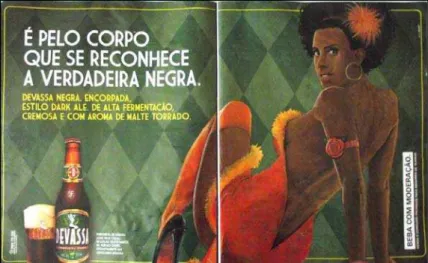
beer Cerveja Devassa7, published in 2010 (Figure 4).
Figure 4 – Advertisement of Cerveja Devassa. Source: Rolling Stones Magazine (2010).
There is, above, the advertisement of Cervejaria Devassa, made by
Roll-ing Stones Magazine and published in December 2010: It is by the body that one recognizes the true black woman. Devassa negra. Full-bodied, dark ale of high fermentation style, creamy and with roasted malt aroma. Associating in
its entire line of production the image of women to the image of beer,
De-vassa uses ambiguity in order to confuse the two fields. Even the beer’s
name is an attempt: after all, what is the Devassa, or who is the devassa?
Noteworthy is that all beers produced in this line receive female names and
are called sisters: a very unusual family, all sisters are tasty, as the official
product page says8. We present thus the Blonde, the Redhead, the Black, the
India and the Sarará: but not everyone can handle 4 on the same night, af-firms the webpage (Braga, 2013).
The environment created to the publicity of the black Devassa is a
E‐ISSN ‐ 0 style, the tiles – when they are not the typical Lusitanian tile decorated with floral or abstract shapes – are accommodated in the form of lozenges, over-lapping two color tones, as it shows us the scene. Associated with the tile,
there is the beer image: draft beer or long neck. While the bottle is presented
– ice-cold – for the reader taste, the draft beer, in customized glass, over-flows its foam, such as someone who has just been taken: both ready for consumption, offering themselves to the consumer's eyes and taste (Braga, 2013).
Competing with this Devassa, however, it is presented – greater! – the
black woman who spreads along the rest of the advertisement. She is the
counterpoint to the long neck bottle or the draft beer. Similarly, it is she
who puts in scene the image of the brothel already commented: she is seat-ed, with thighs exposseat-ed, high heels, low-cut dress (carefully designed), one rose tied to her arm, a tiara, and finally a look that is meant to seduce who-ever sees the scene. In contrast to the green tiles, the black woman is wear-ing red, in an atmosphere of passion and lust. In typical costumes of a con-cubine, her body has its back to the viewer: her arms rest on the floor and her face is shown. It is from this angle that we can see the biggest neckline of her clothes: she undresses her shoulders and her back, while threatening to show her breasts and suggesting, under her costume, the design of her
buttocks. Simultaneously, the verbal language signals: it is by the body that
one recognizes the true black woman. Beyond suggesting a simple justification
for nudity, the phrase in question brings back a memory and reminds us of
the process of buying and selling slaves in warehouses, time when the buyer used to touch the women for sale, as if he was seeking in their body the rea-sons for such a purchase, a clear allusion to the acquisition of women slaves
destined exclusively to work in the casa-grande and bought for the
patriar-chal desires (Braga, 2013).
A reading of the statement in its historical density will tell us,
there-fore, that the true black woman here is, actually, a discursive event that
up-dates the memory of a sex slave. The true black woman has an exposed body
and offers it to the eyes of those who observe, brings a half-open mouth (as if ready to surrender to the kisses of those who want), wears seductive clothes (that show more than hide) and has a look that reveals a supposed
E‐ISSN ‐ 0
it is by the body that we recognize her, it is through her curves that we can identify her, the same as the buyer of slaves used to do (Braga, 2013).
Not coincidentally, the advertisement in question caused chain
reac-tions and led the Secretaria de Políticas de Promoção da Igualdade Racial
(Seppir) [Department of Policies for Racial Equality Promotion] to open a
judicial process in the Conselho Nacional de Autorregulamentação
Public-itária (Conar) [National Council for Publicity Self-Regulation]. In March 2012, the agency replied the process determining that the group responsible
for producing Devassa should change the advertisement, understanding that
it reinforced the process of racism and spread stereotypes about the sexuali-ty of the black population (Braga, 2013).
To this accusation, Devassa group seems to answer citing the joy and
creativity of the Brazilian people. On their website, they made available, at
that time, a Manifest alluding to Devassa as synonymous of freedom,
au-thenticity and relaxation: to show who we really are and to do what we feel
like doing are some of the possibilities presented by the beer, because those who drink Devassa are looking for freedom. Don’t make faces, don't pretend to be what you're not. Thus, the meaning produced leads us to conclude that the advertisement they released aimed to offer visibility and space for the black woman to be exactly who she is and finally assume her identity. If we want to go back to the parameter made by Da Matta (1986, p. 60) between women and food, in detriment of a black woman who was shaped by a so-cial discourse that imposes control over her identity, conduct and sexual
appetite, Devassa would keep the idea of the true black woman as “food for
all” in the author’s words, or, perhaps, “drink” for all (Braga, 2013).
This parameter – of a black woman food or drink for all – and
especial-ly the ambiguities present in the advertising proposal of the magazine – the names of the beers, the way each of them is introduced, and the lush scen-ery provided on its website – that will offer us the confusion purposely es-tablished between the product offered in the advertisement and the
adver-tisement girls. After all, who is this Devassa: the black woman who is spread
on the advertisement or the beer that is introduced, discreet, at her side?
What does the advertisement is really offering: the woman's body or the
ac-E‐ISSN ‐ 0
cording to the advertisement, the “devassa” side of the black (woman or
beer) would only be noticeable by her/its body (Braga, 2013).
Conclusion
From the project proposed here – the one that suggests to discursively
analyze how the image of the easy mulatto emerges in the slavery period and
is later woven by history –, we conclude that this sensual character attribut-ed to the black body travels through Brazil’s history adopting either an ex-plicit exposure, either a denial (although this denial has been betrayed by MPB), either a resumption theoretically camouflaged by affirmative actions, advertisements, music, or even by a certain tone of humor.
Let’s see: the image of the easy mulatto built in the slavery period
of-fered, to the black body, the signs of eroticism, lust, and exacerbated sensu-ality, especially regarding to slaves chosen for housework, meant to satisfy the patriarchal desires. After all, resuming the interview with Djamila Ribei-ro mentioned at the beginning of this paper, “[...] since an early age the boy was raised to be a male, to be the provider, violent, aggressive” (Ribeiro,
2016)9, even if it meant, since always, to maintain a rape culture addressed
in this case, particularly, to the black woman.
From the nineteenth to the twentieth century, as opposed to the moral
appeal made by African-Brazilian associations that defended an honorable
life style governed by rules and codes of civility, granting the woman only the role of prudish mother, housewife and good wife, the MPB songwriter left no doubt about the continuity of this speech, especially when it comes to the performances embodied by the mulattos of the carnival, samba, slum (Braga, 2013).
Concerning the present moment, in addition to affirmative action pol-icies, that recommend an exaltation speech to a positive image of black
people, is not the discourse about the easy mulatto that appears in the
E‐ISSN ‐ 0
zilian way. Not surprisingly, the songs we spoke about are still recorded nowadays.
With this, we want to show the articulation of a history that moves as it refreshes memories, keeping them and updating them. The marks of an
easy mulatto built in the Brazilian slavery period are spread out in the MPB, created during the twentieth century. Following, the marks of this sensuali-ty overrun the Brazilian imagination and come to our advertisements, with our music, our carnival. They are speeches that cross time and keep they strength, as they work in their maintenance in the dispersion of historical time.
The purpose of this article was, therefore, to think about the necessity of breaking these discourses. In this sense, it seems to be already a horizon: we are finally discussing the racist content of our carnival songs; we have a black Miss Brazil after 30 years; black feminism is gaining visibility
throughout the country; Globeleza is no longer announcing carnival
na-ked... In sequence, we will need to denature some practices, guiding discus-sions that deal with the empowerment of black women, in an attempt to
claim another history to be written about their bodies.10
Notes
1 Data of the Violence’s Map of 2015.
2 T. N.: “young master” is an approximate translation for the Portuguese word
“nhonhô”. This word refers to a young master of slaves, but it also has a sen-timental charge in it.
3 T.N.: “casa-grande” is a Portuguese word that means, literally, “big house”. In
the Brazilian slave period, it referred to the house where the master of slaves lived.
4 Originally published: Semana Ilustrada, Rio de Janeiro, ano 11, n. 572, 26 nov. 1871, p. 4572. Currently cataloged in Moura (2000, p. 561).
5 Freyre (2010 [1963], p. 170).
6 Freyre (2010 [1963], p. 166).
7 T.N.: the Portuguese word “devassa” is an adjective that refers to a libertine
E‐ISSN ‐ 0
8 Available at: <www.devassa.com.br>. Accessed on: 11 December 2012.
9 Electronic reference, no page.
10 References
BRAGA, Amanda. Retratos em Branco e Preto: discursos, corpos e imagens em uma história da beleza negra no Brasil. 2013. 239 f. Tese (Doutorado em Letras) – Programa de Pós-Graduação em Letras, Universidade Federal da Paraíba, João Pessoa, 2013.
BRAGA, Amanda. Cafuza, mulata, negra: corpo e memória no discurso publici-tário de cervejas brasileiras. Revista Línguas & Letras, Cascavel, v. 17, n. 35, p. 142-162, 2016.
COURTINE, Jean-Jacques. O Discurso Inatingível: marxismo e lingüística (1965-1985). Tradução de Heloisa Monteiro Rosário. Cadernos de Tradução, Porto Alegre, n. 6, p. 5-18, abr./jun. 1999.
COURTINE, Jean-Jacques. Uma genealogia da Análise do Discurso. In: COURTINE, Jean-Jacques. Metamorfoses do Discurso Político: derivas da fala pública. Tradução de Carlos Piovezani e Nilton Milanez. São Carlos: Claraluz, 2006. [1992]. P. 37-57.
COURTINE, Jean-Jacques. Discurso e imagens: para uma arqueologia do imagi-nário. Tradução de Carlos Piovezani. In: PIOVEZANI, Carlos; CURCINO, Luzmara; SARGENTINI, Vanice (Org.). Discurso, Semiologia e História. São Carlos: Claraluz, 2011. P. 145-162.
COURTINE, Jean-Jacques. Decifrar o Corpo: pensar com Michel Foucault. Tradução de Francisco Morás. Petrópolis: Vozes, 2013.
DAMATTA, Roberto. O que faz o brasil, Brasil? Rio de Janeiro: Rocco, 1986. DOMINGUES, Petrônio José. Frentenegrinas: notas de um capítulo da participação feminina na história da luta anti-racista no Brasil. Cadernos Pagu, Campinas, n. 28, jan./jun. 2007. Disponível em: <http://www.scielo.br/scielo.php?pid=S0104-83332007000100015&script=sci_arttext>. Acesso em: 22 nov. 2012.
E‐ISSN ‐ 0
FREYRE, Gilberto. Os Escravos nos Anúncios de Jornais Brasileiros do Século XIX: tentativa de interpretação antropológica, através de anúncios de jornais bra-sileiros do século XIX, de característicos de personalidade e de formas de corpo de negros ou mestiços, fugidos ou expostos à venda, como escravos, no Brasil do sé-culo passado. 4 ed. São Paulo: Global, 2010. [1963].
GREGOLIN, Maria do Rosário. J.-J. Courtine e as metamorfoses da Análise do Discurso: novos objetos, novos olhares. In: SARGENTINI, Vanice; GREGO-LIN, Maria do Rosário (Org.). Análise do Discurso: heranças, métodos e obje-tos. São Carlos: Claraluz, 2008. P. 21-37.
LIPOVETSKY, Gilles. A Terceira Mulher: permanência e revolução do femini-no. Tradução de Maria Lucia Machado. São Paulo: Companhia das Letras, 2000. LUCINDA, Elisa. Mulata Exportação. In:LUCINDA, Elisa. O Semelhante. 5. ed. Rio de Janeiro: Record, 2006. P. 184-185.
MALDIDIER, Denise. A Inquietação do Discurso: (re)ler Michel Pêcheux hoje. Tradução de Eni Orlandi. Campinas: Pontes, 2003.
MEDEIROS, Maria Beatriz de. Aisthesis: estética, comunicação e comunidades. Chapecó: Argos, 2005.
MOURA, Carlos Eugênio Marcondes de. A Travessia da Calunga Grande: três séculos de imagens sobre o negro no Brasil (1637-1899). São Paulo: Editora Uni-versidade de São Paulo, 2000.
NASCIMENTO, Elisa Larkin. O Sortilégio da Cor: identidade, raça e gênero no Brasil. São Paulo: Summus, 2003.
O Quilombo. anno II, n. 9. maio 1950.
PIOVEZANI, Carlos. Verbo, Corpo e Voz: dispositivos de fala pública e produ-ção da verdade no discurso político. São Paulo: Ed. da UNESP, 2009.
RIBEIRO, Djamila. “É preciso discutir por que a mulher negra é a maior vítima de estupro no país”. El país Brasil, São Paulo, 23 jul. 2016. Entrevista concedida a Marina Novaes. Disponível em: <http://brasil.elpais.com/brasil/2016/07/14/politica/1468512046_029192.html>. Acesso em: 25 jul. 2016.
SCHECHNER, Richard. O que é performance? O Percevejo, Rio de Janeiro, ano 11, p. 25-50, 2003.
E‐ISSN ‐ 0
Amanda Braga holds a PhD in Letters from Universidade Federal da Paraíba, with cotutelary period in Universidade Federal de São Carlos. Associate Professor of the Departament of Classic and Vernacular Languages of Universidade Federal da Paraíba.
E-mail: [email protected]
This unpublished text, translated by Raquel Peixoto do Amaral Camargo and Renata Tonini Bastianello and proofread by Ananyr Porto Fajardo, is also publis-hed in Portuguese in this issue.