Article received on December 10, 2013 and accepted for publishing on January 5, 2014.
News and Perspectiveson Treatment of NormalPressure
InternalHydrocephalus
Cristia Năstase1
, Maria Mitrică1, Cristian Popescu1
Abstract: Many patients, usually over 60 years old, presenting presenile dementia associated with marked gait disorders, impaired balance, urinary incontinence, have been shown to have enlarged ventricles associated with relatively small cortical atrophy. Intracranial pressure monitoring indicates normal values, or subject to only minor peaks, usually at night. Because some of these patients improve markedly after ventricular shunting procedures it has been suggested that their neurological dysfunction may be caused by a pressure effect on the brain from the increased internal surface of the ventricles. Many of these patients do benefit from surgery, and a lot of them have a history of subarachnoid hemorrhage, traumatic brain injury or meningitis which might have impaired the CSF absorption.
INTRODUCTION
We would like to present the experienceof our clinic over the last fiveyears regarding the treatment ofnormal pressure internal hydrocephalus(28 patients operated between January2009 and December 2013), to report our results andcompare them with the statistics and results fromthe international literature. Normal pressure internalhydrocephalus (NPIH) represents an increase ofCSF volume, with different etiology, that causes anenlargement of the ventricular system as a consequenceof the hydrodynamic CSF circulation disorders.
The cause of this disease cannot be identifiedin 60% of cases. It was described in 1965 with theHakim & Adams triad: gait disorders and impairedbalance, cognitive disorders (progressive dementia),sphincter disorders (8). The imagistic explorations(CT scan) indicate the size of hydrocephalus; ICP< 15 mmHg
and the pressure gradient between theventricles and subarachnoid space is very low. Fortreatment there are extrathecal shunts (particularlyventriculo-peritoneal shunt) and intrathecal shunts(particularly endoscopic ventriculocisternostomy).
Both methods have been practiced successfully inour clinic.
The ideal treatment method for hydrocephalusstill does not exist. None of the surgical techniquesis perfect and no shunting device gave total satisfaction(4, 7).
Hydrocephalus represents the enlargement ofone or more parts of the CSF containing anatomicstructures. The CSF total volume is about 150 ml inadult; the ventricular system contains 25-30 ml, thespinal subarachnoid space contains 30 ml and therest of CSF
ORIGINAL ARTICLES
1
Vol. CXVII •New Series • No. 1-2/2014• Romanian Journal of Military Medicine
is contained by the cranial subarachnoidspace and basal cisterns (1).
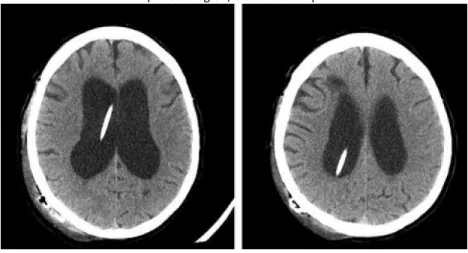
Figure 1. The ventricular enlargement shown on CT scan
The total production ofCSF is about 600 – 700 ml/24 hours, approximately0,35 ml/min. The CSF participates in maintainingthe endocranial volume constant by adjusting theproduction/absorption ratio depending on the cerebral parenchyma volume and the intracranial bloodvolume variations according to the Monro-Kellierelationship. Changing the volume of one of thethree intracranial components (brain tissue, blood,CSF) is followed by a compensatory reaction fromthe other two components in order to
maintain insidean inextensible space the endocranial volumeconstant (9).
Based on its underlying mechanisms, hydrocephaluscan be classified into obstructive and communicating.
The obstructive hydrocephalus is definedby any condition that restricts the CSF flowto and from the ventricular system. Any CSF flowinterruption outside the ventricular system definesthe communicating hydrocephalus (5).
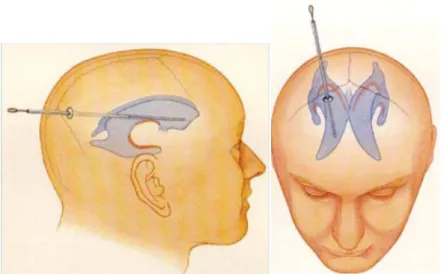
Figure 2. Lateral ventricles puncture
The NPIH etiology is not fully known. Thereare many possible congenital or acquired causes, butthe most important are the subarachnoid hemorrhages(20%),
ventricular system, intoxications, Alzheimerdisease (15%).
Hydrocephalus of the adult patients is a communicating,chronic and normal pressure hydrocephalus(3).
DIAGNOSTIC
The CT scan and the MRI revolutionized thediagnosis and the postoperative follow-up of thehydrocephalus. The CT scan is the first stage of diagnosis.
It highlights an obstructive cause, evaluatesthe ventricular enlargement, appreciates the cerebralparenchyma condition (periventricular hypodensity)and the subarachnoid spaces condition (basal cisterns,sylvian fissures, interhaemispheric fissure, corticalsulci).
Bifrontal index measuring (the distancebetween frontal horns / intracranial distance ratio, onthe same CT slice) > 50% is suggestive for a possibledecompensation of hydrocephalus.
The Evans index> 30% has the same meaning (the frontal horns size/ the maximum biparietal diameter ratio). It suggestsan active hydrocephalus. The MRI completes the CTscan by describing the obstructive lesions accuratelyand obtaining dynamic information over the CSFflow (the absence of CSF flow through Sylvius aqueduct).
The preventing treatment is important becauseof the existing risk of postoperative hydrocephalus afterany neurosurgical procedure. Cisternograms withradioactive markers (99Tc-DTPA) remain controversialand rarely used.
The radionuclide is injectedinto the subarachnoid space by a lumbar punctureand serial images are taken by planar scintigraphy 3,6 and 24 hours after the injection. In case of NPIHintraventricular radioactivity can be obtained even48 hours after the injection. Serial lumbar punctureswith repeated evacuation of 15 – 30 ml CSF associatedwith clinical improvement can predict a favorableresponse to shunting procedures. Patients withinitial measured
CSF pressure >15 mmHg respondedfavorably after ventriculo-peritoneal shunting (6, 8, 9).
TREATMENT
The treatment of hydrocephalus depends onthe moment of diagnosis, etiology, age and clinicalcondition of the patient (particularly the acuteform) and the complementary investigations results.
The treatment with acetazolamide, a carbonic anhydraseinhibitor has favorable effects predominantlyby inhibiting the chorioid plexus secretion and lessby the diuretic effect.
The acetazolamide dose is 25mg/kg/day with simultaneously administration offurosemide 1 mg/kg/day.
The treatment of obstructive hydrocephalus isremoving the obstacle (excision of tumors). The surgicaltreatment seeks not returning to normal size ofventricles but regaining most of the lost neurological functions.
The diuretic and corticosteroid therapiescomplete the CSF evacuation by lumbar punctions.The CSF lumbar drainage will be performed onlyafter the confirmation of communicating chronichydrocephalus by imagistic methods.
There are several types of extrathecal derivationsof CSF: controlled external ventricular drainage,ventriculoperitoneal drainage, ventriculoatrialdrainage, ventriculopleural drainage.
The currentlyused valves are predetermined opening pressurevalves (low, medium and high pressure), modularopening valves and programmable valves with variableresistances, self-regulating valves etc.
The intrathecal derivation (particularly theendoscopic ventricular cysternostomy) representsan alternative treatment method. Both extra- andintrathecal derivations have been successfully performedin our clinic.
Vol. CXVII •New Series • No. 1-2/2014• Romanian Journal of Military Medicine
betweenintraventricular and subarachnoid liquidian compartments.
MATERIAL AND METHODS
We retrospectively studied 28 patients admittedto our clinic between January 2009 and December 2013. The patients were all neurologicaland imagistic diagnosed with normal pressure internalhydrocephalus.
Only in 18 cases, a cause forimpaired CSF absorption and ventricular enlargementcould be detected. 8 patients had a historyof traumatic brain injury, 4 patients had a historyof subarachnoid hemorrhage (First and secondgrade on Hunt and Hess scale) with
o al essels e e al a giog a , patie ts
were diagnosedwith Alzheimer disease prior to admissionand 4 patients had a history of ischemic stroke.
3 of the patients with NPIH after subarachnoidhemorrhage underwent endoscopic procedureswith intrathecal derivations (ventriculocisternostomy).
On the other 15 patients were performedventriculo-peritoneal shunts using various valves(most of them were low pressure valves). The mostfrequently used were the Delta (Medtronic), Spitz – Holter, Heyer – Schulte, Pudenz, Cordis – Hakimvalves. In 10 cases, a cause for NPIH was not revealedand these patients were diagnosed withidiopathic NPIH. They have also
been performedventriculoperitoneal shunts with low pressurevalves.
Clinical improvement was significant inmost patients, but only partial in the patients diagnosedwith Alzheimer disease.
According to statistics from literature, urinaryincontinence is the main symptom that resolves aftershunting procedures.
Gait disorders and impairedbalance are subsequently remitted and dementia isthe last that improves (3, 4, 8).
Black and collaboratorsestablished few criteria that can predict thefavorable clinical course after shunting procedures:
- clinical: the presence of symptomatic triad;approximately 77% of the patients presenting gaitdisorders as primary symptom improve their locomotorfunction after shunting; the patients withdementia without gait disorders rarely improve afterdrainage;
- patients with CSF pressure >18 mmHgon lumbar puncture or continuous monitoring improvetheir
neurological status after
ventriculoperitonealdrainage;
- patients with CT or MRI showing largeventricles with minimal cortical atrophy have favorableevolution after shunting procedures.
The response to drainage is especially good asthe symptoms started recently (1, 5).
ILLUSTRATIVE CASES
Case 1.
66 year old male patient complaining ofgait disorders, impaired balance, cognitive impairment(occasionally) and sphincter disturbances(imperious need to urinate) which started abouta year ago, slowly progressive despite of conservativetreatment. We decided to install ventriculoperitonealdrainage with self-regulating valve. Postoperativeevolution was favorable, symptoms therebyimproving considerably about 3 months after theprocedure.
Case 2.
59 year old male patient complaining of headache, nocturnal insomnia, depressive syndrome,cognitive
i pai e t, gait diso de s a d lo o oto s
instability.
Case 3.
revealsenlarged ventricular system. It was decided to install VP drainage with Delta low pressure valve. The symptomsimproved partially after one month with
significant improvement 6 months after the procedure.
Figure 3. The ventricular catheter placed inside the right lateral ventricle and the selfregulating valve placed in the right parietal region, under the scalp.
Figure 4. The ventricular catheter placed inside the frontal horn of the right lateral ventricle, near septum pellucid; VP drainage with Delta (Medtronic) low pressure valve.
Case 4.
64 year old male patient facing important balance disorders, persistent vertigo, extremely difficultgait, urinary incontinence (and incipient stercoral), onset of Alzheimer disease (after neurological and psychiatricexaminations). It was inserted a Delta low pressure valve. The symptoms improved partially after3-4 months; the gait has become easier, sphincter disturbances have improved and the cognitive impairmentstill exist, but more tolerable.
Case 5.
72 year old female patient hospitalized for walking
difficulties, balance disorders, persistent vertigoand vomiting, dehydration. A central venous catheter was inserted into the right subclavian vein andVP drainage with a Delta low-pressure valve was inserted on the left side; intraoperative CSF pressure was15 mmHg.
Case 6.
Vol. CXVII •New Series • No. 1-2/2014• Romanian Journal of Military Medicine
symptoms improved after one month with the complete remission of gait disorders,
impairedbalance and sphincter disturbances.
Figure 5. The ventricular catheter placed inside right lateral ventricle (functional drainage).
CONCLUSIONS
The ventricular enlargement and the pressureon the frontal lobes are probably responsible for theoccurrence of cognitive disorders and dementia.
The pressure on the regulator centers of the sphincterfunctions located in the paracentral lobule maybe responsible for the urinary incontinence. Theventricular dilatation may compress the internalcapsule and secondary the pyramidal tract, responsiblefor the gait disorders, impaired balance and pyramidalsyndrome (4, 5, and 9).
To determine the surgical indication and to anticipatethe subsequent postoperative evolution, severalclinical and imaging criteria must be established:
• the o st u ti e auses fo h d o ephalus ust e
excluded;it must be a communicating form;
• a periventricular hypodensity on CT scan or hyperintensityon T2 sequence (MRI) might be transependimar CSFresorption and might anticipate a favorable evolutionafter the shunt procedure;
• the ou di g a d s et i al alloo i g of the
frontalhorns;
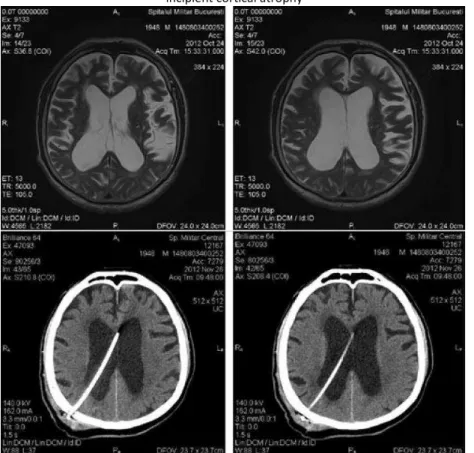
Figure 6. Preoperative MRI (T2 sequence) and postoperative CT scan; right ventricular catheter;prominent convexity sulci; incipient cortical atrophy
Vol. CXVII •New Series • No. 1-2/2014• Romanian Journal of Military Medicine
Figure 8. Important hydrocephalus with cortical sulcus persistent; catheter placed inside the left lateral ventricle (coronal section).
Maintaining good results depends on periodicmedical checks, immediate recognition and treatmentof complications (insufficient drainage shouldbe suspected first). There is no ideal method for thetreatment of hydrocephalus. None of the surgicaltechniques is perfect and no device gave total satisfaction.
The accelerated development of technology andthe practical experience in CSF intra- and
extrathecaldrainage allow overcoming the current difficulties.
The world population undergoes a pronounced agingprocess, the number of people aged over 60, increasingto 400 million over the last 40 years. The ratio ofthe elderly population has been modified, representingover 50% in developed countries, with the Europeanzone being the aged (10).
References:
1 Black P., Kaye A. - Operative Neurosurgery.Churchill
Livingstone.2000, pp. 1235-1247.
2 Connelly S., Mc Khann G., HuangJ., Chondhry T. –
Fundamentals ofOperative Techniques in
Neurosurgery.Thieme 2001, pp. 345 - 355
3 Constantinovici A., Ciurea A.V. –Practical Guide of
Neurosurgery,Medical Publishing House 1998, pp.353-414
4 Jennett B., Lindsay K. – Neurosurgery;Fifth Edition;
Springer-Verlag1996 ; pp.283-289;
5 Greenberg M. – Handbook of Neurosurgery,fifth edition,
Thieme2001, pp. 191-195;
6 Gorgan R. M. – Handbook of Surgery(Prof. Irinel
Popescu), II, RomanianAcademy Publishing House,2007, pp. 114 – 120;
7 Kempe G. L. - Operative Neurosurgery,Springer – Verlag
1968, pp.203-214;
8 Karaguiosov L. - Operative Neurosurgery,Medicina I
9 Wilkins R.H. – Principles of Neurosurgery,McGraw Hill
inc.1985.pp.2341 – 2356.
10 Yasargil M.G. – Microsurgery volII, Clinical
Considerations Surgeryof Intracranial Aneurysms and
Results.New York. Georg Thieme Verlag1984, pp. 232-295
11 Youmans J.R. - Neurological Surgery,Fourth Edition, W.