Polymethyl methacrylate (Linnea Safe) causes local
inflammatory response after intramuscular implant in
BALB/c mice but it is not observed in distant organs
Polimetilmetacrilato (Linnea Safe) provoca resposta inflamatória localizada
após implante intramuscular em camundongos BALB/c,
mas não é observado em órgãos a distância
Eduardo Luiz Costa1; Anália C. Milhomem2; Ronaldo Moisés de Moura Filho2; Ruy S. Lino Jr.2
1. Clínica Santorini, Goiás, Brazil. 2. Universidade Federal de Goiás (UFG), Goiás, Brazil.
First submission on 03/05/16; last submission on 23/08/16; accepted for publication on 02/11/16; published on 20/12/16
ABSTRACT
Introduction: Among its different therapeutic functions, the use of polymethyl methacrylate (PMMA) for more than a decade has has stood out in the replacement of the volumes lost with the aging process and illing in wrinkles and creases. It is considered a permanent biomaterial despite its reliability is widely discussed by health professionals. Objective: To analyze the size of the microspheres in of three different commercialized types of PMMA, and the inlammatory process generated by the implant, as well as to evaluate possible migration of the microspheres. Methods: The polymers of the brands Biossimetric®, MetaCrill® and Linnea Safe® were analyzed by scanning
electron microscope (SEM) and had the dispersion and the size of its particles determined. After this analysis, it was decided to implant
in BALB/c mice the polymer of the brand Linnea Safe®, which was the more homogeneous product. The animals submitted to polymer
implantation were euthanized at 3, 7, 15, 30, 60, 90 and 120 days after implantation, allowing the weighing of the implanted paws and the histopathological analysis of some tissues. Results: It was observed that the implantation of Linnea Safe® PMMA microspheres in mice
triggered an acute inlammatory process 3 to 15 days after the surgical procedure, evolving to chronic non-granulomatous inlammation with collagen deposition, tissue reorganization after 30 days of PMMA implantation up to 120 days; also, no microspheres were observed
in distant organs. Conclusion: The Linnea Safe® PMMA behaved as a safe and stable biomaterial, once its microspheres were sized to
prevents phagocytosis, and leads to local and controlled inlammation.
Key words: polymethyl methacrylate; foreign-body migration; inlammation; pathology.
INTRODUCTION
The polymethyl methacrylate (PMMA) was successfully synthesized for the irst time in 1902. In 1994, its microspheres were linked to bovine collagen, creating a pasty vehicle easily implantable in the subcutaneous. Thereafter, a better retention was veriied with the use of the collagen compounds mixed to the PMMA microspheres, evoking great and positive expectations of the researchers and the medical community. Since 1945, this acrylic resin is widely used in dentistry for the preparation of dental prostheses(1). This product has been increasingly used in several surgical specialties and it is known as an excellent
material for stabilization of long bones fractures(2), craniofacial reconstructions(3), intraocular lenses(4), and illing soft tissue(5, 6). PMMA is classiied as good alloplastic material due to some of its characteristics, such as the fact that it is permanent or non-absorbable and non-degradable(7). It has been extensively studied for its numerous and possible applications in the ield of coatings, adhesives, sensors, optical devices, biomaterials, among others(8).
In Brazil, PMMA iniltrative implants are being used to replenish the volume lost during the aging process and for wrinkles illing(9), since there is evidence that it is a polymer that stimulates neocollagenesis, it causes a controlled inlammatory reaction, which stabilizes the material and sets the material in its implant
site. Delayed reactions, such as granulomas, have been observed with the use of PMMA, and are probably related to poor quality of the raw material used to manufacture the products, predisposition of each individual, collagenases, error in the implant procedure, such as variations in the size of the needle, inappropriate volume, irregular distribution and variation in the depth of the implant(10, 11).
Several factors affect the type and intensity of the inlammatory reaction of the body tissues to the PMMA implantation for the purpose of aesthetic illing; among these, is the size of the polymer microspheres, which should be between 36-43 µm, since this seems to be the ideal size for large dermal injections, preventing phagocytosis and allowing the delivery and stabilization of this material. This size is accepted and considered by reports in the medical literature, which shows that microspheres with a diameter smaller than 20 µm trigger an inlammatory granulomatous response and are proven to be phagocytosed(12), and microspheres larger than 50 µm would not be implanted effectively(13, 14). Linked to the size of the injected microspheres, another factor that affects the stability of the implanted PMMA, and therefore, trigger the inlammatory reaction, is the amount of collagen deposition around the polymer microspheres; spheres with a diameter of 100 µm trigger the production of only 56% of ibrous connective tissue around it, while spheres with an average diameter of 40 µm promote growth of about 80% of collagen ibers. The higher the stability of the polymer, the lower the probability of dispersal and consequent exaggerated inlammatory response(5, 6).
Lemperle, Morhenn and Charrier (2003)(15) analyzed and compared ten products commercialized that were being used as soft tissue illers, regarding its biocompatibility and durability. After four years of experiment, the authors were able to observe that all substances, resorbable and non-resorbable, proved to be clinically and histologically safe, even describing late, and mild, inlammatory reaction, in addition to the granulomatous reaction, the authors did not attribute such cellular changes to the implant of polymers.
Sousa et al. (2008)(16) implanted PMMA (Newplastic®) in
BALB/c mice and analyzed the presence of inlammatory response on the implantation site and the way it was manifested, in addition to evaluating the deposition of collagen. The authors concluded that intramuscular implantation of Newplastic® lead to collagen
deposition, but did not induce a chronic inlammation, which demonstrates the biocompatibility of the material to bioplasty purposes; however it was veriied the presence of mononuclear inlammatory iniltrate predominantly at the implantation site of the polymer.
Because of the scarcity of scientiic articles focused on the description of speciic materials in bioplasty, this study becomes
necessary once it evaluates different application materials, standardization of the size of the microspheres and possible inlammatory reaction to the implantation and whether it is possible or not to trigger adverse reactions in distant regions.
The objectives of this study is to analyze the size of the microspheres in three forms of commercialized PMMA and compare them with each other according to their homogeneity, to describe and characterize the inlammatory process generated by the implant, and to evaluate whether there is permanence of the microspheres in the implanted tissue.
MATERIALS AND METHODS
Evaluation of the size of the microspheres
through scanning electron microscopy
The size analysis of the different brands of PMMA (Biossimetric® 30%, MetaCrill® 30% and Linnea Safe® 30%) was
conducted using the scanning electron microscope (SEM) in the Microscopy Laboratory (LABMIC) in the Universidade Federal de Goiás (UFG), Goiás, Brazil.
The polymers were packaged in its commercial form (PMMA, hydroxyethylcellulose, methylparaben, propylparaben and water for injection), which was in gel inside a tube. For the analysis, it was used an aluminum sample holder, which was previously prepared by ultrasonic cleaning and drying in oven. Approximately 0.1 ml of the initial part of the sample in the tube was discarded. Then, in the clean dry tube, another part of the sample was spread using a disposable spatula to form a thin ilm. The tube with the PMMA sample was placed for drying in a desiccator with silica gel at room temperature for approximately 24 hours. After complete drying of the sample, it was covered with gold using a system for ilm deposition (Denton Vacuum, Desk V model), and analyzed in SEM, brand: Jeol, model JSM-6610.
To determine the PMMA particles-size dispersion, images were taken with ixed magniication of 200 times. The software Scandium, Olympus Soft Imaging Solutions GmbH, was used to analyze the images and determine the size of the particle, for this purpose, approximately 1,550 particles were analyzed for each brand. The same professional analyzed the three brands of PMMA repeated this methodology in a standardized procedure.
In vivo
analysis
the Instituto de Patologia Tropical e Saúde Pública (IPTSP)/UFG. The 56 animals used were divided into two groups: Group 1 – 35 mice implanted with 0.1 ml (approximately 5 × 10⁵ particles) of
PMMA Linnea Safe® 30% in the gastrocnemius muscle of the left
posterior limb (ive animals per experimental day); Group 2 – 21 control inoculated mice with 0.1 ml saline solution (three animals per experimental day). The euthanasia was performed after 3, 7, 15, 30, 60, 90 and 120 days after the surgical procedure.
The mice were initially immobilized to allow the trichotomy in the caudal region of the left posterior limb. It was performed an oriice with a 40 × 12 needle puncturing the epidermis and dermis to apply 0.1 ml of PMMA Linnea Safe® 30% or saline solution by
threading technique (preventing implantation in blood vessels and lymphatics vessels) with blunt micro cannula (21 G × 25 mm) and surgical steel pistol which provided the formation of a subdermal tunneling, and intramuscular implantation of PMMA. In order to provide better distribution of the solution, a light massage was performed in the region.
Histopathological analysis
The animals were euthanized at a predetermined time by cervical dislocation. The left posterior limbs and viscera (liver, popliteal lymph nodes, spleen, kidneys and lungs) were removed and left in 4% formaldehyde. The paws were weighed and, subsequently, the gastrocnemius muscles were removed from the paws with longitudinal cuts and dehydrated in alcohol solutions of increasing concentration (80%, 90% and 100%), diaphanized in xylene and embedded in parafin of low melting point, just like the viscera.
The blocks were cut into 5 µm thick pieces and the slides were stained with hematoxylin and eosin (HE). All organs were processed to allow 10 serial slices of each organ in topography from the hilum, in order to evaluate the possible migration of
Linnea Safe® 30% PMMA microspheres and possible inlammatory
reactions caused by it in the tissue; whereas for the muscles, only a cut of the tissue was performed in the place implanted with the PMMA. The images were evaluated regarding the presence of inlammatory iniltrate and collagen deposition, in a semi-quantitatively way, by light microscopy.
RESULTS
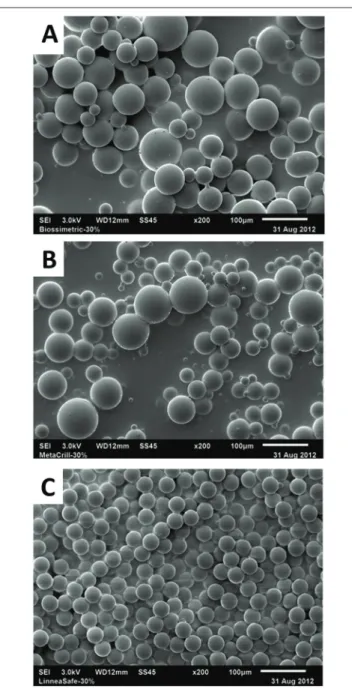
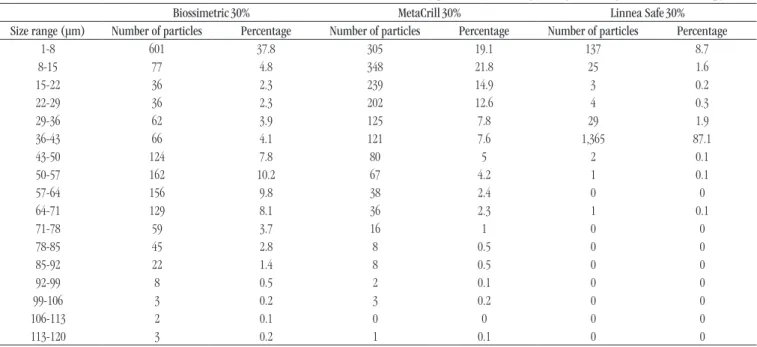
After the morphometric analysis of the PMMA microspheres of three different brands, it was found that the majority (37.8%) of the microspheres diameter of the Biossimetric® brand
(30%) is between 1-8 µm, only 4.1% is between 36-43 µm, and
FIGURE 1 − Scanning electron microscopy of the three brands commercialized of PMMA
A) Biossimetric®; B) MetaCrill®; C) Linnea Safe®, 100 µm scale.
PMMA: polymethyl methacrylate.
36.7% of the diameter is larger than 50 µm. The analysis of the Metacrill® (30%) brand showed that 76.1% of their PMMA
microspheres diameter is between 1-36 µm, 7.6% is between 36-43 µm, and 16.3% is larger than 36-43 μm. Unlike the two brands previously analyzed, Linnea Safe® (30%) presented with a more
homogeneous appearance and highly concentrated microspheres, where 8% of microspheres diameter is between 1-8 µm, 87.1% between 36-43 µm, and only 0.3% is larger than 43 µm (Figure 1
TABLE − Distribution of Biossimetric®, MetaCrill®and Linnea Safe®PMMA microspheres by size range using scanning electron microscopy
Biossimetric30% MetaCrill30% Linnea Safe30%
Size range (µm) Number of particles Percentage Number of particles Percentage Number of particles Percentage
1-8 601 37.8 305 19.1 137 8.7
8-15 77 4.8 348 21.8 25 1.6
15-22 36 2.3 239 14.9 3 0.2
22-29 36 2.3 202 12.6 4 0.3
29-36 62 3.9 125 7.8 29 1.9
36-43 66 4.1 121 7.6 1,365 87.1
43-50 124 7.8 80 5 2 0.1
50-57 162 10.2 67 4.2 1 0.1
57-64 156 9.8 38 2.4 0 0
64-71 129 8.1 36 2.3 1 0.1
71-78 59 3.7 16 1 0 0
78-85 45 2.8 8 0.5 0 0
85-92 22 1.4 8 0.5 0 0
92-99 8 0.5 2 0.1 0 0
99-106 3 0.2 3 0.2 0 0
106-113 2 0.1 0 0 0 0
113-120 3 0.2 1 0.1 0 0
PMMA: polymethyl methacrylate.
The histopathological analysis of the implantation of
Linnea Safe® PMMA microspheres in mice triggered an acute
inlammatory process 3-15 days after the surgical procedure around the implanted spheres with the presence of important predominantly polymorphonuclear (PMN) inlammatory iniltrate, and dissociation of the muscle ibers. Between 30-120 days of the implantation of the polymer, the inlammation decreased assuming a non-granulomatous chronic proile with reorganization of the tissue with predominance of mononuclear cell iniltrates (MN) and higher deposition of collagen adhered to the microspheres and the muscle ibers. There was no necrosis,
granuloma or angiogenesis in the surrounding tissue (Figure 2).
No histopathological changes were observed in the control group.
Linnea Safe® PMMA microspheres were not found in the
ten cuts of viscera (liver, popliteal lymph nodes, spleen, kidneys and lungs) in any groups throughout the analysis period. There were no PMMA microspheres in popliteal lymph nodes, but it was observed reactional aspect of this organ in the early stages of the study. There was no difference between the weights of the paws that received the implant and the other contralateral of the same animals during the study period (Figure 3).
DISCUSSION
The analysis of the three brands of PMMA using SEM allowed demonstrating that the Biossimetric® polymer has a greater
dispersion between the microspheres and greater variability of their size compared with the other two analyzed brands. It is considered a heterogeneous product, since spheres with a smaller diameter are more susceptible to migration and larger spheres may not be implanted correctly, preventing or hindering their ixation and
better reorganization of the implanted tissue. MetaCrill® also
showed signiicant variability in size among their microspheres, and was considered a dispersed product when spaces between the micro-implants were evidenced. Unlike the brands listed and analyzed
above, Linnea Safe® appeared as a homogeneous polymer, since
the microspheres were concentrated, in other words, with minimal dispersion, with equal sizes, close to the expected (36-43 µm).
Piacquadio, Smith and Anderson (2008)(17) also compared, using SEM, different PMMA commercialized brands to determine whether there are signiicant differences between these products, including the Metacrill, which was also analyzed in this study. Signiicantly morphologic differences were revealed, mainly on the size of microspheres of these polymers, leading the authors to conclude that the variability observed between these products may result in different therapeutic outcomes, especially regarding the safety of the patient. For this reason, they were able to infer that doctors and health care professionals should be aware that the products that are “comparable”, and often considered to be similar, may not be equal.
FIGURE 3 − Distribution, per experimental day, of the paws weight (in grams) of the left posterior limb of BALB/c mice after implantation of Linnea Safe®
DAI: days after implantation; p > 0.05 – SIGMA STAT/analysis of variance (ANOVA). 2
1.8
1.6
1.4
1.2
1
0.8
0.6
0.4
0.2
0
3 DAI 7 DAI 15 DAI 30 DAI 60 DAI 90 DAI 120 DAI
BALB/c mice is very well characterized, with a predominance of polymorphonuclear cells in the iniltrate, showing that the immune system of the animal has been activated; the iniltrate was only around the microspheres in an attempt to stop them. Around 15 days after the implantation, there was a dissociation of the muscle ibers and subsequent deposit of the host connective tissue between the microspheres, so there is a substitution of the PMMA vehicle, which is absorbable, by collagen. This inding corroborates Sousa et al. (2008)(16) that described this deposition in the irst month of implantation, followed by complete replacement up to three months after implantation.
After 30 days of the PMMA implantation, inlammation had a non-granulomatous chronic proile with predominance of the mononuclear cell iniltrates in the inlammatory iniltrates, reorganization of muscle tissue and enhanced collagen deposition between the implanted microspheres, similar to that Lemperle,
FIGURE 2 − Photomicrography, stained with HE, of the skeletal musculature of BALB/c mice after implantation of Linnea Safe®
A) damage caused by the implant in the first three days (10×, objective lens); B) increase of the previous figure highlighting inflammatory infiltrate predominantly PMN around the implanted microspheres (100×, objective lens); C) the lesion on the seventh day (10×, objective lens); D) increase of the previous figure (100×, objective lens); E) the lesion on the fifteenth day; F) increase of the previous figure (100×, objective lens); G) the lesion on the thirtieth day with decrease of the inflammatory process and the beginning reorganization of the damaged tissue (10×, objective lens); H) increase of the previous figure showing mixed inflammatory infiltrate with mononuclear cell infiltrates and collagen deposition early; I) lesion healing at the sixtieth day (10×, objective lens); J) increase of the previous figure showing greater collagen deposition, stabilization of microspheres and scarce MN inflammatory infiltrate; K) the lesion on the ninetieth day (10×, objective lens); L) increase of the previous figure (100×, objective lens); M) the lesion on the 120th day, characterized by intense collagen deposition around the
implanted microspheres, discreet presence of MN inflammatory cells and complete reorganization of the damaged tissue (10×, objective lens); N) increasing of the previous figure showing stabilization of microspheres surrounded by collagen and juxtaposed.
RESUMO
Introdução: Entre suas diversas funções terapêuticas, há mais de uma década o polimetilmetacrilato (PMMA) vem se destacando na reposição de volumes perdidos com processo de envelhecimento e preenchimento de sulcos e rugas. É considerado um biomaterial permanente, apesar de sua confiabilidade ser amplamente discutida por profissinais da área da saúde. Objetivos: Analisar o tamanho das microesferas de três formas comercializadas de PMMA e o processo inflamatório gerado pelo implante, bem como avaliar a possível migração das microesferas. Métodos: Os polímeros das marcas Biossimetric®, MetaCrill® e Linnea Safe® foram analisados por microscópio eletrônico de varredura (MEV) e tiveram a dispersão e o tamanho de suas partículas determinados. Após essa análise, decidiu-se implantar em camundongos BALB/c o polímero da marca Linnea Safe®, o qual se apresentou mais homogêneo. Os animais submetidos ao implante do polímero foram eutanasiados aos 3, 7, 15, 30, 60, 90 e 120 dias após o implante, permitindo a realização da pesagem das patas implantadas e a análise histopatológica de alguns tecidos. Resultados: Observou-se que a implantação de microesferas de PMMA Linnea Safe® em camundongos desencadeou um processo inflamatório agudo de 3 a 15 dias após o procedimento cirúrgico, evoluindo para inflamação crônica não granulomatosa com deposição de colágeno e reorganização do tecido após 30 dias de implantação de PMMA até 120 dias; além disso, não foram observadas microesferas em órgãos a distância. Conclusão: O PMMA da marca Linnea Safe® comportou-se como um biomaterial seguro e estável, uma vez que as microesferas apresentaram tamanho que impedem sua fagocitose e provocam inflamação localizada e controlada.
Unitermos: polimetilmetacrilato; migração de corpo estranho; inflamação; patologia. Morhenn and Charrier (2003)(15) described after the analysis of
the Artcoll and Jesus et al. (2015)(10) when using Newplastic. Although Morhen, Lemperle and Gallo (2002)(11) have shown that particles smaller than 20 μm are phagocytized by cells such as keratinocytes and Langerhans’ cell, our study did not show that fact after the analysis of ten viscera cuts (liver, popliteal lymph nodes, spleen, kidneys and lungs) in all the groups during the period analyzed, proving that Linnea Safe® PMMA does not migrates,
which shows that the inlammation triggered by it is local and controlled; that fact is directly related to the homogeneity of its microspheres diameter, since, as described by Lemperle et al., in 2004(12), the particles larger than 20 µm are encapsulated by the connective tissue, most of Linnea Safe®’s microspheres implanted
suffer this stabilization by collagen. Despite not having found
Linnea Safe®’s PMMA microspheres in popliteal lymph nodes,
REFERENCES
1. Lemperle G, Ott H, Charrier U, Hecker JG, Lemperle M. PMMA microspheres for intradermal implantation: part I. Animal research. Ann Plastic Surg. 1991 Jan; 26(1): 57-63. PubMed PMID: 1994814.
2. Cardona LR, Brousse M, Mieres M, et al. Evaluación de la resistencia de un prototipo de placa de compresión dinámica (PCD) fabricada de polimetilmetacrilato (PMMA) probada en fémur canino osteotomizado. Rev Med Vet. [Internet]. 2011 Mar; 21: 13-24. Available at: http://www. scielo.org.co/pdf/rmv/n21/n21a02.pdf.
it was observed a reactive aspect in the early stages of the study, which shows the activation of the immune system of the host when in contact with that foreign body.
It is important to highlight that the techniques most used to search for hematogenic dispersion of particles or cells is the histological analysis of the closest lymph nodes, also called, sentinel lymph node(18, 19). It is widely used in the search for metastatic cancer which allows the detection of micromestastasis in such organs(20).
Therefore, based on the analysis of this study, it can be concluded that the Linnea Safe® PMMA behaved as a safe and
stable biomaterial, once their microspheres obey size uniformity, between 36-45 µm, preventing phagocytosis and consequent migration, which characterizes the inlammation caused by the implantation of the polymer as local and controlled.
3. Abdo Filho RCC, Oliveira TM, Neto NL, Gurgel C, Abdo RCC. Reconstruction of bony facial contour deiciencies with polymethylmethacrylate implants: case report. J Appl Oral Sci. 2010 Out; 19(4): 426-30. PubMed PMID: 21952926.
4. Oriá AP, Neto FAD, Santos LA, et al. Evaluation of polymethylmethacrylate as ocular implant in rabbits subjected to evisceration. Rev Ceres. 2012; 59(4): 452-7.
5. Lemperle G, Knapp TN, Sadick NS, Lemperle SM. ArteFill® permanent
6. Lemperle G, Sadick NS, Knapp TN, Lemperle SM. ArteFill® permanent
injectable for soft tissue augmentation II: indications and applications. Aesthetic Plast Surg. 2010b; 34(3): 273-86. PubMed PMID: 19787393.
7. Puricelli E, Nácul AM, Ponzoni D, Corsetti A, Hildebrand LC, Valente DS. Intramuscular 30% polymethylmethacrylate (PMMA) implants in a non-protein vehicle: an experimental study in rats. Rev Bras Cir Plast. 2011; 26(3): 385-9.
8. Padilha GS, Mansanares V, Bartoli JR. Effect of plasma luorination variables on the deposition and growth of partially luorinated polymer over PMMA ilms. Polímeros. 2013; 23(5): 585-9.
9. Sturm LP, Cooter RD, Mutimer KL, Graham JC, Maddern GJ. A systematic review of dermal illers for age-related lines and wrinkles. ANZ J Surg. 2011; 81(1-2): 9-17. PubMed PMID: 21299793.
10. Lemperle G, Gauthier-Hazan N, Wolters M. Komplikationen nach faltenunterspritzung und ihre behandlung. Handchir Mikrochir Plast Chir. 2006; 38(6): 354-69.
11. Jesus LH, Hildebrand LC, Martins MD, Rosa FM, Danielevicz CK, Sant’Ana Filho M. Location of injected polymethylmethacrylate microspheres inluences the onset of late adverse effects: an experimental and histopathologic study. Clin Cosmet Investig Dermatol. 2015; 8: 431-6. PubMed PMID: 4531029.
12. Morhenn V, Lemperle G, Gallo R. Phagocytosis of different particulate dermal iller substances by human macrophages and skin cells. Dermatol Surg. 2002; 28(6): 484-90. PubMed PMID: 12081676.
13. Lemperle G, Morhenn V, Pestonjamasp V, Gallo R. Migration studies and histology of injectable microspheres of different sizes in mice. Plast Reconstr Surg. 2004; 113(5): 1380-90. PubMed PMID: 15060350.
14. Lemperle G, Gauthier-Hazan N. Foreign body granulomas after all injectable dermal illers: Part 2. Treatment options. Plast Reconstr Surg. 2009; 123(6):1864-73. PubMed PMID: 19483588.
15. Lemperle G, Morhenn V, Charrier U. Human histology and persistence of various injectable iller substances for soft tissue augmentation. Aesthetic Plast Surg. 2003; 27(5): 354-66. PubMed PMID: 14648064. 16. Sousa EM, Costa EL, Silva EB, Filho JAA, Lino-Júnior RS, Junqueira-Kipnis AP. Resposta inlamatória e deposição de colágeno após implante intramuscular após implante intramuscular com polimetilmetacrilato em camundongos Balb/c. Acta Sci Vet. [Internet]. 2008 Jan; 36(1): 13-9. Available at: ttp://www.redalyc.org/articulo. oa?id=289021804003.
17. Piacquadio D, Smith S, Anderson R. A comparison of commercially available polymethylmethacrylate-based soft tissue illers. Dermatol Surg. 2008; 34 Suppl 1: S48-52. PubMed PMID: 18547181.
18. Hata M, Machi J, Mamou J, et al. Entire-volume serial histological examination for detection of micrometastasis in lymph nodes of colorectal cancers. Pathol Oncol Res. 2011; 17(4): 835-41. Pubmed PMID: 21494849.
19. Landi G, Polverelli M, Moscatelli G, et al. Sentinel lymph node biopsy in patients with primary cutaneous melanoma: study of 455 cases. J Eur Acad Dermatol Venereol. 2000; 14(1): 35-45. Pubmed PMID: 10877250. 20. Grabau D, Rden L, Ferno M, Ingvar C. Analysis of sentinel node biopsy - a single - institution experience supporting the use of serial sectioning and immunohistochemistry for detection of micrometastases by comparing four different histopathological laboratory protocols. Histopathology. 2011; 59(1):129-38. Pubmed PMID: 21668472.
CORRESPONDING AUTHOR
Eduardo Luiz Costa