426
J Bras Patol Med Lab, v. 52, n. 6, p. 426-428, December 2016 CASE REPORT
Multisystemic Langerhans cell histiocytosis: case report
Histiocitose de células de Langerhans – forma multissistêmica: relato de caso
Larissa A. Paiva1; Daniela M. Takano1; Valeska A. S. Queiroz2; Laís S. Príncipe3
1. Instituto de Medicina Integral Professor Fernando Figueira (IMIP), Pernambuco, Brazil. 2. Serviço de Veriicação de Óbitos de Pernambuco, Pernambuco, Brazil. 3. Universidade Federal de São Paulo (Unifesp), São Paulo, Brazil.
First submission on 17/06/16; last submission on 19/06/16; accepted for publication on 02/11/16; published on 20/12/16
ABSTRACT
Langerhans cell histiocytosis is the designated name for a spectrum of rare diseases that affects children from one- to three-years-old, which name refers to the proliferation of cells morphologically and immunophenotypically similar to the specialized dendritic cells of the skin and mucosa (Langerhans cells). This article reports a case of multisystemic Langerhans cell histiocytosis diagnosed by autopsy of a four-day newborn with conirmation by immunohistochemistry and secondary systemic infection associated.
Key words: Langerhans-cell histiocytosis; Langerhans cells; sepsis.
INTRODUCTION
Langerhans cell histiocytosis (LCH) is the designated name for a spectrum of rare diseases(1), which name refers to the proliferation of cells morphologically and immunophenotypically similar to the specialized dendritic cells of the skin and mucosa (Langerhans cells). It is considered a rare disease, and its real incidence is unknown, due to the diagnostic dificulty in the general population, and the diagnosis is more frequently concluded only in the reference centers(2, 3).
The condition can be found in any age group and is more common in children from 1-3 years old(2, 3).
The multisystemic form, also called Letterer-Siwe disease, is the disseminated form of LCH affecting many organs(4).
We report in this article a case of multisystemic LCH diagnosed by the autopsy of a four-day newborn who died at the Instituto de Medicina Integral Professor Fernando Figueira (IMIP), Pernambuco, Brazil.
OBJECTIVES
To report the case of a neonatal death due to multisystemic LCH diagnosed after an autopsy at the Serviço de Veriicação de Óbitos
(SVO) (Hospital Postmortem Examination) from Pernambuco, as well as to perform the microscopic analysis of the material collected in the service of Pathological Anatomy of IMIP.
CASE REPORT
Newborn, 4 days following birth, male, prenatal with no particularities, normal delivery at 38 weeks of gestation, weighing 3.3 kg at birth and Apgar score 8/9, with reddish plaques diffusely
distributed throughout the body from the birth (Figure 1). He was
FIGURE 1 − Skin lesions at birth
427
admitted in IMIP at the ifth hour of life with reddish, multiform, raised skin lesions on the face, trunk, limbs and palate. Some lesions have evolved with desquamation, becoming friable, with formation of crusts. Complete blood count (CBC) and coagulation proile were normal; chest X-ray showed bilateral diffuse iniltrate with normal heart area. The patient evolved to death, still under investigation, without diagnosis deinition, was referred to the SVO for autopsy.In gross examination of the autopsy, brown or friable crusted skin lesions were found externally, diffusely throughout
the body (Figure 2). The internal organs exhibited congestion, showing a gallbladder with thick, yellowish, purulent-looking contents, dilated intrahepatic bile ducts – illed by the same material found in the gallbladder –, inlated and wine-colored lungs with bilateral hepatization and enlarged mediastinal lymph nodes with yellowish nodule.
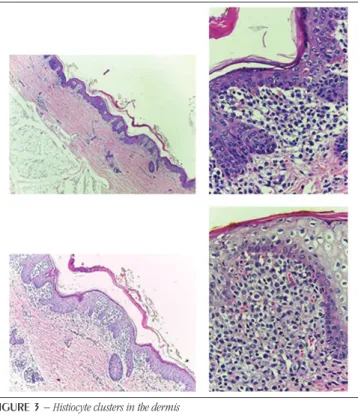
In the microscopic examination of the collected material were observed aggregates of histiocyte with reniform nuclei, sometimes showing cleft, and abundant cytoplasm in the dermis (Figure 3). These aggregates were also found in the lung, spleen, liver, mediastinal lymph nodes, and gallbladder (Figure 4). There were areas of ulceration and bacterial colonies in the epidermis. In the analysis of the other organs, lymphadenopathy, bilateral pneumonia, bilateral acute pyelonephritis, acute transinfectious hepatitis with cholestasis and acute cholecystitis were observed, with bacterial colonies (Figure 4) diffusely present in the internal organs, thus characterizing a generalized infection condition.
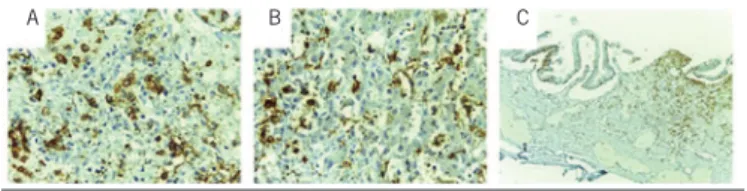
An immunohistochemical study was performed with the markers for the Langerhans cells (CD1a and S100), with positive labeling on dermis suspected cells (Figure 5) and on other organs previously mentioned (Figure 6), conirming the diagnosis of multisystemic LCH – Letterer-Siwe disease.
FIGURE 2 − External examination during autopsy
FIGURE 3 − Histiocyte clusters in the dermis
FIGURE 5 − Dermis
A) positive labeling for marker S100; B) positive labeling for CD1a.
A
FIGURE 4 − Autopsy findings
A) acute pneumonia with bacterial colonies; B) bacterial colony in the lung (highest increase) with suspicious histiocytic aggregates; C) suspected histiocytic aggregates in hepatic parenchyma; D) suspicious histiocytic aggregates in the gallbladder wall.
A
C
B
D
428
REFERENCES
1. Weedon D. Weedon’s Skin Pathology. 3rd ed. Churchill Livingstone Elsevier; 2010.
2. Carstensen H, Ornvold K. The epidemiology of LCH in children in Denmark, 1975-89. Med Pediatr Oncol. 1993; 21: 387.
3. Baumgartner I, von Hochstetter A, Baumert B, Luetolf U, Follath F. Langerhans’-cell histiocytosis in adults. Med Pediatr Oncol. 1997; 28(1): 9. PubMed PMID: 8950330.
4. Geissmann F, Lepelletier Y, Fraitag S, et al. Differentiation of Langerhans cells in Langerhans cell histiocytosis. Blood. 2001; 97(5): 1241-8. PubMed PMID: 11222366.
FIGURE 6 − positive labeling for CD1a
A) lung; B) liver; C) gallbladder.
A B C
DISCUSSION
LCH has been described with different nomenclatures according to the clinical presentation, systemic and prognostic involvement. Oliveira et al. (2012) emphasize that LCH division should be avoided, and it is more appropriate to consider it as a single disease with a broad spectrum of clinical presentations, since one form may evolve to another and the same patient may present characteristics of more than one variant(5). It is extremely important to identify the involvement of multiple organs that requires systemic treatment, and localized
presentations that beneit only from topical treatment and observation(6).
Skin lesions have shown great variability, and are more commonly found in multisystemic presentation, with the presence of multiple pink-yellowish papules on the trunk, face and scalp, simulating seborrheic dermatitis(6). Histologically, the iniltrate is composed of dense aggregates of histiocytes with reniform or indented nucleus and eosinophilic cytoplasm, some cells containing Birbeck granules (observed under the electron microscope), permeated by eosinophils. In the skin, histiocytes can iniltrate the epidermis, developing a pagetoid pattern. The cells express immunophenotyping of Langerhans cells, positively labeled for S100 and CD1a antigens(7).
The case presented characterizes the multisystemic form of LCH, also called Letterer-Siwe disease, which is the acute and disseminated form, most present in the irst year of life, usually with rapid evolution and poor prognosis. In the case reported, generalized secondary infection worsened and contributed to death before diagnosis, preventing treatment of the underlying cause.
RESUMO
Histiocitose de células de Langerhans é a nomenclatura designada para um espectro de doenças raras que acomete preferencialmente crianças de 1 a 3 anos, cujo nome refere-se à proliferação de células morfológica e imunofenotipicamente similares às células dendríticas especializadas da pele e da mucosa (células de Langerhans). Este artigo relata um caso de histiocitose de células de Langerhans multissistêmica, diagnosticado por meio de autópsia de um recém-nascido de 4 dias, com confirmação pela imuno--histoquímica e presença de infecção generalizada secundária associada.
Unitermos: histiocitose de células de Langerhans; células de Langerhans; sepse.
5. Oliveira A, Pinto de Almeida T, Lobo I, Machado S, Selores M. Langerhans cell histiocytosis: two clinical presentations in the same patient. Dermatol Online J [Internet]. 2012; 18(1): 8. Available at: http:// escholarship.org/uc/item/543311pg.
6. Rubio-González B, García-Bracamonte B, Ortiz-Romero PL, Postigo-Llorente C, Vanaclocha-Sebastián F. Multisystemic Langerhans cell histiocytosis mimicking diffuse neonatal hemangiomatosis. Pediatric Dermatol. 2014 mai/jun; 31(3): e87-9. PubMed PMID: 24588084.
7. Rakesh SV, Thappa DM. Quiz. Indian J Dermatol Venereol Leprol [Internet]. 2003; 69: 241-2. Available at: http://www.ijdvl.com/text. asp?2003/69/3/241/1012.
CORRESPONDING AUTHOR
Larissa Albuquerque Paiva
Laboratório de Anatomia Patológica do IMIP; Rua dos Coelhos, 300; Boa Vista; CEP: 50070-550; Recife-PE, Brasil; e-mail: [email protected].