Effe ct o f ryano dine o n sinus no de
re co ve ry tim e de te rm ine d
in vitro
Centro de Engenharia Biomédica and Departamento de Engenharia Biomédica, Faculdade de Engenharia Elétrica e de Computação,
Universidade Estadual de Campinas, Campinas, SP, Brasil J.W.M. Bassani,
C.M.G. Godoy and R.A. Bassani
Abstract
Evidence has indicated that the sarcoplasmic reticulum (SR) might be involved in the generation of spontaneous electrical activity in atrial pacemaker cells. We report the effect of disabling the SR with ryanodine (0.1 µM) on the sinus node recovery time (SNRT) measured in isolated right atria from 4-6-month-old male Wistar rats. Electro-gram and isometric force were recorded at 36.5o
C. Two methods for sinus node resetting were used: a) pulse: a single stimulus pulse interpolated at coupling intervals of 50, 65 or 80% of the regular spontaneous cycle length (RCL), and b) train: a 2-min train of pulses at intervals of 50, 65 or 80% of RCL. Corrected SNRT (cSNRT) was calculated as the difference between SNRT (first spontaneous cycle length after stimulation interruption) and RCL. Ryanodine only slightly increased RCL (<10%), but decreased developed force by 90%. When the pulse method was used, cSNRT (~40 ms), which represents intranodal/atrial conduction time, was independent of the coupling interval and unaffected by ryanodine. However, cSNRT obtained by the train method was significantly higher for shorter intervals between pulses, indicating the occurrence of overdrive suppression. In this case, ryanodine prolonged cSNRT in a rate-dependent fashion, with a greater effect at shorter intervals. These results indicate that: a) a functional SR, albeit important for force development, does not seem to play a major role in atrial automaticity in the rat; b) disruption of cell Ca2+ homeostasis by inhibition of SR function does not appear to affect conduction; however, it enhances overdrive-induced depres-sion of sinusal automaticity.
Co rre spo nde nce
J.W.M. Bassani
Departamento de Engenharia Biomédica
FEEC, UNICAMP Caixa Postal 6040 13083-970 Campinas, SP Brasil
Fax: + 55-19-289-3346
E-mail: bassani@ deb.fee.unicamp.br Research partially supported by CNPq (Nos. 300069/95-2 and 301905/84-3-NV). Publication supported by FAPESP. The present address of C.M.G. Godoy is Núcleo de Pesquisas Tecnológicas, Universidade de Mogi das Cruzes, 08780-210 Mogi das Cruzes, SP, Brasil.
Received September 9, 1998 Accepted April 20, 1999
Ke y wo rds
·Sinus node recovery time
·O verdrive suppression
·Electrical stimulation
·Calcium
·Sarcoplasmic reticulum
·Ryanodine
The sinus node is considered to be the primary pacemaker responsible for heart au-tomaticity. Disturbances in sinusal automa-ticity itself, in its chronotropic response to autonomic modulators and/or in conduction of the electrical impulse through the right atrium may lead to rhythm dysfunctions gen-erally referred to as sick sinus syndrome (1). Programmed electrical stimulation of the
heart and estimation of the sinus node recov-ery time (SNRT) have been used as a clinical approach to evaluate atrial automaticity/con-duction (e.g., 2,3).
is based on the interpolation of a single, premature electrical stimulus between two spontaneous depolarizations to achieve si-nus resetting (4). If the previous regular spon-taneous cycle length (RCL) is subtracted from the interval between stimulus delivery and the first spontaneous depolarization (i.e., SNRT), the corrected SNRT (cSNRT) is obtained. cSNRT thus represents the sum of the anterograde and retrograde conduction times between the site of stimulation and the pacemaker, plus the intranodal conduction time (4,5). The second method (2), which is technically simpler, involves pacing the atrium at a rate higher than the spontaneous frequency, in order to entrain the sinus node. However, it has been shown that this method may yield comparatively higher cSNRT val-ues when pacing is done at relatively higher rates (see e.g., 5,6). This additional delay for the spontaneous rhythm to resume is termed overdrive suppression.
Ca2+
has been implicated in impulse con-duction in cardiac tissue (7). The
sarcoplas-mic reticulum (SR) is the main Ca2+ store in
mammalian cardiac myocytes, representing
most of the contraction-activating Ca2+
pool during excitation (8). There have been indi-cations that the SR might be involved in the generation of spontaneous activity in atrial pacemaker cells. The electrogenic extrusion,
via Na+
/Ca2+
exchange, of Ca2+
released from the SR may generate an inward current which appears to play an important role in diastolic depolarization of atrial latent pacemaker cells (9). It has been shown that irreversible inhi-bition of SR function markedly depresses spontaneous activity in these cells (9,10).
In the present study, we investigated the role of a functional SR in the determination of the clinically used parameter cSNRT,
us-ing a previously characterized in vitro
ap-proach (6). In these experiments, the plant alkaloid ryanodine was used to disrupt SR
function by impairing SR Ca2+
accumula-tion.
Right atria were isolated from adult male
Wistar rats (4-6 months old) and incubated in Krebs-Henseleit solution of the following composition: 122.3 mM NaCl, 4.6 mM KCl, 2.5 mM CaCl2, 1.2 mM KH2PO4, 17.7 mM NaHCO3, 1.2 mM MgSO4, 11.1 mM glu-cose, pH 7.4, saturated with 95% O2/5%
CO2, at 36.5o
C. The upper extremity of the atrial appendage was connected to a force transducer (model F-60, Narco Bio-Systems, Austin, TX, USA) and the lower one was impaled on a tetrapolar platinum electrode used for electrogram detection and stimula-tion (6). Electrical stimulastimula-tion and signal acquisition were controlled by a computer-based system (11). Electrogram and isomet-ric tension signals were acquired via a cus-tomized acquisition system (analog/digital converter CAD1236; acquisition software Aqdados 4, Lynx Tech. Electr. Ltd., São Paulo, SP, Brazil). After application of 0.5 gf resting tension, an equilibration period of 45 min was allowed to elapse.
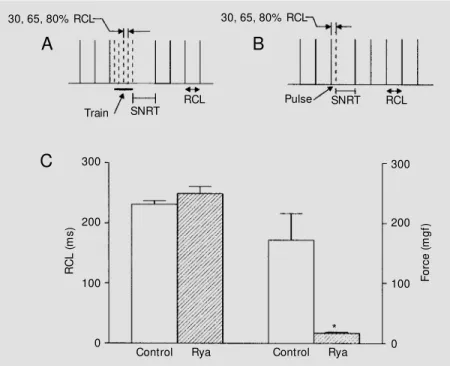
After a stable RCL was reached, SNRT was determined by application of : a) a 2-min long train of pulses at intervals of 50, 65 or 80% of RCL (train method, see Figure 1A), and b) a single, premature stimulus (5-ms duration, 1.2 x threshold current) after an interval corresponding to 50, 65 or 80% of RCL (pulse method, see Figure 1B), as de-scribed by Marques et al. (6). These intervals (pulses) or frequencies (trains) were ran-domly applied. After SNRT was obtained with both methods under control conditions, 0.1 µM ryanodine (Calbiochem, La Jolla, CA, USA) was added to the bath solution. After 20-min incubation, when the full ef-fects of ryanodine were attained, the stimu-lation protocol was repeated. SNRT values obtained from the electrogram were consid-ered acceptable only when they indicated sinus node resetting. cSNRT was calculated subtracting the previous mean RCL from SNRT.
con-sidered to occur for values of P<0.05. Ryanodine showed a dramatic negative inotropic effect (Figure 1C), reducing peak twitch force by 90% (P<0.01), which is in agreement with previous observations in rat myocardium (8). The negative chronotropic effect, however, was small and nonsignifi-cant, with an increase of less than 8% in RCL (Figure 1C).
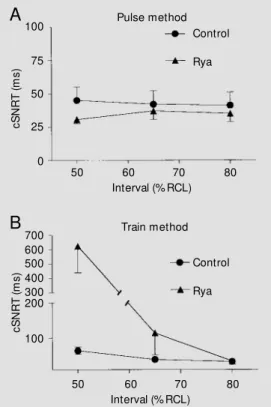
As shown in Figure 2A, cSNRT values obtained by the pulse method under control conditions were similar regardless of pulse prematurity (45 ± 10, 42 ± 10 and 41 ± 10 ms for intervals of 50, 65 and 80% RCL, respec-tively). Ryanodine did not significantly change cSNRT (P>0.9) under these condi-tions (31 ± 3, 37 ± 6 and 35 ± 6 ms for intervals of 50, 65 and 80% RCL, respec-tively), suggesting that atrial/internodal con-duction times do not seem to be affected by loss of SR function.
However, when the train method was used, analysis of variance indicated a signifi-cant influence (P<0.05) of pulse interval on cSNRT. As shown in Figure 2B, in control experiments a negative relationship between cSNRT and interval was observed, so that cSNRT at the shortest interval (64 ± 10 ms at 50% of RCL) was twice as long as that recorded with the interval closer to RCL (33 ± 4 ms at 80% of RCL). The latter was not significantly different from the values ob-tained with the pulse method. This indicates that rapid pacing introduced a component apparently due to depression of sinus auto-maticity (overdrive suppression). SR inhibi-tion with ryanodine caused an interval-de-pendent prolongation of cSNRT (P<0.05): while no effect was observed at 80% of RCL (34 ± 4 ms), cSNRT was markedly increased after ryanodine at 50% of RCL (624 ± 187 ms). This result indicates potentiation of overdrive suppression by impairment of SR function.
Ryanodine greatly suppresses contractil-ity in heart muscle. At nanomolar concentra-tions it binds to high-affinity sites in the SR
Ca2+
release channels, locking them open in a subconductance state. This promotes
con-tinuous leakage of the stored Ca2+
and dis-rupts normal excitation-contraction coupling, which normally involves activation of SR
Ca2+
release by the Ca2+
pool that enters the
cell via sarcolemmal Ca2+
channels during the action potential (for a review, see Ref. 8). Sinus node cells are also able to store
considerable amounts of Ca2+
in the SR (10). However, the role of the SR in the automa-ticity of these cells is still unclear. Li et al. (12) have described a strong negative chro-notropic effect of ryanodine in rabbit sinus node cells. However, SR disabling with ry-anodine or thapsigargin has shown minimal effects on the duration of spontaneous cycle length in cat sinus cells, while the
automatic-ity of atrial latent pacemaker cells and Ca2+
-overloaded myocytes was greatly suppressed
30, 65, 80% RCL 30, 65, 80% RCL
Train SNRT RCL
Pulse SNRT RCL
A
B
C
300200
R
C
L
(
m
s
)
100
0
Control Rya Control Rya
300
200
F
o
rc
e
(
m
g
f)
100
0
Figure 1 - Stimulation protocols for the determination of sinus node recovery time (SNRT) in isolated rat right atria by the train method (A) and the pulse method (B). Stimuli are represented as broken lines, w hereas solid lines represent spontaneous beats at steady-state (RCL represents the spontaneous, regular cycle length). PanelC show s the chronotro-pic and inotrochronotro-pic effects of 0.1 µM ryanodine (Rya) on isolated rat right atria. Bars on the left indicate mean ± SEM RCL, w hile bars on the right indicate mean ± SEM isometric active tension. Data from 5 preparations are reported. * P<0.01 compared to control (analysis of variance).
by this treatment (9,10). These apparently contradictory results might reflect cell- and species-dependent variation in the impor-tance of the different currents for generation of pacemaker activity. Although electrical activity of individual sinus node cells was not recorded in the present experiments, the small effect of ryanodine on RCL suggests that the SR does not play a major role in the generation of sinus automaticity in the rat.
Conduction time (retrograde plus antero-grade) may be estimated as the cSNRT value obtained with the pulse method (4,5). The lack of an effect of ryanodine on this vari-able also indicates that an important role of the SR in atrial/intranodal conduction of excitation is unlikely.
However, ryanodine greatly enhanced overdrive suppression. Automaticity suppres-sion after rapid pacing has already been
described both in vivo (e.g., 2,3,5) and in
vitro (5,6,13,14). The mechanisms
respon-sible for this effect in atrial tissue have not yet been ascertained. In addition to pace-maker shift, the main mechanisms proposed
include: a) acetylcholine (ACh) release dur-ing pacdur-ing (13): although pacdur-ing may induce ACh release in isolated right atria (11) and exogenous ACh enhances overdrive suppres-sion (5,6,13), the observations that over-drive suppression is not abolished by atro-pine (5,6) and also occurs in isolated sinus node cells (15) suggest that ACh release may not be essential for automaticity suppression by overdrive; b) depression of sinus node
automaticity by extracellular K+
accumula-tion due to rapid pacing (13): although this effect may not be ruled out in multicellular preparations, it is unlikely that it alone might account for overdrive suppression in view of the occurrence of suppression in perifused, isolated sinus node cells (15), and also be-cause potentiation of overdrive suppression
by increased extracellular [K+
] is mostly due to decreased conduction velocity (5,14); c) membrane hyperpolarization due to
activa-tion of the Na+
-K+
pump (16): an increase in diastolic membrane potential during over-drive stimulation has been described in Purkinje fibers. However, in isolated sinus node cells, progressive depolarization, rather than hyperpolarization, has been observed during overdrive (15); d) decrease in
trans-membrane Ca2+
current (ICa) (15): in sinus node cells, ICa has been considered the major depolarizing current responsible for action potential upstroke (17). In addition to the
observation that sarcolemmal Ca2+
channel blockers enhance overdrive suppression (5,18), the existence of a slow ICa inactiva-tion has already been described in single sinus node cells (19). This rate-dependent inactivation of ICa (which is more pronounced at less negative potentials, closer to the dia-stolic membrane potential of sinus node cells) has been identified as an important mech-anism for overdrive suppression in isolated sinus node cells, while other currents also implicated in spontaneous diastolic depolar-ization (IK and If) do not seem to be involved (15). Our observations, using ryanodine as a
tool to disrupt Ca2+
regulation in cardiac
A
c
S
N
R
T
(
m
s
)
100 75 50 25 0
700 600 500 400 300
100
Train method Interval (% RCL) 50 60 70 80
Pulse method
200
Interval (% RCL) 50 60 70 80
Control Rya
Control Rya
c
S
N
R
T
(
m
s
)
B
Figure 2 - Corrected sinus node recovery times (cSNRT) obtained for isolated rat right atria before (control) and after 0.1 µM ryano-dine application (Rya). PanelsA
cells, lend support to this proposal.
The mechanism by which ryanodine po-tentiates overdrive suppression (without ap-parent change in impulse conduction time) might involve mainly its ability to prevent
effective Ca2+
accumulation by the SR dur-ing pacdur-ing. Although short-term (up to hours) ryanodine exposure does not affect L- or T-type ICa in striated muscle (20), ryanodine
maintains SR Ca2+
release channels open in a subconductance state, which leads to
con-stant release of SR Ca2+
. At a higher
stimula-tion frequency, leaked Ca2+
may build up in the cytosol, especially in the subsarcolemmal space, even during diastole. Indeed, a rate-dependent, progressive increase in diastolic
intracellular [Ca2+
] has been observed in isolated rabbit myocytes treated with ryano-dine (Bassani RA, Bassani JWM and Bers
DM, unpublished results). Subsarcolemmal
Ca2+
accumulation might slow down even further ICa recovery from inactivation via the
mechanism of Ca2+
-dependent inactivation (21), in addition to decreasing current
ampli-tude by reducing the Ca2+
transmembrane electrochemical gradient.
Our results indicate that disturbances of
cell Ca2+
homeostasis, which are common in a number of cardiopathic conditions, may enhance automaticity suppression by high rate electrical stimulation, and this should be taken into account when using the SNRT for clinical evaluation of sinus automaticity.
Ackno wle dgm e nts
We are grateful to Mr. Gilson B. Maia Jr. for technical assistance.
Re fe re nce s
1. Ferrer M I (1973). The sick sinus syn-drome. Circulation, 47: 635-641. 2. Narula OS, Samet P & Javier RP (1972).
Significance of the sinus node recovery time. Circulation, 45: 140-158.
3. Yee R & Strauss HC (1987). Electrophysi-ologic mechanisms: sinus node dysfunc-tion. Circulation, 75 (Suppl III): III-12-III-18. 4. Strauss HC, Saroff AL, Bigger Jr JT & Giardina EGV (1973). Premature atrial stimulation as a key to the understanding of sinoatrial conduction in man. Presenta-tion of data and critical review of the lit-erature. Circulation, 47: 86-93.
5. Prinsze FJ (1993). Cellular aspects of over-drive suppression in the sinoatrial node. Doctoral thesis, University of Amsterdam, The Netherlands.
6. M arques JLB, Bassani RA & Bassani JWM (1990). M ethodology and instru-mentation for the in vitro sinus node re-covery time determination. Journal of Pharmacological M ethods, 23: 117-127. 7. Sugiura H & Joyner RW (1992). Action
potential conduction betw een guinea pig ventricular cells can be modulated by cal-cium current. American Journal of Physi-ology, 263: H1591-H1604.
8. Bers DM (1991). Excitation-Contraction Coupling and Cardiac Contractile Force. Kluw er Press, Dordretch, The Netherlands.
9. Lipsius SL, Rubenstein DS & Zhou Z (1993). Cellular mechanisms of right atrial latent pacemakers. New Trends in Ar-rhythmias, 19: 11-23.
10. Bassani RA, Bassani JWM , Lipsius SL & Bers DM (1997). Diastolic SR Ca efflux in atrial pacemaker cells and Ca-overloaded myocytes. American Journal of Physiolo-gy, 273: H886-H892.
11. Bassani JWM , Godoy CM GG & Bassani RA (1998). Role of acetylcholine in electri-cally-induced arrhythmia in rat isolated atria. Journal of M olecular and Cellular Cardiology, 30 (Suppl): A4 (Abstract). 12. Li J, Qu J & Nathan RD (1997). Ionic basis
of ryanodines negative chronotropic ef-fect on pacemaker cells isolated from the sinoatrial node. American Journal of Phys-iology, 273: H2481-H2489.
13. Lange G (1965). Action of driving stimuli from intrinsic and extrinsic sources on in situ cardiac pacemaker tissues. Circula-tion Research, 17: 449-459.
14. M arques JLB & Bassani JWM (1989). In-fluence of the KCl concentration on rat sinus node recovery time in vitro. Brazil-ian Journal of M edical and Biological Re-search, 22: 803-806.
15. W at anabe E-I, Honjo H, Boyet t M R, Kodama I & Toyama J (1996). Inactivation of the calcium current is involved in
over-drive suppression of rabbit sinoatrial node cells. American Journal of Physiology, 271: H2097-H2107.
16. Vassale M (1970). Electrogenic suppres-sion of automaticity in sheep and dog Purkinje fibres. Circulation Research, 27: 361-377.
17. Irisaw a HH, Brow n HF & Giles W (1993). Cardiac pacemaking in the sinoatrial node.
Annual Review of Physiology, 73: 197-227.
18. Konishi T (1976). Electrophysiological con-siderations on sick sinus syndrome. Japa-nese Circulation Journal, 40: 194-201. 19. Habushi Y, Noda T, Nishim ura M &
Watanabe Y (1990). Recovery of the in-w ard current from Ca2+-mediated and
voltage-dependent inactivation in the rab-bit sinoatrial node. Journal of M olecular and Cellular Cardiology, 22: 469-482. 20. Kenyon JL, M cKemy DD, Airey JA &
Sutko JL (1995). Interaction betw een ry-anodine receptor function and sarcolem-mal Ca2+ currents. American Journal of
Physiology, 269: C334-C340.