Desmin: molecular interactions and
putative functions of the muscle
intermediate filament protein
Laboratório de Diferenciação Muscular e Citoesqueleto,
Departamento de Histologia e Embriologia, Instituto de Ciências Biomédicas, Universidade Federal do Rio de Janeiro, Rio de Janeiro, RJ, Brasil
M.L. Costa, R. Escaleira, A. Cataldo, F. Oliveira and C.S. Mermelstein
Abstract
Desmin is the intermediate filament (IF) protein occurring exclusively in muscle and endothelial cells. There are other IF proteins in muscle such as nestin, peripherin, and vimentin, besides the ubiquitous lamins, but they are not unique to muscle. Desmin was purified in 1977, the desmin gene was characterized in 1989, and knock-out animals were generated in 1996. Several isoforms have been described. Desmin IFs are present throughout smooth, cardiac and skeletal muscle cells, but can be more concentrated in some particular structures, such as dense bodies, around the nuclei, around the Z-line or in costameres. Desmin is up-regulated in muscle-derived cellular adaptations, including con-ductive fibers in the heart, electric organs, some myopathies, and experimental treatments with drugs that induce muscle degeneration, like phorbol esters. Many molecules have been reported to associate with desmin, such as other IF proteins (including members of the membrane dystroglycan complex), nebulin, the actin and tubulin binding protein plectin, the molecular motor dynein, the gene regula-tory protein MyoD, DNA, the chaperone αB-crystallin, and proteases such as calpain and caspase. Desmin has an important medical role, since it is used as a marker of tumors’ origin. More recently, several myopathies have been described, with accumulation of desmin depos-its. Yet, after almost 30 years since its identification, the function of desmin is still unclear. Suggested functions include myofibrillogenesis, mechanical support for the muscle, mitochondrial localization, gene expression regulation, and intracellular signaling. This review focuses on the biochemical interactions of desmin, with a discussion of its putative functions.
Correspondence
M.L. Costa
Laboratório de Diferenciação Muscular e Citoesqueleto Departamento de Histologia e Embriologia, ICB, UFRJ 21949-590 Rio de Janeiro, RJ Brasil
Fax: +55-21-2562-6480 E-mail: [email protected]
Presented at the XII Brazilian Congress of Cellular Biology, Campinas, SP, Brazil, July 15-18, 2004.
Research supported by CNPq, FAPERJ, PRONEX, and Fundação Universitária José Bonifácio (FUJB).
Received July 16, 2004 Accepted September 14, 2004
Key words
•Desmin
•Intermediate filaments •Muscle
•Myogenesis •Myopathy
Introduction
Desmin is the intermediate filament (IF) protein of muscle and endothelial cells. The cytoskeletal category of IFs was suggested by Holtzer’s group (1) based on the 10-nm diameter filaments observed in electron
for its alleged function of linking sarco-meres. Biochemical purification led to anti-body production, which in turn led to the determination of its spatial distribution in several tissues (4). The gene has been identi-fied by Capetanaki et al. (5), and desmin knockouts have been produced by the groups of Paulin (6) and Capetanaki (7). Desmin has been shown to interact with several mol-ecules, and therefore particular functions for desmin are attributed to each of these inter-actions. Many aspects of the cell biology of desmin are remarkable, like its resistance to chemical denaturation and mechanical sta-bility, and its direct interaction with the mus-cular differentiation program. It is the first muscle-specific structural protein and one of the more persistent in several differentiation conditions. The recent finding of several cases of human diseases linked to altered desmin expression (8) has renewed the inter-est in the physiological roles of desmin. However, despite all the curiosity it inspired, the function of desmin is still unknown.
Biochemical aspects
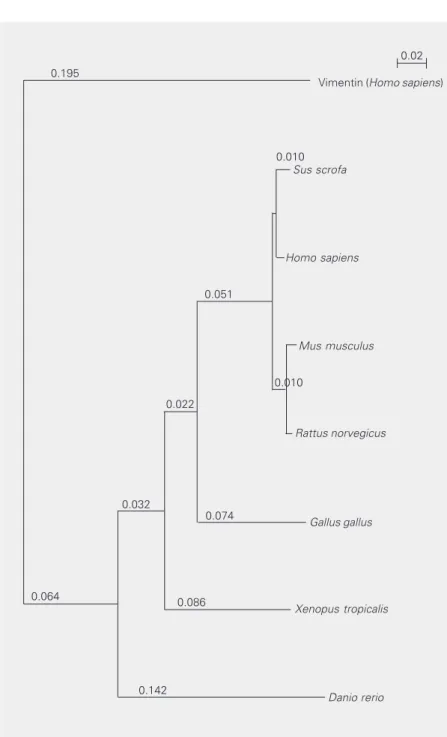
Human desmin is a protein of 52 kDa, 470 amino acids, with pI 5.4. There is a single desmin gene (DES) in all vertebrates, with reasonable sequence conservation, since there is great homology between the gene from zebrafish and man, as is shown in the phylogenetical analysis (Figure 1). The DES
gene has been sequenced in several animal species, such as man, rat, mouse, cow, pig, hamster, chicken, Xenopus, and zebrafish (9). While only vertebrates express desmin, there are related molecules in other animals. Tunicates have an St-A protein, an interme-diate filament protein has been described in
C. elegans, lamins have been found in Dro-sophila, and an intracellular transport pro-tein, with 20% homology with desmin, was found in Saccharomyces. The desmin pro-tein, like all intermediate filaments, has two conserved central rod domains (H1 and H2),
Figure 1. Phylogenetic relationships of desmin from several animals. Multiple sequence alignments were generated following the alignment of the human gene using the CLUSTALX software. The evolutionary tree was prepared with the NIPLOT software. This figure shows that desmin is quite conserved evolutionarily. The changes are very well related to phylogeny (more time of species divergence, more differences among the desmins). This constant rate of evolutionary change over time indicates that desmin should be on a high selective pressure and should have a high adaptive value. The following sequences were obtained from PubMed: 1-gi|6686280|Desmin[Homo sapiens], 2-gi| 118453|Desmin[Gallus gallus], 3-gi|48374063|Desmin[Sus scrofa], 4-gi|38197676| Desmin[Rattus norvegicus], 5-gi|33563250|Desmin[Mus musculus], 6 gi|38511808| Desmin[Xenopus tropicalis], 7-gi|18858539|Desmin[Danio rerio], 8-gi|4507895|Vimentin| [Homo sapiens].
0.02
Vimentin (Homo sapiens) 0.195
0.010
Sus scrofa
Homo sapiens
Mus musculus
0.010
Rattus norvegicus
Gallus gallus
Xenopus tropicalis
Danio rerio
0.142 0.086
0.074 0.032
0.022 0.051
4 linker regions (L1A, L1B, L2A, and L2B), and two globular end domains. The central rod domains are responsible for polymeriza-tion by lateral associapolymeriza-tion. The exact struc-ture of the filament is still unclear, but it is known that IF molecules associate laterally in pairs, which in turn associate with each other. The 10-nm filament may be formed by about 8 individual protofilaments (10). In this way, a truncation of the desmin carboxy-terminal domain in a few molecules leads to the disassembly of the filament network, when a truncated desmin gene is expressed in a few nuclei in a multinuclear myotube (11).
The central IF domain is composed of several heptapeptide repeats, which form coiled-coil α-helices. This domain is present
in several protein families from spectrin to plectin. Desmin has also a less conserved IF head domain, and the end domains are over-all quite variable among IFs. Sequence ho-mology, and therefore evolutionary relation-ships, and the ability to co-polymerize are the main criteria for their classification into 6-7 groups (10, but see Ref. 12). Thus, desmin is classified as a type III IF, and shares high homology with mesenchymal cell vimentin and glial cell GFAP (glial fibrillary acidic protein). All type III IFs can form homopoly-mers with themselves or heteropolyhomopoly-mers with
each other. The acid and basic cytokeratins of epithelial cells are classified as types I and II, respectively, and they are obligatory het-eropolymers between the two classes. The three different neurofilament proteins com-pose the type IV IF. Type V is defined by the lamins, which are ubiquitous supporters of nuclei in all eukaryotic cell types, and are thought to be the evolutionary more primi-tive IF protein. Lamins have a nuclear local-ization signal and an extra domain, which induces the formation of a lattice instead of the conventional filaments. While some clas-sifications propose class VI to be composed of large molecular weight proteins (synemin, paranemin), others suggest type VI to be a special group for lens-beaded filaments (phakinin and filensin) or as an orphan group of unclassified proteins. Several other IF proteins, like peripherin, gelfitin, transitin, tanabin, gliarin, macrolin, etc., have been described, in an ever-growing list. A total of 65 IF genes have been detected in a screen-ing of a draft version of the human genome (13).
Desmin is usually phosphorylated, and the number of isoforms correlates with phy-logeny: there is a single isoform in mamma-lian muscle, 2 in an avian muscle and 3 in fish muscle (Figure 2). As is the case for all IFs, phosphorylation regulates desmin
merization, so the number of isoforms may correlate with the structural state of each tissue. Signaling molecules like protein ki-nase C can increase the phosphorylation of desmin and change the structure of the fila-ment network (14). Interestingly, some par-ticular physiological conditions or patho-logic situations can also increase the number of desmin isoforms. Thus, there are 5-6 desmin isoforms in Purkinje fibers, special-ized conducting cells in the heart of large mammalians (15). In people with familial congenital heart disease, there are also 5-6 isoforms (16). We could show that there are five desmin isoforms in the electric organs of the electric eel Electrophorus electricus
L. (17). Furthermore, our group showed that each of the three different electric organs of the electric eel has a distinct desmin isoform pattern (18). All of these muscle derivatives also have a higher IF to myofibril ratio than normal muscle.
Myogenesis
Desmin is expressed since the early for-mation of skeletal, cardiac and smooth muscle, and endothelial cells. In avian cells, desmin is the first muscle-specific cytoskel-etal protein or isoform to be expressed, after (or together with) the commitment of precur-sor cells to the muscle lineage. During em-bryonic development, the notochord secretes the inductive factors SHH, the neural plate secretes Wnt and the lateral plate secretes BMP4, which will cause the somite cells to become committed to the muscle lineage. These proteins induce the expression of the muscle regulator factor Myf5, which in turn will induce MyoD, which will induce mgn. The genes of most of the structural muscle proteins have a MyoD-binding regulation region. Desmin has been reported to be ex-pressed in muscle together with Myf5 and before MyoD (19). The detection of desmin inside the nucleus and the finding that desmin can form a dimer with MyoD are very
intri-guing (see below). The direct relationship between desmin expression and muscle dif-ferentiation is difficult to establish, since muscle cells can develop without desmin (6,7), but muscle can also form in the ab-sence of MyoD or mgn (but not of MyoD and mgn). In chick, muscle-committed cells exit the cell cycle, and the forced expression of MyoD shows a coordinated beginning of desmin expression and inhibition of 5-bromo-2'-deoxyuridine labeling (20). In mice, repli-cating muscle cells express desmin (21). It should be pointed that those two models have quite different in vitro behavior, be-cause mammalian cells replicate more easily and form small myotubes in culture, while avian cells stop replicating and form enor-mous and vigorously contracting myotubes. While there are several mammalian muscle cell lines, no well-differentiated avian muscle lines have been established (the main avian muscle line QM7 does not form myotubes). The subcellular distribution of desmin changes during development from thick fila-ments widespread throughout the cell to a diffuse association with the Z-line and stria-tion. It should be noted that the mesenchy-mal precursors of muscle cells already have a vimentin IF network. Accordingly, this change in distribution is a marker of myo-genesis, which we used to characterize the extent of MyoD conversion in transfected non-muscle chick cultured cells (20) and to point out the particularities of the myogen-esis in zebrafish embryos (22).
Cellular distribution
The best way to visualize the distribution of desmin in different cell types is by immu-nofluorescence (Figure 3). Desmin appears sometimes as long isolated filaments, but it also appears as a fluorescence haze, prob-ably because of its sub-resolution size (10 nm, smaller than the 0.2-µm light micro-scope limit).
every distinct muscular cytoskeletal struc-ture (Figure 4). In mononucleated smooth muscle cells, desmin is spread throughout the cell, but is concentrated in the dense bodies (Figure 4, a), where the microfila-ments also attach. Dense bodies are centers
of contraction, and have α-actinin and actin
beside desmin, being homologues to Z-lines and intercalated disks (23). Desmin can make up to 2% of the smooth muscle mass, and chicken gizzard is commonly used for desmin extraction.
Figure 3. Desmin distribution in several cell types detected by immunofluorescence. One-day-old cultured skeletal muscle chick cell, stained for desmin (A), myosin (B) and DNA (4',6-diamidino-2-phenylindole dihydrochloride) (C). At this developmental stage, myoblasts are beginning to elongate, desmin is distributed throughout the cyto-plasm, and myosin appears first around the nucleus. Five-day-old cultured skeletal muscle chick myoblast stained for desmin (D), Z-line titin (E) and DNA (F). This myoblast is already striated for desmin and titin. Desmin is present on the Z-line, but not as restricted as titin. There is also desmin around the nuclei and diffusely in the cytoplasm. Twenty-four-hour zebrafish somites stained for desmin (G), α-actinin (H) and differential interference contrast (I).
These 2-hour-old myocytes in the fish embryo show a pattern similar to the 5-day chicken culture, with striations visible by desmin and α-actinin stain and by differential interference contrast. Three-day-old cultured heart chick
cell stained for desmin (J), α-actinin (K) and DNA (L). In cardiac myocytes, desmin distribution on the Z-line is more
restricted than in skeletal muscle, but there is also more desmin in the cytoplasm. The myofibrils are not aligned as in skeletal muscle, as can be seen by the α-actinin stain. Scale bar: 10 µm for all panels. For details, see Refs.
In the multinucleated striated skeletal muscle, again there is desmin all over the cell, but there is more desmin in the Z-line (lateral attachments of microfilaments; Fig-ures 3D,G,J and 4, b) and in the costameres (periodic structures in the membrane that are connected to the Z-lines, Figure 4, c). Costameres are composed of several protein clusters and link IFs and actin microfila-ments to the membrane (24). One type of costamere, the dystroglycan protein com-plex (DPC), connects actin through dystro-phin to the transmembrane ß-dystroglycan, which in turn binds to extracellular α
-dys-troglycan, laminin 2 and collagen. Another type of protein complex connects actin through spectrin, talin, paxillin, and vinculin to trans-membrane integrins, which bind to fibronectin, laminin and collagen. Desmin connects to DPC in the costameres, through plectin and dysferlin. The DPC alterations cause Duchenne and Becker muscular dys-trophies, frequent congenital diseases that can be fatal. In skeletal muscle, desmin has been described in myotendinous junctions, together with nestin (Figure 4, d) (25), and in
neuromuscular junctions, associated with the cholinergic receptors (Figure 4, e) (26). Myo-tendinous junctions are specialized regions of skeletal muscle attachment to connective tissue, and have characteristic molecules, such as type XII and XIII collagens and α
7-integrin. The neuromuscular junctions me-diate the contraction stimulus through chem-ical signaling between acetylcholine releas-ing nerve cells and the cholinergic receptors in the synapse, a special membrane region with clefts (invaginations) and particular con-stituents, like type XVIII collagen and agrin. Desmin may also be present around the M-line, particularly associated with skelemin (see below). Desmin also connects myo-fibrils to the costameres, forming an extra-myofibrillar cytoskeleton (Figure 4, f).
Heart cells are mono- or binucleated and have desmosomes, where the IFs of neigh-bor cells are connected through cadherins and cytokeratin (Figure 4, g). Desmosomes are typical of strongly attached epithelial cells, and are composed of desmoplakin ag-glomerates that bind transmembrane cadher-ins in adjacent cells (27). In cardiac cells, desmosomes bind myocytes laterally, while the myofibrils of each cell end in a special Z-line that attaches to adjacent cells, the inter-calated disk (Figure 4, h). Therefore, desmin and α-actinin are present in all the
contrac-tion organizing centers in the three muscle cell types. The distribution of both proteins is mostly coincident, but clearly is not re-stricted to the same places. In non-muscle cells, α-actinin is distributed along actin
fila-ments and links them to the membrane, and in striated muscle, α-actinin aggregates on
the membrane could be nucleating centers for myofibrillogenesis. Heart cells have the highest proportion of desmin and also a large number of mitochondria.
Desmin, like all IFs, is also concentrated around the nucleus (Figure 4, i) in the three muscle types. In muscle cell fractionation experiments, desmin has been found to re-main bound to the nuclear fraction (data not
shown). Furthermore, there is a direct inter-action between cytoplasmic IFs and the nuclear lamins (28). Interestingly, the muscle nuclear envelope has a particular lamin-as-sociated protein, emerin, which was identi-fied as missing in people with Emery-Dreifuss muscular dystrophy (29). It is possible to speculate that the muscle nuclei should have a particular structure to withstand the me-chanical load of contraction, in the same way as the desmin network could be unique. Mutations in the lamin A gene in humans are also responsible for muscular dystrophy, and knock-out for lamin A induces the muscular dystrophy phenotype (30). Because lamin A is present in several cell types and only muscles are affected by its absence, muscle nuclei could be subjected to a greater me-chanical stress than other cell types.
Mitochondria are somehow connected to
desmin IFs in addition to microtubules (Fig-ure 4, j).
Molecular interactions
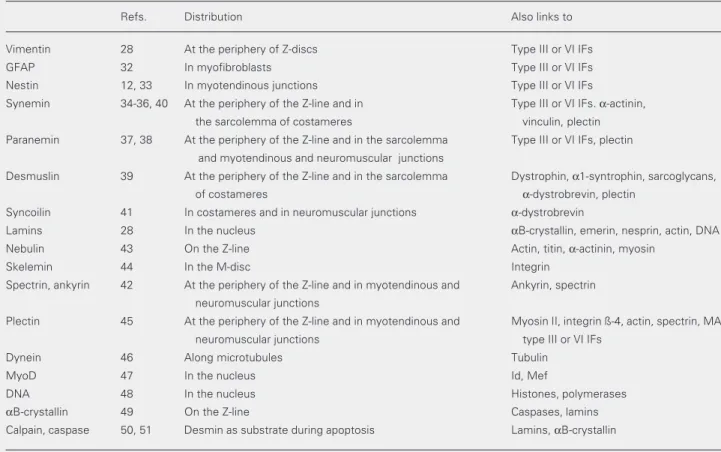
Desmin interacts with several molecules (Table 1). First of all, it forms heteropolymers with IF proteins of the same class, like vi-mentin, GFAP, nestin, etc., which may co-exist in some cell types, and with type VI IF proteins. The other IF proteins that may co-polymerize with desmin in vitro will not be considered in this review. While vimentin is co-expressed in vivo, it is down-regulated along myogenesis, and almost not present in adult tissues. The exact amount of vimentin protein present in adult tissues is still un-clear, but specific silencer regulatory se-quences have been identified in the gene (31). GFAP can polymerize with desmin in
Table 1. Macromolecules that interact with desmin.
Refs. Distribution Also links to
Vimentin 28 At the periphery of Z-discs Type III or VI IFs
GFAP 32 In myofibroblasts Type III or VI IFs
Nestin 12, 33 In myotendinous junctions Type III or VI IFs
Synemin 34-36, 40 At the periphery of the Z-line and in Type III or VI IFs. α-actinin,
the sarcolemma of costameres vinculin, plectin Paranemin 37, 38 At the periphery of the Z-line and in the sarcolemma Type III or VI IFs, plectin
and myotendinous and neuromuscular junctions
Desmuslin 39 At the periphery of the Z-line and in the sarcolemma Dystrophin, α1-syntrophin, sarcoglycans,
of costameres α-dystrobrevin, plectin
Syncoilin 41 In costameres and in neuromuscular junctions α-dystrobrevin
Lamins 28 In the nucleus αB-crystallin, emerin, nesprin, actin, DNA
Nebulin 43 On the Z-line Actin, titin, α-actinin, myosin
Skelemin 44 In the M-disc Integrin
Spectrin, ankyrin 42 At the periphery of the Z-line and in myotendinous and Ankyrin, spectrin neuromuscular junctions
Plectin 45 At the periphery of the Z-line and in myotendinous and Myosin II, integrin ß-4, actin, spectrin, MAP, neuromuscular junctions type III or VI IFs
Dynein 46 Along microtubules Tubulin
MyoD 47 In the nucleus Id, Mef
DNA 48 In the nucleus Histones, polymerases
αB-crystallin 49 On the Z-line Caspases, lamins
Calpain, caspase 50, 51 Desmin as substrate during apoptosis Lamins, αB-crystallin
vitro, but only a few cell types actually co-express both proteins at the same time. One interesting case is the dynamic and develop-mentally plastic myofibroblast, which we showed to be positive for desmin, GFAP and vimentin (32). Nestin is typical of central nervous system stem cells, but is also present with desmin in muscle ligaments (33). Since there is a relationship between the expres-sion of nestin and the aggressiveness of tu-mors, nestin has been an important marker in cancer research. Synemin, initially purified as a desmin-associated molecule (34) but now known to be a legitimate type III or VI intermediate filament, is present in striated muscle. Synemin may function to directly link muscle cell intermediate filaments to both myofibrillar Z-lines and costameres, since it has binding sites for desmin, α
-actinin and vinculin (35). Curiously, synemin is expressed in all muscle tissues (although at higher levels in skeletal muscle), but also in other tissues, particularly in myoepithelial cells and glial cells (36). Paranemin was also initially described as an IF-associated pro-tein (37), but later was shown to be a type VI large IF protein. Paranemin, but not synemin or nestin, has been shown to be essential for the formation of an extended desmin IF net-work (38). Desmuslin is an IF protein re-cently characterized from the dystrophin complex that associates with α-dystrobrevin
in costameres and with desmin in costameres and around the Z-line (39). But sequence homology suggests that desmuslin may be the human homologue of synemin, more specifically of the smaller synemin ß tran-script (40). Syncoilin is another dystrophin-associated protein that seems to concentrate in neuromuscular junctions (41). Interest-ingly, nestin, desmuslin and syncoilin are not type III filaments: while nestin may be classified as type IV, desmuslin has been proposed to be a type VI or VII, and syncoilin could be a type IV, since it can form fila-ments by itself. Desmin may associate with lamins, as mentioned before.
Besides IF proteins, desmin also binds to other sarcomeric and sub-membrane pro-teins. The extra-myofibrillar desmin cyto-skeleton links to the membrane adhesion complexes indirectly through syncoilin and desmuslin/synemin, but there is a direct as-sociation between desmin and the proteins spectrin and ankyrin (42). A direct interac-tion between desmin and nebulin was shown using a yeast two-hybrid approach (43). Nebulin is a molecular ruler that controls the size of the A-band through its binding to actin. Desmin binds to skelemin around the M-line (44). The proposed structure of skelemin has internal myosin-binding regions and two desmin-binding regions, one in each extremity. In this way, desmin binds both to the Z- and M-lines.
The three major filaments of the cyto-skeleton are linked by the protein plectin, which has been shown to bind to microtu-bules, microfilaments and IFs (45). Plectin is a member of the plakin family of cytolinkers, which include the desmosomal desmoplakin, and which also bind to integrins and cadher-ins. The distribution of plectin is not affected in desmin knock-out mice, but in plectin knock-out mice the amounts of vinculin and spectrin are reduced. IFs seem to be trans-ported throughout the cell associated with microtubules and/or microfilaments via cy-toplasmic dynein (46).
Desmin can be present in the nucleus, where it has been suggested to bind to MyoD to form a heterodimeric gene regulation pro-tein (47). The interaction of desmin with MyoD establishes a new self-regulatory path-way, because the MyoD gene has E-boxes, regulatory sequences, MyoD binding sites, as does the desmin gene. Inside the nucleus, desmin can bind directly to DNA. The inter-action of type III IFs (vimentin in particular) with several DNA arrangements has been well characterized, and all type III filaments have the same DNA-binding domain (48).
(49). First identified as a structural protein in the eye lens, αB-crystallin is known to exist
in several cell types. Other crystallin iso-forms also have dual enzymatic and struc-tural roles.
The proteases calpain and caspase can interact with desmin during differentiation and particularly in apoptosis. Caspase 6 phos-phorylates specific residues in desmin, in-duced by change in serum concentration that controls differentiation (50). Desmin has been described as a major substrate for proteoly-sis by a muscle-specific calpain (51).
Desminopathies
Since the IF proteins are cell type specif-ic, they have been used to type the origin of undifferentiated cells in tumors or other cells of unknown origin, like electrocytes (17).
The first identified involvement of desmin in human diseases was a familial cardiomyop-athy that had filament deposits (15). The ad-vances in molecular diagnosis led to the iden-tification of desmin-related myopathies (52). Their symptoms include skeletal muscle weak-ness, arrhythmias, heart failure, and accumu-lation of desmin in cardiac and skeletal muscle cells. The desmin accumulation can be caused by desmin mutations or mutations in α
B-crys-tallin. Several mutations from different fami-lies have been characterized. This type of disease has been called surplus myopathy be-cause it arises not from the absence of the protein but from its accumulation due to misaggregation caused by the inability to poly-merize properly or by the lack of chaperones (αB-crystallin), or by its overexpression caused
by problems in recycling proteins (caspase, calpain). Experimentally, a small overex-pression of desmin does not lead do any damage, but a significant overexpression leads to accumulation of desmin and the formation of aggregates inside the cell, typi-cal of human desminopathy patients. It is still unclear if the accumulation is the cause or the consequence of the disease, which can
affect health to varying extents.
Putative functions
Many functions have been attributed to desmin since its identification. Some can be classified as mechanical or structural, with a role being attributed to the filament itself, but some hypotheses propose that desmin has regulatory roles.
Desmin IFs have been proposed to be required for myofibrillogenesis. Several lines of evidence argue against this hypothesis, including the fact that desmin knock-out mice go through their myogenesis basically unaffected (6,7) and that cells without the IF network caused by transfection with trun-cated desmin also assemble their myofibrils perfectly (11). By contrast, electroporation of desmin antibodies disrupts the Z-line and the myofibril (53).
Desmin could be involved in the regula-tion of gene expression. In this case, the main argument is the ability of desmin to bind DNA and its cellular distribution from the cell periphery into the nucleus, where it can interact with lamins (28,54). The nuclear lamins, once thought to be involved only in the mechanical support of the nuclear mem-brane, now are also suspected to have regu-latory functions because of their associa-tions with DNA transcription proteins (55). Desmin function could be the localiza-tion of mitochondria. Desmin knock-out mice have their mitochondria displaced, and these alterations could lead to a deficiency in oxy-gen metabolism (56). It is noteworthy that these changes in mitochondrial distribution happen before other disturbances.
phorbol 13-acetate, desmin is phosphorylated, the myofibrils disassemble but the IF network persists, and the nuclei are clustered together in the center (57). Our recent results show that cholesterol withdrawal with the drug methyl-beta-cyclodextrin also induces nucleus mis-alignment (58).
Desmin could be responsible for the elas-tic properties of muscle, like resistance to stretch. This assumption originated before the identification of the elastic protein titin, which binds the Z- to the M-line. Further-more, desmin knock-out muscles show the same passive elastic properties as control muscles (59).
While the function of desmin is still un-certain, the same is not true for other IFs and their proteins in other cell types. Thus, it is clear that cytokeratins have a structural role in epithelia because there is a skin blister phenotype both in the cytokeratin knock-out mouse and in the equivalent human disease, epidermolysis bullosa (60). On the other hand, vimentin knock-out mice do not show any greatly altered phenotype (61) and there are no known vimentin-related diseases. One possibility is that IFs perform different func-tions in specific tissues, and that some of them have structural roles while others have regulatory roles. If this is true, the trend initiated by Holtzer (1) of integrating all the intermediate filaments and their proteins in a single cytoskeletal entity should be reversed by an approach where the differences, more than the similarities, of each filament should be emphasized.
Microfilaments and microtubules have a monotone basic structure of conserved globu-lar molecules in all cells, but they perform several different functions because of their greatly varied associated proteins. IFs have a dual structure, with a central conserved do-main and varied terminal dodo-mains. We could imagine that the conserved domain is analo-gous to the basic actin and tubulin blocks, while the varied domains would function to give their cell type specific functions. Not only
may the IFs in each cell type have different functions, but they could perform specific func-tions even in different places in the cell. There are several actin-containing compartments in one cell, each with different properties, as there are different microtubule populations. It is possible, for instance, that the sub-sarcolem-mal desmin has a somewhat different function than the nuclear desmin. But in the case of microfilaments and microtubules, the associ-ated proteins are different in each sub-cellular structure. Therefore, we can imagine that each desmin structure is different, maybe because of different associated molecules (such as nestin in myotendinous junctions) or even because of filament arrangement or isoform composition. If there are many “sub-functions” of desmin, it is reasonable to assume that desmin may have (some) different roles in skeletal, cardiac and smooth muscle. Muscles are an extreme adaptation of a ubiquitous cytoskel-eton for force production, and the existence of three main muscle types indicates quite different adaptive solutions, consistent with restricted distributions of some desmin-in-teracting molecules to each particular muscle type. However, the overall association of desmin with the muscular program is clear-cut, because all vertebrate muscles express desmin from their differentiation to all pos-sible adaptations.
The mechanical and physiological func-tions of microfilaments and microtubules are not exclusive. Focal contacts are sites of strong adhesion to the substrate and of sig-naling through kinases. Likewise, desmin could have concomitant structural and regu-latory roles. In this way, it will be impossible to look for a single function for desmin, and all the mentioned functions could be true.
Acknowledgments
References
1. Ishikawa H, Bischoff R & Holtzer H (1968). Mitosis and intermedi-ate-sized filaments in developing skeletal muscle. Journal of Cell Biology, 38: 538-555.
2. Small JV & Sobieszek A (1977). Studies on the function and compo-sition of the 10-NM(100-A) filaments of vertebrate smooth muscle.
Journal of Cell Science, 23: 243-268.
3. Lazarides E & Hubbard BD (1976). Immunological characterization of the subunit of the 100 A filaments from muscle cells. Proceed-ings of the National Academy of Sciences, USA, 73: 4344-4348. 4. Lazarides E (1980). Intermediate filaments as mechanical
integra-tors of cellular space. Nature, 283: 249-256.
5. Capetanaki YG, Ngai J & Lazarides E (1984). Characterization and regulation in the expression of a gene coding for the intermediate filament protein desmin. Proceedings of the National Academy of Sciences, USA, 81: 6909-6913.
6. Li Z, Mericskay M, Agbulut O, Butler-Borwne G, Carlsson L, Thornell L-E, Babinet C & Paulin D (1997). Desmin is essential for the tensile strength and integrity of myofibrils but not for myogenic commit-ment, differentiation, and fusion of skeletal muscle. Journal of Cell Biology, 139: 1-16.
7. Milner DJ, Waltzer G, Tran D, Bradley A & Capetanaki Y (1996). Disruption of muscle architecture and myocardial degeneration in mice lacking desmin. Journal of Cell Biology, 134: 1255-1270. 8. Carlsson L & Thornell LE (2001). Desmin-related myopathies in
mice and man. Acta Physiologica Scandinavica, 171: 341-348. 9. Strelkov SV, Herrmann H & Aebi U (2003) Molecular architecture of
intermediate filaments. Bioassays, 25: 243-251.
10. Herrmann H & Aebi U (2000). Intermediate filaments and their associates: multi-talented structural elements specifying cytoarchi-tecture and cytodynamics. Current Opinion in Cell Biology, 12: 79-90.
11. Schultheiss T, Lin ZX, Ishikawa H, Zamir I, Stoeckert CJ & Holtzer H (1991). Desmin/vimentin intermediate filaments are dispensable for many aspects of myogenesis. Journal of Cell Biology, 114: 953-966. 12. Steinert PM, Chou YH, Prahlad V, Parry DA, Marekov LN, Wu KC, Jang SI & Goldman RD (1999). A high molecular weight intermedi-ate filament-associintermedi-ated protein in BHK-21 cells is nestin, a type VI intermediate filament protein. Limited co-assembly in vitro to form heteropolymers with type III vimentin and type IV alpha-internexin.
Journal of Biological Chemistry, 274: 9881-9890.
13. Hesse M, Magin TM & Weber K (2001). Genes for intermediate filament proteins and the draft sequence of the human genome: novel keratin genes and a surprisingly high number of pseudogenes related to keratin genes 8 and 18. Journal of Cell Science, 114: 2569-2575.
14. Huang X, Li J, Foster D, Lemanski SL, Dube DK, Zhang C & Lemanski LF (2002). Protein kinase C-mediated desmin phosphory-lation is related to myofibril disarray in cardiomyopathic hamster heart. Experimental Biology and Medicine, 227: 1039-1046. 15. Thornell LE & Eriksson A (1981). Filament systems in the Purkinje
fibers of the heart. American Journal of Physiology, 241: H291-H305.
16. Rappaport L, Contard F, Samuel JL, Delcayre C, Marotte F, Tome F & Fardeau M (1988). Storage of phosphorylated desmin in a familial myopathy. Federation of European Biochemical Societies. Letters, 231: 421-425.
17. Costa ML, Moura Neto V & Chagas C (1988). Desmin heterogeneity in the main electric organ of Electrophorus electricus. Biochimie, 70: 783-789.
18. Costa ML, Mermelstein CS, Froes MM, Chagas C & Moura Neto V (1988). Differences in the isodesmin pattern between the electric organs of Electrophorus electricus L. Comparative Biochemistry and Physiology. Part B, Biochemistry and Molecular Biology, 119: 715-719.
19. Li H & Capetanaki Y (1993). Regulation of the mouse desmin gene: transactivated by MyoD, myogenin, MRF4 and Myf5. Nucleic Acids Research, 21: 335-343.
20. Choi J, Costa ML, Mermelstein CS, Chagas C, Holtzer S & Holtzer H (1990). MyoD converts primary dermal fibroblasts, chondroblasts, smooth muscle, and retinal pigmented epithelial cells into striated mononucleated myoblasts and multinucleated myotubes. Proceed-ings of the National Academy of Sciences, USA, 87: 7988-7992. 21. Kaufman SJ & Foster RF (1988). Replicating myoblasts express a
muscle-specific phenotype. Proceedings of the National Academy of Sciences, USA, 85: 9606-9610.
22. Costa MC, Escaleira RC, Rodrigues VB, Manasfi M & Mermelstein CS (2001). Some distinctive features of zebrafish myogenesis based on unexpected distributions of the muscle cytoskeletal proteins actin, myosin, desmin, α-actinin, troponin and titin. Mechanisms of Development, 116: 95-104.
23. Stromer MH & Bendayan M (1988). Arrangement of desmin inter-mediate filaments in smooth muscle cells as shown by high-resolu-tion immunocytochemistry. Cell Motility and the Cytoskeleton, 11: 117-125.
24. Ervasti JM (2003). Costameres: the Achilles’ heel of Herculean muscle. Journal of Biological Chemistry, 278: 13591-13594. 25. Tidball JG (1992). Desmin at myotendinous junctions. Experimental
Cell Research, 199: 206-212.
26. Mitsui T, Kawajiri M, Kunishige M, Endo T, Akaike M, Aki K & Matsumoto T (2000). Functional association between nicotinic ace-tylcholine receptor and sarcomeric proteins via actin and desmin filaments. Journal of Cellular Biochemistry, 77: 584-595.
27. Tokuyasu KT, Dutton AH & Singer SJ (1983). Immunoelectron mi-croscopic studies of desmin (skeletin) localization and intermediate filament organization in chicken cardiac muscle. Journal of Cell Biology, 96: 1736-1742.
28. Cartaud A, Jasmin BJ, Changeux JP & Cartaud J (1995). Direct involvement of a lamin-B-related (54 kDa) protein in the association of intermediate filaments with the postsynaptic membrane of the Tor-pedo marmorata electrocyte. Journal of Cell Science, 108: 153-160. 29. Holaska JM, Wilson KL & Mansharamani M (2002). The nuclear
envelope, lamins and nuclear assembly. Current Opinion in Cell Biology, 14: 357-364.
30. Sullivan T, Escalante-Alcalde D, Bhatt H, Anver M, Bhat N, Naga-shima K, Stewart CL & Burke B (1999). Loss of A-type lamin expres-sion compromises nuclear envelope integrity leading to muscular dystrophy. Journal of Cell Biology, 147: 913-920.
31. Farrell FX, Sax CM & Zehner ZE (1990). A negative element involved in vimentin gene expression. Molecular and Cellular Biology, 10: 2349-2358.
32. Guma FCR, Mello TG, Mermelstein CS, Fortuna VA, Wofchuk ST, Gottfried C, Guaragna RM, Costa ML & Borojevic R (2001). Interme-diate filament modulation in an in vitro model of the hepatic stellate cell activation or conversion into the lipocyte phenotype. Biochem-istry and Cell Biology, 79: 409-417.
34. Granger BL & Lazarides E (1980). Synemin: a new high molecular weight protein associated with desmin and vimentin filaments in muscle. Cell, 22: 727-738.
35. Bellin RM, Huiatt TW, Critchley DR & Robson RM (2001). Synemin may function to directly link muscle cell intermediate filaments to both myofibrillar Z-lines and costameres. Journal of Biological Chem-istry, 276: 32330-32337.
36. Hirako Y, Yamakawa H, Tsujimura Y, Nishizawa Y, Okumura M, Usukura J, Matsumoto H, Jackson KW, Owaribe K & Ohara O (2003). Characterization of mammalian synemin, an intermediate filament protein present in all four classes of muscle cells and some neuroglial cells: co-localization and interaction with type III interme-diate filament proteins and keratins. Cell and Tissue Research, 313: 195-207.
37. Breckler J & Lazarides E (1982). Isolation of a new high molecular weight protein associated with desmin and vimentin filaments from avian embryonic skeletal muscle. Journal of Cell Biology, 92: 795-806.
38. Schweitzer SC, Klymkowsky MW, Bellin RM, Robson RM, Capetanaki Y & Evans RM (2001). Paranemin and the organization of desmin filament networks. Journal of Cell Science, 114: 1079-1089.
39. Mizuno Y, Thompson TG, Guyon JR, Lidov HG, Brosius M, Imamura M, Ozawa E, Watkins SC & Kunkel LM (2001). Desmuslin, an intermediate filament protein that interacts with α-dystrobrevin and
desmin. Proceedings of the National Academy of Sciences, USA, 98: 6156-6161.
40. Titeux M, Brocheriou V, Xue Z, Gao J, Pellissier JF, Guicheney P, Paulin D & Li Z (2001). Human synemin gene generates splice variants encoding two distinct intermediate filament proteins. Euro-pean Journal of Biochemistry, 268: 6435-6449.
41. Newey SE, Howman EV, Ponting CP, Benson MA, Nawrotzki R, Loh NY, Davies KE & Blake DJ (2001). Syncoilin, a novel member of the intermediate filament superfamily that interacts with α
-dystrobre-vin in skeletal muscle. Journal of Biological Chemistry, 276: 6645-6655.
42. Larsen TH, Dalen H, Sommer JR, Boyle R & Lieberman M (1999). Membrane skeleton in cultured chick cardiac myocytes revealed by high resolution immunocytochemistry. Histochemistry and Cell Bi-ology, 112: 307-316.
43. Bang ML, Gregorio C & Labeit S (2002). Molecular dissection of the interaction of desmin with the C-terminal region of nebulin. Journal of Structural Biology, 137: 119-127.
44. Price MG (1987). Skelemins: cytoskeletal proteins located at the periphery of M-discs in mammalian striated muscle. Journal of Cell Biology, 104: 1325-1336.
45. Wiche G (1998). Role of plectin in cytoskeleton organization and dynamics. Journal of Cell Science, 111: 2477-2486.
46. Helfand BT, Mikami A, Vallee RB & Goldman RD (2002). A require-ment for cytoplasmic dynein and dynactin in intermediate filarequire-ment
network assembly and organization. Journal of Cell Biology, 157: 795-806.
47. Li H, Choudhary SK, Milner DJ, Munir MI, Kuisk IR & Capetanaki Y (1994). Inhibition of desmin expression blocks myoblast fusion and interferes with the myogenic regulators MyoD and myogenin. Jour-nal of Cell Biology, 124: 827-841.
48. Wang Q, Tolstonog GV, Shoeman R & Traub P (2001). Sites of nucleic acid binding in type I-IV intermediate filament subunit pro-teins. Biochemistry, 40: 10342-10349.
49. Horwitz J (2003). Alpha-crystallin. Experimental Eye Research, 76: 145-153.
50. Chen F, Chang R, Trivedi M, Capetanaki Y & Cryns VL (2003). Caspase proteolysis of desmin produces a dominant-negative inhib-itor of intermediate filaments and promotes apoptosis. Journal of Biological Chemistry, 278: 6848-6853.
51. Goll DE, Thompson VF, Li H, Wei W & Cong J (2003). The calpain system. Physiological Reviews, 83: 731-801.
52. Goldfarb LG, Vicart P, Goebel HH & Dalakas MC (2004). Desmin myopathy. Brain, 127: 723-734.
53. Wang SM, Huang YS, Wu JC & Tseng YZ (2000). Role of desmin filaments in chicken cardiac myofibrillogenesis. Journal of Cellular Biochemistry, 77: 635-644.
54. Tolstonog GV, Sabasch M & Traub P (2002). Cytoplasmic intermedi-ate filaments are stably associintermedi-ated with nuclear matrices and po-tentially modulate their DNA-binding function. DNA and Cell Biol-ogy, 21: 213-239.
55. Hutchison CJ (2002). Lamins: building blocks or regulators of gene expression? Nature Reviews. Molecular Cell Biology, 3: 848-858. 56. Milner DJ, Mavroidis M, Weisleder N & Capetanaki Y (2000). Desmin
cytoskeleton linked to muscle mitochondrial distribution and respi-ratory function. Journal of Cell Biology, 150: 1283-1298.
57. Mermelstein CS, Costa ML, Chagas Filho C & Moura Neto V (1996). Intermediate filament proteins in TPA-treated skeletal muscle cells in culture. Journal of Muscle Research and Cell Motility, 17: 199-206.
58. Mermelstein CS, Portilho DM, Medeiros RB, Matos AR, Einicker-Lamas M, Tortelote GG, Vieyra A & Costa ML (2004). Cholesterol depletion by methyl-b-cyclodextrin enhances myoblast fusion and induces the formation of myotubes with disorganized nuclei. Cell and Tissue Research (in press).
59. Shah SB, Davis J, Weisleder N, Kostavassili I, McCulloch AD, Ralston E, Capetanaki Y & Lieber RL (2004). Structural and functional roles of desmin in mouse skeletal muscle during passive deformation. Bio-physical Journal, 86: 2993-3008.
60. Fuchs E (1996). The cytoskeleton and disease: genetic disorders of intermediate filaments. Annual Review of Genetics, 30: 197-231. 61. Colucci-Guyon E, Portier MM, Dunia I, Paulin D, Pournin S & Babinet