ABSTRACT:Objective: To quantify and typify the feminicides occurred in the city of Porto Alegre from 2006 to 2010. Methods: Cross-sectional study that examines the sociodemographic characteristics of victims and perpetrators and the circumstances of feminicides obtained in police investigations of women murdered in the city of Porto Alegre. Statistical analyses were performed using the SPSS software, version 20.0, with the χ2
test; p <0.05 was considered as signiicant. Results: Of the 89 surveys analyzed, we categorized 64 deaths (72%) as feminicides. Most victims were young, poorly educated and exercised socially undervalued occupations. They had a history of violence perpetrated by an intimate partner and one quarter of them had registered a police report. Conclusion: These data indicate the magnitude of this crime and the need to identify risk situations and prevent lethal outcomes.
Keywords: Violence against women. Homicide. Gender and health.
Feminicides in Porto Alegre:
How many? Who are they?
Feminicídios na cidade de Porto Alegre: Quantos são? Quem são?
Ane Freitas MargaritesI, Stela Nazareth MeneghelI, Roger Flores CecconI
IUniversidade Federal do Rio Grande do Sul – Porto Alegre (RS), Brazil.
Corresponding author: Ane Freitas Margarites. Rua Duque de Caxias, 876, apto. 1.102, CEP: 90010-280, Porto Alegre, RS, Brasil. E-mail: [email protected]
INTRODUCTION
Femicide is a political and legal concept of murders based on gender, or female deaths by aggression because the victim is a woman. It comprises a wide range of situations, not only the ones that take place in the domestic or family environment. The death of women represents the inal stage of a continuum which may include rape; torture; mutilation; physi-cal, emotional and/or sexual violence; incest; sexual harassment; genital mutilation; unnec-essary gynecological surgeries; compulsory heterosexuality; forced sterilization and/or maternity; psychic and cosmetic surgeries. Whenever any of these types of violence results in death, it is a femicide1.
The debate about the use of the term femicide or feminicide is still recent, con-sidering it is a relatively new concept. Mexican militants for the rights of women2
proposed the use of the term femicide to designate any murder of women and, fem-inicide to indicate the murders of women because of their gender, in which there is negligence by the State, allowing them to be considered crimes against human-ity. Although in previous studies and papers we chose to use the term femicide3-6,
we adopted te concept of feminicide after the creation of the Brazilian law about the women homicide7.
Feminicide has been provided for in legislation since the enforced Law No. 13.104/2015, which considers this type of crime as a qualifying circumstance for homicide. Thus, fem-inicide is considered as the murder of a woman just because of her gender, i.e., when the crime involves domestic and family violence and/or disregard or discrimination against being a woman7. Whereas simple homicides are punished by 6 to 20 years,
qual-iied homicides have penalties ranging from 12 to 30 years. Heinous crimes are unbail-able, with no possibility for reduced penalty and subject to aggravation, with increased penalty by 1/3 when feminicide is committed during pregnancy or up to 3 months after
RESUMO:Objetivo: Quantiicar e tipiicar os feminicídios ocorridos no município de Porto Alegre entre 2006 e 2010. Métodos: Estudo transversal que identiica as características sociodemográicas das vítimas e dos agressores e as circunstâncias de mortes femininas por agressão obtidas em inquéritos policiais na cidade de Porto Alegre. As análises estatísticas foram realizadas por meio do software SPSS, versão 20.0, utilizando o teste χ2 e considerando
signiicativo p<0,05. Resultados: Dos 89 inquéritos analisados, 64 mortes (72%) foram categorizadas como feminicídios. A maioria das vítimas era jovem, com baixa escolaridade e exercia ocupações pouco valorizadas socialmente. Elas tinham histórico de violências perpetradas por parceiro íntimo e um quarto delas havia registrado boletim de ocorrência policial. Conclusão: Esses dados indicam a magnitude desse crime e a necessidade de identiicar situações de risco e prevenir desfechos letais.
giving birth, when the victim is under the age of 14 or older than 60 years of age, when it is committed against people with disabilities and in the presence of the victim’s ances-tors or descendants7.
Preparing this law led to a long process of work and social mobilization among groups in the ield of gender, feminism and women’s rights and, even though Brazil is one of the countries with the highest number of registered homicides among women 8,9, the law was
irst received with criticism from more conservative sectors of the legal ield10. Currently, in
addition to Brazil, 14 countries in the Americas have drafted laws on feminicide: Argentina, Bolivia, Chile, Colombia, Costa Rica, Ecuador, El Salvador, Guatemala, Honduras, Mexico, Nicaragua, Panama, Peru and Venezuela11.
Worldwide, 60,000 murders of women are estimated every year, representing 17% of total deaths by aggression. More than half of women homicides correspond to feminicides, a phenomenon with great variation in diferent parts of the world. There are 25 coun-tries in which rates are very high; half of them are located in the Caribbean, and Central and South America; these regions are considered, therefore, quite dangerous for women. The countries are El Salvador, Jamaica, Guatemala, Honduras, Lesser Antilles, Colombia, Bolivia, Bahamas and Brazil12-15. El Salvador had the highest rates in the Americas in 2006:
13/100,000 women, over the level of 6/100,00012-15.
In Brazil, data presented in the Map of Violence9 reveal that in the 30 years between 1980
and 2010, over 92 thousand women were murdered. In the last decade, there were over 43.7 thousand murders, representing an increase of 230%. These data show the number of female homicides; however, they do not indicate how many of them are feminicides. For the most part, women at most risk of being murdered are young, migrants, black or part of minority ethnicities and in situation of economic and social vulnerability. Aggressors are usually current or past intimate partners, family members, sexual violence perpetrators, pimps, human traickers and criminals related to traic13,16,17.
Feminicides perpetrated by intimate partners are common in honor-bound cultures, in which men kill women when it is believed that they did not fulill their socially desig-nated gender-related roles, when they want to break apart or if they maintained extra-marital afairs18. Feminicides are more frequent when gender relations are strict and
traditional, and when women occupy a subordinate position16,19,20; and in situations in
which there are unequal power relations between genders, with men remaining domi-nant over women.
The information contained in the death certiicates provide data related to age, gender, marital status, profession and place of residence of the victim, not including the author of the homicide. In many situations, medical examiners do not declare homicide as the cause of death, characterizing these deaths as caused by unspeciied external causes21. Data from
the mortality system do not allow, therefore, the characterization of feminicides, making the issue of gender associated to these deaths invisible.
researchers3,4,9,22 consider the total number of female deaths by aggression as an
approxi-mate indicator of the number of feminicides, a resource that may result in either oversized (when the system of mortality information is fairly reliable and is located in a region where lethal violence against women is not highly prevalent) or undersized situations (when not all deaths are recorded).
The lack of studies quantifying feminicides in the Brazilian Society, as well as of a clas-siication which allows identifying murders based on gender11 are reasons that motivated
the production of this work, whose objective was to quantify and typify feminicides in the municipality of Porto Alegre.
METHODS
This is a cross-sectional study presenting information about the sociodemographic char-acteristics of victims of perpetrators and about the circumstances of female murder, in addi-tion to identifying the number of deaths considered feminicide. More vulnerable scenarios for the crimes were identiied, and deaths classiied as feminicides were compared to other female crimes caused by aggression, in which gender was not determinant.
The data were obtained in police investigation iles of women murdered in Porto Alegre from 2006 to 2010. The admittance in the ield was negotiated with the police oicer in the only existing Homicide Police Department at the moment the study started, and the surveys regarding the murders of all females were requested, gradually made available for local consultation. Eighty-nine concluded police investigations were obtained regarding the murders of women in the period studied. The search for data in the Homicide Police Department was extended from 2010 to 2013, ending its collection due to the diiculty in inding additional inquiries. At the time of data collection, inquiries would be read aloud and recorded in audio in order to reduce the time of permanence of the research team in the police station, and also to not interfere with police activities. There was not a speciic script for data collection, compiling the identiication ile of the cases and the inal report of the inquiries with the summary of the case and the inal version prepared by the police authority, pressing charges, referral to the Public Ministry or closure of the document due to lack of evidence.
A database was organized containing information on the victim, the ofender and the crime, and the crime was categorized as feminicide or another kind of female homicide. The variables selected were: age, skin color, schooling and the neighborhood in which vic-tims and perpetrators lived in. Regarding the crime, we analyzed the location, the method used, physical and sexual violence history, previous complaint, relation of the aggressor with the victim and indictment of the author.
The statistical analyses were made using the SPSS software, version 20.0, with the χ2 test,
were absent in regular homicides, and therefore no statistical test was used to compare the groups, as well as “schooling”, whose percentage of ignored information was high.
Feminicides were categorized by the analysis of the data contained in the inquiries, case by case. The criteria for classiication were based in the study by Ana Carcedo16, and included
murders of women perpetrated by current or former intimate partners, in which either the author confessed or there was evidence against them; deaths with sexual violence, including murders of prostitutes in their work place; deaths with genital mutilation or disigurement of the victim’s face; disproportional use of lethal means; and executions related to traic, in which the fact of being a woman was considered as a potentializing factor for the crime. Murders which were not considered feminicides included accidental deaths in shootings, ights, robberies or even executions in which the issue of gender was not proven to be the trigger for violence.
The article was part of a larger research named “Femicides – Female homicides in Rio Grande do Sul”5. There is no conlict of interests in this study, and the Project was approved
by the Research Ethics Committee of the Public Health School, protocol n. 473/09.
RESULTS
This study estimated that approximately 200 police inquiries would be found, along with data regarding female deaths by aggression registered in the Mortality Information System (Sistema de Informação de Mortalidade – SIM), in Porto Alegre, from 2006 to 2010. All female deaths were considered as a search parameter and an indirect indicator of femi-nicide, once this may occur at any victim’s age, also reaching children and elderly women. However, only 89 inquiries were made available by the Homicide Police Department, repre-senting less than half of the women killed by aggression in the period. Table 1 presents the
Year SIM/DATASUS
Deaths by residence
Deaths by occurrence
Homicide Police Department
n %
2006 32 38 23 72
2007 44 50 25 57
2008 45 54 20 44
2009 39 46 9 23
2010 47 50 12 26
Total 207 238 89 43
SIM/DATASUS: Mortality Information System of the Informatics Department of the Brazilian Health System (Sistema
de Informação de Mortalidade do Departamento de Informática do Sistema Único de Saúde do Brasil).
number of female deaths available in SIM in the Informatics Department of the Brazilian Uniied Health System (Departamento de Informática do Sistema Único de Saúde do Brasil — DATASUS) according to the place of residence (207), location of occurrence (238) and data on the inquiries (89), corresponding to 43% of the total female deaths by aggression accord-ing to the place where they live.
Therefore, the information presented in this article refer to 89 police inquiries on female murders occurred in Porto Alegre from 2006 to 2010. The classiication of female deaths allowed categorizing 64 cases as feminicides, representing 72% of the total inquiries studied. Most feminicides (39 deaths) were classiied as intimate, meaning these were crimes perpe-trated by current or former partners —husbands, boyfriends, iancées or dates. From the 21 deaths that took place in public places, 10 of them presented sexual violence (8 out of these 10 victims were prostitutes) and 10 were executions of women in traic environments, in which the fact of being a woman was determinant for their death.
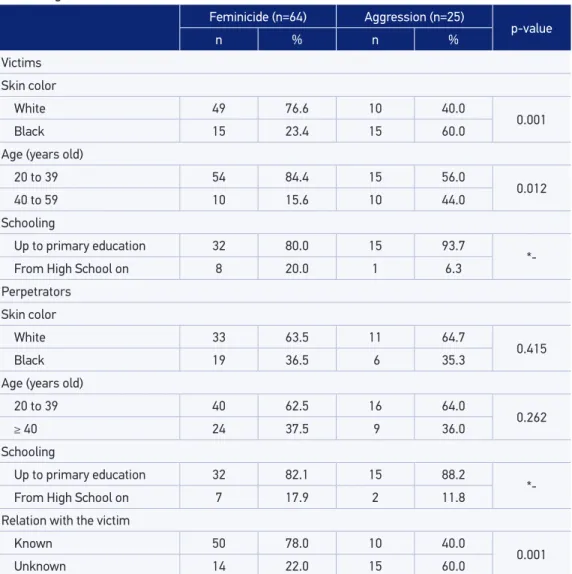
Regarding demographic characteristics, both victim and aggressor are predominantly young, although perpetrators are a little older than the women. It was observed that, pro-portionally, more young women die by feminicide than by other types of female homicide, once 84% (54) of victims were aged 40 years old or less, whereas this percentage was 56% (15 deaths) for the other ones. Black women represent 20% of the female population in Porto Alegre23, characterizing, therefore, an excessive mortality rate of of black women in
all types of homicides, representing 23% of feminicides (15 women) and 60% of the remain-ing murders (15 women). The comparison between feminicides and other female deaths presented statistically signiicant diferences regarding the age of the victims and the rela-tion victim/perpetrator. It was found that, in 78% of feminicides, the aggressor was known by the victim (50 deaths) (Table 2).
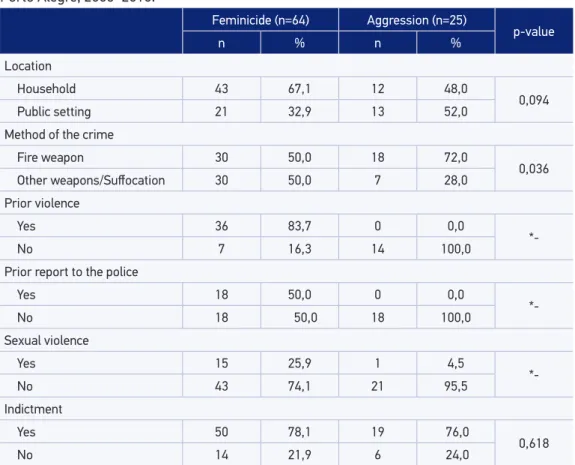
Table 3 shows the scenarios and characteristics of the crimes, comparing feminicides to other deaths. The most frequent location was the victim’s household, in 67% of femi-nicides (43 deaths) and in 48% of other crimes (12 deaths). Although no statistical test was performed, an important diference between victims of feminicide and other women was the history of prior violence, present in 83% of feminicides (36 cases) and absent in the remaining ones. As for previous reporting of these situations of violence to police authori-ties, 50% of the victims (18 women) had denounced the aggressor through the Bulletin of Occurrence. It should be noted that women who iled complaints were not necessarily the same ones with a history of violence on the part of the aggressor.
DISCUSSION
In 2012, according to the Map of Violence, Porto Alegre ranked eighth in the national order of female deaths by aggression, with a rate of 6.6 female homicides per 100 thousand women9. In the Map of Violence, the data come from SIM, not allowing the identiication
Feminicide (n=64) Aggression (n=25)
p-value
n % n %
Victims
Skin color
White 49 76.6 10 40.0
0.001
Black 15 23.4 15 60.0
Age (years old)
20 to 39 54 84.4 15 56.0
0.012
40 to 59 10 15.6 10 44.0
Schooling
Up to primary education 32 80.0 15 93.7
*-From High School on 8 20.0 1 6.3
Perpetrators
Skin color
White 33 63.5 11 64.7
0.415
Black 19 36.5 6 35.3
Age (years old)
20 to 39 40 62.5 16 64.0
0.262
≥ 40 24 37.5 9 36.0
Schooling
Up to primary education 32 82.1 15 88.2
*-From High School on 7 17.9 2 11.8
Relation with the victim
Known 50 78.0 10 40.0
0.001
Unknown 14 22.0 15 60.0
Table 2. Deaths by aggression and demographic characteristics of victims and perpetrators. Porto Alegre, 2006–2010.
*Test not performed due to the high frequency of data considered ignored; due to the exclusion of these data, the total number of the variables were not presented: victims’ schooling (33 ignored) and perpetrators’ schooling (33 ignored).
This study allowed calculating the portion of deaths corresponding to murders based on gender, with 64 deaths (72%) identiied as feminicides. No other Brazilian study was found that calculated the prevalence of feminicides from the data in police inquiries, since it is common3,4,21,22 to use the total number of female deaths by aggression as an
indica-tor of feminicide. The percentage found (72%) is similar to the one found for other coun-tries, in which 60 to 70% of female homicides correspond to feminicides20. This inding
Feminicide (n=64) Aggression (n=25)
p-value
n % n %
Location
Household 43 67,1 12 48,0
0,094
Public setting 21 32,9 13 52,0
Method of the crime
Fire weapon 30 50,0 18 72,0
0,036
Other weapons/Sufocation 30 50,0 7 28,0 Prior violence
Yes 36 83,7 0 0,0
*-No 7 16,3 14 100,0
Prior report to the police
Yes 18 50,0 0 0,0
*-No 18 50,0 18 100,0
Sexual violence
Yes 15 25,9 1 4,5
*-No 43 74,1 21 95,5
Indictment
Yes 50 78,1 19 76,0
0,618
No 14 21,9 6 24,0
Table 3. Settings and characteristics of the crimes, feminicides and deaths by aggression. Porto Alegre, 2006–2010.
*Test not performed due to the high frequency of data considered ignored; due to the exclusion of these data, the total number of the variables were not presented: prior violence (32 ignored), prior report to the police (25 ignored) and prior sexual violence (9 ignored).
The characterization of victims showed they are young and have low income, and that there is overmortality of black women. Although those do not constitute the majority of victims in Porto Alegre, where 80% of the population is self-declared white, they correspond to 23% of feminicide victims and 60% of victims of other murders, totaling 1/3 of these crimes. These data corroborate other analyses that show higher feminicide rates in locations of predominant social vulnerability, black population and violent crimes24-26. In Brazil, the
black population is a priority victim of homicide violence and, whereas mortality coeicients for the white population are decreasing, the ones for the black population are increasing27.
In addition, most female homicides are perpetrated by men, whereas less than 5% of male deaths are committed by women24. In Porto Alegre, in the studied period, only two women
were authors of homicides in which the victim was also a woman.
afection and intimate relations28, showing that the heterosexual couple is the arrangement
ofering the highest risk for women1.
It has been observed that the high frequency of female murders is accompanied by high levels of social tolerance to violence29,30 and by aggressions and threats perpetrated by a
current or former intimate partner26. In this research, 84% of the murdered women had a
history of sufered violence.
The presence of a gun in the household is a risk for the occurrence of a homicide31.
This study observed high frequency of feminicides and other female deaths caused by ire weapons. Despite the Disarmament Statute, Brazil is the country with the highest number of people killed by ire weapons in the world, being the irst cause of death among young people32 and the means used in 48% of female murders27.
Today, we are experiencing the emergence of new scenarios for feminicides, such as those of Central America and Mexico, in territories marked by structural violence16,30.
These types of feminicides were also observed in Porto Alegre, even if in smaller propor-tions. Similar situations were identiied in regions where women are killed due to their connections to traicking, when competing for typically male spaces, denouncing traick-ers or because they are easier targets in vendettas against their mates, children and other family members.
In territories occupied by traic, there is a second State, operating as a militia, using cruelty and according to the codes of the patriarchy. In this context, deaths and executions are trivialized and have not been considered feminicides; many of them remain unsolved and investigations are closed due to lack of evidence, witnesses and clues. Even more worrisome is the fact that these deaths are not seen as feminicides, and these victims are merely referred to, by both the population and the police authority, as “traicking deaths”. Thus, social and gender determination is deprived, removing the political connotation of these murders.
Although it was not the main objective of this paper, understanding the process of elab-oration of police documents was a necessary step. The low of a police investigation begins with reporting the incident, being followed by an investigation, recording all relevant infor-mation of the process, including witnesses’ statements, expert reports, death certiicates and the inal report. There was great diversity between inquiries, as some of them were closed basically blank, without data, and others were made up of dozens of pages.
A study carried out in Brazil21 about the homicide information system identified
in different municipalities from the one where the victim was murdered, which did not correspond to this study.
Many inquiries were still being conducted three years after the crime. In legal terms, the inquiry must be concluded within 10 days if the accused is arrested in the act or is arrested in custody, or after 30 days when the accused is released, with or without bail33. A study
car-ried out in Pernambuco34 about the production of police inquiries observed that the
aver-age time between the diferent steps of the procedure always surpasses what is determined, considering the inquiry is sent from police authorities to the Public Ministry in about eight months after the date of occurrence. In Porto Alegre, the existence of many incomplete inquiries in 2013 shows the fragility of the police system in carrying out these investiga-tions, in addition to not having a speciic registry for feminicides, not even a categorization or separation by gender, making it rather diicult to search for them.
In many cases, the inquiry was closed due to the “law of silence”, a factor mentioned as an obstacle in the pursue for information in Porto Alegre, as well as in other studies and locations34. There were situations in which the killers could have been arrested or indicted,
but they easily blend in the urban scenario, and there was no identiication of the perpetra-tor and indictment in 20% of the inquiries.
Incorrectly measuring the magnitude of female murders may lead to the false impres-sion that this is a rare event. To this end, performing a broad classiication of feminicide is important, including not only deaths caused by an intimate partner, in order to not underes-timate the real incidence of this matter by excluding feminicides occurred in public settings.
CONCLUSION
This study allowed the identiication of the number of feminicides among female mur-ders in Porto Alegre, showing not only their high incidence, but also a pattern for gender-re-lated violence which begins to appear in public settings, crimes with sexual violence and execution of women in traicking disputes.
Although divergences between information systems from the ields of public safety and health are common knowledge, we consider that the study of these deaths should always include data from SIM/DATASUS, to make the information coming from the two systems compatible. It is noteworthy that police inquiries are the only source of information about the aggressor, and allow identifying the types of feminicide, even though their study is a meticulous and time-consuming work, apparently with simple results.
There is still a concept in Society that most feminicides are of intimate nature and occur behind closed doors. Structural violences of the “apocalyptic stage of capitalism”35, which
Porto Alegre, and the history of many deaths observed in the police inquiry are not dif-ferent at all from the scenes of cruelty and horror that take place in Central America and Mexico. Therefore, incorporating these other crimes to the broader concept of feminicide is necessary, in order to not underestimate the real prevalence of these situations, resulting in a statistical proile which does not correspond to reality.
We hope the results of this study are a contribution for proper systematization of data related to feminicide. Interinstitutional actions are required so that the records from legal, police and health sectors allow identifying how many feminicides are there and who are these victims, in order to produce more efective prevention strategies of such crimes.
1. Russel D, Caputti J. Femicide: The Politics of Women Killing. New York: Twayne Publisher; 1992.
2. Lagarde M. Antropología, feminismo y política: violência feminicida y derechos humanos de las mujeres. In: Bullen C, Mintegui CD, editors. Retos teóricos y nuevas practicas. España: Ankulegi Antropologia Elkartea; 2008. p. 209-39.
3. Meneghel SN, Hirakata VN. Femicides: female homicide in Brazil. Rev Saude Pública 2011; 45(3): 564-74.
4. Leites GT, Meneghel SN, Hirakata VN. Homicídios femininos no Rio Grande do Sul, Brasil. Rev Bras Epidemiol 2014; 17(3): 642-53.
5. Meneghel SN. Femicídios e outros assassinatos pautados em gênero no Rio Grande do Sul. [Projeto de pesquisa]. Porto Alegre: UFRGS; 2010.
6. Meneghel SN, Ceccon RF, Hesler LZ, Margarites AF, Rosa S. Femicídios: narrativas de crimes de gênero. Interface 2013; 17(46): 523-33.
7. Brasil. Presidência da República. Lei nº 13.104, de 9 de março de 2015. Altera o art. 121 do Decreto-Lei nº 2.848, de 7 de dezembro de 1940 - Código Penal, para prever o feminicídio como circunstância qualiicadora do crime de homicídio, e o art. 1.º da Lei nº 8.072, de 25 de julho de 1990, para incluir o feminicídio no rol dos crimes hediondos. Brasília; 2015.
8. Agência Patrícia Galvão. Dossiê violência contra as mulheres. [Internet]. Disponível em: http://www. agenciapatriciagalvao.org.br/dossie/violencias/ feminicidio (Acesso em: 7 de abril de 2016).
9. Waiselisz JJ. Mapa da Violência 2012: Os novos Padrões da Violência Homicida no Brasil. Caderno complementar 1. Homicídio de mulheres no Brasil. 2012. [Internet]. Disponível em: http://www.mapadaviolencia.org.br (Acesso em: 10 de junho de 2015).
10. Cabette ELS. Feminicídio. Lei 13.104/15 consagra a demagogia legislativa e direito penal simbólico
mesclado com o politicamente correto. [Internet]. Disponível em: https://jus.com.br/artigos/37148/ feminicidio (Acesso em: 1º de janeiro de 2016).
11. Brasil. Ministério da Justiça. A violência doméstica fatal: o problema do feminicídio íntimo no Brasil. Brasília: Centro de Estudos sobre o Sistema de Justiça; 2015.
12. Geneva Declaration of Armed Violence. Global Burden of Armed Violence. When the victims is a women. 2011:113-44. [Internet]. Disponível em: http://www. genevadeclaration.org/ileadmin/docs/GBAV2/ GBAV2011_CH4.pdf (Acesso em: setembro de 2013).
13. Mathew S. “Cada seis horas”: femicidio íntimo en África del Sur. PATH; 2009. [Internet]. Disponível em: http://docplayer.es/18259704-Fortaleciendo-la- comprension-del-femicidio-de-la-investigacion-a-la-accion.html (Acesso em: 7 de junho de 2015).
14. Prieto-Carrón M, Thomson M, Mac Donald M. No more killings! Women respond to femicides in Central America. Gend Dev 2007; 15(1): 25-40.
15. Velez-Guzman Y. Feminicidios en Medellín, 2010-2011: conceptualización, caracterización y análisis. Rev Crim 2012; 54(2): 13-26.
16. Carcedo A, editor. No olvidamos niaceptamos: Femicídio en Centroamérica, 2000-2006. San José: Associación Cetroamericana de Información y Acción; 2010.
17. Álvarez MD, D’Angelo A. El femicidio em Nicaragua. Abordaje y propuesta de indicadores para la acción / PATH. Managua: InterCambios; 2010.
18. Correa M. Morte em família. Rio de Janeiro: Edições Graal; 1983.
19. Carcedo A, Sagot M. Femicidio en Costa Rica: balance mortal. Med Leg 2002; 19(1): 5-16.
20. Carcedo A, Sagot M. Femicidio en Costa Rica 1990-1999. Washington, D.C.: Organización Panamericana de la Salud; 2000. (Colección Teórica, 1).
21. Brasil. Ministério da Justiça. Homicídios no Brasil: registro e luxo de informações. Brasília: Ministério da Justiça, Secretaria Nacional de Segurança Pública; 2013.
22. Garcia LP, Freitas LRS, Da Silva GD, Höfelmann DA. Violência contra a mulher: feminicídios no Brasil. IPEA; 2014. [Internet]. Disponível em: https://fusiondotnet. iles.wordpress.com/2014/09/130925_sum_estudo_ feminicidio_leilagarcia.pdf (Acesso em: 13 de maio de 2015).
23. Secretaria Municipal de Saúde de Porto Alegre. Proporção de mulheres negras em Porto Alegre. 2010. [Internet]. Disponível em: http://lproweb.procempa. com.br/pmpa/prefpoa/sms/usu_doc/pms.pdf (Acesso em: 1.º de junho de 2015).
24. Campbell JC, Glass N, Sharps PW, Laughon K, Bloom T. Intimate partner homicide: review and implications of research and policy. Trauma Violence Abuse 2007; 8(3): 246-69.
25. Grana SJ. Sociostrutural considerations of domestic femicide. J Fam Violence 2001;16(4): 421-35.
26. Dobasch RM, Dobasch RP, Cavanagh K, Lewis R. Not an ordinary killer – just an ordinary guy: when men murder an intimate woman partner. Violence Against Women 2004; 10(6): 577-605.
27. Waiselisz JJ. Mapa da violência 2015: Homicídios de mulheres no Brasil. Brasília: Flacso; 2015. [Internet]. Disponível em: http://www.mapadaviolencia.org.br/ pdf2015/MapaViolencia_2015_mulheres.pdf (Acesso em: 9 de abril de 2016).
28. Sagot M. Ruta crítica de las mujeres afectadas por la violencia intrafamiliar en América Latina: estudios de caso de diez países.Washington: OPAS; 2000.
29. Segato RL. Que és um feminicídio. Notas para um debate emergente. Brasília: Universidade Nacional de Brasília; 2006. Série Antropologia, 401. [Internet]. Disponível em: http://www.dan.unb.br/images/ doc/Serie401empdf.pdf (Acesso em: 10 de junho de 2015).
30. Monarrez Fragoso J. Feminicidio sexual serial en Ciudad Juarez: 1993-2001. Debate Feminista 2002; 25(13): 1-16.
31. World Health Organization. Femicidio. Comprender y abordar la violéncia contr a las mujeres. [Internet]. Disponível em: http://www.who.int/ reproductivehealth/topics/violence/vaw_series/es/ (Acessado em: 13 de junho de 2015).
32. Waiselisz JJ. Mapa da violência 2015: mortes matadas por armas de fogo. Brasília: Flacso; 2016. [Internet]. Disponível em: http://www.mapadaviolencia.org. br/ (Acessado em: 7 de abril de 2015).
33. Brasil. Código Penal Brasileiro. São Paulo: Revista dos Tribunais; 2008.
34. Ratton JL, Torres V, Bastos C. Inquérito policial, Sistema de Justiça Criminal e políticas públicas de segurança: dilemas e limites da Governança. Soc Estado 2011; 26(1): 29-58.
35. Gago V. Entrevista com Rita Segato. Pedagogia da crueldade. Suplemento de las 12. Los 12. Buenos Aires; 2015. [Internet]. Disponível em: http://www. pagina12.com.ar/diario/suplementos/las12/13-9737-2015-05-29.html (Acessado em: 11 de junho de 2015).
Received on: 04/13/2016