A Work Project, presented as part of the requirements for the Award of a Masters Degree in Finance from the Faculdade de Economia da Universidade Nova de Lisboa
Depreciation manipulation and its impact on firms’ returns
Kristina Vadeikaite Mst16000210
A Project carried in Finance, with the supervision of Professor Ana Marques
Abstract
Earnings management is typically achieved via discretionary accruals (such as depreciation). Dechow et al. (1996), Archibald (1972), and Peasnell et al. (2000) present results on the market reaction to depreciation manipulation that are inconsistent. They find either no reaction or a negative one. This study aims at settling this contradiction by using several different methods, in order to identify a possible manipulation, with a sample of S&P500 firms.
Data suggests that firms are manipulating depreciation. Furthermore, an analysis of useful life of assets reveals that firms have been increasing it since the dot com bubble burst and that its value is larger in profitable firms. However, results of our event studies reveal that the market is not reacting to deprecation manipulation. Thus, it seems possible for firms to fool the markets via this specific manipulation.
1. Introduction
Depreciation is one of the accounting activities that has a sizable impact on companies’ profits. There is some flexibility for calculating the value of depreciation, which in turn allows firms to window-dress their accounts to a certain extent. Depreciation manipulation is a tool of earnings management and, according to Bartov (1993), can be classified as an act of earnings-smoothing. Brenton and Stolowy (2004) state that the ―additional‖ fund (result of the manipulation of depreciation) can be saved over the good times and used over the bad ones, in this way smoothing the normal fluctuation of earnings.
Manipulation of depreciation can be achieved in two ways: via switching depreciation method or changing estimation of assets useful life. The key reasons behind these changes are an aspiration to increase profits and a need to be comparable with the industry accounting standards (Healy and Wahlen, 1999). Comiskey (1971) indicates that a change from accelerated to straight line depreciation accounting method increases the reported earnings per share in all the companies included in her study of the steel market. Dechow et al. (1996) indicate that once earnings manipulation becomes known to the public, the price of the share drops accordingly to the amount that is perceived to be overstated. Archibald (1972) does not find abnormal performance of the stock during the announcement of the change of depreciation method. However, Peasnell et al. (2000), state that earnings management through depreciation manipulation is ―a somewhat transparent‖, and thus it
does make an impact to the market price of the firm
This study aims to enrich existing earnings management literature by studying financial markets’ reactions to the manipulation of depreciation. In order to identify the possible manipulation, four different depreciation manipulation proxies have been used. The first two estimate the value of abnormal depreciation (following the methodologies of Marquardt and Wiedman’s (2004) and Jennings and Marques (2006) (unpublished)), the
third one is depreciation index (Beneish’s (1997) method) and the final one is useful life of assets (Jennings and Marques (2006) (unpublished)). The sample consists of firms from the Standard & Poor’s 500 Index (S&P500) and the data covers a period of 9 years (from 1999 to 2007).
The study yields three important results. First, by using four different methodologies it is found that firms manipulate depreciation to a certain extent. Second, useful life of asset over the sample has a tendency to increase since dot com burst bubble and is superior in profitable companies, which might imply that firms manipulate depreciation for earnings management. Third, four regressions (two with variable of interest abnormal depreciation, one with depreciation index and one with useful life of assets) yield the same result, that is market does not react to depreciation manipulation.
as market does not react to this manipulation. Finally, the paper creates new questions and areas for exploration in finance research literature.
The remainder of the paper is organized as follows. The next section reviews pertinent literature and develops the research questions. Section three explains how the final sample was obtained. Section four outlines the methodology used in this study. Section five reports the descriptive statistics and reports the results. The last section concludes the paper and suggests some lines for future research.
2. Literature review and research questions 2.1 Earnings manipulation and management
In finance, manipulation can be defined as an act where false signal or information is being sent in order to make investors purchase or vend specific securities, to make a gain out of this operation (Ogut et al., 2009). It can be classified into three categories, as it can be action-based, trade-based or information-based manipulation (Allan and Gale, 1992). Financial information manipulation is also called accounting manipulation and, according to Beneish (2001), it is vaguely different from earnings management. As a result, the two terms are sometimes used interchangeably. Earnings manipulation can be defined as ―intentional misstatements or omissions of amounts and disclosures in financial statements
financial performance or make an impact on contractual outcomes that depend on this information‖.
According to Ayres (1994) there are three ways of managing earnings. The first is accrual management, which can be explained as a desire to modify earnings by varying items such as useful lives, probability to recover debts and other. The second way is to alter the timing of the introduction of obligatory accounting policies. The final way is to change from one accounting method to another.
2.2 Reasons and consequences of earnings management
Earnings management has several consequences on company’s results and its appearance to the stakeholders. Barton and Simko (2002) find that authors reveal that ―the penalty imposed by the market per penny of earnings per share (EPS) missed is more severe for firms missing by a penny than by a larger amount―. Dechow et al. (1996) indicate that once
earnings manipulation becomes known to the public, the price of the share drops accordingly to the amount that is perceived to be overstated. Consequently, the cost of capital for these companies increases. Beneish (1997) finds that companies that have violated GAAP, in order to favorably improve the financial reports, experience abnormal negative returns for the following two years.
2.3 Depreciation manipulation
One way to manage earnings is to smooth them by manipulating depreciation. As there is some flexibility for calculation of the depreciation amount, firms may window-dress their accounts to a certain extent (Brenton and Stolowy, 2004). Beck (2003) quotes Wexler (economist at Merrill Lynch, 2001), which states that depreciation manipulation accounted for 25% of the improvements in second-quarter profits (S&P500 firms). Hiller and Mccrae (1998) study the earnings smoothing potential of systematic depreciation and find that manipulation can be achieved in two ways: (i) via switching depreciation method and (ii) changing estimation of assets’ useful life.
restricted. For instance, the switch of depreciation method allows firm to build up an ―earnings bank‖, which will be used upcoming year and the need to have another one will
require to change accounting procedures once more1. Comiskey (1971) indicates that a change from accelerated to straight line depreciation accounting method increases the reported earnings per share in all the companies included in her study of the steel market. Archibald (1972) does not find abnormal performance of the stock during the announcement of the change of depreciation method. Finally, Jackson et al. (2008) find that the number of firms using accelerated depreciation method for all or some of their depreciable assets have dropped from roughly 31 percent in 1988 to around 14 percent in 2006. Results indicate that the choice of depreciation method makes an impact on firm’s management decisions regarding limited capital resource.
Changing the estimation of useful life of assets’: Bartov (1993) reveals that income from the sale of assets in the companies that experience low income are higher than in the ones who are having high incomes, which suggests the conclusion of manipulation of timing of the assets. More recent research by Gunny (2005) indicates that manipulation of timing of asset sale (in a sense of earnings management) has a negative economic impact on the operating results of the following period (earnings and cash flow). Herrmann et al. (2003) reveal that ―in case firms report current operating income is below (above) management's forecasted number, firms tend to increase (decrease) earnings through the sale of fixed assets‖ (this research was conducted on Japanese firms).
1
2.4 Research questions
Plummer and Mets (2001) comment that although prior research suggests that ―firms manage earnings to achieve certain reporting objectives, the literature provides limited evidence on which specific components or accruals are used for earnings management‖.
Hillier and McCrae (1998) state that although there were numerous studies made on earnings smoothening, ―only a few of those has concentrated on depreciation‖. Bartov
(1993) also indicates that the potential of depreciation to smoothen earnings and ability to manipulate depreciation method is quite unexplored. This paper aims at
filling the gap that is present in the earnings management literature with regard to depreciation manipulation. Specifically, two research questions will be addressed. The first is whether firms currently manage earnings via depreciation expenses. If the answer to the first research question is positive the second research question is whether the market reacts to this manipulation. Finding a negative market reaction for manipulation would indicate that capital markets can see through manager’s manipulation of this value. On the other
hand, finding no market reaction suggests that firms can fool the market via the calculation of the depreciation expense.
3. Sample
though manipulation of accounting methods can occur in the middle of the year, it is important to study year-end financial statements, as they are accessible for public use and are employed by investors and analysts.
The calculation of the firms included in the final sample is described in Table 1. Firms belonging to financial and utilities industries were excluded due to their specific regulation. This is done by using the Global Industry Classification Standards (GICS), which according to Bhojraj et al. (2003), are significantly better in various settings of capital markets research than other industry classification schemes. This yields a potential sample of 385 firms. Due to time constraints, we randomly select 223 firms. The sample period covers a period of 9 years (from 1998 to 2007).
Data is collected from two sources. First, the information needed for the calculation of abnormal depreciation and useful life of assets is retrieved from Compustat quarterly database. Second, market reaction information is collected from CRSP.
4. Methodology
4.1. Measures of abnormal depreciation, depreciation index and manipulation of useful life
The first abnormal depreciation variable (ABDEP1) is calculated following Marquardt and Wiedman’s (2004) method. It is based on the calculation of the expected value of
depreciation, which is assumed to remain a constant in proportion with gross property, plant, and equipment and its subtraction from the ―real‖ value of depreciation.
, , 1 , , 1 , 1
ABDEP1 DEPj t DEPj t *GrossPP&Ej t /GrossPP&Ej t /TAj t
Net depreciation (Q2), coded as ―Depreciation Net Qtly‖ in Compustat.
Gross PP&E (Q), coded as ―PP&E-Total Gross Qtly‖ in Compustat.
Total Assets (Q), coded as ―Total Assets Qtly‖ in Compustat.
The second abnormal depreciation variable (ABDEP2) and useful life of asset (UL) is calculated by using formula created by Jennings and Marques (2006)3. Authors, after the revision of existing literature, look at a case study of ―Waste Management, Inc.‖, which
mentions three items to be compared at an industry level: percent of Net PP&E in Assets (capital intensity), useful life, and a ration of depreciation/revenues. Thus, authors suggest calculating useful life of asset. The analysis of this item should portray the willingness to manipulate depreciation.
on Depreciati
E P MeanGrossP
UL &
2 Q - quarterly data
3Jennings and Marques was working on the topic ―The manipulation depreciation‖, though the paper has not been published. The paper
Gross depreciation (Q), coded as ―Depreciation Gross Qtly‖ in Compustat.
Gross PP&E (Q), coded as ―PP&E-Total Gross Qtly‖ in Compustat.
The useful life of asset is an important item for the calculation of unexpected depreciation.
&
ABDEP2 Depreciation MeanGrossPP E
lagUL
Gross depreciation (Q), coded as ―Depreciation Gross Qtly‖ in Compustat.
Gross PP&E (Q), coded as ―PP&E-Total Gross Qtly‖ in Compustat.
It is important to emphasize that the calculation might be biased due the fact that Compustat database yield depreciation and amortization as one item named depreciation and there is none specific item for land.
The third depreciation variable (DEP_INDEX) is calculated by using Beneish’s (1997)
methodology. The author indicates that a depreciation index greater than one is an indicator of the slow down of the rate by which assets have been depreciated. This can occur due to two reasons: firm has switched its depreciation method in order to increase earnings or estimation of asset’s useful life has been raised.
1/ ( 1 & 1)
DEP _ INDEX
/ ( & )
t t t
t t t
Depreciation Depreciation PP E Depreciation Depreciation PP E
Gross depreciation (Q), coded as ―DepreciationGross Qtly‖ in Compustat.
Gross PP&E (Q), coded as ―PP&E-Total Gross Qtly‖ in Compustat.
2005). According to Zatta (2005), the depreciation index needs to be interpreted by looking at it in the multiple period samples. Moreover, the author states ―if the rate of depreciation falls over two periods, it raises the possibility that the company has boosted its estimates of assets’ useful lives or adopted a new depreciation method that increases income‖. This
method yielded 23 companies in the sample, which probably manipulated depreciation. For these companies an indicator variable is created, in which manipulators are coded as 1 and non-manipulators as 0.
4.2. Reaction to abnormal depreciation and manipulation of useful life
The next part of this study tests market reactions to the abnormal depreciation and the manipulation of the useful life of assets. Equations 1, 2 and 3 correspond to the three different proxies for abnormal depreciation discussed above. Equation 4 analyzes the reaction to the manipulation of useful life. The models are as follows:
CAR = 0
variables of interest: + 1 ABDEP1
other variables: + 2 UNE + 3UNS + 4 SIZE (1)
CAR = 0
variables of interest: + 1 ABDEP2
other variables: + 2 UNE + 3UNS + 4 SIZE (2)
CAR = 0
variables of interest: + 1 DEP_INDEX
other variables: + 2 UNE + 3UNS + 4 SIZE+ 5DM (3)
CAR = 0 variables of interest: + 1 UL
In order to measure market reaction, an event study is conducted, with its 3-day window centred at the date of the earnings announcement. The study is made by using the 4th quarter earnings’ announcement day, as it contains the yearly performance of the company. Normal return in this study refers to the firm-specific daily return, while the expected return is calculated using a value-weighted index.
The control variables used in regressions were unexpected earnings (UNE), unexpected sales (UNS), and size (SIZE). According to Hsu (2002), unexpected earnings occur when company’s reported earnings deviate from analysts’ forecasts and are considered to be a
useful tool in predicting abnormal returns. In this study, unexpected earnings are calculated as a real value minus value of the same quarter last year. Moreover, unexpected sales are calculated in the same manner. According to Kothari (2001), the size of a company is related to the abnormal returns during earnings announcement days. This variable is calculated as natural logarithm of total assets.
5. Findings
5.1. Descriptive statistics
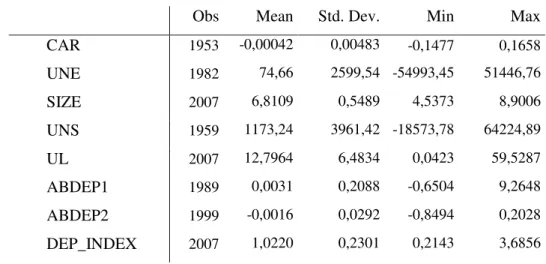
outliers that could be further investigated for earning manipulation. For example, DEP_INDEX has a maximum value of 3,68 (and more than one suggest earnings management).
According to Evans (1997), outliers’ identification is significant in regression analysis as
outliers can impact model in such way that it will make the conclusions of study biased. In order to eliminate this impact, 2% of extreme data points are removed (1% from each side). As expected, this procedure increased adjusted R-squared of the regression lines. The first regression, for example, had a adjusted R-squared of 0,4% before procedure and 5,47% after it. In addition to that, scaling is made by dividing variables by market value, as this procedure allows normalizing data.
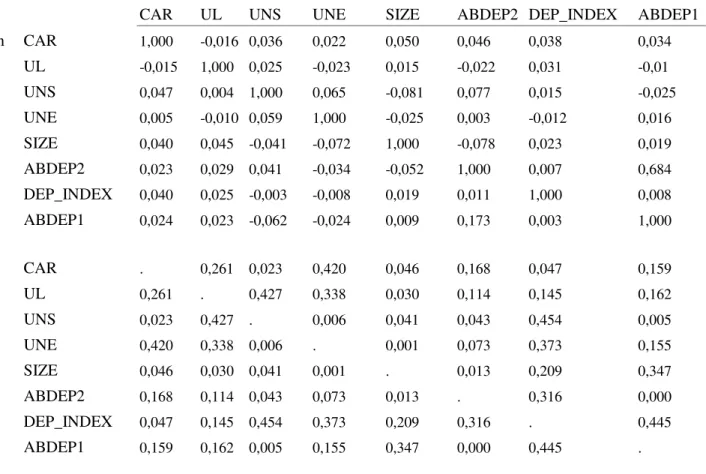
Table 3 shows the correlation between variables. The table depict that variables have a weak (coefficient from -0,2 to 0,2) relationship (by Pearson and Spearman correlation)4, where the strongest one are seen between CAR and unexpected sales and the two of the proxies for abnormal depreciation, ABDEP1 and ABDEP2, which are also strongly correlated (0,684). Moreover, this relationship is statistically significant (p-value of 0.000). All of the regressions have positive significant correlation between CAR and unexpected sales, which suggests that market reacts positively to unexpected sales (as expected in line with Hsu, 2002). On the other hand, the table depict that there is a low positive correlation between CAR and ABDEP1, and ABDEP2 (respectively 0,018 and 0,011), suggesting that when abnormal depreciation is increasing CAR is increasing as well, and low negative correlation between CAR and DEP_INDEX, and UL (respectively -0,03 and -0,014), suggesting that when abnormal depreciation or useful life of asset is increasing CAR is
4 Spearman correlation indicates relationship between X and Y, when they are related by any monotonic fuction, while Pearson
decreasing. In addition, table 3 shows that significance correlation is found between UL and SIZE (0,030), UNE and SIZE (0,006) ABDEP1 and UNS (0,005), UNS and SIZE (0,041), ABDEP2 and SIZE (0,013), and UNE and SIZE (0,001).
Table 4, panel A presents analysis of useful life of assets for a timeframe from 1999 to 2007. This suggests that, on average, until the ―dot com bubble burst‖ the useful life of the assets in the sample companies was decreasing and after this event it has a tendency to increase. This implies smaller depreciation expenses and larger net income (2001-onwords), which is an important figure for analysts, investors and market in general. Moreover, t-test, represented in a third column of the table, evaluates if the change from one year to another is significant; we can see that these changes were significant from 2001 to 2002, from 2002 – 2003, and from 2005 to 2006. The significant change in 2001-2002 reconfirms assumption that after ―dot com bubble burst‖, the increase in useful life of assets
is statistically significant. 2002-2003 significance can be explained by recovering economy after slowdown in 2001. 2005-2006 corporate earnings were slowing down due to rising rates and commodities’ prices (Mellody Hubson, President of Ariel Capiltal Management,
2006).
Additionally, table 4, panel B reveals that profitable companies on average have higher useful life of the assets than firms with a loss. These results might suggest earnings management by manipulating useful life of assets (one of the ways to manipulate depreciation). T-test reconfirms that difference between these two values is significant.
5.2. Results of event study
random effects. Fixed effects are used when it is important to control for omitted variables that vary among cases but are invariable over time. The model gives more consistent results, but might not be most efficient model to run. Random effects are used to control for omitted variables that alter over time but are constant between cases. The model gives better P-values, but it might be inconsistent due to omitted variables. In this study, estimation regressions are ran by using random effects.
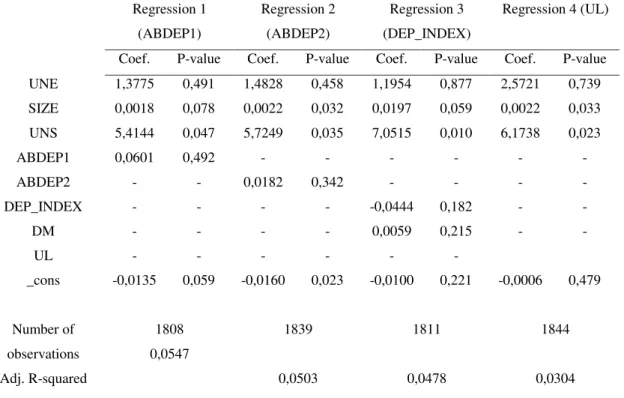
Table 5 represent the estimation results for the four linear regressions. The results obtained provide no support to the second hypothesis that the market reacts to depreciation manipulation, since there is no relationship between CAR and ABDEP1, ABDEP2, DEP_INDEX, and UL. In fact, all estimated coefficients are not statistically significant. This result is consistent with the correlation coefficients present in table 3 – a weak, and close to zero correlation. On the other hand, the estimated coefficients for unexpected sales are all positive and statistically significant, as expected. Size is the other variable that is statistically significant, but only in regressions 1 and 4. Adjusted R2 is 5,47%, 5,03%, 4,78%, and 3,04% (respectively to each regression). This suggests that the fourth proxy is the least informative one.
The result that markets do not react to depreciation manipulation is in line with several previous findings. Archibald (1972) finds no abnormal performance of stock during the announcement of the change of depreciation method. Moreover, some authors have predicted similar results. Beneish (1997) stated ―earnings management via depreciation is
depreciation manipulation is ―a somewhat transparent‖, it does make an impact to the
market price of the firm.
On the other hand, Comiskey (1971) finds that depreciation manipulation increases earnings per share. Dechow (1996) states that once earnings management is known the price of the stock drops. Beneish (1997) indicates that companies which violate GAAP experience negative abnormal returns for two following years. Taking into account that four different proxies are used in this study, the findings in this paper should end the dispute: financial markets do not react to depreciation manipulation.
6. Conclusion
This study analyzes a sample of S&P500 firms, using four different methods to identify firms which may be manipulating earnings via depreciation and assesses the extent of the market reaction to this possible manipulation.
There are three important results. First, abnormal depreciation methodologies used in this study proved that firms manipulate depreciation to a certain extent. Second, useful life of assets over the sample has a tendency to increase since the dot com burst and is superior in profitable companies, which might imply firms manipulate depreciation for earnings management. Third, all specifications of the event study conducted regressions yield the same result: capital markets do not react to depreciation manipulation.
returns, market adjusted returns, control portfolios, or risk adjusted returns. Second, the models used in the study may not be able to capture depreciation manipulation, for example Harrington (2005) quotes Beneish, author of one of the methodologies used state, ―the best rate of success we had for the earning management index is 50 percent‖. Third, data from
Compustat gives a combined data of amortization and depreciation, which may have an impact on results.
References
Ayres, F.L., 1994. ―Perceptions of earnings quality: What managers need to know‖.
Management Accounting, Vol. 75 (9), pp. 27-29.
Allen, F. and G. Douglas, 1992, ―Stock-Price Manipulation‖. The Review of Financial Studies, Vol. 5 (3), pp: 503-529.
Altamuro, J., A. L. Beatty and J. Weber, 2005. ―The Effects of accelerated revenue
recognition on earnings management and earnings informativeness: Evidence from SEC Staff Accounting Bulletin No. 101‖. The Accounting Review, Vol. 80 (2), pp. 373-401.
Archibald, T. R., 1972. ―Stock Market Reaction to the Depreciation Switch-Back‖. The Accounting Review, Vol. 47 (1), pp. 22-30.
Arens, A. A. and J. K. Loebbecke, 2000. Auditing: An Integrated Approach, Prentice Hall International, Inc., New Jersey.
Barton, J., and P. Simko. 2002. ―The balance sheet as an earnings management
constraint‖. The Accounting Review, Vol. 11 (Supplement), pp. 1-27.
Brooks, C., 2008. ―Introductory Econometrics for Finance‖. Cambridge University
Press.
Bartov, E., 1993. ―The timing of asset sales and earnings manipulations‖, The Accounting Review, Vol. 68 (4), pp. 840 – 855.
Beck R., 2003. ―Second quarter profit growth rooted in shaky ground‖. Source: http://www.dailyherald.com/business/col_beck.asp.
Beneish, M. D., 1997. ―Detecting GAAP violation: Implications for assessing earnings management among firms with extreme financial performance‖. Journal of
Accounting and Public Policy, Vol. 16 (3), pp. 271–309.
Bhojraj, S., C. M. C. Lee, and D. K. Oler. 2003. ―What’s my line? A comparison of industry classification schemes for capital market research‖. Journal of Accounting
Research, Vol. 41 (5), pp. 745-774.
Breton, G. and H. Stolowy, 2004. ―Accounts Manipulation: A Literature Review and Proposed Conceptual Framework‖. Review of Accounting and Finance, Vol. 3 (1), pp.5- 66.
Comiskey, E. E., 1971. ―Market Response to Changes in Depreciation Accounting‖.
The Accounting Review, Vol. 46 (2), pp. 279-285.
Dechow, M. P., G. R. Sloan and P. A. Sweeney, 1996. ―Causes and Consequences of Earnings Manipulation: An Analysis of Firms Subject to Enforcement Actions by the SEC‖. Contemporary Accounting Review, Vol. 13 (2), pp. 1-36.
Evans P., 1997. ―Strategies for Detecting Outliers in Regression Analysis: An Introductory Primer‖, Paper presented at the Annual Meeting of the Southwest Educational
Research Association.
Gunny, E., 2005.――What are the Consequences of Real Earnings Management?‖. University of Colorado at Boulder - Department of Accounting.
Harrington C. (2005). ―Formulas for detection / Analysis ratios for detecting
financial statement fraud‖. Fraud Magazine (4 ).
Healy, P. M. and J. M. Wahlen, 1999. ―A review of the earnings management
Herrmann, D., T. Inoue and W. B. Thomas (2003) The Sale of Assets to Manage Earnings in Japan‖. Journal of Accounting Research, Vol. 41 (1), pp. 89-108.
Hillier, J., M. McCrae, 1998. ―The earnings smoothing potential of systematic
depreciation‖, Abacus, Vol. 28 (1), pp. 32-39.
Hsu C., 2002. "Standardized Unexpected Earnings in the U.S. Technology Sector‖, International Business and Economics Research Journal, Vol. 33 (1).
Jackson, S. B., K. X. T. Liu and M. Cecchini, 2008. ―Economic Consequences of Firms’ Depreciation Method Choice: Evidence from Capital Investments‖. Journal of
Accounting & Economics, Vol. 3 (1), pp. 73–109.
Kothari, S., 2001.‖ Capital markets research in accounting‖. Journal of Accounting
and Economics, Vol. 31 (1–3), pp. 105–231.
Laudicina, P. A., 2005. ―World out of balance – navigating global risks to seize competitive advantage‖. McGraw-Hill.
Marquardt, A. C., I. C. Wiedman, 2004. ―How Are Earnings Managed? An Examination of Specific Accruals‖. Contemporary accounting Research, Vol. 21 (2), pp. 413-439.
Myers, H. J., 1967. ―Depreciation manipulation for fun and profit‖. Financial
Analysts Journal, Vol. 23 (6), pp. 117-123.
Ogut, H., R. Aktas, A. Alp and M. M. Doganay (2009). ―Prediction of financial information manipulation by using support vector machine and probabilistic neural network‖. Expert Systems with Applications: An International Journal, Vol. 36 (3) pp. 5419-5423.
Perry, J., P. Lim, K. Hobson, N. Neusner, 2001. ―Biz blahs and blame‖. U.S. News & World Report (October 29), pp. 54.
Plummer, E., D. P. Mest, 2001. ―Evidence on the management of earnings
components‖. Journal of Accounting, Auditing & Finance, Vol. 16 (4), pp. 301-323. Seiler, M. J., 2000. ―The efficacy of event-study methodologies: measuring ereit abnormal performance under condition of induced variance‖, Vol. 113 (1).
Stubben, S., 2006. ―Do firms use discretionary revenues to meet earnings and
revenue targets?‖ Working paper: Stanford University.
Table 1 – Sample
Panel A: Sample selection
S&P500 firms 500
Financial institutions (GICS=40) 81
Utilities (GICS=55) 34
Potential sample 385
Firms with data problems 162
Final sample 223
Panel B: Sample division into industries
Final Sample S&P 500
Energy 10 9,9% 10,1%
Materials 15 7,7% 7,5%
Industrials 20 16,2% 15,3%
Consumer Discretionary 25 21,2% 20,8%
Consumer Staples 30 11,3% 10,4%
Health Care 35 12,2% 14,0%
Information Technology 45 18,9% 19,5%
Telecommunications Services 50 2,7% 2,3%
Note: The percentage is calculated by excluding financial and utility sectors
Table 2 – Descriptive statistics
Obs Mean Std. Dev. Min Max
CAR 1953 -0,00042 0,00483 -0,1477 0,1658
UNE 1982 74,66 2599,54 -54993,45 51446,76
SIZE 2007 6,8109 0,5489 4,5373 8,9006
UNS 1959 1173,24 3961,42 -18573,78 64224,89
UL 2007 12,7964 6,4834 0,0423 59,5287
ABDEP1 1989 0,0031 0,2088 -0,6504 9,2648
ABDEP2 1999 -0,0016 0,0292 -0,8494 0,2028
Table 3 – Correlation and statically significance
CAR UL UNS UNE SIZE ABDEP2 DEP_INDEX ABDEP1
CAR 1,000 -0,016 0,036 0,022 0,050 0,046 0,038 0,034
UL -0,015 1,000 0,025 -0,023 0,015 -0,022 0,031 -0,01
UNS 0,047 0,004 1,000 0,065 -0,081 0,077 0,015 -0,025
UNE 0,005 -0,010 0,059 1,000 -0,025 0,003 -0,012 0,016
SIZE 0,040 0,045 -0,041 -0,072 1,000 -0,078 0,023 0,019
ABDEP2 0,023 0,029 0,041 -0,034 -0,052 1,000 0,007 0,684
DEP_INDEX 0,040 0,025 -0,003 -0,008 0,019 0,011 1,000 0,008
ABDEP1 0,024 0,023 -0,062 -0,024 0,009 0,173 0,003 1,000 Spearman/Pearson
Correlation
CAR . 0,261 0,023 0,420 0,046 0,168 0,047 0,159
UL 0,261 . 0,427 0,338 0,030 0,114 0,145 0,162
UNS 0,023 0,427 . 0,006 0,041 0,043 0,454 0,005
UNE 0,420 0,338 0,006 . 0,001 0,073 0,373 0,155
SIZE 0,046 0,030 0,041 0,001 . 0,013 0,209 0,347
ABDEP2 0,168 0,114 0,043 0,073 0,013 . 0,316 0,000
DEP_INDEX 0,047 0,145 0,454 0,373 0,209 0,316 . 0,445
ABDEP1 0,159 0,162 0,005 0,155 0,347 0,000 0,445 .
Table 4 – Characteristics of useful life of asset Panel A: analysis made by years
Year Useful Life of Asset T-test
1999 11,75
2000 11,67 0,515
2001 11,73 0,742
2002 12,92 0,000
2003 13,25 0,038
2004 13,41 0,202
2005 13,29 0,399
2006 13,52 0,037
2007 13,62 0,432
Panel B: analysis by loss/profit firms
Firms’ profitability Useful Life of Asset T-test
Positive 13,10
Negative 10,45 0,023
Table 5 – Results of linear regressions (dependent variable – CAR)
Regression 1 (ABDEP1) Regression 2 (ABDEP2) Regression 3 (DEP_INDEX)
Regression 4 (UL)
Coef. P-value Coef. P-value Coef. P-value Coef. P-value
UNE 1,3775 0,491 1,4828 0,458 1,1954 0,877 2,5721 0,739
SIZE 0,0018 0,078 0,0022 0,032 0,0197 0,059 0,0022 0,033
UNS 5,4144 0,047 5,7249 0,035 7,0515 0,010 6,1738 0,023
ABDEP1 0,0601 0,492 - - - -
ABDEP2 - - 0,0182 0,342 - - - -
DEP_INDEX - - - - -0,0444 0,182 - -
DM - - - - 0,0059 0,215 - -
UL - - - -
_cons -0,0135 0,059 -0,0160 0,023 -0,0100 0,221 -0,0006 0,479