LISBOA.
N
EWHOTEL
S
OFTWARE
’
S
I
NTERNATIONALIZATION
STRATEGY TO ARGENTINA
MANUEL LUÍS FERNANDO MOREIRA DOS SANTOS
STUDENT NUMBER:716
A PROJECT CARRIED OUT ON THE FIELD LAB OF SMALL AND MEDIUM ENTERPRISES COMPETITIVENESS:
INTERNATIONALIZATION STRATEGY, UNDER THE SUPERVISION OF:
PROFESSOR SÓNIA DAHAB AND PROFESSOR FILIPE CASTRO SOEIRO
Index
Executive Summary ... 1
Methodology ... 2
Description of the Firm ... 2
Overview of the Firm ... 2
Perspective on Business Mission and Strategic Objectives ... 3
Products & Services ... 3
Target Market ... 5
Revenue Model ... 6
Distribution Channels ... 7
Cost Structure... 7
Organizational Structure ... 8
The Hotel Management Solutions Industry ... 8
Porter’s 5 Forces Analysis ... 8
Industry Mapping ... 9
Competitive Assessment ... 11
Competitive Advantage ... 12
The Argentinean Market ... 14
Country Overview ... 14
The Travel & Tourism Industry ... 16
The Hotel Industry ... 17
Strategy for NHS ... 18
Marketing Mix –The 4 P’s ... 18
Internationalization Process ... 19
Mode of Entry ... 19
Implementation Plan –The 4 M’s ... 20
Risk Analysis & Contingencies ... 24
Conclusions & Recommendations ... 25
Bibliography ... 26
Endnotes ... 26
Reports & Books... 27
Reference Sites ... 28
Exhibits ... 30
1
Executive Summary
Newhotel Software is an IT company that develops software solutions mainly for the hotel industry. It was founded in Portugal and is now present in 26 different countries with 6 offices. Its software is developed from the ground up, providing key operational efficiencies that allows the firm to fully
integrate, adapt and customize its products to its clients’ needs. It also provides technical support
with services such as maintenance and a help desk structure to ensure the satisfaction of its customers which correspond to 4 and 5 star hotels capable of yielding complex business practices. The company also has a wide portfolio of software capable of serving other players in the hospitality industry.
Currently, the firm is planning to further develop their internationalization strategy by targeting additional countries. In this regard, Argentina proved to be a market with a significant size and an outstanding future growth prospect. At the same time, the government is also investing heavily the international trade promoting the abolition of structural barriers and is investing in the software industry providing fiscal and legal benefits to companies all the while conferring national treatment to foreign investors.
From the analysis of the market and the company itself, it was proposed that the course of action to be taken in this market was to begin with a low level commitment strategy and increasingly build to a higher level of commitment translating into the recruitment of a sales team by 2013 and the establishment of an office by 2014.
Throughout the project, several recommendations were made to a few of the most underdeveloped operations of the company, more specifically, its marketing activities as it was established through an industry analysis that brand awareness was one of the key success factors and the least sought out by the firm. This project aims to help and provide a clear picture of what to expect if the firm chooses to enter in Argentina.
2
Methodology
Newhotel Software business description information was gathered through several business meetings with the firm. Out of all the aspects of its operations, information on the cost structure and
value chain is extremely limited due to the company’s unavailability of data. The industry analysis
was primarily based on the business meetings with the company due to the secretive and fragmented nature of the software industry. The market assessment phase was done primarily through internet research with sources such as the Argentinean statistics office and Ministry of Tourism, the World Travel and Tourism Council and the World Tourism Organization. Available information of hotel rooms was limited as well as other hospitality players such as restaurants. Macroeconomic data was obtained mainly through the World Bank.
Description of the Firm
Overview of the Firm
Newhotel Software (NHS) was created in 1984 and is a “Property Management System” (PMS) developer and licensor for the Hotel industry. It was founded by Engº João Matoso due to the identification of a badly managed resort in Quinta do Lago, he quickly set out to develop software capable of adjusting to its clients needs. Since then, they now have a wide array of products ranging from the front office management system to numerous marketing tools capable of delivering not only a product, but a competitive advantage to their customers.
Ever since the beginning, the company has been experiencing constant growth achieving 3.9 million EUR in net sales in 2010 from a value of 2.2 million EUR in 2003, an annual growth rate of about 8,5%. The firm has established subsidiary companies in Madrid, Vilnius, Bogotá, Lima, Miami and Panama and is present in a total of 26 countries through their distribution network. In Portugal, they now have four offices (Lisboa, Algarve, Braga, Madeira) and hold a market share of 34,11%1.
3 clients are from Europe, 32% from America and 10% from Africa. However, due to the size and growth potential of their clients, 60% of NHS’s revenues come from outside of Europe - See Exhibit
1,2 and 3 for general information of NHS.
NHS offers a wide array of hotel management solutions systems as well as IT services and
maintenance support to satisfy their clients’ needs. Their target market is mainly four and five star
independent hotels with complex operational requirements to capitalize on high number of products and the ability to provide a fully integrated solution.
Perspective on Business Mission and Strategic Objectives
NHS has business values which are experience, innovation, dedication and reliability. It employs, in our point of view, a mission of “to provide a global and fully integrated software solution to the hospitality industry with the most up to date and easy to handle applications focusing mainly of the
hotels’ most demanding needs”.
Our business vision proposition for NHS is: “To become a worldwide player in the information technology industry for the hospitality segment with the visionary goal of being present in the five continents of the world by 2020”. In light of NHS current position and their products we propose the following strategic objectives:
To continue growing at least 8,5% per year until 2020 (roughly 8.800.000€) ;
To enter in a new geographical market per year until 2020;
Establish commercial activities with at least 2 hotel chains until 2020;
Products & Services
4 correspond to roughly 15% and maintenance contracts accounted for 50% of net sales - See Exhibit 6 for the net sales composition by product category.
NHS licenses its products under the prefix “New”.For instance, their software’s names are: Newhotel
PMS Front-Office, NewGolf, NewSpa, NewStock, NewClub, etc. This source branding strategy eases the association between the products and the company. When considering the software the firm develops, we can establish three different sub categories: Hotel, Multi-Hotel & Group Solutions, Food & Beverage and Business & Leisure Solutions. NHS has 60 software products out of which 44 are for the first sub category. These software solution systems range from Central Reservations system to their flagship product, the PMS Front-Office, representing, from a historical perspective, 31,26% out of the revenues of their software licenses – See Exhibit 7 for historical weights of each product in total software licensing sales. Other than the software, NHS also produces interfaces (or modules) which are specific software that makes a link between the software licensed to its clients. An example is a hotel with a PMS Front Office for management of the front desk and also a “Point-of-Sale” (POS) for restaurants. NHS possesses an interface which connects the two systems into a single integrated product. This highlights one of the most important concepts of the
company’s activity: “cross-selling”. Usually, a new client can start out by asking for simple
management software, such as the reservations system. Consequentially, as its business grows larger, the demand for other products will increase and NHS can capitalize on this growth phase by selling different products and having the ability to integrate any management software. This concept also makes NHS reduce its client acquisition costs as it represents additional revenue from an existing client.
The Food & Beverage sub category offers a POS information system for restaurants and bars which
encompasses the NewPOS, NHS’s top product on this category representing 11,70% of total
5 Software Development Development of the company's products IT Consulting Understanding the client's needs
to customize product
Customization
Development of a fully integrated, adapted and customized software Installation and Training Operationalize and transfer know how to
client Technical Support Maintenance Contracts and Help Desk Support
products such as event and conventions management software, golf course management software and thermal spa unit management.
On another note, services performed by NHS include IT Consulting, training of clients’ employees, software installation and design of computer solutions. However, the most important service is the maintenance. They include the help desk services, on-site support and updates of the software.
Unlike NHS’s software, these contracts are charged at an annual fee which explains the huge role it
has in terms of revenues for the company. However, we need to take into account that the software category is the one that drives profit on the other two as IT services and maintenance contracts revenues depend on the software licenses. All of these products and services can also be organized through the following value creation process.
Graph 1 –NHS’ value creation process
Target Market
Because of NHS’s wide array of products, their clients are present in different industries. However,
6 Revenue Model
As previously mentioned, there are two types of software NHS produces and licenses: the product software and the interfaces that connects them. Regardless of their nature, the software price is charged as a lifetime license fee for their clients. All of the software is priced independently, which is, in my opinion, deterring the company to fully take advantage of their competitive advantages as the integration, customization and adaptability are their main selling points and the customers might lose interest when they do not have a discount based on modules/software ordered.
The product software, such as the PMS Front Office is sold through license agreements based on the end user requirements. For instance, the more hotel rooms the client has, the higher the price of the license fee. This is obviously due to the required increased complexity of customization and integration. This concept is also applied when speaking about the interfaces, they are charged according to a variable which is usually the number of rooms that need to be integrated into a whole management system – See Exhibit 8 for the PMS Front-Office pricing. In addition to this cost based pricing, NHS also applies a quantity discount pricing strategy. In the case the variable for pricing is number of hotel rooms. The more hotel rooms the client has, the smaller will the increase per added room be, leading to a decrease in the average price per hotel room. This pricing strategy
is on par with NHS’s target market. Services such as IT Consulting, Installation, Training and
computer solutions design is based on a per hour price. Maintenance contracts are annual fees, which usually correspond from 20% to 30% from licensing fees, charged based on the type of client
–See Exhibit 9 for levels of maintenance contracts. However, the fees are linear and their price
7 Distribution Channels
NHS selects its distributors according to their know-how of software and hardware development. They want distributors that are already in the IT distribution system and preferably, with a high market share. Distributors which already supply the hospitality segment through sales of IT systems are highly valued. Also, NHS has clearly specified the conditions under which the distributors’ revenues come from2: (1) a percentage commission on the software sold according to the total
annual sales and goals accomplished by the distributor, (2) services provided by the distributor when they develop the know how such as training, installation, parameterization (customization) and support for new systems and (3) a 50% off the maintenance contracts corresponding to the support given by the distributor. These goal based contracts are extremely important in enhancing commitment. However, the maintenance contracts will also be the main source of revenues for the distributor and NHS, in order to achieve a long term commitment from its distributors, should give a lower than 50% percentage of the contracts to the distributor, and depending on goals achieved, increase this percentage. Information on new products should also be given on a regular basis to
promote the relationship and commercial capabilities of NHS’s distribution network3 – See Exhibit
10 for the evolution of the relative importance on the total sales of the distributors and
clients.
Cost Structure
At the first stage of software development inside the company, NHS acquires the tools to build their software from Oracle. As important is the supplying activity is, it only represents 1,18% of the
company’s total costs. On the other hand, and as expected since the company’s primary activity is
8 activities. Lastly, being a software company and a service supplier, there are very little variable costs associated with the software licensed. Fixed costs represent the majority of expenditures.
Organizational Structure
In terms of its organization, NHS has a hybrid form. It’s organized by functions on its internal activities (Software Development, Technical Services, Administrative Services and International Operations) but, when it comes to commercial activities, it is organized geographically –See Exhibit 11 for organizational structure. Out of the four main areas mentioned above, the Software Development department, as expected, employs the most workers (16 out of the total 74).
Due to the importance of maintenance services provided by NHS, the contracts, licenses and invoices segment in the administrative services takes a huge part in the company as this is clearly an area that needs to be carefully addressed.
The Hotel Management Solutions Industry
Porter’s 5 Forces Analysis
Threat of new entrants: Low/Medium
There are certain structural barriers preventing the entrance of new players such as the required capital expenditure and initial investment in R&D, and the nature of the software which is usually protected by copyright laws preventing reverse engineering. Also, clients in this Industry have high shifting costs based on the fact that it is almost impossible for a hotel to withstand a period without a PMS which increases brand loyalty. In spite of this, IT companies developing software for other businesses can enter in this industry more easily as economies of scope come into action.
Threat of substitute products or services: Low
9 Bargaining power of buyers: Medium
Two key factors contribute to a high bargaining power of suppliers: shifting costs of the customers and the sheer number of PMS suppliers. However, very few customers are essential to a single supplier and the customers are extremely dependent on having a PMS on their hotel.
Bargaining power of suppliers: Low/Medium
Suppliers of the hotel management solutions Industry are database providers which include a high number of companies such as Microsoft, Oracle and MySQL. However, not all the companies have the ability to provide the adequate databases for hotel management software which reduces the number of suppliers. At the same time, since the database providers offer the use of its systems through license fees based on sales, the switching costs are extremely low of a company such as NHS.
Intensity of competitive rivalry: Medium
In spite of the high number of PMS suppliers, the secretive nature of the industry (i.e. patents and non disclosed prices) prevents profit erosion. Because of this, firms are currently competing according to three different key success factors4: (1) brand awareness which translates into lower
client acquisition costs, (2) continuous product innovation, pressuring R&D expenses and (3) post sales services such as maintenance and help desk services. This gives a wider range of variables for a firm to compete in which reduces the likelihood of a price war and maintains profitability in this Industry.
Industry Mapping
This exercise provides the explanation of the main relationships between key players in the Industry, putting in evidence the business environment that NHS operates in. Suppliers and external distributors were excluded as they were already mentioned in the previous chapter –See Exhibit 12
10 Government & other legislators: management software needs to contemplate certain accountancy standards; therefore, products must be customized which makes these players influential in this Industry.
IT Companies: the IT Industry serves several markets with software and, as such, a technological breakthrough by one of them can immediately dictate new ways of doing business inside this sector. Online Booking agencies, Tourism Operators and Global Distribution Systems (GDS): as consumers are shifting towards online booking systems, it becomes of extreme importance for a hotel to be able to effectively manage the bookings from third party websites through a front office system. Therefore, NHS has a set of partners to enable this procedure: Expedia and Sabre (SynXis CRS), for instance. Hotel Networks: this player is extremely important, particularly during an internationalization process since it provides the access to customer bases in target markets. Usually, hotel networks are created to serve hotels and provide a platform of reservation for all the members and boost their brand image
by being associated with other hotels. They are represented, for instance, by “Leading Hotels of the
world”, an international network and “Alnorte – Alianza de hotelels del norte”, an Argentinean hotel
network. Currently, NHS does not have any partnerships with this player but striving to achieve one in order to be recommended as a “trustworthy” management supplier could translate into high brand awareness for commercial purposes.
11 Instead of simply licensing software, they provide the product through a remote system which can be accessed online. Price is charged according to use. This type of sales model of software is regarded as the next step in the software industry5. However, in anticipation, NHS is already investing in the development of its own “Cloud” PMS which will be available in the near future.
Competitive Assessment
As exposed, NHS faces direct competition from firms that develop and license software, mainly, to the hotel industry. Two international companies, Micros Systems and INFOR Softbrands, were chosen to perform this assessment based on their presence in the Argentinean market and their overall strength at the international level. Northwind was also chosen due to its resemblance to NHS as a small enterprise currently investing in internationalization –See Exhibit 13 for an overview of a few of NHS’s competitors.
The companies were also chosen based on the complexity of businesses their software can handle
(to relate more to NHS’s target market). This was measured by the number of clients their software
can support, their clients’ number of employees due to increased complexity of the needed software
and the revenues which illustrates the ability to serve higher hotel segments such as chains and resorts6.
The core product of every hotel management supplier is the PMS Front-Office as it holds the highest sales margin and is, obviously, the most sought out software for hotels, while other products serve to complement their offering to the hotel Industry. In terms of the PMS software provided, there are negligible differences between the products these companies offer and those of NHS –See Exhibit
14 for a detailed comparison between the PMS software offered by these companies. However, despite these little differences, there are several features of the company that serves to create a competitive advantage.
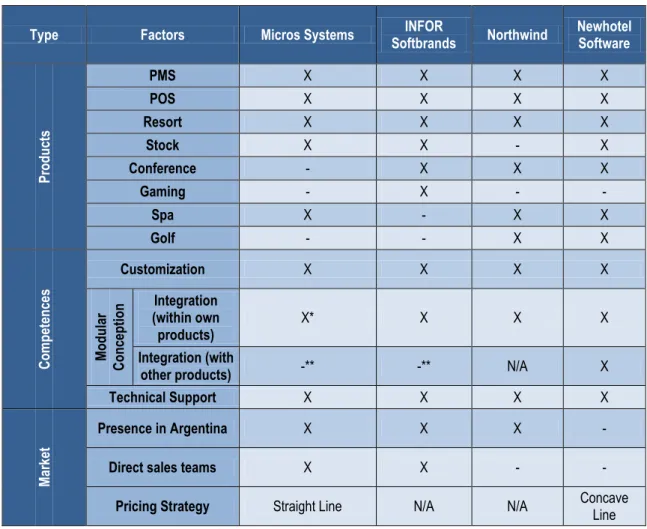
From table 1, presented below, NHS’s has the most software applications for the hotel Industry. In
12
competitors, NHS also offers the possibility of integrating their software with a competitors’ creating
the possibility of following a strategy based on complementing the other product offerings. To better
understand the advantages that can be deducted we need to carefully analyze the company’s
resources and competences.
Table 1 – Competitive Assessment
Type Factors Micros Systems INFOR
Softbrands Northwind
Newhotel Software P ro d u ct s
PMS X X X X
POS X X X X
Resort X X X X
Stock X X - X
Conference - X X X
Gaming - X - -
Spa X - X X
Golf - - X X
Co m p et en ce s
Customization X X X X
M o d u lar Co n ce p tio n Integration (within own products)
X* X X X
Integration (with
other products) -** -** N/A X
Technical Support X X X X
M
ar
ke
t
Presence in Argentina X X X -
Direct sales teams X X - -
Pricing Strategy Straight Line N/A N/A Concave
Line Source: Companies’ websites and NHS
*Due to Micros’ acquisition tactics, full integration of their products is more expensive and time consuming
because there are different source codes7
**According to NHS, both INFOR and Micros do not integrate their products with competition due to their size in
the market which doesn’t make it profitable for them to incur in these integration costs
Competitive Advantage
13 Core Competences: NHS has software development department which is able to react to market trends by innovating with new products / features of existing products. The company also created a set of interfaces (or modules) which allows them to make a connection between different software. Furthermore, NHS developed their software from scratch which has important implications in terms of access to the source codes.
Competitive Advantage: Generally speaking, NHS has a wide array of products which enables them
to enter into niche markets their competitors cannot. “Modular Conception” or, the existence of
interfaces allows them to link different software, which means that NHS’s products can be integrated
into a single management system and, at the same time, integrate its products with any competitors’
software. This enables them to address the same clients as competitors by selling different applications further exploiting the concept of “cross-selling”. Also, the existence of interfaces, coupled with developing the software from scratch which enables fast access to source codes, allows them to customize their products faster than competition while incurring in less costs (operational efficiency) and providing more efficient technical support, such as the Help Desk, as the source codes can be accessed almost immediately. Also, because NHS is a relatively small player in this Industry, it has more flexibility to respond to market changes. However, in Argentina, these advantages can be different.
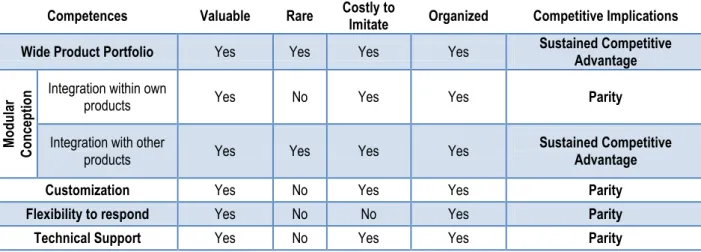
Table 2 –VRIO Framework for NHS’s Competences
Competences Valuable Rare Costly to
Imitate Organized Competitive Implications
Wide Product Portfolio Yes Yes Yes Yes Sustained Competitive
Advantage
M
o
d
u
lar
Co
n
ce
p
tio
n Integration within own
products Yes No Yes Yes Parity
Integration with other
products Yes Yes Yes Yes
Sustained Competitive Advantage
Customization Yes No Yes Yes Parity
Flexibility to respond Yes No No Yes Parity
14 From the cross analysis of table 1 and 2, we can conclude that the ability to integrate its products with competitors and its wider product portfolio are the only sustainable competitive advantages that exist when compared to Northwind and INFOR. In spite of this, we know that the major player in the market is Micros Systems and most companies are benchmarked against this major competitor8.
NHS has distinct competitive advantages comparing to this company. As explained in table 2, Micros Systems followed an aggressive acquisition strategy to enter the hotel management solutions industry. Because of this, it has a fragmented company with different source codes of its software. This translates into more time consuming and expensive integration, less operational efficiency, particularly concerning customizing products and, lower quality of technical support as it takes more time for them to perform, for instance, help desk services. Because of this superiority in relation to
Micros, the Industry’s leader, NHS can still take advantage of the whole array of competences to
generate competitive advantages; therefore, the competences in the VRIO framework listed as
“parity” would become sources of temporary advantages9.
The Argentinean Market
Country Overview
Argentina has been characterized by a having a very volatile business environment. However, from 2003 to our current years, the political stability enjoyed by this country, brought by Néstor and Cristina Kirchner, has had a major impact on industrial development and international trade, making efforts to remove entry barriers and providing benefits to high value adding industries. Now, Argentina is considered an emerging economy being part of the G-2010, and has registered an
15 Concerning the technological prism, in 2010, the Information, Communication and Technology (ICT) services exports represented 12,0% of GDP while the ICT goods imports increased to 11,2% of the GDP. At the same time, the royalties and license fees payments to foreign investors have grown at an annual growth rate of, approximately, 17.52%, from 2006 to 201012.
On a more subjective level, regarding the Index constructed by the Heritage Foundation and the Wall Street Journal, the Property Rights Index, was reported to be one of the lowest in the world: a mere 20 points. Compared to the world average, of 43.6 points, Argentina was classified as having a repressed property rights management system. The judiciary system is defined by the Heritage Foundation as inefficient and it also refers to the wide availability of pirated copies of IT products (a piracy rate of 71% with an estimated loss of US$209million13), which makes many foreign investors
seek outside intervention14. However, this piracy issue refers mainly to products targeted at the mass audience. NHS’s risk is greatly reduced as it licenses a product from a “B2B” (Business to Business)
perspective.
Argentina has been focusing on the IT Industry. For instance, the “2004-14 Software Strategic Plan
in Argentina” promotes the development of several important market factors that weigh in a great
deal in IT firms. This plan focuses on the development of adequate Human Resources, offering 117 Engineering Degrees and investing in scholarships, the creation of industrial hubs in the most important regions (Buenos Aires and Córdoba) and is even endorsed by the judiciary institutes which
have created a number of fiscal benefits to IT firms, such as the “Software Promotion Law”, enacted
in 2008, which gives a 10 year tax stability for IT firms, a credit account on the payments of the VAT equal to 70% of wages and a 60% benefit on taxable results to encourage IT firms to invest in R&D.
Also, the FONSOFT (“Fondo de Promoción de la Industria del Software”) was created in 2007 to
16 The Travel & Tourism Industry
In the last ten years, the number of arrivals in the Argentinean market has greatly increased as seen in the chart below. Between 2000 and 2010, this number increased by about 50% from 3 million arrivals to 4,5 million16 - See Exhibit 16 for the evolution of international arrivals in Argentina. It
is also foreseen that these numbers will continue to increase, particularly due to the depreciation of the Argentinean currency17.
The T&T Industry has shown a considerable evolution from previous years and Argentina is now one of the most attractive countries in terms of tourism potential and bolsters an extremely good forecast for the future.The following table provides data of the most important indicators of the T&TI and their growth forecast. The other countries in this assessment were chosen as they represent the other options of NHS’s internationalization. This should provide a clear picture of if Argentina is a good choice.
Table 3 – Market Attractiveness test
Market Attractiveness Test - Data of 2011
Variables Direct* Contribution of T&TI to GDP
Direct Contribution of T&TI to Employment
Visitor Exports / Total Exports
Investment / Total Investment
World Ranking (T&TI Contribution to GDP)
Countries %
Annual Growth Rate forecast % Annual Growth Rate forecast % Annual Growth Rate forecast % Annual Growth Rate forecast
Relative Absolute
Argentina 4,00% 5,00% 3,80% 3,50% 7,10% 14,00% 7,00% 5,80% 73 23
Angola 1,40% 5,40% 1,30% 2,80% 1,30% 7,20% 4,00% 3,50% 174 107
Brazil 3,30% 4,80% 2,90% 2,30% 2,90% 16,40% 5,80% 6,50% 85 6
Chile 3,10% 4,60% 3,00% 1,70% 3,50% 9,10% 7,80% 6,10% 93 40
Mexico 6,20% 4,60% 7,30% 1,30% 5,40% 9,30% 6,50% 6,50% 58 11
Source: World Travel & Tourism Council18
*Direct Contribution: direct impact of T&T expenses. Total contribution includes indirect expenditure on the T&TI which is
contemplated in other macro economical variables, such as, government expenditure in T&TI18.
17 the T&TI, such as hotels. In this regard, Argentina is put aside by Brazil and Mexico, but being ranked 23rd worldwide is a very positive indicator for future sustainability in this Industry.
On a different note, the government, in 2010, separated the Ministry of Tourism from the Ministry of Industry and Tourism due to the importance that is being attributed to this Industry19. Furthermore, it developed the “Plan Federal Estratégico de Turismo Sustentable – 2016” to provide information of
the tourism industry in order to incite its sustainable development20.
The Hotel Industry
The Argentinean market is divided into seven different regions, according to data from the Ministry of Tourism (2010): City of Buenos Aires, Region of Buenos Aires, Patagonia, Cuyo, North, Coast and Center. However, a great part of the number of hotels is concentrated in the city of Buenos Aires and the region around it. In 2010, together, they have a total number of 1839 hotels, 33% of the country’s market followed by Patagonia, with 29%, and the center, with 18%. The city of Buenos Aires alongside the region around it, detain a leadership position in terms of number of hotels by type.
They hold 38% of the whole market’s 4 and 5 star hotels, 33% of the 3 star hotel, aparthotels and
boutiques segment as well as 35% of the 1 & 2 star hotel segments - See Exhibit 17 for a market segmentation of hotels by region and type of hotel. Also, in 2009, there were a total of 315 hotel chains in Argentina, out of which 95 were located in Buenos Aires and 49 around the capital21.
According to data from Ministry of Tourism (2010) we can also observe the number of available hotel rooms during 201022 in each region. The city of Buenos Aires and the region surrounding it holding
18 (61,72%) among all other regions putting in evidence the thriving development of the hotel industry- See Exhibit 19 information on the evolution of occupation rate by region.
Strategy for NHS
From the previous analysis, it is possible to infer that NHS needs to invest in increasing brand awareness as it is one of the key success factors in this industry and, as such, important in the Argentinean market. Furthermore, in relation to Micros specifically, NHS has clear and distinct competitive advantage which could, and should, be capitalized in an internationalization process and, as there are temporary advantages, the firm should invest in withdrawing the most value from them, as fast as it can. Given the growth of the Argentinean hotel Industry and the concentration around a small area (Buenos Aires), the internationalization to this market is a logical step in
increasing NHS’s global presence. It becomes a necessity to invest in such processes in order to be
sustainable in the long run. NHS should, therefore, enter the Argentinean market by using a penetration strategy focused around its diverse portfolio of products and its key operational efficiencies. The target market should be organized according to size. First, NHS should make an effort in targeting the 4 & 5 star hotel segment, however, focus should also be given to boutique hotels and 3 star hotels as they can also present the size required for NHS’s to take full advantage of its value proposition - See Exhibit 20 and 21 for a SWOT & TOWS analysis, respectively.
Marketing Mix –The 4 P’s
Product: because NHS deals, it can easily export goods which remove any restriction to choose a single product to enter in the market. In addition, because of their product portfolio and operational efficiency, it can easily find gaps in hotels even using another PMS system, and complement the
hotel’s business with interfaces and other management solutions. Therefore, the choice of product is
completely dependent on the clients’ needs, and NHS has the ability to serve each and any of those
19 Placement: According to the hotel industry analysis, NHS should definitely focus on city of Buenos
Aires. It concentrates the bulk of Argentina’s hotel industry and should be a priority for the company
holding 38% and 33% of 4 and 5 star hotels, and 3 star and boutique hotels, respectively. Other regions should be targeted at a later stage encompassing areas such as the Region of Patagonia and the North.
Price: NHS has a very specific pricing strategy which grants them a competitive advantage, but only for larger hotels. This is an advantage that should be exploited, however, because their competitor’s are already present in the market, NHS should reformulate its pricing model to become more competitive in lesser segments.
Promotion: different levels of promotion should be exercised in order to increase brand awareness in the market. First, door to door and personal meetings should be scheduled by NHS’s employees with potential clients and distributors. Second, attend national and international fairs and specific IT gatherings, not only to increase awareness, but, also, to assess potential competition. Due to the expected cost and NHS’s budget constraints, advertisements in industry specific media should be avoided.
Internationalization Process
Mode of Entry
20 Concerning the mode of entry now, there are several possibilities depending on the level of commitment NHS wants to induce in this strategy. Feasible modes of entry include lower commitment strategies such as direct exports (licensing) to either direct clients or distributors, or entering, effectively, in the Argentinean market through setting up a separately incorporated subsidiary –See Exhibit 22 for information on the legal framework. My advice, mostly because of competitors present in this market, is to start with a low level commitment strategy and increasingly build into a higher commitment strategy carefully assessing retaliation along the way. Therefore, the previously mentioned strategies are not mutually exclusive and NHS can and should take advantage of its flexibility as a small enterprise. To achieve a successful strategy, therefore, I propose that for a 3 year period, different strategies should be applied: first, the pre entry market assessment where important market information should be acquired. Second, and depending on the success rate of the first, NHS should engage in a higher commercial commitment in order to establish good relationships with players in the market and serve them through direct exports (licensing). This phase should be accompanied by the creation of sales force. Thirdly, enter effectively in the market under the legal form of a separately incorporated subsidiary to serve the whole market. Entering, based solely on distributors, is an even lower commitment strategy. However, in order to increase brand awareness, they should be considered as a parallel mode of entry by providing greater access to different distribution networks. Based on this proposal, the following objectives are to be considered for a 2 year time frame (2014):
Achieve a market share of 3,50% (roughly 20 hotels) in the 3, 4, 5 star and boutique hotel
segment in the Region of Buenos Aires.
Establish an office with adequate sales people (2).
Implementation Plan –The 4 M’s
21 come from this office due to the similarities in language and culture. However, the technician should come from the headquarters to also serve as a vehicle for a better communication between senior management and this team. They should make a 14 day trip to Buenos Aires to establish a first contact with potential clients through a door to door tactic. They should have clear objectives in the market such as: (1) establishing contact with target hotels in Buenos Aires, (2) finding suitable distributors and (3) carefully assessing potential competitors in this market and their level of commitment. The same two people should also make a 7 day trip on a later stage to be present in the “FIT – Feira Internacional de la América Latina de Turismo”. They should work for the same objectives as in the first trip but also be proactive in building NHS’s brand image in the market with product demonstrations. On a later stage, if the initial market assessment proved that the market has enough potential, NHS should recruit 2 sales people that should be trained in knowledge of the software and should have goal based contracts. Wages should start low and increase based on commissions of contracts achieved. This should increase productivity and help NHS increasing the commitment from its employees. Contacts will, again, be made through a door to door tactic. They should later be incorporated in the office and be promoted to full employees of NHS. Throughout the whole process, NHS should send, on a yearly basis, a manager to supervise and communicate with the local team in order to establish any additional objectives and motivate the team.
Minute: the following table presents the major steps that NHS needs to make in order to enter the market. The first phase is to be completed during the 1st semester of the 1st year. However, because
22
Table 4 – Mode of entry steps
Phase Actions
2012 2013 2014
March April May June July August Rest 1st Sem 2nd Sem 1st Sem 2nd Sem
1 - Market Assessment
Contact with target hotels
in Buenos Aires
Contact with potential
distributors
Contact with hotel
networks
Presence in Tourism Fairs
Assesment of valued
product features
Sales Forecast
2 - Direct Exports
Assessment of legal
environment
Creation of sales team
Training of sales team
Product demonstrations
Product Customization
Review of the strategy
adopted
3 - Separatly Incorporated Subsidiary
Assessment of legal
environment
Sales and cost Forecast
Creation of sales office
Contact with target hotels
in other regions
Product demonstrations
Product Customization
Review of the strategy
adopted
As mentioned, another focus point is the presence in tourism fairs; the “FIT – Feira Internacional de
la América Latina de Turismo” is the most important for NHS as, not only will it give contacts in the
industry, but its targets also encompass NHS’s target either at an International level, or in the city of Buenos Aires. It is held on the second semester of the year which is why, in the table, the presence of NHS in this fair was only considered periodically –See Exhibit 24 for more information on the International Fairs.
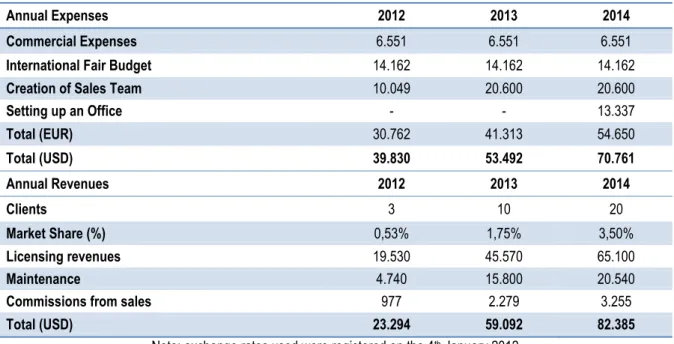
23 assessed. The costs associated with each phase are summed up in table 5 –See Exhibit 25 for a detailed cost prediction of each activity.
Table 5 –Cost Forecast & Sales required for Break-even
Annual Expenses 2012 2013 2014
Commercial Expenses 6.551 6.551 6.551
International Fair Budget 14.162 14.162 14.162
Creation of Sales Team 10.049 20.600 20.600
Setting up an Office - - 13.337
Total (EUR) 30.762 41.313 54.650
Total (USD) 39.830 53.492 70.761
Annual Revenues 2012 2013 2014
Clients 3 10 20
Market Share (%) 0,53% 1,75% 3,50%
Licensing revenues 19.530 45.570 65.100
Maintenance 4.740 15.800 20.540
Commissions from sales 977 2.279 3.255
Total (USD) 23.294 59.092 82.385
Note: exchange rates used were registered on the 4th January 2012
The number of clients presented in table 5 represents the break-even point. By 2014, NHS should have acquired 20 clients with an average size of 9323 hotel rooms. This is an ambitious goal but,
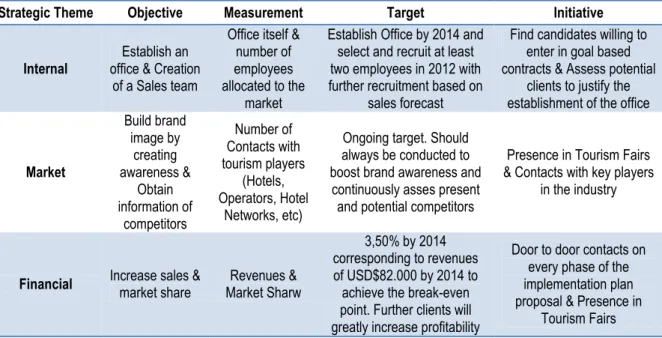
24 Memo: The following table summarizes the key strategic theme in the internationalization process.
Table 6 –Strategic Themes for the internationalization process
Strategic Theme Objective Measurement Target Initiative
Internal
Establish an office & Creation
of a Sales team
Office itself & number of employees allocated to the
market
Establish Office by 2014 and select and recruit at least two employees in 2012 with further recruitment based on
sales forecast
Find candidates willing to enter in goal based contracts & Assess potential
clients to justify the establishment of the office
Market Build brand image by creating awareness & Obtain information of competitors Number of Contacts with tourism players (Hotels, Operators, Hotel Networks, etc)
Ongoing target. Should always be conducted to boost brand awareness and
continuously asses present and potential competitors
Presence in Tourism Fairs & Contacts with key players
in the industry
Financial Increase sales & market share
Revenues & Market Sharw
3,50% by 2014 corresponding to revenues of USD$82.000 by 2014 to achieve the break-even point. Further clients will greatly increase profitability
Door to door contacts on every phase of the implementation plan proposal & Presence in
Tourism Fairs
Risk Analysis & Contingencies
The main risk associated with the proposed internationalization process is not achieving enough clients to, first, justify the costs and then to make of Argentina a truly profitable market. In spite of this, the growth prospects are extremely positive for this market as the T&T industry is becoming a prominent part of the economy. At the same time, most of the clients targeted by NHS are concentrated in Buenos Aires which reduces customer acquisition costs. Despite of the expenses proposed on the internationalization process, it’s important to note that, through planning ahead, NHS can foresee quite easily if opening an office in two years will be profitable. For instance, creating the sales team will only occur if the pre market assessment, which only represents a cost of about EUR 20.000, is successful in gathering market information, more specifically, potential clients. Note that the highest expense in this phase is the presence in the proposed fair. Even if the prospects of future clients were dim, there could be spill over effects to South American markets where NHS is currently present as this fair targets all of South America. However, from the market
25 also need to take into account the presence of competitors in the market. As there is little available knowledge about the commitment and market rivalry amongst NHS’s competitors, it might be extremely difficult to acquire new clients. As such, it is extremely important for NHS, when talking to potential clients, to gather information about the strongest competitors. Be it what it may, our firm has a technologically advanced product and an efficient technical support to triumph in such a case. The legal system, in Argentina, as mentioned, is extremely inefficient. NHS should, therefore, as soon as possible, register the copyright of its software in the Ministry of Justice, Security and Human Rights. On a broader scale, geopolitical risks such as terrorist attacks greatly influence the hotel
industry which has a direct impact on NHS’s revenues. This is, however, uncontrollable, but should
always be considered by the company.
Conclusions & Recommendations
26
Bibliography
Endnotes
1Source: NHS information and www.ine.pt (Accessed on the 21st of October) 2Contract available on the website when applying to become an NHS distributor
3Through contacts carried out; there was a lack of communication, particularly in what refers to future
projects
4According to information obtained based on our meetings with NHS
5Source: http://www.marketsandmarkets.com/Market-Reports/cloud-computing-234.html (Accessed
on the 29th of October)
6Source: http://www.capterra.com/hospitality-property-management-software (Accessed on the 5th of
November)
7Due to Micros size and leadership position, its brand is, obviously, the most recognized by consumers and as such, and also according to NHS’s business meetings, most clients request a
comparison between what NHS’s and Micros’ software.
8Source: http://www.alacrastore.com/mergers-acquisitions/MICROS_Systems_Inc-1011094
(Accessed on the 6th of November)
9As the Industry evolves and competitors such as INFOR gain power, these competitive advantages
would not hold true, making them a temporary advantage
10Source: http://en.wikipedia.org/wiki/Economy_of_Argentina (Accessed on the 17th of November) 11Source: http://data.worldbank.org/indicator/BX.KLT.DINV.CD.WD/countries (Accessed on the 17th
of November)
12 Source: http://data.worldbank.org/indicator/BM.GSR.ROYL.CD/countries (Accessed on the 17th of
November)
13Obtained from the report of the International Intellectual Property Alliance. See on the reports &
27
14Source: http://www.heritage.org/index/Property-Rights (Accessed on the 17th of November) 15Obtained from the “Plan Estratégico de SSI: 2004-2014”. See on the reports & books section for a
reference to the study.
16Source:
http://www.tradingeconomics.com/argentina/international-tourism-number-of-arrivals-wb-data.html (Accessed on the 13th of November)
17Source: http://www.hotelnewsresource.com/studies/global032202.htm (Accessed on the 17th of
November)
18Data from this table was obtained from the reports in the reports & books section from the World
Travel & Tourism Council analysis of Argentina, Angola, Brazil, Chile and Mexico.
19Source: http://www.asiatraveltips.com/news10/27-ArgentinaTourism.shtml (Accessed on the 5th of
December)
20Obtained from the “Plan Federal Estratégico de Turismo Sustentable 2016”. See on the reports &
books section for a reference to the study.
21Obtained from the “Plan Federal Estratégico de Turismo Sustentable 2016”. See on the reports &
books section for a reference to the study.
22Available hotel rooms is a measure calculated as the number of hotels rooms times the average number of days the establishments are open during one month. “INDEC” did not disclose information
on the number of hotel rooms.
23Information on the calculation of average hotel rooms can be found in exhibit 27 in the Annexes
section.
Reports & Books
International Intellectual Property Alliance (IIPA): “2010 Special 301 Report on Copyright
Protection and Enforcement” (Accessed on the 17th of November)
“Ministerio de Economía y Producción”: “Plan Estratégico de SSI: 2004-2014” (Accessed
28
World Travel & Tourism Council: (Accessed on the 5th of December)
o “Travel and Tourism: 2011”
o “Travel and Tourism Economic Impact: 2011, Latin America”
o “Travel and Tourism Economic Impact: 2011, Argentina”
o “Travel and Tourism Economic Impact: 2011, Angola” o “Travel and Tourism Economic Impact: 2011, Brazil” o “Travel and Tourism Economic Impact: 2011, Chile” o “Travel and Tourism Economic Impact: 2011, Mexico”
Argentina’s Ministry of Tourism: (Accessed on the 7th of December)
o “Encuesta de Ocupación Hotelera: 2010” – Data from this study can also be found
on “INDEC – Instituto Nacional de Estadística y Census”
o “Encuesta de Ocupación Hotelera: 2009” – Data from this study can also be found on “INDEC – Instituto Nacional de Estadística y Census”
o “Encuesta de Ocupación Hotelera: 2008” – Data from this study can also be found
on “INDEC – Instituto Nacional de Estadística y Census”
o “Encuesta de Ocupación Hotelera: 2007” – Data from this study can also be found
on “INDEC – Instituto Nacional de Estadística y Census”
o “Plan Federal Estratégico de Turismo Sustentable 2016” (Accessed on the 8th of
December)
o Daniels, John D., Radebaugh, Lee H, Sullivan, Daniel P, International Business –
Environments and Operations, 12th Ed. Pearson International Edition.
o Porter, Michael E., 1996, What is strategy, Harvard Business Review.
Reference Sites
29 INE: http://www.ine.pt/xportal/xmain?xpid=INE&xpgid=ine_main
AICEP: http://www.portugalglobal.pt/PT/Paginas/Home.aspx World Bank: http://www.worldbank.org/
Heritage Foundation: http://www.heritage.org/ World Travel & Tourism Council: http://www.wttc.org/ World Tourism Organization: http://unwto.org/
30
Exhibits
Exhibit 1 – Newhotel Client Base per major Region
Source: Newhotel Software
Exhibit 2 –Newhotel Group Companies’ Net Sales
Note: Europe and International do not contain the other specified countries
31 Exhibit 3 – Newhotel Software’s rooms installed per geographical presence
32 Exhibit 4 – Newhotel Software product categories
Source: NewHotel Software website
Exhibit 5 –List of all Newhotel Software’s Products
Hotel Management Solutions
Newhotel PMS Front-Office Newhotel PMS Property Management System
PMS Software for advanced hotel management. Supports multiple businesses and operation: bookings, groups, guests, packages, invoicing, night auditor, housekeeper, reports, Multilanguage, multicurrency and multi-hotel.
GDS Interface two-way Sabre SynXis SynXis SABRE CRS+IDS Web distributor IF
Two easy full integration with SABRE-SynXis. Access to CRS and IDS web distribution channels. Requires web and Newhotel booking engine license.
Newhotel Cloud PMS Newhotel Front-desk Express
Cloud PMS front-office. Internet browser user interface. Supplied as software as service (SaaS) with a monthly fee including software license and maintenance.
WebNewhotel Web Services Internet Online Direct Booking
Internet booking engine for online web reservations into Newhotel PMS. License for unlimited reservation. Interface available for seamless integration with internet sales channels (extra fee).
IDS Interface Web Channels/ Regis Interface Internet Bookings Channel Manager Seamless integration with internet bookings channels (Expedia and others). Requires web and Newhotel booking engine license.
Web Booking Express Internet Online Direct Bookings
Express web booking service for direct web reservation. Flat fee monthly payment. Optional contract for payment per reservation.
Multi-Hotel and Groups Solutions
33
Newhotel Front-office licenses.
NewCentral Server + NewTrans Central Group Manager
Hotel chain central package. Manages remote hotels (front-offices. POS or stocks), including contracts, prices, clients and other operational parameters.
NewCentral Client Front-Office Client Front-Office PMS NewCentral
Client module for connecting the hotel front-office to the hotel chain central.
NewCentral Client POS Client POS NewCentral
Client module for connecting the hotel points-of-sale to the hotel chain central.
NewCentral Client Stocks Client Stocks NewCentral
Client module for connecting the hotel stocks to the hotel chain central. Point of Sale, Food & Beverage
POS – Point of Sale Points of Sale Hotel, Restaurant and Bar
Highly specialized point of sale software application for the most demanding restaurant and hotel operation. Unlimited PLU and programmable product keys for touch screen operation. Multi-currency, internal consumption and happy hour prices.
Restaurant Module for POS Table Reservation for OS Restaurant
Additional module to POS software for restaurant with table reservation and client database.
Portable POS Server Hand Held POS System
Base module software for mobile point of sale. One base controls unlimited POS palmtop terminals.
Portable POS Terminal Portable Hand Held POS Terminal
Mobile POS Palmtop terminal. Requires one base module software and palmtop wireless network.
NewStock Stocks Food and Beverage
Stocks and inventory management specialized for food and beverage operations. Complete set of features for sophisticated food and beverage management, including recipes, compositions, buffet tables, reduction planning. Allows automatic deduction of stock from POS sales.
NewClub Management of Clubs and Cabarets
Software for management of cabarets, showrooms and similar operation. Table and seat reservation, door control, sale packages, and allows integration with POS.
NewPaga Accounts Payable
Accounts payable with automatic integration with NewSotck. Database of providers, registers of purchases. Account statements and ageing analysis.
Business and Leisure Solutions
NewSPA Wellness, Spa and Health Club
Software for Wellness, SPA and Health Club operation. Controls reservations for SPA resources, services therapists and doctors. Visual planning for day and week. Invoicing and hotel integration.
NewPlan Conventions and Meeting Rooms
Manages Salons and other resources for events and conventions. Visual planning and daily work assignments. Additional services, audio-visuals, coffee-breaks, etc. invoicing and hotel integration.
NewGolf Golf Course Management
Golf Course management and reservations. Visual interactive planning. Golf shop sales operations with simple POS-type workstation.
NewGolf Web Reservations Online Reservations for Golf Courses
Internet reservations for golf courses using NewGolf software and database
NewCondo Multi-Property Condos Multi-Property
Additional module integrated with NewHotel PMS for controlling condo and time-share operations. Owner’s files and accounts. Contracts and profit and cost sharing. Automatic reservations into hotel.
34
Customer Relationship Management with integrated access to NewHotel Software family client and guest databases.
NewConta Accounts Receivable
Accounts receivable fully integrated with NewHotel Front-Office. Account statements and ageing analysis.
NewChange Exchange Currency
Module for currency exchange workstation. Integrates with Hotel Front-Office and Guest Databases.
NewSurvey Quality Control and Guest Satisfaction
Module for designing guest satisfaction forms. Collects and analyses the information. Produces static and dynamic statistics and graphs.
NewPlan – Services and Activities Resources Sports and Leisure Activities Manages resources for timed-based rentals in hotels, resorts and leisure businesses. Visual planning and daily work assignments. Additional services, audio-visuals, coffee-breaks and etc. invoicing and hotel integration.
Interfaces
Telephone Call Accounting Telephone Call Accounting
Time-based call accounting. Flexible price tables configuration by line trunk.
Export Accounting Front Office Standard Interface Accounting (Front Office) Module for exporting Newhotel Front-Office data for accounting. Flexible file format configuration.
Export Accounting Stocks Export Accounting Stocks
Module for exporting NewStock data for accounting. Flexible file format configuration.
Export Accounting SPA Export Accounting SPA
Module for exporting NewSPA data for accounting. Flexible file format configuration.
Export Accounting NewPlan Export Accounting NewPlan
Module for exporting NewPlan data for accounting. Flexible file format configuration.
IF Electronic Invoicing Electronic Invoicing
Module for producing and sending certified electronic invoices according to the established legal rules.
IF NewPOS – Front-Office Interface Points of sale – Front Office
Interface for complete integration of POS operations and sallies in hotel front-office. Posting room charges, credit control, preparation, table accounts, and multiple types of payment.
IF NewPOS - Stocks Interface Points of Sale – Stocks
Interface for automatic deduction from stock of POS sales and consumptions. User’s recipes and compositions for associating POS items with corresponding stock products.
IF Telephone 1 Way Interface Telephone 1 Way
Unidirectional telephone interface with front-office, pulse or value call charges sent by the central are inserted into guest accounts.
IF Telephone 2 Way Interface Telephone 2 Way
Bidirectional telephone interface with front-office, pulse or value call charges sent by the central are inserted into guest accounts. Extra functions: Open/close lines, rooms status, wake-up, minibar consumptions, etc.
IF Telephone 2 Way + Extras Interface Telephone 2 Way Advanced
Bidirectional telephone interface with front-office, pulse or value call charges sent by the central are inserted into guest accounts. Extra functions: Open/close lines, rooms status, wake-up, minibar consumptions, text messages, do not disturb database swap, etc.
IF Door Key Cards Interface Magnetic Cards
35
IF Pay TV Basic Interface Pay TV Standard
Interface Pat-TV enable/disable, check-in/out and room charges, and guest welcome.
IF Pay TV + Extra Functions Interface Pay TV Advanced
Interface Pat-TV enable/disable, check-in/out and room charges, and guest messages. Extra functions: room’s status, view bill, messages, wake-up, guest information.
IF Minibars Interface Minibar Systems
Interface module for automatic charges in Newhotel Front-Office of minibar systems consumptions.
IF Scanner Documents Interface Documents Scanner
Interface scanner documents: passports, identity cards read and insert guest information in Newhotel cardex files.
IF Internet Charges Control Interface Internet Guests
Interface module for automatic charge in Newhotel Front-Office of internet access consumptions.
IF Credit Cards EFT Interface Credit Cards Payments
Interface with credit cards electronic fund transfer: payments and devolutions.
IF SMS Messages Interface SMS Messages
Interface module for sending SMS written messages. Requires porting to cellular phone provider.
IF External POS Room Charges Interface External POS – Newhotel Front-office Fiscal printer interface for the legal requirement of some countries.
IF Fiscal Printer POS Interface Fiscal Printer POS
Fiscal printer interface for the legal requirement of some countries.
IF Fiscal Printer Front Office Interface Fiscal Printer Front-office
Fiscal printer interface for the legal requirement of some countries.
IF Fiscal Printer NewSPA Interface Fiscal Printer NewSPA
Fiscal printer interface for the legal requirement of some countries.
IF Fiscal Printer NewPlan Interface Fiscal Printer NewPlan
Fiscal printer interface for the legal requirement of some countries.
IF Golf - Newhotel Interface Golf – Newhotel
Interface for integrating golf sales in hotel production.
Export Accounting Front-office Non-standard Central Reservations
Central reservations for hotel chains. Inserts bookings for several hotels. Very reliable and resistant to communication failures. Requires NewCentral installation.
IF NewSPA – NewStock Interface NewSPA – NewStock
Interface for deducting stocks products for use and sale in SPA operations.
IF NewPlan – NewStock Interface NewPlan – NewStock
Interface for deducting stocks products for use and sale in NewPlan events operations. Manager Tools
Newhotel PMS Revenue Manager Toolkit for Revenue and Yield Management
Easy to use interactive toolkit that performs automatic analysis of Newhotel PMS database for revenue and Yield Management.
Navigator Navigator Hotel Manager Assistant
Easy to use intuitive explorer and analyser of hotel information for assisting managers decision making.
Compass - Groups Compass Group Manager Assistant
36
Hundreds of clear charts and graphical analysis.
Newhotel Workstation Calls
Workstation Call Workstation License Embedded Oracle
Workstation license for embedded Oracle database engine. Source: NewHotel Software
Exhibit 6 – Newhotel Software Net Sales Composition
37 Exhibit 7 –Newhotel Software’s top product licensing sales
Source: NewHotel Software
Exhibit 8 – PMS Front Office pricing example
Software License Unit Price Hours of Technical Support Maintenance
Rooms Price Extra Rooms Installation Consulting Training Annual
25 $1,750 $70 2h 8h 32h $840
50 $3,500 $70 2h 8h 32h $1,005
75 $5,250 $70 2h 8h 32h $1,580
100 $7,000 $70 4h 12h 40h $2,100
125 $8,750 $70 4h 12h 40h $2,630
150 $10,500 $56 4h 12h 40h $3,150
175 $11,900 $56 4h 12h 40h $3,570
200 $13,300 $56 4h 12h 40h $3,990
225 $14,700 $56 4h 12h 40h $4,410
250 $16,100 $42 4h 12h 40h $4,830
300 $18,200 $42 4h 12h 40h $5,460
350 $20,300 $42 4h 12h 40h $6,090
400 $22,400 $42 4h 16h 64h $6,720
450 $24,500 $42 4h 16h 64h $7,350
500 $26,600 $42 4h 16h 64h $7,980
>500 $26,600 $42 4h 16h 64h $7,980
38 Exhibit 9 – Levels of Maintenance Services
LEVELS OF MAINTENANCE SERVICES GOLD SILVER BRONZE BASIC
HelpDesk 24-hour remote support Yes Yes No No
New versions & upgrades Yes No No No
Telemaintenance services available Unlimited Week 9-18h No No
No charge maintenance included hours Unlimited 16h /year No No
Availability for local interventions 24 hours Week 9-18h No No
Source: NewHotel Software
Exhibit 10 – Newhotel Software’s revenue by distribution channel
39 Exhibit 11 – Newhotel Software organizational chart
40 Exhibit 12 – Industry Map