*) Corresponding author: [email protected] _____________________________
doi: 10.2298/SOS0901059V
UDK 546.281'246:546.28:546.77
Features of Formation of Composite Ceramics From SiC-Si-Mo
at High Pressure
M. Vlasova
1*), A. Bykov
2, I. Rosales
1, M. Kakazey
1, R. Guardian
1 1CIICAp, Autonomous University of the State of Morelos, Av. Universidad, 1001,
Cuernavaca, Mexico,
2
Frantsevych Institute for Problems of Materials Science of NASU,
3, Krzhyzhanovsky St., Kyiv, 03142, Ukraine
Abstract:
SiC-based composite ceramics were investigated by X-ray diffraction, electron microscopy and electron-probe X-ray microanalysis. It is established that, depending on the composition of the initial powder mixtures, at T = 1500—1800 °C and P = 4 GPa, different types of composite ceramics formed. Ceramics obtained from mixtures with CSiC ≥ 50 wt. %
contains SiC, Si, and Mo. Ceramics on the base of SiC—MoSi2 was obtained from mixtures
with CSiC < 50 wt. %.
Keywords: Silicon carbide, Silicon, Molybdenum, Composite ceramics.
1. Introduction
Silicon carbide possesses unique properties. Specifically, SiC is characterized by a high hardness, a high modulus of elasticity, and a high thermal conductivity, a low thermal expansion coefficient, and the semi-conductor type of conduction, etc. [1—3].
Silicides form a large class of inorganic compound exhibiting different physical, chemical, and electrophysical properties [4]. Molybdenum silicides have found an extensive application, specifically MoSi2 as a heating element.
Composites on the base of silicon carbide and molybdenum silicides synthesized in the last decade extended essentially the fields of application of each of these compounds [5— 8]. That is why, at present, different compositions and technologies for synthesizing such composites are being continuously developed [1, 2, 9].
The aim of the present work is to synthesize composite ceramics on the base of β-SiC, Mo, and Si. It is assumed that in sintering of different mixtures in the temperature range 1500—1800°C, it is possible to obtain a number of different composites, namely, from ceramic-metal composites (cermets) to self-bonded conductive SiC ceramics.
2. Method of Preparation of Specimens and Experimental Procedure
size of about 10 nm) formed by thermal destruction of saccharose, was used. The ratio of the components corresponded to the formation of SiC with a 6% excess of Si. Mixtures of Mo and Si powders with a particle size of 1—5 µm were introduced into the β-SiC powder. The Mo/Si ratio was calculated for the formation of MoSi2 with a 5% excess of silicon. Using the
indicated powders, the following mixtures were prepared 80 wt. % SiC + 20 wt. % (Mo + Si), 50 wt. % SiC + 50 wt. % (Mo + Si), and 20 wt. % SiC + 80 wt. % (Mo + Si); besides these compositions, SiC powder free from additives and the Mo + Si mixture were investigated. All mixtures were homogenized by mixing in a ball mill for 30 min. The homogenized mixtures were compacted in rugid steel die to produce 40% porosity green body. Sintering of these green compacts was carried out with the lens-type high-pressure apparatus at P = 4 GPa and 1500, 1650, and 1800 °C for 1.5 min. The rate of temperature rise was 100 °C/s.
An X-ray analysis of obtained specimens was performed using a Siemens D-500 diffractometer in Cu Kα radiation. Scanning electron microscopy studies were carried out with
a Leo 1450VP microscope equipped with an EDS system. Hardness tests were performed in a Leco LM-300AT Microhardness tester using a load of 2 N and a holding time of 15 s.
3. Results
3.1. SiC and MoSi
2ceramics
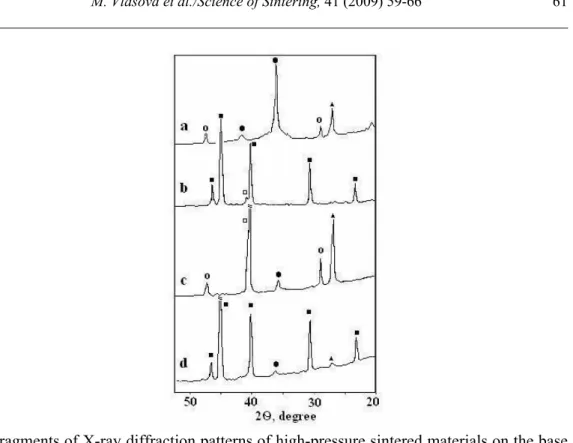
Silicon carbide ceramics consists mainly of the β-SiC phase. An insignificant amount of SiC and C (about 5 wt. %) is present in it, which is due to features of synthesis of nanosized SiC powders and sintering conditions of the ceramics (Fig. 1a). From electron micrographs one can see that the ceramics consists of large dense grains containing an insignificant amount of pores. Between large grains, fine grains are located (Fig. 2a). According to X-ray microanalysis data, these grains are also SiC.
The sintering of specimens obtained from the Mo + Si mixture resulted in the synthesis of α-MoSi2, in which traces of Mo were registered (Fig. 1b). A sintered MoSi2
specimen has a fine-grained structure (Fig. 2b).
3.2. Composite Ceramics
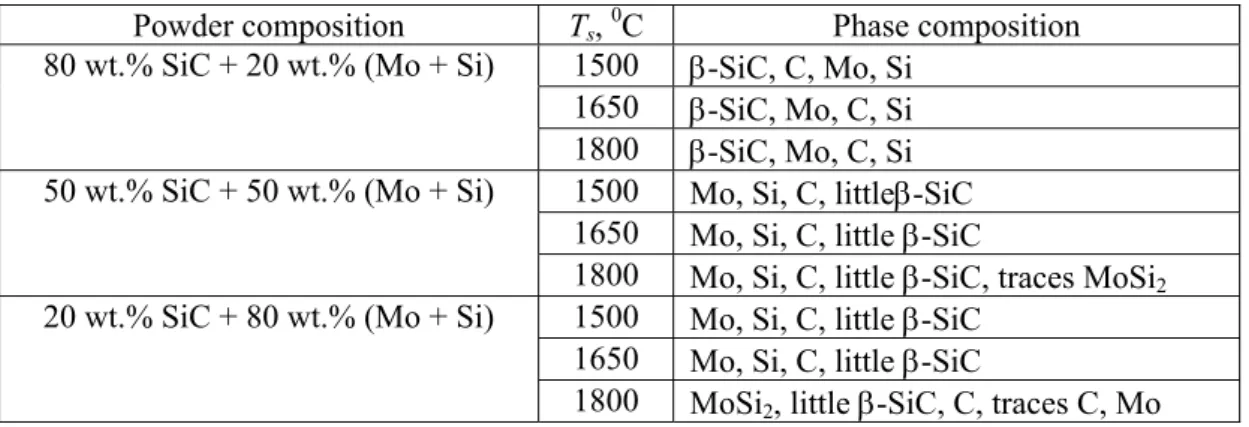
The X-ray phase analysis results show that, depending on the composition of used mixtures and sintering temperature, composites differing substantially in the phase composition and microhardness can be obtained (Fig. 1c and d, Fig. 3, and Tab. I).
Tab. I. Phase compositions of sintered specimens.
Powder composition Ts, 0C Phase composition 1500 β-SiC, C, Mo, Si
1650 β-SiC, Mo, C, Si 80 wt.% SiC + 20 wt.% (Mo + Si)
1800 β-SiC, Mo, C, Si 1500 Mo, Si, C, littleβ-SiC 1650 Mo, Si, C, little β-SiC 50 wt.% SiC + 50 wt.% (Mo + Si)
1800 Mo, Si, C, little β-SiC, traces MoSi2
1500 Mo, Si, C, little β-SiC 1650 Mo, Si, C, little β-SiC 20 wt.% SiC + 80 wt.% (Mo + Si)
Fig. 1 Fragments of X-ray diffraction patternsof high-pressure sintered materials on the base of SiC ceramics (a), MoSi2 (b) and composite ceramics obtained from mixtures 50 wt.% SiC
+ 50 wt.% MoSi2 (c) and 20 wt.% SiC + 80 wt.% MoSi2 (d). Ts= 1800 oC, ts = 60 s. (•) β-SiC,
(x) SiO2, ( ) α-MoSi2, () Mo, (o) Si, ( ) C.
In high-temperature sintering (1800°C) of mixtures containing ~20 wt. % SiC, MoSi2—SiC composites formed. Sintered specimens obtained from the mixtures with CSiC≥
50 wt. % are SiC—Si, Mo composites. Such ceramics can be classified with cermets. Moreover, in all these specimens, C, Si, and Mo are present. The contents of these elements depend on the composition of the initial powder mixture and synthesis conditions.
Fig.2. Electron micrographs of SiC-ceramics (a) and MoSi2 (b) obtained by sintering at Ts= 1800 oC, ts = 1.5
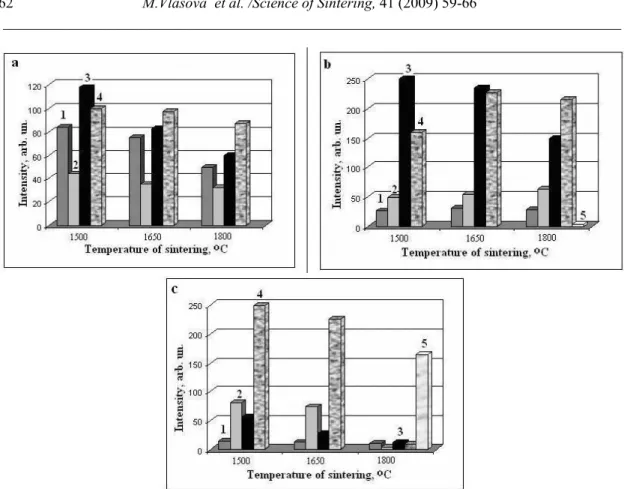
Fig. 3 Changes of the intensities of diffraction lines with sintering temperature of ceramics obtained from the 80 wt.% SiC + 20 wt.% (Mo + Si) mixture (a), 50 wt.% SiC + 50 wt.% (Mo + Si) mixture (b), and 20 wt.% SiC + 80 wt.% (Mo + Si) mixture (c). ts = 60 s. (1) β-SiC;
(2) Si; (3) C; (4) Mo; (5) α-MoSi2.
From Fig. 3, it is evident that the decrease in the intensity of the diffraction lines of β -SiC, does not correlate with the reduction in the silicon carbide content in the initial mixture. Furthermore, in the ceramics, carbon appears (see Fig. 1c and d, Fig. 3, Tab. I). The diffraction lines of molybdenum broaden as the content of molybdenum and silicon in the initial mixtures and the sintering temperature increase (Fig. 4).
Fig. 4 Change of the width of XRD line of Mo (d = 0.222 nm) in ceramic specimens: (1) for specimens obtained from the 80 wt. % SiC + 20 wt. % (Mo + Si) mixture; (2) for specimens obtained from the 50 wt. % SiC + 50 wt. % (Mo + Si) mixture; (3) for specimens obtained from the 20 wt. % SiC + 80 wt. % (Mo + Si) mixture. Ts = 1800°C,
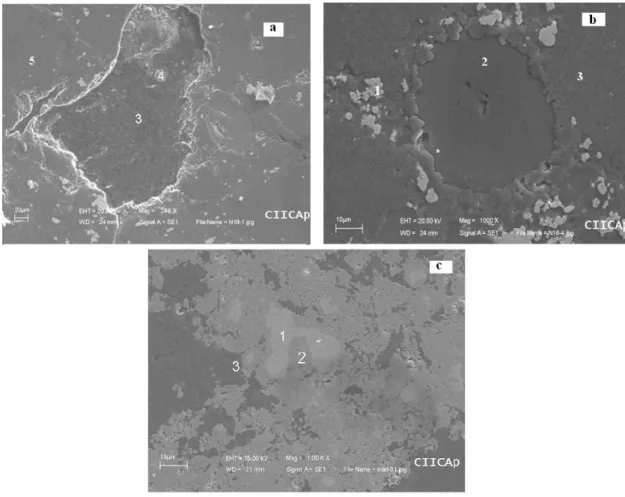
From micrographs (Fig. 5) it is seen that the distribution of the components in specimens obtained from each of SiC + (Mo + Si) mixtures is inhomogeneous. Specimens with 80 wt. % SiC mainly consist of silicon carbide grains, between which cracks and pores are located. The most noticeable traces of destruction are seen on grain boundaries. Carbon and a small amount of silicon are concentrated near grain boundaries (see Fig. 5a and Tab. II). As the (Si + Mo) content in the mixtures increases, it becomes difficult to detect SiC grains by X-ray method. They may be under the layer of silicon and molybdenum silicides. On the surface of the specimens, the number of cracks decreases substantially, and the number of pores increases slightly (see Fig. 5 b, c and Tab. II).
Fig. 5 Electron micrographs of ceramics obtained from 80 wt.% SiC + 20 wt.% (Si + Mo) mixture (a), 50 wt.% SiC + 50 wt.% (Si + Mo) mixture (b), and 20 wt.% SiC + 80 wt.% (Si + Mo) mixture (c). Ts = 1800 oC, ts = 1.5 min.
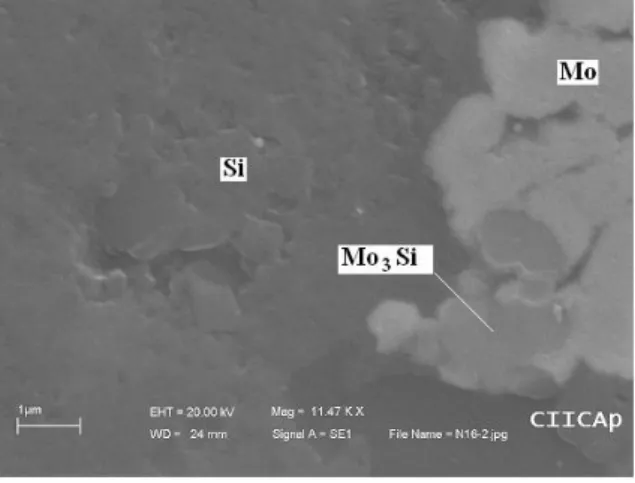
On molybdenum inclusions neighboring with silicon melt, Mo3Si, Mo5Si3, and MoSi2
were detected (Fig. 5, Fig. 6, and Tab. II). In specimens obtained from the mixture with a larger content of (Si + Mo), the most representative phase is MoSi2.
The microhardness data (Hµ) measured at places designated by figures in Fig. 5 are
presented in Tab. II. As expected, the maximal hardness was registered for SiC. The minimal hardness was observed at places of localization of molybdenum. Apparently, this is due to the formation of loose molybdenum inclusions (see Fig. 6). In regions where molybdenum silicides formed, values of Hµ are close to the values presented in Tab. 3 for different
Tab. II Microhardness of silicon carbide composites with molybdenum and silicon additives synthesized at 1800°C
Element contents, wt.% Powder
Composition
Microhardness
(GPa) Si Mo C
Compound correlation
80 wt.% SiC + 20 wt.% (Mo + Si)
zone 1 zone 2 zone 3 zone 4 zone 5 4.70 ** 13.16 11.28 25.50 not 2.81 5.75 13.61 55.20 100 not not 86.39 not not 97.19 94.25 not 44.80 Mo C, Si C, Si Mo5Si3
SiC Mo Mo5Si3
-MoSi2
50 wt.% SiC + 50 wt.% (Mo + Si)
zone 1 zone 2 zone 3 4.59 13.23 12.55 not 29.39 100 100 70.61 not not not
not Si
20 wt.% SiC + 80 wt.% (Mo + Si)
zone 1 zone 2 zone 3 4.66 14.51 13.24 not 41.32 100 100 58.68 not not not Mo MoSi2
not Si
The number of each zone corresponds to the figure designating this zone in Fig. 5. **The area of the zone is not large enough for performing microhardness measurements.
Fig. 6. Electron micrographs of ceramics obtained from 50 wt.% SiC + 50 wt.% (Si + Mo) mixture. Ts = 1800 oC, ts = 1.5 min.
High values of microhardness obtained in regions where, according to X-ray microanalysis data, silicon or carbon are registered (see Tab. II) indicates that, under the investigated layer, a harder layer of silicon carbide or molybdenum silicide is located.
4. Discussion
The obtained data show that, in the sintered specimens, the initial and newly formed compounds are inhomogeneously distributed. This inhomogeneity of the specimens is due to the inhomogeneity of the used powder mixtures. Thus, in an analysis of the phase formation during sintering, this factor must be taken into account.
The presence of pores and free carbon in specimens (Fig. 1, Fig. 3, and Tab. 2) indicates the decomposition of SiC according to the reaction [3, 10]
SiCs→ Sig + C,
where g designates gas and s designates solid.
It is not inconceivable that the registering of small amounts of Si in regions of concentration of free carbon in specimens with 80 wt. % SiC (see Fig. 5a) is due to the formation of secondary SiC΄ because, in sintering, silicon melt is present [3]
Cs + Sil→ SiC΄s,
where l designates liquid and SiC' is secondary SiC.
The absence of lines of molybdenum carbide in diffraction patterns can be explained by the absence of direct contact between C and Mo particles.
The inconsistency between the intensity of the diffraction lines of SiC and the amount of the introduced silicon carbide in sintered specimens (Fig. 3) can be explained by the shielding of SiC grains with the solidified Si melt and molybdenum silicides.
The broadening of the diffraction lines of molybdenum which is noticeable for the (Mo + Si) contents above 50 wt. % (Fig. 4), the reduction in the Si content (Fig. 3), and registering of different molybdenum silicides after synthesis (Fig. 3, Fig. 6, and Tab. 2) indicates that Si diffuse into Mo particles (aggregates). Thus, the initial stage of diffusion of silicon is characterized by the broadening of the diffraction lines of molybdenum. Then, depending on the local Si/Mo ratio and sintering temperature, different molybdenum silicides form according to the following sequence of transition of lower silicides to higher ones: Mo + Si → Mo3Si → Mo5Si3→ MoSi2 [4].
The data of local hardness of the materials reflect the development and completeness of the processes of dissociation, melting, and phase formation at each individual place. Finally, the relation between the microhardness and the formation or presence of a phase with a lower melting point than that of SiC allows us to conclude that the melt plays the role of a binder of silicon carbide grains.
Undoubtedly, during sintering of the composite ceramics, all aforementioned processes are realized simultaneously. However, the contribution of each of them depends on both the contents of the components and sintering temperature. Therefore, all these processes should be considered within the framework of local parity of components and the interaction of solid particles (grains) of different size with silicon melt.
The composite formed in the presence of an excess of silicon when MoSi2 did not
form in sufficient amounts should be considered as a composite on the base of self-bonded silicon carbide [3].
In the presence of molybdenum silicides (particularly MoSi2) in sufficient amounts in
the ceramics, the formation of conductive silicon carbide ceramics is realized [4].
5. Conclusions
The results of the performed investigations of the high-temperature synthesis at high pressure show the following.
2. The main processes proceeding during sintering are dissociation of SiC, interaction of silicon melt with molybdenum, and formation of molybdenum silicides.
3. Silicon and molybdenum silicides serve as binders of SiC grains.
References
1. Handbook of Ceramic Composites, N. P. Bansal (Ed.), Plenum Press, Kluwer Academic Publishers, New York, 2005.
2. Handbook of Advanced Ceramics, v.II. Processing and their Applications, S. Somiya, F. Aldinger, N. Claussen, R.M. Spriggs, K. Uchino, K. Koumoto, M. Kaneno (Eds.) Elsevier Acad. Press, Amsterdam, Tokyo, 2003.
3. T. Ya. Kosolapova, T. V. Andreeva, T. B. Bartnitskaya, G. G. Gnesin, G. N. Makarenko, I. I. Osipova, E. V. Prilutskiy, Nonmetallic Refractory Compounds, Metallurgiya, Moscow, 1985.
4. G.V. Samsonov, L.A. Dvorina, B.M. Rud, Silicides. Metallurgia, Moscow, 1979. 5. B.V. Cockeram, J. Am.Ceram. Soc., 88 (2005) 1892.
6. O. Chakrabarti, P. K. Das, J. Am.Ceram. Soc., 83 (2000) 1548.
7. A.E. Martinelli, R.A.L. Drew, E.A. Fancello, R. Rogge, J.H. Root, J. Am.Ceram. Soc., 82 (1999) 17872.
8. A.E. Martinelli, R.A.L .Drew, R. Berriche, J. Mater. Sci., 15 (1996) 307.
9. 9. Advances in Ceramic Matrix Composites IX : Proceedings of the Ceramic Matrix Composites Symposium Held at the 105th Annual Meeting of the American Cer-US N. P. Bansal, J. P. Singh, W.M. Kriven (Eds.), Amer. Ceram. Soc. Published, 2004/04 (pp. 309- 317).
10. S.K. Bhaumik, C. Divakar, S. Usha Devi, A.K. Singh, J. Mater.Res., 14 (1999) 906. 11. Handbook of the Physico-Chemical Properties of Elements, G.V. Samsonov (Ed.),
Plen. Publishing, N.-Y., USA, 1968.
Са р а: К SiC ј ,
ј .
У ђ ј T = 1500—1800 °C
P = 4 GPa ј . К ј
CSiC≥ 50 wt. % SiC, Si, Mo. К SiC—MoSi2 ј
CSiC < 50 wt. %.