FREE THEMES
1 Curso de Nutrição, Universidade Federal de Uberlândia. Av. Pará 1720, Campus Umuarama. 38405-320 Uberlândia MG Brasil. [email protected]
2 Departamento de Oncologia Clínica, Hospital de Câncer de Barretos. Barretos SP Brasil.
Food intake and the nutritional status
of women undergoing chemotherapy
Abstract The objective behind this study was the analysis of food intake and the nutritional status of women with breast cancer (BC) undergoing chemotherapy (CT). The quantitative dietary evaluation was performed in accordance with Di-etary Reference Intakes (DRI), whereas the quali-tative evaluation was performed through the Bra-zilian Healthy Eating Index – Revised (BHEI-R). From among the total number of patients (n = 20), 60% (n = 12) presented waist circumference, equal to or higher than 88cm. It was noted that 75% (n = 15) individuals were overweight. The average intake for calcium, copper, iron, dietary fiber, magnesium, potassium, vitamin A, niacin, vitamin B6 and zinc, were found to be below ad-equate intake levels, while the intake of vitamin C, phosphorus, manganese, sodium and thiamine were all found to be above DRIs recommendations. As for the analysis of the BHEI-R, 80% (n = 16) of the patients presented a “diet that needs modi-fications”, while 20% (n = 4) presented a “healthy diet”. Noted from these observations was the pres-ence of a high overweight rate, a discrepancy in the intake of micronutrients and a diet that needed improvements. In this manner, the establishment and use of a nutritional intervention protocol are very important when it comes to the improvement of the diet in patients with BC and who are un-dergoing CT.
Key words Food Intake, Nutritional status, Breast
neoplasms, Chemotherapy, Obesity
Isabela Borges Ferreira 1
Eduarda da Costa Marinho 1
Isis Danyelle Dias Custódio 1
Cristiana Araújo Gontijo 1
Carlos Eduardo Paiva 2
Cibele Aparecida Crispim 1
Fe
rr
eir
Introduction
According to estimates from the World Health Organization (WHO), in 2012 there were around 14.1 million new cases of cancer in the world and
8.2 million deaths associated with the disease1. In
Brazil, it was estimated that in 2015 there were 576 thousand new cases of cancer. Breast cancer is the neoplasm type that affects women world-wide whether they are from developing or devel-oped countries. The estimative of new cases of
BC in Brazil was around 57.120 in 20152.
Among the cited risks associated with BC are age, ethnicity, race, geographic variation, early menarche, late menopause, nulliparity, first birth in advanced age, family history of cancer before forty years, exposure to ionizing radiation, over-weight, consumption of alcohol, and use of oral
contraceptives3. Obesity is related to the risk of
developing along with a worse prognosis of BC. Besides, there is an association between the el-evated Body Mass Index (BMI) and the
devel-opment and prognosis of cancer4. The energy
balance, the interaction of energy consumption, participation in physical activities, the BMI and metabolic rate are also relevant factors to the
de-velopment of this neoplasm5.
Chemotherapy is a form of treatment for cancer, being a systemic approach that allows for the cure of some types of tumour and permits the anticipated treatment of non-detectable me-tastasis. This model of treatment causes many side effects, which are associated with the fact that they do not affect only the tumorous cells. Among such effects, are found
myelosuppres-sion, vomiting, nausea, diarrhea and alopecia6.
According to Berteretche et al.7, food
aver-sions developed by patients with cancer stem from the relationship between the discomfort brought by the chemotherapy treatment and the taste of the food being consumed. Further still, some affirm to the hypothesis that during the time the antineoplastic drug is active, the sen-sorial taste cells are impaired, which produces a decrease in sensibility and flavours.
By taking into consideration that food is not consumed singly, since there is diversity during the process of consumption, there exists great in-terest in the global standards of diet concerning
cancer, by means of diet quality indexes8. There
are studies that have used dietary indexes, relat-ing such to the risk of developrelat-ing breast cancer, risk of recurrence and death due to the disease. These indexes are based on a variety of param-eters, such as alimentary groups, variety and/or
diversity of diet and specific nutrients9. The
re-searchers Previdelli et al.10 adapted the Healthy
Eating Index (HEI), which gave rise to the Bra-zilian Healthy Eating Index – Revised (BHEI-R). This Index evaluates the conformity with a healthy diet, being based upon the combination of a diverse number of food groups, nutrients and components of the diet, in relation to dietary recommendations. The BHEI-R is made up of a twelve component system, which determines a variety of aspects of a healthy diet, those being the intake of total whole fruits, total vegetables, dark green and orange vegetables and legumes, total grain, whole grain, milk and dairy, meats, eggs and beans, oils, saturated fat, sodium and SoFAAS (Calories from solid fats, alcoholic
bev-erages, and added sugars)10.
In light of the above, the objective of this study was the analysis of food intake and the nutritional status of women with breast cancer, undergoing chemotherapy in the Oncology Sec-tor of the Brazilian university hospital (HC-UFU, Uberlandia, Minas Gerais, Brazil).
Methods
This was a transversal study, where an evaluation was made of all patients that were attended at the Oncology Sector during the months of March to August 2014. These patients fell into the in-clusion criteria and signed a Terms of Consent Agreement. All those women that were in the first cycle of chemotherapy participated in the study, independent of being curative, neoadjuvant, ad-juvant or palliative.
ex-e C
ole
tiv
a,
21(7):2209-2218,
2016
pression similar to luminal epithelial cells of the mammary gland, the cancer is classified as Lu-minal. If the expression is similar to breast basal cells, the cancer is classified as Basal-like or Triple negative. Those cells that overexpress the human epidermal growth factor receptor 2 (HER2) are classified as HER2. Triple negative or Basal-like tumours present (ER, PR and HER2 negatives).
In this study, the patients included had age equal to or higher than 18 years old, with recent-ly diagnosed breast cancer and who presented physical, verbal and cognitive conditions for re-sponding to the necessary mechanisms at data collection.
The anthropometric variables evaluated were current weight and height for calculating the Body Mass Index (BMI), Waist Circumference (WC) and Waist-to-height ratio (WHtR).
For the measurement of weight and height and the BMI classification for adult patients, the methods and cutoff values recommended by the
World Health Organization (WHO)11 were
ad-opted, and for elderly people , the nutritional status was evaluated according to cutoff values proposed by the Pan-American Health
Organi-zation (PAHO)12.
For the WC analysis, the measure of the mid-point between the lower costal margin and the
iliac crest was used13, with a standard two
cen-timetres above the navel, and cutoff points for classification of the increased risk of metabolic complications, with a value higher or equal to 80cm, and substantially increased, with a value
higher or equal to 88cm14. For the WHtR the
cut-off used was ≥ 0.5 as an indication of excessive
abdominal fat15.
The information relevant to food intake was obtained by means of 24-Hour Dietary Re-call (24HR). Three 24HR reRe-calls were applied on non-consecutive days, including one at the weekend, in order to better reproduce the food habits of the sample under study. The application of the 24HR was performed through telephone interviews. The interviewer encouraged the pa-tients to describe all consumed foods from the day before, from the moment they awoke to the moment they went to sleep.
Through use of the 24HR data, the following were analysed: total energy from the patient’s diet, carbohydrates, protein, lipids, total fiber, calcium, iron, zinc, phosphorous, potassium, magnesium, manganese, sodium, copper, total cholesterol, vitamin A, thiamine, riboflavin, pyr-idoxine, niacin, vitamin C, saturated fatty acids, monounsaturated and polyunsaturated.
The values from these nutrients were calcu-lated by means of the software Dietpro® version 5.7i, using as a reference the Brazilian Table of Food Composition (Tabela Brasileira de
Com-posição de Alimentos (TACO))16. An average was
taken from the values obtained over the three 24HR recalls.
The quantitative evaluation for the consump-tion of nutrients was performed by means of a comparison of values from the intake averages based on individual necessity in accordance with the values recommended by the Dietary
Refer-ence Intakes (DRIs)17 and Brazilian Cardiology
Society18 (only for monounsaturated,
polyunsat-urated and satpolyunsat-urated fats).
The qualitative evaluation was performed by the Brazilian Healthy Eating Index – Revised
(BHEI-R) proposed by Previdelli et al.10,
based on the Dietary Guidelines for the Brazilian
Population (2006)19. The data taken in
home-made measures from the 24HR were converted
into units of measure by thesoftware Dietpro®,
along with the saturated fat, energy and sodium values. The value for the portion was obtained by means of a specific spreadsheet from the
Micro-soft Excel® program, into which the weight –
ex-pressed in grams, for each food was inserted and the quantity of portions was generated for each food group present on the table. The complete preparation were separated into their respective ingredients. After obtaining the number of por-tions, the scores for the BHEI-R were calculated. The number of daily portions was defined for 1,000 kcal/day. For intake superior or equal to the portions recommended for the group’s food of 1,000 kcal/day, the maximum score is given and zero for no intake. However, the proportion for the components saturated fat, sodium and So-FAAS is inverse (the higher the consumption, lower will be the score). The intermediary values were calculated in accordance with the quantity consumed.
In order to characterize the quality of the diet across the population, the total score for the in-dex was divided into three categories, those be-ing “inadequate diet”, considered scores below 51 points, “diet requires modification”, between 51 and 80 points and “healthy diet”, with a score
above 80 points20.
A descriptive analysis was performed by
means of the software Microsoft Excel®, with
Fe
rr
eir
Results
Twenty women participated in the present study. The sample group had a homogeneous distri-bution and 100% of patients presented invasive ductal carcinoma. The average age of the par-ticipants was 53.4 ± 11.0 years. Table 1 presents the clinical characteristics of the patients and demonstrates that the majority presented lym-phatic invasion.
In terms of the tumour stage, 40% were larger than 2cm and less than 5cm and a majority were moderately differenced (G2).
Upon analysing the immunohistochemical characteristics, it was found that the majority of patients exhibited positive for the Estrogen
Re-ceptor, while 45% of the patients presented posi-tive for the Progesterone Receptor.
Further still, in accordance with (Table 1), a majority of the patients presented negative for Receptor 2 of the human epidermal growth fac-tor (HER2). Regarding the molecular phenotype, 25% were classified as triple negative phenotype, which represents the worst prognosis.
From the anthropometric data for patients (Table 2) and the cutoff values for WC, the ma-jority exhibited WC equal or superior to 88cm, which indicates an elevated risk concerning metabolic complications. Through the waist-to-height ratio (WHtR), the majority of patients presented values above the recommended (0.5), which indicated excess fat in the abdominal re-gion.
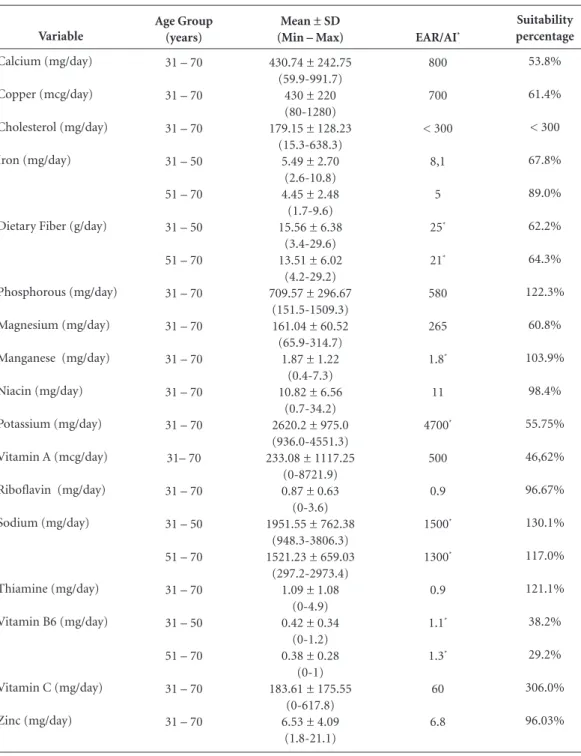
A general classification was performed of the nutritional status, according to the Body Mass In-dex (BMI) of the 20 women, where it was found that 10% (n = 2) were classified as underweight, 15% (n = 3) were normal weight and 75% (n = 15) were “Excessive Weight”. We included in the classification of “Excessive Weight”, overweight and obese women. In relation to the food intake (Table 3), it was noted that the average intake for calcium, copper, iron, niacin, dietary fiber, magnesium, potassium, vitamin A, vitamin B6 and zinc were below the recommended set out in Dietary Reference Intakes (DRIs), while averages for phosphorus, manganese, sodium, thiamine and vitamin C were above the recommended.
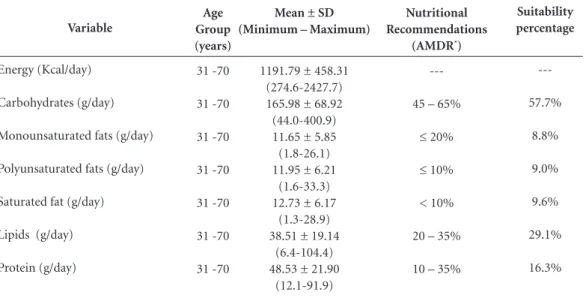
Regarding the intake of macronutrients (Ta-ble 4), one notes that they are in agreement with that recommended by DRIs. Besides, the
recom-Variable
Lymph node Status cN0
cN1-3 Tumour staging
cT1 cTis cT2 cT3 cT4 Tumour grade
G1 G2 G3 ER Status
Negative Positive PR Status
Negative Positive HER2 Status
Negative Positive Molecular Subtypes
Luminal HER2 Triple negative
No.
6 14
5 0 8 5 2
2 12 6
8 12
11 9
16 4
12 3 5
%
30 70
25 0 40 25 10
10 60 30
40 60
55 45
80 20
60 15 25
Table 1. Clinical and hormonal characteristics of
women with breast cancer attended by the Oncology Sector of the Brazilian university hospital (HC-UFU, Uberlandia, Minas Gerais, Brazil), in 2014.
Abbreviations: ER = Estrogen receptor; HER2 = human epidermal growth factor receptor 2; PR = Progesterone receptor.
Patients
Variable
Age Weight (kg) Height (cm) BMI (kg/m2)
WC (cm) WHR
Table 2. Mean ± Standard Deviation of the age and
the anthropometric variables of women with breast cancer attended by the Oncology Sector of the Brazilian university hospital (HC-UFU, Uberlandia, Minas Gerais, Brazil), in 2014.
Abbreviations: BMI = Body Mass index; SD = Standard Deviation; WC = Waist Circumference; WHtR = Waist-to-height ratio.
Total (N = 20) Mean ± SD
53.4 ± 11.0 73.0 ± 15.4 160.0 ± 10.0
29.1 ± 6.7 92.3 ± 20.2
e C
ole
tiv
a,
21(7):2209-2218,
2016
mendations for the intake of monounsaturated, polyunsaturated and saturated fats presented themselves as on the recommended limit. How-ever, within the limits in accordance with
Brazil-ian Cardiology Society18.
Regarding the BHEI-R analysis, the major-ity of women presented a “diet requires modifi-cation” (n = 16), while 20% (n = 4) presented a “healthy diet”. The components of BHEI-R that present lower scores were Whole grain cereals, Milk and Dairy, Saturated Fat and Sodium (Ta-ble 5).
Discussion
Noted here was the fact that a majority of pa-tients exhibited a positive lymph-nodal status, which indicates that they had already had me-tastasis, and in relation to the tumour stage, the results showed that the cancer is invasive.
According to Abreu and Koifman 21, the
di-mension of the cancer in conjunction with the condition of the axillary lymph-nodal condi-tion, are the two most relevant indicators for the prognosis of breast cancer. These form the basis of the TNM staging system (Tumour/Lymphat-ic nodes/Metastasis), agreed upon and declared
by the Union for International Cancer Control (UICC). The most significant prognostic infor-mation is to know the axillary involvement and the number of damaged lymph nodes. Besides, a number of studies show that there is a direct re-lationship between the patient survival rates and the number of damaged lymph nodes.
The histological measure represents the ma-lignancy potential of the tumour, thus demon-strating its high or low metastatic capacity. Prognostic indexes for breast cancer, which use the association of disease stage and histological measure, are constantly used thus aiding in the
improvement of result prediction21.
According to the data established in this study, a majority of patients presented the classification of Waist Circumference with elevated risk for de-veloping metabolic complications, along with the Waist-to-height ratio (WHtR) presenting values above the recommended, which indicates exces-sive fat levels in the abdominal region.
In the study from Felden and Figueiredo22, it
was also noted that abdominal fat is a risk fac-tor, when it comes to the development of breast cancer evaluated by WC. It was found that those women with a WC > 88 cm were shown to hold a greater possibility of developing the disease than those with a WC between 80-87 cm. Similar
re-Variable
Energy (Kcal/day)
Carbohydrates (g/day)
Monounsaturated fats (g/day)
Polyunsaturated fats (g/day)
Saturated fat (g/day)
Lipids (g/day)
Protein (g/day)
Table 3. Mean ± Standard Deviation for the intake of energy, macronutrients, nutritional recommendations
and percentage of suitability in relation to nutritional recommendations (DRIs), after analysis of the 24-Hour Dietary Recall (24HR) for women with breast cancer attended at the Oncology Sector of the Brazilian university hospital (HC-UFU, Uberlandia, Minas Gerais, Brazil), in 2014.
Abbreviations: AMDR = Acceptable Macronutrient Distribution Range; * Brazilian Cardiology Society. Age
Group (years)
31 -70
31 -70
31 -70
31 -70
31 -70
31 -70
31 -70
Mean ± SD (Minimum – Maximum)
1191.79 ± 458.31 (274.6-2427.7) 165.98 ± 68.92 (44.0-400.9) 11.65 ± 5.85 (1.8-26.1) 11.95 ± 6.21
(1.6-33.3) 12.73 ± 6.17
(1.3-28.9) 38.51 ± 19.14
(6.4-104.4) 48.53 ± 21.90
(12.1-91.9)
Nutritional Recommendations
(AMDR*)
---45 – 65%
≤ 20%
≤ 10%
< 10%
20 – 35%
10 – 35%
Suitability percentage
---57.7%
8.8%
9.0%
9.6%
29.1%
Fe
rr
eir
sults were identified in the study by Mobarakeh
et al.23, in which 81.1% of the participants
diag-nosed with breast cancer, presented a WC greater than or equal to 80 cm.
In addition, a high occurrence was observed of overweight individuals among these patients, as evinced by the BMI. As stated in Miranda et
al.24, women diagnosed with breast cancer and
Variable
Calcium (mg/day)
Copper (mcg/day)
Cholesterol (mg/day)
Iron (mg/day)
Dietary Fiber (g/day)
Phosphorous (mg/day)
Magnesium (mg/day)
Manganese (mg/day)
Niacin (mg/day)
Potassium (mg/day)
Vitamin A (mcg/day)
Riboflavin (mg/day)
Sodium (mg/day)
Thiamine (mg/day)
Vitamin B6 (mg/day)
Vitamin C (mg/day)
Zinc (mg/day)
Table 4. Mean ± Standard Deviation of the intake of micronutrients and suitability percentage in relation to
nutritional recommendations (DRIs), after analysis of the 24-Hour Dietary Recall (24HR) for women with breast cancer attended at the Oncology Sector of the Brazilian university hospital (HC-UFU, Uberlandia, Minas Gerais, Brazil), in 2014.
EAR, Estimated Average Requirement; AI = Adequate Intake. Age Group
(years)
31 – 70
31 – 70
31 – 70
31 – 50
51 – 70
31 – 50
51 – 70
31 – 70
31 – 70
31 – 70
31 – 70
31 – 70
31– 70
31 – 70
31 – 50
51 – 70
31 – 70
31 – 50
51 – 70
31 – 70
31 – 70
Mean ± SD (Min – Max)
430.74 ± 242.75 (59.9-991.7)
430 ± 220 (80-1280) 179.15 ± 128.23
(15.3-638.3) 5.49 ± 2.70
(2.6-10.8) 4.45 ± 2.48
(1.7-9.6) 15.56 ± 6.38
(3.4-29.6) 13.51 ± 6.02
(4.2-29.2) 709.57 ± 296.67
(151.5-1509.3) 161.04 ± 60.52 (65.9-314.7)
1.87 ± 1.22 (0.4-7.3) 10.82 ± 6.56
(0.7-34.2) 2620.2 ± 975.0 (936.0-4551.3) 233.08 ± 1117.25
(0-8721.9) 0.87 ± 0.63 (0-3.6) 1951.55 ± 762.38
(948.3-3806.3) 1521.23 ± 659.03
(297.2-2973.4) 1.09 ± 1.08
(0-4.9) 0.42 ± 0.34
(0-1.2) 0.38 ± 0.28
(0-1) 183.61 ± 175.55
(0-617.8) 6.53 ± 4.09
(1.8-21.1)
EAR/AI*
800
700
< 300
8,1
5
25*
21*
580
265
1.8*
11
4700*
500
0.9
1500*
1300*
0.9
1.1*
1.3*
60
6.8
Suitability percentage
53.8%
61.4%
< 300
67.8%
89.0%
62.2%
64.3%
122.3%
60.8%
103.9%
98.4%
55.75%
46,62%
96.67%
130.1%
117.0%
121.1%
38.2%
29.2%
306.0%
e C
ole
tiv
a,
21(7):2209-2218,
2016
underwent adjuvant chemotherapy exhibited an increased disposition to weight gain. Although there is still no clear motive found as to this weight gain, it may be as much related to food intake, the reduction in physical exercise, the modification in basal metabolic rate (BMR) or to menopause, as it may be to the type of chemo-therapy protocol used, which themselves can be related to the modification in the corporal
com-position of these patients. In addition, the excess and gaining of weight after the diagnosis are con-sidered risk factors, as much for the recurrence as for death from cancer for the survivors of this
disease25.
Studies from Miranda et al.24 and Tartari et
al.26 also found the incidence of overweight
indi-viduals in accordance with the BMI, among on-cological patients. However, highlighted here is that the BMI becomes a restricted parameter for the oncology patient; this is due to the elevation in the concentration of inflammatory mediators such as cytokines. This can go on to cause protein degradation as much as it can cause the increase in extracellular liquid, thus provoking water re-tention. The effects caused by these situations therefore make any accurate determination to the nutritional status of the patient a
complicat-ed task24.
In accordance with the intake of micronutri-ents, the patients showed a low vitamin A intake. Similar findings were encountered in the study
conducted by Chaves et al.27, in which the
partic-ipants presented an insufficient intake of vitamin A, related to the high prevalence of overweight individuals. A possible relationship of over-weight individuals with the consumption of vita-min A, may be linked to the thyroid metabolism.
Correspondingly, Zimmermann28 notes that the
insufficient intake of this nutrient presents vari-ous effects concerning the pituitary-thyroid axis, related to thyroid gland metabolism modulation, peripheral metabolism of the thyroid hormone and thyrotropin (TSH) synthesis by the pituitary. The low intake of calcium was also
encoun-tered in the study from Tartari et al.26, these
re-searchers suggested a connection to a possible aversion to dairy products. There exists a pos-sible correlation between the inadequate intake of calcium and weight control through various mechanisms. In the intestinal tract, this mineral provides a link with fatty acids and this restricts calcium absorption. In addition, its participation in the regulation of body temperature and in the increase of thermogenesis has been regarded as
having an anti-obesity effect29.
Intakes below the recommended were also seen in the consumption of iron, shown through
the study performed by Tartari et al.26, which
demonstrates that the treatment may lead to the aversion of red meats, the principal source of
heme iron. However, Ambrosi et al.30 differed in
their findings, by providing evidence for a con-siderable increase in the intake of iron among women under treatment for breast cancer.
Components of the BHEI-R (Minimum and Maximum Scores)
Total Grainsa (0-5)
Whole Grains (0-5)
Total Fruitsb (0-5)
Whole Fruitsc (0-5)
Total Vegetables (0-5)
Dark Green and Orange Vegetables and Legumesd (0-5)
Milk and Dairye (0-10)
Meat, Eggs and Beans (0-10)
Oilsf (0-10)
Saturated Fat (0-10)
Sodium (0-10)
SoFAASg (0-20)
BHEI-R TOTAL (0-100)
Mean ± SD (Minimum -
Maximum)
4.8 ± 0.7 (2.3 – 5.0) 0.7 ± 1.5 (0.0 – 5.0) 4.4 ± 1.3 (0.0 – 5.0) 4.3 ± 1.6 (0.0 – 5.0) 4.8 ± 0.5 (3.2 – 5.0) 4.5 ± 1.1 (1.3 – 5.0) 3.5 ± 2.3 (0.0 – 6.9) 9.2 ± 0.9 (6.3 – 10.0) 10,0 ± 0,0 (10.0 – 10.0) 4.2 ± 3,9 (0,0 – 10,0) 4,5 ± 2.1 (0.7 – 9.2) 18.8 ± 2.0 (13.3 – 20.0) 74.1 ± 5.7 (63.6 – 82.7)
Table 5. Mean ± Standard Deviation for the
alimentation group scores in accordance with the Brazilian Healthy Eating Index – Revised (BHEI-R), after analysis of the 24-Hour Dietary Recall (24HR) for women with breast cancer attended at the Oncology Sector of the Brazilian university hospital (HC-UFU, Uberlandia, Minas Gerais, Brazil), in 2014.
Fe
rr
eir
In relation to the vitamin C, its intake was above the recommended, and according to
Neu-mann et al.31, may be related to central or
abdom-inal obesity when below the recommended. In
the meta-analysis by Harris et al.32 , the
consump-tion of vitamin C was correlated to a lower mor-tality rate by breast cancer. One of the hypothesis is that vitamin C can influence the progression of cancer by means of its anti-oxidant properties, thus neutralizing the free radicals.
On the other hand, the intake of dietary fiber was below the recommended, this was a similar
result as to that encountered by Tartari et al.26.
The regular intake of fibers is a protective fac-tor against the development of breast cancer. These data corroborate with those encountered in the study Healthy, Eating, Activity and Life-style (HEAL), which demonstrated a decrease of around 32% in breast cancer in women that
in-gested higher quantities of fiber33.
The association that exists between zinc and obesity has been studied in relation to the in-volvement this nutrient has in the role of leptin and insulin resistance. Zinc is an important ap-petite regulator and its deficiency leads to a di-minished food intake. Therefore, appetite can be
increased through a supplement of this mineral34.
Regarding the macronutrients, the patients presented an intake within the recommended. In the study conducted by Surwillo and
Waw-rzyniak35, it was noted that when it came to mean
caloric consumption, the intake of carbohydrates and proteins was insufficient in those patients with breast cancer. However, in the study by
Ambrosi et al.30 there was noted a substantial
in-crease in intake of energy and lipids during the treatment of this disease.
In regards to some of the components from the BHEI-R, it was noted that they reach an av-erage score, which is indicated as adequate. This was a different result to that encountered by
Ce-ccatto et al.9, in which only the total fruit groups,
whole fruits, total vegetables, dark green and orange vegetables and legumes obtained an ad-equate average score.
Besides, a majority of patients presented scores for “diet requires modification”, where this
result, similar to the study by Previato36, was also
realized with women with breast cancer.
Howev-er, in the study by Oliveira et al.37, also realized
with patients with breast cancer, a “bad quality” dietary pattern was noted, in this case the diet was evaluated by the Adapted Healthy Eating Index.
It is worth noting that there may have oc-curred some limitations in this study concerning the methodology used, when referring to the area of data collection. The data for food intake were reported by the very patients by telephone inter-view, which in itself may have led to errors, as it is information collected from past events, which may have underestimated intake.
In addition, the BMI is a flawed method, which can mask over the nutritional status, as it uses as its principal data weight and not body composition. The size of the sample also may limit the findings of this study, as it deals with a small number of patients.
Conclusion
e C
ole
tiv
a,
21(7):2209-2218,
2016
References
International Agency for Research on Cancer. Latest world cancer statistics Global cancer burden rises to 14.1 million new cases in 2012: Marked increase in breast can-cers must be addressed. Paris: International Agency for Research on Cancer; 2013.
Instituto Nacional de Câncer (INCA). Estimativa 2014: Incidência de câncer no Brasil. Rio de Janeiro: INCA; 2014.
Rosa LM, Radunz V. Taxa de Sobrevida na Mulher com Câncer de Mama: Estudo de Revisão. Texto Contexto Enferm 2012; 21(4):980-989.
Fontanella C, Lederer B, Gade S, Vanoppen M, Blohmer JU, Costa SD, Denkert C, Eidtmann H, Gerber B, Ha-nusch C, Hilfrich J, Huober J, Schneeweiss A, Paepke S, Jackisch C, Mehta K, Nekljudova V, Untch M, Neven P, von Minckwitz G, Loibl S. Impact of body mass index on neoadjuvant treatment outcome: a pooled analysis of eight prospective neoadjuvant breast cancer trials. Breast Cancer Res Treat 2015; 150(1):127-139. Chajés V, Romieu I. Nutrition and breast cancer. Matu-ritas 2014; 77(1):7-11.
Rodrigues FSS, Polidori, MM. Enfrentamento e Resi-liência de Pacientes em Tratamento Quimioterápico e seus Familiares. Rev Bras Cancerol 2012; 58(4):619-627. Berteretche MV, Dalix AM, d´Ornano AM, Bellisle F, Khayat D, Faurion A. Decreased taste sensitivity in can-cer patients under chemotherapy. Support Care Cancer 2004; 12(8):571-576.
Jacobs DR, Steffen LM. Nutrients, foods, and dietary patterns as exposures in research: a framework for food synergy. Am J Clin Nutr 2003; 78(Supl. 3):508S-513S. Ceccatto V, Pietro PFD, Previdelli AN, Vieira FGK, Schiavon CC, Engel R, Cardoso LA, Assis MAA, Crippa GC, Chica DAG. Brazilian healthy eating in-dex revised (BHEI-R) of women before and during adjuvant treatment for breast cancer. Nutr Hosp 2014; 30(5):1101-1109.
Previdelli NA, Andrade SC, Pires MM, Ferreira SRG, Fiberg RM, Marchioni DM. Índice de Qualidade da Dieta Revisado para população Brasileira. Rev Nutr 2011; 45(4):794-798.
World Health Organization (WHO). Report of a WHO Expert Committee. Physical status: the use and interpre-tation of anthropometry. Geneva: WHO; 1995. (Techni-cal Report Series, v. 854).
Organização Pan-Americana da Saúde (OPAS). Saúde, Bem-estar e Envelhecimento – O Projeto Sabe no mu-nicípio de São Paulo: uma abordagem inicial. Brasília: OPAS; 2003.
I Diretriz Brasileira de Diagnóstico e Tratamento da Síndrome Metabólica. Arq Bras Cardiol 2005; 84(1):1-28.
World Health Organization (WHO). Obesity: prevent-ing and managprevent-ing the global epidemic – report of a WHO consultation on obesity. Geneva: WHO; 2000.
Ashwell M, Hsieh SD. Six reasons why the waist-to-height ratio is a rapid and effective global indicator for health risks of obesity and how its use could simplify the international public health message on obesity. Int J Food Sci Nutr 2005; 56(5):303-307.
Tabela Brasileira de Composição de Alimentos (TACO). 4ª ed. Campinas: Unicamp; 2011.
1.
2.
3.
4.
5. 6.
7.
8.
9.
10.
11.
12.
13.
14.
15.
16. Collaborators
IB Ferreira worked on data collection, data com-piling and preparation of the manuscript. EC Marinho worked on data collection, data com-pilation, result analysis and compilation of the article. IDD Custódio worked on analysis, data interpretation and elaboration of the manu-script. CA Gontijo worked on the elaboration of the manuscript. CA Crispim worked on the elab-oration of the manuscript. CE Paiva worked on article design and interpretation of results. YCP Maia worked on article design, analysis, data in-terpretation and elaboration of the manuscript.
Acknowledgements
Fe
rr
eir
Institute of Medicine (IOM). Dietary Reference Intakes of Energy, Carbohydrate, Fiber, Fat, Acids, Cholesterol, Protein, and Amino Acids. Washington: The National Academy of Sciences; 2002-2005.
Sociedade Brasileira de Cardiologia. IV Diretriz Brasi-leira sobre dislipidemias e prevenção da aterosclerose. Arq Bras Cardiol 2007; 88(Supl. 1):2-19.
Brasil. Ministério da Saúde (MS). Guia Alimentar Para a População Brasileira: Promovendo a Alimentação Sau-dável. Brasília: MS; 2006. Normas e manuais técnicos. Bowman SA, Lino M, Gerrior SA, Basiotis PP. The Healthy Eating Index: 1994-96. US Department of Ag-riculture. Washington: Center for Nutrition Policy and Promotion; 1998. CNPP-5.
Abreu E, Koifman S. Fatores prognósticos no câncer da mama feminina. Rev Bras Cancerol 2002; 48(1):113-131.
Felden JBB, Figueiredo ACL. Distribuição da gordura corporal e câncer de mama: um estudo de caso-contro-le no Sul do Brasil. Cien Saude Colet 2011; 16(5):2425-2433.
Mobarakeh ZS, Mirzaei K, Hatmi N, Ebrahimi M, Dabiran S, Sotoudeh G. Dietary Habits Contributing to Breast Cancer Risk Among Iranian Women. Asian Pac J Cancer Prev 2014; 15(21):9543-9547.
Miranda TV, Neves FMG, Costa GNR, Souza MAM. Estado Nutricional e Qualidade de Vida de Pacientes em Tratamento Quimioterápico. Rev Bras Cancerol 2013; 59(1):57-64.
Miller PE, Morey MC, Hartman TJ, Snyder DC, Sloane R, Cohen HJ, Demark-Wahnefried W. Dietary Patterns Differ between Urban and Rural Older, Long-Term Survivors of Breast, Prostate, and Colorectal Cancer and Are Associated with Body Mass Index. J Acad Nutr Diet 2012; 12(6):824-831.
Tartari RF, Busnello FM, Nunes CHA. Perfil Nutricio-nal de Pacientes em Tratamento Quimioterápico em um Ambulatório Especializado em Quimioterapia. Rev Bras Cancerol 2010; 56(1):43-50.
Chaves GV, Pereira SE, Saboya CJ, Ramalho A. Nonal-coholic Fatty Liver Disease and Its Relationship with the Nutritional Status of Vitamin A in Individuals with Class III Obesity. Obes Surg 2008; 18(4):378-385. Zimmermann MB. Interactions of Vitamin A and Io-dine Deficiencies: Effects on the Pituitary-Thyroid Axis. Int J Vitam Nutr Res 2007; 77(3):236-240. Zemel MB, Thompson W, Milstead A, Morris K, Camp-bell P. Calcium and Dairy Acceleration of Weight and Fat Loss during Energy Restriction in Obese Adults. Obes Res 2004; 12(4):582-590.
17.
18.
19.
20.
21.
22.
23.
24.
25.
26.
27.
28.
29.
Ambrosi C, Pietro PFD, Rockenbach G, Vieira FGK, Galvan D, Crippa CG, Fausto MA. Fatores que influen-ciam o consumo energético de mulheres no tratamen-to do câncer de mama. Rev Bras Ginecol Obstet 2011; 33(8):207-213.
Neumann AILCP, Shirassu MM, Fisberg RM. Consumo de alimentos de risco e proteção para doenças cardio-vasculares entre funcionários públicos. Rev Nutr 2006; 19(1):19-28.
Harris HR, Orsini N, Wolk A. Vitamin C and survival among women with breast cancer: A Meta-analysis. Eur J Cancer 2014; 50(7):1223-1231.
Belle FN, Kampman E, McTiernan A, Bernstein L, Baumgartner K, Baumgartner R, Ambs A, Ballard-Bar-bash R, Neuhouser ML. Dietary fiber, carbohydrates, glycemic index, and glycemic load in relation to breast cancer prognosis in the HEAL cohort. Cancer Epidemi-ol Biomarkers Prev 2011; 20(5):890-899.
Gomez GA, Hernandez ES, Gonzalez MO, Martinez EA. Efecto de la administracion oral de zinc sobre sensibilidad a la insulina y niveles séricos de leptina y andrógenos em hombres com obesidad. Rev Méd Chil 2006; 134(3):279-284.
Surwillo A, Wawrzyniak A. Nutritional assessment of selected patients with cancer. Rocz Panstw Zakl Hig 2013; 64(3):225-233.
Previato HDRA. Qualidade da dieta de mulheres brasi-leiras com câncer de mama [tese]. Ouro Preto: Universi-dade Federal de Ouro Preto; 2013.
Oliveira DR, Carvalho ESC, Campos LC, Leal JA, Sam-paio EVC, Dantas G. Avaliação nutricional de pacientes com câncer de mama atendidas no Serviço de Masto-logia do Hospital das Clínicas, Belo Horizonte (MG), Brasil. Cien Saude Colet 2014; 19(5):1573-1580.
Article submitted 05/06/2015 Approved 22/08/2015
Final version submitted 24/08/2015 30.
31.
32.
33.
34.
35.
36.