Semiotic analysis of empathic and non-empathic interaction sequences:
microgenetic study
1Pablo Fossa* Carlos Cornejo
David Carré
Pontiicia Universidad Católica de Chile, Psychology School. Santiago, Chile
Abstract: This study aimed to explore and describe the process of dialogic regulation in conversational interactions. It were recorded on video 30 pairs of students together in unknown interactions that were oriented to generate a non-empathic or sympathetic handling situation, and four segments of conversation, two for each type of interaction, were selected. The text was analyzed with a protocol of semiotic analysis based on the analysis model proposed by Molina (2007). The results show that empathic interactions are characterized by a process of co-construction of meaning, with proper management of stress and an identification with the linguistic sign. Moreover, non-empathic interactions are characterized by the emergence of linguistic signs that do not continue the construction sequence of meanings, with high dialogic tension, and a strategy of distancing or abandonment of the meaning field.
Keywords: semiotic analysis, interaction, empathy, microgenesis.
1 Funding information: FONDECYT. Registration number: 1100863 – National Commission of Research, Science and Technology of Chile. * Corresponding address: [email protected]
Introduction
Over the past few decades the elements underly-ing the construction of psychological processes, such as the processes of mutual regulation on the intersubjective experience of two agents, have become an important fo-cus of study within the phenomenological approach of human interaction (Josephs, Valsiner & Surgan, 1999; Marková, 2003). At the same time, under this perspec-tive discourse processes have been used to understand emotional regulation in the intersubjective interaction between two speakers (Voloshinov, 1986; Marková, 1995; Valsiner & Van der Veer, 2000; Valsiner 2002; Valsiner, 2004).
In this context, one of the perspectives to study and understand it is Jaan Valsiner’s Sociogenetic model of the mind (2002; 2003; 2004). This model comprises the differ-ent evolutionary levels of human experience and psycho-logical processes (namely, macro, meso and micro genetic), as a never-ending development of communication with oneself, with others and with culture, through semiotic me-diation which establishes linguistic signs (Valsiner 2000, 2003). From this perspective, the psychological processes are understood as ever changing dynamic processes, be-cause there is a constant innovation in the construction of signs that give shape to experience (Valsiner, 2002). Every linguistic sign emerging at the present, however, is also a semiotic mediation mechanism for future meanings: each meaning emerges from a previous meaning and from this
is possible to predict in which direction the next meaning will emerge. Therefore, the sign emerging at any given time connects the recent past with a near yet anticipated and unknown future (Valsiner, 2004).
Meaning co-construction
meanings (Valsiner, 2004), avoiding some meanings and emphasizing or intending other (Josephs & Valsiner, 1998; Valsiner, 1999). In this sense, the meaning constructed by dialogic interaction which takes shape in language depends on someone to give it life in the dialogue, when each speak-er will express his or hspeak-er subjective expspeak-erience through it (Bakthin, 1981, 1984; Cornejo, 2004).
Self(ves) in dialogue
This semiotic dynamics creates a constant balance and unbalance of the bond between speakers—either of the subject with culture, or of the subject with him or herself. In the case of an interpersonal relationship, the interact-ing selves would be involved in this constant development of dialogical exchange, based on opposition and harmony. Because, as stated by Valsiner & van der Veer (2000) and Marková (1995, 2003), the human self has a dialogic nature, i.e., is permanently in dialogue, just as the creation of mean-ing occurs through the dialogue between speakers. In this constant negotiation between speakers and between each one with him or herself, the self of each speaker is develop-ing over time, in interaction (Hermans (2002; 2004). Also, according to Mead (1992; 2002) this regulatory process does not occur at a particular time or after a single event, but it is a process that unfolds constantly through experience.
Thus, when the speaker constructs the meaning the speaker gets rid of it, expressing his or her subjectivity through it. The meaning belongs then to the interaction part-ners. When meaning is constructed, it becomes part of the intersubjective space and at the same time it maintains a spe-cific direction to an interlocutor, therefore, speech expresses the subjective position from which each speaker negotiates the relationship. (Bakhtin, 1981; 1984; Voloshinov, 1986)
Methods of semiotic analysis
Given this semiotic and dialogic nature of human interactions, it is possible to analyze them from this point of view, using a model of Semiotic Analysis as the one put forward by Molina (2007). The main tools of analysis are the sign, the focused meaning, the semiotic mechanisms, the dynamics of dialogics of self, the effect on the process of construction, the positions of the self and the receiver of the sign constructed.
According to Molina (2007), the first stage of anal-ysis consists in identifying the focused meaning, i.e., the meaning-complex distinguished in each communication turn and which refers to the semantic aspect of the sign (Josephs & Valsiner, 1998). Then, one must identify the se-miotic mechanisms regulating change and maintenance of meanings, both in resources and mediators, and regulation between two selves. On the other hand, the dynamics of di-alogics of self refer to its subjective position and experience expressed by means of constructing signs. Furthermore, each constructive process has an effect in the process of
up in interaction, it may support a previously constructed meaning, establish tension, try to overcome a meaning, etc. Finally, it is important to identify the actors in the process, i.e., the author and the receiver, since only identifying the source of the meaning and the addressed receiver it is pos-sible to know dialogic micro-movements that the actors use to manage tension and connect with the other.
Semiogenesis and emotional processing
At the beginning of the 20th century, Theodor Lipps developed and introduced the concept of Einfühlung in psychological thought, which was subsequently trans-lated as empathy to refer to an observer experience when contemplating a work of art. This concept was later extrap-olated to human interactions, however, Lipps (1903/1924) proposed that inner experience of feeling and experienc-ing other’s emotions would be a particular process of each interaction, i.e., an emerging relational process, emerging every moment. Thus, from this understanding emotional connection or empathy would be a process in which inter-actants characteristics and contexts of interaction are de-termining factors to develop an empathic connection. For the same reason, a subject does not have a permanent em-pathic connection with all subjects with whom he interacts, but through micro-sequencies of emotional syntony, which can be observed together with its respective fluctuations to the inside of the same interaction.
This way of understanding the shared emotional processes has a direct relationship with abovementioned semiotic regulation phenomena. Processes of intersubjec-tive regulation, however, through co-construction of signs which take shape in language, determine the nature of the connection between interactants: harmonic, tense, distant, etc. On the other hand, understanding self-regulation and emotional processes as phenomena emerging from human interactions, within many types of social interactions could be observed micro-variations of emotional connection, as well as micro-variations of the process of self-regulation.
From this perspective and from the problems raised, this study aims to describe human interactions from a semiotic perspective in situations of emotional connec-tion (empathic) and others in which it becomes hindered (non-empathic). Therefore, it is sought to determine dia-logic characteristics of an empathic and a non-empathic interaction, observing the micro-genetic process of con-structing meanings. In other words, to describe the move-ment of signs which take shape in language, the semiotic expression of emotional regulation, and the relationship be-tween this dialogic regulation or deregulation process and the emergence of an emotional connection in interactants intersubjective space.
Method
the methodology has always been descriptive with a micro-genetic orientation. With the objective of exploring the im-mediacy of dialogue between interactants we looked for a particular phenomenon: empathic and non-empathic micro-moments in interaction, through sequences of meanings con-structed in dialogic interaction between both participants.
Out of 30 undergraduate students dyads from the Pontifical Catholic University of Chile that were record-ed on video during their participation in a study on em-pathic and non-emem-pathic interactions in the Laboratory of Language, Interaction and Phenomenology (LiF), we deliberately chose 2 cases for micro-genetic analysis. The first case participated in an empathic situation, which asked both participants to discuss a series of questions, with the objective of knowing and understanding each other. These participants were asked to put much attention in the conver-sation because after this is they would be asked questions about the other participant. On the other hand, the second video was selected from recorded conversations aimed to hinder emotional connection (non-empathic), in which the participants talked over the same questions, but they were told that in any of these one of them could be lying. In this case, the participants were asked to to identify in which question the other participant would be lying. Thus, in the 2 recordings selected, one empathic condition and another non-empathic condition, participants were females. Despite the different instructions, both participants answered spon-taneously to the same questions, which were taken from
Fast Friends Procedure (Aron et al., 1997). Each interaction lasted for approximately 25 minutes.
We selected from the recordings 2 sequen-cies of dialogue of the empathic condition and 2 micro-sequencies of dialogue of the non-empathic condition. The criteria for choosing empathetic moments were: (1) mo-ments when participants established an obvious emotional connection, and (2) moments when there was no evident emotional tension or disagreement. On the other hand, the criteria for choosing non-empathic moments were: (1) the lack of emotional connection and participants visible dis-comfort during interaction; (2) moments when one of the participants was not interested or did not understand what the other was saying; or (3) moments of clear disagreement and visible tension among speakers.
We used a protocol of Semiotic Analysis (Molina, 2007) to explore empathic and non-empathic moments through micro-sequencies of meaning construction which emerged in the dialogue, from a micro-genetic perspec-tive based on the method of analysis proposed by Valsiner (2002, 2003, 2004).
Results
We present below four selected events to be ana-lyzed, with the purpose of illustrating analysis procedure. Following each event we describe the most relevant indica-tors in the interactions observed.
Table 1
Event No. 1 Empathic Interaction
Part. Intervention
S1 What you would like to do professionally after finishing college?
S2
Oh, great question! Actually I have not decided what is the ideal job for me, but I would enjoy working in radio or in the press. In radio because I could combine my interests, especially music, but then I have to see what happens, that is like in the press or T.V., I want to keep my options open, I would love to travel, travel a lot. . . and you?
S1 I would like to dedicate myself to forensic psychology.
S2 Ah yes, that’s what I was going to ask you, what is forensic psychology anyway?
S1 Mmm. . . I think it’s like psychologists that work with the PDI (Investigations Police).
S2 Ah I get it. . .
S1 As for investigations. . . It interests me a lot.
S2 Very nice! You know, but it is just as frightening, because you have to deal with psychopaths and things like that, or not?
S1 Yes. . . haha. I would have to go to study abroad because here there is no. . .
S2 No? Not even in PDI?
S1 It’s like, like I think that the forensic psychology thing doesn’t, then. . .
S2 Ahh yes, it’s more specialized.
Te first segment starts with S1 asking about the things S2 would like to do after finishing college. Here emerges the meaning-complex [TO DO / NOT TO DO]. Then the conversational partner says: “Oh, great ques-tion!”, positioning herself subjectively in the dialogic in-teraction and expressing her willingness to talk about this topic. The same expression is used by the conversational partner to construct the complex [THE IDEAL JOB / NOT THE IDEAL JOB], saying that she has not defined yet her ideal work in the journalism area. She mentions her interest of working in radio or the press, since she could then devel-op her interest in music, positioning her subjectivity in the dialogue. It is a communication turn dominated by tension, expressed through the semiotic mechanism “but”, con-fronting two parts of the dialogue: her interests and her real possibilities. S2 finishes the speech act saying she would also like a job in which she could travel. She shows thus another side of herself in the same communication turn. S1 does not take any of these meanings constructed by S2 and says she would like to dedicate herself to forensic psychol-ogy, extending the meaning-complex [THE IDEAL JOB / NOT THE IDEAL JOB] in pole [A]. Before S1’s answer, S2 stops and shows interest and asks “Ah yes! That’s what I was going to ask you, what is forensic psychology any-way?”. A micro-sequence of communicative exchange is established in which S1 tries to explain to S2 what forensic psychology is, explaining that it is about psychologists who
work with the Investigations Police (PDI). In this move-ment she draws away from the constructed sign by say-ing “the psychologists” not identifysay-ing herself with them. Immediately after, S1 identifies herself again with the sign when she says “it interests me a lot”. This exchange shows a process of co-construction in the chain of meanings, ex-tending the field [A] of the meaning-complex . In the next communication turn S2 approximate to the meaning iden-tifying herself with it and allowing the meaning “FEAR” to emerge. In this movement S2 increases tension, but gets in touch with the thrill of working as a psychologist in the PDI, with which she empathizes with the subjective experi-ence that the conversational partner tries to communicate. S1 does not take the meaning and reduces tension saying “I would have to go to study abroad”. S2 interferes to un-derstand whether in the PDI one can be trained in forensic psychology and S1 answers negatively. S2 says “ah yes, it’s more specialized”; S1 agrees and ends the first segment.
In this event there is a process of co-construction of meanings between the speakers during interaction. Both participants properly manage dialogic/discursive tension when communicating, oriented to the focused meaning and giving their conversational partner subjective experi-ence meaning. Finally, there is an evident approximation or identification with the constructed sign, which construc-tively turns towards meanings with emotional content, fa-cilitating the empathic encounter of interactants.
continues...
Table 2
Event No. 2 Empathic Interaction
Part. Intervention
S2
Photography is my hobby, it entertains me a lot because since I was a little girl, I’ve been enjoying photography for a long time and I was testing with a digital camera, and this year I have an analog camera, so now it’s much better with the analog camera
S1 But the analog camera is more complicated and it’s more expensive
S2 Yes, but you learn much more, much more
S1 Yes, it’s true. . .
S2 Yes, the rolls of film are more expensive and developing photos as well, though I’m used to it since I was a little girl.
S1 Do you send pictures to develop or. . .
S2 Yes, I send them to develop, I don’t know how yet. . . I want to learn how to do it myself. And you?
S1 I play football
S2 Really? How long have you been playing?
S1 Since seventh grade
S2 It’s a long time!
S1 Yes, it’s so much fun. And I really like it. What I like the most is that there is a lot of teamwork, then with all games we play we have a really good vibe in our team
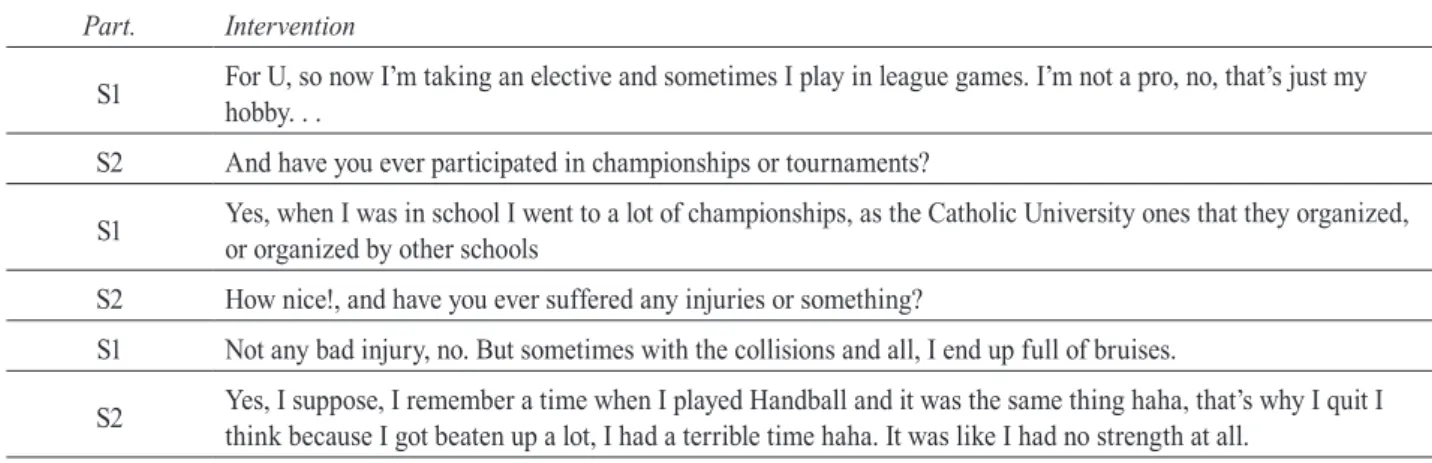
In this second empathic event, S2 begins describ-ing her hobby. Through this intervention the meandescrib-ing- meaning-complex [TAKE PICTURES / NOT TAKE PICTURES] is constructed. The dialogic movement in this conversation extends field [A] of the meaning-complex through semiotic mechanisms such as “for a long time” and “since I was a little girl”. On the next turn, occurs a micro-sequence of interaction dominated by tension caused by the semiotic mechanism “but” in the following two turns. S1 says “but it is more complicated and more expensive” and S2 says in turn “but you learn much more”. When complicated-expensive and learn are opposed, there is a dialogic ten-sion that is resolved because S2 abandons the field of the meaning, distancing herself from the sign complicated and expensive, taking and incorporating to her experience the sign learning. We observe in this micro sequence a with-drawal not as strategy to decrease tension, but as a true experience in which the constructed meaning by the other makes sense and affects experience.
In a second stage of interaction, S1 mentions that her hobby is playing football. In the next turn S2 quickly gets interested in S1’s hobby. The following communica-tion turns “How long have you been playing?” and “Since seventh grade” extend field [A]. On the next communica-tion turn S1 unfolds a self-posicommunica-tioning strategy through “it interests me a lot” and “what I like the most”, giving rise to the meaning [TEAMWORK], overcoming the previous meaning. In this respect, S2 does not use the new meaning and performs a strategy of closed circle to retake the com-plex [FOOTBALL GAME / NO FOOTBALL GAME], through expressions such as “. . . now are you attending college or high school?”, and have you gone to champion-ships?”, and have you had any accidents?” This dialogical sequence shows the interlocutor’s interest in the inner ex-perience of the other in a stress-free exchange.
Table 2
Continuation
Part. Intervention
S1 For U, so now I’m taking an elective and sometimes I play in league games. I’m not a pro, no, that’s just my hobby. . .
S2 And have you ever participated in championships or tournaments?
S1 Yes, when I was in school I went to a lot of championships, as the Catholic University ones that they organized, or organized by other schools
S2 How nice!, and have you ever suffered any injuries or something?
S1 Not any bad injury, no. But sometimes with the collisions and all, I end up full of bruises.
S2 Yes, I suppose, I remember a time when I played Handball and it was the same thing haha, that’s why I quit I think because I got beaten up a lot, I had a terrible time haha. It was like I had no strength at all.
At the end of the sequence, in view of the answer given in which S1 refers that it has not suffered accidents but it has bruises on it legs, S2 performs a dialogical move-ment in which it identifies with the constructed meaning; in this way, it says that when it played Handball the same thing happened to it, consistent with the subjective experi-ence of the other.
In segment No. 3, a micro-sequence corresponding to a non-empathic interaction is shown. An exchange of in-formation interventions with a brief response is observed. In view of the answer given by S1, an investigation of the subjective experience by S2 is not observed. In the follow-ing sequence, a dialogical interaction between the speakers dominated by the tension is observed. We observed as S2 through the action “Ah ok” is distanced from the focused meaning that S1 is communicating, abandoning the field of meaning and ending the conversation without deepening in the inner experience of the other. However, S2 generates the expression “me too” realizing that its experience is sim-ilar. Despite this, there is no evidence of an emotional con-nection between participants. This is because soon after, in the next communication turn, S1 says the following phrase “Like everyone in high school,” as a strategy of generaliza-tion and distancing through a semiotic strategy of referring to another abstract or generality, strategy that allows to de-crease the tension and complete the micro-sequence.
Table 3
Event No. 3: Non-empathic Interaction
Part. Intervention
S2 Why did you apply to study this course?
S1 Because I couldn’t study anywhere else. . . haha.
S2 What did you want to study?
S1 Law.
S2 Where?
S1 At the Diego Portales University.
S2 Ah, ok.
S1 Haha, and you?
S2 Me too. I couldn’t study psychology at the Catholic University and also because I have no idea what to study.
S1 Like everyone in high school.
Table 4
Event No. 4: Non-empathic Interaction
Part. Intervention
S2 What do you want to do after completing the course?
S1 It depends on whether I study Law or Psychology, but in both of them I would like to focus on helping people. And you? Haha.
S2 Well, it really depends on whether I attend Psychology or Commercial Engineering, but. . . I also want to be. . . a contribution. . . haha. . . to the world.
S1 haha to the country. . .
Finally, in segment No. 4, a particular movement of the tension is observed. Both participants construct com-municative expressions dominated by the tension within the communication turn, represented in the semiotic mechanism “but”. When asked by S2, S1 uses the semiotic mechanism “it depends” which quickly gives different al-ternatives or ways to continue the construction sequence. This dialogical movement increases the tension because it realizes that there would be requirements for certain situations to occur. S1 in this communicative expression constructs the meaning [HELPING PEOPLE]; although it self-positions subjectively in the dialogue, there is no incli-nation to go deeper into what this could mean for the per-son. S2, although it seems to agree with the meaning that S1 constructs, surpasses the previous meaning through the emergence of [BEING A CONTRIBUTION]. However, this last dialogical movement acts as a self-constructed se-miotic strategy oriented to take distance from the field of meaning and prevent entering into the intimate experience to which the meaning refers. The semiotic mechanism “be-ing a contribution to the world” or “be“be-ing a contribution
ourselves from the field of meaning as well as from the experience of the other. It does not allow the continuation and co-construction of the sequence, but, on the contrary, it stops it. It emerges as a socially adequate dialogic strategy that is self-explanatory, without the need to direct the pro-cess towards new ways of meaning.
In this event, we observed again the tension, the ab-sence of co-construction of signs and the distancing from the field of meaning as a characteristic of a non-empathic interaction, evidencing a change in the recipient of the dialogic expression, from the other interlocutor to another abstract through a strategy that acts as a symbolic helper in the dialogue and allows to take psychological distance and decrease the emotional commitment with the other and with the expressed in the meaning.
Discussion
the observed data, the empathic interaction sequences are characterized by a process of co-construction of meanings between the interacting ones; that is to say, a dialogic chain is constructed coordinately in which each interlocutor takes the meanings constructed by the other and contrib-utes, on these, new meanings. This shows a clear process of emotional connection between the speakers of the dia-logue, who are positioned in the encounter with the other. In addition, empathic sequences also demonstrate an ad-equate tension management. This means that the interlocu-tors resort to dialogic strategies that allow maintaining the tension in adequate levels, which allow boosting the con-structive process without weakening the experience link. The speakers perform movements that may decrease the tension in some moments and establish opposition in the dialogue without stressing the link. Finally, empathic in-teractions show an identification and loss of psychological distance, by personal or contextual variables, with the sign constructed by the interlocutor. This is a clear phenomenon of emotional connection, in which an individual manages to transmit through dialogue the emotion of a particular ex-perience, while the other can identify itself with that mean-ing, recognizing and appropriating the emotion expressed by the first.
In addition, in non-empathic interaction sequenc-es, there is no evidence of a co-construction of meanings, that is, when a participant constructs a sign, which is then not used by the interlocutor to continue the constructive sequence. On the other hand, there is evidence of a high level of dialogic tension and a strategy of distance or aban-donment of the field of meaning in those moments where tension increases. These strategies to manage the tension in the encounter with the other consist in detaching or de-identifying of a determined meaning previously put in the dialogue; the individual stops reforming a meaning in which to be positioned in the dialogic space unbalances the harmony and generates tension. The increase of the tension is caused by an inadequate management of the opposition in the dialogue, before which, the interlocu-tors resort to abandonment of the field as a way to finish the constructive sequence and thus avoid the discomfort of the stressed link. Finally, in non-empathic interaction sequences, we can also observe semiotic strategies that produce a change in the recipient of the utterance, from the other as an interlocutor to an abstract other not present in the interaction. In the same sense, we can also observe a dialogic strategy of generalization, in which an inter-locutor tends to generalize and normalize a situation by executing a self-explanatory argument, as a strategy to dissolve the tension.
From the material analyzed in this study, the com-plexity of the human encounter and the micro-variations almost imperceptible for the speakers, which take place during the course of an interaction, is outlined. In a so-cial interaction where we found two different individuals, with stories, experiences and ways of seeing life that are different, this difference or otherness is inherent to the
human and constitutes the basis of the tension that char-acterizes the mutual encounter. In each social interaction, there is a tension which emerges from the otherness, that is, from the encounter between one I and another. In this human encounter, each interlocutor offers a story and in-vites the other to this story. When an empathic connec-tion occurs, the other accepts to be part of that world and accepts the declarative and relational offer with the rules of the other. The interlocutor accepts to be part of the in-ner world of the other, trying to know and understand their experience, feeling the emotions experienced by the other. In this micro-phenomenon, both individuals are part of a microcosm and constitute both a single system. In this type of encounter, an individual tries to communicate an aspect of their existence, which does not succeed in being accurately represented in the language. Discursive artifacts fail to capture the inner experience or translate this experi-ence into vocalized language. It is at this moment, when in an empathic micro-sequence the interlocutor manages to decipher and capture the vital force that hides the sign, that bodily felt emotion that tries to be expressed and that remains as something not said.
On the other hand, when the interlocutor decides not to accept this offer and invitation to know the other’s inner world, the individual takes only part of the story, which is used to emphasize an aspect of its own. This intentional-ity of the communicative process reflects an interpersonal contact in the absence of empathy. Each interlocutor is po-sitioned subjectively in a point of view. There is neither a relational offer nor an intention to know the other’s inner world. It is here, where through some dialogic strategy, the individuals neutralize the conversation and end the chain of meanings.
From the interactional dynamics analyzed, the dia-logic exchange is presented as a way of understanding the richness of the interpersonal experience at the micro level, mediated by some system of signs. In this sense, this article postulates the dialogic regulation as a way of regulation of the states of the self, a co-constructed movement through which it is possible to approach another and understand their subjective experience. This allows highlighting the importance of language as a way of accessing the inner vital force of the other, which seeks to be expressed and shared (Humboldt, 1990). Being able to connect with this inner force is to feel the emotion of the other, through a process of exchange of linguistic meanings and nonverbal signs, which in a process in constant construction, allows to understand the experience of the other until emotion-ally merging in the experience, where the speakers remain, for milliseconds, in a micro-system of relation, as Lipps (1903/1924) proposed it early.
non-empathic link beyond the condition in which they par-ticipated, reason why specific micro-sequences and not full interactions were selected for this study.
In relation to future lines of research, it would be possible to analyze empathic and non-empathic interaction sequences in a single social interaction. From this study, we can conclude that interpersonal encounters fluctuate moment by moment between states of greater emotional connection and states of imbalance and emotional malad-justment. The application of this methodology to the whole of a social interaction would contribute to the understand-ing of human phenomena. Through this design, we could observe the micro-variations of the emotional connection during the whole of a human encounter evidencing the vol-ubility of the emotional processes and the emergence of the
emotional connection determined by a series of contextual and personal factors of all the interacting ones.
Finally, another line of future research could em-phasize the construction of instruments and research de-signs to explore the relationship between language and emotion. In this study, we observed that, during an em-pathic interaction, the interlocutors succeed in decipher-ing and understanddecipher-ing the vital force behind the ldecipher-inguistic sign, which cannot be expressed purely in language, and that, however, seeks to be communicated. Constructing ar-tifacts that allow us to investigate the extent to which what is expressed represents the individual’s internal experience and in what way the interlocutor’s felt emotion seeks to be put into dialogue through existing linguistic artifacts is un-doubtedly a methodological challenge of the research.
Análise semiótica de sequências de interação empáticas e não empáticas: um estudo microgenético
Resumo: Este estudo teve como objetivo explorar e descrever o processo de regulação dialógica em interações conversacionais. Foram ilmadas trinta duplas de alunos, desconhecidos entre si, em interações em conjunto, orientadas a gerar uma situação de manipulação não empática ou empática. Foram selecionados quatro segmentos de conversação, dois para cada tipo de interação. O texto foi analisado com um protocolo de análise semiótica com base no modelo de análise proposto por María Elisa Molina. Os resultados mostraram que as interações empáticas são caracterizadas por um processo de construção conjunta de sentido com uma adequada administração da tensão e identiicação com o signo linguístico. Além disso, as interações não empáticas são caracterizadas pelo surgimento de signos linguísticos que não continuam a sequência de construção de signiicados, com alta tensão dialógica e uma estratégia de distanciamento ou abandono do campo de signiicado.
Palavras-chave: análise semiótica, interação, empatia, microgênese.
Analyse sémiotique de séquences d’interaction empathique et non-empathique: une étude microgénétique
Résumé: Cette étude vise à explorer et décrire le processus de régulation dialogique dans les interactions conversationnelles. On a enregistré sur vidéo 30 paires d’étudiants inconnus à l’autre dans des interactions ensemble, qui ont été orientés pour générer une situation de manipulation non-empathique ou empathique. Quatre segments de conversation, deux pour chaque type d’interaction, ont été sélectionnés. Le texte a été analysé avec un protocole d’analyse sémiotique basé sur le modèle d’analyse proposé par María Elisa Molina. Les résultats montrent que les interactions empathiques sont caractérisées par un processus de co-construction du sens, avec une bonne gestion du stress et une identiication avec le signe linguistique. Par ailleurs, les interactions non-empathiques sont caractérisées par l’émergence de signes linguistiques qui ne poursuivent pas la séquence de la construction des signiications, avec la tension dialogique haute et une stratégie de séparation ou de l’abandon du champ de sens.
Mots-clés: analyse sémiotique, interaction, empathie, microgenèse.
Análisis semiótico en secuencias de interacción empáticas y no empáticas: un estudio microgenético
References
Aron, A., Melinat, E., Aron, E., Vallone, R. D., & Bator, R. (1997). The experimental generation of interpersonal closeness: a procedure and some preliminary findings.
Personality and Social Psychology Bulletin, 23(4), 363-377. doi: 10.1177/0146167297234003
Bakthin, M. (1981). The dialogic imagination. Austin, TX: University of Texas Press.
Bakhtin, M. (1984). Problems of Dostoevsky´s poetics. Minneapolis, MN: University of Minnesota Press. Cornejo, C. (2004). Who says what the words say? The
problem of linguistic meaning in psychology. Theory & Psychology, 14(1), 5-28.
Hermans, H. J. M. (2002). The dialogical self as a society of mind: introduction. Theory Psychology, 12(2), 147-160. Hermans, H. J. M. (2004). The dialogical self in
psychotherapy. New York, NY: Brunner-Routledge. Humboldt, W. V. (1990). Sobre la diversidad de la estructura
del lenguaje humano. (Ana Agud, trad.). Barcelona, España: Anthropos.
Josephs. I., & Valsiner, J. (1998). How does autodialogue work? Miracles of meaning maintenance and circumvention strategies. Social Psychology Quarterly, 61(1), 68-83.
Josephs, I., Valsiner, J., & Surgan, S. (1999). The process of meaning construction. In J. Branststätdter and R. M. Lerner (Eds.), Action & self development. Thousand Oaks, CA: Sage.
Marková, I. (1995). Mutualities in dialogue. Cambrigde: Cambrigde University Press.
Marková, I. (2003). Constitution of the self: intersubjectivity and dialogicality. Culture& Psychology, 9(3), 249-259.
Mead, G. H. (1992). Mind, self and society. London, ENG: The University of Chicago Press.
Mead, G. H. (2002). The philosophy of the present. Greats books in philosophy. New York, NY: Prometheus Books. Molina, M. E. (2007). Proceso de construcción de
significados asociado a la experiencia de sufrir el abuso sexual de un hijo (Tesis para optar al grado de Doctor en Psicología). Pontificia Universidad Católica de Chile, Santiago, Chile.
Lipps, T. (1923). Los fundamentos de la estética. Madrid, España: D. Jorro. (Publicación original del año 1903) Valsiner, J. (1999). I create you to control me: a glimpse
into basic processes of semiotic mediation. Human Development, 42(1), 26-30.
Valsiner, J. (2000). Culture and human development: an introduction. London, ENG: Sage.
Valsiner, J. (2002). Forms of dialogical relations and semiotic autoregulation within the self. Theory & Psychology,
12(2), 251-265.
Valsiner, J. (2003). Beyond social representations: a theory of enablement. Papers on Social Representations, 12, 7.1-7.16
Valsiner, J. (2004). Semiotic autoregulation: dynamic sign hierarchies constraining the stream of consciousness. Paris, França: Sage.
Valsiner, J., & Van der Veer R. (2000). The social mind: construction of the idea. Cambridge, ENG: Cambridge University Press.
Voloshinov, V. (1986). El marxismo y la filosofía del lenguaje. Cambridge, ENG: Harvard University Press.