Periodontics
76 Braz Oral Res., (São Paulo) 2013 Jan-Feb;27(1):76-9
Short CommuniCation
osmar aparecido Cuoghi(a) Pedro marcelo tondelli(b) Carlos alberto aiello(c)
marcos rogério de mendonça(a) Silvano Cesar da Costa(d)
(a)Department of Pediatric and Community
Dentistry, School of Dentistry, Univ Estadual Paulista - UNESP, Araçatuba, SP, Brazil.
(b)Department of Oral Medicine and Pediatric
Dentistry, School of Dentistry, Univ Estadual de Londrina - UEL, Londrina, PR, Brazil.
(c)Hospital de Reabilitação de Anomalias
Craniofaciais - HRCA, Univ de São Paulo - USP, Bauru, SP, Brazil.
(d)Department of Statistics, School of Statistics,
Univ Estadual de Londrina - UEL, Londrina, PR, Brazil.
Corresponding author
Osmar Aparecido Cuoghi E-mail: [email protected]
importance of periodontal ligament
thickness
abstract: This study evaluated whether periodontal ligament (PL) thick-ness varied with root size and examined the possible inluence of this variation on orthodontic mechanics. Measurements were taken of the maxillary left irst molar in 54 male Wistar rats. Mean mesial and distal PL thicknesses were compared between the intermediate buccal and me-siobuccal roots using paired Student’s t-tests with a 5% signiicance level. Mean values differed signiicantly between roots (p < 2.2 × 10⁻¹⁶). PL
thickness in rats is directly proportional to root dimensions.
Descriptors: Periodontal Ligament; Rats; Tooth Movement; Tooth Root.
introduction
In experimental studies in humans and animals, periodontal ligament (PL) thickness is reported by giving mean values and ranges. For exam-ple, mean PL thickness in rats is 0.130 (range, 0.100–0.160) mm across the molar region.1-3
The maxillary irst molars of Wistar rats have an average of ive roots of different sizes and diameters. Tooth movement studies4,5 in which
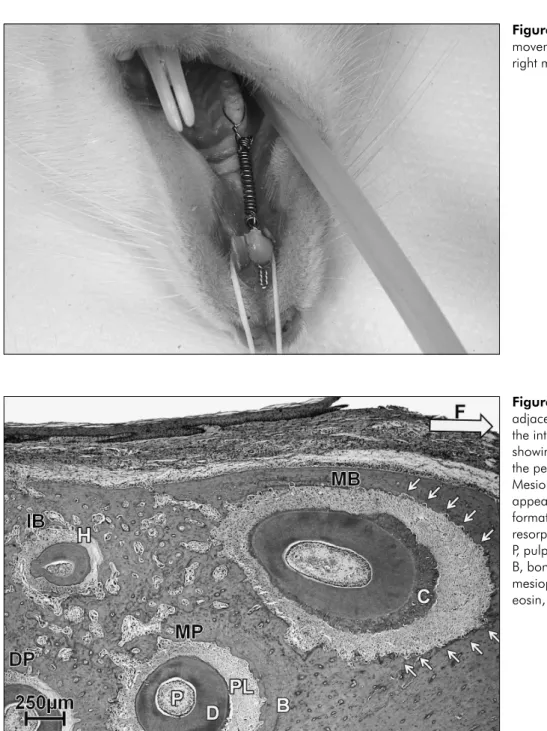
force was applied to these molars found that responses differed between the larger mesiobuccal (MB) root and the smaller intermediate buccal (IB) and distopalatal roots (Figures 1 and 2). These indings raise the question of whether different responses to force application can be ex-plained by differences in root size. Alternatively, because roots are single, solid structures ixed to a tooth that dissipate pressure into the PL along the entire length of the radicular surface, different responses may be ex-plained instead by variation in PL thickness.
This study assessed whether PL thickness varied with root size and whether this variation inluenced the biological response to orthodontic force.
methodology
Immobile maxillary left irst molars of 54 male white Wistar rats (Rattus norvegicus; ~90 days old, 300 g each) were measured in this study. For histologic examination, 6-µm-thick transverse sections were taken from the cervical regions to the separation points of all irst mo-lar roots and stained with hematoxylin and eosin. Images were captured using an AxioCam MRc5 microscopic camera and optical microscope (Carl Zeiss, Göttingen, Germany). Measurements were taken using
Im-Declaration of interests: The authors certify that they have no commercial or associative interest that represents a conflict of interest in connection with the manuscript.
Submitted: Aug 25, 2012
Cuoghi OA, Tondelli PM, Aiello CA, Mendonça MR, Costa SC
77
Braz Oral Res., (São Paulo) 2013 Jan-Feb;27(1):76-9
ageLab 98 software (Diracom Bio Informatics Ltda, Vargem Grande do Sul, Brazil) after the following series of lines were drawn on the images (Figure 3):
1. A line joining the centers of the IB and MB roots and continuing to the cementum;
2. A line dividing each root into mesial and distal sections, perpendicular to line 1 and passing through the center of the root; and
3. A line bisecting lines 1 and 2 and continuing to the cementum.
Analyses were made perpendicular to the radicu-lar surfaces extending to the cortical bone at lines 1 and 3, i.e., three measurements each were taken on the mesial and distal root surfaces. The mean of these three measurements was used to determine PL thickness on the mesial and distal sides, respective-ly, of each root. Mesial and distal thicknesses were then compared between the IB and MB roots using paired Student’s t-tests with a 5% signiicance level.
Figure 1 - Orthodontic tooth movement device on the maxillary right molar, anchored to the incisor.
Importance of periodontal ligament thickness
78 Braz Oral Res., (São Paulo) 2013 Jan-Feb;27(1):76-9
ing in hyaline formation that covered up to half of the compressed PL (Figure 2). In this study, we eval-uated whether this difference could be explained by variations in PL thickness.
Kondo6 reported that blood circulation in the PL
persists when its thickness is compressed by 1/3. In view of this inding, Kogure and Noda7 applied
forc-es that comprforc-essed 1/3 and 2/3 of the PL. They ob-served hyaline formation and severe root resorption in PLs that had been compressed by 2/3, but not in those that had been compressed by 1/3.
In this study, we found wide variation in PL thickness between transverse sections of the IB and MB roots of immobile molars that were associated with root size and shape. Mean mesial and distal PL thicknesses differed signiicantly between the MB and IB roots; the mesial PL thickness of the MB root was almost twice that of the IB root. Thus, PL thickness is clearly related directly to root dimen-sions, increasing with root size.
These indings suggest that the application of in-tense force that completely compressed the PL of the IB root would compress the PL of the MB root to only half of its thickness. Thus, greater PL thickness in the MB root leads to better dissipation of force, whereas stress is more concentrated in the thinner PL of the IB root, with a greater potential for hya-line formation and root resorption.
results
Mean distal and mesial PL thicknesses were 0.091 mm and 0.099 mm, respectively, on the IB root, and 0.117 mm and 0.171 mm, respectively, on the MB root (Figures 4 and 5). Mean values differed signiicantly between roots (p < 2.2 × 10⁻¹⁶).
Discussion
Orthodontic tooth movement (OTM) experi-ments in rats are performed to evaluate the effects on supporting tissues and the amount of tooth move-ment.3-5 For example, the maxillary right irst molar
can be subjected to OTM by means of a closed coil spring anchored to the maxillary right incisor (Fig-ure 1). The spring produces a force that moves the molar anteromesially. Microscopic analysis can then be performed to evaluate the effects of the force on tissues surrounding the roots.
An OTM study in rats using intense force ob-served no hyalinization around the MB roots,4 but
direct bone resorption on the compressed side. Such resorption is often associated with the slight appli-cation of force to the PL,2 suggesting that force is
better distributed in the PL of the larger MB root of the irst molar compared with the PLs of smaller roots, reducing hyaline formation and root resorp-tion. However, in our observations of OTM, the IB root seemed to experience intense pressure,
Cuoghi OA, Tondelli PM, Aiello CA, Mendonça MR, Costa SC
79
Braz Oral Res., (São Paulo) 2013 Jan-Feb;27(1):76-9 Figure 4 - Mesial periodontal ligament thicknesses on the
intermediate buccal (IB) and mesiobuccal (MB) roots. +, mean; °, outlier.
Figure 5 - Distal periodontal ligament thicknesses on the intermediate buccal (IB) and mesiobuccal (MB) roots. +, mean; °, outlier.
Bone and root surfaces are not uniform, and stress or strain can be concentrated in areas other than the PL, as demonstrated by Cataneo et al.8 By
analogy with experimental studies in rats, PL thick-ness is also likely to vary in the roots of human teeth, which also have varying shapes and sizes. Smaller roots may show more severe effects, such as resorption and hyalinization, which are not results of their smaller size, but of reduced PL thickness, which compromises pressure dissipation.
PL thickness (mean in rats, 0.130 mm) can be reduced by lack of function to around 0.055– 0.114 mm.1 Age-related variation in prostaglandin
E2 levels in the PL can explain differences in the rate of orthodontic treatment.9 Thus, PL thickness is a
determining factor in the effect of force application; a thinner PL will result in an increased local effect.
Conclusion
The results of this study indicate that PL thick-ness in rats is directly proportional to root dimen-sions, and that the biological response to force ap-plication varies with PL thickness. Thus, care should be taken in interpreting the results of research in-volving roots of different dimensions.
references
1. ElDeeb ME, Andreasen JO. Histometric study of the effect of occlusal alteration on periodontal tissue healing after surgical injury. Endod Dent Traumatol. 1991 Aug;7(4):158–63. 2. Brudvik P, Rygh P. Non-clast cells start orthodontic root
re-sorption in the periphery of hyalinized zones. Eur J Orthod. 1993 Dec;15(6):467–80.
3. Tengku BS, Joseph BK, Harbrow D, Taverne AAR, Symons AL. Effect of a static magnetic field on orthodontic tooth movement in the rat. Eur J Orthod. 2000 Oct;22(5):475–87. 4. Yokoya K, Sasaki T, Shibasaki Y. Distributional changes of
osteoclasts and preosteoclasts cells in periodontal tissues during experimental tooth movement as reveled by quan-titative immunohistochemistry of H+-ATPase. J Dent Res. 1997 Jan;76(1):580–7.
5. Tomizuka R, Shimizu Y, Kanetaka H, Suzuki A, Urayama S, Kikuchi M, et al. Histological evaluation of the effects of
initially light and gradually increasing force on orthodontic tooth movement. Angle Orthod. 2007 May;77(3):410–6. 6. Kondo K. [A study of blood circulation in the
periodon-tal membrane by electrical impedance plethysmography]. Kokubyo Gakkai Zasshi. 1969 Mar;36(1):20–42. Japanese. 7. Kogure K, Noda K. Periodontal response to experimental
tooth movement by interrupted orthodontic force in rats. Or-thod Waves. 2009 Sep:68(3);97–106.
8. Cattaneo PM, Dalstra M, Melsen B. Strains in periodontal ligament and alveolar bone associated with orthodontic tooth movement analyzed by finite element. Orthod Craniofac Res. 2009 May;12(2):120–8.