Braz Dent J 14(1) 2003
22Braz Dent J (2003) 14(1): 22-25 D.D.L. Dantas et al.
Clinical-Pathological Parameters in
Squamous Cell Carcinoma of the Tongue
Dilana Duarte Lima DANTAS1
Carlos César Formiga RAMOS2
Antonio de Lisboa Lopes COSTA1
Lélia Batista de SOUZA1
Leão PEREIRA PINTO1
1Department of Oral Pathology, School of Dentistry, Federal University of Rio Grande do Norte 2Department of Pathology, “Dr. Luis Antonio” Cancer Hospital
Natal, RN, Brazil
The correlation between TNM classification and histological scores of malignancy, and the correlation of these parameters with the prognosis was evaluated in 16 cases of squamous cell carcinoma of the tongue. The cases were selected from the files of “Dr. Luiz Antônio” Cancer Hospital, Natal, RN, Brazil. After analysis of the patients’ records, the data concerning TNM classification and prognosis (in a 5-year-follow-up) were obtained. All cases were classified according to the histological malignancy grading system proposed by Anneroth et al. (1) [Scand Dent Res 1987;95:229-249].There was no correlation (r = 0.3083) between TNM classification and histological scores of malignancy. There was significant correlation (r = 0.7206) between TNM classification and prognosis, but there was no correlation between the histological scores of malignancy and the prognosis.It was concluded that TNM classification is an important prognostic indicator of squamous cell carcinoma of the tongue.
Key Words: oral cancer, TNM classification, malignancy grading system, tongue squamous cell carcinoma.
Correspondence: Prof. Dr. Leão Pereira Pinto, Av. Senador Salgado Filho, 1787, Lagoa Nova, 59056-000 Natal, RN, Brasil.Tel: + 55-84-215-4132. Fax: +55-84-215-4138. e-mail: [email protected]
ISSN 0103-6440
INTRODUCTION
Oral squamous cell carcinoma is the most fre-quent malignancy in the mouth, corresponding to 95% of all oral malignant lesions. The most affected sites are the tongue, inferior lips and floor of the mouth. Males are affected twice as frequently as females and the majority of patients are more than 45 years old (2-4).
When compared to other oral cancers, squamous cell carcinoma of the tongue has a great predisposition to produce metastasis in lymph nodes (incidence 15-75%) depending on the extension of the primary lesion. In clinical practice, the treatment plan and prognosis of oral squamous cell carcinoma is mainly based on the TNM classification. However, this system does not provide any information on the biological characteris-tics of the tumor. Information about characterischaracteris-tics is important to obtain new objective prognostic factors that may provide information about the aggressiveness of this kind of tumor (5,6).
The aim of this study was to assess the correla-tion between the TNM classificacorrela-tion and the histological malignancy grading system proposed by Anneroth et al. (1), and the correlation of these parameters with the prognosis of squamous cell carcinoma of the tongue. The specific objective was to assess some indicative parameters that would assist in the prognosis of these lesions and in the correct choice of therapy.
MATERIAL AND METHODS
Sample Selection and Morphological Analysis
Braz Dent J 14(1) 2003
Squamous cell carcinoma of the tongue 23
T1N0M0; stage T2 = T2N0M0; stage T3 = T3N0M0 or T1,
T2, or T3N1M0; stage T4 = any T4 lesion, or any N2 or N3
lesion, or any M1 lesion.
Hematoxylin and eosin (H&E) stained samples had been submitted to morphological study with optic microscopy. The histological grading system of malig-nancy (1) consists of 6 morphological characteristics: degree of keratinization, nuclear polymorphism, num-ber of mitosis, invasive pattern, “stage of invasion” and lymph plasmocytic infiltration. As recommended by Pinto Jr. et al. (7), the parameter “stage of invasion” was omitted because these were incisional biopsies of oral squamous cell carcinoma. All mean scores for malignancy histological grading were obtained by the sum of the scores given to each morphological param-eter, and then divided by the number of used parameters. According to Anneroth et al. (8), scores ranging from 1.0 to 2.5 are considered to be low malignancy, and those ranging from 2.6 to 4.0 are considered to be high malignancy.
Statistical Analysis
The Pearson correlation test was applied to
as-sess the correlation between the TNM classification and malignancy histological scores and the Spearman correlation test was applied for the TNM classification and prognosis, as well as for malignancy histological scores and prognosis. The statistical tests were carried out with the GMC software, model 7.1, with a level of significance of 1%.
RESULTS
Based on the clinical data provided by the records of patients with squamous cell carcinoma, 75% (12 cases) of the sample were males and 25% (4 cases) were females, with ages ranging from 39 to 94 years. The most frequent age group was 61 to 70 years old with 43.75% (7 patients) of all cases.
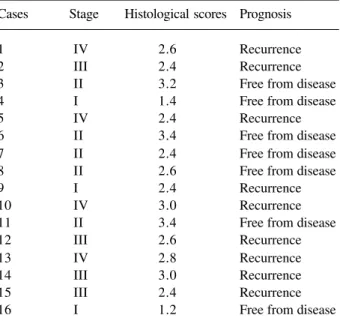
The TNM classification showed that 4 cases were classified as stage IV, 4 were stage III, 5 were stage II and 3 were stage I (Table 1). In terms of the malignancy histological scores, the results showed that 7 were classified as low score (1.2 to 2.5) and 9 were classified as high score (2.6 to 3.4) (Table 1). Results relative to the prognosis revealed that 9 patients had recurrence of the disease after the follow-up of 5 years, while 7 were free of disease.
Data analysis using Pearson correlation coeffi-cient showed no significant statistical correlation (r = 0.3083) between the TNM classification and malignant histological scores. The Spearman correlation coeffi-cient showed a statistically significant correlation (r = 0.7206) between TNM classification and prognosis. However, the Spearman correlation test revealed no statistically significant correlation (r = -0.1535) be-tween the malignant histological scores and prognosis.
DISCUSSION
With a considerably high frequency among ma-lignant tumors of the oral cavity, squamous cell carcinoma is characterized by a disordered prolifera-tion of cells in the squamous layer of the epithelium, where these cells express varied degrees of similarity with their cells of origin.
The endless search into histological samples of oral squamous cell carcinomas as one means of assist-ing in the evaluation of prognosis and in the plannassist-ing of adequate therapy for the patient led the authors to conduct this study.
Table 1. Data relative to TNM classification, malignancy histological scores and prognosis from 16 cases of squamous cell carcinoma of the tongue.
Cases Stage Histological scores Prognosis
1 IV 2.6 Recurrence
2 III 2.4 Recurrence
3 II 3.2 Free from disease
4 I 1.4 Free from disease
5 IV 2.4 Recurrence
6 II 3.4 Free from disease
7 II 2.4 Free from disease
8 II 2.6 Free from disease
9 I 2.4 Recurrence
10 IV 3.0 Recurrence
11 II 3.4 Free from disease
12 III 2.6 Recurrence
13 IV 2.8 Recurrence
14 III 3.0 Recurrence
15 III 2.4 Recurrence
16 I 1.2 Free from disease
Braz Dent J 14(1) 2003
24 D.D.L. Dantas et al.
The data for gender (75% males, 25% females) and most frequent age group (61-70 years; 43.75%) are in agreement with Oliver et al. (9) and Gervásio et al. (4).
In the analysis of the variable TNM classifica-tion, the results revealed that there was a clear relation between lesion size and lymph node involvement, con-sidering that, from the 16 cases included in this study, 8 had lesions with a diameter greater than 4 cm (lesions in stages III and IV). This fact certainly leads to a worse prognosis, if compared to lesions with smaller diam-eters without lymph node involvement, corroborating data from Snow and Leemans (10) and Tytor and Oloffson (11). According to these authors, there is a directly proportional relation between these two fac-tors, given that, the smaller the lesion, the easier will be the use of the conventional treatment means available for this kind of tumor, with a great possibility of cure after the first treatment.
It is important to mention that, from the 9 cases that had recurrence, 4 were in stage III, 4 were in stage IV and only 1 in stage I. This shows the great impor-tance of the stage of the disease and its impact on metastasis.
From the 8 cases in stages I and II (Table 1), only one patient had active disease due to refusal of treat-ment after surgery. The remaining cases showed no recurrence of disease. This indicates that the tumor stage has an expressive significance upon its prognosis. These findings are in agreement with those reported by Snow and Leemans (10) and Tytor and Olofsson. (11). When the histological malignancy grading sys-tem (1) was applied, it could also be observed that from the 7 cases classified with low scores of malignancy, 3 patients were free from the disease and 4 had recur-rence. Of the 9 cases classified as high malignancy, 4 patients were free from disease and 5 had recurrent disease at a minimum follow-up of 5 years.
Based on these results, it was evident that there was no substantial correlation between the histological scores of malignancy and the prognosis, considering that 57% of the lesions classified as low scores of malignancy showed recurrence at follow-up. On the other hand, from the 9 patients classified as high malig-nancy, 44% of these patients were diagnosed as free from disease after the follow-up of five years.
Histological evaluation results are likely to be more precise in establishing prognosis than those
es-sentially clinical, because histological changes can be seen microscopically before clinical changes.
From the point of view of the authors, the histo-logical grading system proposed by Anneroth et al. (1), modified by Pinto Jr. et al. (7), was not an effective prognosis indicator. Therefore, the present data contra-dict the findings of other studies (12-17) which consider the histological grading as a valuable indicator of prog-nosis for oral squamous cell carcinomas. However, it is important to report that, in this study, of 9 patients with lesions with a high malignancy score, 55% had con-firmed active disease at the 5-year follow-up. These data are in agreement with the above authors for consid-ering that the higher the malignant histological grading score, the worse will be the prognosis of the lesion.
With the purpose of testing the hypothesis of correlation between TNM classification and histologi-cal malignancy grading, statistihistologi-cal analysis was carried out which demonstrated that there was no significant statistical correlation between the two variables. From the point of view of the authors, among the disadvan-tages of the histological grading system proposed by Anneroth et al. (1) are situations in which the applica-tion of the parameters makes a large and representative biopsy sample necessary.
In addition to these aspects, Crissman et al. (18) consider that, in histological grading, only the charac-teristics which demonstrate isolated prognosis value should be evaluated. A high importance should not be given to variables of difficult identification and of low isolated prognosis value, such as mitosis number and nuclear atypia, at the expense of other more objective variables and of proven significance such as tumor thickness, neural infiltration and lymphatic emboliza-tion. These authors call attention to the fact that tumors that are well differentiated are likely to invade tissues in a pattern characterized by well-defined margins, while the more undifferentiated tumors infiltrate tissues in small cell groups or even as isolated cells, which may explain its correlation with the prognosis.
Braz Dent J 14(1) 2003
Squamous cell carcinoma of the tongue 25
incisional and representative biopsies should be used which provide visualization of all the invasive front and borders, as recommended by Bryne (19) and Piffkó et al. (20).
RESUMO
A correlação entre classificação TNM e escores histológicos de malignidade e a correlação destes parâmetros com o prognóstico foi avaliada em 16 casos de carcinoma epidermóide de língua. Os casos foram selecionados dos arquivos do Hospital Dr. Luiz Antonio, Natal, RN, Brasil. Após a análise dos prontuários foram obtidos os dados relativos à classificação clínica TNM e o prognóstico (seguimento de cinco anos). A classificação morfológica dos casos foi realizada de acordo com o sistema de gradação histológica de malignidade proposto por Anneroth et al. (1) [Scand Dent Res 1987;95:229-249]. Não houve correlação (r = 0,3083) entre classificação TNM e escores histológicos de malignidade. Houve correlação significante (r = 0,7206) entre classificação TNM e prognóstico, o mesmo não foi observado entre escores histológicos de malignidade e prognóstico. Diante destes resultados concluímos que o estadiamento clínico TNM constitui um indicador de prognóstico importante do carcinoma epidermóide de língua.
REFERENCES
1. Anneroth G, Batsakis J, Luna M. Review of the literature and a recommended system of malignancy grading in oral squamous cell carcinomas. Scand Dent Res 1987;95:229-249.
2. Beltrão RV, Sampaio MCC, Xavier MN, Duarte RC, Costa LJ. Epidemiologic study of the mouth cavity squamous cell carci-noma. J Dent Res 1999;78:1016 (abstract).
3. Line S, Lopes MA, Zaia AA, Jacks Júnior J. As alterações gênicas e o desenvolvimento do câncer bucal. Rev APCD 1995;49:51-56. 4. Gervásio OLAS, Dutra RA, Tartaglia SMA, Vasconcelos WA, Barbosa AA, Aguiar MCF. Oral squamous cell carcinoma: a retrospective study of 740 cases in a Brazilian population. Braz Dent J 2001;12:57-61.
5. Dib LL, Sabba LMB, Marques LA, Araújo NS. Fatores prognósticos em carcinoma de borda de língua: análise clínica e histopatológica. Acta Oncol Bras 1994;14:88-93.
6. Hiratsuka H, Miykawa A, Nakamori K, Kido Y, Sunakawa H, Kohama G. Multivariate analysis of occult lymph node metastasis
as a prognostic indicator for patients with squamous cell carci-noma of the oral cavity. Cancer 1997;80:351-356.
7. Pinto Jr DSP, Nunes FD, Sousa SCOM, Araújo VC. A célula de Langerhans e o prognóstico dos carcinomas epidermóides bucais. RPG 1994;1:10-13.
8. Anneroth G, Batsakis J, Luna M. Malignancy grading of squa-mous cell carcinoma in the floor of the mouth related to clinical evaluation. Scand Dent Res 1986;94:347-350.
9. Oliver AJ, Helfrick JF, Gard D. Primary oral squamous cell carcinoma: a review of 92 cases. J Oral Maxillofac Surg 1996;54:949-954.
10. Snow GB, Leemans CR. Prognostic factors of neck node me-tastases. Head Neck 1993;3:513-518.
11. Tytor M, Olofsson J. Prognostic factors in oral cavity carcinomas. Acta Otolaryngol 1992;492(Suppl):75-80.
12. Bryne M, Nielsen K, Koppang HS, Dabelsteen E. Reproducibility of two malignancy grading systems with reportedly prognostic value for oral cancer patients. J Oral Pathol Med 1991;20:369-372.
13. Anneroth G, Hansen LS, Silverman Jr S. Malignancy grading in oral carcinoma I. Squamous cell carcinoma of the tongue and floor of mouth: histologic grading in the clinical evaluation. J Oral Pathol 1986;15:162-168.
14. Holm LE, Lundquist PG, Silfversward C, Sobin A. Histological grading of malignancy in oral squamous cell carcinoma of the tongue. Acta Otolaryngol 1982; 94:185-192.
15. Bryne M, Koppang HS, Lilleng R, Stene T, Bang G, Dabelsteen E. New malignancy grading is a better prognostic indicator than Broders' grading in oral squamous cell carcinomas. J Oral Pathol 1989;18:432-437.
16. Odell EW, Jani P, Sherriff M, Ahluwalia SM, Hibbert J, Levinson DA, Morgan PR. The prognostic value of individual histologic grading parameters in small lingual squamous cell carcinomas. Cancer 1994;74:789-794.
17. Costa ALL, Pereira JC, Nunes AAF, Arruda MLS. Correlação entre a classificação TNM, gradação histológica e localização anatômica em carcinoma epidermóide oral. Pesq Odonto Bras 2002;16:216-220.
18. Crissman JD, Gluckman JL, Cummings G. Prognostic value of histopathologic parameters in squamous cell carcinoma of the oropharynx. Cancer 1984;54:2995-3000.
19. Bryne M. Is the invasive front of an oral carcinoma the most important area for prognostication? Oral Dis 1998;4:70-77. 20. Piffkó J, Bankfalvi A, Ofner D, Rasch D, Joos U, Schmid KW.
Standardized demonstration of silver stained nucleolar organizer regions associated proteins (AgNORS) in archival oral squamous cell carcinomas and adjacent non-neoplastic mucosa. Mod Pathol 1997;10:98-104.