_____________________________
*)
Corresponding author: [email protected]
doi: 10.2298/SOS1203365T
UDK 551.4.03;549.514.6;519.224
Effect of Binder Molecular Weight on Morphology of TiO
2Films
Prepared by Tape Casting and Their Photovoltaic Performance
N. Tasi
ć
1,*
), Z. Brankovi
ć
1, Z. Marinkovi
ć
-Stanojevi
ć
1, G. Brankovi
ć
11
Department of Materials Science, Institute for Multidisciplinary Research, University
of Belgrade, Kneza Višeslava 1, Belgrade, Serbia
Abstract:
Titanium(IV) oxide in the form of anatase has proven to be the best choice for photoanodic material in dye-sensitized solar cells (DSCs). The aim of the work was to study the influence of binder molecular weight on the morphology of deposited films, and consequently, DSC parameters. For this study, five different TiO2 tape casting slips were
prepared from commercially available nanoanatase powder and polyethylene glycol (PEG) as a binder. The process of drying and sintering was carefully designed, so that the organic template was slowly decomposed, leaving favorable crack-free, porous structure. It was found that there is an optimal region of binder molecular weight for obtaining homogeneous, non-agglomerated and porous microstructure which is a necessary condition for application of TiO2 films in DSCs.
Keywords: Dye-sensitized solar cell, TiO2, Tape casting, PEG.
1. Introduction
Dye-sensitized solar cells (DSCs) are considered to be a promising alternative to conventional solid-state photovolatic devices, because of their simple assembly and low-cost fabrication [1]. Typical DSC comprises of a photoactive anode, redox electrolyte and counter electrode. Photoactive anode is a semiconducting film deposited on transparent conductive oxide (TCO) glass, covered with the monolayer of dye, for the purpose of visible light harvesting. Upon the introduction of light into the cell, electrons are excited from dye and injected into the conduction band of semiconducting film. The charge carriers are transported to the external load through the anode, while the dye molecules are regenerated via electrolyte, which is present throughout the cell interior. Electrolyte cycle is completed on the counter electrode, usually Pt-coated TCO. Detailed structure and photovoltaic mechanism of DSCs is given elsewhere [2,3].
Special interest is developed towards the synthesis and characterization of an ideal semiconducting material for photoactive anode. It has been concluded that the general demands for highly effective photoanodic films are large surface area, high porosity (50-65%), continuity between its particles, absence of cracks, average thickness 8-12 μm and good adhesion on TCO substrate [4,5].
irradiation in solution, tunable morphology and physical properties. The highest reported solar-to-current efficiency and long term stability under the irradiation [7,8] are related to DSCs with TiO2 as anodic material.
One of the most convenient manners for producing uniform nanostructured layers of desired porosity and thickness is tape casting. It involves the preparation of well-dispersed slips of precursor ceramic powders, with different functional organic additives, including solvents, antiflocculants, binders and plasticizers.
The role of binder in tape casting slips is to provide the polymeric network that holds the entire chemical system together for further processing. Binder polymeric network is the only continuous phase within the slip, which decomposes during the sintering process. The presence of binder strongly affects the rheological properties of the slip as well as strength and density after sintering [9,10].
In this work we have prepared five different TiO2 slips using polyethylene glycol
(PEG) as a binder. PEG is a nonionic surfactant commonly utilized in thin film fabrication as a structure directing agent, owing to its favorable burnout characteristics, low glass transition temperature and good solubility in water and organic solvents [11-15]. We have chosen a wide range of PEG molecular weights (1000-20000) and examined its impact on the porosity, particles size and shape, thickness and adhesion of sintered films, and consequently, the operating parameters of DSCs. Other ingredients of prepared slips include binary solvent system isopropanol/α-terpineol, stearic acid as antiflocculant and low molecular weight PEG as a plasticizer, and their role in tape casting process is explained elsewhere [9, 16-18].
2. Experimental
2.1. Slip preparation
TiO2 slips with different compositions were prepared starting from 0.1200 g of
titanium(IV) oxide nanopowder (<25nm particle size, spec. surface area 45-55 m2/g, Sigma Aldrich), 1.125 ml of isopropanol (min. 99.7%, AnalaR NORMAPUR, VWR) and 0.375 ml of α-terpineol (96%, Alfa Aesar), which were vigorously grinded together in agate mortar. Then, 0.100 g of stearic acid (Superlab) was added to mixture, and the mixture was additionally grinded for 10 minutes. Finally, after the addition of binder (PEG, molecular weight 1000/4000/6000/8000/20000, Alfa Aesar) and plasticizer (polyethylene glycol, molecular weight 200, Alfa Aesar), slips were deposited on FTO-glass substrates (8 Ω/sq, Xopglass) and microscope glass slides using Elcometer 3580 Casting Knife Applicator. The samples were named based on PEG used for their preparation, for example sample PEG 4000 means the ceramic sample was prepared with PEG 4000 as a binder etc.
As deposited films were dried at 60 °C, and sintered at 475 °C for 1 h, with the temperature raise of 1 °C/min, and a mid-step at 300 °C for 1 h.
Scanning electron microscopy of the films was performed using TESCAN VEGA3 SB microscope, while the X-ray diffractograms were obtained by Rigaku X-Ray Spectrometer KG-3.
2.2. DSCs fabrication and characterization
As-sintered films were immersed in 3·10-4 mol/dm3 solution of cis-bis(isothiocyanato) bis(2,2’bipyridyl-4,4’-dicarboxylato) ruthenium(II) bis-tetrabutylammonium (Dyesol, N719) in CH3CN/t-butanol (50:50 vol %) for 10 h. The
iodide-based redox shuttle solution (the electrolyte consisted of 0.50 mol/dm3 1-methylbenzimidazole iodide, 0.05 mol/dm3 I2 and 0.5 mol/dm3 lithium iodide in
methoxypropinitrele) was dripped between the FTO/TiO2/dye working electrode and the
Pt onto FTO-coated glass (8 Ω/sq, Xopglass,) via thermal decomposition of H2PtCl6 solution
(2 mg of Pt in 1 cm3 of ethanol) at 450 °C for 30 min. The dye-covered electrodes and Pt counter electrodes were assembled into a sandwich-type cell and sealed with a Surlyn 1702 hotmelt gasket 50 μm thick. Finally, the assembled cell was filled with the electrolyte containing the I−/I3− redox couple. For the photovoltaic measurements, the DSCs were
illuminated with an AM1.5 solar light simulator (SolarLight XPS400) at 100 mW/cm2 and their current density-voltage (j-V) characteristics were registered with a Solartron 1287 Potentiostat/Galvanostat.
3. Results and discussion
In has been concluded elsewhere [19], that the anatase crystal phase has superior photovoltaic behavior compared to other TiO2 phases. Thus, it was of great importance to
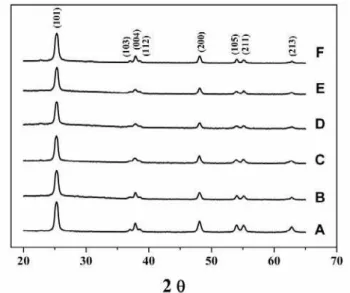
preserve the anatase presence in sintered films. X-ray diffractograms presented in Fig. 1. confirmed that the chosen sintering regime suppressed the formation of other crystal phases, showing prominent anatase peaks.
Fig. 1. X-ray diffractograms corresponding to (A) nanoanatase precursor powder, (B)-(F) TiO2 films prepared from slips with PEG 1000/4000/6000/8000/20000, respectively.
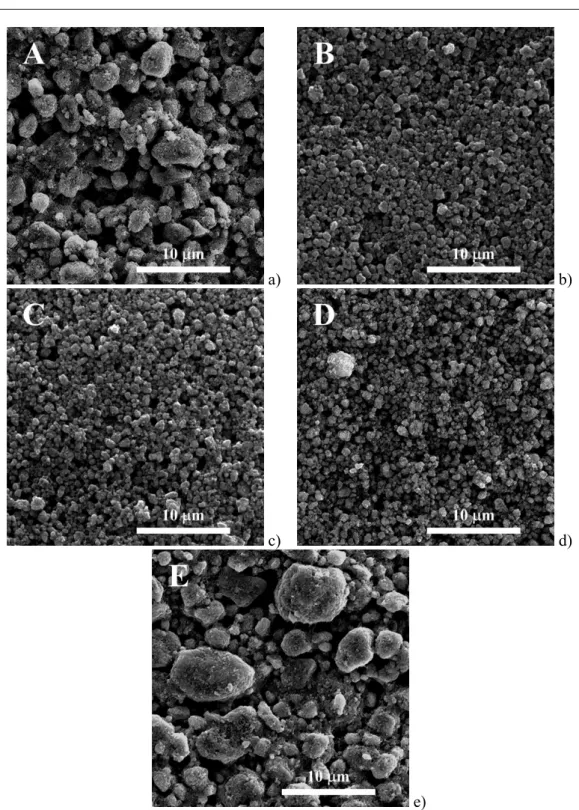
SEM analysis of as-sintered films confirmed the presence of uniform structure in the films with PEG 4000/6000/8000 (Fig. 2). Carefully designed drying and sintering processes allowed the organic ingredients to decompose slowly, leaving porous, crack-free and non-flaking structure. The absence of cracks can also be attributed to chosen powder to binder mass ratio, and to the use of low volatile solvent, α-terpineol [20]. Detailed analysis of micrographs indicates that the average particle size is higher than of the precursor powder. Particles have irregular sphere-like shape, with average size decreasing with the increase of binder molecular weight. The estimated values of the mean grain size are 0.37 μm, 0.38 μm and 0.45 μm, for films with PEG 8000, PEG 6000 and PEG 4000, respectively.
а) b)
c) d)
e)
Fig. 2. SEM micrographs of the TiO2 films sintered at 475°C from slips with different
binders: (A) PEG 1000, (B) PEG 4000, (C) PEG 6000, (D) PEG 8000, (E) PEG 20000.
agglomeration and non-uniform porosity are reasons because the films with PEG 1000 and PEG 20000 were excluded from further investigation of the DSCs.
a) b)
c)
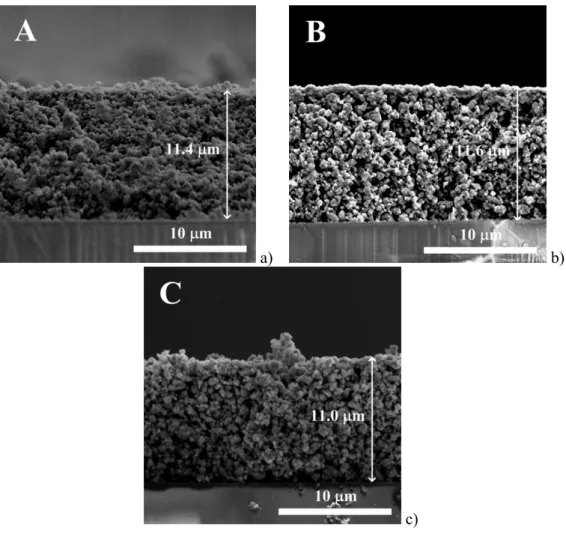
Fig. 3. SEM micrographs of the TiO2 film’s cross-section. Films were deposited on
microscope glass slides, with same gap on the tape casting applicator: (A) PEG 4000, (B) PEG 6000, (C) PEG 8000.
Another proof of favorable structure of the films with PEG 4000/6000/8000, comes from SEM micrographs of the films’ cross-sections, showed in Fig. 3. Micrographs confirmed the absence of cracks, the presence of pores throughout the TiO2 films, and interconnected
network of TiO2 particles, which are important characteristics for providing good photovoltaic
performances. The film with PEG 6000 showed slightly higher porosity. All three films exhibited satisfactory adhesion, which was tested using a tape stripping method explained elsewhere [22].
Tab. I. Photovoltaic parameters (open-circuit voltage (Voc), short-circuit current density (jsc),
fill factor (FF) and conversion efficiency (η)) of DSCs with different TiO2 photoanodes.
TiO2 sample Voc, V jsc, mA/cm2 FF η, %
PEG 4000 0.72 5.65 0.54 2.18
PEG 6000 0.72 7.29 0.50 2.63
Photovoltaic performance of DSCs prepared from as-sintered TiO2 films, acting as
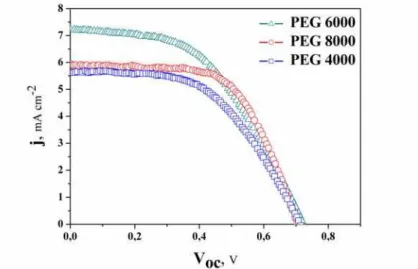
photoanodes, was investigated by recording the current density–voltage characteristic (j-V), shown in Fig. 4. Parameters of merit, extracted from curves, are presented in Table I.
As it was expected based on microstructural properties, all three films showed similar efficiencies. Nevertheless, there are some differences in certain parameters. All curves have same values of open-circuit voltage, Voc, i.e. the potential that corresponds to zero current.
Fig. 4. Current density–voltage characteristic (j-V) of DSCs consisting of TiO2 photoanodes,
prepared from slips containing PEG with different molecular weights.
This is attributed to the same chemical nature of photoanodic material, previously confirmed in XRD analysis. The slight difference between values of jsc, i.e. short circuit
density that flows with zero resistance (V = 0), arise from different light trapping within TiO2
electrodes, but also from active surface area, which are both dependent, between other factors, upon the porosity. Thus, the best result was achieved in samples PEG 6000 and PEG 8000. The sample PEG 6000 showed the highest value of short-circuit current density (jsc), but a fill
factor, FF, parameter that describes the “squareness” of the j-V curve, is the highest in sample PEG 8000, due to the presence of clear electron paths, i.e. the lowest internal resistance. Considering all the parameters, extracted from the curves, overall efficiencies were calculated, with the highest value of 2.64% in Sample PEG 8000.
4. Conclusion
Five different TiO2 slips were prepared starting from commercial nanoanatase
powder, and deposited on FTO-glass substrates using tape casting applicator. The correlation between the binder molecular weight and morphology of deposited films, and consequently, the operating parameters of DSCs was established. Films with PEG 4000/6000/8000 showed uniform, crack-free, non-flaking porous nanostructure and good adhesion on FTO substrates. Films with PEG 1000 and PEG 20000 showed structure with large agglomerates, and non-uniform porosity. It was found that there is an optimal region of binder molecular weight for obtaining homogeneous, non-agglomerated and porous microstructures and consequently better solar-to-current efficiency.
The best overall solar-to-current efficiency was achieved with DSSC consisting of TiO2 photoanode, prepared from slip with PEG 8000 (η = 2.64%). Sample with PEG 6000
the highest fill factor (FF = 0.63), was recorded for the sample 8000 due to better connectivity between particles.
Acknowledgement
This work was financially supported by the Ministry of Education, Science and Technological Development of the Republic of Serbia (Project number III45007).
We are very grateful to Dr. Márcio de Sousa Góes and Dr. Paulo Roberto Bueno of Institute of Chemistry, Physical Chemistry Department, UNESP, Araraquara, São Paulo, Brazil for measurements of the solar cells.
5. References
1. B. O'Regan, M. Grätzel, Nature, 353(1991) 737. 2. M. Gratzel, J. Photoch. Photobio. C, 4(2003) 145.
3. J. Halme, P. Vahermaa, K. Miettunen, P. Lund, Adv. Mater., 22(2010) E210. 4. M. Gratzel, Inorg. Chem., 44(2005) 6841.
5. K. Hara, H. Arakawa, Dye-sensitized solar cells, Handbook of Photovoltaic Science and Engineering, Wiley, 2003
6. M.J. Šćepanović, M. Grujić-Brojčin, Z.D. Dohčević-Mitrović, Z.V. Popović, Sci. Sintering, 41(2009) 67.
7. M.K. Nazeeruddin, F. De Angelis, S. Fantacci, A. Selloni, G. Viscardi, P. Liska, S. Ito, B. Takeru, M. Gratzel, J. Am. Chem. Soc., 127(2005) 16835.
8. U. Bach, Y. Tachibana, J-E. Moser, S.A. Haque, J.R. Durant, M. Gratzel, D.R. Klug, J. Am. Chem. Soc., 121(1999) 7445.
9. R.E. Mistler, E.R. Twiname, Tape Casting Theory and Practice, Wiley - American Ceramic Society, 2000
10. S.K. Dhungel, J.G. Park, Renew. Energ., 35(2010) 2776.
11. M.A. Khan, M.S. Akhtar, O-B. Yang, Sol. Energy, 84(2010) 2195. 12. K. Fan, M. Liu, T. Peng, L. Ma, K. Dai, Renew. Energ., 35(2010) 555. 13. B. Guo, Z. Liu, L. Hong, H. Jiang, Surf. Coat. Tech., 198(2005) 24. 14. T. Miki, K. Nishizawa, K. Suzuki, K. Kato, J. Mater. Sci., 39(2004) 699. 15. K. Kato, K-i. Niihara, Thin Solid Films, 298(1997) 76.
16. Z. Jingxian, J. Dongliang, L. Weisensel, P. Greil, J. Eur. Ceram. Soc., 24(2004) 2259. 17. Z. Jingxian, J. Dongliang, L. Weisensel, P. Greil, J. Eur. Ceram. Soc., 24(2004) 147. 18. K.H. Zuo, D.L. Jiang, J. Zhang, Q.L. Lin, Ceram. Int., 33(2007) 477.
19. N.-G. Park, J. van de Lagemaat, A.J. Frank, J. Phys. Chem. B, 104(2000) 8989. 20. N. Negishi, K. Takeuchi, Thin Solid Films, 392(2001) 249.
21. M.N. Ramahan, Ceramic Processing and Sintering, Marcel Dekker, Inc., 2003
22. G. Balasubramanian, D.D. Dionysiou, M.T. Suidan, V. Subramanian, I. Baudin, J.-M. Laine, J. Mater. Sci., 38(2003) 823.
Са р а: (IV)- , ,
( .
dye-sensitized solar cells, DSCs). Ц
, ,
. П TiO2
, FTO „tape casting” . П
,
, , .
, ,
, TiO2
DSCs.