Vol.50, n. 6 : pp.971-978, November 2007
ISSN 1516-8913 Printed in Brazil BRAZILIAN ARCHIVES OF
BIOLOGY AND TECHNOLOGY
A N I N T E R N A T I O N A L J O U R N A L
Alveolus-Capillary Permeability on Both Normal and HIV
Seroreactive Individuals
José Carlos Carriel1,3,4, Carmelindo Maliska1,3,5*, José Henrique Piloto2, Antônio Neres Norberg3, Joaquim D´Almeida1,2,3, Gilsy S. Ferreira3 and Maria Expósito Penas5
1
Serviço de Medicina Nuclear do Hospital Central do Exército; Rua Francisco Manoel, 126; Triagem, 20911-270; Rio de Janeiro - RJ - Brasil. 2Serviço de DST-AIDS do Hospital Geral de Nova Iguaçu; Av. Henrique Duque Estrada Mayer, 953; Alto da Posse; Nova Iguaçu - RJ - Brasil. 3Faculdade de Ciências Biológicas e da Saúde; UNIG; Av. Abílio Augusto Távora, 2134; Centro; Nova Iguaçu - RJ - Brasil. 4Faculdades Unificadas; FESO; Av. Alberto Torres, 111; Alto Teresópolis - RJ - Brasil. 5Serviço de Medicina Nuclear; Hospital Universitário Clementino Fraga Filho; UFRJ; Av. Brigadeiro Trompowski, s/nº; Ilha do Fundão; Rio de Janeiro - RJ - Brasil
ABSTRACT
The aim of this study was to evaluate the alveolus-capillary permeability by the lung clearance rate of 99m Tc-DTPA(Technetium99m-diethylene triamine penta-acetate), (LCR-DTPA), both in normal and in asymptomatic HIV seroreactive patients. Thirty individuals were studied, 21 seronegative normal volunteers and 9 HIV seroreactive patients presenting normal chest radiography and no respiratory infection symptoms. LCR-DTPA was determined by inhaling 99mTc-DTPA and obtaining images in a gamma camera. The 99mTc-DTPA clearance rate in normal individuals was 0.99±0.15%.min-1 and in patients 2.31±1.25%.min-1. There was a significant statistical difference between the two groups (p< 0.05). Two patients who presented LCR-DTPA higher than 4.3 %.min-1 presented pneumocystis pneumonia one month later. Seroreactive AIDS patients, previously asymptomatic that presented pneumonia later showed higher LCR-DTPA than the seroreactive who did not develop the illness. These results suggested that LCR-DTPA could be a predictive method for the clinical development of pneumocystis pneumonia in asymptomatic HIV seroreactive patients.
Key Words: HIV seroreactive, alveolus-capillary permeability, 99mTc-DTPA clearance, pneumocystis pneumonia
*
Author for correspondence
INTRODUCTION
The number of AIDS cases has been increasing all over the world in spite of adoption of health programs aimed at information and guidance of preventive measures. According to the Brazilian Health Ministry, between 1980 and 2001 AIDS cases reported in Brazil were 237,588; 35,387 of them located in Rio de Janeiro (Brazil 2001). Since the onset of the acquired immunodeficiency syndrome (AIDS), both in
HIV infection (McGuinness 1997). The most common pathogen of pulmonary infection in HIV seroreactive patients is Pneumocystis jiroveci (Pneumocystis carinii) (Kuhlman 1996). Pneumocystis pneumonia is usually characterized by progressive dyspnea, hypoxemia with pulmonary infiltration. Pneumocystis pneumonia may be difficult to diagnose because the symptoms – fever, cough and shortness of breath – are non-specific (Katz & Hollander 2004). A lymphocytic alveolitis is commonly noticed during the course of HIV disease. Meignan et al. (1990) have found a high incidence of such an alveolitis in HIV seroreactive patients without detectable lung infection or tumor. The functional integrity of the alveolus-capillary barrier may be altered in aseries of pathologic condition, such as chronic lung diseases and smoking cigarettes, leading to an increase on the alveolus-capillary permeability (Jones et al. 1980, Nery et al. 1988).
Recently, great interest has been developed in the method of measuring respiratory epithelial permeability through the use of radioactive aerosols of low molecular weight solutes, particularly Technetium-99m-diethylene triamine penta-acetate (99mTc-DTPA) complex. The 99mTc-DTPA complex when deposited on the pulmonary epithelial surface diffuses from the airspace to the vascular space, hence, it equilibrates rapidly with the total-body extra-cellular fluid space and once in blood stream, it is simultaneously filtered by the kidneys. The procedure to assess the integrity of the pulmonary epithelium is based on the clearance rate of aerosolized 99mTc-DTPA (Mason et al. 1983).
As the epithelium is the most impermeable component of the alveolar-capillary barrier, injury to this membrane can enhance solute diffusion from the alveolar to the vascular compartment (Barrowcliffe & Jones 1987). Mason et al. (1987) have found in 12 patients with pneumocystis pneumonia very high values of 99mTc-DTPA clearance rate. In 13 HIV seroreactive patients, with respiratory symptoms of pneumocystis pneumonia, studied by Meignan et al. (1990), the 99mTc-DTPA clearance was significantly elevated, ranging from 2.00% to 11.60%.min-1 (normal = 1.1% ±0.34.min-1). Rosso et al. (1992) studied 39 patients with diagnosis of pneumocystis
pneumonia have found a 99mTc-DTPA clearance greater than 4.5%.min-1 and suggested that this clearance value was both sensitive and specific for the diagnosis of pneumocystis pneumonia. The aim of this study was to evaluate the permeability of pulmonary epithelium by the determination of the lung clearance rate of
99mTc-DTPA (LCR-DTPA) both in normal
individuals and in non symptomatic HIV seropositive patients.
MATERIALS AND METHODS
Patients
Clearance measurements were made in 21 asymptomatic and healthy volunteers (15 males, 6 females), mean age of 48.9 years old (range from 22 to 69) with no recent history of upper respiratory illness, 7 of them never smoked cigarettes and 14 stopped smoking 1-6 years before the study; in 9 HIV seroreactive patients (4 males and 5 females) mean age 33.2 years old (range from 28 to 40) which presented normal chest radiographs, neither opportunistic infection symptoms nor suggestive signs of pulmonary infection. As smoking increases
99m
Tc-DTPA clearance (Jones et al. 1980, Nery et al. 1988) only patients who had refrained from smoking for more than three weeks prior to clearance determinations were included in this study. Patients HIV seroreactive were ordered from DST-AIDS Service at General Hospital of Nova Iguaçu (Rio de Janeiro, Brazil).
This study was approved by the ethic committee of the hospital and patients gave informed consent before undergoing the exam.
Radiopharmaceuticals
The sodium pertechnetate (Na 99mTcO4) -
obtained from a 99Mo/99mTc generator - and diethylene triamine penta-acetate (DTPA) was produced by the Institute of Energetic and Nuclear Research (IPEN–CNEN, São Paulo, SP, Brazil). To generate the 99mTc-DTPA complex, 2.2 MBq (60 mCi) of sodium pertechnetate was introduced into a vial containing 3.3 mg of DTPA. The binding efficiency of 99mTcO4 to
Equipment
All images were acquired with a dual-head gamma camera Nucline DH MB 9500 SPECT (Mediso, Budapest, Hungary). The windows were centered over the 99mTc photo peak with a width of 20%. Parallel holes, low energyu, general purpose collimator was used.
Nebulizer
Aerogama (Gama Medical, Porto Alegre, RS, Brazil), a shielded jet nebulizer that produces an aerosol of 0.86µm MMAD (mass median diameter), with standard geometric deviation of 0.98µm (Droplet and Particle Analyzer, [Malvern, series 2.600], Laboratório de Caracterização Tecnológica – Departamento de Engenharia de Minas, Escola Politécnica, Universidade de São Paulo, São Paulo, Brazil; Report of 06/02/96).
Method
Diagnostic of HIV was done by enzyme-linked immunosorbent assay (ELISA). Absolute CD4 lymphocyte count and the values of serum lactate dehydrogenase were determined. Clearance determination has been described in detail elsewhere (Maliska 1997). A dose of 1.1MBq (30 mCi) of 99mTc-DTPA preparation was diluted in 2 mL of 0.9% saline solution introduced in the nebulizer and submitted to compressed air at a flow rate of 9L/min to produce the aerosol to be inhaled by mouth through a mouthpiece for 2 min with normal tidal volumes, with a clip in the nose. Immediately after the inhalation, the individual
was positioned (in the supine position) with his back facing the detector. Dynamic acquisition of the detected lung field radioactivity was monitored for 15 min, with images of 30 s duration, with a digital gamma camera linked to a computer.Time-activity curves were derived from the activity computed in regions of interest comprising the entire right lung field and fitted by a mono-exponential model according to the equation: A(t) = Ao.ekt, where Ao is the activity contained the lung field immediately after the end of the inhalation. The clearance rate (k) derived from the fit performed on the curves during the first 7 min after the end of the inhalation, was expressed in %.min-1. The half life (T1/2) of aerosol permanence in the lung was
also determined, as follows: T1/2 = 0.693/k.
Group mean data were expressed as the mean ±standard deviation. Student´s t test was employed for intergroup comparisons. P values <0.05 were considered statistically significant.
RESULTS
Fig. 1 shows the pulmonary clearance of 99m Tc-DTPA aerosol and its pulmonary distribution in a healthy volunteer. Mean value of pulmonary clearance rate of 99mTc-DTPA aerosols in normal individuals was 0.99±0.15 %.min-1. Table 1 shows the mean age and the results of LCR-DTPA in %.min-1 and T1/2 of LCR-DTPA
expressed in min for both groups.
Table 1 - Lung clearance rate of 99m Tc-DTPA in normal individuals and in HIV serore active patients.
Age in years 48 ±14,8 33,3 ± 5,3
LCR (%.min-1) 0,99± 0,15 2,31 ± 1,15
LCR (T1/2.min-1) 72,4 ± 10,4 38,6 ± 20,0
(1)mean ± SD
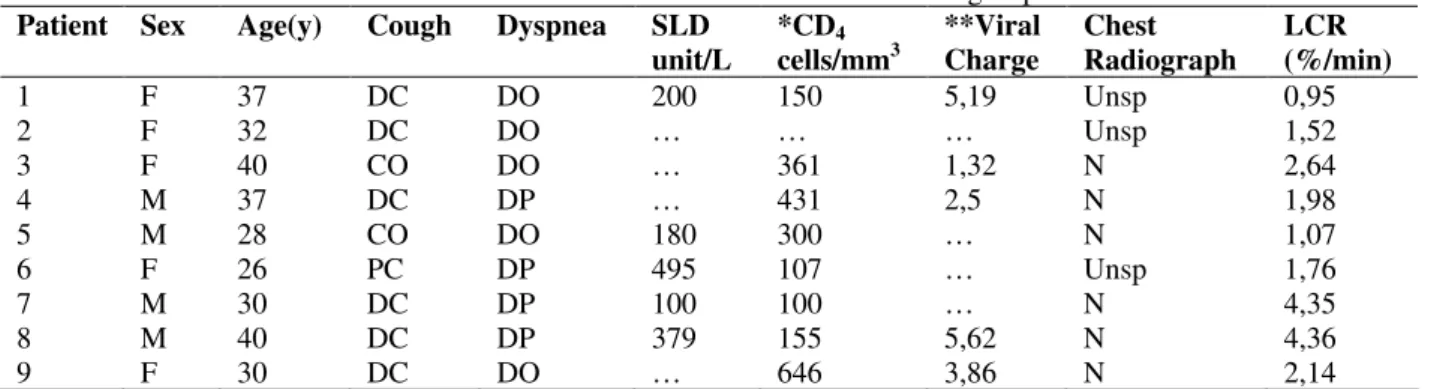
There was a significant statistical difference between the means of normal subjects group and HIV seroreactive group (p< 0.05). Mean value of all 9 HIV seroreactive patients was 2.31±1.15%.min-1 (Table 2), the value of LCR-DTPA of seroreactive patients nº 7 and 8 was
4.36 ± 0.01%.min-1 and the value of the other seven patients seroreactive, that did not develop pneumocystis pneumonia was 1.72 ± 0.60%.min-1 (p<0.01). The pulmonary clearance of 99mTc-DTPA in HIV seroreactive patients are shown in Figs. 2 and 3.
Table 2 - Clinical and laboratorial data and LCR values of the HIV seroreactive group.
Patient Sex Age(y) Cough Dyspnea SLD
unit/L
*CD4 cells/mm3
**Viral Charge
Chest Radiograph
LCR (%/min)
1 F 37 DC DO 200 150 5,19 Unsp 0,95
2 F 32 DC DO … … … Unsp 1,52
3 F 40 CO DO … 361 1,32 N 2,64
4 M 37 DC DP … 431 2,5 N 1,98
5 M 28 CO DO 180 300 … N 1,07
6 F 26 PC DP 495 107 … Unsp 1,76
7 M 30 DC DP 100 100 … N 4,35
8 M 40 DC DP 379 155 5,62 N 4,36
9 F 30 DC DO … 646 3,86 N 2,14
*CD4: lymphocyte count; **Viral charge in log of virus/mL
CO: cough out; DC: dry cough; ; PC: productive cough; DO: dyspnea out; DP: dyspnea present; SLD: serum lactate
dehydrogenase; N: normal; Unsp = unspecific; LCR: Lung Clearance Rate of 99mTc-DTPA aerosol;
Figure 3 - Curves of radio active counts versus time Monitored over the lung regions of interest and the image of radioactive aerosol distribution in a sero-reactive patient - No.7 -, who had late developed pneumocystis pneumonia (LCR-DTPA = 4.35 %.min-1). Note the accentuated decline in the curves of radioactivity counts as compared to the curves in Fig. 1 and 2, and also the image of intense 99mTc-DTPA elimination through the kidneys
DISCUSSION
The HIV seroreactive patients are subject to opportunistic infections, due to the loss of inflammatory response and during their short life intervals they can present pneumocystis pneumonia episodes (Mills 1986).
In contrast to gases, which are able to diffuse through the whole of the alveolar-capillary area, the diffusion of hydrophilic solutes, such as 99m Tc-DTPA, is thought to be restricted to the much smaller surface area occupied by the intercellular junctions. Some studies have shown that solute permeation of epithelial junctions is about 10 times less than that of the endothelium. The equivalent pore radii calculated from physiological studies are around 0.6 – 1.0 nm for the epithelium and around 4.0 – 5.8 nm or more for the endothelium (Taylor & Gaar 1970). As the epithelium is the most impermeable component of the alveolar-capillary barrier, injury to this membrane can enhance solute diffusion from the alveolar to the vascular compartment (Barrowcliffe & Jones 1987).
Measurement of lung clearance of aerosolized
99m
Tc-DTPA is currently used to assess the integrity of the alveolus-capillary barrier. The clearances rate of 99mTc-DTPA (LCR-DTPA) is increased in a wide variety of both acute and chronic diseases that result in morphologic injury to the pulmonary epithelium. Elevated 99m Tc-DTPA clearances have been documented among
In the present study, lung epithelial permeability measured by the 99mTc-DTPA clearance rate was elevated (LCR-DTPA of 1.72 ± 0.60%.min-1) in seven non symptomatic HIV seroreactive patients that did not develop pneumocystis pneumonia later. The two other patients showed a clearance rate of 4.35 and 4.36 %.min-1. One month later, they developed pneumocystis pneumonia, one of them died in consequence of his refusal to undergo a specific treatment. The other underwent the proposed treatment (trimethoprim sulfamethoxazole) and had an excellent therapeutic response. Such facts were in agreement with the low count of CD4 leucocytes of these two
patients (100 and 155 cells/mm3), but not with the other group of patients HIV seroreactive that did not develop the illness. In those patients, there was a disagreement between the CD4 leucocytes count
and the LCR-DTPA values.
The small elevation in LCR-DTPA in patients that did not develop pneumocystis pneumonia perhaps could be explained by the observation of Meignan et al. (1990) that lymphocytic alveolitis was observed in 70% of HIV seroreactive patients without detectable lung opportunistic infection. Alveolar HIV- specific cytolytic T-lymphocytes were found in patients at early stage of HIV disease and gradually disappeared during the course of HIV infection. Meignan et al. (1990) observed lymphocytic alveolitis in patients with normal LCR-DTPA and without alveolar lytic activity and suggested that the alteration of pulmonary epithelial permeability as measured by LCR-DTPA could be induced by the presence of CD8+D44+ lymphocytes reacting in vivo with HIV-infected alveolar macrophages.
Documentation of Pneumocystis jiroveci
infections usually requires invasive diagnostic procedures. Bronchoscopy is generally conducted in patients with a predisposing factor, such as AIDS, who present with cough, fever and dyspnea with hypoxemia and pulmonary infiltrate. Galium-67 scans are sometimes used to help to determine which patients require bronchoscopy (Coleman et al.1984), but the main disadvantage of this method is the minimum 48h delay to have the results (Mason et al. 1987). It is important to note that mean value of LCR-DTPA of seroreactive patients nº 7 and 8 (4.36 %.min-1) was more than four times higher the mean value of normal volunteers, in contrast with mean value (1.72%.min-1) for the other seven patients that did not develop pneumocystis pneumonia, which was too close to
mean normal value. This observation suggested that the procedure was very sensitive, however, to detect specific pathogenic organism bronchoscopy must be performed.
Three points should be emphasized. One is that irradiation exposure to 99mTc-DTPA clearance studies is minimal. The doses can be compared with the annual natural irradiation dose and to the radiation dose delivered by one chest radiography. In a larger sense, the irradiation dose due to scintigraphic examination is between the natural environmental dose and radiological dose (Baulieu 1993). The other one is that LCR-DTPA studies appears to be useful as a screening test because it is non-invasive, physiologic, easy to perform, well tolerated and permits quantification of data. Third is that the method can be used to test efficacy of medication because clearance rates normalize after treatment (Mason et al. in 1987). Than, it could be concluded that the present study was in agreement with literature and suggested that LCR-DTPA could be a good predictive method for the clinical development of pneumocystis pneumonia in non symptomatic HIV seroreactive patients.
ACKNOWLEDGMENTS
The authors are indebted to Drs. Grimário Nobre de Oliveira, Gen Med; Carlos José Vaz da Silva, Cel Med; Plotino Ladeira da Matta, Cel Med, Directors, at different times, of the Central Brazilian Army Hospital and Rodrigo Antoun Collares, Maj Med, Nuclear Medicine Department Head, where this research was carried out. The authors thank Mr. Julio Cesar Deberg for his technical assistance.
RESUMO
HIV sororreativos. Foram estudados 30 indivíduos, sendo 21 voluntários normais e 9 HIV sororreativos sem sintomas de infecção oportunista, com radiografias de tórax normais ou sem sinais sugestivos de infecção pulmonar. A LCR-DTPA foi determinada após inalação de
99mTc-DTPA sob a forma de aerossóis e contagem
externa da radiação, em função do tempo, em gama câmara. A LCR-DTPA dos controles foi de 0.99±0.15 %.min-1 e nos pacientes sororreativos,de 2.31±1.15%.min-1 houve diferença significativa entre os dois grupos (p< 0.05). Dois pacientes tiveram LCR-DTPA acima de 4,3%.min-1, estes desenvolveram um mês após o exame. Observou-se que os pacientes sororreativos por Imunodeficiência Adquirida (SIDA), sem sintomas específicos para pneumocistose que posteriormente desenvolveram a doença, a LCR-DTPA foi significativamente maior que a dos outros HIV pneumocistose clínica sororreativos que não desenvolveram a doença (p<0.01). Estes resultados sugerem que a LCR-DTPA pode ser um método preditivo do desenvolvimento clínico da pneumocistose, não invasivo, de fácil realização e cômodo, para o paciente HIV sororreativo assintomático.
REFERENCES
Baulieu, J.L.(1993) Practical Notions for Carrying Nuclear Medicine Examination. In – Nuclear Medicine and Lung Diseases ed. P, Diot., J-L. Baulieu., E. Lemarié. Springer-Verlag, Paris, pp. 39-44.
Barrowcliffe, M.P., Jones, J.G. (1987), Solute Permeability of the Alveolar Capillary Barrier. Thorax ,42, 1-10.
Brazil (2001) Programa Nacional de Doenças Sexualmente Transmissíveis / AIDS. In - AIDS - Boletim Epidemiológico. Ministério da Saúde do Brasil, Brasília. pp. XV-1.
Clark,W.R., Grossman, Z.O., Ritter-Hrncirik, Z. (1988), Clearance of aerosolized 99mTc-diethy-lene triamine pentacetate before and after smoke inhalation. Chest,
1994, 22-27.
Coleman, D.L., Dodek, P.M.,Golden, J.A, Murray JF.(1984) Correlation between serial pulmonary Function tests and fiberoptic bronchoscopy in patients with Pneumocystis carinii pneumonia and the acquired immune deficiency syndrome Am .Rev.Resp.Dis.,129, 491-493.
Das SS, Hall VA, Warenham DW, Briton KE (2002) infection imaging with radiopharmaceuti-cals in the 21st Century. Braz. Arch. Biol. Tech., 45, 25-37.
Gottlieb, M.S., Schroff, R., Schanker, H.W.(1981). Pneumocystis carinii and mucosal candidiasis in previously healthy men: Evidence of a new acquired cellular immuno-deficiency.New. Engl. J. Med., 305 (24), 1425-1431.
Jeffries, A.L, Coates, J.G.,O´Brodovich, H. (1984) Pulmonary epithelial permeability in hyaline-membrane disease. N.Engl.J.Med., 311, 1075-80. Jones, J.G., Minty BD, Lawler P, Hulands G, Crawley
JCW, J.C.W. Veall N. (1980) Increased alveolar epithelial permeability in cigarette smokers. Lancet,
1, 66-68.
Katz, M.H. & Hollander, H. (2004) HIV Infection. In:Current Medical Diagnosis & Treatment 43ed., ed. M.Tierney, S.J. McPhee, M.A. Papadakis. Lange/McGraw-Hill, New York, pp.1263-1292. Kuhlman,J.E. (1996). Pneumocystis infections: The
radiologist´s perspective. Radiology, 198, 625-635. Maliska C (1997) Contribuição da Medicina Nuclear no
Estudo da Permeabilidade do Epitélio Pulmonar. PhD thesis. Federal University of Rio de Janeiro, Rio de Janeiro.
Mason, G.R, Effros, R.M., Uszler, J.M, Mena I. (1983). Measurements of pulmonary epithelial permeability in vivo. Am.Rev.Respir.Dis. 127, 559-585.
Mason, G.R., Effros, R.M., Uszler, J.M, Mena,I.(1985). Small solute clearance from the lungs of patients with cardiogenic and noncardiogenic pulmonary edema. Chest, 88, 327-334.
Mason, G.R., Duane, G.B., Mena,I.,Effros, R.M. (1987) Accelerated solute clearance in Pneumicystis carinii pneumonia. Am .Rev. Respi. Dis., 135, 864-868. McGuinness, G. (1997). Changing trends in the
pulmonary manifestations of AIDS. Radiol.Clin. North. Am.,35, 1029-1032.
Meignan, M., Guillon, J-M., Denis, M., Joly, P. Rosso J, Carette M-F, Baud L, Parquin F, Plata F, Debre P, Akoun G, Autran B, Mayaud D.C. (1990). Inccreased lung epithelial permeability in HIV-Infected patients with isolated cytotoxic T-lymphocytic alveolitis. Am. Rev.Respir.Dis.,141, 1241-1248.
Mills, J. (1986). Pneumocystis carinii and Toxoplasma gondii infections in patients with AIDS. Rev Infect .Dis., 8, 1001-1011.
Nery, L.E., Sandoval, P.R.M., Jardim, J.R.B. Bagatin, E, Alonso G.(1988) The effects of smoking and exposure to silica on epithelial permeability.radio-aerosol study with 99mTc-DTPA. Brasil. J.Med. Biol. Res., 21, 223-232.
Pinheiro, G.A.,Antão,V.C.S.,Jansen, J.M., Maliska, C. (2000). Technetium-99m-DTPA in avaluation of alveolar-capillary permeability in silicoses. Europ. Resp. J., 16 (Suppl.31), 28s.
Pinheiro, G.A., Maliska, C., Antão, V.C.S., Jansen, J.M. (2003). Pulmonary epithelial permeability in simple and complicated silicosis by means of inhaled
99m
Rinderknecht, J.M, Shapiro L, Krauthammer, M., Taplin G, Wasserman K, Uszler, J.M, Effros RM. (1980) Accelerated clearance of small Solutes from the lungs in interstitial lung disease. Am. Rev. Respir. Dis.,121, 105-117.
Rosso, J.,Guillon, J.M., Parrot, A. Denis M, Akoun G, Mayaud DC, Scherer M, Meignan M. (1992). 99m Tc-DTPA aerosol and 67Gallium scanning in pulmonary complications of immunodefici-encency virus infection. J. Nucl. Med., 33, 81-8.
Taylor AE, Gaar KA.(1970) Estimation of equivalent pore radii of pulmonary capillary and alveolar membreanes.Am. J.Physiol., 218,1133-1140.
Wareham DW, Michael J, Das SS.(2005) Advance in bacterial specific imaging. Braz. Arch. Biol. Tch. 48
(Special), 145-152.