ISSN: 1809-4430 (on-line) www.engenhariaagricola.org.br
Doi:http://dx.doi.org/10.1590/1809-4430-Eng.Agric.v38n2p 238-243/2018
OPERATOR EFFORT ON THE OPERATION OF THE KNAPSACK SPRAYER PUMPING LEVER
Edson Lambrecht
1*, Douglas S. da Rosa
2, Roberto L. T. Machado
2,
Antônio L. T. Machado
2, Ângelo V. dos Reis
21*Corresponding author. Universidade Federal de Pelotas/ Pelotas - RS, Brasil. E-mail: edsonlambrecht@g mail.co m
KEYWORDS
Ergonomics, upper
limb effort, effort in
sprayers.
ABSTRACT
Several equipments are used in the application of agrochemicals by small scale farmers,
with emphasis on the knapsack hand sprayer due to the low cost of acquisition and
viability of use in different operating conditions. Although it is an equipment widely used,
few studies have been developed in order to ascertain its functional characteristics. This
study has the objective of presenting a methodology to measure the effort to which the
operator is subjected in the activation of the pumping lever of knapsack hand sprayer
verifying if these machines fit within the limitations foreseen by the Brazilian laws and
international regulations. The methodology used was adequate to measure the operator’s
required efforts for the activation of knapsack hand sprayer. All sprayers tested with water
have achieved satisfactory results by national standards, but only two by international
regulations.
INTRODUCTION
The applications of pesticides are made by means of spraying, that is, by the generation and emission of liquid particles, in order to control pests and help to increase the productivity of the crops, being part of the world agricultural production (Silva et al., 2015).
Several equip ments are used in the application of agrochemicals, and in the family properties the knapsack hand sprayer is highlighted due to the low cost of acquisition and variability of use in different operating conditions (Lopes et al., 2011) and technologies, as it can incorporate even the electrostatic charging of the spray liquid (Mamidi et al., 2013).
The standard ISO 19932-1: 2013 (Crop Protection Equip ment - Knapsack sprayer Part 1: Requirements and test methods) specifies the min imu m requirements, test methods and performance limits for the knapsack sprayer in order to ensure safety.
According to Souza & Santana (2011) workers, when using heavy equipment are subject to fatigue and development of musculoskeletal problems. The authors recommend the adoption of posture training, workout gymnastics and the adoption of scheduled breaks to mitigate the risks involved due to the sprayer weight. This
recommendation is hardly followed by the users of knapsack sprayers. Sasaki et al. (2014) indirectly measured the physical effort to work with knapsack hand sprayers (cardiac frequency and O2 consumption), classifying this
activity as “moderately heavy”.
knapsack hand sprayer using the tractor as a power source (França et al., 2015).
There is little information that provides parameters of maximu m effort applied in upper limbs, particularly the shoulder, arm and forearm of a worker. Ho wever, Phadke et al. (1992) evaluated the ergonomic conditions of a knapsack sprayer operator. The authors themselves claim to be pioneers in this study; for the tests were considered four models of knapsack sprayers. The results obtained were: average effort to lo wer the pumping lever of 71.40 N and to raise, an average effort of 18.70 N, not distinguishing the right arm fro m the left; number of strokes required to create 300 kPa pressure was 10.15 and the number of strokes required to maintain the 300 kPa pressure was 11.05, mean values.
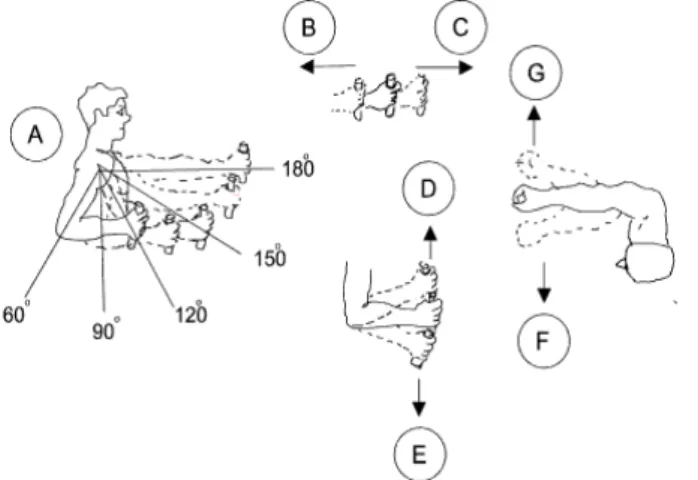
No other relevant materials were found, as mentioned, most of them are ergonomic analyzes of different operations, but it can also be mentioned the Consolidation of Labor Laws (CLT - Brazilian Law nº. 6.514 de 22.12.1977), in its Chapter V, Section XIV, article 198, wh ich establishes as being 60 kg the maximu m weight that an employee can remove individually. However, Bill of law No. 5,746-C modified this law in 2003, setting this value at 30 kg. Therefo re for on ly one arm it is arbitrated that it is the half of 15 kg or 147.1 N. The NR-17 in its item 17.2 (Regulatory Standard No. 17 of the Ministry of Labor of Brazil) wh ich describes about the overview, transport and individual discharge of materials, there is no reference to maximu m weights. The most indicated value was the NASA-STD-3000B (Man-Systems Integration Standards (MSIS)), wh ich reports that the maximu m effort (at worst) of an operator with the arm at 60° (Figure 1a) is 53.6 N for the left arm in ascending motion (Figure 1d) and 60.8 N in descending motion (Figure 1e). For the right arm, the maximu m effo rt is 71.2 N, both for the ascending movement (Figure 1d) and descending (Figure 1e). The NASA-STD-3000B also reveals that tests on young men, 80% (5th percentile group) with ample working space, 95% of these can lift weights at the follo wing heights: 180 N at a height of 1.5 m, 280 N at a height of 0.9 m, 590 N at a height of 0.6 m and 680 N at a height of 0.3 m.
FIGURE 1. Stress positions for upper limbs. Source:
http://www.roymech.co.uk/Useful_Tables/Human/Human_streng th.html.
Therefore, this study has the objective of presenting a methodology to measure the effort to which the operator is subjected in the activation of the knapsack sprayers pumping lever verifying if these machines fit within the limitations foreseen by the Brazilian laws and international regulations.
MATERIAL AND METHODS
The study was carried out in the facilities of the Nucleus of Innovation in Agricultural Machinery and Equip ment (NIMEq) at Federal University of Pelotas (UFPEL).
In order to carry out the tests, six models of sprayers were selected for being the most offered in the agricultural equip ment trade and in virtual stores of the national market. For the evaluation, the equipment were randomly labeled A, B, C, D, E and F, to evaluate their conformity with respect to the requirements, test methods and minimu m performance prescribed by the standard ISO 19932-1:2013.The sprayers studied were fro m brand Guarany, model: SE-20, Brudden, model: S-20, Macrotop, model: MPM-200, Eccofer, model: Eccofer 20l and Jacto, models: PJH 20l and XP 20l, but will not be identified in the results. Out of these, two do not have option of inversion activation on the right or left side.
The sprayers were individually adapted to a test rig (Figure 2a).In this, the sprayer pumping lever is activated by a device made by a crank rod system type Scotch Yok e Mechanism® (Figure 2b), wh ich transforms uniform
circular motion into alternating linear motion, provided by
(a) (b) (c)
FIGURE 2. Test Rig (a), crank rod system type Scotch Yok e Mechanism® (b) and “V” mobile roller mechanis m (c).
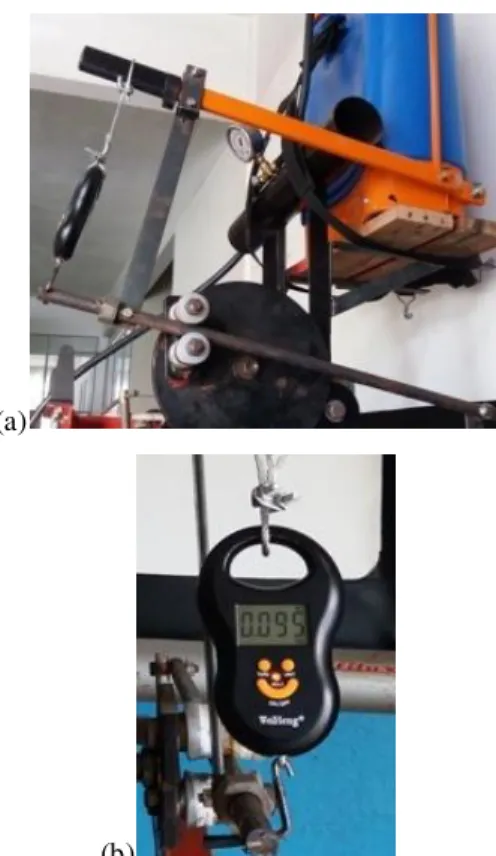
In order to measure the effort exerted on the pumping lever (activation arm) of each sprayer, two pumping lever system was constructed in parallel, according to Figure 3a, where a dynamometer, commercially known as Digital Scale Hook WeiHeng, model 128, resolution of 0.010 kgf, capacity of 40 kgf (Figure 3b) which allowed the verification of the values on the applied efforts in different positions of the movement on the sprayers pumping levers. For data recording regarding to the reading of different applied loads in the different positions of the pumping lever, we used a digital camera, Oly mpus brand, model VR 320.
(a)
(b)
FIGURE 3.Pu mp ing lever system for transferring the applied efforts on the sprayers pumping levers (a) and digital scale to measure the efforts (b).
The lower pu mping lever activation occurred by means of the crank rod mechanism. The dynamometer was fixed between the two levers by means of cables, obtaining measurements of the activation efforts when the upper
the activation mechanism, simu lating the activation movement of the operator.
The mechanism developed made it possible to perform the movements of the sprayer pumping lever with the necessary amplitude for each model, allo wing adjustment to the different course and length measures of the pumping levers, according to the constructive model of each of the tested equipment.
The activation speed was adjusted digitally by means of a frequency inverter, W EG b rand, model CFW 08, wh ich allowed the variation of the rotation between zero (0.00) and 999.9 rp m, thus allowing the control of the pump activation number per minute, that is, the number of the lever activations. The frequency of 650 Hz was used in this equipment providing rotation of 21 rp m, thus allowing the sprayers to reach the required working pressure, which was stabilized at 300 kPa, accord ing to the standard ISO 19932-1: 2013. The pressure was controlled by a COMAM pressure gauge with a scale from0 to 2.06 MPa. The spray tip used was Magno 11001-AD brand, made of ceramic and anti-drift type spray jet for all tests. This was chosen for being common ly sold with the equipment in question and working with the established standard pressure in the 300 kPa.
The readings of different applied loads in the different positions of the activation lever were filmed, allo wing the data collection to be stored in a spreadsheet for later analysis. First we tested the empty sprayers and later with water working with pressure of 300 kPa, being measured finally the loads necessary to return the pumping lever to the superior position.
standard ISO 19932-1: 2013. Sprayer model was considered as treatment and number of cycles as repetitions in each test. The performed tests were: average return effort required to the operator, the effort and the quantities of cycles required reaching the 300 kPa pressure and the required cycles and amounts of cycles after reaching the pressure of 300 kPa to check pressure maintenance during work. The response variables were number of cycles, average activation effort (N), maximu m activation effort (N) and time (s) in each cycle (displacement of the pumping lever fro m top to bottom and its return to top).
RES ULTS AND DISCUSS ION
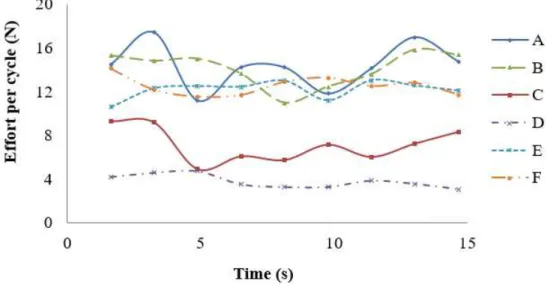
The normality test after the 300 kPa pressure showed normal d istribution by the Shapiro-Wilk test (W) and significant (p <0.05). However, the observation of the scatter chart for the means of return efforts (Figure 4) shows an asymmetry fo r the means of the determined efforts with CV lower than 22% (Table 1). Mean values of the return efforts, and to reach pressure of 300 kPa did not present a significant normal distribution (p <0.05). With the logarithmic transformation of the data it was observed that they adjusted satisfactorily to the normal and significant distribution (p> 0.5).
TABLE 1. Average return effort required by sprayer operator when supplied with water.
Sprayer A B C D E F
Average (N) 14.35a 14.10ab 7.11d 3.80e 12.19c 1112.52bc Maximu m (N) 17.46 15.89 9.32 4.81 13.04 1114.12
σ (N) 2.06 1.57 1.57 0.59 0.78 0.88
CV (%) 0.14 0.11 0.22 0.16 0.07 0.07
The averages followed by the same letter do not differ from each other at a significance level of 5%.
When testing with the empty sprayers it was not possible to reach the working pressure of 300 kPa, this is due to the decrease in air volume inside the sprayer tank and the inability of the activation pump to be able to compress the air until reach the pressure of 300 kPa.
By analyzing the return efforts in the activation when water was used in the sprayer tank (Table 1 and
Figure 4) it was verified that sprayer “D” was the one with
the lowest value in this operation, being significantly different fro m the others. The average value obtained with this sprayer was 3.82 N with maximu m of 4.81 N.
Sprayers “A” and “B” were the ones that provided the
highest mean values of the activation effort, at the rate of 14.32 N and 14.10 N, respectively, almost four times
greater than the value obtained with “D” sprayer, not having differed significantly from each other. The “E” and “F” sprayers did not differ from each other, in relation to
the average activation effort presenting the second highest
value, wh ich were 12.19 N and 12.52 N, respectively. On
the other hand, the “C” sprayer differed from the others
with a mean activation effort of 7.11 N, practically twice
as great as the effort obtained with the “D” sprayer, which
was the lowest.
The results demonstrate that the maximu m upward effort required by the sprayer pumping lever was 17.46 N (sprayer A). Co mparing the result with the value obtained by Phadke et al. (1992) wh ich was 18.70 N it verified that the results are very close, characterizing agreement of results. This fact can be attributed to the technology of the liquid pu mping, which was practically unchanged in these mach ines in the considered period. The CLT - Law no. 6,514 pred icts as limit 147.1 N fo r the upper limbs, considering only one of the limbs. Yet the NASA-STD-3000B limits to 53.6 N. Therefore, the maximu m return effort of the pumping lever is below the limits foreseen by CLT and NASA.
When analyzing the activation effort required reaching300 kPa pressure for the water fluid (Table 2), the
“E” sprayer provided the lowest average effort, with a
value of 10.10 N. However, it required 15 cycles to reach this pressure which was due to the fact that for this sprayer there was a need for increasing activation efforts at each
cycle. Sprayer “A” was the one that provided the least
number of activations (8 cycles) to reach the pressure of 300 kPa, demonstrating that it has a higher pressure capacity per cycle when co mpared to the others. Among the tested models it can be considered as the most efficient, although it requires higher activation effort (37.76 N). Th is can be caused by greater use of the work due to, for example, a more perfect fit between the cylinder and the piston, or higher cylinder volume.
Sprayers “C”, “D”, “E” and “F” did not differ in relation to
the average activation effort, presenting the lowest values which were 19.81 N; 24.61 N; 10.10 N and 22.65 N;
respectively. Sprayer “B” differed from “C”, “E” and “F”
with an average activation effort of 38.05 N, almost four times greater than the effort obtained with the “E” sprayer,
which was the smallest.
The results demonstrate that the maximu m (downward) effort required by the sprayer pumping lever was 69.3 N (Sprayer D). Considering the CLT - Law no. 6,514, the activation effort required to achieve the 300 kPa pressure was below the proposed limits. However, compared to that recommended by NASA-STD-3000B, the effort is above the limit of 60.8 N for the left arm, but within the limit for the right arm o f 71.2 N in descending movement wh ich is the predominant arm of the operators.
TABLE 2. Results of the efforts and amounts of cycles required to achieve a pressure of 300 kPa with water.
Sprayer A B C D E F
Average (N) 37.76ab 38.05a 19.81bc 24.61abc 10.10c 22.65bc
Nu mber of Cycles 8 14 14 15 15 19
Maximu m (N) 47.07 67.67 53.25 69.33 34.91 54.13
σ (N) 8.92 9.61 16.28 22.75 10.40 14.22
CV (%) 0.24 0.25 0.82 0.92 1.03 0.63
The averages followed by the same letter do not differ from each other at a significance level of 5%.
Analyzing the effort after reach300 kPa p ressure for
the water fluid (Table 3) it was verified that the “A”
sprayer required a lower average effort and a lower maximu m effort which were respectively 26.73 N and 34.72 N. In this way, it can be affirmed that the “A”
sprayer becomes, among the analyzed equipment, the one which provides greater comfort to the operator. The
sprayers “B”, “C” and “F” did not differ in relation to the
average activation effort, presenting intermediate values which were 54.19 N; 65.24 N and 59.27 N, respectively.
On the other hand, the “D” sprayer differed from the
others with average value activation effort of 88.89 N,
more than three times the obtained effort with the “A”
sprayer which was the lowest (26.73 N). Finally, sprayer
“E” (46.45 N) also differed significantly from the others.
The results demonstrate that the maximu m effort required by the sprayer pumping lever was 108.56 N (Sprayer D). Considering the CLT - Law no. 6,514, the activation effort required to achieve the 300 kPa pressure was below the proposed limits. However, according to NASA-STD-3000B, the effort is above the limit of 60.8 N for the left arm with downward movement.
TABLE 3. Results of pumping lever activation efforts after reaching 300 kPa pressure with water.
Sprayer A B C D E F
Average (N) 26.73e 54.19c 65.24b 88.89a 46.45d 59.27bc
Nu mber of Cycles 11 11 11 11 11 11
Maximu m (N) 34.72 61.98 73.35 108.56 54.13 64.92
σ (N) 3.43 6.86 5.98 11.57 5.39 4.31
CV (%) 0.13 0.13 0.09 0.13 0.12 0.07
The averages followed by the same letter do not differ fro m each other at a significance level of 5%.
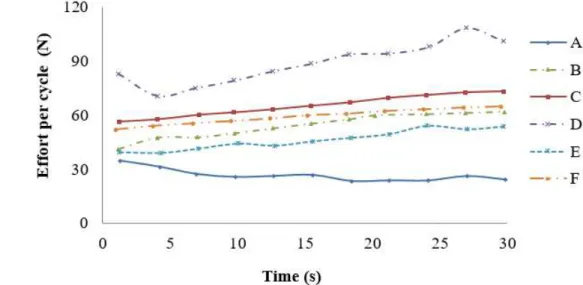
The data of the activation efforts measured in the sprayers with water are shown in the scatter chart, shown in Figure 5.
It is noted that the “A” sprayer, in addition to requiring lower values, also provides decreasing activation effort over time,
FIGURE 5. Scatter chart of the efforts of the sprayer pumping lever tested with water.
In general, the results demonstrate that the “A”
Sprayer required more effort for the return activation
(17.46 N). The “D” sprayer required a higher activation
effort fo r both before and after reaching the pressure at 300 kPa, being 69.33 N, 108.56 N, respectively. The “E”
Sprayer was the least intense in relation to the average activation effort to obtain the pressure of 300 kPa (10.10
N).The “A” Sprayer was the most regular and least intense
in relation to the average activation effort to maintain the pressure of 300 kPa (26.73 N), besides requiring a smaller amount of activation cycles of the pumping lever to reach the work pressure.
Although we obtained only one bibliographical reference that could make the co mparisons of the results and despite of this reference being very old, it was observed that the results were very similar to those found by Phadke et al. (1992).Therefo re, the application of the proposed methodology proved to be efficient, easy and of low cost, so that further studies could be done to provide data for the analysis of the ergonomic working conditions of sprayers and other manual activation lever.
CONCLUS IONS
The emp loyed methodology was adequate to
measure the operator’s upward and downward effort
required for the operation of knapsack hand sprayers. Considering the Brazilian laws, CLT - Law no. 6,514, all sprayers obtained satisfactory results, i.e. with effort
values below the expected limit. However, only “A” and “E” sprayers obtained satisfactory results for the
international indications (NASA-STD-3000B) for manual activation lever.
REFERENCES
França JA L, Gonçalves WS, Ro meiro BP, Benett CGS, Silva AR (2015) Desenvolvimento e avaliação de u m pulverizador hidráu lico de barras ríg idas horizontais de baixo custo. Revista de Agricultura Neotropical 2(1):17-23.
Freitas CS (2006) Análise ergonômica da atividade co m pulverizador costal manual na cultura do café no município de Caratinga. Dissertação Mestrado, Centro Universitário de Caratinga.
Lopes ES, Oliveira FM, Rodrigues CK (2011) Determinação da carga física de trabalho na atividade manual de herbicida. A mbiência 7(2):329-337.
Mamidi VR, Ghanshyam C, Ku mar PM, Kapur P (2013) Electrostatic hand pressure knapsack spray system with enhanced performance for s mall scale farms. Journal of Electrostatics 71(4):785-790. DOI:
https://doi.org/10.1016/j.elstat.2013.01.011
Phadke SM, Adhaoo SH, Gite LP, Pandya AC, Patel SL (1992) Test code and procedure for ergonomic evaluation of lever-operated knapsack sprayers. International Journal of Industrial Ergono mics 10(4):293-300. DOI:
https://doi.org/10.1016/0169-8141(92)90096-I
Sasaki RS, Furtado Júnior MR, Leite ES, Sou za AP, Teixeira MM, Fernandes HC (2014) Avaliação
ergonômica de pulverizadores costais utilizados no setor florestal. Rev ista Árvore 38(2):331-337.
Silva JA, Carolino L, Gimenez LB (2015) Análise e avaliação da tecnologia de aplicação de defensivo agrícola na cultura da lichia. Rev ista Científica Eletrônica de Agronomia.27. Available in:
http://faef.revista.inf.br/site/e/agronomia-27-edicao-junho-de-2015.html#tab1156. Accessed: Dec 26, 2016.
Souza NSS, Santana VS (2011) Incidência cu mulativa anual de doenças musculoesqueléticas incapacitantes relacionadas ao trabalho em u ma área u rbana do Brasil. Caderno de Saúde Pública 27(11). DOI: