Enteral fluid therapy administered in continuous flow by naso-ruminal
route using three maintenance electrolyte solutions: effects on physiological
biomarkers and the hemogram of bovines
Hidratação enteral via nasorruminal em fluxo continuo utilizando três soluções eletrolíticas de manutenção: efeitos sobre os biomarcadores fisiológicos e o hemograma de bovinos Pedro Ancelmo Nunes Ermita1* José Dantas Ribeiro Filho1 Rinaldo Batista Viana2
Micheline Ozana da Silva1 Samuel Rodrigues Alves1 Lorena Chaves Monteiro1
Caio Monteiro Costa1 Lucas Drumond Bento1 Artur Neves Passos1 Felipe Sperandio Mattos3
ISSNe 1678-4596
INTRODUCTION
The prevalence of hydroelectrolyte and acid-base disorders is common in variable bovine diseases; therefore, fluid therapy has become an indispensable part of the buiatric routine (RIBEIRO FILHO et al., 2013). In this
way, accurate evaluation of dehydration and acid-base disorders is necessary for optimal hydroelectrolyte replacement.
In bovine medicine, fluid therapy is most
commonly administered by intravenous and oro-ruminal routs (RIBEIRO FILHO et al., 2013). Due to the large volumes administered, professional
1Departamento de Veterinária, Universidade Federal de Viçosa (UFV), Av. PH Rolfs, s/n, Campus universitário, 36570-900, Viçosa, MG,
Brasil. E-mail: [email protected]. *Corresponding author. 2Universidade Federal Rural da Amazônia (UFRA), Belém, PA, Brasil. 3União de Ensino Superior de Viçosa (UNIVIÇOSA), Viçosa, MG, Brasil.
ABSTRACT: The aim of this study was to evaluate the effects of three enteral electrolyte solutions, each with different energy sources,
administrated as continuous flow on the physiological parameters and blood count of healthy Holstein heifers. Six Holstein heifers were used in a crossover design. All animals received all three treatments: solution with calcium propionate, 4g of NaCl, 0.5g of KCl, 0.3g of MgCl2, and
10g of calcium propionate diluted in 1000mL of water (measured osmolarity: 299mOsm/L); solution with glycerol, 4g of NaCl, 0.5g of KCl, 0.3g of MgCl2, 1g of calcium acetate, and 10mL of glycerol in 1000mL of water (measured osmolarity: 287mOsm/L); solution with propylene
glycol, 4g of NaCl, 0.5g of KCl, 0.3g of MgCl2, 1g of calcium acetate, and 15mL of propylene glycol in 1000mL of water (measured osmolarity:
378mOsm/L). Physical evaluations and blood samples were collected immediately before the initiation of fluid therapy, at 3-hour intervals over the 12-hour period of fluid therapy, and 12 hours after the end of fluid therapy. Animals presented no signs of stress or discomfort. All solutions resulted in a significant decrease in erythrocyte concentration, hemoglobin concentration, and hematocrit, without affecting the leukogram. Enteral fluid therapy administered as continuous flow via the naso-ruminal route was well-tolerated by animals with minimal effects on animal welfare, even when administered for 12 hours. This technique is indicated as an alternative route for parenteral maintenance fluid therapy. Electrolyte solutions proposed here were able to significantly expand blood volume.
Key words: ruminants, polyionic solutions, physiologic parameters, volemia, hemogram.
RESUMO: Objetivou-se avaliar os efeitos de três soluções eletrolíticas enterais de manutenção com diferentes fontes de energia administradas em bovinos adultos por via nasorruminal em fluxo contínuo sobre parâmetros fisiológicos e hematológicos. Foram utilizadas seis novilhas holandesas em um delineamento crossover. Os animais foram submetidos a três tratamentos: Solução contendo Propionato de cálcio - 4g de NaCl, 0,5g de KCl, 0,3g de MgCl2 e 10g de propionato de cálcio para cada 1000mL (Osmolaridade mensurada: 299mOsm/L); Solução
contendo Glicerol - 4g de NaCl, 0,5g de KCl, 0,3g de MgCl2, 1g de acetato de cálcio e 10mL de glicerol para cada 1000mL (Osmolaridade
mensurada: 287mOsm/L); Solução contendo Propilenoglicol - 4g de NaCl, 0,5g de KCl, 0,3g de MgCl2, 1g de acetato de cálcio e 15mL
de propilenoglicol para cada 1.000mL (Osmolaridade mensurada: 378mOsm/L). Foi realizado exame físico e colheita de sangue para os hemogramas imediatamente antes do início da hidratação e a cada três horas durante 12h de tratamento e mais uma colheita 12h após o final do período experimental, perfazendo seis colheitas ao total. Todas soluções promoveram ao longo das 12 horas de tratamento hemodiluição com redução nos valores de hemácias, concentração de hemoglobina e volume globular, sem, contudo, alterar o leucograma. A hidratação enteral em fluxo contínuo via nasorruminal, mostrou-se uma técnica bem tolerada pelos animais, como mínimos efeitos sobre o bem-estar, mesmo quando administrada por 12 horas, sendo, portanto, uma técnica indicada como uma opção à hidratação parenteral na terapia de manutenção de fluidos. As três soluções eletrolíticas aqui propostas são capazes de expandir significativamente a volemia.
Palavras-chave: ruminantes, soluções poliônicas, parâmetros fisiológicos, volemia, hemograma.
supervision is required during fluid therapy, and the final cost of administration via the parenteral
route is sometimes unviable (RIBEIRO FILHO et
al., 2011). Consequently, this route of fluid therapy
is only used under critical scenarios, such as hypovolemic shock.
Enteral fluid therapy, like the oro-ruminal route, allows a large volume of electrolyte fluid to be administered directly into the rumen in cases of mild and moderate dehydration (ROUSSEL, 2014), and is used careful in cases with motility disorder. Although, this technique is simple, when performed over several days, successive tube passages increase the risk of laryngeal and esophagus lesions. In addition, large volumes of fluid can cause some discomfort to the animal when administered quickly into the rumen.
An alternative method that has been used and studied in Brazil for more than 10 years,
is enteral fluid therapy with continuous flow, using
a naso-gastric or naso-ruminal tube with a small diameter. This technique has been used successfully in horses (AVANZA et al., 2009; RIBEIRO FILHO et al., 2012; RIBEIRO FILHO et al., 2015); owing to the small gastric capacity of this species, several doses or slow and continuous administration is required throughout the day.
In goats (ATOJI-HENRIQUE et al., 2012), calves (RIBEIRO FILHO et al., 2017), and bubaline calves (ERMITA et al., 2016) continuous
flow via the naso-ruminal route has been tested
and promising results have been reported. Some studies have already been performed in adult cattle (RIBEIRO FILHO et al., 2009; RIBEIRO FILHO et al., 2011; RIBEIRO FILHO et al., 2013); however, many questions remain unanswered, including osmolarity, the correct electrolyte composition, energy precursor, and infusion rate for these animals. This is because this technique is not widespread in this species, and animals need to remain in an individual stall during therapy.
One important characteristic of enteral
fluid therapy is the possibility of creating new
solutions with altered compositions that meet the needs of the animal and increase the therapeutic
efficiency (RIBEIRO FILHO, 2011). When used in continuous flow, the deleterious effects described
above are minimized, besides not preventing the animal from walking and laying inside the stall and
feeding during fluid therapy.
According to CONSTABLE (2003), solutions for enteral use should contain sodium,
potassium, chloride, calcium, phosphate, and a glycemic precursor, such as propionate. In addition, RIBEIRO FILHO et al. (2014) stated that by maintaining volemia and electrolyte balance, the solution should not cause any adverse events.
The objective of this study was to evaluate the effects of enteral fluid therapy administered as continuous flow by the naso-ruminal route with three enteral electrolyte solutions, containing different energy precursors, on the physiological biomarkers and the hemogram of clinically healthy cattle.
MATERIALS AND METHODS
This experiment included six healthy Holstein heifers from the flock of the Experimental Research and Extension Unit in Dairy Cattle of the Federal University of Viçosa (Unidade Experimental de Pesquisa e Extensão em Gado de Leite da Universidade Federal de Viçosa), aged 16 and 18 months and with a mean body weight of 300kg. Animals were adapted to the experimental environment for 10 days before the beginning of the study, during which they were restricted in an individual stall in a Tie Stall system. Animals were fed with corn silage as a balanced ration and water was provided ad libitum.
A crossover 6×3 design was adopted (six animals × three treatments) and all animals received all treatments. To avoid an overlap effect, there was a 7-day interval between treatments. The composition of the electrolyte solutions was as follows: Solution with calcium propionate solution (SEPCa), 4g of NaCla, 0.5g of KCla, 0.3g of
MgCl2aand 10g de calcium propionateb in 1000mL
of water (measured osmolarity: 299mOsm/L); glycerol solution (SEGly), 4g of NaCla, 0.5g of
KCla, 0.3g of MgCl 2
a, 1g of calcium acetatea, and
10mL of glycerolc in 1000mL of water (measured
osmolarity: 287mOsm/L); and a solution with propylene glycol, 4g of NaCl, 0.5g of KCl, 0.3g of MgCl2, 1g of calcium acetate, and 15mL of propylene glycol in 1000mL of water (measured osmolarity: 378mOsm/L).
A naso-ruminal tube with a small diameter (4mm diameter and 1.8m length) was
used to administer fluid. The tube was attached
to the halter and connected to a gallon with a 20L capacity with a spiral hydration systemd, set 1.5m
above the head of the animal. The continuous flow
period. After the hydration period, the animals were in water and food fasting for 12 hours, for a 24-hour experimental cycle. Samples were collected and evaluated at the following times: T0h, just before the beginning of the experiment; T3h, 3 hours after the beginning of hydration; T6h, 6 hours after the beginning of hydration; T9h, 9 hours after the beginning of hydration; T12h, 12 hours after the beginning of hydration and the end of hydration period; and T24h, 12 hours after the end of hydration (observation period).
The following physiological parameters were analyzed: heart rate (HR, bpm), respiratory rate (RR, mpm), rectal temperature (RT, °C), ruminal movements (RM in 3 minutes), abdominal girth (AG, cm), and fecal humidity (FH%). Blood samples were collected via jugular venipuncture using a vacuum systeme in K
2EDTA tubes, and
blood counts were determined in an automatic blood counter devicef. White blood cell counts were
obtained by blood scrubbing as recommended by STOCKHAM & SCOTT (2011). Abdominal girth was calculated using a measuring tape across the
flank of the bovine. Feces were collected directly
from the rectal ampulla and were immediately weighed and dried in a drying oven at 60°C for several days. The feces were weighed until a constant weight was achieved. Humidity was determined using the following equation: [(initial
weight - final weight) × 100/initial weight].
Results were analyzed descriptively to obtain the mean and the standard deviation. The normality of the data was evaluated with the
Shapiro-Wilk test and the sphericity of the variances was determined with the Mauchly test. When the
pre-requisites of normality and sphericity were achieved, analysis of variance (ANOVA) based on the factorial design of repetitive measures was used to evaluate the main effects across time, treatments, and in the time*treatment effect. Multiple
comparisons were compared using the Tukey post hoc test. When it was not possible to use ANOVA,
the Friedman test with the Wilcoxon post hoc test associated with a Bonferroni correction was used. All analyses were performed with the statistical
package SPSS 20 (IBMD, Statistic). Significance
was considered when P<0.05.
RESULTS AND DISCUSSION
Physiological variables have been used to evaluate the welfare and adaptation of cattle under variable edaphoclimatic and management
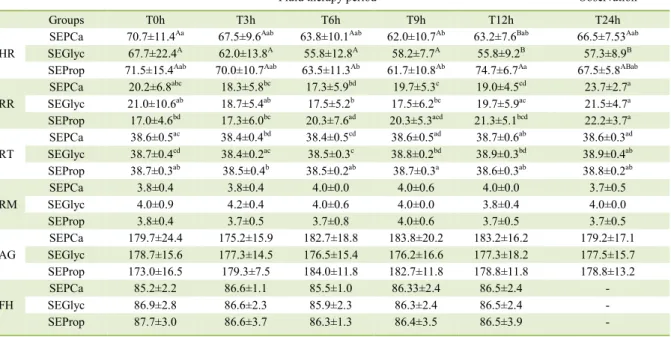
conditions (DINIZ et al., 2017). In this study, a decrease (P<0.05) in the heart rate of animals in the SEPCa group was observed during the hydration phase, and the respiratory rate remained the same (P>0.05) at baseline in the three groups. Notably, under all situations, these biomarkers remained within the reference values suggested by FEITOSA (2004). In this way, the data observed in
the present study (Table 1), confirmed that enteral fluid therapy administered as continuous flow
under the proposed conditions (solution type and
fluid therapy technique), does not cause stress to
the animals, demonstrating that the use of naso-ruminal tubes and the administration of these solutions did not cause discomfort to animals. This was clearly observed during the hydration period when the heifers were mostly laying down, quiet, and ruminating, as previously described by RIBEIRO FILHO et al. (2011, 2013).
Several factors can alter body temperature, including exercise, environmental temperature, digestion, water intake, disease, and time of day (circadian or nictemeral variation), which can cause variation of 1.5°C in 24 hours
(FEITOSA, 2004). During the fluid therapy period
between T0h and T3h, the rectal temperature of animals in the SEPCa group, was not correlated with the technique used or experimental time; this variation was probably caused by the circadian variation and, at all time points observed, the temperature remained inside the reference interval for the species (REECE, 2015). Stability in rectal temperature was also observed by RIBEIRO FILHO et al. (2015) and ERMITA et al. (2016).
The ruminal movements were not affected over time with either treatment, as described by ATOJI-HENRIQUE et al. (2012). Effects of enteral
fluid therapy on gastrointestinal tract motility seem
to be associated with the dose and solution used, as described by RIBEIRO FILHO et al. (2012)
who used enteral fluid therapy in healthy horses
and observed an increase in intestinal motility. Although, using the same dose in the present study (15mL/kg/h), solution used by authors contained different concentrations of electrolytes and other energy sources. This suggested that in addition to physiological differences between species, the solution used could be a major factor for the effects observed in the intestinal tract.
fermentation. This can result in gas production and accumulation inside the gut, causing discomfort or conditions such as a bloat. This kind of change was not observed in the present study, as there was no significant change in abdominal girth (P>0.05) across the whole fluid therapy period under all treatments, corroborating the findings of RIBEIRO FILHO et al. (2013). The choice of energy precursor directly affects these findings, because calcium propionate, glycerol, and propylene glycol can be oxidized by the ruminal microbiota or absorbed in the integral form, not over-stimulating gas production.
There was no variation in fecal humidity (P>0.05) over time or between treatments. This result confirmed that the electrolyte solutions proposed were readily absorbed by the intestinal tract with minimal losses through feces. Osmolarity is an important characteristic for the efficacy of an electrolyte solution, as hypo or isotonic solutions are absorbed quickly and in large amounts, as suggested by AVANZA et al. (2009). Hypertonic enteral solutions (osmolarity>320mOsm/L) could have decreased volemic effects, remaining longer
in the intestinal lumen, increasing the risk of osmotic diarrhea; however, this was not observed in the present study, even for the SEProp group with 378mOsm/L, which was well tolerated by the animals.
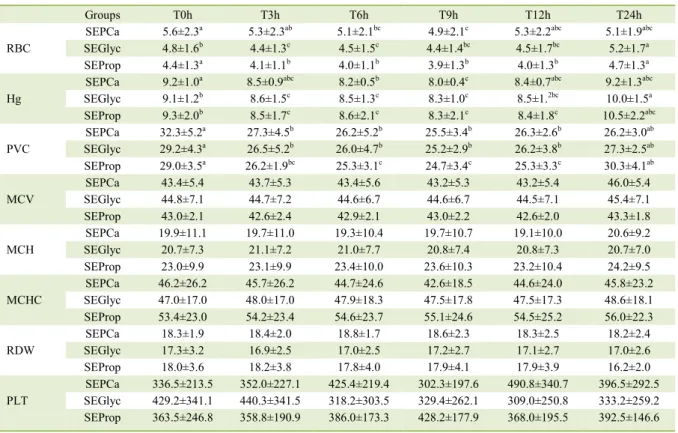
The concentrations of red blood cells and hemoglobin (Table 2) decreased significantly after 6 hours of fluid therapy (T6h) with all treatments, and remained low over 12 hours of fluid therapy (T12h) in the SEGly and SEProp groups, returning to basal levels at 24 hours (T24h). These results confirmed that the solutions were well absorbed by the gastrointestinal tract and that the osmolarity of SEProp did not limit its use. The expanse capacity of the solutions (hemodilution) is demonstrated by the decreased hematocrit concentration (P<0.05) observed following 3 hours of fluid therapy (T3h) in all groups. After being absorbed in the rumen and gut, the solutions dilute the solid components of the blood and proteins, explaining the results of this study, as described by RIBEIRO FILHO et al. (2011) and RIBEIRO FILHO et al. (2013). These findings showed that enteral fluid therapy
Table 1- Mean ± standard deviation of the heart rate (HR – bpm), respiratory rate (RR - mpm), rectal temperature (RT - °C), ruminal movement/3 min. (RM), abdominal girth (AG - cm) and feces humidity (FH - %) of heifers under enteral fluid therapy in continuous flow with three different electrolyte solutions.
---Fluid therapy period--- Observation
Groups T0h T3h T6h T9h T12h T24h
HR
SEPCa 70.7±11.4Aa 67.5±9.6Aab 63.8±10.1Aab 62.0±10.7Ab 63.2±7.6Bab 66.5±7.53Aab SEGlyc 67.7±22.4A 62.0±13.8A 55.8±12.8A 58.2±7.7A 55.8±9.2B 57.3±8.9B SEProp 71.5±15.4Aab 70.0±10.7Aab 63.5±11.3Ab 61.7±10.8Ab 74.7±6.7Aa 67.5±5.8ABab
RR
SEPCa 20.2±6.8abc 18.3±5.8bc 17.3±5.9bd 19.7±5.3c 19.0±4.5cd 23.7±2.7a SEGlyc 21.0±10.6ab 18.7±5.4ab 17.5±5.2b 17.5±6.2bc 19.7±5.9ac 21.5±4.7a SEProp 17.0±4.6bd 17.3±6.0bc 20.3±7.6ad 20.3±5.3acd 21.3±5.1bcd 22.2±3.7a
RT
SEPCa 38.6±0.5ac 38.4±0.4bd 38.4±0.5cd 38.6±0.5ad 38.7±0.6ab 38.6±0.3ad SEGlyc 38.7±0.4cd 38.4±0.2ac 38.5±0.3c 38.8±0.2bd 38.9±0.3bd 38.9±0.4ab SEProp 38.7±0.3ab 38.5±0.4b 38.5±0.2ab 38.7±0.3a 38.6±0.3ab 38.8±0.2ab
RM
SEPCa 3.8±0.4 3.8±0.4 4.0±0.0 4.0±0.6 4.0±0.0 3.7±0.5
SEGlyc 4.0±0.9 4.2±0.4 4.0±0.6 4.0±0.0 3.8±0.4 4.0±0.0
SEProp 3.8±0.4 3.7±0.5 3.7±0.8 4.0±0.6 3.7±0.5 3.7±0.5
AG
SEPCa 179.7±24.4 175.2±15.9 182.7±18.8 183.8±20.2 183.2±16.2 179.2±17.1 SEGlyc 178.7±15.6 177.3±14.5 176.5±15.4 176.2±16.6 177.3±18.2 177.5±15.7 SEProp 173.0±16.5 179.3±7.5 184.0±11.8 182.7±11.8 178.8±11.8 178.8±13.2
FH
SEPCa 85.2±2.2 86.6±1.1 85.5±1.0 86.33±2.4 86.5±2.4 -
SEGlyc 86.9±2.8 86.6±2.3 85.9±2.3 86.3±2.4 86.5±2.4 -
SEProp 87.7±3.0 86.6±3.7 86.3±1.3 86.4±3.5 86.5±3.9 -
as continuous flow is an effective alternative to intravenous fluid therapy for adult cattle. All other parameters of the erythrogram remained unchanged and within the reference intervals for this species.
There were no changes in the leucogram
profile throughout the experimental period or
between treatments (Table 3). This result clearly shows that intubation with a naso-ruminal tube for 12 hours, and all experimental management,
had no significant excitatory or stressful effects
on the animals, which would result in relative
polycythemia following the release of adrenaline (THRALL et al., 2012).
CONCLUSION
Enteral fluid therapy given as a continuous flow via the naso-ruminal route is well-tolerated by
animals with minimal effects on welfare, even when administered for 12 hours, and is indicated as an
alternative route for parenteral maintenance fluid
therapy. The three electrolyte solutions proposed
here are able to significantly expand blood volume. Table 2- Mean ± standard deviation of erythrogram (red blood cells (RBC - 106 cells/µL), hemoglobin (Hg – g/dL), packed cell volume
(PVC - %), mean corpuscular volume (MCV – fL), mean corpuscular hemoglobin (MCH – pg), mean corpuscular hemoglobin concentration (MCHC - %), Red Cell Distribution Width (RDW - %) and platelets (PLT - 103 cells/µL) of heifers under enteral fluid therapy in continuous flow with three different electrolyte solutions.
---Fluid therapy period---
Groups T0h T3h T6h T9h T12h T24h
RBC
SEPCa 5.6±2.3a 5.3±2.3ab 5.1±2.1bc 4.9±2.1c 5.3±2.2abc 5.1±1.9abc SEGlyc 4.8±1.6b 4.4±1.3c 4.5±1.5c 4.4±1.4bc 4.5±1.7bc 5.2±1.7a
SEProp 4.4±1.3a 4.1±1.1b 4.0±1.1b 3.9±1.3b 4.0±1.3b 4.7±1.3a
Hg
SEPCa 9.2±1.0a 8.5±0.9abc 8.2±0.5b 8.0±0.4c 8.4±0.7abc 9.2±1.3abc SEGlyc 9.1±1.2b 8.6±1.5c 8.5±1.3c 8.3±1.0c 8.5±1.2bc 10.0±1.5a SEProp 9.3±2.0b 8.5±1.7c 8.6±2.1c 8.3±2.1c 8.4±1.8c 10.5±2.2abc
PVC
SEPCa 32.3±5.2a 27.3±4.5b 26.2±5.2b 25.5±3.4b 26.3±2.6b 26.2±3.0ab SEGlyc 29.2±4.3a 26.5±5.2b 26.0±4.7b 25.2±2.9b 26.2±3.8b 27.3±2.5ab SEProp 29.0±3.5a 26.2±1.9bc 25.3±3.1c 24.7±3.4c 25.3±3.3c 30.3±4.1ab
MCV
SEPCa 43.4±5.4 43.7±5.3 43.4±5.6 43.2±5.3 43.2±5.4 46.0±5.4
SEGlyc 44.8±7.1 44.7±7.2 44.6±6.7 44.6±6.7 44.5±7.1 45.4±7.1
SEProp 43.0±2.1 42.6±2.4 42.9±2.1 43.0±2.2 42.6±2.0 43.3±1.8
MCH
SEPCa 19.9±11.1 19.7±11.0 19.3±10.4 19.7±10.7 19.1±10.0 20.6±9.2
SEGlyc 20.7±7.3 21.1±7.2 21.0±7.7 20.8±7.4 20.8±7.3 20.7±7.0
SEProp 23.0±9.9 23.1±9.9 23.4±10.0 23.6±10.3 23.2±10.4 24.2±9.5
MCHC
SEPCa 46.2±26.2 45.7±26.2 44.7±24.6 42.6±18.5 44.6±24.0 45.8±23.2
SEGlyc 47.0±17.0 48.0±17.0 47.9±18.3 47.5±17.8 47.5±17.3 48.6±18.1
SEProp 53.4±23.0 54.2±23.4 54.6±23.7 55.1±24.6 54.5±25.2 56.0±22.3
RDW
SEPCa 18.3±1.9 18.4±2.0 18.8±1.7 18.6±2.3 18.3±2.5 18.2±2.4
SEGlyc 17.3±3.2 16.9±2.5 17.0±2.5 17.2±2.7 17.1±2.7 17.0±2.6
SEProp 18.0±3.6 18.2±3.8 17.8±4.0 17.9±4.1 17.9±3.9 16.2±2.0
PLT
SEPCa 336.5±213.5 352.0±227.1 425.4±219.4 302.3±197.6 490.8±340.7 396.5±292.5 SEGlyc 429.2±341.1 440.3±341.5 318.2±303.5 329.4±262.1 309.0±250.8 333.2±259.2 SEProp 363.5±246.8 358.8±190.9 386.0±173.3 428.2±177.9 368.0±195.5 392.5±146.6
ACKNOWLEDGEMENTS
To the Post-Graduation Program in Veterinary Medicine of the Universidade Federal de Viçosa (UFV) for the
financial support. To the Biobrotas Olequímica Ltda. for granted
the glycerol utilized in the study.
ACQUISITION SOURCES
aSulfal Química Ltda., Belo Horizonte, MG, Brazil; bAdicel Ltda., Belo Horizonte, MG, Brazil; cBiobrotas Olequímica, Brotas, SP, Brazil; dEnterequi System, Viçosa, MG, Brazil; eVacuteiner BD, Juiz de Fora, MG, Brazil; fHumanCount Plus, Belo Horizonte, MG, Brazil.
BIOETHICS AND BIOSSECURUTY COMMITTE APPROVAL
The project was previously approved for the Ethical Committee in the Use of Animals of the Universidade Federal de Viçosa (CEUA/UFV) with the protocol number 44/2017.
CONFLICTS OF INTEREST
The authors declare no conflict of interest. The founding sponsors had no role in the design of the study; in the collection, analyses, or interpretation of data; in the writing of the manuscript, and in the decision to publish the results.
REFERENCES
ATOJI-HENRIQUE, K. et al. Enteral fluid therapy through
nasogastric tube in rumen cannulated goats. Pesquisa Veterinária Brasileira, v.32, n.12, p.1281-1284, 2012. Available from: <http:// dx.doi.org/10.1590/S0100-736X2012001200011>. Accessed: Nov. 11, 2017. doi: 10.1590/S0100-736X2012001200011.
AVANZA, M.F.B. et al. Enteral fluid therapy in horses-electrolyte
solution associated or not with glucose, maltodextrine and magnesium sulphate: laboratory results. Ciência Rural, v.39, n.4, p.1126-1133, 2009. Available from: <http://www.scielo.br/pdf/ cr/2009nahead/a127cr272.pdf>. Accessed: Sept. 07, 2016. doi: 10.1590/S0103-84782009005000021.
CONSTABLE, P. Fluid and electrolyte therapy in ruminants. Veterinary Clinics of North America: Food Animal Practice, v.19, Table 3 - Mean ± standard deviation of leucogram (leucocytes (Leu - 103 cels./µL), lymphocytes (Lym - cels./µL), neutrophils (Neut -
cels./µL), band neutrophils (BN - cels./µL), monocytes (Mon - cels./µL), eosinophils (Eos - cels./µL) and basophils (Bas - cels./µL)) of heifers under enteral fluid therapy in continuous flow with three different electrolyte solutions.
---Fluid therapy period---
Group T0h T3h T6h T9h T12h T24h
Leu
SEPCa 9.9±4.1 11.0±4.6 12.4±4.4 12.6±5.4 9.1±3.1 10.0±3.6
SEGlyc 10.3±4.8 10.8±5.6 11.8±6.0 12.8±4.8 10.4±2.1 10.0±3.4
SEProp 9.9±0.3 10.5±1.8 11.4±2.1 11.5±10.3 10.9±2.7 9.8±1.9
Lym
SEPCa 6515±3201 7189±4254 8714±4100 8851±5335 6061±2726 6324±2382
SEGlyc 6963±2900 6614±3070 8508±5206 8305±2853 7099±1841 6538±49
SEProp 7155±439 6846±1802 7509±2195 7556±1087 7138±1853 6462±1920
Neut
SEPCa 3139±1077 3470±1239 3170±1455 3350±1887 2813±788 3149±1321
SEGlyc 2987±1880 3837±2473 3958±2403 4015±1600 2872±434 3412±2088
SEProp 2311±298 3340±197 3542±887 3454±1057 3224±1339 3055±673
BN
SEPCa 73±64 64±74 88±91 89±65 109±84 41±55
SEGlyc 105±49 63±51 73±64 134±126 118±129 83±143
SEProp 125±50 97±60 63±58 139±96 168±51 45±62
Mon
SEPCa 109±125.9 122±79 224±163 89±65 36±43 174±171
SEGlyc 75±67 136±156 215±180 62±86 162±85 219±206
SEProp 76±50 101±108 152±134 99±169 158±120 168±128
Eos
SEPCa 64±102 155±89 147±138 192±160 68±88 261±105
SEGlyc 334±427 160±211 307±361 284±319 180±86 312±273
SEProp 272±124 136±126 85±91 232±179 222±193 46±63
Bas
SEPCa 0.0±0.0 0.0±0.0 16±32 0.0±0.0 14±28 0.0±0.0
SEGlyc 0.0±0.0 0.0±0.0 0.0±0.0 0.0±0.0 0.0±0.0 0.0±0.0
SEProp 0.0±0.0 0.0±0.0 0.0±0.0 0.0±0.0 0.0±0.0 15±33
n.3, p.557-597, 2003. Available from: <https://doi.org/10.1016/ S0749-0720(03)00054-9>. Accessed: Feb. 20, 2015. doi: 10.1016/ S0749-0720(03)00054-9.
DINIZ, T.A. et al. F1 Holstein x Zebu Cows in late pregnancy show physiological adaptation when raised in semiarid environment. Journal of Agroveterinary Sciences, v.16, n.1, p.70-75, 2017. Available from: <http://dx.doi.org/10.5965/223811711612017070 >. Accessed: Nov. 22, 2017. doi: 10.5965/223811711612017070.
ERMITA, P.A.N. et al. Effects of enteral fluid therapy in continuous flow administered by nasogastric tube in buffalo calves. Journal of Buffalo Science, v.5, n.3, p.60-69, 2016. Available form: <http:// dx.doi.org/10.6000/1927-520X.2016.05.03.2>. Accessed: Dec. 22, 2016. doi: 10.6000/1927-520X.2016.05.03.2.
FEITOSA, F.L.F. Semiologia veterinária. A arte do diagnóstico. São Paulo: Roca, 2004. 792p.
REECE, W.O. Body temperature and its regulation. In: REECE, W. O. et al. Dukes’ physiology os domestic animals.
Wiley-Blackwell, 2015. Cap.14, p. 149-154.
RIBEIRO FILHO, J.D. Electrolytic solutions with low osmolarity are effective in enteral hydration? Veterinária e Zootecnia, v.18, supl, p.47-50, 2011. Available from: <http://www.pvb.com.br/ pdf_artigos/25-04-2014_09-29Vet%201631_3150%20MF.pdf>. Accessed: Jul. 17, 2015.
RIBEIRO FILHO, J.D. et al. Enteral Electrolyte Solutions With
Different Osmolarities: Clinical and Laboratory Assessment in Equines. Journal of Equine Veterinary Science, v.35, n.8, p.673-678, 2015. Available from: <http://dx.doi.org/10.1016/j.jevs.2015.06.019>. Accessed: Jan. 02, 2018. doi: 10.1016/j.jevs.2015.06.019.
RIBEIRO FILHO, J.D. et al. Enteral electrolyte solutions with
different osmolarities administered in a continuous flow in newborn
calves. Ciência Rural, v.47, n.5, p. 01-06, 2017. Available from: <http://dx.doi.org/10.1590/0103-8478cr20160891>. Accessed: Jan. 02, 2018. doi: 10.1590/0103-8478cr20160891.
RIBEIRO FILHO, J.D. et al. Enteral fluid therapy in cattle by
continuous nasogastric infusion. Brazilian Animal Science, v.11, Supl, p.24-28, 2009. Available from: <https://www.revistas.ufg.br/ vet/article/view/7708/5472>. Accessed: Nov. 17, 2017.
RIBEIRO FILHO, J.D. et al. Enteral fluid therapy in cattle: evaluation
of isotonic electrolyte solutions administered via nasogastric tube on
continuous flow. Ciência Rural, v.41, n.2, p.285-290, 2011. Available from: <http://www.scielo.br/pdf/cr/v41n2/a874cr3631.pdf>. Accessed: Nov. 13, 2015. doi: 10.1590/S0103-84782011005000012.
RIBEIRO FILHO, J.D. et al. Enteral Fluid Therapy: Biochemical
Profile of Horses Treated with Hypotonic Enteral Electrolyte Solutions
Associated with Energy Sources. Journal of Equine Veterinary Science, v.34, n.6, p.759-764, 2014. Available from: <http://dx.doi. org/10.1016/j.jevs.2014.01.004>. Accessed: Dec. 12, 2017. doi: 10.1016/j.jevs.2014.01.004.
RIBEIRO FILHO, J.D. et al. Evaluation of isotonic electrolyte solution administered by enteral via in healthy cattle or dehydrated experimentally. Veterinária e Zootecnia, v.20, n.3, p.09-16, 2013. Available from: <http://www.fmvz.unesp.br/rvz/index.php/rvz/ article/view/184/472>. Accessed: Nov. 14, 2015.
RIBEIRO FILHO, J.D. et al. Treatment of experimental large colon
impaction in horses: enteral and parenteral fluid therapy and senna (Cassia
augustifolia Vahl). Revista Ceres, v.59, n.1, 2012. Available from: <http:// dx.doi.org/10.1590/S0034-737X2012000100005>. Accessed: Nov. 13, 2015. doi: 10.1590/S0034-737X2012000100005.
ROUSSEL, A. J. Fluid Therapy in Mature Cattle. Veterinary Clinics of North America: Food Animal Practice, v.30, p.429-439, 2014. Available from: <http://dx.doi.org/10.1016/j.cvfa.2014.04.005>. Accessed: Nov. 12, 2017. doi: 10.1016/j.cvfa.2014.04.005.
STOCKHAM, S.L.; SCOTT, M.A. Fundamentos de patologia clínica veterinária. Rio de Janeiro: Guanabara Koogan, 2 ed., 2011. p. 744.